STUART, Va. — A sawmill owner who offhandedly could catalog trees with the accuracy of a top-flight arborist.
A star driver who was a two-time track champion at Bowman Gray Stadium and one of NASCAR’s original 50 greatest.
An entrepreneurial team owner who employed David Pearson, A.J. Foyt, Dan Gurney and many of the greatest names in racing.
Glen Wood, who would have turned 100 on Friday (July 18), was a man of many talents, and he made sure to document every facet of his life less ordinary.
RELATED: Mementos from Wood Brothers Racing Museum
“Collector wouldn’t be the term, but he didn’t throw anything away,” Len Wood said of his father.
“Yeah, he was a keeper,” Eddie Wood, Len’s older brother, said with a laugh. “Old school and kept everything.”
That’s evident from spending a day in the Wood Brothers Racing Museum.
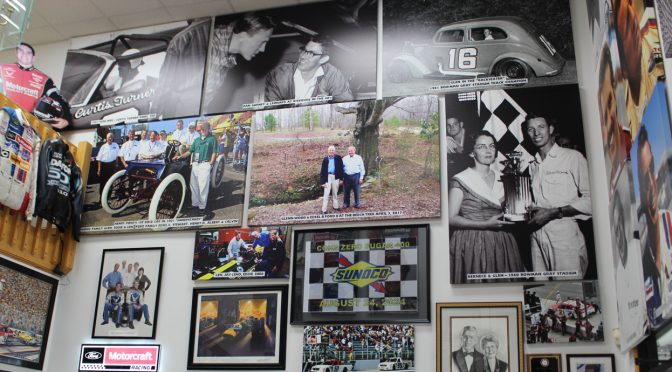
This ostensibly is a shrine to the most venerable team in NASCAR history. For 53 of its 75 years, the team competed out of Stuart — the building now housing the museum is the last of its four shops here — and the life-size photos of racing legends exulting in their glory are omnipresent from the first step inside the lobby.
But the vast collection of trinkets, tools and treasures from everyday life also tell the story of growing up in rural Southwest Virginia during the mid-20th century. For several years before his death on Jan. 18, 2019 (“93 and a half to the day,” Len notes), Glen Wood spent much of his time organizing thousands of mementos.
He designed the main trophy room at the museum, which was founded after 4,000 fans crowded into the building at an April 2011 autograph signing on the heels of Trevor Bayne’s Daytona 500 victory.
“Before that this is just where we raced, and we just left stuff laying there when we left (for a new North Carolina shop in 2003), and it was the biggest mess you ever seen,” Eddie Wood said. “And then Trevor wins the 500, and we cleaned it up. We started hanging photos, and that started it.”
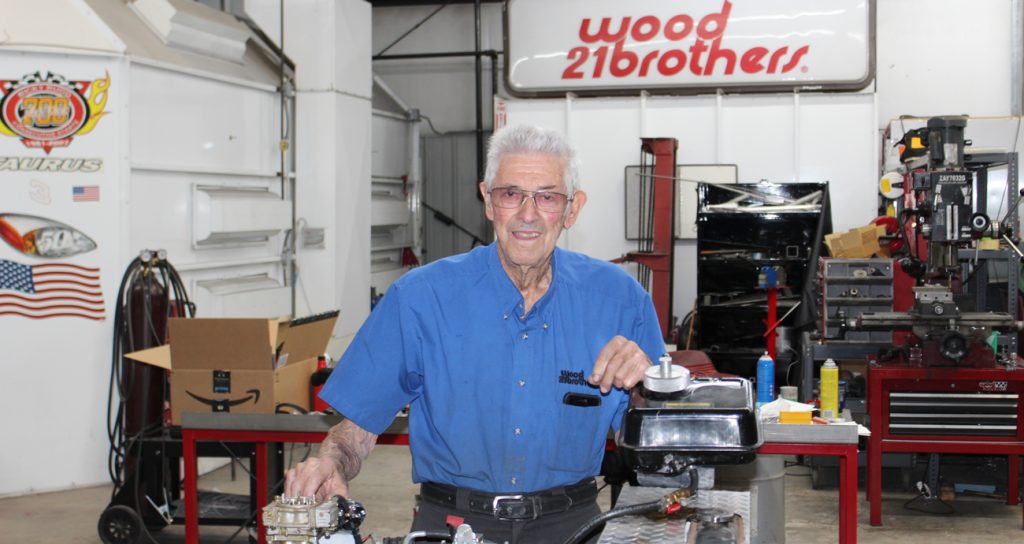
Dozens of photos are hanging from the walls (Eddie finds the images, and Len does the layout), and many of those featured are often at the museum in the flesh. Leonard Wood, the 90-year-old who founded Wood Brothers Racing with his older brother, still is tinkering daily on carburetors and half-scale engines in a shop area at the back of the 15,000-square-foot space (his 93-year-old brother, Delano, the team’s longtime jack man, still stops in occasionally, as does their sister, Crystal, 92).
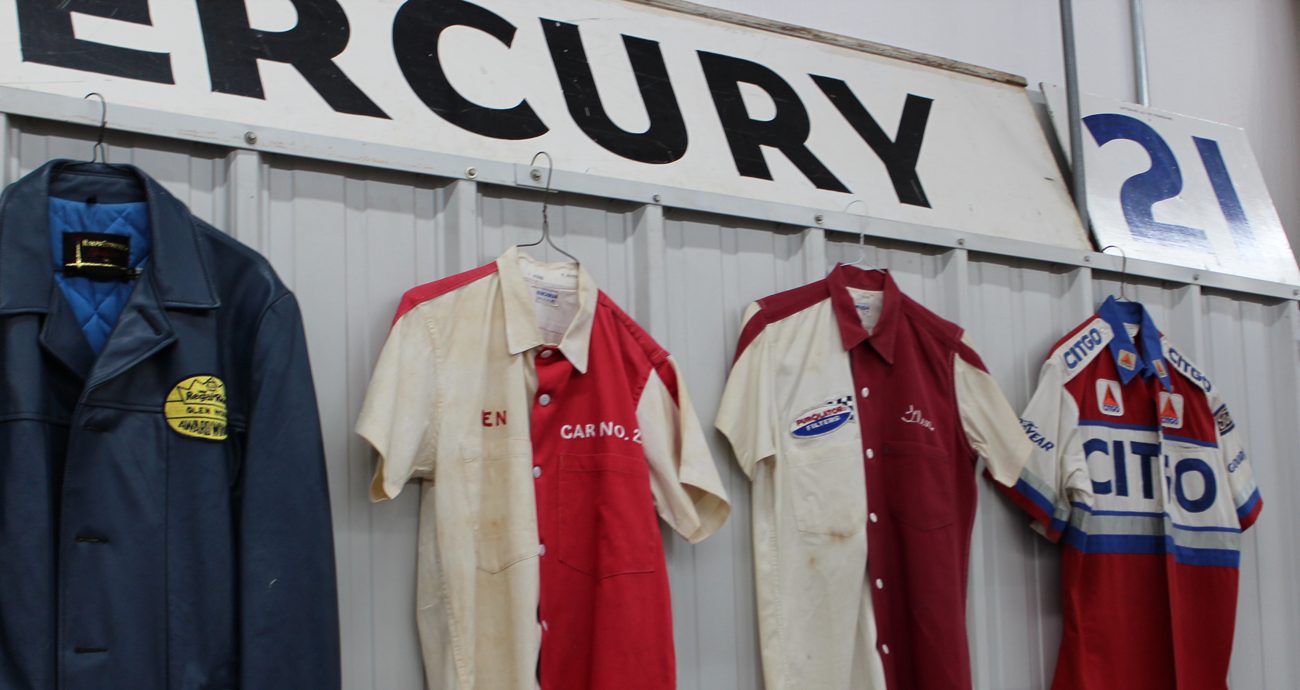
On a Wednesday afternoon last month, the main project on the rear loading dock was sifting through dumpsters filled with thousands of old uniforms being chosen for display. The work was interrupted by the arrival of a wooden cargo crate containing the trophy (and multiple replicas) from Josh Berry’s victory at Las Vegas Motor Speedway, the team’s 100th in Cup.
“I call it a living museum,” Len said. “And it changes all the time.”
Some displays are on loan in the Great Hall of the NASCAR Hall of Fame (which opened its 75th anniversary of Wood Brothers Racing exhibit in May), and Bayne’s winning Daytona car remains at the Henry Ford Museum in Dearborn, Michigan.
But those absences are hardly noticeable amid the endless keepsakes in the trophy room alone. Among the highlights are Glen’s handwritten 2012 Hall of Fame speech and a metal flip board filled with dozens of driver mugshots. (Glen collected photos of every person he could remember racing.)
There is a wall dedicated to Dan Gurney, who won four Cup races at Riverside International Raceway with Wood Brothers Racing. The exhibit includes Gurney’s final NASCAR racing helmet that was donated by his family in exchange for WBR’s trophy from his 1966 win at Riverside (which completed a collection of his Cup victories). Nearby is the uniform worn by Glen to fuel Gurney’s winners at Riverside.
“Another of our unique finds that Daddy just came walking out of his closet with eight years ago,” Len said.
That’s one of the museum’s myriad firesuits. There also are nearly two dozen cars covering three generations of NASCAR — along with some quirky surprises.
On the wall to the left of the door to the old shop, there is a laminated wedding announcement for Betty Jane Zachary and William C. France. (“The bride wore a gown of Chantilly lace with a bustle effect in the back. She is Miss Bowman Gray Stadium of 1956-57.”) Lying randomly atop a best-in-class blue ribbon (won by the team’s famed 1971 Mercury Cyclone at The Amelia Concours d’Elegance car show) is a 2023 annual hard card for the Historic Sportscar Racing series. The photo credential identifies Jim France as an official of the series owned by NASCAR.
Eddie Wood’s favorite recent addition came from an old toolbox at his parents’ house (“we run across stuff there all the time”), where he found a pair of hammers with special bronzed heads.
On the back was an Indy 500 logo. The hammers were used to practice changing tires (Leonard on the front, late brother Ray Lee on the rear) for 1965 Indy 500 winner Jim Clark.
“Everything here’s got a story,” Eddie Wood said.
Many of them involve Glen Wood.
Honoring the centennial of his birth, here are a few of the special exhibits and touches at the Wood Brothers Racing Museum that help tell his life story:
— No place like “Homeplace”: Wood Brothers Racing’s first shop was inside a small barn in the Buffalo Ridge area about 12 miles from the museum. Affectionately known as “the Homeplace,” it’s part of the house and property where Glen Wood and his five siblings were raised, and there are many nods to their origins.
A chain hangs from the ceiling and is connected to a branch symbolizing the beech tree used to hoist engines out of WBR’s early race cars (the original beech tree still stands and is the site of the family’s annual Thanksgiving Day photos). There’s a piece of the Homeplace’s original hardwood floor, and the crib in which several generations of Woods were rocked from 1923-92.
— A sharper edge: The museum features numerous chainsaws that were fancied by Glen, who remained into botany and gardening long after leaving the sawmill business. He bought the team’s first race car with $25 that he made from the sawmill (a friend chipped in another $25).
“Once he kind of got established, he began making more money in a race car than he did a sawmill,” Len Wood said. “The sawmill was harder work, but racing was more dangerous.”
— Glen vs. Glenn: Many of the museum’s items refer to “Glenn Wood,” which is the name on his birth certificate. His spire in the NASCAR Hall of Fame lists his name as “Glen,” which Eddie and Len said their father began using to sign his employees’ checks in the late 1950s.
“He’d shorten it up for paying them all,” Len said. “We try to use two N’s when we do anything with his name now. But we don’t change anything that had it as ‘Glen.’ ”
— Special banners: It’s about a 30-minute drive to Martinsville Speedway, the Cup track closest to Stuart and the family’s heart. On the first race weekend there after Glen’s death, nearly 1,500 signatures were collected on posters honoring “The Woodchopper” under the watchful eye of his widow, Bernece (who died in 2021).
“We got a chair for Momma so she could just sit there as all the people would walk by her to sign,” Len Wood said. “Bill Elliott, Chase Elliott, Darrell Waltrip, Michael Waltrip, Kyle Petty. They all have signed it.”
— Sunday driving: One of the newest vehicles in the museum actually isn’t a race car but the last street car owned by Glen Wood — a silver 2003 Jaguar XJ Vanden Plas.
“He got up one morning and said, ‘I need to get a new car, I might get a Jag,’ ” Eddie Wood said. “Jackie Stewart was running the Jaguar F1 team at the time. So Dad went to Greensboro and came back with it.”
Always attuned to fuel mileage, Glen Wood annually tried to complete the 610-mile trip from Stuart to Daytona Beach on a single tank of 23 gallons, but it was the only Daytona finish line that his car couldn’t reach.
“Mama would be screaming at him, ‘You’re going to run out of gas,’ ” Eddie said. “So he would stop about 100 miles or 50 miles out.”