The Sunday of Memorial Day weekend is Christmas Day for racing fans around the world, with a tripleheader of prestigious events capped off by the Monster Energy NASCAR Cup Series’ Coca-Cola 600 at Charlotte Motor Speedway.

The night cap precedes Formula 1’s race in Monaco, with the IndyCar Series’ Indianapolis 500 sandwiched in the middle.

Monster Energy Series points leader Kyle Larson has plenty of stock car experience and a reputation of being willing to drive any car, any time at any location, and he may expand his racing role on this day in the future — at least that’s what he told FOX’s Kenny Wallace during a Sunday pre-race interview.

Wallace playfully pressed Larson on running the Indy 500 in the future, to which Larson replied: “I will someday. I just have to get the courage up. For sure, I want to.”

Larson has an “in” already with team owner Chip Ganassi, who also owns an open-wheel team.

The list of NASCAR drivers to attempt the famous “double” — that is, running the Indy 500 and then flying to Charlotte for another 600 miles in the Coca-Cola 600 — is a short one.

John Andretti was the first to do it in 1994, with Tony Stewart (twice), Robby Gordon and Kurt Busch following suit. Sounds like Larson will one day add his name to that list.

RELATED: NASCAR holds pit crew combine | Learn about the Drive for Diversity program

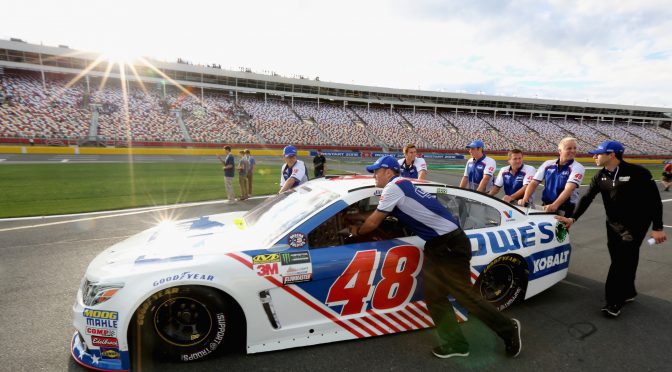
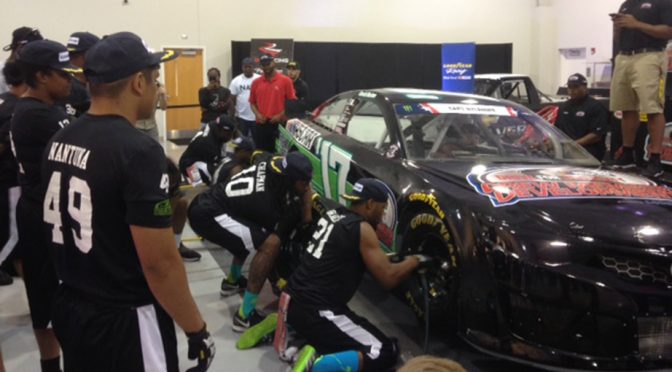
CONCORD, N.C. — The pit guns are buzzing. Lug nuts are flying off tires. There’s chatter and instruction back and forth. Encouragement, competitive banter. It’s a money stop taking place not on pit road in a Monster Energy NASCAR Cup Series event, but in the NASCAR Drive for Diversity National Pit Crew Development Combine Presented by Goodyear.

The second annual event was held May 25-26 at NASCAR’s Research & Development Center, just a few miles down the road from Charlotte Motor Speedway where Sunday’s Coca-Cola 600 (6 p.m. ET, FOX, PRN, Sirius XM NASCAR Radio) takes place.

Under the direction of Rev Racing pit crew coach Phil Horton and his team of coaches — including some current NASCAR crewmen — 17 male and female athletes participated in the program as the sport searches for its next wave of pit road talent.

The athletes, recruited from colleges and universities across the United States such as Bethune-Cookman, Virginia State, Arizona State, Vincennes University, Norfolk State and San Diego State, participated in the two-day event. On Thursday, the athletes learned their roles on a pit crew, getting familiar with the equipment and a stock car. On Friday, the participants were evaluated through a series of fitness, agility and pit crew drills that culminated with a live pit stop competition.

The live pit stop competition brought plenty of competitive fire from the participants, each trying to make faster times for their own crews. Several notable faces watched the scene: Mike Helton, Vice Chairman of NASCAR, Eason Fromayan — a former college football player who left Georgia Tech early to pursue his NASCAR dream — as well as Jesse Iwuji, an officer in the United States Navy and a driver in the NASCAR K&N Pro Series West. Former Hendrick Motorsports pit crew member and college football player Dion Williams served as the emcee of the event.

RELATED: With drive, Fromayan follows heart to NASCAR

“This program in particular is one that I take a lot of pride in,” said Jim Cassidy, NASCAR senior vice president of racing operations. “This is Year 2 of a nationally based combine where we have reached out to a number of universities across the land and had great participation from some of the top athletes in the nation.

” … 17 college graduates that have degrees in fields outside of what we are doing here, they had a lot of options in front of them and still have a lot of options in front of them and we’re encouraged that they selected a path within NASCAR.”

While nearly two-thirds of the participants had a background in collegiate football, other sports represented included softball, baseball, basketball, lacrosse, track and wrestling. The growing trend of using former college athletes on pit road in NASCAR is all about trying to gain an edge on the competition as the athletic component on pit road has evolved in recent years.

For some, this is their first exposure to the world of NASCAR. The quickness in which one picks up the world of pit stops is the key to one’s success, Horton said.

“How fast they pick up handling the tools, handling the tires, the gas can,” Horton said. “Once you learn the basic eight fundamentals of how to do a pit stop, it’s a mental thing. It’s how you are able to do that under pressure; that’s the most important thing. They’re going to be fast, but we’re going to do have to slow them down, we’re going to have to get them under control. They’re going to have to learn those fundamentals to see if they can do that when it counts the most.”

Horton and his staff have a template based on height, weight and what position an athlete played in their college sport to identify who they feel fits best as a tire changer, tire carrier and jackman.


Bryce Bradley just graduated from Virginia State University. A defensive back in college for the Trojans, he found that there were far more similarities to his college athletic background to a role on pit road than he realized.

“Hand speed, hand-eye coordination,” Bradley told NASCAR.com. “I played defensive back so I do a lot of jamming and pressing at the line of scrimmage. Definitely with that (pit) gun you’ve got to hit with some force to get the (lug) nuts off.

” … Hip flexibility, when you got to sit down and get low. Because if you are high, you can’t really see the lug nuts all the way. As a defensive back, you have to have good hips so you can turn and run. So when you get down in there, if your hips aren’t flexible, you’re not going to be able to get low enough.”

Ezell Ruffin is another athlete looking to “go pro” in NASCAR. A former wide receiver for the San Diego State Aztecs, Ruffin attended training camp with the Indianapolis Colts in 2015. Ruffin cited the athletic mindset of performing as being a key takeaway from the experience.

“Being able to focus under pressure, especially when they put us on the actual car with all the cameras,” Ruffin told NASCAR.com. “You can’t really think about that. You just got to go in there and do your job. You got to be consistent and make it happen. They are counting on you to change that tire.”

One thing that was very present during the combine — the camaraderie of the participants as they went through different drills. Ruffin said that bond was formed very quickly among each other.

“When we all first came in everybody really bonded. We all come from athletic backgrounds. Everybody just graduated so we all got a lot in common. Out here, we’re athletes, everybody wants to compete so that’s going to drive everybody to everything faster, better, which is good. You need that environment when you’re trying to be at an elite level.”

At present, there are 35 NASCAR Drive for Diversity crew member development program graduates that are working in NASCAR, with 25 alums as part of pit crews in the Monster Energy NASCAR Cup Series. Just three weekends ago at Talladega, three graduates — Kevin Richardson (front tire carrier), Mike Russell (jackman) and Raphael Diaz (rear tire changer) — were part of the No. 17 Roush Fenway Racing pit crew that helped Ricky Stenhouse Jr. to his first Monster Energy Series win.

RELATED: Drive for Diversity helps power Stenhouse Jr.’s crew

The top performers from Friday’s event will be invited to join NASCAR Drive for Diversity’s crew member development program, operated by Rev Racing. From there, the selected athletes will receive expert training as tire changers, carriers and jackmen while they pursue full-time employment in the NASCAR national series.

The true measuring stick of success, Horton said, is to get crewmembers to a top-15 Monster Energy Series team within three to four years. Last year’s class has already seen immediate returns. Lamar Neal, a 2016 participant in the combine, currently serves as a pit crew member for Richard Childress Racing in the NASCAR XFINITY Series.

“Last year, we brought in 18 athletes and we selected 10 (for the development program),” Horton said. “Fortunately two of those individuals that came out of the Combine last year will be pitting in the (Coca-Cola) 600.”
RELATED: Complete race results | Detailed breakdown

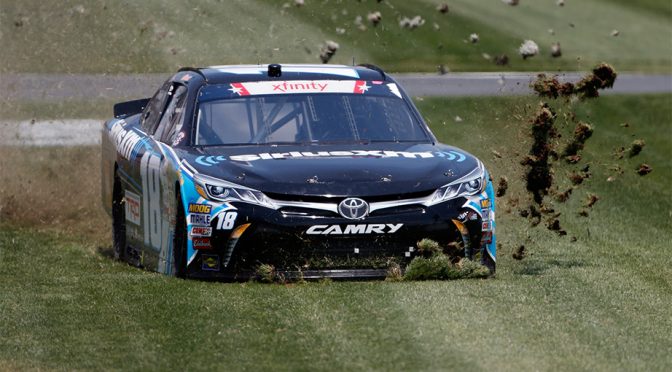
CONCORD, N.C. — A spin on Lap 3 wasn’t the start Christopher Bell was hoping for in his NASCAR XFINITY Series debut, but the afternoon’s twists and turns over 300 miles ended with a hearty handshake from team owner Joe Gibbs.

Gibbs came by to extend his congratulations to Bell following his fourth-place run in the Hisense 4K TV 300. The 22-year-old Oklahoma native was the lone non-Monster Energy NASCAR Cup Series regular to finish inside the top six and the top Joe Gibbs Racing car in Saturday’s race at Charlotte Motor Speedway.

Coach Gibbs’ message to the young driver: “Good job. That was well done.”

The early incident involving Bell and Ryan Reed could have easily been discouraging for Bell, but he kept pushing forward.

“We had to fight through a lot of adversity there,” Bell said. “We had a lot of issues where we’d start passing guys and we’d have to come back and start at the tail. I’m glad it was a 200-lapper because we used every single bit of it.”

Part of Bell’s adversity on the day was seven pit stops during the race – many of the cars in the top 10 only made four stops on the day – to repeatedly work on the car after the early-race incident.

“I felt like we were coming back a lot,” Bell said. “It’s nice to know I can do it and we can run back up through the field, but I just have to put it all together. It sucks having to come back up through there. Your day is a lot easier when you can stay up front; you’re in cleaner air, the car drives better. I just have to execute and do a better job at the beginning of races and not make these mistakes.”

Bell kept digging and grinding toward the front, getting back into the top 10 on Lap 170. From there several cautions late in the race and fortuitous positioning on restarts — the outside lane — helped Bell come home in fourth. In post-race inspection, the No. 18 Toyota was found to be too low. Any penalties would be announced next week.

Earlier this month, a test session for the XFINITY and Camping World Truck Series was held at Charlotte. A test that Bell said was extremely beneficial for this start.

“The test was huge,” Bell said. “I had never sat in one of these cars before the test. Whenever Toyota came to me and said they have some XFINITY races, I was pretty excited that they said Charlotte was the first one because Charlotte was one of my favorite race tracks whenever we got to run the Truck race in the daytime (in 2016).

“Being able to just get seat time and just get a feel for it … I don’t think I was very fast at the test, so I knew … all I needed to do was get a feel for it and get some laps and come here this weekend and show speed. Thankfully our SiriusXM Camry was really, really good.”

Bell’s performance was the latest by a young driver to turn some heads. Race runner-up and Monster Energy NASCAR Cup Series star Kevin Harvick took notice.

“There’s a lot of these guys that are going to be really good,” Harvick said. “I think when you look at (race winner Ryan) Blaney and Christopher and you could just keep going on and on … The sport’s in good hands and as you look at the experience these guys are getting at a young age, they are going to be well-seasoned by the time they’re 25.”

Next up on Bell’s XFINITY schedule is a June start at Iowa Speedway, followed by five more starts toward the end of the 2017 season.

“I can’t wait man,” Bell said. “These things are a ton of fun to drive. JGR brings awesome cars so I’m excited for the next one.”

RELATED: Complete race results | Detailed breakdown

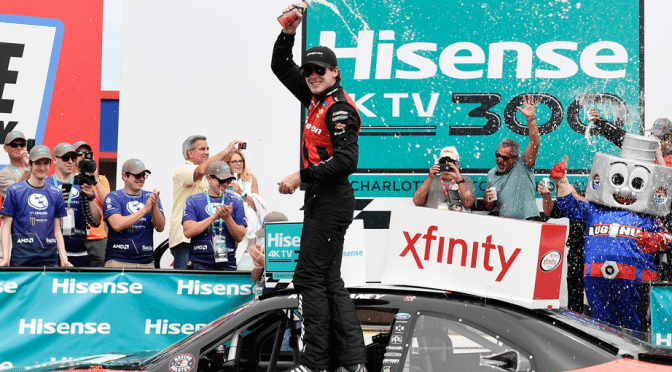
CONCORD, N.C. — Kevin Harvick was between a rock and a hard place with three laps left in Saturday’s Hisense 4K TV 300 at Charlotte Motor Speedway, and Ryan Blaney took full advantage of the veteran driver’s conundrum.

Passing Harvick for the lead after a restart on Lap 198 of 200, Blaney crossed the finish line .244 seconds ahead of the driver of the No. 41 Stewart-Haas Racing Ford.

Blaney had pushed Harvick to the front past eventual third-place finisher Austin Dillon on a restart after the 10th caution, brought out when Michael Annett’s No. 5 JR Motorsports Chevrolet scraped the Turn 3 wall on Lap 176.

But when Blaney powered his No. 12 Team Penske Ford into second-place after the 11th caution, Harvick was faced with a dilemma when the caution flew for the final time for Darrell Wallace Jr.’s spin in Turn 2 on Lap 194. If Harvick chose the inside lane for the final restart, second-place Blaney would have lined up in front of Team Penske teammate Brad Keselowski, setting up the possibility of a ferocious push.

Harvick chose the top lane but couldn’t clear Blaney through the first two corners after the restart with three laps to go. Blaney surged ahead and had the lead by the time he exited Turn 4. End of story.

“We were able to push Kevin (Harvick) to the front and get to second, and that gave us a shot and got by him at the end there on that last restart,” said Blaney, who won at the same track that gave his father, Dave Blaney, his only NASCAR XFINITY Series victory in 2006. Dave Blaney was at CMS on Saturday to celebrate with his son.

“To win at a track where my father did is pretty cool,” Blaney said.

WATCH: Blaney says, ‘It’s awesome to get back in Victory Lane’

Blaney won for the first time this season, the first time at Charlotte and the fifth time in his career.

Harvick took the defeat philosophically, knowing he was confronted with a pair of difficult choices at the end.

“I knew I was in a pickle then,” Harvick said. “I didn’t really know what to do. If you take the bottom and get the 12 (Blaney) and 22 (Keselowski) hooked up, we might have got beaten worse.

“We just got beat by the 12. He did a great job all day on the restarts.”

In fact, Blaney led 107 laps to Harvick’s 58, but was shuffled back to third during his final pit stop on Lap 160 when he was blocked in his stall on pit road.

“I thought we had a really good pit stop,” Blaney said. “I just kind of got boxed in, didn’t angle out very well. That was on me. But luckily we were able to get back on the front row and give us a shot. It was so hard starting third when you only have a couple of laps to get to the front row.

“That was really tough, and I thought we were going to run out of laps to make it happen.”

The final caution, however, gave Blaney the opportunity he needed.

RELATED: Bell says he knew his care was ‘really, really good’

Christopher Bell finished fourth in his NASCAR XFINITY Series debut, after a remarkable recovery from a spin off Turn 4 on the third lap of the race. Turned sideways by a tap from Ryan Reed’s Roush Fenway Racing Ford, Bell’s No. 18 Joe Gibbs Racing Toyota slid through the infield grass but avoided major damage to the undercarriage.

Bell spent the next 195 laps working his way back toward the front.

“I’m glad it was 200 laps, because we used every single bit of it,” Bell said. “We didn’t have a lot of luck on the restarts at the beginning of the race, starting on the bottom, but we got the luck (with outside starting positions) when we needed it at the end.”

Denny Hamlin finished fifth, followed by Keselowski, Cole Custer, Brennan Poole, Brendan Gaughan and Tyler Reddick.

Despite his crash and 35th-place result, Sadler retained the series lead by six points over JR Motorsports teammate Justin Allgaier, who started from the pole and finished 12th.

RELATED: Practice 3 results

Pos Car Driver From Lap To Lap Avg Speed
1 1 Jamie McMurray 22 31 180.914
2 20 Matt Kenseth 20 29 180.526
3 24 Chase Elliott 21 30 180.482
4 42 Kyle Larson 9 18 180.414
5 48 Jimmie Johnson 33 42 180.370
6 18 Kyle Busch 25 34 180.301
7 78 Martin Truex Jr. 19 28 180.300
8 4 Kevin Harvick 21 30 180.282
9 14 Clint Bowyer 21 30 180.191
10 11 Denny Hamlin 21 30 179.966
11 5 Kasey Kahne 29 38 179.883
12 3 Austin Dillon 18 27 179.806
13 31 Ryan Newman 22 31 179.757
14 41 Kurt Busch 26 35 179.644
15 22 Joey Logano 23 32 179.453
16 17 Ricky Stenhouse Jr. 16 25 179.324
17 13 Ty Dillon # 8 17 178.908
18 27 Paul Menard 24 33 178.736
19 95 Michael McDowell 22 31 178.618
20 32 Matt DiBenedetto 3 12 178.284
21 10 Danica Patrick 19 28 178.273
22 38 David Ragan 1 10 178.185
23 6 Trevor Bayne 18 27 178.155
24 43 Regan Smith(i) 16 25 177.527
25 2 Brad Keselowski 19 28 177.090

RELATED: Practice 2 results

Pos Car Driver From Lap To Lap Avg Speed
1 78 Martin Truex Jr. 1 10 184.886
2 18 Kyle Busch 1 10 183.538
3 42 Kyle Larson 5 14 183.492
4 10 Danica Patrick 1 10 182.402
5 14 Clint Bowyer 14 23 182.325
6 20 Matt Kenseth 13 22 182.219
7 24 Chase Elliott 22 31 181.834
8 1 Jamie McMurray 10 19 181.764
9 2 Brad Keselowski 18 27 181.494
10 88 Dale Earnhardt Jr. 23 32 181.375
11 41 Kurt Busch 13 22 181.313
12 95 Michael McDowell 17 26 178.802
13 32 Matt DiBenedetto 10 19 176.511
14 51 * Timmy Hill(i) 1 10 173.719

* Car must run 10 consecutive laps on the track to be included in the above chart.
(i) Ineligible for driver points in this series

No drivers ran 10 consecutive laps in opening practice on Thursday.
RELATED: Practice 1 results

Final practice: Practice results

Kyle Larson topped final practice at Charlotte Motor Speedway ahead of Sunday’s Coca-Cola 600 (6 p.m. ET, FOX, PRN, SiriusXM NASCAR Radio). Larson posted a fast lap of 186.400 mph in his No. 42 Chip Ganassi Racing Chevrolet to pace the 55-minute session.

Ryan Blaney came in second in his No. 21 Wood Brothers Racing Ford (185.861 mph) followed by Matt Kenseth in third (No. 20 Joe Gibbs Racing Toyota, 185.046 mph). Kurt Busch (No. 41 Stewart-Haas Racing Ford, 184.856 mph) and Sunoco Rookie of the Year contender Erik Jones (No. 77 Furniture Row Racing Toyota, 184.818 mph) rounded out the top five.

Polesitter Kevin Harvick placed 20th in his No. 4 Stewart-Haas Racing Ford, while defending race winner Martin Truex Jr. came in 17th.

WATCH: Keselowski spins during final practice

Brad Keselowski’s No. 2 Team Penske Ford suffered some right-rear damage from clipping the wall off Turn 4. The car also went for a slide through the infield grass. Keselowski would make it back out to run laps in practice and finish 16th in the session

Second practice: Practice results | Best 10-lap times

The young drivers paced Saturday morning practice at Charlotte Motor Speedway with 23-year-old Ryan Blaney and 20-year-old Erik Jones going 1-2. Blaney, in the No. 21 Wood Brothers Racing Ford, paced the 40-car field with a quickest lap of 188.055 mph. Jones, in the No. 77 Furniture Row Racing Toyota, clocked in at 187.598 mph.

2016 Coca-Cola 600 dominator — and victor — Martin Truex Jr. was third-fastest in his No. 78 FRR Toyota (187.084). Last year, Truex led 392 of 400 laps in NASCAR’s marathon — 98 percent of laps run.

Joe Gibbs Racing’s Daniel Suarez (186.838 mph) and Roush Fenway Racing’s Trevor Bayne (186.239 mph) completed the top five in fourth and fifth, respectively.

Polesitter Kevin Harvick was ninth on the speed charts in his No. 4 Stewart-Haas Racing Ford (185.567 mph).

Denny Hamlin, Kyle Busch, Paul Menard, David Ragan, Kurt Busch, Kyle Larson and Corey LaJoie spent the start of the session parked on pit road, serving a 15-minute hold for qualifying inspection failures. Points leader Larson failed to make a qualifying lap Thursday evening and will start Sunday’s main event 39th.

READ: Larson misses qualifying

Chris Buescher, too, completed a 15-minute hold and lost his pit stall selection for failing pre-qualifying inspection three times.

At a Glance: 

What: Coca-Cola 600
Where: Charlotte Motor Speedway, 1.5-mile tri-oval in Concord, N.C.
When: Sunday, May 28, 2017
Green flag: 6:18.30 p.m. ET
TV/Radio: FOX, PRN, SiriusXM NASCAR Radio
Forecast: A 20 percent chance of showers and thunderstorms after 1pm. Partly sunny, with a high near 86. Calm wind becoming southwest around 6 mph in the afternoon.
National anthem: 82nd Airborne Division All-American Chorus
Honorary Race Director: Mitch Carmichael, Senate President of West Virginia
Honorary Starter: Larry Hogan, Governor of Maryland
Grand Marshal: Channing Tatum, actor
Race distance: 400 laps, 600 miles
Competition caution: Lap 25
Pit road speed: 45 mph
Caution car speed: 55 mph
Stage lengths: Stage 1 ends on Lap 100; Stage 2 end on Lap 200; Stage 3 ends on Lap 300; Final stage is scheduled to end on Lap 400.

RELATED: ‘Fit’ Row presented by Lilly Diabetes launches on NASCAR.com

Ryan Reed led the way in a different kind of race around Charlotte Motor Speedway on Friday afternoon.

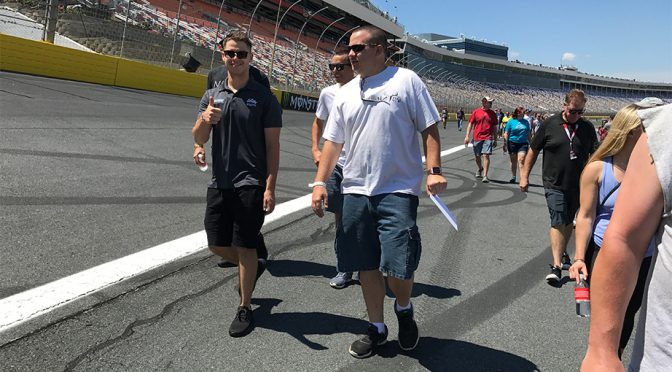
The driver of the No. 16 Lilly Diabetes Ford Fusion for Roush Fenway Racing gave the command and joined 200 people walking the 1.5-mile oval. It was the kickoff event for the Lilly Diabetes and NASCAR health and wellness initiative as Lilly not only sponsors Reed but is the official diabetes health partner of NASCAR.

“First of all, it’s a huge thank you to Lilly, not just as the driver that they sponsor but as someone living with diabetes,” Reed said. “To see their commitment to spreading awareness, doing events like this, that it’s not just talk about encouraging people to manage their diabetes, live a healthy lifestyle but putting on events where they can walk around Charlotte Motor Speedway and actually get out here and do something active. It’s so cool.”

Reed signed autographs and took pictures along the route, which began just past the big screen TV situated above the backstretch wall. Fans who participated in the event were encouraged to create pledge banners and sign a hood that will be used during an XFINITY Series race later this year.

With the amount of participation seen Friday, Ashley Brewer, the consumer director of marketing for Lilly Diabetes, announced at the conclusion of the walk that Lilly Diabetes would donate $10,000 to the American Diabetes Association chapter of Charlotte.

“Some other things we’re doing throughout the year is we just recently kicked off an editorial called Fit Row on NASCAR.com and the intent of Fit Row is really to put out stories that talk more about an active lifestyle and continuing to be healthy not just with diabetes but in overall general health as well,” Brewer said.

“We’re also planning an event in October to kind of culminate the whole season and it’ll be a fun activity that we’re not announcing completely yet. More to come on the event back here at Charlotte in October.”

Having been diagnosed with Type 1 diabetes in 2011, Reed has climbed through the motorsports ranks despite being told he would never race again. Now a two-time winner in the XFINITY Series, Reed said the most enjoyable thing about doing events with Lilly Diabetes is the people he meets along the way.

“Just today alone I probably met 10 people who talked about living with diabetes or that their son or daughter has diabetes,” Reed said. “I met a boy, he was probably 12 or 13 years old, and he was out here walking today and he has Type 1 diabetes. His dad was here talking to me about all the different things he does to help his son play sports and different stuff.

“It’s just so cool to see that commitment. As someone who lives with diabetes, when you meet someone else with diabetes who goes through the same everyday challenges, you instantly have a connection and a bond. The relationships I’ve built through events like these are probably the coolest thing.”

Crossing the red and white finish line signaled the end of another day at the office for Reed. Only instead of being behind the wheel, he was again spreading a positive message.

“The No. 1 thing that I try to preach is just never give up,” Reed said. “Diabetes is a lot like other challenging things in life where it can be defeating. It can make you want to give up at times, but if you can persevere and manage it and work with your doctor, you can do what you love to do.”

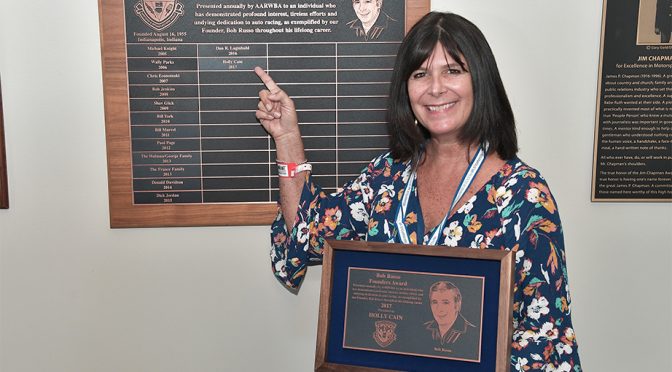
NASCAR.com senior writer Holly Cain, who has been a respected motorsports journalist for more than 25 years and shown courage and provided inspiration in the face of personal adversity, Friday was honored with the Bob Russo Founders Award for dedication to auto racing.

The award was presented to Cain by Russo Award Chairman Bill Marvel, Russo’s longtime friend and 2011 honoree, in a ceremony in the Indianapolis Motor Speedway’s media center.

Russo, the much-admired and honored motorsports journalist/publicist/historian, founded the American Auto Racing Writers and Broadcasters Association in 1955. Russo helped racing gain early national media attention in the 1950s via his stories in Speed Age magazine. He consulted IMS owner Tony Hulman on the future direction of the sport when AAA stopped sanctioning races, which led to the formation of the U.S. Auto Club. Among Russo’s successes in public relations were the legendary Mobil Economy Run and with NHRA and Riverside International Raceway. His historical research and archives benefited the sport overall, including the Motorsports Hall of Fame of America. He died in 1999 at age 71.

The Russo Award, as stated on the plaque, is presented “to an individual who has demonstrated profound interest, tireless efforts and undying dedication to auto racing as exemplified by Russo throughout his lifelong career.”

Cain’s career includes award-winning tenures at the Tampa Tribune, Seattle Post-Intelligencer and Dallas Morning News. She also wrote for AOL Fanhouse and FoxSports.com and authored the book “Rusty’s Last Call,” on driver Rusty Wallace’s last NASCAR season. She has been with NASCAR.com since 2012.

Cain has earned numerous journalism honors, including awards from the Associated Press Sports Editors, National Motorsports Press Association and Society of Professional Journalists.

She was diagnosed with breast cancer in July 2014 and has written candidly about her experiences battling the disease. She also speaks to public groups and helps in cancer research fundraising activities. Despite her illness, Cain has continued with insightful motorsports coverage, and in 2015 won the NMPA’s Spirit Award in recognition of her positive attitude and achievement in the face of adversity.

Cain is the first female to win the Russo Award on an individual basis. A permanent plaque with all winners’ names is on display in the Speedway media center.

Previous Russo Award winners include: 2005 – Michael Knight; 2006 – Wally Parks; 2007 – Chris Economaki; 2008 – Bob Jenkins; 2009 – Shav Glick; 2010 — Bill York; 2011 — Bill Marvel; 2012 — Paul Page; 2013 — The Hulman-George and France Families; 2014 — Donald Davidson; 2015 — Dick Jordan; 2016 — Dan Luginbuhl.