Editor’s note: This story was originally published Oct. 21, 2015.
MORE: READ PART 1 HERE | READ PART 2 HERE
The Race
“Historically, just the mere mention of the word ‘Talladega’ has been enough to give the drivers chills and the fans thrills.” — Dr. Jerry Punch, ESPN pre-race, Oct. 15, 2001.
ESPN’s pre-race show wrapped, having covered the major stories entering the race: the restrictor-plate change, Hamlin’s injury and the championship race. Once the green flag flew, few clear favorites emerged.
Pole winner Joe Nemechek was shuffled back at the start and failed to lead any of the 188 laps; 59-year-old Dave Marcis jumped up to lead Lap 2, the final lap that he led in his 35-year career; and 21 drivers set the pace for at least one lap. But four drivers — Dale Earnhardt, Dale Earnhardt Jr., Bill Elliott and Jeff Gordon — spent the most time out front, each leading more than 25 laps. The thrills lived up to their billing, even as drivers became more familiar with the race’s aerodynamic traits.
Dale Jarrett: We were all learning as we went along and it made for great racing, entertaining. I really quite honestly don’t know why we didn’t do more of it.
Helton: It’s a typical 500-mile superspeedway race where early in the day, particularly with something new like that package, you’d see drivers — I wouldn’t call it experimenting — but getting used to it and figuring out what they could do later in the day. And then in the middle, it settles down and then toward the end, it picks back up and everybody starts moving around, but the best I remember from that race that year, it never stopped.
Punch: I think I made some comment, ‘I don’t know why they sold tickets, sold seats that day at Talladega because no one has used them. They’ve been standing since they waved the green flag. That’s how good it is.’
Dave Marcis (owner/driver, Marcis Auto Racing No. 71 Chevrolet): I remember running up front that day a little bit. I think I remember Tony Stewart was running second at that one time when I got the lead. I got by Tony and really was clear. I should have gone down and blocked that inside lane when I got by him, but I didn’t and then he got a push from some other people and he got back by me.
Elliott: My biggest goal was to get to the end of the race, regardless of what you had to do. The problem back then was you had so many guys that were like the bull in the china closet syndrome that thought it was the last lap just 10 laps into the race. You just had to deal with it.
Lawrence: I remember that day, (Earnhardt) said, ‘My car’s really fast, it just won’t lead.’ So I think his whole plan was the whole time to do exactly what he did, to kind of ride around then and then take the lead right at the last. … He had a plan, I guess you could say.
With the jumble for positions in full swing, several drivers spent the early stages trying to steer clear of the fray up front. It marked one of the earliest uses of a strategy that’s now fairly common at Talladega — running at the back.
Jeff Burton: I remember having that conversation with Rusty saying, ‘Hey look, I think I’m gonna go ride around in the back,’ and Rusty saying, ‘Hell no. You can’t do that. That’s crazy.’ But, again, the whole thing about the closing rate was so fast. There were a lot of things going on that me and many other people believed there was gonna be a big wreck and just try to stay the hell out of it.
Rusty Wallace: I’m not the type of guy nowadays and late in my career where I would want to go to the back. I don’t like that. I’ve watched it many times and seen ’em wreck in the back, the middle and up front. And so going to the back, to me, doesn’t make a lot of sense.
McReynolds: That’s one thing (Earnhardt and Skinner) did have in common — they never believed in laying back. Their goal was to go up there and lead every lap that they possibly could. I know when I worked with Dale I would always try to encourage him in practice at Daytona or Talladega, ‘Hey, how about getting back in the pack a little bit. Let’s see what this car will do in a pack.’ And his response was, ‘Nope, because I don’t plan on being back there.’
Despite the frantic nature of the racing, the 500-miler remarkably didn’t witness its first yellow flag until past the halfway point when Dave Marcis’ car stalled on the track after 101 laps. Marcis’ early exit was of particular concern to the RCR camp, which often tried experimental parts on the veteran’s No. 71 Chevrolet. A tire rub and eventual blowout thwarted Ward Burton’s strong car, bringing out the second caution period.
The third and final yellow — for a multi-car crash involving Bobby Hamilton and Mark Martin — set up a final scheduled pit stop for all the front-runners. It also sparked a spirited debate among the No. 3 bunch, which eventually took two tires though several teams opted for a fuel-only stop to retain or gain track position.
Hamlin: When they were wrecking, I wanted him to come in the pits and then he went by on the front straightaway. Of course, I couldn’t see all this unfold and that’s when I was asking him, ‘Well, what part of pitting right now did you not understand?’ and that’s when he came back with, ‘Oh oh g——, boy, just would have torn the car up right there trying to come down the pits. They were wrecking right there.’ I was like, ‘Yep, OK no problem then.’ Like I said, I was pretty jacked up on painkillers.
Lawrence: Kevin said to him, ‘Just stay out,’ and he said, ‘I’m not going to stay out. I can win this race.’ And (Hamlin) said, ‘If you pit, you’re going to be the only one that can pit, everybody can make it on fuel,’ and he’s like, ‘I’m coming down pit road.’
Hailey: We never questioned it — not only with that race but every other race. If he wanted two tires or four tires, you always gave him what he wanted because he knew the car better than anybody else. He knew what he needed for adjustments and it was just our job to support him the best we could.
Hamlin: As usual, even at Talladega, you would think the tires weren’t that big a deal for sure. That’s why I argued with him that track position was going to be way more important than the tires, but he was just determined.
Childress: I think he had a point to prove that he was gonna win it. When we gave him those tires, he knew he was gonna win.
Jeff Burton: Not being afraid to come in and pit, not being afraid to give up the track position, having the guts to make a difficult decision and then go make it work. That was Dale.
Hailey: When he was behind and we had done all we could do, we had done our last pit stop and he was out there by himself, we started watching and we had all the confidence in the world with that man and that car at that time, but we had no idea what he was getting ready to do.
The green flag flew for the last time that afternoon with 15 laps left, with Jeff Gordon leading Ricky Rudd, Earnhardt Jr., Skinner and Bobby Labonte in the top five. Gordon was quickly shuffled back in the initial mad scramble off the restart, setting up an Earnhardt Jr.-Labonte 1-2 order that remained in place for several laps. Meanwhile, Dale Earnhardt was mired back in the pack, trying to move forward as the front half of the field blockaded the No. 3.
Kenny Wallace: I was really disappointed at the end of the race because we had a bad pit stop. We were only supposed to do two tires and the crew chief, Jimmy Elledge, said, ‘Just stay here. We’re gonna put on four tires.’ Well, lo and behold, I’m leaving the pits and I keyed the mic and said, ‘What happened to Earnhardt? He’s back here with me.’
Punch: We go to a commercial and we were talking about who are we going to mention coming back and I remember Benny (Parsons) said, ‘Don’t forget about Earnhardt.’ And I said, ‘He’s 18th.’ He said, ‘Yeah, but there’s still 15 laps to go,’ and we looked at Benny like he had two heads.
Hutchens: I don’t know that we could look up at the stars and go, ‘Hey, guess what he’s getting ready to do?’ I mean, we’d seen him do it a number of times in many situations.
Kenny Wallace: When the green flag dropped on that last restart at Talladega I passed Earnhardt. I remember passing him through Turns 1 and 2. Somehow he got by me.
Lawrence: He was telling us on the radio, ‘We got this, we got this.’ Of course, we were all there thinking there’s five cautions in the last four laps, there’s this, there’s that. Generally they’re four-wide. I’m not going to say I doubted him because he did some miraculous things, but we weren’t where any of us thought we needed to be. But he felt real confident with it.
With five laps remaining, Earnhardt had failed to make hay in the middle of the pack, but he was about to find help in the form of a longtime ally. Up front, the contenders began to get impatient as the laps wound down to crunch time.
Punch: I had never seen anyone orchestrate the air in the draft like he did in those final laps at Talladega because there was no way to go in the middle of the race track. He had to go around people high and low.
Waltrip: He always seemed to have a knack for finding somebody that was almost willing to help him win over themselves trying to win like Kenny Wallace did.
Ward Burton: He had a guy without a shadow of a doubt that was going to follow in his foot tracks. Kenny was trying to make a name for himself, and he knew that he could have a good run and that his chances of having a good run following the No. 3 car were probably better than anyone else, and it just worked out that he got hooked up.
Kenny Wallace: I stayed loyal to Senior. I stayed loyal to that black number 3. Now that black number 3, the reason I pushed him is because he knew where he was going. It’s one thing to push somebody and hoping they know where to go because I was giving Dale everything he could handle.
Punch: There was something on the backstretch. He pulled up and I said, ‘It looks like he’s waiting on somebody,’ and Benny said, ‘He’s waving for Kenny Wallace. Get up there, Kenny. We’re going, buddy.
Kenny Wallace: He was wearing white gloves, and you can see it on the replay. He does this to me (making hand gesture) and I’m like, ‘OK, you’ve got the best to do this with.’
Hamlin: Jimmy Elledge told Kenny, no matter what, don’t leave the back bumper. They just made their way up there.
Myers: This wasn’t one of those deals where you had a spotter up there and the spotter is telling (Earnhardt) to go high and go low. No, no, no. You didn’t talk to him. You didn’t tell him anything. If he wanted to know something, he’d come on the radio and ask you to tell him, but any other time you didn’t tell him anything. He did his deal. He knew where he wanted to go. He knew what was getting ready to happen.
He began making his way forward in trademark Earnhardt fashion, brushing into the door of Rich Bickle’s No. 60, which was forced into Rusty Wallace’s No. 2 in three-wide formation. Scraped and battered on its right side, Earnhardt’s No. 3 kept coming forward.
Childress: Before Kenny got to pushing him he had come up through several cars and I remember the whole right side of the car was marked up from tire marks where him and someone had gotten together.
Punch: He was all the way to the bottom of the track, right on the apron, he came off the apron and door-slammed two cars that were to his outside — so much so that when he came around the next time the number 3 was almost gone. You can barely see the tip of the white number 3 on the right door.
Waltrip: Kenny Wallace and him, everybody was leaving the middle open and he was able to get in the middle and kind of worked his way. He was the master of the side draft. He understood that probably better than anybody and probably did it more than anybody else, drafting off the cars that were beside of him.
Petree: As a matter of course now — even on the unrestricted tracks — you see how they pull down on that door and use that side draft. Earnhardt discovered that.
Skinner had dispatched Tony Stewart to move to third place, riding firmly behind Earnhardt Jr. and Bobby Labonte. But he wasn’t content to wait, stepping out of line with four laps to go, pulling John Andretti with him. Andretti and Skinner clanged fenders, briefly creating a four-wide battle for the lead. But the sound of the capacity crowd was beginning to roar in conjunction with the black No. 3 car’s charge through the middle lane, causing Ron Scalise, ESPN’s audio expert, to open up the grandstand mikes, capturing the sound of fans over the full-song engines.
Punch: We could hear it begin to rumble and I said, ‘Listen to this crowd. Here comes Earnhardt.’ To this day I get chills thinking about it because he was up on the wheel and those fans were up on their toes, screaming, elbows and fists flying in the air, screaming, pumping those fists. It was a scene with 140,000, 150,000 people there that are seeing it. They think they’re seeing history and now we know that they indeed were.
Ned Jarrett (analyst, ESPN): Our immediate thoughts were on the people that were running up front and which one of them was gonna draft past each other to win that race. And then all of a sudden he just started moving up on the board at such a rapid pace and I thought, ‘Wait a minute. We need to pay attention to this guy.’ I don’t know that we said that, but I think we felt it and looked at each other and said, ‘He’s coming. There’s no question about it.’
Dunlap: The crowd roar when that black 3 would go to the front back then was just overwhelming and even though you’re there to do a job, it would make the hair stand up on your neck a little bit.
Helton: Talladega’s got a mile-long grandstand to start with, so it’s not concentrated in a small area, and then when the field goes by, it kind of takes the noise with it, so the fans can voice what they appreciate, and sometimes they voice what they don’t appreciate. You can kind of pick up on that at Daytona and Talladega maybe better than other places. But this day, you can remember the ovation, even when the cars came down the frontstretch and bring the noise with them. The fans still won that battle.
Sturtz: We were in the infield and we could actually hear the people cheering, especially when he got into Turn 1 and into Turn 2 when they started getting away from us. You could actually hear the people in the crowd going berserk.
Hailey: We all of a sudden we transferred from pit crew to race fans, so we’re getting up on the wall just cheering on with all the fans. We became fans watching this man do something with a race car that we had no idea that he could do.
Skinner emerged as the beneficiary of the scrum to take the lead for Lap 186, but Earnhardt drove past cars in bunches, pulling in behind Andretti before quickly bypassing him, all while Kenny Wallace continued to push the black car’s rear bumper, setting up the final two-lap sprint to the checkers. There was no out-of-bounds rule at the time, so the entire track — apron and all — was fair game.
Allen Bestwick (play-by-play announcer, Motor Racing Network): It’s almost like watching somebody playing checkers where the board opens up for them and they keep jumping people left, right, left, right, left. And I just remember that the board opened up and he just seemed to be hopping cars two at a time, and two at a time. I remember that more so than anything else.
Kenny Wallace: I’m not close. I’m on him. I mean, we’re bumper-to-bumper. I’ve got pictures, so I know we were pushing and all of a sudden that 43 of John Andretti, it just went up and there we went and then it was on, then we had a clear lane.
Skinner: That particular day as I look back at it now, I made my move one lap too early. I should have waited one more lap to make the pass for the lead, and that would have changed there. But whenever you have two cars that hook up together and one can push the other one, they’re always gonna be faster than the sitting duck out there.
Earnhardt Jr.: Right when Dad got in position to be almost even with Mike, I made the decision to try to pass Mike and got underneath him out of the tri-oval and we were going down the front straightaway and he wasn’t going to acknowledge that I was there.
Kenny Wallace: I’ll never forget. They were waving that white flag and, man, I looked to my left and I remember seeing Dale Jr. about lose it. He started wiggling and I saw that. I thought, ‘Oh gosh, I hope he don’t wreck and come up into us.
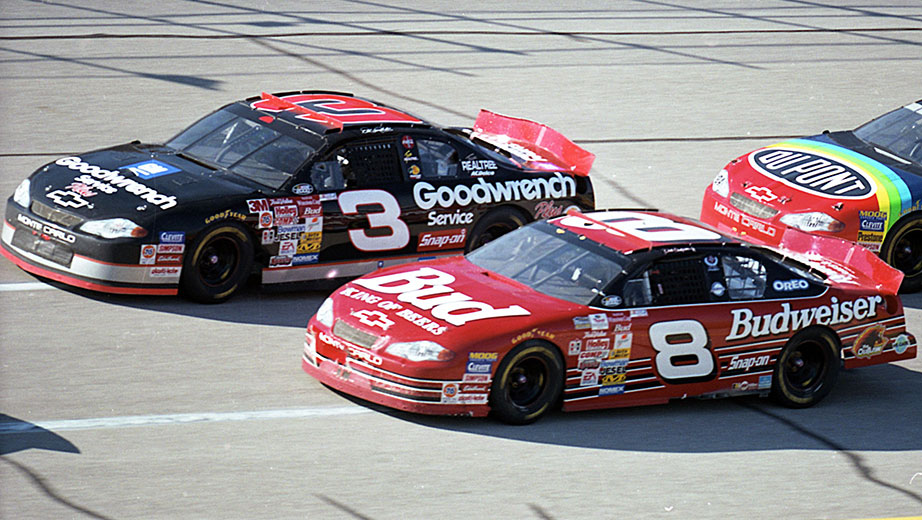
Dale Earnhardt was a master at restrictor-plate tracks, including a record 10 victories at Talladega. It’s a moniker his son, Dale Earnhardt Jr. — shown here in the No. 8 — has upheld, even if his late wiggle in 2000 nearly caused a huge problem.
Skinner: We were still OK and Dale Jr. ran plumb down the inside and about wrecked us all, and that basically put me out there as a sitting duck.
Earnhardt Jr.: So I was either going to have to go into the corner on the apron or lift or drive into Mike’s door and wreck the field, so I had to lift and get out of the whole situation I was in because of what Mike decided to do there.
Skinner: When he went down there he went half out of control and that was probably the craziest part. Today, that would have not flown and if you watched the race, there were several times that there were people down there that was in the current-day out-of-bounds area. But that was the rule at the time and it was what it was.
Earnhardt Jr.: It really hurt our whole line. Mike didn’t have a push anymore until someone filled that void that I was in, and it basically broke up the inside line even more to give those guys in the outside line the opportunity to keep on going.
Skinner: There was nothing I could do but watch Dale ride by and think, ‘Oh well, at least it’s one of Richard’s cars, and the team just won a million bucks. It’s good.’
Kenny Wallace: There we were, the sea parted and I didn’t know history was gonna be made because I didn’t know that was gonna be the last win of Dale’s life.
Earnhardt led by a fraction of a second at the unfurling of the white flag, as his son made a miraculous save, then forced his way off the apron and back into traffic. That move disrupted the rest of the pack, allowing his father to lead a three-car breakaway with Andy Petree Racing teammates Wallace and Nemechek in formation behind him to settle it on a tense final lap.
Kenny Wallace: Once we set sail at the same time I looked in my mirror and I’m like, ‘I’ve got a run. I think I can pull out and pass Dale,’ and to this day that’s that little wish — should I have pulled out and passed him. The only reason I didn’t is because I didn’t think the car behind me would go with me. I could slap myself an hour later because come to find out it was my own teammate, but my own teammate had a special paint scheme. I was used to the blue-and-white Oakwood Homes and at that time Joe Nemechek had like a Charlie Daniels, Jack Daniels, some type of different paint scheme, but I didn’t recognize the car or at that moment I would have tried to pass and I didn’t, and I finished second.
Petree: Yeah. I don’t think during the race he even knew that was Joe, but that’s Kenny.
Ramey: About a lap to go or so I hear the roar of the crowd and I thought, ‘Oh man, there’s been a wreck or something like that.’ So I dart over to the side of the coach and see on the outside TV that here’s Earnhardt and Wallace and they’re just moving through the pack. The fans were going crazy, so I’m like, ‘We might win this thing,’ and damn if we didn’t. It was one of those things where you could write it off and it turned right around in the drop of a hat.
Earnhardt crossed the start/finish line with a car-length separating his No. 3 Chevrolet and Kenny Wallace’s No. 55. But behind the front-runners, a crash erupted just past the checkers, snatching up the cars of Steve Park, Ward Burton and others.
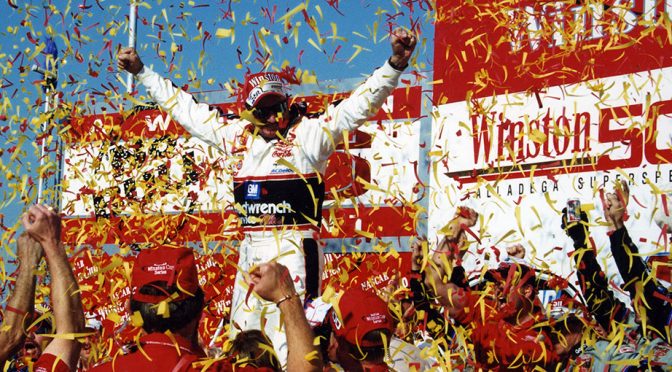
The on-track pandemonium was rivaled only by the eruption of emotion in the No. 3 pits, where Childress embraced engine builder Lawrence and the rest of the RCR crew before the raucous Victory Lane celebration. Dunlap asked Childress if it was the most unbelievable race he’d ever seen, and he replied in the affirmative.
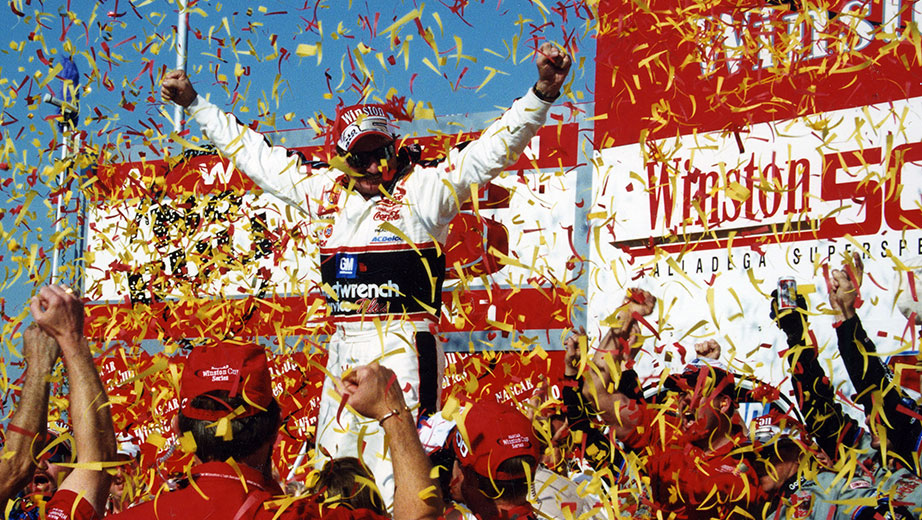
The confetti fell in Victory Lane for Dale Earnhardt, who put the exclamation mark on his career with this victory 15 years ago.
Dunlap: I just remember looking up. I got up on the pit box to talk to Richard to do an interview and we were jumping up and down and he’s hugging me. I about fell off the top of the pit box because he knew what a big deal that was for Dale.
Myers: Every win was a great day with the high fives and all, but this one was just different because you usually wait. You wait and you wait and you kind of hold it to yourself. The best wins are not the wins when you know you’re gonna win. The best wins are the wins you get when you don’t think you’re gonna win.
Jeff Burton: If somebody else would have made that move it would have been, ‘Wow, look at that.’ But with Dale making it, it was like, ‘OH MY GOD.’ It just plain and simple added to who he was. It added to his legacy.
Dale Jarrett: There probably wasn’t anyone in that race and probably isn’t anyone today that you could put them in that situation and they would make their way all the way to the front and win the race. It was kind of the perfect storm for the perfect driver.
Punch: Walt Disney couldn’t have scripted a better movie than that. … Five laps to go. You don’t think about what you’re gonna do you just do it, and that’s what Earnhardt was best at — just doing it.
Lawrence: After it’s all over with, we were going for a million dollars. A lot of the media people got confused because Earnhardt was tickled to death, he was all happy. They thought he was real happy because he won that million dollars. He didn’t give a s— about that million dollars; he didn’t care if we were racing for five dollars. He just loved passing cars and loved winning races.
Hamlin: It took me a while because I walked to Victory Lane, but it took me a long time to get there. Things had already kind of unfolded by the time I got there. Of course, Earnhardt — in his own Earnhardt style — wants to grab me, and I’m like, ‘Don’t touch me. Do not touch me.’ I don’t even remember seeing him that morning before the race. All’s I remember is when he was going down pit road and he came on the radio and said, ‘Oh, there’s my monster truck driving crew chief.’
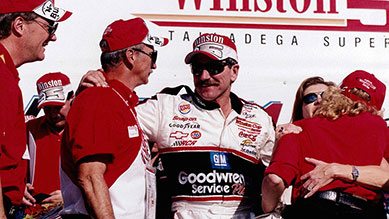
Amid all the hoopla, Earnhardt emerged from his car and made sure Richard Sturtz — his special guest and a newly minted millionaire — felt welcome.
Sturtz: What really impressed me is when Dale pulled me up on his car in the winner’s circle. That had to be one of the greatest moments of my entire life other than being married to my wife. Actually, he was telling me where to invest my money that we actually won, and told me he wanted me to come to his shop to have lunch with him and his whole family.
Lawrence: We had a good time in Victory Lane. They’re throwing million dollar bills around and this and that, and I remember (Earnhardt) saying, ‘Let’s get our picture made.’ There were people holding up those million dollar bills and he’s like, ‘Throw that s— down. Let’s just get our picture made,’ so he wouldn’t let everybody hold up money. … The people on the inside knew he didn’t care about the million dollars. All he wanted to do was win that race.
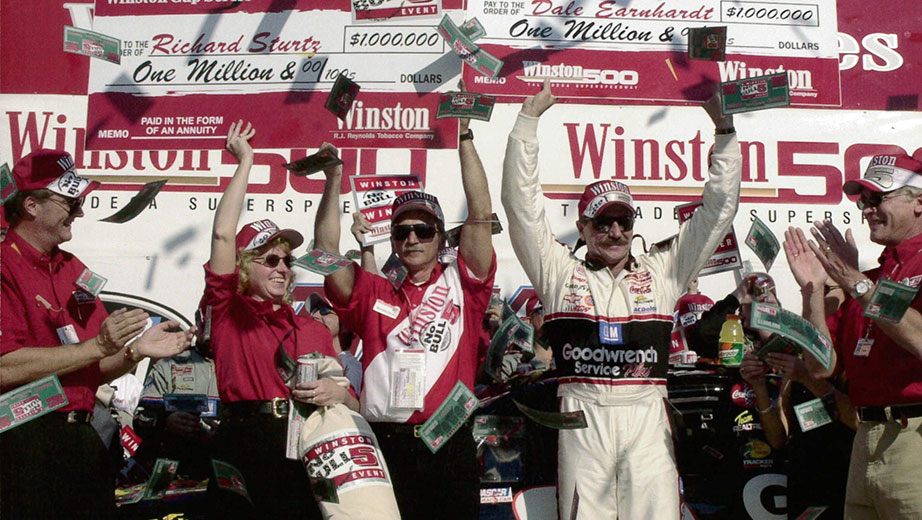
Richard Childress Racing won $1 million due to Earnhardt’s win, but “The Intimidator” was more pleased to have won the same amount of money for Richard Sturtz. (Photo courtesy of Richard Sturtz)
Earnhardt’s chief competitors were left with a mixed bag of results: Teammates Kenny Wallace and Nemechek wound up second and third, joking in post-race interviews that Earnhardt should split the money with them in return for their aerodynamic assistance. Skinner faded to a sixth-place run with Earnhardt Jr. slipping to 14th place. Bobby Labonte salvaged a 12th-place finish to retain his points lead, but he had a new rival in second place behind him — Earnhardt, who left the media and his peers to marvel at what had just taken place.
Skinner: Friday we had the best car. Saturday we had the best car. Sunday we had the best car. We had the best car all weekend and then to finish (sixth) with the best car makes you feel like you really messed it up as a driver because they gave you a car that was capable of winning and you didn’t win again. Believe it or not, I was not only happy for Dale I was happy for the team, I was happy for Richard, I was happy for our team. But by the same token it was very bittersweet.
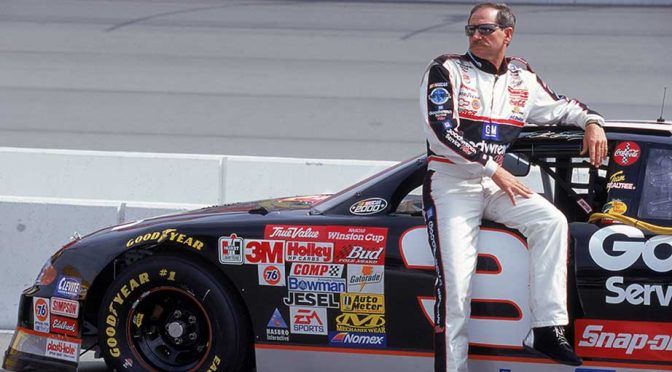
Kenny Wallace: There’s such a generation gap that a lot of people don’t realize that in October or November of 1988, Dale Earnhardt let me drive his No. 8 GM Goodwrench Chevrolet at Martinsville, Virginia in the Busch Series race, which is now the Xfinity race. I flew out of St. Louis and I drove that car and the reason I drove it is because he wanted me to, he let me, and I had to because NASCAR said, ‘Kenny, you can’t just go to Daytona and race. We’ve got to see if you can drive.’ So because of Dale Earnhardt and me driving his car at Martinsville, I told Earnhardt, I said, ‘You don’t owe me a damn thing for me helping you win that million dollar bonus.’ Earnhardt put me in a bear hug and he said, ‘What do you mean? What can I do for you?’ And I said, ‘You don’t owe me nothing. You gave me the first start of my NASCAR career.’ And with that old grin he looked at me and goes, ‘I’m glad you remembered that.’ And that was it. That was the moment.
Punch: To this day if you ask Kenny Wallace that’s probably one of the proudest moments in his career was being able to be the guy who pushed Dale Earnhardt to victory for the final time.
McReynolds: I remember Kevin and I talked a lot, and I remember going up to the office on Monday and just telling him what an unbelievable job that this was and he said, ‘Let me tell you something. It wasn’t that race car. It wasn’t me. It wasn’t anything about that car, it was the cat behind the steering wheel.’ When a man does what he did that day, that’s a lot about what’s behind the wheel of that race car. I’m not underestimating anybody else’s ability, but I’m not sure anybody else could have pulled off what was pulled off that day except for Dale Earnhardt.
Park: It’s hard to downplay it, but it was kind of like when you came back from Talladega if Earnhardt didn’t win, that was more odd than it was him winning, if that makes any sense. So we came back from Talladega and it was typical to congratulate Dale on a win. I know any time to himself or any of us on the team had won races, they would buy lunch in the trophy room, so I think all the workers always looked forward to us going to Talladega because we had a 1-in-4 shot of trying to win that race and everybody getting a free lunch on Monday.
Punch: When the race was over and we’re trying to catch our breath up there and Victory Lane is happening and the race is over, we get in the elevator to go down out of the tower and we get in our rental car — it’s Benny and myself, we’re gonna drive to Birmingham to catch a flight — and from the time we left the booth to the time we got in the rental car, nobody said a word. And we backed out of our spot and we’re driving around the track and I looked over at Benny and I said, ‘I don’t believe what we just saw. What we just saw isn’t humanly possible.’ And Benny looked up and looked me square in the eye and shook his head back and forth and said, ‘He ain’t human. He’s Earnhardt.’
• • • • •
The Aftermath
“I think all of the guys at RCR are ready to go out and race for a championship this year. I know I am.” — Dale Earnhardt, Charlotte Observer, Jan. 26, 2001.
Earnhardt held on for second place in the final 2000 standings behind eventual champion Bobby Labonte. His highest finish in the points since 1995, combined with newfound health, prompted talk about a potential eighth championship — a title that would break his long-running tie with King Richard Petty — in 2001. Tragedy struck just four months after his final triumph at Talladega with a fatal crash in the last lap of the Daytona 500.
Hutchens: That was the first year in several years that the team and the parts and the pieces, the cars, the chemistry was there to get him back to that championship. I really (think) 2001 would have been his year if we wouldn’t have had the unfortunate accident at Daytona.
Lawrence: Actually in 2001, Dale was in the best shape he’d ever been in. He’d had his neck fixed. He was a man. He would race with his hands being numb and being hurt, and he didn’t want a spotter, he didn’t want an air conditioner. He wanted things his way. We had no idea that was going to be it.
Myers: When you can accomplish something like he accomplished that day it’s got to be a big boost for him, knowing that he’s still got it and he can still get the job done. I know that he was very excited going into the 2001 season about a championship.
Lawrence: We really thought that we could win every race we went to. We didn’t have a clue. We’d had a really good winter in 2000, 2001, and he was in a great mood all of Daytona. He’d run the 24-hour race, and I mean, he was stronger that he’d ever been.
Hailey: I was seeing eight, nine and 10 in our future. He was on a mission. Our whole team was on a mission. Everything was rolling fine. We were coming on strong.
No one that mid-October day could have known that Earnhardt’s Talladega victory would be his last. With 15 years gone by, Earnhardt’s historic comeback — important both for how he won it and where he won it — has stood the test of time, only adding to the first-ballot Hall of Famer’s legacy.
Earnhardt Jr.: On the surface, it doesn’t stand out when you look at all the other things he did, but when you watch the race and understand how it unfolded, it’s a great example of his determination, never-give-up attitude and how hard he was as a competitor and a fighter, and that he could overcome almost anything. He had that much confidence that no matter how far back he was, how late in the race it was, he wasn’t supposed to be there and he knew it. Somehow he was going to figure out how to get out of that situation and get back to the front. I think a lot of other people would’ve resigned themselves to well, the race was out of my hands, and the race was never out of his hands.
Myers: That was one of those days where even the haters became believers because of what he did was so incredible.
Dunlap: It wasn’t like he went from fifth to first. He went through the field, and you don’t see that today because it’s not possible.
Sturtz: The truck I got from Dale has been almost a year at the International Motorsports Hall of Fame, and then Teresa (Earnhardt) came and got it here a few years ago and she had it for seven months in Dale’s museum. I still have the full bottle of champagne they gave me. I’ve got all that stuff — pictures of him pulling me up on the car. It’s just unbelievable the stuff they gave me.
Lawrence: I remember the next week, (Earnhardt) said, ‘You know, we changed that cat’s life.’ The hype and everything and everybody thought he was more excited because of the million dollars, that had nothing to do with it. He was excited for the fan, but if there hadn’t been a million dollars on the line and he passed those cars, he would’ve been just as happy.
Earnhardt Jr.: I imagine a million dollars would definitely change your life, no matter how you got a hold of it. I can’t imagine what it must’ve felt like for that fan. He must’ve been the biggest Dale Earnhardt fan in the place that day.
Sturtz: We made a pact, me and the other four contestants … I did give each one of them $10,000 of that money when we got it. And then that 9/11 happened and we lost a lot of the money, but I think it’s coming back. I know we’ve sure got more money than we ever had in our entire life, and like I say it’s all because of Dale.
Lynch: I think it’s sad that Dale left us early, but it’s nice for us to be the last place he won, too, and him still to be our all-time winner. We’re very proud of that here at Talladega.
Helton: If you asked 10 guys in the garage area that are over 55 years old to give you their 10 most interesting moments, you’re going to get a pretty wide girth, but I suspect that’s probably 80 percent of those guys that would have that in the top 10.
Punch: That race, that package at Talladega, and those final five laps epitomized his career. He was gonna put that car where nobody else could put it. He was gonna pass people on the outside against the wall, on the apron, and until they waved that checkered flag he was gonna keep digging. Whenever I hear Dale Earnhardt Jr. say, ‘Hey, we’ve just got to keep digging,’ those words ‘keep digging’ reminds me so much of what his daddy said in the car.
Bestwick: Really, wasn’t that the exclamation point at the end of the story? Not knowing the events that were coming in the near future after that, but, really, wasn’t that the exclamation point on how Dale drove, who he was, the magic that he seemed to find? You know the whole story about seeing the air and all that kind of thing, wasn’t that kind of performance, particularly in hindsight, really the exclamation point on Dale Earnhardt’s story and Dale Earnhardt’s story at Talladega?
McReynolds: I don’t think anybody on this Earth would have ever believed that as he celebrated that day in Victory Lane that that was gonna be the last. I think that day, that race, that win … there are hundreds of examples of what made Earnhardt what Earnhardt was as a race car driver, but that certainly would be one that would be pretty darn close, if not at the very top of the chart.
Kenny Wallace: The way that Dale Earnhardt Sr. won that race was vintage Dale Sr. He represents every working man across the world. He wore them cowboy boots and had that moustache, and here we were last like the middle-class working man — down and out. We were down and out, but he never gave up, and he inspired me. I said, ‘Hell, since you ain’t giving up, I ain’t giving up either,’ and I was going, but we really weren’t going anywhere until we teamed up. That’s Earnhardt’s legacy. He represents the working man. Don’t ever give up.
Sturtz: He was just ungodly nice to me for some reason. I mean, I guess that’s the way he was, but the man really changed our lives for the better. I don’t know what else to say. That was something. I still miss him. I’m sure there are a lot of people that do.