RELATED: NASCAR 101: Format fast facts | Complete starting lineup

At a Glanc
e

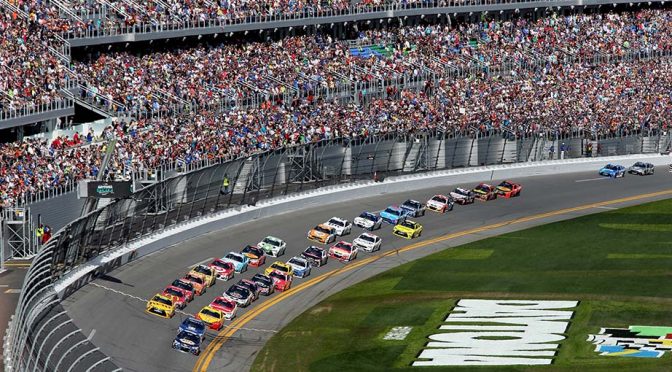
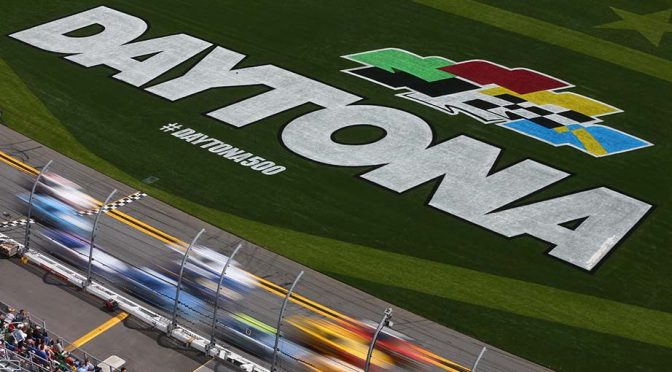
Where: Daytona International Speedway, 2.5-mile tri-oval in Daytona

Green flag: 2:30 p.m. ET
Stage lengths: Stage 1 ends on Lap 60, Stage 2 ends on Lap 120, Stage 3/race slated to end on Lap 200

TV/Radio: FOX, MRN, SiriusXM NASCAR Radio 

Forecast: Sunny with a high temperature of 68 degrees, according to the National Weather Service. North-northeast winds of 10 to 15 mph, with gusts up to 20 mph

National anthem: Jordin Sparks, starring in "God Bless the Broken Road," DAV Ambassador

Grand Marshal: Actor Owen Wilson

Race distance: 200 laps, 500 miles

Pit road speed: 55 mph

Caution car speed: 70 mph


RELATED: Final practice results


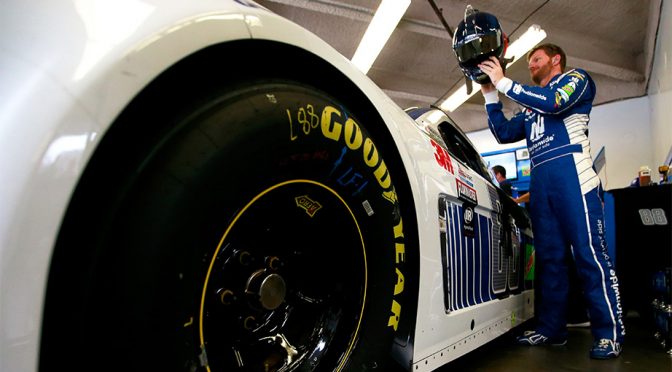
In Saturday’s final Monster Energy NASCAR Cup Series practice, Dale Earnhardt Jr. ran 30 laps at Daytona International Speedway, second only to the 36 posted by Hendrick Motorsports teammate Kasey Kahne.


The No. 88 team changed from a qualifying engine to the race engine after practice on Friday, a practice customary at the Daytona  500. But Earnhardt found his car less responsive with the new engine; in addition, the car developed a slight vibration that led to the team changing drive shafts in the car.


"We changed the motor and went to the race engine today, took the qualifying motor out last night," Earnhardt explained. "I thought our car was a little better yesterday in practice. In the pack, it would develop runs a little bit better. It just seemed like I had to get a little luckier today with what was happening behind me, where yesterday the car would do some things or develop some things kind of on its own. 


"The thing about that is every time you get out there — you might not even change anything — it just depends on what kind of pack you get in, what kind of cars are around you, and your car’s performance can change and kind of fool you a little bit. I’m just hoping that today was a little more laid back, not quite as many cars out there, not quite as active in the draft, and maybe that’s why we didn’t see our car respond like it did yesterday."


RELATED: Junior’s Daytona 500 history


The vibration was of particular concern.


"You worry about that, because any kind of thing that is out of balance is going to hurt that straight-line speed," Earnhardt said. "We tried to work on that and were able to fix it right there on that last run. It’s just simple stuff like flipping drive shafts and things like that. 


"You want to get all that out of there so you don’t have any doubts about anything holding your car back. Otherwise, it’s been really uneventful. We haven’t had any issues or problems with the car mechanically, and nothing happened on the race track, so it looks like we are going to get this thing on the grid tomorrow and ready to go."


The change in drive shafts won’t affect Earnhardt’s second-place starting position on Sunday.

2018 DAYTONA 500 Travel Packages are now available from PrimeSport! As the Official Ticket Exchange of Daytona International Speedway, PrimeSport has your access to all the action at the World Center of Racing! Receive $50 off per reservation when you book your 2018 DAYTONA package by Saturday March 4th. Use code DAYTONA18 at checkout. Coupon code DAYTONA18 is active now through Saturday March, 4th. | GO HERE

DAYTONA BEACH, Fla. (Feb. 25, 2017) — Reserved stadium tickets for the 59th annual DAYTONA 500, the season-opening event for the Monster Energy NASCAR Cup Series, are sold out, Daytona International Speedway President Chip Wile announced today.
 
Ticket holders for "The Great American Race" on Sunday will enjoy all the amenities that come with the world’s only motorsports stadium including 101,500 permanent and wider seats, five expanded and redesigned entrances, 40 escalators and other upgrades throughout the 11 football-field sized neighborhoods in the facility.
 
Premium hospitality, infield admissions and UNOH Fanzone/Pre-Race access still remain for the DAYTONA 500 and are available at www.daytonainternationalspeedway.com or by calling 1-800-PITSHOP as well as through PrimeSport.com, the official ticket exchange and travel package provider of Daytona International Speedway.
 
This is the second straight year that the DAYTONA 500 has sold out.
 
"The ticket demand for the DAYTONA 500 continues to be a constant in our sport," Wile said. "Likewise, the race continues to be the perfect kick-off to a new NASCAR season, showcasing the unique and energized at-track experience that our sport — and our stadium — provides to our fans.
 
"This is the most prestigious event on the NASCAR schedule and a true American sports tradition. Fans have always recognized those facts. This latest sellout, once again, reflects that recognition."
 
This year’s Daytona  500 will be attended by fans representing 41 different countries and every state in the U.S.

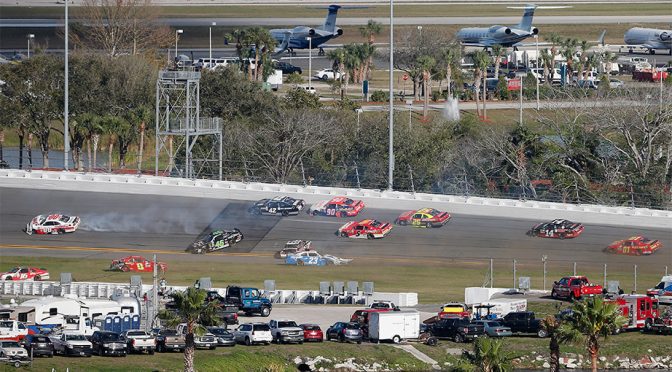
The "Big One" occurred in the waning laps of Stage 1 in the XFINITY Series Daytona opener with 12 cars involved.

During a Lap 26 restart — following a 20-car wreck on Lap 23 — the No. 33 Richard Childress Racing Chevrolet of polesitter Brandon Jones, the No. 7 JR Motorsports Chevy of Justin Allgaier and the No. 21 RCR Chevrolet of Daniel Hemric got loose, sparking the melee.

Both Jones and Allgaier hit the wall hard, bringing the No. 18 Joe Gibbs Racing Toyota of Daniel Suarez with them.

Roush Fenway Racing‘s Darrell Wallace Jr. and JGR teammates Matt Tifft and Erik Jones were affected as well. Other cars in the wreck included Chris Cockrum, Harrison Rhodes, Brandon Hightower, Scott Lagasse Jr. and Blake Koch.

“I think the 7 got turned by somebody and I saw Erik didn’t lift, so I didn’t lift and we were trying to go through the middle, and I think me and Daniel collided there," Wallace said. "It was just unfortunate circumstances that put us there. We probably looked like a boy band group walking out all together, but I just hate it for my guys."

NASCAR quickly parked the field under red-flag conditions.

RELATED: Format FAQ | Full Speedweeks schedule


NASCAR’s 2017 race format enhancements debuted for the NASCAR XFINITY Series on Saturday, and veteran Elliott Sadler was the early beneficiary.


The sanctioning body introduced three race stages for all three NASCAR national series in the offseason, with points awarded for top finishers in Stage 1 and Stage 2. The Final Stage concludes the race and awards full race points.


For Stages 1 and 2, the first-place driver at the conclusion of each earns 10 race points, as well as one bonus playoff point for the postseason. Nine race points are awarded to the second-place driver, eight points for third-place, down to one point for 10th place.


Here are the stage results from Saturday:


* asterisk denotes driver ineligible for points in this series

RELATED: Race results | Standings | Detailed breakdown


DAYTONA BEACH, Fla. — For Ryan Reed, there’s magic in the air at the Birthplace of Speed.

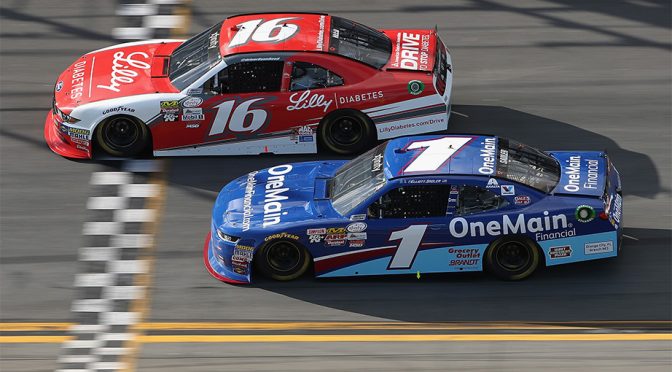
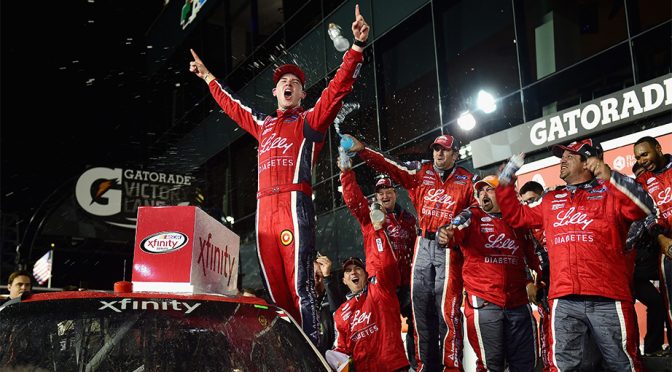
Reed went to Victory Lane at Daytona International Speedway in February 2015 and hadn’t won since — until Saturday night, when he held off Monster Energy NASCAR Cup Series veteran Kasey Kahne in overtime to claim victory in the Powershares QQQ 300 NASCAR XFINITY Series season opener.

With the race going four laps past its scheduled distance of 120 laps, and with the series running NASCAR’s new three-stage event format for the first time, Reed blocked Kahne in Turn 2 on the first of two overtime laps and stalled his momentum.

MORE: See how the entire field fared in Stage 1, Stage 2

From that point on, Reed stayed out front and got to the finish line .219 seconds ahead of Kahne, with Austin Dillon a close third and Brad Keselowski and Brendan Gaughan fourth and fifth, respectively.

Reed’s triumph was a welcome start to the season for Roush Fenway Racing, which suffered through a winless season in 2016.

"I’m just so excited," Reed said in Victory Lane. "I knew if I could run two perfect laps (in overtime) with however many blocks I had to do in those two laps, I’d be standing here."

In a race that produced 10 cautions, one short of the event record, 20 of the 40 cars were running at the finish. Only three cars escaped damaged from a succession of major wrecks—those of Kahne, Ty Dillon (who ran out of gas on the first overtime lap) and David Starr (who dropped out after four laps with engine issues).


MORE: 20-car wreck brings out red flag | Twelve cars affected in ‘Big One’

The driver who got the worst end of the accident toll was Elliott Sadler, who led a race-high 40 laps and won the first two stages under caution (earning one playoff point for each) before clobbering the backstretch wall on Lap 104 in a 16-car accident.

Sadler was credited with a 24th-place finish but managed to hold third in the series standings, thanks to points earned in the first two stages. Reed leaves Daytona with a nine-point lead over second-place Brendan Gaughan, with Sadler 14 back.

"Man, that was a heck of a race," Gaughan said. "What a run to get back to the top five! Me and Austin — we were beasts coming through the field.

Before the race reached the end of the 30-lap first stage, the event had been red-flagged twice for a pair of massive wrecks that eliminated more than a handful of drivers expected to contend for the series championship.

On Lap 23, Scott Lagasse Jr. turned the No. 42 Chevrolet of Tyler Reddick across traffic on the backstretch, causing a colossal chain-reaction pileup that involved 20 cars — literally half the field. That wreck knocked out Cole Custer in his debut in the No. 00 Stewart-Haas Racing Ford, as well as Sunoco rookie Spencer Gallagher in the No. 23 GMS Racing Chevrolet.

"My bad," Lagasse said on his radio in perhaps the tersest apology ever for a mistake that damaged that many cars.

As drivers jockeyed for position on Lap 29, rookie Daniel Hemric hit a patch of “speedy-dry” from the first wreck — which he described as "like driving on ice" — and washed up the track into the left rear of Justin Allgaier‘s Chevrolet, triggering a crash that involved 13 cars.

The melee damaged the cars of Hemric, Allgaier, Erik Jones, Darrell Wallace Jr., pole winner Brandon Jones and 2016 series champion Daniel Suarez beyond repair.

"I feel like we were racing too hard," said Suarez, who is running for points in the Monster Energy NASCAR Cup Series this season. "It’s too early. I don’t really know what happened exactly. I haven’t seen the replay slowly.

"I feel like we have to be a little bit smarter than that. I just feel like it’s a long race, and we should be a little bit more smart."

Reed was involved in three of the accidents, including the Lap 104 incident, but recovered to win the race.

"I started out pretty aggressive and made some mistakes and ended up in the back of the pack," said Reed, who suffers from Type 1 diabetes. "I knew if I was there at the end it doesn’t matter where you are at, you will have a shot.

"I reminded myself of that, took a deep breath, bided my time and found my way to the front at the end. Everyone was so aggressive. This new format is breeding a lot of aggression — there’s a ton of incentive."

DAYTONA 500: Starting lineup | Race-day schedule | Key info
RELATED: Junior fulfilled with his career numbers

DAYTONA BEACH, Fla. — He tested at Phoenix earlier this year, qualified on the outside of the front row for Sunday’s Daytona  500 (2 p.m. ET, FOX, MRN, SiriusXM NASCAR Radio) and on Thursday he led the bulk of his Can-Am Duel qualifying race before finishing fifth.

Dale Earnhardt Jr. is officially back.


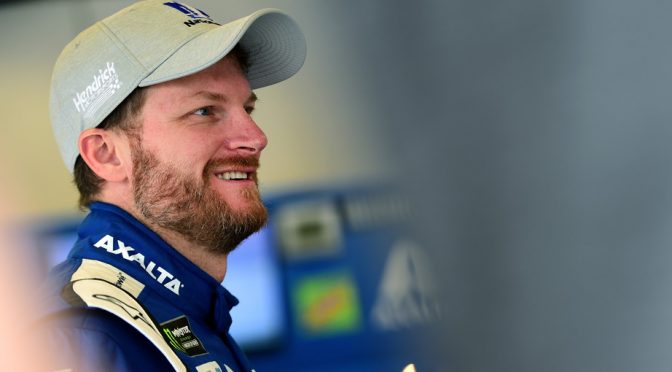
Today marks his return to the Monster Energy NASCAR Cup Series, and no one is more pleased about it than the driver of the No. 88 Chevrolet for Hendrick Motorsports.


"I really had fun," Earnhardt said Thursday evening after a strong return at a track where he’s typically one of a handful of drivers expected to run well. "I hated to lose but still we have to be aware of how far we’ve come to get back here. To go out there and lead all those laps and be able to make some good smart moves, it felt great."


The road back has been a long one for the 42-year-old Earnhardt, who missed the final 18 races of 2016 while recovering from a concussion. It marked the second time he had been sidelined by such an injury, and he admitted there were times he questioned what his racing future held.


RELATED: Junior emerges from injury stronger, centered and ready to win


"There was a lot of time during the recovery where there were days I was 90 percent sure I wasn’t going to drive again," he said. "There were days when it was 50 percent. It was just moving all over the place depending on what I felt that day. Your recovery is up and down, you have good days and bad days. …


"When it came down to it, I had to decide for myself if I wanted to drive anymore. I’m not going to race because of any other reason than I want to be out there."


Earnhardt will roll off second alongside Elliott, the pole winner, for the 59th running of the Daytona  500. He is a two-time winner of the "Great American Race" and one of the favorites based on past success and this year’s efforts thus far.


RELATED: Chronicling Junior’s return to racing | Dale Jr. in the 500


Restrictor-plate races are breeding grounds for multi-car crashes, with cars running two-, three- and sometimes four-wide, a dozen or more rows deep at 200-plus mph. Earnhardt doesn’t dwell on the possibility of another accident and what might result.


"I don’t want to wreck to sort of quantify my recovery," he said. "I think should that happen and I come out the other side of it feeling great, that will add a ton of confidence. I can’t sit here and say that I know exactly how I’m going to react in those situations with confidence. So yeah, when I go through that process, there’s a box or two to check that aren’t checked yet."


Three-time series champion Tony Stewart hung up his NASCAR uniform at the end of the ’16 season. Two of Stewart’s final four years driving for Stewart-Haas Racing were cut short due to injuries the Columbus, Indiana, native suffered in non-NASCAR events.


But there was no apprehension about climbing back in the car following lengthy recovery periods, he said.


"Never. It was more excitement to get back because you have to remember, we’re drivers," Stewart, the winner of 49 Monster Energy NASCAR Cup Series races, said. "That’s what we want to do, drive.


"When you have an injury, all it is is a pain in the ass. It’s keeping you from doing what you want to do. That’s why you heard so many drivers praise Junior last year (when) he chose not to run. And that’s hard."


Fellow driver Martin Truex Jr. has a close relationship with Earnhardt — the two were teammates from 2004-07 at Dale Earnhardt Inc. and spend time away from the track each fall on hunting trips.


"I know he’s got a lot on his shoulders," Truex said. "A lot of people put a lot of pressure on him, obviously. I think in a lot of ways he sometimes feels like he needs to be here for other people. But hopefully he made the decision based on what’s best for him. I think he did. I know he’s excited about racing still. He obviously still loves it and wants to do it and hopefully things will all work out for him."


It has been 20 races since Earnhardt won his last race and just five — due to his shortened ’16 season — since his last top five. Sunday affords the opportunity to reset both those streaks. After that? He’s yet to win a championship at NASCAR’s top level, but has finished as high as third. And, yes, he did say if he wins the title in ’17 "it would be hard to not call it a career."


RELATED: Earnhardt Jr. would consider walking away as champion


He has a new outlook and seems to be at peace with the road he’s traveled. For the longest time, he said "I let racing be who I was instead of what I did.


"Like Richard Petty said, I’ve got a whole other life beyond driving and I really believe that," Earnhardt said. "I’ve got a lot of things I’d love to do. Even outside of having a family, there are a lot of things in business that I’d love to see if I could succeed at. I think we got a glimpse of what that would be like; it looks pretty awesome."


For now, though, the Daytona  500 and another season of crisscrossing the country await. And Earnhardt is more than OK with that.


"Like I said, I crave to drive the car," he said. "I love the position I’m in with the team I’m with, (crew chief) Greg (Ives) and the guys, and until that feeling … and that ‘want’ to be there is gone, I want to keep going."
RELATED: Daytona results | ‘Big One’ at end of Stage 1 | Recap
 
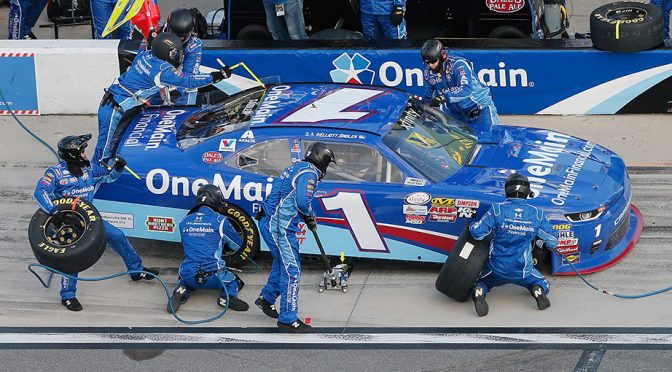
DAYTONA BEACH, Fla. — Elliott Sadler climbed out of his wrecked No. 1 JR Motorsports Chevrolet in the Daytona International Speedway garage, looked over his car and still managed a reluctant smile even as the race field roared by on track.


After leading three times for 40 laps of the Powershares QQQ 300, Sadler was knocked out of the race on Lap 107 of the extended 124-lap XFINITY Series opener. Contact between Sadler and Austin Dillon from behind in the tight pack of front-running cars sent Sadler’s Chevy spinning on track. And while his crew tried to make repairs, the damage proved too much to fix in the allotted five-minute time window on pit road and he had to settle for a 24th-place finish after starting the race 11th.


"Someone got into the back of us just trying to bump draft," Sadler said. "It wasn’t anything intentional, it was just go-time. When he hit us it lifted the rear tires off the ground. The OneMain Financial car was really fast. We can’t hang our heads because we were way fast and way good. We’ll rebound (next week) in Atlanta.


"It’s been fun the whole day, really. We had a really good car, it’s a shame to see it get torn up. We did get our bonus points and if we can do that every once in a while it will set us up here for a championship run.


"You have to be aggressive, it’s Daytona. That’s part of racing here, you’ve got to be if you want to win."


Ryan Reed ultimately won the race to take a likely playoff berth, but Sadler looked like the class of the field for most of the three-hour opener, which included two lengthy red flag periods (totaling more than 40 minutes) for multi-car accidents.


RELATED: Sadler sweeps first two Stages


Sadler, last year’s XFINITY Series championship runner-up, led a race-best 40 laps through the first two stages, earning 20 regular-season points for leading at both the Stage 1 (10 points) and Stage 2 (10 points) breaks. He additionally received two playoff points — again for winning the first two race stages — that could come into play should he make the playoffs. His P24 finished granted him an additional 13 regular-season points, totaling 33 for the day.


Saturday’s effort places Sadler third in the XFINITY Series standings, 14 points behind race winner Reed.


"At least we don’t leave with nothing to show for it," Sadler said, managing a smile. "We got points to take with us into the playoffs and build on that. Our car was fast and we’ll build on that. Accidents happen. 


"With new points system it was fun to race like that, to be honest, and get to each stage and see how people are reacting. Definitely a lot of fun.


"It’s just typical racing. It’s Daytona. You’ve got to go and be aggressive if you want to win. It’s a shame we don’t have anything to show for it."


On the Monster Energy NASCAR Cup Series side, Sadler was one of four "open" teams to earn a starting position in Sunday’s Daytona  500 (2 p.m. ET, FOX, MRN, SiriusXM NASCAR Radio) and will start 40th in the 40-car field driving the No. 7 Golden Corral Chevrolet.


RELATED: See the stages for every 2017 race

DAYTONA BEACH, Fla. — The Daytona  500 turns 59 on Sunday, just one year shy of a solid, round milestone number. But the otherwise ordinary anniversary has a momentous wrinkle thrown in.

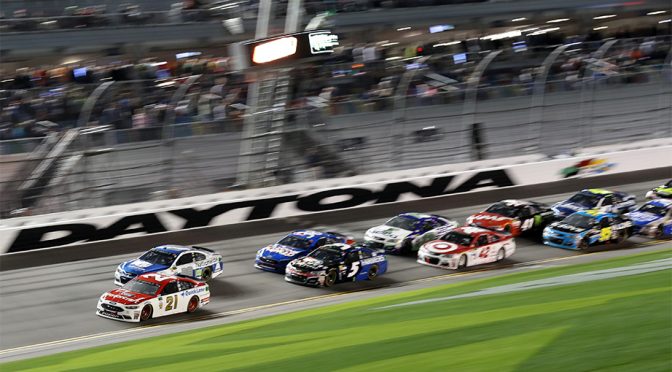
For the first time in its history, the "Great American Race" will be run in three stages — 60, 60 and 80 laps — with points incentives to the top finishers in each segment. It’s an infusion of a new-school format, transposed against the backdrop of the Monster Energy NASCAR Cup Series‘ most prestigious event.

The significance isn’t lost on the 40 drivers who will take the flag in Sunday’s 500 (2 p.m. ET, FOX, MRN, SiriusXM NASCAR Radio), and neither is the bounty of bonus points that will be available. It’s a tantalizing carrot, one that could alter teams’ approaches as each race plays out this season.


RELATED: Format enhancement fast facts


"I think that’s the biggest thing — it’s going to change the strategy," said Kevin Harvick, the 2007 Daytona  500 winner. "I think there is going to be a lot of strategy involved. Late cautions in (stages) or the timing of the (stages) … if there is an early caution … do you stay out and gain the points and pit later? There’s going to be a lot of strategy that will mix the field up more than we’ve seen in the past. …

"There’s really no time to relax and I think that’s going to create a bit more of a chaotic atmosphere for the fact that there is so much to get and if you don’t aggressively go out and try and get those things, you’re going to get behind really fast."

The lure for drivers at the end of the first two stages are regular-season points awarded to the top 10, plus a bonus point for a stage winner to carry into the playoffs. That format will be in place for all 36 points-paying races through the season.

The scoring system is no different for the other 35 events, but Sunday’s opener has the weight of the Harley J. Earl Trophy and a career-changing victory at the end of the third stage.


RELATED: Changes in NASCAR for 2017


"I’d love to get those points, obviously, at the end of each stage, but I do feel like there’s going to be people that wreck at the end of the stages," said Austin Dillon, who won the Daytona  500 pole position in 2014. "So, I don’t know. If I’m running in the top three and I keep in my position, I probably won’t pull out of it."

While on-track discretion will remain in play, the format may have an unintended effect on restrictor-plate racing at Daytona and sister track Talladega in potentially discouraging the play-it-safe tactic of laying back of the main pack.

Joey Logano, the 2015 Daytona  500 winner, said he imagines that stage strategy will evolve for crew chiefs over the course of the season, but that for him, there’s little strategy to dither over.

"For me as a driver, nothing changes because I’m as wide-open as I can be," Logano said. "I don’t have a slower gear. It’s high speed all the time and I’m gonna try to pass everyone every time I can, so that part doesn’t change for me."