BUY TICKETS: See the Daytona 500 live!

NASCAR’s extensive history spans all the way back to its founding in 1948. Over the course of those nearly 69 years, plenty of races — from the first starts on Daytona Beach sand to today’s modern speedways — have taken place.


In that time, a colorful blend of pioneers and superstars have etched their names into NASCAR’s record books. Some all-time milestones may never be repeated while still other categories await new benchmarks to be written.


Going inside the numbers and traditions of the sport at racing-reference.info reveals plenty of all-time statistics and figures in what is now the Monster Energy NASCAR Cup Series. A sampling:


All-time wins: 200 by Richard Petty. | See more
All-time pole positions: 123 by Richard Petty.
Most series championships: 7 by Dale Earnhardt, Jimmie Johnson and Richard Petty.
Most road-course wins: 9 by Jeff Gordon. | See more
Most restrictor-plate wins: 12 by Jeff Gordon. | See more
Most wins on dirt: 42 by Lee Petty. | See more
All-time best winning percentage: 21.05 percent by Herb Thomas (48 wins in 228 career starts)
All-time best average finish, career: 7.602 by Lee Petty.
All-time best average starting position, career: 4.874 by Dick Hutcherson.
All-time most laps completed: 307,836 by Richard Petty.
All-time most laps led: 51,406 by Richard Petty.
All-time lead-lap finishes: 588 by Jeff Gordon.
Most all-time wins by car number: 209 by cars carrying No. 11. | See more

BUY TICKETS: See the Daytona 500 live!


FOX Sports announced additions to its driver-analyst lineup for the 2017 NASCAR XFINITY Series, giving Chase Elliott and Jamie McMurray one race each in the booth this season.


The two newcomers join returning guest analysts Kevin Harvick, Brad Keselowski, Joey Logano as Monster Energy NASCAR Cup Series drivers lending their voices to XFINITY Series broadcasts.


Elliott, the Sunoco Rookie of the Year in the Monster Energy NASCAR Cup Series last season, will help call the action March 4 at Atlanta Motor Speedway in his home state of Georgia. McMurray, a former Daytona 500 winner, will join Adam Alexander and Michael Waltrip in the FOX booth for the series’ March 11 stop at Las Vegas Motor Speedway.


Harvick, who earned high marks for his guest commentary on XFINITY telecasts the last two years, will have the biggest workload among the group. He’ll be in the booth for five races, beginning with the season-opening PowerShares QQQ 300 (Feb. 25, 3:30 p.m. ET, FS1, MRN, SiriusXM NASCAR Radio) at Daytona International Speedway. Harvick is also planning to serve as guest analyst for three events in the NASCAR Camping World Truck Series this year.


Team Penske teammates Keselowski and Logano have been tapped for two races each. FOX Sports indicated that guest analysts for three races would be determined later in the season.


The network previously announced that Dale Earnhardt Jr. would serve as guest commentator in the Feb. 18 Advance Auto Parts Clash (8 p.m. ET, FS1, MRN, SiriusXM), a non-points exhibition for a select field of Monster Energy Cup Series drivers.


* indicates a non-XFINITY Series race

BUY TICKETS: See the Daytona 500 live!


NASCAR’s race enhancements have set up stages that will see drivers battling for stage wins and playoff bonus points. The impact of accumulating playoff points has a big benefit during the 10-race playoff in the Monster Energy NASCAR Cup Series that starts in September, and it could lead to added pressure on pit road.


A playoff point from a stage win could end up representing the difference between a driver advancing deeper into the playoffs or being eliminated based on the amount of playoff points one carries into a round. Those point perks could be delivered to a driver by some clutch work on pit road.

That fact is not lost on Mike Lepp, the senior athletic advisor at Joe Gibbs Racing, who was the organization’s longtime athletic director working with the team’s pit crews.

“With the new format — can you get those stage wins with a pit stop? Yes, you can,” Lepp told NASCAR.com. “All you got to do is go back to the All-Star Race. If you go back and look at that All-Star stop, which is similar to what this is, we went from fourth to first.”

RELATED: Fast facts about the race enhancements

In 2015, JGR driver Denny Hamlin used a strong final stop in the Sprint All-Star Race at Charlotte Motor Speedway to leave pit road with a lead he would not give up over the final 10 laps for the $1 million win.

“I think pit stops are going to start getting looked at even more — more scrutiny and more pressure because winning a stage is points that carry over (to the playoffs). We see every one of these championships have been one or two things. I think the pressure on pit stops is going to go up with the new format.”

Playoff points will be added at the start of the playoffs and then roll over at the start of every subsequent round of the playoffs except for when the four drivers reach the championship at Homestead-Miami Speedway.

Interestingly enough, Hamlin advanced to the Round of 8 in 2016 on a best finish tiebreaker over Austin Dillon as they had the same amount of points after the fall race at Talladega.

“You could name 10 instances during the season where that point came from,” Lepp said. “That is what you always try to tell the drivers and tell people. You start thinking about, you win the Daytona 500, you are in the playoff. … Now you go, I can’t just say I’m in the playoffs, I got to still get some points and build a cushion in case something comes down to a tiebreaker. Those stages wins are going to become important — people are going to look at them.

“Are you going to cost yourself a whole race doing something stupid to win a stage and you can’t win the whole race because you did something silly? No. I think you are going to look at it and go, we’ve seen the instances. Look at Tony and Carl in 2011 (Stewart and Edwards finished tied in the standings in 2011, but Stewart won the title on a wins tiebreaker). Tiebreakers can be big deals. I think that’s another pressure thing that these guys have to think about on the over-the-wall stuff.”

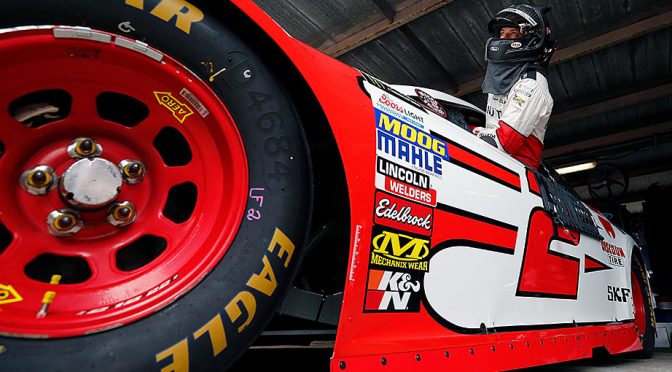
The enhancements will also change a crew chief’s thinking as Paul Wolfe, who sits atop the pit box for Brad Keselowski’s No. 2 Team Penske team, told SiriusXM NASCAR Radio’s Tradin’ Paint on Friday.

“The strategy, calling the race, when to pit, when not to with these segments that will be a big one for me,” Wolfe said.

The 2 team has been known to roll the dice on strategy, whether it’s a call for four fresh tires on the last lap of regulation (under caution) at Fontana in 2015 that saw Keselowski drive up from 18th to the lead on the final lap, or last year at Kentucky, with three wins in hand, when Keselowski and Wolfe gambled on fuel and held off Carl Edwards for a victory.

“I think you’ll see it evolve as we go and people learn how the format’s going to play and strategies and different ideas,” Wolfe said. “As your season goes on, whether or not you get a win early, or if you are trying to race your way in on points, I think guys could be on different strategies during the race depending on what their ultimate goal is for that weekend. … I think you got to be able to adapt and continue to learn as we go to the early stages of the season.

“Whenever there is this much change, a lot of times, I like it. I think it’s exciting. It means there’s opportunity. An opportunity to get a head start on some guys and hopefully we can be a team that does that and have some success early on with all this.”

In addition to earning a playoff point for a stage win, drivers can receive points for finishing in the top 10 of a stage. Those points are part of one’s point total immediately. The race enhancements are part of all three NASCAR national series starting in 2017.

BUY TICKETS: See the Daytona 500 live!

Spencer Gallagher has a question for you.

"How would you feel if you were a NASCAR driver?" he asks.

If it brings a smile to your face, then Gallagher says there’s the answer as to why he is the way he is — a ridiculously funny guy whose personality will take over the XFINITY Series garage this year.

Yes, Gallagher says he has always been a happy-go-lucky guy. It’s no front. He’s certainly not doing it for attention.

"The first time I got into a stock car and turned the engine on and started turning laps, it became real to me, and it hasn’t stopped being a joyous experience," said Gallagher, who will embark on his rookie XFINITY Series season in 2017 with GMS Racing. "If you wonder where I get that mile-wide smile at the track, I’m living my dream every second of the day when I get to wake up and go drive a race car, and I see no reason not to love that."

"I could be ditch-digging for God’s sake. But I get to wake up every day and drive a race vehicle, so of course, I’m going to love that. There’s no reason to hold that back. People love to see passion. People love to see people who love what they do. I love the hell out of what I do."

From sunglasses painted red, white and blue to a "Run GMS" T-shirt (based off hip-hop group Run DMC), Gallagher can instantly ignite any room. He skillfully incorporated the word "fatso" into an answer during last month’s NASCAR Media Tour presented by Charlotte Motor Speedway when asked about his change in diet and fitness.

Don’t tell officials at GMS Racing, but Gallagher admitted he’s been thinking about getting "Run GMS" tattooed on his arm. In other words, for fans who are looking for a driver with personality, Gallagher is their guy. And he’s heard feedback from some who have taken a liking to him for that very reason.

"What I try to always remind myself is once upon a time I wasn’t going to be a race car driver," Gallagher said. "I was going to live in San Francisco and work on computers the rest of my life and be happy as a clam. But you know what, here I am, and this is a universe I’m lucky to be in, so I always try to keep that joy in my heart. And I do think the fans really resonate with it.

"People want to have that internal confirmation that if they can’t be driving a race car, the guy that they’re rooting for is having the time of his life out there. I think that means something to them."

What will Gallagher do in 2017 to continue to bring smiles to fans’ faces? Have no fear because he’s recently come into possession of Snapchat Spectacles. Google it and you might get some ideas about the fun that lies ahead.


BUY TICKETS: See the Daytona 500 live!

ELGIN, Ill.  – 
Elgin Sweeper, the leading manufacturer of street sweepers for general street maintenance, special industrial and airport applications, has renewed its partnership with NASCAR Greenu2122 for three years and will continue to serve as the Official Sweeper of NASCAR Green.

"Elgin Sweeper has provided trackside support for NASCAR for more than 15 years. Since we entered into our NASCAR Green partnership four years ago, we have experienced incredible success," said Mike Higgins, vice president and general manager of Elgin Sweeper. "Our company shares NASCAR’s passion for, and commitment to, protecting the environment through sustainable practices."

"Elgin Sweepers are essential to maintaining a clean and dry surface during our events," said Jim Cassidy, senior vice president, racing operations at NASCAR. "Every race weekend, Elgin Sweepers deliver dependable and clean technology that helps us return to green flagging racing more efficiently."

 
Official Sweeper of NASCAR Green

As the Official Sweeper of NASCAR Green, Elgin Sweeper is present at each NASCAR race event weekend to support NASCAR’s Air Titan equipment to dry rain-soaked racetracks, saving jet fuel and reduce NASCAR’s overall carbon footprint. In addition to supporting the Air Titan equipment with the revolutionary Elgin Crosswind® Specialty Track Sweeper, the company helps clean and dry the tracks during caution periods when necessary.

"For years, most racetracks borrowed a local street sweeper, or used a small machine designed for sweeping parking lots," Higgins said. "As the Official Sweeper of NASCAR Green, Elgin Sweeper has raised the bar in terms of racetrack sweeping, drying and conditioning, mitigating dust left behind from absorbent products used to clean fuel spills on the track, and removing rubber and debris in and around the pit area."

Elgin Crosswind Specialty Track Sweeper

In 2016, the Elgin Track Sweeper helped with drying rain-soaked tracks and vacuuming up standing water, rubber and debris around the pit area at 76 races of the National Series and more than 200 National Series practice sessions.

"Based on our Crosswind GRS unit used to vacuum liquid glycol from airport runways, the Elgin Track Sweeper includes unique technology features developed specifically for a racetrack setting," said James Crockett, product manager at Elgin Sweeper. "These features include a thermal imaging camera that helps the operator locate liquids that may be camouflaged from the naked eye; a side air-blast nozzle capable of moving air at 270 mph for locations such as grass on the inside field, pit areas and weepers; a reverse sweep system equipped with radar; a 20,000 CFM-rated fan; a hydraulically-driven side broom with plastic bristles; and a soft-wall attachment to vacuum out behind the cracks on the racetrack and the soft wall before and after each race.

"By speeding up the time it takes to clean and dry the track, the Elgin Track Sweeper assists the overall process of keeping the race event on schedule," Crockett said. "By doing so, the overall operations energy usage around the track – electricity used in the suites, media centers and lighting systems – is also significantly reduced."

Crockett added that the powerful and effective technology incorporated in the Elgin Track Sweeper has been used in sweepers purchased globally by military customers to help keep their respective air force and navy runways clean of debris.

Shared Power technology

The company’s proprietary shared technology system diverts the formerly wasted energy from the sweeper’s chassis engine back to power the Elgin Track Sweeper itself. "This technology offsets about 16 metric tons of carbon dioxide being put into the environment over the course of a full NASCAR season, which is the equivalent of planting 372 new tree seedlings," Crockett said.

Elgin Track Sweeper by the numbers

•       The first Elgin Track Sweeper was built in 2001 for the Kansas Speedway.

•       The sweeper picks up to 50 gallons of water per minute.

•       The sweeper saves roughly one gallon of diesel fuel per hour.

•       The sweeper’s 10-foot sweep path covers the width of 1.5 race cars.

•       16 NASCAR-certified drivers operate the Elgin Track Sweeper throughout the race season.

BUY TICKETS: See the Daytona 500 live!

CHARLOTTE — RacingJobs.com, a new innovative website for matching race teams with employees, was launched this week by Steve Letarte, the NBC Sports NASCAR booth analyst who scored 15 victories as a crew chief for Jeff Gordon and Dale Earnhardt Jr. (including a 2014 Daytona 500 triumph).

Using a smart, searchable database that creates anonymous but detailed online profiles for prospective racing employees, race teams can fill needed positions based on desired qualifications such as education, work experience, skill sets and pay scale.

"The response from the industry is clear," Letarte said. "Race teams are excited for RacingJobs.com and the service it provides in helping them find the right candidates for the right job."

RacingJobs.com won’t be limited in its scope.

Every job that is necessary in the competition side of auto racing — from pit crews to road crews to race shops, from engineers to interior mechanics to fabricators — will be available to be filled by a talent pool that will represent every series, from NASCAR to drag racing to IndyCar.

Race teams can search based on potential openings, ensuring that the prospective employees’ education, experience and proficiency are commensurate with the job’s qualifications.

A list of potential candidates is populated off the search, and the race team winnows the list to the best matches. RacingJobs.com then emails prospects on that filtered list to provide contact information and instructions for reaching the race team — keeping candidates anonymous until they decide to pursue an opportunity.

Because individuals are the foundation to any successful company, RacingJobs.com streamlines the hiring model for the racing industry.

In keeping the profiles anonymous, all prospective employees are on equal ground, and the barriers to entry in a tough job market are reduced. Instead of a search based solely on "who you know" or word-of-mouth networking, having the desired qualifications and correct skill sets will earn consideration on their own merits.

"I created RacingJobs.com to improve the hiring process in motorsports," Letarte said. "This project has been several months in the making, and I’m excited about the site going live and making a positive impact in the industry."

RELATED: Martin relishes Hall of Fame nod


Mark Martin’s return to the NASCAR spotlight as a 2017 inductee to the NASCAR Hall of Fame will be followed by his return to the race track this summer.


Martin has entered the July 15 IWK 250 presented by Steve Lewis Auto Body super late model race at Riverside International Speedway in Antigonish, Nova Scotia, Canada.


"I’ve heard nothing but good things from my NASCAR buddies about the race, the competition and the fans," Martin said in a press release from the track. "It’s always fun to get back to your roots. My career began at local short tracks and I got the opportunity to go to so many great speedways. I can’t wait to check this one out, along with the competition and the fans."


The IWK 250 is a three-day event starting Thursday, July 13, with the IWK 250 Tailgate Party. On July 14, it’s the NAPA Sportsman Series with a 100-lap championship points event, along with the Maritime League of Legends. The super late model race is the main event on July 15.


Fellow NASCAR driver Regan Smith won the IWK 250 in 2008. Other NASCAR drivers who have competed in the event are Aric Almirola, Marcos Ambrose, Matt Crafton, Ricky Craven, Brad Keselowski, Joey Logano, David Reutimann and Austin Theriault.


Martin will drive for Nova Racing, alongside teammates Donald Chisholm, the defending IWK 250 champion, and George Koszkulics, who has three top-10 finishes in four attempts in the race.


Martin retired from NASCAR racing in 2013 with 40 Monster Energy NASCAR Cup Series wins in 882 starts over 31 years with 56 poles.

BUY TICKETS: See the Daytona 500 live!


Tyler Reddick won’t be competing full time in 2017, but the former NASCAR Camping World Truck Series racer expects to log just as many laps this season as he did this past year.


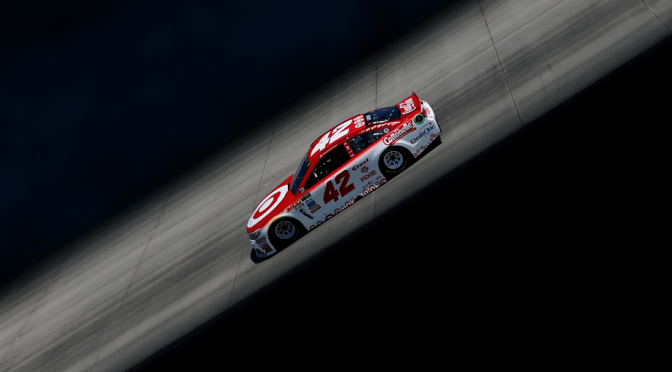
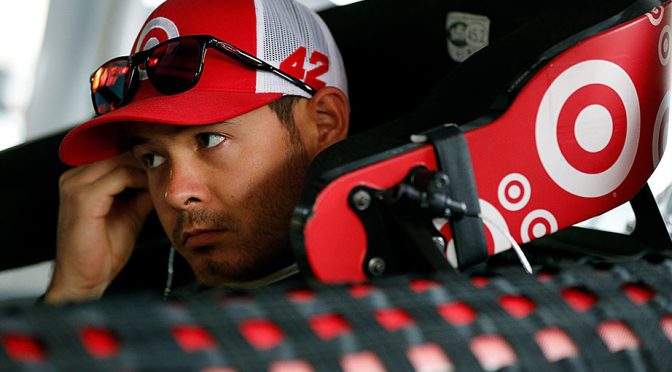
After two full seasons of seasoning with Brad Keselowski Racing, Reddick will split seat time with Kyle Larson this season in the No. 42 NASCAR XFINITY Series entry fielded by Chip Ganassi Racing with Felix Sabates.


BBR Music Group will provide sponsorship for multiple races with Reddick.


His first scheduled start with the team will be the season-opening Powershares QQQ 300 at Daytona International Speedway (3:30 p.m. ET, Feb. 25, FS1, MRN, SiriusXM NASCAR Radio.)


"A full-time schedule in the Truck Series is 23 races," Reddick told NASCAR.com. "The partial (XFINITY) schedule will be 18-20, so when you think about that … and add up all the laps, you’re probably going to get more seat time than you would running a full-time truck schedule, you’ll probably have more tires for practice. So actually I’m probably going to get about the same or maybe a little more seat time than I did running full time in the Truck Series. That’s still a lot of great opportunities to learn and get better and hopefully have some good runs with the team."


Reddick, 21, won three times in the Truck Series. He finished second in points in his first full season in 2015 with wins at Daytona and Dover. He added a victory at Las Vegas last year but slipped to ninth in points.

RELATED: See Reddick’s No. 42 look for 2017


"I could have worked out an opportunity to where I possibly could have remained at BKR one more year but there were definitely some other things going on and some other opportunities to be had," he said. "Fortunately, the right person kind of got us pointed in the right direction, got us talking with Chip’s people and got the ball rolling there. …


"We were just really fortunate that the guys with Ganassi wanted me to be in their vehicle."


Larson and Justin Marks shared driving duties last year for the No. 42 team, which will continue to be led by crew chief Mike Shiplett. Larson also drives the organization’s No. 42 Chevrolet in the Monster Energy NASCAR Cup Series; he picked up XFINITY Series wins at Pocono and Texas while Marks earned the victory at Mid-Ohio last year.


Ganassi also fields additional teams in the Monster Energy NASCAR Cup Series, with driver Jamie McMurray, and the XFINITY Series, with Brennan Poole.


It’s that depth and talent, Reddick said, that makes running a partial schedule just as attractive as running full time elsewhere.


"There are a lot of really good people in the shop and on the road that are within Chip Ganassi in the XFINITY and on the Cup side," he said. "Whether it be a partial schedule with this team or someone different — the advantage with this team is they have Cup cars, they have XFINITY cars and they are more than a single-car team. There’s a lot of good people involved here.


"The other big gains from this are having someone like Kyle Larson that I’m sharing the car with. Being able to go to the race track and when I’m outside the vehicle, being able to take in a different perspective just from afar."


It’s a similar situation to his move into the Truck Series, when he initially ran a partial schedule for Keselowski in 2014 and shared seat time with the owner/driver as well as fellow racer Joey Logano.


"I got to learn a lot just from those guys," Reddick said. "Sitting outside and watching them work with the guys … seeing how they worked with them, how they go about their race, what their race plan is and how they communicate with one another. You wouldn’t think it would do much but it really helps to get things moving in the right direction. I thought it really helped me on my first year."


It’s not the first time Reddick and Larson’s paths have crossed. Both grew up in California — Reddick hails from Corning, while Larson is a native of Elk Grove — and the two often competed in the same events. Larson eventually migrated to Sprint cars while Reddick, at his family’s urging, chose the dirt late model route.


"My family was scared to death of Sprint cars and scared I was going to get hurt so we decided to go dirt late model racing," he said. "That’s where our backgrounds split. But where we learned how to race and drive was pretty much the same — in those early outlaw cars.


"So similar backgrounds; obviously we took two different paths there toward the end but somehow we’ve ended back up in the same place."


Although he will only run between 18 and 20 races with the team this season, Reddick expects to be competitive. The No. 42 entry finished seventh in the owners’ championship a year ago and Reddick said that’s a team goal from the outset.


As for his goals, Reddick said he hopes to step in and compete for top-five finishes out of the box.


"Top 10s would be great but I know this team is capable of that with anybody in the car. I want to get these guys top fives right off the bat," he said. "They are capable of it and I have to do my part. I know this team has won races with Kyle and Justin."


A win, he said, would be "very reasonable."


"I’m not just trying to say ‘Oh yeah, I can win a race’ or come across as being boastful or … arrogant," he said. "That’s how good this team is — they’re very capable of that and I’m not going to sell it short. They won multiple times last year.


"If I do my part and don’t make any mistakes throughout the course of a race, that’s something that’s very reasonable that we can accomplish. No pressure, right? I just have to do my part and be smart about it."

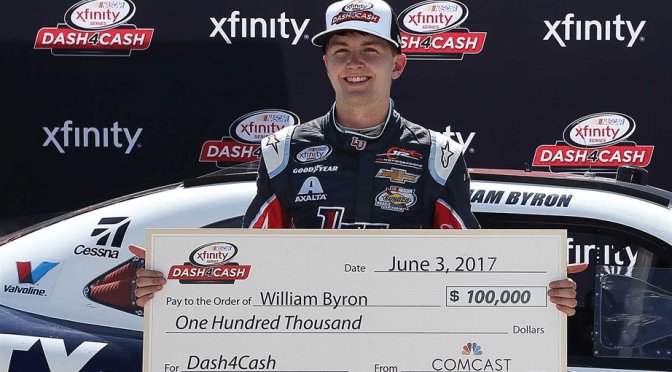
The NASCAR XFINITY Series Dash 4 Cash has an updated format for 2017 with the implementation of stages in each race of the series’ 33-event circuit. Stage 1 and Stage 2 will determine which four drivers are eligible in the main race for the Dash 4 Cash prize, and a $100,000 check for each event.

Plus, $600,000 would be awarded to a driver who wins all four Dash 4 Cash bonuses, making the total possible winnings $1 million this year.

MORE: Fast facts: How the stages work

Get a summary of the four Dash 4 Cash races below and see who took home the Dash 4 Cash prize in each race.

THE RACES
Phoenix Raceway (March 18) | Race recap
 | Photos
Bristol Motor Speedway (April 22)
 | Race recap | Photos
Richmond International Raceway (April 29) | Race recap | Photos
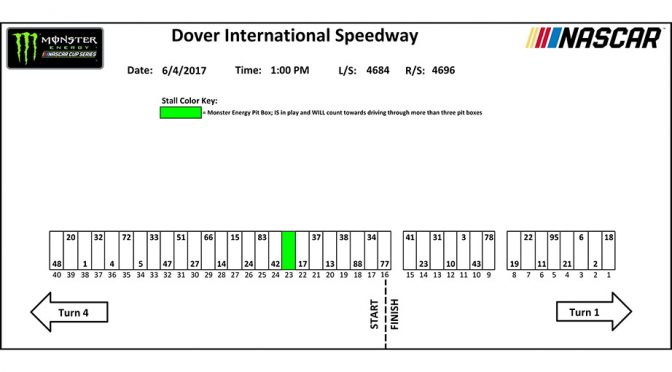
Dover International Speedway (June 3) | Race recap | Photos

RACE FORMATS
Coors Light Pole Qualifying will determine the starting positions for the race.

The field will then begin the race with Stage 1, followed by Stage 2 and the Final Stage.

Phoenix Raceway is new to the four-race Dash 4 Cash schedule this year, replacing Indianapolis Motor Speedway as a designated event.

Based on the participation guidelines announced last year, drivers with more than five years of full-time experience are restricted from the four races in the Dash 4 Cash program.

DASH 4 CASH ELIGIBILITY

The top-two finishing NASCAR XFINITY Series points-earning drivers in each of the two stages will make up the four-driver Dash 4 Cash field for the Final Stage. Once Stage 1 is complete, the two drivers who lock into the main field won’t have their position counted following Stage 2 to ensure a four-driver field.

The highest finisher in the final stage among the four eligible drivers wins the Dash 4 Cash and a $100,000 prize.

PLAYOFF ELIGIBILITY

If a driver earns two Dash 4 Cash wins (not race wins) over the four Dash 4 Cash races, that is equivalent to a regular-season race win for XFINITY Series postseason eligibility.

CONCORD, N.C. — Repairing damaged vehicles during a NASCAR race sometimes is as common a sight as pit stops, restarts and checkered flags.


But the extent to which teams can make repairs will be more tightly policed beginning with the 2017 season.


NASCAR officials unveiled a new Damaged Vehicle Policy on Wednesday at the sanctioning body’s Research & Development Center, a policy that will be enforced in all three national series — Monster Energy NASCAR Cup Series, XFINITY Series and Camping World Truck Series.


Under the guidelines, teams no longer will be allowed to replace damaged body parts that are the result of accidents or contact. Repairs, such as fixing damaged sheet metal, will be allowed; however, teams will be given five minutes to fix damage once they enter pit road. If the damage requires the car to go behind pit wall or to the garage for repairs, the car will not be allowed to return to the race. Also, if the repairs take longer than the five minutes allowed, the car will not be permitted to return to the race.


Once repairs have been made, a car is still required to maintain the minimum speed determined for that event. Once that has been accomplished, the five-minute clock is reset in case the car needs to come back down pit road.


Previously, teams were allowed to replace any damaged panels or parts with no time limit and no penalty. Quarter panels, splitters, hoods and deck lids damaged in accidents were often removed and replaced. Some repairs were completed on pit road; more extensive damage often meant a trip to the garage. Each time, the driver was sent back out onto the track as quickly as possible.


That will no longer be the case.


“We have a lot of cars that are going back on the track that end up in 38th position, for instance, that probably don’t need to be out there from a safety and competition aspect,” Scott Miller, NASCAR senior vice president of competition, told NASCAR.com, “because they always tend to bring out more yellows with stuff falling off.”


Heavily damaged cars that need extensive repairs that can’t be done on pit road, Miller said, “are essentially going to be out of the race.


“There will be many circumstances and many things happen and you will continue to see it where cars are in wrecks and never go to the garage area. They come down pit road, they work on things … and they go back out and make minimum speed. They continue to work on the car as the race goes on. That will still completely be in play.”


Miller said the move is to help officials, who didn’t often see what goes on in the garage but can better observe repairs on pit road.


Miller has worked “on the other side of the fence” as a crew chief and is aware of the hurried atmosphere surrounding a car undergoing significant repairs in the garage.


“I’ve been involved in crash repairs and that’s not a great situation down there in the garage with 20 people running around, oil leaking on the floor, things catching on fire and sharp sheet metal being cut off,” he said. “It’s a fairly unsafe situation. And at times it would be unsafe really for the driver to get back in a car that was damaged that heavily. There’s nothing that doesn’t come with some downside, but I think there is a lot of upside to where we are going with this.”


Safety is a crucial component of the policy, and for any vehicle undergoing repairs, the integrity of the safety systems “must be maintained.”


Teams will be allowed to correct mechanical or electrical failures that aren’t the result of an accident or contact without penalty. Such repairs may be done on pit road or in the garage area, and the five-minute clock will not be in play in those instances.


“We’re not going to tell a guy who breaks his transmission at Watkins Glen or Pocono, for instance, and coasts into the garage area that he’s out,” Miller said. “Because that doesn’t create an unsafe situation; that is a mechanical failure.


“It’s more about crashed vehicles and all that is involved with that, from the crew guys to the drivers to dropping more debris on the track, which always happens. … So there are exceptions for mechanical failures, those things can be rectified in the garage. That’s going to be up to the series director’s discretion to make those calls, but it’s not going to be that difficult.”


There will be modifications to at least two pit-road penalties under the policy for those making repairs. Any driver receiving a pit-road speeding penalty (entry or exit) will lose 15 seconds from the five-minute clock. Any team sending too many men over the wall will result in that car being removed from the race.


“Speeding comes with an additional penalty because speeding in or out is a way to circumvent the clock,” Miller said.


When a car is damaged and repairs are made on pit road, teams know they will be at the tail end of the longest line, so extra men often go over the wall. (Each team is allowed six to work on the car and one to service the driver and/or windshield.)


“That’s another thing we discussed with the teams and internally,” he said. “Too many men over the wall is also defeating the purpose of the policy; it would encourage teams to bring extra people well-versed in going over the wall to repair cars. So too many men over the wall just has to signal the end of that car’s day.”


What will race fans see with the new policy? It’s what they won’t see, Miller said, that is behind the change.


“What they won’t see is stuff we don’t like to see, cars running around out there with stuff flying off,” he said. “We don’t like that because it creates yellows, it creates debris for other cars to run over, it creates a dangerous situation. That’s what they won’t see. What they will see are quality cars on the race track racing one another.”


The 2017 NASCAR season gets underway Feb. 24-26 with all three national series competing at Daytona International Speedway. The Daytona 500, the season’s first Monster Energy NASCAR Cup Series points race of the year, is scheduled for Sunday, Feb. 26 (2 p.m. ET, FOX, MRN, SiriusXM NASCAR Radio).