Editor’s Note: This story was initially published on NASCAR.com in 2016 to coincide with the 15th anniversary of NASCAR’s first race back after 9/11.
The first NASCAR race after the terrorist attacks of 9/11 is one of the most memorable days in the history of the sport. The MBNA Cal Ripken Jr. 400 — held Sept. 23, 2001, at Dover International Speedway — was remarkable for the outpouring of emotion and patriotism before and after the event.
And yes, the fact the race was won by Dale Earnhardt Jr. — the sport’s favorite son who still was mourning the death of his father seven months before — put an exclamation point at the end of a day that already had been written in all caps.
The events leading up to Dale Jr.’s victory lap with a giant American flag flying out his window — from the postponement of the New Hampshire race scheduled for Sept. 16, 2001, to the purchase of 150,000 American flags for fans at Dover to unprecedented fear and security before the race — constitute one of the more unbelievable sequence of events in NASCAR.
1. A nation in shock: ‘Nobody felt like racing’
MIKE HELTON, then the president of NASCAR, now the vice chairman: I was in Daytona in my office. My office has three TV monitors, and I’m constantly watching weather, sports and news. The first part of it was the shock of what was unfolding.
JEFF BURTON, then a driver, now an analyst on NBC: I had taken my daughter to school and run to Roush Racing, who I was driving for at the time. I was listening to the radio about it. I left there and went home to meet with a contractor. We were signing a contract to build a new house. We signed the papers to build a new house after we watched the towers fall. I got a call from my financial adviser telling me not to do that. I said, “If everybody thinks like that, we’ll be in trouble.” I signed the papers. I don’t know what the right word is, but it was my own way of saying, we’ll go on.
STEVE LETARTE, then a mechanic on Jeff Gordon’s team, which won the championship that year, now an analyst on NBC: We didn’t have TVs in the race shop. I remember going out into the hauler that was parked outside and had a satellite dish. Very little stops the movement in a race shop. But for a certain period of time, there was a group of us crowded into the lounge (of the hauler) watching this unfold on TV in disbelief that it was real.
HELTON: Late in the day on Tuesday (Sept. 11), questions started running through our minds. How do you go on after today? The logistics were probably the first conscientious thought of, without airline traffic, (driving) from North Carolina practically through D.C. and skirting New York to get to New Hampshire, what’s that travel going to be like? We got on the phone with Bob Bahre and Gary Bahre, who owned New Hampshire at the time. They basically said, whatever you all decide, we’ll go along with it.
It was myself and Bill France (Jr.), Jim France, Brian France. We talked to several drivers. We got a lot of varying inputs from that. We watched the climate from other groups. That time of year, you were just getting into football. Baseball was still playing. We were racing. College football was just firing up.
BURTON: I was adamant that we go race. I felt that the country needed to move forward. I knew it was too early for the healing process to begin. But I thought it was in our country’s best interest to have a race, to let people focus on something else for a few hours, to get people’s minds off of it, to do something people love doing. I thought it wasn’t necessarily in the sport’s best interest, but in the psyche of the country’s best interest.
I did not realize that in doing so, it would have been difficult for all the services that needed to go to New York. My mind wasn’t complex enough to realize that if we were there, we would be taking away resources as regards to safety personnel, EMS, fire, police, all the things it takes to put on an event that big. Once I understood that, I said, that is more important than (racing).
LETARTE: I didn’t want to leave home. None of my co-workers wanted to leave home.
RICKY CRAVEN, then a driver, now an analyst on ESPN: Frankly, we didn’t have any choice. I don’t think we had any good options, period. Across the board, all my friends, my colleagues, guys I drove against, crew members, nobody felt like racing.
HELTON: I think that was, for the most part, the consensus. As Tuesday unfolded, everybody was in such overwhelming shock that the industry just didn’t feel like it could or should be racing. (But) we were talking five days before (the race). We were trying to look at what the climate would be like on Saturday or Sunday. We even talked about could we shorten up the weekend, and do something just on Sunday, or just on Saturday and Sunday? But as we talked through it, it was, no, this is such an overwhelming set of circumstances that even five days from now, the right thing to do is to not participate.

Dale Earnhardt Jr. and the red, white and blue? It doesn’t get any more American than that.
2. NASCAR connections to the attacks: ‘If he had to go, that’s the way he wanted to go — the big job’
As news of the attack unfolded, NASCAR officials tried to find out if anybody in the industry was hurt or killed, a daunting task considering the dearth of information, the collapse of cell phone communications and how spread out the sport was. Some NASCAR officials had remained in Richmond, Virginia, following the previous race, and others worked at various locations across the country, including at a test in Kansas. At the time, no links were found. But connections between NASCAR and the tragedy have emerged in the time since.
DENIS McGLYNN, then (and now) president of Dover International Speedway: My brother spent a lot of time in New York City. He was in the South Tower when all of this was going on, he and his business partner. When the first tower got hit, the alarms went off saying, evacuate. The South Tower that he was in, the PA came on and said everything was OK, they didn’t need to evacuate.
Everybody was still crowding to get into an elevator. He kind of got pushed in. His partner said, “I’m going to go back and get my computer.” The door shut. When (my brother) got down to the ground level and was exiting, the second plane hit the South Tower right above him and killed his partner.
RON THIEL, then Jeff Gordon’s spotter, now vice president for operations for Hotchkiss Sports Suspension: Long Island is where I grew up for 35 years of my life. I had a body shop on Long Island that I could see the skyline if I stood on the roof. That whole happening struck close to home. We had a few of our friends who lost family members in the towers who were New York City firemen. A friend of mine had an older brother who was killed.
DOUG BAWEL, then co-owner of Jasper Motorsports, now owner of Jasper Engines and Transmissions in Indiana: I was due in the Pentagon that night. I was to work all day (at the team’s shop) and that night I was having dinner with John Jumper, who was the Air Force chief of staff and a four-star general at the Pentagon. John made it (out), and the other people I knew there made it. I could have been there. Who knows what could have happened?
AL NELSON, then a truck driver for FitzBradshaw Racing, now drives AJ Allmendinger’s hauler: I was a fireman for 25 years up on Long Island with my brother and father. My younger brother, Peter, was in Rescue 4 (of the New York City Fire Department).
I tried calling, I tried calling, I tried calling. Can’t get through. We were all trying to call up there. The next night, I came home and said, “Dad, I think we better go up there. I don’t think this is very good. We can’t get ahold of anybody, we can’t talk to anybody.”
So we went. Somebody got through to my older brother and said that they found (Peter), that he lost his leg, but he’s OK. He’s alive. We went to bed that night thinking that was the worst. (But that was wrong). I had people in the hospitals. I had doctors. I had EMTs, there’s quite a network of people that work in my volunteer fire department that knew a lot of people and things going on. We couldn’t find (Peter).
We raced in Phoenix (five weeks later). The race was over. I’m getting ready to head home. I talked to my wife. She said they found him. They found his whole company. They were all together, right next to an elevator shaft, which is where they teach them to go in a collapse. They were all right there. But they were all dead.
I grew up with that kid. We’re two years apart. We grew up in the same bedroom. We played with the same group of kids. We played softball, we played football, we played everything together. He was a great kid to grow up with. I don’t know if this is how I justify it, or look at it, but if he had to go, that’s the way he wanted to go — the big job. He’s always been the first guy in, last guy out kind of guy.
BURTON: Jimmy Makar (then a crew chief for Bobby Labonte) knew some people in the (fire) department, so we went up (to New York City) to visit the fire house and the police station. Bobby Labonte, myself and Jimmy Makar went to (Ground Zero) with no media, no anything.
We were in this fire station. Osama Bin Laden was on the television. They were showing pictures of him. There was a fireman in there cooking. He started screaming at the TV, furious. He kind of demanded that we go see the site. He said people don’t realize. People don’t understand. TV doesn’t show it. We go to the site. That guy was right. TV didn’t do it justice. It was bigger, worse, every adjective you can imagine, it was worse than what TV showed.
I walked into a doughnut store, and I swear to God, it was like time stood still. The clock was stopped on the wall. There were inches of dust in the building. There were coffee cups with coffee in them, plates with doughnuts on them, half eaten food in this doughnut shop in the corner of this building.
One of the regrets of my life is not having images that I can share with people. You had no idea how big it was until you stepped foot on it. I stood there and cried.

Steve Cochran secured 150,000 American flags for the Dover race. He still has some in his basement to this day. | Photo courtesy of Steve Cochran
3. How to buy 150,000 U.S. flags and have them delivered in a week. ‘That’s a lot of flags’
MBNA was the sponsor for the race at Dover. Marketing officials there knew they had to do something special for the event. Meanwhile, virtually all NASCAR teams added patriotic elements to their paint schemes, and some teams completely overhauled their designs — no small task in less than two weeks.
BAWEL: We’ve always had close connections with the military. Over 10 percent of our workforce are veterans. So when this happened, we viewed it as a full-fledged attack against our country. We wanted to show a symbolic stance. The primary sponsors were Federal Mogul and Jasper Engine and Transmission. We called both of them and said, We’d like to make our car totally to deal with the 9/11. They were very, very supportive of (putting “Forever in our Hearts/United We Stand” on the car.)
DAVE ELGENA, then a senior executive vice president at MBNA, now retired: I had the responsibility for all of our racing sponsorships in NASCAR and the NHRA. When we came back to work (Sept. 12), we sat down and said we need to do something different. The race was originally designated as the Cal Ripken 400. Obviously that was long before 9/11. It was honoring (Baltimore Orioles shortstop) Cal Ripken because he was retiring. We obviously can’t change the (name of the) race. But what can we do?
We wanted to have flags for every single person in the stands. We didn’t want those little tiny flags we were seeing everywhere. And we wanted them to be made in America. A gentleman who worked for me by the name of Steve Cochran, one of my marketing guys, went to the Naval Academy. I said, “Steve, this is a good one for you. We need you to find 145,000 flags, made in America, and we need to have them here the Wednesday before the race so we have them to hand them out.”
STEVE COCHRAN, then senior vice president, director of Motorsports Marketing for MBNA, now the associate vice president for affinity sales at Nationwide Insurance. (Cochran also was a Navy helicopter pilot who flew search and rescue missions from 1984-1993.): I made a bunch of phone calls to flag manufacturers and finally landed on the American Legion. I said, “Hey, do you have any American flags? And we’re not looking for the little ones, the 3-inch ones. We’re looking for the 8 by 12, or whatever they come in, the bigger ones.” She said, “Well, I’ve got a line of people out front here who are buying them.”
I said “No, no, no, no. How many do you have in your warehouse?” At this point, she’s a little skeptical. She said, “probably about 75,000.” I said, “Can I buy them all off you?”
She thought maybe I was a crank call. … I asked her, “Where do you get your flags? I need 75,000 more.” She told me about this company out in California. (I called them) and I said, “Here’s what I’m looking for, and I have to have them delivered by this particular date. I know it’s a quick turnaround, but I need them all. I need what you got.”
(They) said, “Well, I think we’ve got about 80 thou—,” I said, “I’ll take 75,000.” They were shipped. We had them stationed at all the entrances, the walkups to the track, where people walked in to get their seats.
ELGENA: I’m sure Steve spent endless hours on the phone getting that lined up. I remember him coming to me just a few days later and saying, “We’re good. We got them.” They’re all made in America, they’re all going to be 8 by 10, and we got, whatever it was, 50, 60 big flags (one was given to each race team). That was a pretty exciting moment that he had accomplished that.

American flags were in full display at Dover, both in the stands and on the track.
4. Fear of another attack. ‘Should we be here?’
Dover had about 140,000 seats then, and the race was the largest gathering of Americans after the attacks. For Dover, NASCAR and law enforcement officials, that caused fear and anxiety. If terrorists wanted to launch another attack, the race track seemed like an easy target. Adding to the trepidation was Dover’s geographic location. It is close to an Air Force base as well as Pennsylvania, New York and Washington, D.C. — the sites of the three terrorist attacks.
McGLYNN: Mike Helton called and said, “You’re going to be the first race back on the schedule.” That started a whole chain of activity and coordination between our ops group and all the law enforcement agencies. There were a variety of agencies here. The FBI was here. ATF was here. Secret Service was here.
JERRY DUNNING (whom McGlynn credits for working with the law enforcement agencies and with handling the minutiae of the day), then and now senior vice president of operations at Dover: There’s 130,000 people coming, and they can’t bring their coolers. They’re going to need a lot of liquid — water and alcohol and whatever else, soda. So we beefed up trying to supply a lot more products with additional sales locations to try to accommodate that. We probably tried to do 400 percent over what we originally would have done. We sold out of water. We did not sell out of soda or beer.
Our cooler checkers became spotters for just about anything and everything that might be suspicious. There were people looking for everything. The same old saying still stays true today. If you see something that doesn’t look right, you have to say something. We used that slogan throughout the weekend, and we continue to use it.
HELTON: There’s an awareness that started that day for the rest of us. We’ve been in that mode ever since, quite frankly. But the first time out, at Dover, in that very historic part of our country which seemed to be on the (terrorists’) radar, the democracy in that area that seemed to be on the radar, and the number of people that would be in the grandstands — my gosh, if you were looking for a big crowd, here it is.
BURTON: There was a major fear. There was a major safety concern. There was a major security concern. There was a lot of fear of, hey, should we be here? Everybody was (nervous). I can remember having a conversation with my wife. “Is it in your best interest to go? Should you stay home?” She went.
CRAVEN: It felt good to get back. It wasn’t perfect, obviously, for anyone. I remember the security was uncomfortable and a bit invasive, even as a driver, to have to go through security to get into the garage area. That’s really unusual and uncomfortable. Being in the race car was very therapeutic. As a driver, you’re back in your comfort zone.
5. Race morning. ‘Electric would be an understatement’
Security was tight. Tensions were high. But as the drop of the green flag approached, a remarkable change washed over Dover’s grandstands, infield and starting grid. The fear and anxiety everybody had lived with for 12 days gave way to patriotism and pride.

Even 15 years later, those involved in the post-9/11 Dover race remember things down to the finite details — including the way the grandstands roared.
DALE EARNHARDT JR., then driver of the No. 8 for Dale Earnhardt Inc., now driver of the No. 88 for Hendrick Motorsports: There was a lot of emotion and everyone in the crowd was angry and proud, so there was a lot of energy of “This is my country, I’m not going to let this just go by.” So there was a lot of red, white and blue everywhere and a real sense of everybody coming together. It’s events like that that really bring all that patriotism to the surface where it’s so visible and vocal. You could see that in the grandstands, especially during the national anthem and it just gave you chills.
BURTON: I will never forget Sunday morning of Dover, pre-race. The place was freaking rocking. There were so many people banging on the bleachers you wondered, are these damn bleachers going to hold up to this?
McGLYNN: That was when trepidation turned into … what’s a good word for it? Maybe unity. Pride in the country. All the way from the hotel at the end of the backstretch in Turn 3, all the way around to Turn 4, all the way up the frontstretch, Turn 1, all the way into Turn 2, down to the beginning of the backstretch, there was nothing but American flags. People started chanting, “USA, USA.” It just never stopped. They were doing the wave. At that point, it became really, really emotional. Even now, 15 years later, I can still feel that. Emotional is the only way I can put it. Electric would be an understatement.
That’s how Americans are. It’s in our DNA. We’re going to suffer and bemoan things. But then we’re going to come back and start kicking ass.
ELGENA (crying softly): It was a building crescendo, with probably the defining moment being when all those flags were being waved constantly through all the introduction. And then the prayer and the national anthem and the speakers. It was really unbelievable.
HELTON: I’ve always thought “God Bless the U.S.A.” does such a remarkable job of telling the American story. If you want to go back to a race track, and you want that event to be a healing event, and resurrect what we’re doing, but more importantly pay tribute to the mood and the sympathy and the sentiment that developed after 9/11, how do you do all that? Lee Greenwood just simply came to mind, that him and that song would be very appropriate for that moment.
LEE GREENWOOD, then and now, a country music star who has performed at dozens of NASCAR races: I’m (taking) this personally because I’m an American. I feel hurt by the attack on America. I’m angry and emotional about the loss of so many. … My heart is hurt. My heart is breaking.
I just sort of gritted my teeth and said, I will get through this, I will not tear up, I’m going to sing this for everybody who is listening to give pride back to everybody in America.
I was determined to not forget a lyric, to sing it as people would expect it, without a lot of tricks. I wanted to make sure I sang it very straight, no variations. All I wanted them to think about was America and the red, white and blue, and I got through it as straight as I possibly could.
BAWEL: You not only had goosebumps. You had tears in your eyes. I can remember it like it was yesterday, and look how many years it’s been. You looked up there, and you knew, as a country, we’re going to be OK.
CAL RIPKEN JR., then the third baseman for the Balitmore Orioles, now a member of the Baseball Hall of Fame and a TV analyst: There was an overwhelming feeling of patriotism from the start. One hundred forty thousand U.S. flags being waved and loud, sustained chants of U-S-A, U-S-A. It gave us chills. The start of the race was a whole other experience that I never had before. They put me in the crow’s nest to start the race by waving the flag and encouraged me to stay out there for a lap. The sheer power of the cars was amazing and you’re hanging over the track as they thunder past and rubber from the tires pelts your face. It’s something I will never forget.
EARNHARDT JR.: The race starts, and it’s a race. We were glad to be back at work. I think it was the complete opposite of the week before where we sort of shut down. In Dover, it was like, “We need to get back to racing, people need to be here and see something and have something to smile about.” It was good to be back at work and it felt right.

In a moment Mike Helton said NASCAR couldn’t script any better if it tried, Dale Earnhardt Jr. won that historic 2001 race.
6. A post-race like no other. ‘Loud and proud and a uniquely American moment’
The sport was still reeling from Dale Earnhardt’s death in the Daytona 500. Earnhardt Jr.’s win in July in the NASCAR’s first race back at Daytona was one of the most popular wins in the history of the sport and was seen as therapeutic across the industry. When Earnhardt Jr. took the checkered flag at Dover, an already incredibly emotional day became iconic.
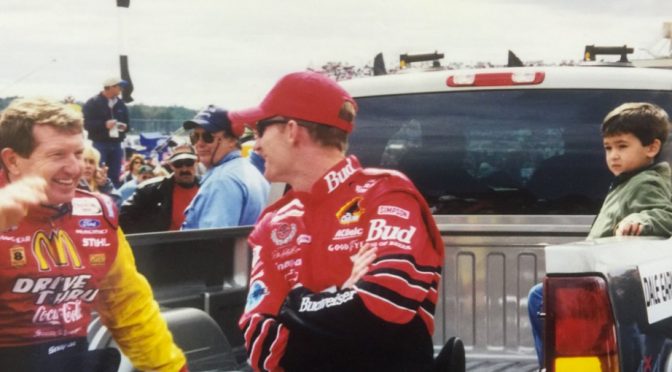
McGLYNN: The impact was magnified 100 fold by his team running out and giving him that big, giant American flag, which has sort of become an iconic photo. That, combined with being in Junior’s car, and I’m sure the Budweiser guys were going (expletive) crazy. He does the Polish victory lap with the flag hanging out the window. That’s what made it special.
EARNHARDT JR.: We had a great car and we’re not sitting there thinking “Man if we win, let’s have this American flag ready.” We weren’t that confident or arrogant. But we won the race and I was out there doing burnouts and one of the guys on the crew said “We’ve got this flag back here, hold on and we’ll bring it to you.” And he stuck it in the window and I was like, “Dang, this is a really big flag, I hope I can hold onto this thing because it’s not supposed to touch the ground.” And so I’m jamming it in there somehow and I’m hanging onto this thing, and I’m driving around the track trying not to go too fast and have it ripped out of my hand. Whoever won that race would’ve done something to show the patriotism that all of the sport felt at that particular time, so we just got to be the lucky guys that got to represent the sport in that very brief moment.
RIPKEN JR.: The entire experience gave me a great understanding not only of what NASCAR is all about and the incredible skill of the drivers but also how passionate the fans are. That experience was the culmination of an incredible final few months of my playing career and one that I am grateful for.
ELGENA: Once it was all done, we all just kind of sat in the infield where we had our headquarters. That’s all we talked about was the excitement of the day, how great of a job everybody did, how proud everybody was. It was a pretty emotional moment, a very proud moment for us as a team.
COCHRAN: Fans were coming out of the race. They saw my MBNA shirt. They said, “Thanks for the flags.” I remember keeping a box that was left over. There were probably over 200 flags, and when I lived in Delaware I would walk around my small neighborhood and put a flag in front of everyone’s mailbox on July 4th.
McGLYNN: It wasn’t until the checkered flag dropped on Sunday and people were getting out of here that we could take a deep breath and say, OK, we got through that one. I experienced every single emotion possible in that 10-day period. After 44 years (at Dover), if anybody asks me what was the first thing you’ll remember about your career there, the first thing is the post-9/11 weekend.
HELTON: I don’t necessarily remember the last 100 laps or 50 laps. But I do remember the end of it with Dale Jr. winning. I think one of the reasons I remember Dale Jr. winning is because of the other things that happened in 2001. After the Daytona 500, Junior comes back and wins the Coke Zero 400, which was therapeutic in its own way for other reasons.
So when he took the checkered flag at Dover, after coming back from 9/11, that day was very emotional for everyone in the garage area, everybody in the grandstands, everybody, everywhere, I’m assuming. I felt like, Wow, here’s Dale Jr. who is carrying so much on his back and shoulders in 2001, and now, to have him win this race … We get accused all the time of writing scripts and figuring out how races should end and who should win them and so forth and so on, which is ridiculous. But that day, for him to win and carry that American flag, it just seemed a bit ironic, a bit poetic, a bit romantic, a bit, just, everything you could attach an emotion to.
It seemed like he was instrumental in a lot of therapeutic moments in 2001, for our industry. For him to win that day, if we could script it, I don’t know if we would have scripted it much different.