RELATED: Full race results | Series standings | Chase Grid
Breaking down the full field for the Hollywood Casino 400 at Kansas Speedway.
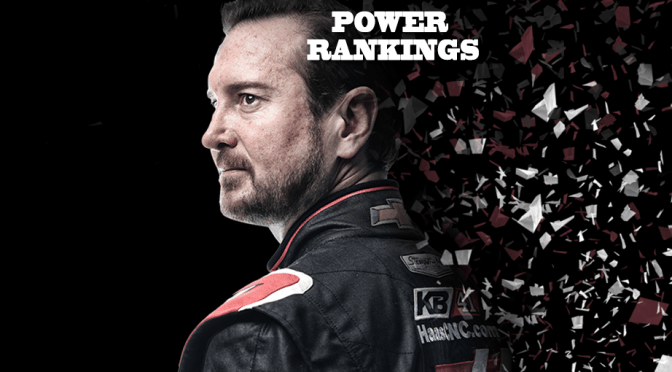
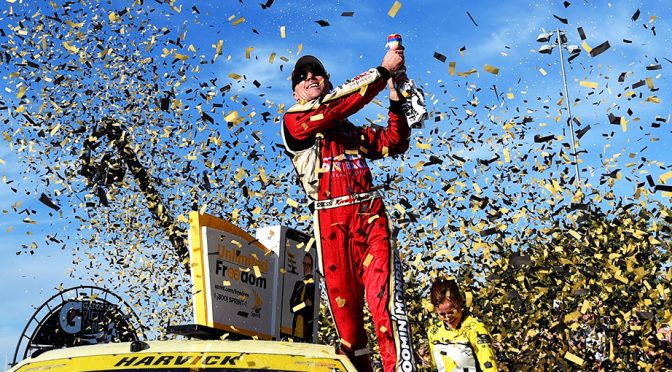
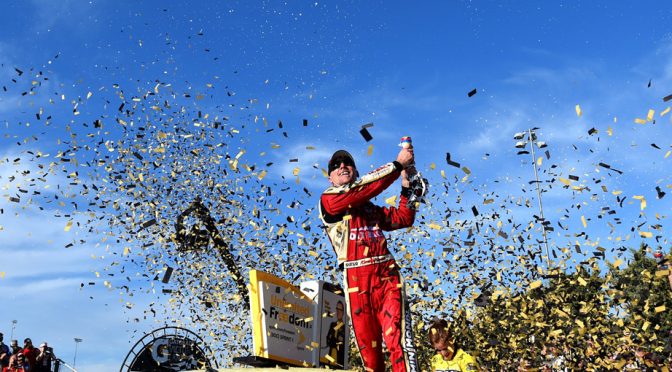
1. Kevin Harvick, No. 4 Chevrolet, Stewart-Haas Racing. As we said after Harvick’s win three weeks ago at New Hampshire: Fear the 4. Grade: A+
2. Carl Edwards, No. 19 Toyota, Joe Gibbs Racing. Hard To Believe Fact No. 1: This was Edwards’ first top five in the second half of the season. He had seven, including two wins, in the first 18 races. Grade: A
3. Joey Logano, No. 22 Ford, Team Penske. Logano bounced back nicely after his 36th-place finish at Charlotte. Grade: A
4. Jimmie Johnson, No. 48 Chevrolet, Hendrick Motorsports. Hard To Believe Fact No. 2: Johnson’s finish gave him back-to-back top-five finishes for only the second time this season (Races 2 and 3). Grade: A
5. Kyle Busch, No. 18 Toyota, Joe Gibbs Racing. Feel free to ask Busch about having the longest active top-10 streak at six races. Just don’t ask him about how it went racing against teammate Carl Edwards during Sunday’s final green-flag run. Grade: A
RELATED: ‘Rowdy’: That’s racing, I guess
6. Austin Dillon, No. 3 Chevrolet, Richard Childress Racing. The No. 3 team’s two-tire call resulted in a huge wreck on a late restart last week at Charlotte. Not so this week, and Dillon grabbed his second top 10 in the past three races. Grade: A
7. Alex Bowman, No. 88 Chevrolet, Hendrick Motorsports. Dale who? (Just kidding.) Bowman posted the best finish of his career (77 starts) and second top 10 in six starts in place of Dale Earnhardt Jr. Grade: A
8. AJ Allmendinger, No. 47 Chevrolet, JTG Daugherty Racing. Not even a pit-road speeding penalty could hold back Allmendinger, who turned in his sixth top 10 of the season, his most since a career-high 10 in 2011. Grade: A
9. Matt Kenseth, No. 20 Toyota, Joe Gibbs Racing. Kenseth led a race-high 116 laps, all in the first 125 laps. But his car wasn’t the same after he hit the wall on Lap 137, a move that made Kenseth feel “dumb and disappointed” after the race. Keep your chin up, Matt: You’re heading into Talladega second in the standings and 29 points above the Chase cut line. Grade: A
10. Kasey Kahne, No. 5 Chevrolet, Hendrick Motorsports. Kahne continues to churn out top 10s. His sixth top 10 in the past seven races gives him a 7.8 average finish in that stretch, the fourth best in that seven-race span. Grade: A
11. Martin Truex Jr., No. 78 Toyota, Furniture Row Racing. Truex’s 400th Cup start was an adventure because of fueling issues and repeated problems with a right-rear tire rub. Despite all that, he finished just outside the top 10. If Truex survives Talladega, a duel with Kevin Harvick for the title could be epic. Grade: B
12. Ryan Newman, No. 31 Chevrolet, Richard Childress Racing. Newman closed out his big week — RCR and Newman agreed to a multiyear extension early in the week — with a solid finish. Grade: B
13. Kurt Busch, No. 41 Chevrolet, Stewart-Haas Racing. Busch had to start in the rear of the field (backup car) but held his ground in the Chase standings (fifth place). Grade: B
14. Ryan Blaney, No. 21 Ford, Wood Brothers Racing. Blaney’s run of top-10 finishes at Kansas ends at two. Grade: B
15. Denny Hamlin, No. 11 Toyota, Joe Gibbs Racing. Hamlin fell two spots in the Chase standings to 10th, but it could have been much worse. He had major problems early with his splitter and then ran into the back of Brad Keselowski on Lap 190 that spelled the end of his chances for a top-10 finish. Grade: B
16. Tony Stewart, No. 14 Chevrolet, Stewart-Haas Racing. Stewart finished 12th and 16th in his final races at Kansas, his best combined finishes at the track since he finished 13th and fifth in 2012. Grade: B
17. Trevor Bayne, No. 6 Ford, Roush Fenway Racing. Bayne ran 15 laps in the top 15 Sunday. And you’re probably thinking, “So?” In the previous four races, he turned a total of six laps in the top 15. Grade: B-
18. Danica Patrick, No. 10 Chevrolet, Stewart-Haas Racing. Patrick followed up last week’s season-best 11th with another top-20 finish, marking the third time this season she has posted back-to-back top-20 finishes. Grade: B-
19. Ricky Stenhouse Jr., No. 17 Ford, Roush Fenway Racing. Stenhouse’s average finish this season is 19.1, and he nailed it Sunday. Grade: B-
20. Paul Menard, No. 27 Chevrolet, Richard Childress Racing. Menard’s career average finish is 22.7, and he nearly nailed it Sunday. Grade: C
21. Chris Buescher, No. 34 Ford, Front Row Motorsports. The nailing stops with Buescher. However, he finished in the top 25 for the third consecutive race, a first for the rookie. Grade: B-
22. Michael McDowell, No. 95 Chevrolet, Circle Sport-Leavine Family. McDowell posted his best finish at Kansas in 11 starts. His previous best was 28th in the May race. Grade: B
23. Casey Mears, No. 13 Chevrolet, Germain Racing. Mears led five laps during green-flag pit stops, topping his totals in each of the past two seasons — four laps in 2015 and four in 2014. The last time Mears led more laps in a race was the fall race at Talladega in 2012 (10 laps). Grade: C+
24. Matt DiBenedetto, No. 83 Toyota, BK Racing. When you’re a small fish in a big pond, you take your triumphs where you can find them. DiBenedetto’s finishes in his past six starts: 37th, 30th, 28th, 27th, 25th, 24th. And his five consecutive top-30 finishes extends his personal best. Grade: B
25. Greg Biffle, No. 16 Ford, Roush Fenway Racing. Then there’s Biffle and RFR, once among the biggest of fishes. Unless Biffle closes out the season strong, 2016 will go down as his worst in 15 seasons (14 full time). Grade: C-
26. Clint Bowyer, No. 15 Chevrolet, HScott Motorsports. Bowyer didn’t have the showing he would have preferred at his home track –unlike Missourian Carl Edwards, Bowyer is actually from Kansas (Emporia). Wait ’til next year. Grade: C-
27. Landon Cassill, No. 38 Ford, Front Row Motorsports. Cassill fell one lap short of finishing on the lead lap. He has eight lead-lap finishes this season, one short of his personal best set last season. Grade: C
28. Brian Scott, No. 44 Ford, Richard Petty Motorsports. Scott had two pit-road speeding penalties and was a factor in the wreck on Lap 36 that claimed teammate Aric Almirola. Not the best of days. Grade: C-
29. Regan Smith, No. 7 Chevrolet, Tommy Baldwin Racing. Smith had to start in the rear of the field for a transmission change and later brought out the eighth caution when he hit the wall. Grade: C-
30. Kyle Larson, No. 42 Chevrolet, Chip Ganassi Racing. Larson brought out the fifth caution when he hit the wall on Lap 177 and went on to post his worst finish in more than five months — since crashing out of the May race at Kansas (35th). Grade: D
31. Chase Elliott, No. 24 Chevrolet, Hendrick Motorsports. Elliott was running with the leaders until tire problems struck on Lap 175. It was all downhill from there. The rest of the race featured more tire rubs and multiple meetings with the wall. He is last in the Chase standings and needs a lot to go his way at Talladega to advance to the next round. Grade: D
32. Michael Annett, No. 46 Chevrolet, HScott Motorsports. Annett finished three laps off the pace, his fewest from a lead-lap finish since he completed 137 of 138 laps of the rain-shortened Pocono race in August. Grade: D
33. Cole Whitt, No. 55 Chevrolet, Premium Motorsports. Driving the No. 55 for the first time since the 15th race of the season (at Michigan, also named for a casino), Whitt finished five laps back. No word if Whitt ran to a roulette wheel at Hollywood Casino behind Turn 2 and placed a tower of chips on the No. 5 before heading home. Grade: D
34. Reed Sorenson, No. 98 Chevrolet, Premium Motorsports. Sunday’s race marked the third time this season — all in the past four races — teammates Sorenson and Cole Whitt have finished next to each other. Grade: D
35. Joey Gase, No. 32 Ford, GO FAS Racing. Gase finished seven laps back in his fifth start of the season. Grade: D
36. David Ragan, No. 23 Toyota, BK Racing. When Aric Almirola slowed as he approached teammate Brian Scott, Ragan ran into the back of Almirola. Despite major damage, the No. 23 was able to return to the track and complete all but nine laps. Grade: C-
37. Jamie McMurray, No. 1 Chevrolet, Chip Ganassi Racing. Contact with Alex Bowman resulted in a flat tire and the No. 1 hitting the wall. That brought out the third caution and began a frustrating day for the No. 1 team. Grade: D
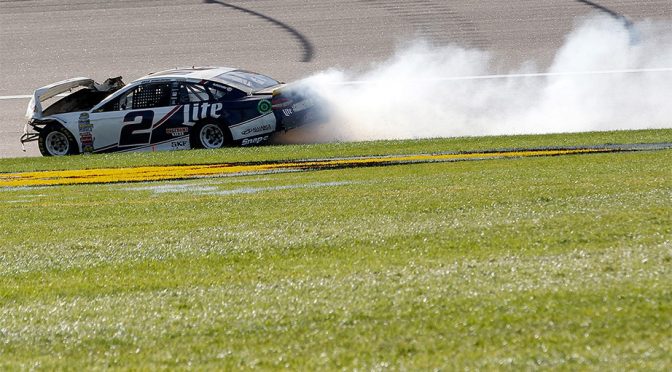
38. Brad Keselowski , No. 2 Ford, Team Penske. Speaking of frustrating days … Keselowski got loose on Lap 190 and drifted high and right into the path of Denny Hamlin, who sent the No. 2 for a damaging spin into the grass. Keselowski also brought out the seventh caution on Lap 221 when his car started smoking soon after he returned to the track. He dropped to 11th in the Chase standings. Buoying the team’s hopes to advance is that Keselowski has four wins at Talladega. Grade: F
39. Josh Wise, No. 30 Chevrolet, The Motorsports Group. Wise took the No. 30 straight to the garage after he brought out the fourth caution when he hit the wall on Lap 116. Grade: F
40. Aric Almirola, No. 43 Ford, Richard Petty Motorsports. When Almirola was unable to slip under teammate Brian Scott and checked up, David Ragan hit the No. 43 from behind. Almirola’s 36 laps completed are his fourth fewest in 210 Sprint Cup starts. Grade: F