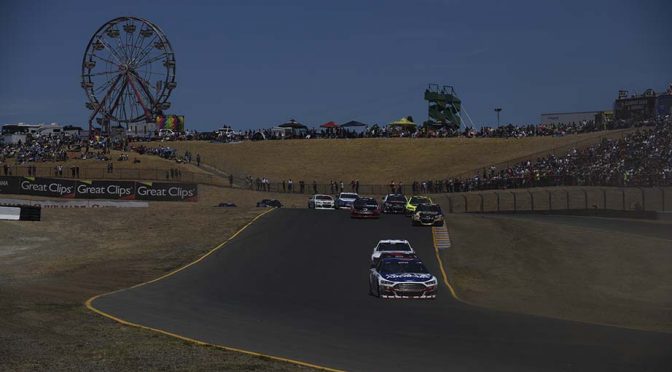
Let’s rewind the clocks back to February 2015. Speedweeks was kicking off at Daytona International Speedway and NASCAR’s plan for the Pit Road Officiating (PRO) system had been unveiled shortly before that. No pressure for a new system to make its debut on the sport’s biggest stage, right?
What ensued was an innovative setup that passed with flying colors and earned largely favorable reviews. Nearly a year and a half later, the system is still going strong, and the use of technology has made one of the most chaotic and frantic times during a race — occurring multiple times during an event — a safer, more consistent place.
The PRO system uses anywhere from 40-50 cameras, with the total number at each track dependent on the layout of the venue. Those cameras feed video of every pit stop to a central hub located in a track’s TV compound.
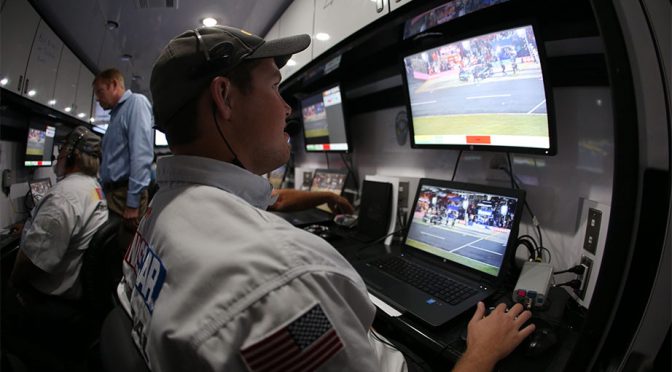
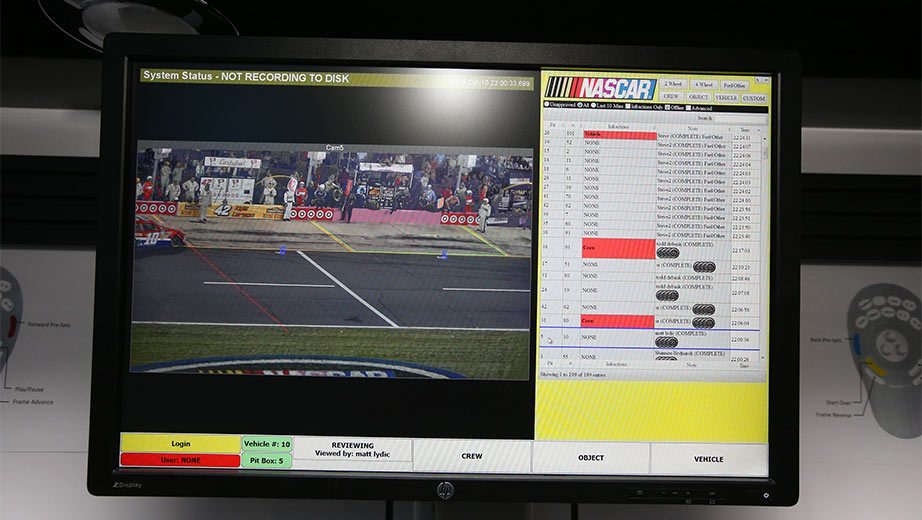
Should a violation or suspected violation occur, the system flags the stop for an official to review immediately. Eight officials inside the PRO Trailer review the footage, reporting violations to the race control tower and logging pertinent information from each stop, such as how many tires were changed or what adjustments were made.
At present, the system is only in place for the NASCAR Sprint Cup Series and companion events. When the Sprint Cup Series was off on Father’s Day weekend, however, the system was at the NASCAR XFINITY Series-NASCAR Camping World Truck Series doubleheader at Iowa Speedway, according to a NASCAR spokesperson.
Last month, NASCAR.com spent part of the NASCAR XFINITY Series Hisense 4K TV 300 at Charlotte Motor Speedway in the PRO Trailer to get a firsthand look at the system and officials in action.
INSIDE THE SETUP
Before a race begins, the cameras and mounts have to be set up at the track. This work typically takes place Wednesday afternoon, when the materials arrive on site. The cameras are put in place, pointing at pit road.
On a typical weekend that culminates in a Sunday race, calibration of the cameras and any necessary tweaks are done Thursday. A check is done Friday, and there typically are races Saturday and Sunday. Two cameras are assigned to a server in the trailer, meaning that if one server fails, the system only loses half of a pit box since each pit box has two cameras pointing to it.
So how does the system read the pit box so well and accurately?
“The system has a wire-line model of the pit road,” Andy Hitchcock, an engineer for the PRO Trailer, told NASCAR.com. “It’s impossible to go and take a real, live camera up there and point it at the exact way that the wire-line model is. So the wire-line model is adjustable so that you can grab a point on the wire-line and actually drag it to the corners of the pit box so that it really does line up. Otherwise, the system doesn’t work because the wire-line has to match the exact image.”
Wind and crowd noise can cause the cameras to move and shake, but the system can recognize fixed objects such as pit walls and banners, which help smooth out the image that is being fed back to the trailer for a steady view.
At the end of a race weekend, everything gets taken down off the roof, the IT infrastructure gets packed up and loaded underneath the PRO Trailer as the circuit heads to its next stop.
MAKING THE CALL ON A RACE DAY
The PRO Trailer’s main activity doesn’t begin until cars come down pit road for service. In the Hisense 4K TV 300, a rash of cautions early in the race made that a frequent occurrence.
When a driver comes down pit road, a bell-like sound alerts officials in the trailer. The officiating system monitors the stop and flags it if a possible violation occurs. That moves the footage to the top of the queue for immediate review, where officials must make a determination. In some cases, the trailer officials overturn violations that the system flags.
Pit road infractions fall into three groups: Vehicle (i.e. pitting outside pit box, driving through too many pit boxes), equipment (i.e. uncontrolled tire, removing gas can from the pit box) and crew (i.e. too many crewmembers over the wall, crewmembers over the wall too soon).
Five cautions occurred in the first 64 laps of the Hisense 4K TV 300, meaning nearly all of the field was on pit road at some point in the opening one-third of the race.
The first in-race violation came at Lap 16 when Dakoda Armstrong was penalized for a crewmember going over the wall too soon. That is a common violation that gets called several times in a race, but also is one that accounts for human interpretation. Officials will consult with each other on judgment calls that are not clearly black and white, like a crewmember’s position as the car is coming to pit.
“I tell the PRO Trailer officials that if you are the crew chief and you are over my shoulder and I’m looking at the penalty, when you look at it you’ve got to be able to say ‘God, you’re right.’ If you look at it and say, ‘See look at that,’ it should be a tie,” Chad Little, NASCAR managing director, technical inspection/officiating told NASCAR.com at Charlotte Motor Speedway.
Little further explained how officials are instructed to rule from the trailer.
“The rules are applied to each team on a more level playing field, but it’s also proof. So it’s more fair for everyone,” Little said. “We constantly remind the officials that tie goes to the runner. The way the analytics work out there, the system (shows) you potentially have a penalty right here. You look at that video and look at it from all different angles and you can either say, ‘No, we shouldn’t do this one — it’s a ‘tie goes to the runner’ or ‘Yes, it’s a penalty.’ That’s the official’s choice.”
Trevor Bayne, who drives the No. 6 Roush Fenway Racing Ford in the NASCAR Sprint Cup Series, said he thinks the visual proof is helpful, but he also understands NASCAR is a hard sport to officiate.
“It’s better when you have real data and visual, videos and stuff to watch and say, ‘OK, we actually did do that. We can’t argue that,’ ” Bayne told NASCAR.com last month. “NASCAR is a tough sport to officiate. There’s no timeout to say, ‘Hey, wait a second, we want to see if we did speed on pit road under green or if we did lose a tire and need a penalty’ or whatever.”
Back to Charlotte, an incident on Lap 25 involving Elliott Sadler, Daniel Suarez and Erik Jones prompted a wave of activity on pit road. The cars involved were issued several penalties, including pitting before pit road is open and too many crewmembers in contact with the pit service area. Those are common penalties for cars coming to fix damage under a caution flag.
When violations are found, crew chiefs get the penalty footage in close to real time, but have a short wait for footage of every one of their stops.
“On Monday after the races are over, (crew chiefs) are able to look at all of their pit stops,” Little said. “During the race, just because of the amount of fiber it takes to see stuff, they only see the penalties. It’s almost real time. It will be after the stop is over, it’s not that real. But it’s almost real time they will get to see the penalty.”
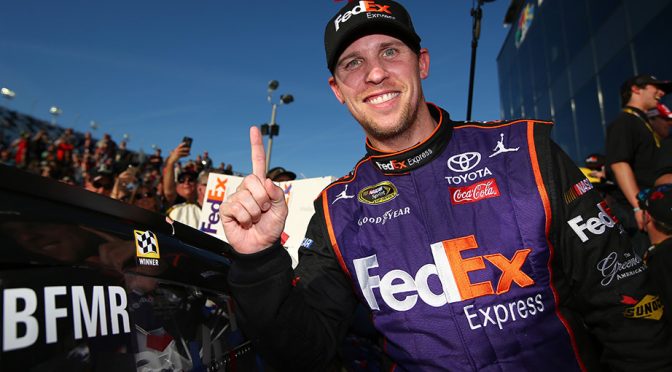
The eventual race-winning team, Denny Hamlin and the No. 18 Joe Gibbs Racing Toyota group, had to recover from an uncontrolled tire penalty on Lap 160. All told, there were 37 infractions on pit road in the race, the second-highest total of the season in the XFINITY Series.
MEASURING THE IMPACT
In just over a year, Little has seen the impact of the PRO Trailer.
“Obviously, safety is a big concern,” Little said. “We’ve made our pit road officials safer by taking them off of pit road. We’ve increased the level of parity as far as how we apply the rules to all the teams. That’s an important part of it. Thirdly, we’ve been able to fine-tune a lot of the pit road rules because of the analytics. So those three things are big things.”
Nothing is perfect, but the PRO system has seen its share of success — and who knows what the future may hold.
“It’s still subjective, but there’s less subjectivity,” Little said. “It’s no different than other sports — football, basketball, baseball. They do reviews now. … We have the luxury of looking at it, got to make a quick decision, but we try to be more fair.”