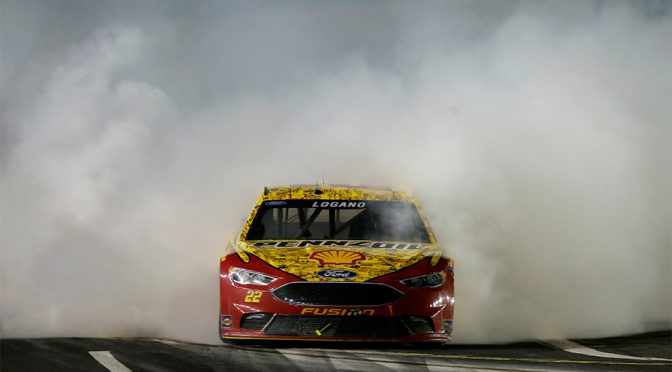
If you’re into motorsports and racing, chances are you’ve at least attempted to do a burnout before. It’s hard, right?


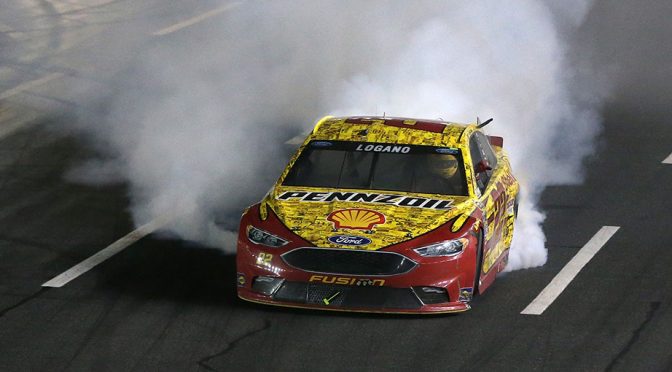
Joey Logano makes it look easy.


The above video came from the moments after the Team Penske driver locked up his first career Sprint All-Star Race win — along with a cool, $1 million prize.

It’s unquestionably the most unique one we’ve seen thus far in 2016 — certainly the longest, both in time and distance — and it’s starting to sink in that Logano is quickly earning himself the title of NASCAR’s master of burnouts.

“I’m just kind of a fan of (burnouts),” Logano told NASCAR.com on Wednesday afternoon. “I like watching other people and I just think it’s fun, you know? It’s a cool thing to do. Everyone has their own celebration and lately I’ve been doing these really fast donuts down the front stretch, that’s kind of been my thing here lately. … They carry some distance, that’s for sure.

“Everyone kind of has their own way to do different things and you think of some drivers like Kyle Larson, he took the steering wheel out one time while he was doing it. Everyone has their own thing and their own technique to how they do it so it’s kind of funny.”

The art of the burnout is one that drivers take seriously.

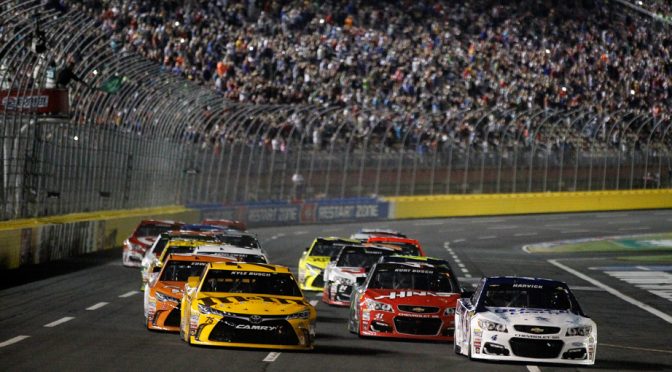
Riding the wave of adrenaline from taking the checkered flag, especially after a beat-and-bang-type finish to hold off Kyle Larson like we saw in last Saturday’s race at Charlotte Motor Speedway that trickled into the wee hours of Sunday morning, the situation is kind of a pressure-filled one, given that a driver suddenly finds him or herself thrust into the spotlight to put on one final performance for the fans.

Luckily for Logano, he’s had 14 times to perfect the craft at the Sprint Cup Series level (11 of which have come in the 2014-2015 seasons alone).

“Most of the practicing is pretty much after you win. I do screw around a lot and do burnouts (on my own), but a lot of times when you can do burnouts with someone else’s car, it makes it a lot more fun and a lot less expensive for me,” Logano joked. “Especially after a race and you’ve already got the good out of the car. It doesn’t really matter anymore, so it makes it a lot of fun to be able to burn them up.”


With the exception of last Saturday’s exhibition win, Logano hasn’t had much of an opportunity to get in his burnout reps thus far in 2016, still looking for wins at both the Cup and NASCAR XFINITY Series levels.

Chalk him up as a favorite in Sunday’s Coca-Cola 600 (6 p.m. ET, FOX, PRN, SIRIUS XM NASCAR Radio) at Charlotte Motor Speedway, however, where he’s the most recent winner and has an average finish of 9.6, the highest among active Sprint Cup drivers.

And if Logano lands in Victory Lane once again, expect him to up his game on the way there.

“I think you can always make (the burnouts) better,” he said. “It’s funny, every time I win, I’ve gotten a little bit more gutsy with it. It hasn’t gotten me in trouble yet, but I feel like I’m kind of on the edge of getting me in trouble. It’s fun. The fans like to see that and it’s something exciting for the driver to do as well. I’ve always enjoyed doing stuff like that.”

And for his next “big” trick — a burnout all the way around the .533-mile Bristol Motor Speedway later this season, perhaps?

“Yes, it is possible. It’s something that’d be very hard to do, though,” said Logano, who celebrated a birthday on Tuesday. “I actually tried to do that at Bristol but I blew the rear tires out around the corner before I actually made it around. Once the tires are blown out, it’s kind of the end. There’s a fine line of how much tire you wear out, so it’s kind of hard to do that.”

While it sounds like the 26-year-old still has plenty of tricks up his sleeve, don’t expect any acrobatics, a la Carl Edwards.

“I’m not doing any backflips,” said Logano. “No backflips for me.”

“I would just rather burn the tires off it.”

Photo credit: Charlotte Motor Speedway

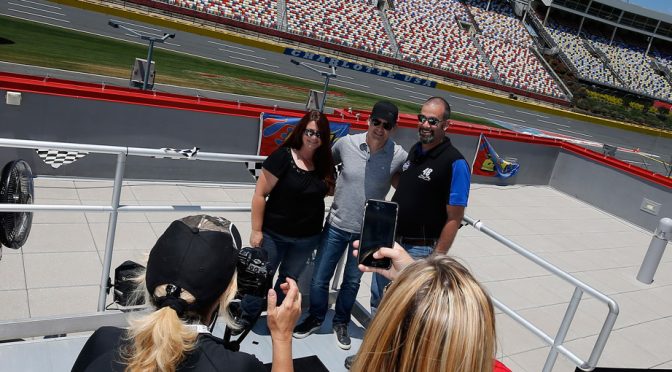
CONCORD, N.C. – With its close proximity to race shops, Charlotte Motor Speedway is known as the home track for most of the NASCAR community. But Tuesday’s gathering at the 1.5-mile speedway had more of a tourist feel, as fans hailed from places near and far.


There was the man from Bakersfield, California, – “Harvick country,” he states proudly – the fan from Switzerland, the Canadian couple and everyone in between. They wore different numbers on their shirts and spoke with different accents, but they were all there to see one man.


Mr. Jeff Gordon.


The FOX Sports analyst and four-time NASCAR champion helped celebrate the 10 Days of NASCAR Thunder leading up to Sunday’s Coca-Cola 600 (6 p.m. ET, FOX, PRN, SiriusXM NASCAR Radio) by taking photos with 100 Charlotte ticketholders. Despite Gordon’s retirement following his championship run last season, the fandom was as feverous as ever, as each visitor itched to exchange a few words with the former No. 24 driver.


“It’s slightly different (now) because many of them say a lot of the same things, ‘I wish you were out there,’ (or) ‘I miss you being out there,'” Gordon said of the fans. “But I’m getting a lot of great comments about being up in the booth, so it’s nice. I’m enjoying myself, so I think it comes across in the broadcast and interacting with the fans, I get to hear that from them as well.”


Gordon and the fans stood on the roof of the infield’s Champion’s Pavilion, the spot providing the group a birds-eye view of the quad oval. The track is impressive; a feeling Gordon reciprocates, as he recalls the first time he laid eyes on it.


“I think it doesn’t mean the same to everybody,” Gordon said, “but for me, the very first time I ever came to North Carolina … when I drove by this facility, I was blown away. I’d seen Indianapolis Motor Speedway, but beyond that, I’d never seen anything that looked like this. Just the appearance of it put me in awe.”


Gordon found success at Charlotte early in his career, earning a runner-up result in his first race at the North Carolina track in 1993. And on Sunday, he’ll broadcast his first Coca-Cola 600; 22 years after he earned his first-ever win in the Cup Series in the ’94 running of the 600-mile event. The win put Gordon on the racing map and made folks wonder about this young “kid” from California who was driving nose-to-nose with Dale Earnhardt.


RELATED: See all the winners of the longest race in NASCAR

But Gordon’s love affair with Charlotte began before the Victory Lane celebration.


“When I drove a stock car here for the first time, I just fell in love with it,” Gordon said. “I love the way the track flows, the banking, the grip level, bumps and everything that comes along with it.  And of course, winning my first race, having it happen in the 600.”


The longest race on the Cup circuit, the Coca-Cola 600 has long been revered as one of NASCAR’s biggest races – one of the sport’s “Majors,” as Gordon says.


“Daytona, here, Brickyard, maybe a Southern 500, some would also say Talladega.” Gordon said, rattling off a list of stock car racing’s biggest events. “But this is a big, big deal to win this race. To me, it’s probably second or third ranking in our series as far as most prestigious events.”


Winning the coveted Coca-Cola 600 trophy is no easy feat – the man who has won three of those races can tell you that. With the cars being more advanced today and eliminating some of the physical aspect, Gordon emphasizes the continued need for mental toughness.


“You’re talking about a minimum of four hours being in the car,” Gordon said. “Pit crews, crew chiefs, everyone’s on edge, not just the drivers … (They’re) pushing the limits every single lap, which is not the way it used to be. You used to pace yourself and be able to manage the tires and your car and you could still be competitive at the end of the day – if you were in one piece.


“That’s not the case anymore – it’s just all out. So, that mentally drains you by pushing that hard for that period of time.”

RELATED: Gordon embraces new career with ‘contagious’ energy

The task of taming a 600-mile monster is daunting, especially for younger drivers. Gordon’s No. 24 replacement Chase Elliott will attempt the feat, as he prepares to make his second Coca-Cola 600 start. Elliott, now in his rookie season, started 28th and finished 18th in the 2015 Coca-Cola 600, then driving the No. 25 for Hendrick Motorsports.


As for any advice from the former boss of the No. 24? Gordon said his 20-year-old successor doesn’t need it.


“I haven’t had to give him much advice on the race track,” Gordon said. “He’s a natural … He gets better every weekend.


“I’m excited for that 24 team. I had to defend a lot with fans being upset about them keeping the No. 24 and I said, ‘Just wait, just wait, I think you’re going to be proud of the results.’ And now, I’m starting to see everybody’s now saying, ‘What a great replacement for the 24!’ “


Gordon’s statement was validated by fans sporting Elliott-themed shirts earlier, one young boy in particular wearing a blue No. 24 NAPA hat. This fan will likely grow up knowing Elliott — rather than Gordon — as the driver of the legendary No. 24 Chevrolet.


It’s a mark of a racing transition, a generational shift. And Gordon loves it.


“Listen, I love seeing the sport grow,” he said. “I’m still heavily involved in the sport, not just from the FOX side, but from Hendrick Motorsports. And I think the sport is amazing right now. The racing is as good as it’s ever been. We have some great young talents. Not to mention veterans that are doing great things … I’m all for bringing new fans and seeing fans get excited about it, people like Chase or Ryan Blaney or Kyle Larson.


“I support it 100 percent.”

One NASCAR Camping World Truck Series team was issued a P3 penalty coming out of the weekend’s race at Charlotte Motor Speedway, and a second was given a written warning, according to Tuesday’s penalty release via NASCAR.


No penalties or warnings were issued to NASCAR Sprint Cup Series teams.


The No. 30 Truck Series team, which had Jesse Little as its driver over the weekend, had infractions found during opening-day inspection related to throttle body shafts. Examples of a possible violation, according to the NASCAR Rule Book, are meeting a minimum combined thickness of 0.197 inches or ensuring that the shafts seal, to prevent air leakage.


The team was also penalized for having an engine ancillary component that did not meet the NASCAR rules, according to the penalty report. The truck did not make the race after qualifying was rained out.


Crew chief Mark Rette was fined $5,000 for the infractions.


Additionally, the No. 41 team of Ben Rhodes was issued a written warning. Its truck trailing arms did not meet specifications on opening-day inspection.


Also on Tuesday’s penalty report: Crew member Kelly Johnson has been suspended indefinitely for violating the sanctioning body’s substance abuse policy.

https://www.nascar.com/drivers/kyle-busch/
0
Joe Gibbs Racing

Busch just barely managed to finish in the top 10, but did make it out in front of the pack for 15 laps. With zero wins and plenty of near-misses at Charlotte, expect him to race hungrily for 600 miles.

Harvick finished just behind the reigning champ. He has two wins in the 600, and there’s no reason to think he won’t be a force again in NASCAR’s longest race.

GALLERY: All the 600 winners

Edwards overcame a lot to rally for a top-five finish, a typical M.O. for the No. 19 team in 2016. And hey, he’s going to be on a videogame cover!


MORE: Edwards earns NASCAR Heat cover

Busch kept the momentum going at Charlotte, landing his seventh-straight top-10 finish (exhibition race or otherwise).

https://www.nascar.com/drivers/brad-keselowski/
1
Team Penske

Think there’s any chance Joey Logano splits some of his $1 mllion earnings with his Team Penske teammate, who finished second? Probably not, but a runner-up performance with an altered rules package is a solid consolation prize.

Care to guess who won the most recent points-paying race at Charlotte? Hint: he’s $1 million richer after this weekend.


MORE: Logano wins Sprint All-Star Race

https://www.nascar.com/drivers/jimmie-johnson/
-3
Hendrick Motorsports

After a forgettable All-Star Race performance, perhaps Johnson should focus on imitating the six-time champ that he is.


MORE: Johnson does driver impressions

Kenseth couldn’t win on back-to-back weeks, wrecking with Tony Stewart in the second segment. Still, his race wasn’t going too well before that, having been penalized.


MORE: Stewart, Kenseth collide

https://www.nascar.com/drivers/dale-earnhardt-jr/
1
Hendrick Motorsports

Junior has been vocal about his team’s (lack of) performance of late, so a third-place All-Star finish could mean big gains moving forward.


MORE: Dale Jr. looks to carry success to 600

Now that Matt Kenseth’s team has shedded its skin as the "snake-bitten team," that onus may fall on the No. 78 squad and Truex Jr.

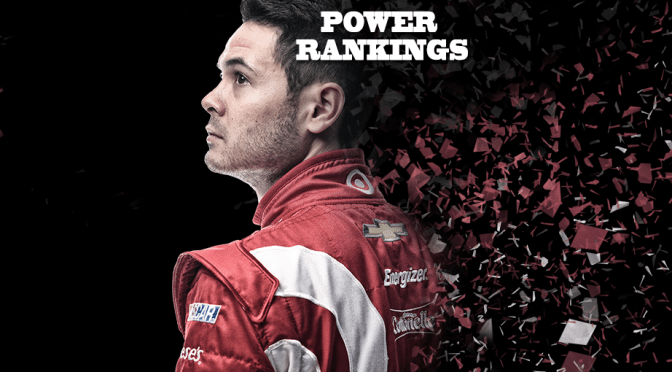
The past two weekends have belonged to Larson, despite not landing in Victory Lane. The breakout is upon us.


MORE: Hard luck, near-win for Larson

https://www.nascar.com/drivers/chase-elliott/
-1
Hendrick Motorsports

Apart from coming up short to Kyle Larson in the Sprint Showdown, Elliott didn’t do a whole lot to impress on Saturday. But hey, he won the Sprint Fan Vote.


MORE: Elliott wins Sprint Fan Vote

https://www.nascar.com/drivers/denny-hamlin/
-1
Joe Gibbs Racing

Hamlin was unable to win back-to-back All-Star Races, but his 10 top-10 finishes in the past 11 points-paying races at Charlotte should be enough to help him sleep throughout the week.

https://www.nascar.com/drivers/austin-dillon/
-1
Richard Childress Racing

After failing to make the All-Star Race, look for Dillon to come back next Sunday with a vengeance — and possibly even pick up his first Cup win.

Like Austin Dillon, expect Blaney to come out in the Coca-Cola 600 guns-a-blazin’ after failing to make the Sprint All-Star Race. The No. 21 team should have good info after running both Charlotte races with the young driver last year.

Kahne had the bad luck of getting caught up in the Kenseth/Stewart wreck. He does have a career-high four wins at Charlotte, however, and could get back on track on Sunday.

McMurray doesn’t have many tracks at which he’s typically considered to be among the players going in, but Charlotte (two wins, seven top-fives) is certainly one of them.

Newman doesn’t always win poles, but when he does, he prefers them to come at Charlotte Motor Speedway (career-high nine).

https://www.nascar.com/drivers/ricky-stenhouse-jr/
0
Roush Fenway Racing

Stenhouse Jr. had to watch the All-Star Race from the sidelines, while his girlfriend and two teammates both raced in the 20-car field. He’ll be itching to get on track Sunday.

Allmendinger didn’t make the big race this past weekend, but did have back-to-back top-10s at Charlotte once … in 2011.


The 2014 season finale at Homestead-Miami Speedway was one of the most anticipated races in NASCAR history, the culmination of the sport’s widely anticipated new Chase for the NASCAR Sprint Cup format. Already that year, the Chase had been the wildest in history, with drivers fighting after races at Charlotte and Texas, and Ryan Newman wrecking Kyle Larson on the last lap at Phoenix to bully his way into the four-driver finale.


The final race pitted Kevin Harvick against Newman, Joey Logano and Denny Hamlin in the first-ever, best-finisher-wins-the-Sprint-Cup format. Harvick had already had the most dominant season of his career and set personal records in poles, laps led and earnings — all of which would be diminished, if not forgotten, if he didn’t win the championship. He was the favorite, but in a high-stakes, one-race, do-or-die format, nobody knew what to expect, Harvick included.


Leading up to the race, he examined problems that could crop up and strived to eliminate as many of them as he could. He thought back to the season finale the year before. His son, Keelan, was 1 1/2 at the time and had cried all night long. It’s hard enough to sleep in a house with a racket like that. In the 40-foot motorhome in which Harvick sleeps at the race track, it was impossible. Harvick got, at most, two hours of sleep that night. He managed to overcome his exhaustion enough to finish 10th. But he knew that a sleep-deprived 10th wouldn’t be good enough to win the 2014 championship.


On the eve of the season finale in 2014, Keelan was 2 1/2 and thus less likely to spend the whole night crying, but Harvick took no chances. He rented a separate motorhome for Keelan to sleep in and parked it near his own motorhome in the infield. If Keelan screamed for hours, Harvick would be oblivious. Harvick slept better that night than he had any other night that week, woke up refreshed, then won the race and the championship.

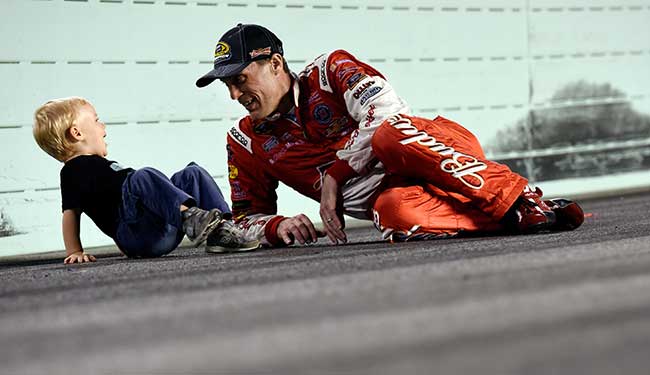
Kevin Harvick said sitting up near the wall and tossing rocks down the track with son Keelan hours after he won his first premier series title was one of the most memorable moments of his night.

There is irony in the fact Harvick made sure Keelan didn’t keep him from winning the championship because many NASCAR observers — including even Harvick himself — believe the arrival of Keelan helped Harvick get to that position in the first place.


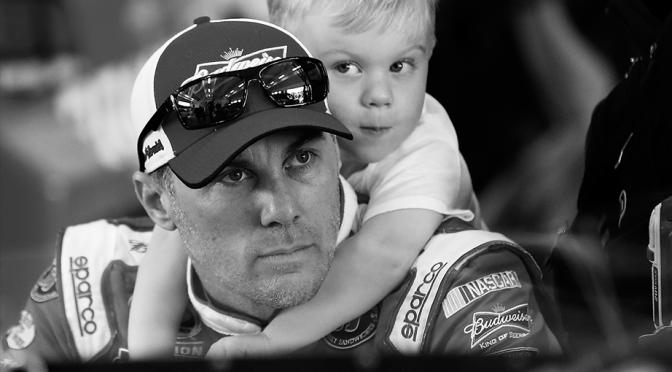
Because of Keelan, Harvick and his wife, DeLana, sold the race teams they owned, moved to Charlotte and dramatically simplified their lives, all so they could focus on being better parents. The upturned life has unleashed a calmer, cooler Harvick, one who is still fiery and competitive but less likely to lose his temper. The on-track results have been obvious. Keelan was born in Harvick’s 12th season, 2012. In the three full seasons since, Harvick has set or tied career bests in every major statistical category and has been the sport’s most dominant driver. He led more laps in those three seasons than he did in the previous 12 combined.


Of course, there is far more to Harvick’s emergence than the fact he’s a father now. His Stewart-Haas Racing Chevrolets are among the best in the sport, and his crew chief, Rodney Childers, is among the most respected leaders in the garage. But Harvick’s surge also sheds light on the issue of fatherhood and racing that has been front and center in NASCAR over the last nine years. Since 2007, 16 Sprint Cup drivers have become fathers while also racing full time. More than two dozen children have been born into NASCAR households during that span.


Every time a driver has a first child, questions about his performance start. Will he be able to manage his new life? Will the distractions of fatherhood slow him down?


Drivers are nothing if not great compartmentalists. They believe they can turn off the world when they turn on the engine. They believe the birth of a child can change every single solitary thing about their lives, except for what happens inside that 850-horsepower machine.


The statistics suggest otherwise.


‘Something that’s bigger than you’


We conducted an analysis of the results of 16 drivers whose wives or girlfriends gave birth to a driver’s first child in recent seasons, starting with Jeff Gordon (2007) and ending with Brad Keselowski (2015).


The average driver saw a decline in finish of 1.6 spots per race in the first six races after the birth of his first child relative to his average finish in the previous 10. Relative to his career average, the drop was 1.25. That’s enough to be the difference between making the Chase and missing it, advancing during the Chase and being eliminated, or winning the championship and losing it.


This is a touchy issue for drivers. None of them want to admit that becoming a father made him slow, even over a short time frame. Harvick was the only driver to acknowledge a direct connection between results and fatherhood. Most drivers said becoming a father made no difference in their performance, better or worse, short term or long. But former drivers, crew chiefs and team officials all say it does — and almost laugh at drivers who say otherwise, in an “of course it does!” way.


“It’s what I call the blind obvious,” says Darrell Waltrip, the analyst on FOX, three-time champion and father of two. Drivers are selfish creatures of habit, Waltrip says, and their every waking moment is focused on their careers. Then they become fathers, and making the car fast is no longer the most important thing in their lives.


“There’s no way you could be performing at peak, I don’t think,” says Marshall Carlson, the president of Hendrick Motorsports. “Right after having a baby, shoot, I was probably lucky to keep my job. My first baby, I was falling asleep all the time.”


A driver’s schedule usually centers on the driver only. When he becomes a father, it caters to a baby and his or her penchant for spitting up, crying and pooping whenever he or she pleases, and sleeping almost never.


Instead of thinking about changing tires, drivers are thinking about changing diapers. Instead of worrying about passing drivers, they’re worrying about pacifiers. That makes a difference, even if the driver himself is the only one who can’t see it.


“It is a major distraction, to be blunt and non-politically correct,” says Steve Letarte, who was Gordon’s crew chief in 2007 and now is an analyst on NBC (and father of two). “Having a child for anyone, in any professional career, is a distraction. Now it is a blessing, it’s the best part of most people’s lives, to have their children. But there’s no way, as a competitor, from a purely competitive standpoint, to not say it’s distracting.”


The most talked-about distraction is the hardest to prove — that a new dad will suffer from a creeping sense of mortality. Consumed with worry about orphaning his child, he will lift, even if ever so slightly, when he barrels three-wide into Turn 3.

Kevin and DeLana Harvick reordered their lives to be better parents to son Keelan.

There is research to support the idea that fatherhood mellows a man. A 19-year study by researchers at Oregon State and the University of Houston published in Journal of Marriage and Family found a marked decline in high-risk behavior by men after they become fathers.


Many drivers argue the opposite happens: The desire to win for the child, and make him or her proud, forces a driver to push himself harder. “You now have something that’s bigger than you, for which you want to win,” says former driver Jeff Burton, a father of two and now an analyst on NBC Sports. “When you race for something that’s bigger than you, I promise you, you do not bring less to the table.”


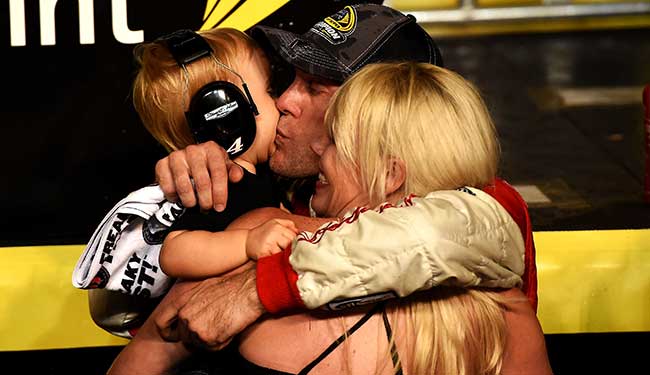
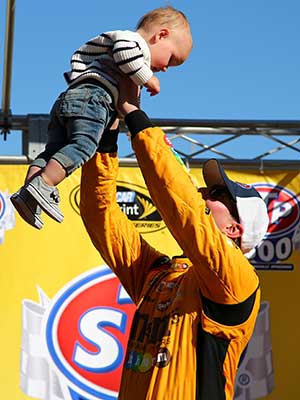
Burton loves to discuss this topic, loves to argue about it, and he insists that normal standards don’t apply to drivers. “There’s some sort of a switch — and I’m talking about the best race car drivers — that turns common sense off,” Burton says. “You don’t get in that race car on a Sunday afternoon thinking, ‘I’m going to get hurt.’ You get in that race car thinking, ‘I’m going to win this damn race, and when I do, I’m going to take a picture with me and my kids in Victory Lane.’ “


That’s a popular sentiment, one echoed by many drivers. But Victory Lane has proved elusive for new fathers. Of the 16 drivers in the analysis, only Kyle Busch won within the first 11 races after becoming a father, and he did it four times in nine races.


Before Gordon became a father in June of 2007, he had won four of the previous 10 races. He didn’t win again for 15 races. Denny Hamlin won five times in 2012. His daughter was born a month before the start of the 2013 season. Hamlin won only once that year — the final race of the season. His Joe Gibbs Racing teammates won a combined 11. Hamlin missed four races due to injury, and his average finish in 32 races that season was 21.0, the worst of his career by far. He said the baby had nothing to do with it. “It really doesn’t change anything,” he says. “When I’m in the car, I’m so focused on what I’m doing, there’s nothing outside that enters your mind.”


Championships have proven even harder to win than races for new dads. The worst seven-race stretch of six-time champion Jimmie Johnson‘s career started the week before his first child was born in July of 2010. After back-to-back wins, Johnson finished 31st, 25th, 22nd, 10th, 28th, 12th and 35th for an average finish of 23.3. His average finish in the other 29 races that season: 9.5.


Johnson recovered from that worst-ever stretch, as is the hallmark of his career, and he won his fifth straight championship. In doing so, he became the first driver in the modern era (dating to 1972) to win a championship in the same year he became a father.

Hello, Brexton. Baby Busch celebrated his first birthday May 18.

‘Trying to hold my eyes open’


Johnson wrote a diary for USA Today during the Chase that year. In a September entry, when his daughter was about two months old, he wrote: “It’s amazing how good you feel with very little sleep. You have a sense of pride you’re taking care of your child, and it’s OK to only have four or five hours of sleep. There’s no guilt associated with it. You have this amazing high of, ‘I was in the trenches last night trying to help my daughter!’ Those days are hopefully behind us with her sleeping through the night. Early on, you’re so sleep-deprived trying to put it all together and function, it’s pretty wild.”


Wild, indeed. Most parents can tell a horror story about zombie-ing through life in the days after the births of their children, trying to produce the same quality of work without the same quality of rest. In a results-driven industry like racing, overcoming sleep deprivation becomes even more critical.


Amy Bender, a sleep and athletic performance researcher at the Center for Sleep and Human Performance, works with pro and Olympic athletes and says they need more sleep than a normal person because they burn off so much more energy and therefore need more sleep to recover.


She said typical effects of sleep deprivation include slower reaction time, poor-decision making and irritability, any one of which would doom a race car driver. Those factors would be more pronounced around the race than during it, because race-spawned adrenaline would kick in. “Obviously during a race situation you’re not really very sleepy,” she says.

In last year’s NASCAR XFINITY Series opener, Kyle Busch crashed and broke his right leg and left foot. His wife, Samantha, was pregnant at the time. Busch focused his recovery efforts on being able to walk into the hospital room when his son was born. He succeeded — he was standing by his wife’s side when Brexton was born on May 18.


While Busch’s goal for healing was to greet his newborn son, it had the added benefit of making him stronger both mentally and physically when he got back in the race car shortly after Brexton’s birth. “I do believe that probably transpired to helping me be better behind the wheel and being more ready sooner,” he says.


Busch qualified as one of the four drivers for last year’s finale at Homestead. Much like Harvick the year before, he was on the brink of a career- and life-altering first championship. Also much like Harvick, Busch wanted to make sure Brexton, then 6 months old and an inconsistent sleeper, didn’t keep him up all night by crying. He sent Brexton to stay at a hotel with his nanny, who also is the wife of his motorhome driver.


Busch smiles and says he was so wound up about the final race he tossed and turned for an hour anyway. Like Harvick, he won the race and the championship.
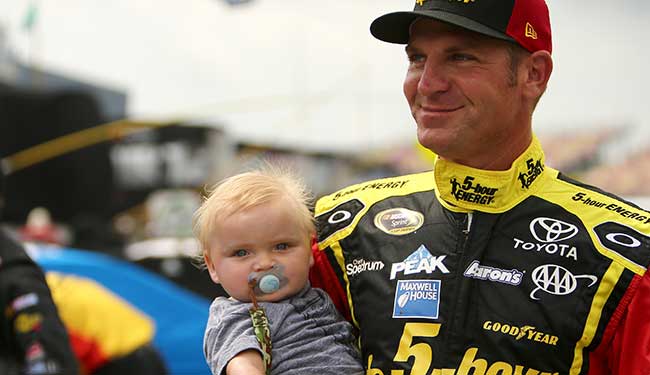
 

Cash wasn’t a good sleeper, as Clint Bowyer will attest, but the driver had a few tricks to get enough sleep — likely to the chagrin of wife Lorra.


While Harvick and Busch went to great lengths to ensure good night’s sleep, other drivers concoct more conventional schemes to deal with crying babies. “Sometimes — not saying I’ve ever done this — in the middle of the night you hear screaming —  sometimes, periodically, the first thought is to open one eyelid and see if (my wife) is up yet,” says Clint Bowyer, whose first child, son Cash, was born in October of 2014. “And if she’s not — not that I’ve ever done this — possibly a little bit of a leg tap and see if they come to, and if they don’t, damn it, I guess it’s my turn. Not that I’ve ever done that.”


Cash was not a good sleeper, so Bowyer has plenty of experience with that … or would if he ever did it, which he hasn’t. “Sleeping, for me, has always been a premium,” Bowyer says. “When you’re tired, I’ve never been able to do very good. It’s not necessarily in a race car, just in general.”


Still, Bowyer says Cash’s arrival didn’t have any effect on how he drove that season for Michael Waltrip Racing. That season was bad overall for MWR, Bowyer included. His average finish in the 29 races before Cash was born was 16.2. In the seven races after, it was 21.0. In 2014, he had six finishes of 38th or worse — the same amount he had in the previous six seasons combined.


The fact some drivers struggle in the weeks after becoming fathers seems to line up with emerging research on sleep deprivation, fatherhood and work. Researchers in Australia studied the work safety of 221 men in the first 12 weeks after they became fathers and concluded, “(daytime sleepiness) during early fatherhood poses a potential risk for work and public safety.”


The vast majority of men in the study — 85.4 percent — got fewer than six hours of sleep per night, far below the minimum threshold of seven hours before the effects of sleep deprivation start to appear. They were 14 percent more likely to report a near-miss accident at work as compared to their non-father counterparts. And none of those guys race 3,400-pound stock cars for a living.


The last time Jeff Gordon finished dead last in his storied career was at Texas in 2008, when he crashed and completed just 124 of 339 laps. Gordon described it as a virtual perfect storm of badness. He wasn’t all that great at Texas to begin with, on top of that his car wasn’t any good, and it happened to coincide with the first time he took his first child, who was then 9 1/2 months old, to the track.


“I’m showing up to the race track trying to hold my eyes open because I’m sleep-deprived because she was up crying at 3 in the morning,” Gordon told reporters in June 2009. “I knew my car was not where I wanted it to be, and I knew that Texas was a challenging track for me already, and I had the worst day that I could ever imagine, and it was because I didn’t get any sleep.”


‘Life was better’


It’s not just the race that requires the drivers’ attention. New fathers also must suffer through endless meetings about camber and shocks and setups and who knows what else. That is, assuming a driver shows up for those meetings. A study in the Journal of Family Economic Issues found “a significant decline” in the amount of hours spent at work by men aged 25-29 who become new fathers.


Drivers don’t skip races or blow off practices after becoming fathers, but they do start looking at their watches if a post-practice breakdown session runs long and the opportunity to coo at Junior or Juniorette awaits. And their willingness to show up for appearances or meetings during the week goes down if it cuts into their ability to take their kids to school or pick them up after.


Still, some in the sport suggest the time away from racing could be a good thing for drivers because it gives them something else to think about other than why their cars are so slow.

Son Alex came at a time when Aric Almirola’s rookie season wasnt going the way he wanted — but it immediately went on the upswing after Alex’s birth, with some timely help from new crew chief Todd Parrott.

Aric Almirola was as prepared as any race car driver can be to become a first-time father. In 2010, while Almirola was a full-time driver in the NASCAR Camping World Truck Series and part-time driver in the XFINITY and Sprint Cup series, he also served as a surrogate for Johnson as the birth of Johnson’s first child approached. Almirola practiced Johnson’s No. 48 car, sat in on debriefs and watched races from the top of Johnson’s pit box — all in case Johnson was called away to be with his wife, Chandra, for their daughter’s birth.


In 2012, Almirola was a rookie in the Sprint Cup Series driving for Richard Petty Motorsports. His wife, Janice, was pregnant with their first child, a son they named Alex. As the date neared, Almirola leaned on Johnson and other drivers for advice about the intersection of fatherhood and racing. They told him he had no idea what he was in for, and after Alex was born, Almirola learned they were right. “Pre-kid, your whole life revolves around racing,” Almirola says. “When I had kids, that definitely changed.”


Almirola discovered quickly that his obsession with racing had limits. “Todd (Parrott, his crew chief) had my undivided attention while I was in the race car and after I got out of the race car for a finite amount of time,” Almirola says. “Once I went back to the motorhome, (I was) certainly not really thinking about the race car or practice or even thinking about upcoming qualifying or anything else. … The very first thing I’d do would be to FaceTime with Janice, and I’d want to see Alex. I’d want to see how he was doing. I was completely engulfed and focused on what was going on with my family at home.”


Before Alex’s birth in early September, Almirola’s rookie season had gone poorly. He had already burned through one crew chief and wasn’t doing any better with the second. In the 11 races before his son was born, Almirola’s average finish was 23.6 with zero top-15 finishes. If things had kept going like that, Almirola says now, he doubts he’d still be in NASCAR. He knows he wouldn’t be racing at the Sprint Cup level.


But things didn’t keep going like that. After Alex was born, Almirola’s average finish in the final 11 races jumped by 6.6 spots to 17.0, and he had four top-15s. He attributes the improvement “absolutely 100 percent” to the fact his third crew chief of the season, Todd Parrott, started the second race after Alex was born.


Parrott built Almirola fast race cars, and the two bonded over conversations about their families. Alex’s first race was Talladega, when he was 36 days old. Almirola drove from Charlotte to Talladega. Parrott rode shotgun with him, with Alex snug in a car seat in the back. “All of a sudden I’ve got fast race cars. I’m a new dad. I’m coming home with better results, and I’ve got a family at home,” Almirola says. “Life was better.”

Slowing down, for the kid’s sake


Justin Allgaier admits he consciously makes different, more conservative decisions when he drives … only he means in a street car.


Allgaier’s wife, Ashley, went into labor on a Tuesday evening, Aug. 6, 2013. All day Wednesday, no baby. Finally, at 6 a.m. Thursday, Harper Grace took life’s green flag and entered the world. Harper’s proud father tweeted a picture of her at 10:09 a.m. His crew chief, Scott Zipadelli, jokingly tweeted back: “Congratulations on Gods amazing gift to you!  OK so now tht we got tht outa the way, plane leaves at 3:30! Hurry”


Allgaier gave Harper the first bath of her life, then left to catch a flight to a race at Watkins Glen in the XFINITY Series, in which he was competing full time. “That was the hardest thing I’ve ever done, was to leave that hospital and go,” he says.


With visions of a 5-pound, 11-ounce, 18.5 inches long baby dancing in his head, Allgaier qualified sixth for the race and finished seventh. That began a six-race stretch in which his worst finish was 12th. In the previous six races, he had finished better than 12th only once.


He says he’s the same Allgaier in the race car and a different Allgaier in a passenger car.


“When I have Harper, I have trouble figuring out what to do, how to be safe, how to not put myself in bad positions,” he says. “But not in a race car. That’s the part I don’t understand.”
RELATED: 600 Miles of Remembrance: Drivers honor fallen military members


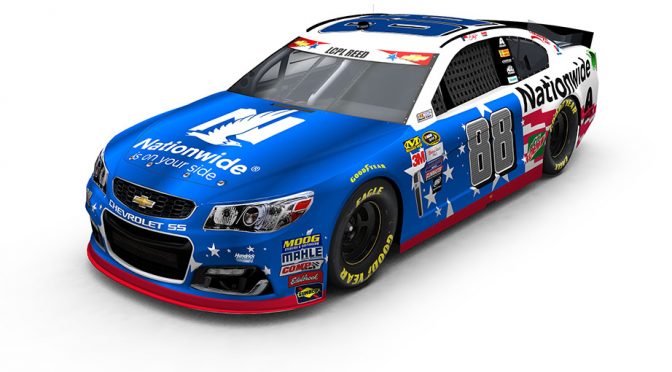
Dale Earnhardt Jr.’s special patriotic scheme for his No. 88 Nationwide Chevrolet for Hendrick Motorsports was revealed after an overwhelming response on social media.


The patriotic look for Sunday’s Coca-Cola 600 (6 p.m. ET, FOX, PRN, SiriusXM NASCAR Radio) honors Lance Corporal Aaron Reed. Reed was killed in Iraq in 2005 while serving in the U.S. Marine Corps. 


Originally, the scheme was to be revealed at 4 p.m. ET on Tuesday, but the social media response of more than 2,600 retweets led to the company revealing the paint scheme at 2 p.m. ET on Monday.


Earnhardt is winless in 32 points-paying starts at Charlotte Motor Speedway with 12 top 10s at his home track.

RELATED: Watch live stream here | Inside look on official NASCAR inspection


From 8-11 a.m. ET on Tuesday, NASCAR.com will live stream the post-race inspection process.


The three-hour look takes you behind the scenes as NASCAR officials inspect NASCAR Sprint Cup Series vehicles following Saturday’s Sprint All-Star Race at Charlotte Motor Speedway.

The cars being inspected this week are: the No. 22 Ford of Joey Logano (winner of Saturday’s race) and the No. 2 Ford of Brad Keselowski (runner-up in Saturday’s race).

For more information on what the inspection process entails, click here.

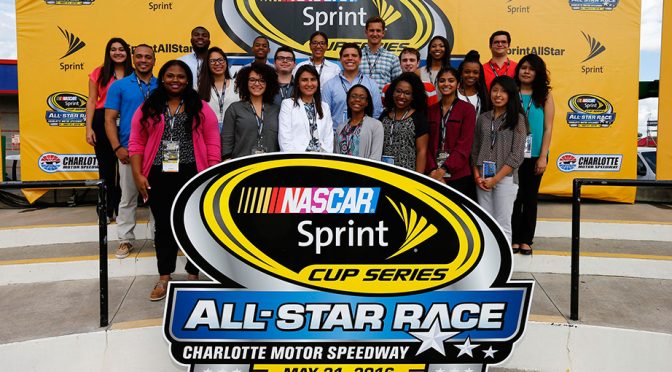
DAYTONA BEACH, Fla. (May 23, 2016) – Twenty-six of the best and brightest college students from across the country and abroad ventured to Charlotte Motor Speedway this past weekend as the sport introduced the 2016 NASCAR Diversity Internship Program (NDIP) class at the NASCAR Sprint All-Star Race Weekend. 


The 10-week, paid program exposes multicultural college students to employment opportunities within America’s number one motorsport, whether in departments within the sanctioning body or with organizations that NASCAR partners with to enhance the fan experience both on and off the race track. Through an all-inclusive orientation experience, the interns gain a behind-the-scenes look at the business of the sport and insight into prospective careers in motorsports. “


The NASCAR Diversity Internship Program has grown to become one of the most popular and attractive internships in sports,” said Jim Cassidy, NASCAR senior vice president of racing operations. “This program has given talented students an opportunity to gain relevant work experience and opportunities for careers in our industry since 2000.” 


NDIP continues to grow in popularity year over year. The key to that growth is the ongoing support of industry partners. Companies such as International Speedway Corporation, Roush Fenway Racing, Rev Racing, Daytona International Speedway, Octagon and Taylor have been longstanding supporters of NDIP. Recent partners include Toyota, Switch and Pocono Raceway. These valued partners increase the number of internship opportunities for young talent and contribute to the program’s overall success.    


Interns will work in multiple departments including in the areas of engineering, finance, marketing, licensing and public relations. In addition to receiving hand-on experience, the interns will also participate in professional development workshops, networking events and volunteer opportunities throughout their internship experience.


Victoria Kim, a recent graduate of Penn State, participated in the program last summer. Kim also received the NASCAR Diversity Outstanding Intern Award at the 2016 NASCAR Diversity Awards and was recently hired at NASCAR.


“The NASCAR Diversity Internship Program was an incredible opportunity to get a hands-on, behind-the-scenes look at NASCAR,” Kim said. “NDIP was a stepping stone and helped me get to where I am today, a full-time employee in the Daytona office for the Touring Series Racing Operations. I am grateful to have been a part of the NDIP class of 2015 and am thankful for the opportunity to pursue my dreams.”


More than 300 interns have participated in the NDIP since its inception, and many secured full-time jobs in motorsports following their internships. Recent graduates have found roles at Phoenix International Raceway, Richard Petty Motorsports, event marketing agency Switch, and many other companies tied to the industry.  


Several NDIP alumni are now employed at NASCAR within multiple business units, including: Brandon Thompson, director, racing operations; Marvin Aylor Jr., manager, marketing; Lauren Houston, senior account executive, multicultural development; Kathryn Lee, manager, events; Jusan Hamilton, senior account executive, industry operations; Ade Herbert, senior coordinator, social media; Jason Simmons, licensing account coordinator; Victoria Kim, coordinator touring series operations and Cameron McCarty, pit road technician.


“The NASCAR Diversity Internship Program has proven to be an effective pipeline for hiring top talent across the industry,” said Paula Miller, NASCAR senior vice president and chief human resources officer. “We have hired several former interns who are important contributors to the sport’s continued growth.”


The 2016 class participated in NASCAR 101 and received guided tours of the NASCAR Research & Development Center, NASCAR Hall of Fame and Charlotte Motor Speedway before watching the NASCAR Sprint All-Star Race. 


The class includes the following students from colleges and universities across the country:

NASCAR Diversity Internship Class of 2016

Name Department/Organization University Hometown
Adrianne Bright Switch Central Michigan University Flint, Mich.
Andre Reimer NASCAR Business Development Liberty University Sao Paulo, Brazil
Antonio Russo Pocono Raceway Drexel University Valencia, Venezuela
Ariadna Jaramillo NASCAR Public Affairs University of California, Berkeley, School of Law Ibarra, Ecuador
Cameron Joe NASCAR Legal Indiana University – Maurer School of Law Charlotte, N.C.
Chelsea Reaves NASCAR Weekly Touring University of North Carolina at Chapel Hill Raleigh, N.C.
Colette Garcia NASCAR Integrated Marketing Communications University of Southern California New York, N.Y.
Felix Santana Toyota New Jersey Institute of Technology Franklin, N.J.
Gregory Carty NASCAR Licensing Winston-Salem State University Durham, N.C.
Ian Jenkins NASCAR Brand Platforms Marketing East Tennessee University Birmingham, Ala.
Isabel D’Elia NASCAR Green Innovation University of San Diego Caracas, Venezuela
Jade McCrary ISC Marketing Florida A&M University Daytona Beach, Fla.
Jasmine Lewis Daytona International Speedway Full Sail University Chicago, Ill.
Jasmine Neely Taylor University of North Carolina at Chapel Hill Charlotte, N.C.
Jorge Jones Rev Racing University of the Incarnate Word San Antonio, TX
Keani Chinn NASCAR Finance Shephard University Honolulu, HI
Keyzza Plaza NASCAR Production Engineering University of Puerto Rico at Mayaguez Toa Alta, Puerto Rico
Michael Fernandez NASCAR Creative Design The Art Institute of Charlotte FairLawn, N.J.
Michael Rueda Roush Fenway Racing University of Virginia Ashburn, Va.
Peri Karslioglu The NASCAR Foundation Syracuse University Fairfax Station, Va.
Rebecca Toro Condori NASCAR Market Research/Industry Services Virginia Technical University Fairfax, Va.
Sajani Patel NASCAR Human Resources Armstrong State University Savannah, Ga.
Shirley Mendez NASCAR Digital Media North Carolina State University Charlotte, N.C.
Sydnei Fryson NASCAR Multicultural Development Columbia University Graduate School of Journalism Charleston, W.V.
Vanessa Watson Octagon University of North Carolina at Chapel Hill Kenly, N.C.
Whitney Martin NASCAR Integrated Marketing Communications North Carolina A&T University Charlottesvile, Va.

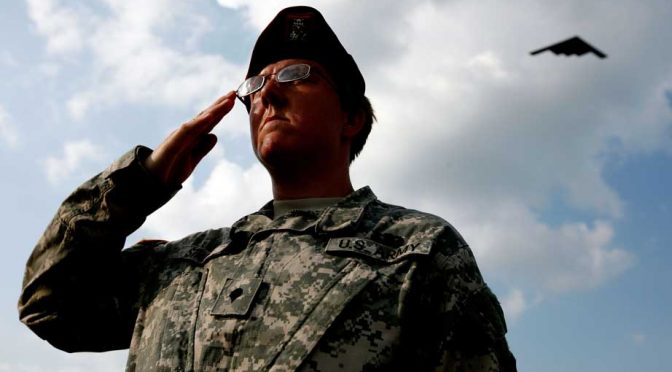
DAYTONA BEACH, FLA. (May 23, 2016) — Continuing the sport’s long-standing tradition of honoring the United States Armed Forces, all 40 NASCAR Sprint Cup Series drivers will bear the name of a fallen service member on their race car windshields during Sunday’s Coca-Cola 600 at Charlotte Motor Speedway (6 p.m. ET on FOX, PRN, SiriusXM NASCAR Radio), NASCAR announced today.

For the second consecutive year, “600 Miles of Remembrance” will pay tribute this Memorial Day Weekend to those who bravely served and died defending our country. Windshield headers normally reserved for drivers’ last names will read “SGT HARVEY,” “LCPL RAMIREZ,” and “SPC BEAUDOIN,” among other names of the fallen.

The special tribute will commemorate the launch of NASCAR: An American Salute™, the industry’s collective expression of respect and gratitude for members of the U.S. Armed Forces, past and present. Fans can follow the conversation on social media using #NASCARsalutes.

“Each of the names proudly displayed on these race cars tells a story of honor and sacrifice,” said Brent Dewar, NASCAR chief operating officer. “As the NASCAR industry reflects on Memorial Day Weekend, we’re proud to honor these and all fallen service members in a way that helps ensure their stories and lives are never forgotten.”

Many of the service members whose names will be displayed on the race cars were chosen by the teams, and some have unique connections to the fallen. Navy SEAL Denis Miranda, who was killed in a helicopter crash in Kabul, Afghanistan in 2010, trained in BUD/S alongside Graham Molatch, jackman for the No. 42 Chip Ganassi Racing team. Miranda’s name will appear on Kyle Larson ‘s car during the Coca-Cola 600.

Lance Corporal Scott Lynch served in the United States Marine Corps with Mark Singleton, tire changer for Chip Ganassi Racing, and will be honored on Jamie McMurray ‘s No. 1 car. Furniture Row Racing employee John Parks served in the Marines with Jeffrey Bohr, Jr., a gunnery sergeant who was killed during Operation Iraqi Freedom and whose name will be carried on Martin Truex Jr. ‘s No. 78 car.

Toyota will also honor the names of fallen service members on its pace cars and grand marshal cars for the Coca-Cola 600 as part of 600 Miles of Remembrance.

Many of the families of the service members being recognized will be in attendance at Charlotte Motor Speedway. The track will host more than 6,000 active military members at the Coca-Cola 600 in honor of Memorial Day.

Throughout the week, NASCAR: An American Salute will feature various activities demonstrating the industry’s support for the military, including:

·       During Saturday’s Hisense 4K TV 300, NASCAR XFINITY Series drivers will display red, white and blue XFINITY windshield decals on their race cars.

·       Goodyear will replace the “Eagle” sidewall design with “Support Our Troops” messaging on all tires used during the Memorial Day Weekend races.

·       NASCAR, Coca-Cola and Mars, through the annual military support program, DeCA, will offer a sweepstakes to shoppers at more than 180 commissaries who will have a chance to win a trip for two to NASCAR Sprint Cup Series Champion’s Week in Las Vegas. The kickoff event will take place at Fort Bragg on May 25 and feature No. 11 Joe Gibbs Racing driver Denny Hamlin. The 2016 DAYTONA 500 winner will tour the Warrior Transition Battalion Unit and visit with families at the South Commissary.

·       In partnership with Operation Gratitude, Mars will invite race fans to help assemble care packages for the troops in the midway at Charlotte Motor Speedway. The care packages will include Mars candy and be shipped following the Coca-Cola 600 to deployed military members.

·       NASCAR and Honor and Remember, Inc. will display specially prepared Honor and Remember flags representing those who lost their life in service to our country from each of the 50 United States throughout the NASCAR Sprint Cup Series garage at Charlotte Motor Speedway.

During the Coca Cola 600 pre-race broadcast (5:30 p.m. ET, FOX), FOX Sports will recognize all service members who have lost their lives in the past year by displaying their names and branch of service on a graphic scroll.

This Sunday, NASCAR drivers will discuss 600 Miles of Remembrance on SiriusXM NASCAR Radio (channel 90) during a special military tribute show airing at 1 p.m. ET. The Dialed In Salute to the Troops special, hosted by Claire B. Lang, will feature interviews with several drivers as well as service men and service women from different branches of the military.

The NASCAR Sprint Cup Series’ Coca-Cola 600 will be broadcast live from Charlotte Motor Speedway at 6 p.m. ET on FOX, PRN and SiriusXM NASCAR Radio. Additional live coverage can be found on NASCAR.com.

To view an online gallery of the service members honored as part of 600 Miles of Remembrance, visit www.NASCAR.com/salute.