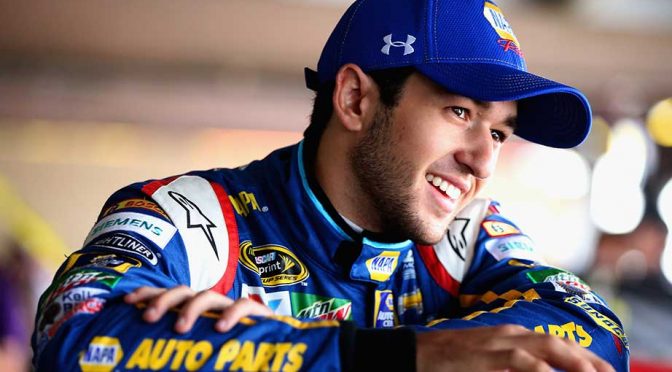
The fans have spoken. Chase Elliott is headed to the Sprint All-Star Race as the Sprint Fan Vote winner.
Danica Patrick finished in second place and also transfers into the Sprint All-Star Race to complete the 20-car field.
“Definitely really appreciate everybody voting and taking time out of their day to vote for us and get us in this race. Obviously wish I could’ve gotten us in racing our way, but fortunately have some great fans to do that for us.”
Patrick was appreciative of the fan support as well as she will make her third Sprint All-Star Race start.
“First and foremost, thank you to the fans,” Patrick said. “The only thing that would make this any better is if I could deliver a great finish for them and an exciting race and pass cars and make the car better for next week.
“… It’s just even that much better to know that I have incredible fans that always come through. Don’t think that I don’t see social media fans. And I see all the times that people said they voted for me. So, thank you very much.”
The Sprint All-Star Race, scheduled for 9 p.m. ET Saturday night, awards $1 million to the winner. The annual rite of spring boasts an impressive history and plenty of elite drivers. The 2016 version is televised on FS1 with radio coverage on MRN and SiriusXM NASCAR Radio.
Fifteen drivers had qualified for the event heading into Saturday morning’s Sprint Showdown by virtue of either winning a points-paying race in 2015 or thus far in 2016, having won a previous Sprint All-Star Race or being a former series champion.
Three drivers qualified from the Sprint Showdown’s three segments: Trevor Bayne, Greg Biffle and Kyle Larson.
The top five vote-getters heading into the final week of voting were, in alphabetical order: Ryan Blaney, Matt DiBenedetto, Chase Elliott, Kyle Larson and Danica Patrick.
RELATED: Full practice results
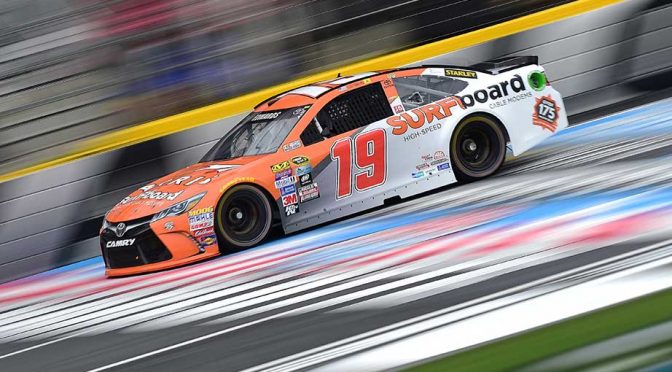
Carl Edwards topped the charts in Saturday’s extended Sprint All-Star Race practice at Charlotte Motor Speedway with a speed of 192.027 mph in his No. 19 Joe Gibbs Racing Toyota. Brad Keselowski posted an identical speed as Edwards in his No. 2 Team Penske Ford but was officially scored second in the practice session because of owner points.
Rounding out the top five were Denny Hamlin (No. 11 JGR Toyota, 191.904 mph), Kurt Busch (No. 41 Stewart-Haas Racing Chevrolet, 191.795 mph) and Joey Logano (No. 22 Team Penske Ford 191.700 mph).
Sprint Cup Series points leader Kevin Harvick was seventh-fastest with a speed of 191.008 mph in the No. 4 Stewart-Haas Racing Chevrolet.
Practice was halted for dampness on the 1.5-mile track with 16 minutes left in the session. It eventually got back underway with a 10-minute session that included practice for Sprint All-Star qualifying, which includes a four-tire pit stop with no speed limit on pit road.
Some Sprint Cup cars will be back on the track for the Sprint Showdown (FS1) as those who are not yet in the Sprint All-Star Race field attempt to gain entry by winning one of three segments (20 laps, 20 laps, 10 laps).
CONCORD, N.C. — Questions about gamesmanship and tire requirements dotted the drivers’ meeting before Saturday’s NASCAR Sprint All-Star Race, prompting several “what-if” scenarios for the annual non-points event.
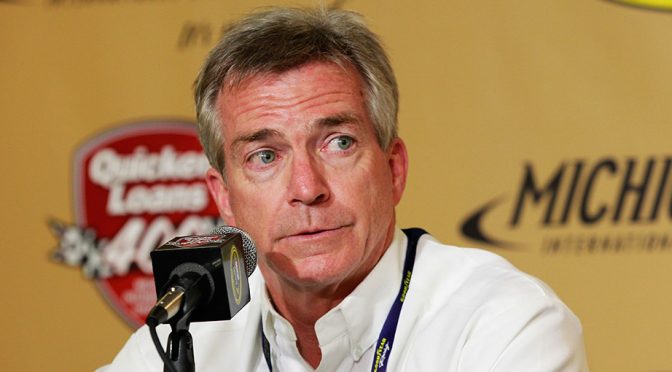
NASCAR Sprint Cup Series Managing Director Richard Buck spelled out the race’s unique procedures in a nearly six-minute instructional in the Charlotte Motor Speedway garage, but there was conjecture about some of the rules. Teams will compete in three segments (50 laps, 50 laps, 13 laps), with pit road closing on Lap 85 of the second segment. The top nine, 10 or 11 cars — the number is selected by random draw during the Lap 100 break before the 13-lap final shootout — will be required to pit for four tires.
The basis for the format is to spice up the running order, putting cars with fresher tires behind those in front with older rubber for the dash to the finish. Chad Knaus, crew chief for the Hendrick Motorsports No. 48 Chevrolet driven by Jimmie Johnson, was the first to ask about the requirement in the question-and-answer session that followed.
“I got a little lost there through some of that,” Knaus said, before asking Buck if a caution flag during the final 13-lap segment would allow all teams to stop and change tires if they were damaged by an incident.
“There’s many scenarios there,” Buck said. “The premise is to have cars with 15-laps-old tires on them and cars behind them with new tires on them. We will not permit gaming of that. If we have an incident, for an example, we will have to go red and clean it up, we’ll take care of that situation, we’ll come back to it and then allow the teams to pit on or around (Lap) 85, wherever that may be, or any circumstance like that.”
Kyle Busch piped up: “That didn’t answer the question. Chad’s talking about in the last segment, in the last 13 laps if there’s a wreck, not after Lap 85 in the second segment, you follow? He’s asking about 100 and 113.”
Buck told the room that the field would not be allowed to take tires. Pressed by Busch about whether tires flat-spotted in a spin or damaged by running over debris would be fair game for a change, Buck replied: “That’s EIRI (except in rare instances). Like I said, we’ll manage that from the tower.”
Defending race winner Denny Hamlin, Busch’s Joe Gibbs Racing teammate, was the next to raise his hand, asking whether the “100 percent rule” requiring competitors to race at their fullest ability was in effect. Buck replied in the affirmative.
The question was prompted by suggestions that drivers might hold back and aim for 12th place or further back before the final segment, allowing them to have the benefit of four fresh tires for the final shootout. The “100 percent rule” was added in September 2013 in the wake of the Richmond scandal, where the former Michael Waltrip Racing team was penalized for attempting to manipulate the race results.
Buck also said in his explanation of rules that NASCAR officials would make a mandatory lug-nut check during the two breaks between segments. Buck said the penalty for missing or loose lug nuts not fastened up against the wheel will require the offending team to remedy the issue, sending them to the tail of field.
RELATED: Results from Segment 3
CONCORD, N.C. — Kyle Larson shoehorned his way into the NASCAR Sprint All-Star Race by whatever means necessary, making a full-contact lean on Chase Elliott‘s fenders on the last lap of Saturday’s Sprint Showdown preliminary.
Did the contact cross the line of sportsmanship? Maybe not, with both drivers deeming it a compulsory evil with the checkered flag in sight and a chance at a $1 million payday in the Sprint All-Star Race up for grabs.
In the end, both drivers won out by transferring into Saturday night’s main event, but through different methods. Larson snatched one of three transfer spots available to segment winners, joining Roush Fenway Racing‘s Trevor Bayne (first segment) and Greg Biffle (second segment) in the non-points invitational. Elliott claimed his berth by winning the Sprint Fan Vote. Danica Patrick finished runner-up in the fan vote to fill the 20-car field.
Larson’s method of securing his eligibility ranked as the most dramatic of the five. The Chip Ganassi Racing driver recovered from an opening-segment wall scrape to work his way back to first place by the start of the final 10-lap dash to the finish. He led all the way, but Elliott gained tremendous ground on fresher tires, pulling alongside Larson through Turns 3 and 4 for the final time.
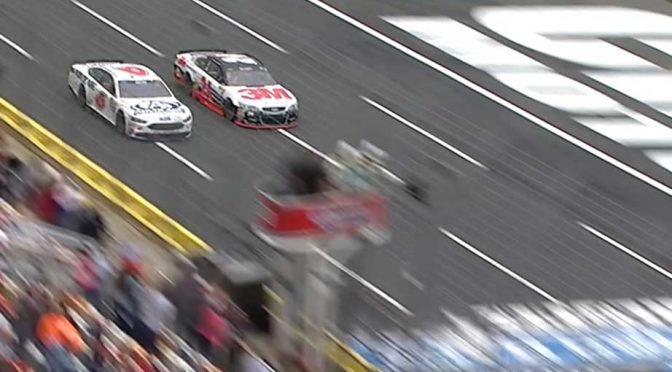
Larson’s No. 42 and Elliott’s No. 24 Chevrolets locked fenders and scraped side-by-side all the way to the checkers, with Larson prevailing by just .015 seconds to qualify for his first All-Star Race.
“I would hate to be raced like that, like I raced him,” Larson said. “But I knew he was going to win the fan vote, so I knew he was going to be in the All-Star Race either way and I wasn’t if I didn’t win. I had to do what I had to do to get the win. Hate racing like that, obviously, but I felt that’s what I had to do to make it in.”
Larson was on the receiving end of a similar shove in 2014, when Ryan Newman slammed him aside on the final corner of the final lap at Phoenix to land the final spot in the Chase for the NASCAR Sprint Cup championship race. Back then, Larson said he understood the circumstances.
Saturday, Larson indicated that he knew Elliott was justifiably upset with him. Based on his sometimes choppy responses in post-race interviews, Elliott was, but he also said he understood Larson’s aggressive move considering the stakes.
“He did what he had to do to beat us back to the line, that’s all there is to it,” Elliott said. “Part of it.”
Elliott found himself on the short end of an even closer finish in the first 20-lap leg, edged by .005 seconds by Bayne, who split the middle on a bold, three-wide move shortly after the segment’s final restart. That restart also proved to be the undoing of rookie Ryan Blaney, who was black-flagged for jumping the green flag and could only recover for a third-place finish overall.
RELATED: Watch the Segment 1 finish unfold
The nifty maneuver, though, launched Bayne into his first All-Star Race since 2012.
“You don’t hesitate when you can see the front any time, and especially when it’s like this — not a points race,” said Bayne, who scored his only Sprint Cup win in the 2011 Daytona 500. “If it doesn’t work out, it doesn’t work out. You’ve got to win. It was pretty cool. Maybe if you’re battling to get in the Chase on points, you don’t make that move for third or fourth, but when it’s for a win even in a points race, you’ve got to do it every time.”
Biffle, his Roush Fenway teammate, had a slightly easier time of it, slipping past Austin Dillon six laps into the second 20-lap segment to clinch his 13th consecutive All-Star start. Biffle advanced into the main event as a Showdown segment winner last year as well. His transfer inspired some lively banter with crew chief Brian Pattie.
“Hope no one had dinner reservations,” Pattie said over the team radio on the segment’s cool-down lap. “Nope, I was planning on being here all night,” Biffle replied, later noting the seven-figure incentive for the All-Star Race winner.
RELATED: Biffle ecstatic after finish
Patrick advanced through fan balloting for the third time in four years.
“I definitely thought if there were two spots, I had a lot better shot,” Patrick said. “My fans voted well.”
RELATED: Race results | SHOP: Logano gear
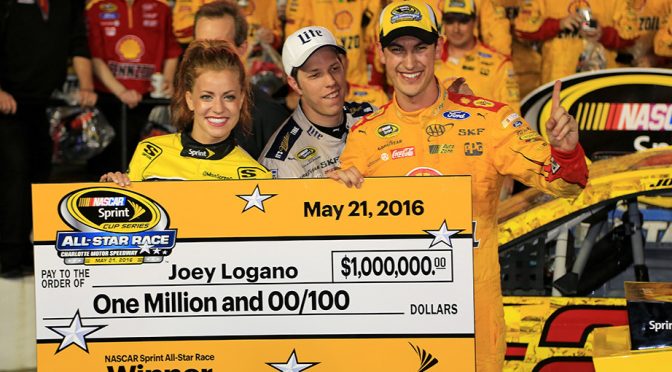
CONCORD, N.C. – At the end of a wild and crazy Saturday night at Charlotte Motor Speedway, Joey Logano got the upper hand in an intense battle with last-chance qualifier Kyle Larson and took home the million-dollar prize as the winner of the NASCAR Sprint All-Star Race.
Trying to block the stronger car of Logano in the closing 13-lap final segment of the race, Larson buried his car into Turn 1 as Logano edged ahead. Larson’s No. 42 Chevrolet got loose and sailed up the track into the outside wall with less than two laps left.
“I tell you, Larson is a hard racer,” Logano said. “I watched him in the Showdown earlier today, and I knew what I was up against. I knew he was going to run hard. I’m a hard racer, so I knew it was going to be a fun battle for sure. I got underneath him once, and I got to the outside of him once, we went up high, and I got underneath him and I got loose underneath him.
“I knew I had position on him going into the corner and had to keep him on my quarter panel and not let him get to my door, so I drove in there hard. He was going to drive in there hard to keep on my door and I was going to drive in there hard to keep him at my quarter.
“What a crazy battle for a million dollars at the end. This is the All-Star Race. It’s special just to be in the race. Forget winning it–it’s just special. It’s neat to be in Victory Lane.”
RELATED: Logano reflects on all-star win
Larson’s contact with the wall on the penultimate lap was an opportunity for Logano’s Team Penske teammate, Brad Keselowski, who finished second, 1.142 seconds behind the race winner. Dale Earnhardt Jr. came home third, followed by Carl Edwards, Kurt Busch and Chase Elliott.
Larson brought his damaged car to pit road as Logano sped to the win.
“I was able to get to the front pretty quick there and be in the best position for that last restart,” Larson said. “I got clear right away and thought I could cruise, but I got looser throughout the race—we were making adjustments, but I guess we weren’t making big enough ones.
“I just got loose, and Joey caught me, and he did a really good job of side-drafting me. I tried to hang on his quarter, and I just got really loose as soon as I got down in the corner. We were going so fast I couldn’t correct it and drilled the wall.”
RELATED: Larson heartbroken after late lead slips away
The victory was Logano’s first in the non-points event. Team Penske‘s 1-2 finish marked the first time an organization has swept the top two spots in the All-Star Race.
After two segments of 50 laps each, which included a six-car Lap 73 wreck that eliminated the cars of Matt Kenseth, Kasey Kahne and Tony Stewart (who was competing in his final All-Star Race), Logano restarted fifth on fresh tires under unique rules devised for this year’s event.
Larson, who restarted third behind two cars required to stay out on old rubber—those of Jimmie Johnson and Kyle Busch—surged into the lead and held the top spot until Logano tracked him down and made the winning pass on the next-to-last lap.
Keselowski was the primary architect of this year’s All-Star Race format, and he believed the new rules accomplished their purpose, even though there were unforeseen consequences that confused some of the competitors—as when Kenseth failed to make a mandatory green-flag stop in the first segment and trapped a handful of cars a lap down.
“There was a next-to-last-lap pass for the lead,” Keselowski said. “There were several passes for the lead. The last four (All-Star) races, there hasn’t been a pass for the lead in the last 20 or 30 laps. I think our fans deserve a better format than that, and they got that today.
“I don’t know how you can get much more compelling racing than what we saw today, so they need to get unconfused and enjoy the racing.”
RELATED: Full race results | Updated series standings
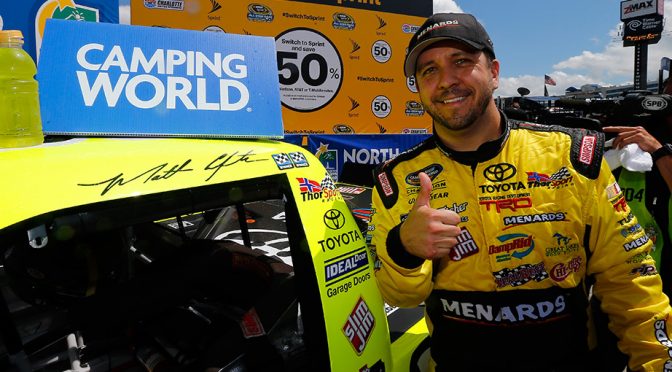
CONCORD, N.C. — Matt Crafton had a lot to overcome on Saturday — a 17th-place starting position and a difficult pit stall that cost him dearly in the early stages of Saturday’s North Carolina Education Lottery 200 at Charlotte Motor Speedway.
But after 134 laps, Crafton was 5.748 seconds ahead of second-place Kyle Busch, winning the race and extending his series lead to 12 points over seventh-place finisher Timothy Peters. In fact, the two-time champion won consecutive races for the first time in his NASCAR Camping World Truck Series career, going back-to-back in successive weeks at Dover and Charlotte.
Even though it took Crafton more than half the race to get to the front, he sensed the quality of his ride from the drop of the green flag.
“I literally did,” Crafton said. “I was like, ‘Wow!’ This thing was unbelievable from the time we dropped the green. This thing went through (Turns) 1 and 2 — well, the first original start, everybody got jumbled up and went through (Turns) 1 and 2 and then 3 and 4, and I’m like, ‘This thing feels really good right here.’
“Then we fell back to the 20s (after pit road issues) at that point and we started driving back through them and I was like, ‘Oh, my goodness, these boys are in trouble today.’ “
The victory was the 13th of Crafton’s career, but despite the wide margin of victory, his No. 88 ThorSport Racing Toyota didn’t take the lead for the first time until Lap 80, when Crafton tracked down Peters and passed him for the top spot.
After starting mid-pack, Crafton worked his way forward during the first run but had major issues on pit road, first sliding through his pit box and later getting blocked in his stall. The miscues forced Crafton to pass a gaggle of cars, but by Lap 78 he was fourth for a restart after Christopher Bell‘s spin off Turn 4, and two laps later, Crafton had the lead.
The advantage grew to more than 8.5 seconds before a cycle of green-flag pit stops for fuel trimmed Crafton’s winning margin in the closing laps.
Johnny Sauter did an extraordinary job of saving fuel and rolled home third behind Crafton and Busch. Tyler Reddick and Matt Tifft, the latter recently named to the 2016-17 NASCAR Next class, were fourth and fifth, respectively, both on fuel strategy.
Spencer Gallagher, Peters, Bell, Daniel Hemric and polesitter William Byron completed the top 10.
Busch led 27 laps in the early going but suffered a suspension part failure that caused the handling of his No. 18 Tundra to tighten up. Nor did it help that Busch’s team was penalized for an uncontrolled tire during a pit stop on Lap 68, forcing the driver to restart at the rear of the field on Lap 71.
“Once we got back in traffic, it just got super, super tight,” said Busch, whose Kyle Busch Motorsports organization also owns the trucks driven by Bell, Byron and Daniel Suarez. “Something broke, and after that, it was just laying on the splitter.”
CONCORD, N.C. — NASCAR Sprint Cup Series teams saw their time cut short this past week during a tire test at Michigan International Speedway, but Goodyear officials said the on-track time was sufficient for the tire supplier’s needs.
Additionally, NASCAR officials were on hand for the May 17 session to examine the impact of recently announced rule changes for ’16 and potential aerodynamic adjustments for the ’17 season.
Rain around the 2-mile track delayed the start of the test, and returned later, forcing officials to end the session just after 2 p.m.
“We were able to run through our stuff pretty quickly and got some long runs in,” Greg Stucker, Director of Race Tire Sales for Goodyear, said Friday at Charlotte Motor Speedway. “It was a confirmation test; we weren’t going through a lot of different combinations or anything. We just confirmed that what we had taken was the right combination. Everyone was very comfortable with it.
“There was plenty of grip; it was cool, but we knew that going in. No surprises. We were real comfortable with everything.”
Drivers taking part in the test were Martin Truex Jr. (Furniture Row Racing No. 78 Toyota), Austin Dillon (Richard Childress Racing No. 3 Chevrolet), Aric Almirola (Richard Petty Motorsports No. 43 Ford) and Kyle Larson (Chip Ganassi Racing No. 42 Chevrolet).
More cars and warmer track temperatures will be in store when teams return to the Irish Hills for the Firekeepers Casino 400, scheduled for Sunday, June 12.
“You know that going in,” Stucker said. “But obviously we had to get up there at a certain time to confirm that our production is going to be OK. You don’t have a choice. But you rely on a lot of history, understand how the conditions will change and you’ve got some of that built into your recommendation. You just have to know that going into it.”
NASCAR officials gathered on-track information on a variety of spoiler, skirt, splitter and deck fin combinations under consideration for next season’s package.
• This week’s rule adjustments involving rear toe and the use of electric fans take downforce and side force away, moves that should give Goodyear more flexibility in tire builds.
“If anything it’s going in the less grip direction,” he said. “So I think it will open up the window a little bit more for the tire package rather than something that’s going to make the cars faster and make it harder on tires. It’s actually going in the other direction.”
The rear toe adjustment, which will decrease the amount of skew (slant) in a car’s setup, is in place only for this weekend’s Sprint All-Star Race at this time.
• Stucker said the supplier had confirmed a tire for this year’s return to Watkins Glen International following a test there on the recently repaved road course.
“Where we landed was actually the (right-side) tire that we raced at Iowa from a compound and construction perspective,” he said. “It’s a known quantity, which is good for us. We know the compound well. It gave us the performance we felt was where we need to be.”
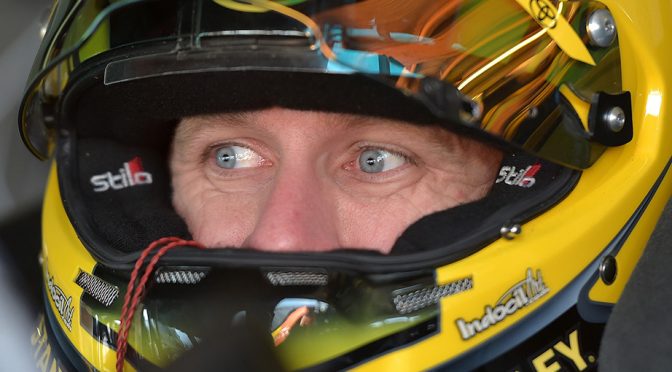
RELATED: Fresh paint schemes for the All-Star Race
CONCORD, N.C. — Mandatory pit stops, a random draw to reset approximately half the field and a 13-lap dash that will pit track position against fresh tires.
It’s NASCAR’s annual Sprint All-Star Race, and few of those here at Charlotte Motor Speedway for Saturday night’s event (9 p.m. ET, FS1, Sirius XM NASCAR Radio) say they know what to expect.
“I think with the new format no one knows, nobody has any way to predict how this is going to go,” Carl Edwards, driver of the Joe Gibbs Racing No. 19 Toyota, said Friday. “I think it’s going to be a really crazy event.”
This year’s race will consist of three segments — 50 laps, 50 laps and 13 laps. For each of the two 50-lap segments, teams are required to make one green-flag pit stop for a minimum two-tire change. There is also a mandatory two-tire stop required following each break.
The race off pit road will determine the restart order for the second segment. However, only those running first through either ninth, 10th or 11th (to be determined by random draw) will be required/allowed to pit following the second segment. Pit road will be closed to the remainder of the field.
The resulting “inversion” will put those in the back half of the field up front but on older tires going into the final 13-lap dash.
“We have to see how the tires wear,” Edwards, winner of the 2011 event, said. “That’s really going to be the key. And then, man, it’s just … I was going through it this morning, if you are running sixth or seventh before the final stop, I don’t know, then it becomes maybe a race for 12th or something. I just don’t know how this thing is going to play out.”
Former series champion (2014) Kevin Harvick said it’s hard for him to come to grips with racing for 12th prior to the final segment, in hopes of re-starting mid-pack or better and on fresher tires.
“I’d rather be first (at the end of the second segment) and try to be on the outside of that first row of cars on new tires,” the Stewart-Haas Racing driver said. “I don’t know. It’s just against the grain and there’s a lot of thought that has to go into it because there is strategy that plays into it.
“I think if you’re going to win the race, I think you’re going to have to kind of guess at what the right strategy is. And you’re also going to have to get lucky because you’re going to have to come off pit road; if that’s the strategy, it seems like the common strategy. The common theme is usually not just one guy that’s thinking about it.”
The field for Saturday night’s race will consist of 20 teams, 15 that qualified by either winning a race win since the start of the 2015 season or being a former All-Star Race winner or Sprint Cup Series champion. The final five spots will be awarded to the three segment winners in the Sprint Showdown preliminary event and two determined by the Sprint Fan Vote.
RELATED: Full lineup for Showdown
Ryan Blaney (Wood Brothers Racing No. 21 Ford) is one of those hoping to advance out of the Showdown and into the All-Star Race.
“I think with the new rules package it will be easier to pass going up through the field,” Blaney said. “Even though you have 13 laps, if you have 30-lap fresher tires than the people in front of you, you can make good ground.”
Although driving to the front from outside the top 10 sounds “pretty tough,” Blaney said, “it’s been done before for sure, especially with people on different strategies, so it’s doable and that’s kind of where my gut is telling me to want to be at.”
Matt Kenseth, another former winner of the race, said he expects the strategy will consist of teams racing for 12th before the end of the second segment.
“And I think that’s going to be very interesting,” the JGR driver said. “I might be 100 percent wrong on that; that’s what it feels like today and especially after watching the last few (All-Star) races. It’s still really important to be out front and I don’t know that (13) laps after a … break to cool down on your tires is enough to be a huge deficit to four new ones.
“It might be, I hope it is because it will mix the field up a lot more. I don’t think anyone will be sure until we see it.”
Eleven 2015 race winners are locked into the field, as are previous All-Star Race winners Jamie McMurray, Ryan Newman and Kasey Kahne. Tony Stewart is also in the field as a Sprint Cup champion and former All-Star Race winner.
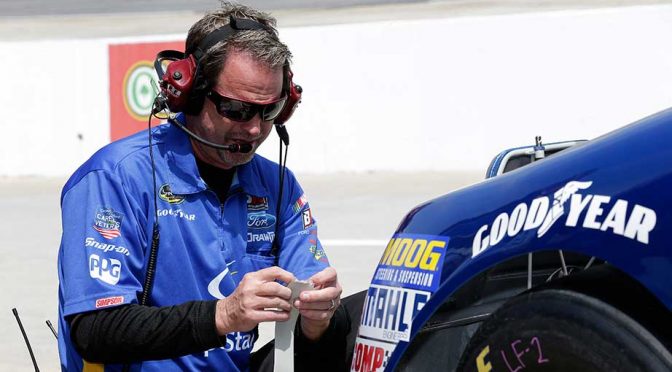
Doug Randolph graduated from the University of Tennessee with a degree in Wildlife and Fisheries Biology.
So it was only natural that the Morristown, Tennessee, native eventually found employment in racing.
“I use it every day,” Randolph said, grinning.
If you think he’s kidding, think again.
“The definition of wildlife biology is it’s a science and it’s an art, manipulating habitat for animals. To me, racing is the same way,” said Randolph, crew chief for driver Tyler Reddick and the No. 29 Cooper Standard Ford for Brad Keselowski Racing in NASCAR’s Camping World Truck Series. “If you go into it 100 percent engineering driven, and you forget the art of it, the pumping your driver up, assessing where his head is, you might not be able to pull off the success you want. For sure, that definition plays a huge role in racing I think.”
Reddick is eighth in points following two straight top 10s — a seventh-place finish at Dover and a fourth-place showing at Charlotte. Teammate Daniel Hemric is third in the standings.
Randolph didn’t set out to become a crew chief, but he did hope to be involved in racing in some capacity.
And not just videotaping local races from the top of a press box in an effort to lure fans to the local pizza join for viewing and a meal later. Yeah, he really did that.
“One of my best friends worked for Mr. Gatti’s Pizza and we went around to softball games, local races and videotaped them,” Randolph said. “Then we’d try to convince people at the games or races to eat at Mr. Gatti’s and watch the replays.
“He and I would get on top of the press box. He would video and I would sit there and drink beer, to be honest. But those were good times.”
Randolph has served as crew chief in all three of NASCAR’s national series, winning in the NASCAR XFINITY Series with drivers Scott Riggs and Clint Bowyer, as well as the Camping World Truck Series with Ryan Blaney, Keselowski and Reddick. There were near-wins in Sprint Cup, second-place finishes at Bristol (with Jimmy Spencer) and Talladega (with Paul Menard).
But his start came with a local standout, L.D. Ottinger, a Newport, Tennessee-based driver. Randolph was on the crew in 1990 when Ottinger won an event in what is now known as the XFINITY Series at Bristol Motor Speedway. It was in that race that Michael Waltrip survived one of the most devastating crashes in NASCAR, his car exploding after striking the exposed corner of the outside wall.
“Nobody will ever remember who won the race; they’ll always remember the wreck,” Randolph said. “L.D. wasn’t the first one by the wreck, but he took everyone down pit road. And when he did, he said ‘He’s dead.’ He said it three times.
“They red-flagged the race … it was hard.”
Incredibly, Waltrip was not injured.
The time spent working for Ottinger helped lay the foundation for what was to come. “Probably one of the best people for somebody that didn’t know anything about racing to learn from,” Randolph said, “because his attention to detail. I’d be putting the fender decals on and one might be just a little crooked. He’d say, ‘You’ve got to fix that’ and I’d say, ‘They can’t see it from the stands.’ He’d say, ‘Yeah but I’ll be driving around the race track worried that that thing’s crooked.’ “
Understanding professors helped Randolph complete his college education while still heading to the race tracks each weekend. Eventually, he made the decision to “do this racing gig for a year or two.
“L.D.’s led into going to Junior Johnson’s and, man, once you’re there, how do you leave racing?,” Randolph said.
Johnson, an inaugural member of the NASCAR Hall of Fame and one of the sport’s legendary figures, won 50 times as a driver, and nearly three times that often as an owner (132 all told).
Randolph’s first job as crew chief came in 2001, at Bill Davis Racing with driver Dave Blaney. Eleven years later, he helped guide Blaney’s son, Ryan, to the win in a Truck Series race at Iowa.
He’s found a home in the series, and a home at Brad Keselowski Racing.
“When you’re Cup racing, that is your life,” Randolph said. “You have no (other) life. I’ve got a wonderful wife, wonderful kids. Truck racing came for me at a point in my life when my daughter was in high school playing every sport imaginable. I missed a lot of that with my son. It was great to experience it with my daughter. …
“We’re very lucky here that Brad has given us an organization with a definite vision that’s different. He wants to give back to the sport and he’s given us the freedom to go and do it. We have a great group of guys that support each other. It’s a lot of fun. If you’re Cup racing and you’re not one of those first five guys, you’re not having any fun.”
But there’s stress at every level of racing, and that’s “what you hope for,” he admitted. “You hope there is a stressful situation and you and your driver and your team can get through it better than the next guy.”