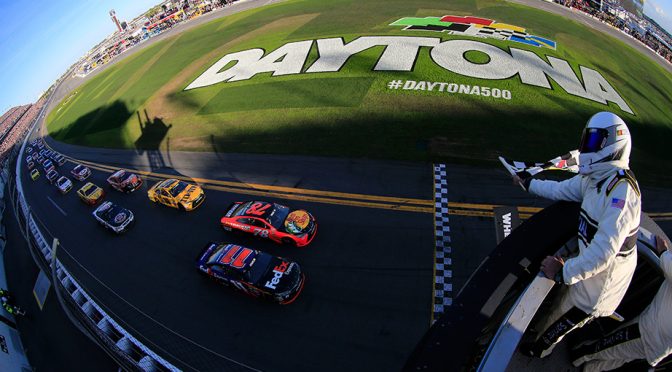
Sunday’s Daytona 500 provided fans with the closest finish in the history of the Great American Race when winner Denny Hamlin edged runner-up Martin Truex Jr. by .010 seconds — roughly four inches on the track. But Hamlin’s impressive victory at Daytona International Speedway wasn’t the only record-setting event of the day.
On Wednesday, NASCAR released social media numbers generated from its biggest race, and Sunday’s Daytona 500 produced a litany of milestones.
The 2016 Daytona 500 set a record for most social impressions generated in one day by NASCAR’s social channels, with race-day impressions up 63 percent over last year’s Great American Race.
Engagement with NASCAR social media content — likes, comments and shares — increased threefold over the total generated during the 2015 Daytona 500.
“Social media gives fans a chance to get to know their favorite driver outside the track – their likes, dislikes and all-around personality,” JTG Daugherty Racing driver AJ Allmendinger said. “It allows fans to feel closer to their driver, and that helps push our sport forward into a new generation.”
The reasons for the spike are plenty, most notably the celebrity factor that the Daytona 500 often attracts. Singer Justin Bieber tweeted a photo of a NASCAR racing helmet to his 76 million followers. Ditto for actor Ashton Kutcher to his 17.4 million followers. Among the celebrities in attendance on Sunday, Baseball Hall of Famer Ken Griffey Jr., actor Gerard Butler, WWE wrestler John Cena, rapper Wyclef Jean, National League MVP Bryce Harper and comedian Gabriel Iglesias all tweeted from the grounds.
This year’s race dominated the Twitterverse. The Daytona 500, which peaked at 14.1 million television viewers tuned in for the checkered flag, generated more tweets than any other TV program on Sunday, beating second-place WWE Fastlane by 66 percent.
“The Daytona 500 is one of the biggest sporting events in the world and this year millions of fans consumed the race across television, radio, digital and social media,” said Steve Phelps, NASCAR executive vice president and chief marketing officer. “Sunday was especially a huge success for our social platforms, with race-day conversation around the Daytona 500 at an all-time high.
“By delivering original content via social channels during the race, we were able to engage with millions of passionate fans worldwide and set a single-day record for NASCAR social media impressions.”
NASCAR’s digital platform racked up 2.1 million unique visitors and 13 million page views. Fans spent a record 2.8 million minutes watching Daytona 500 content on a new race viewing product called NASCAR Drive, recently launched on NASCAR.com.
More than 23,000 unique Twitter users competed in the Hashtag 500, a “race” to be the 500th person to tweet unique hashtags, with race-used memorabilia as prizes. A tweet promoting the competition to win Dale Earnhardt Jr.’s Daytona 500 firesuit generated the most NASCAR-related mentions in 60 seconds since the debut of the NASCAR Fan and Media Engagement Center, which measures such things.
A new partnership with Snapchat enabled NASCAR to reach millions of users with videos and photos uploaded as Daytona 500 content for the first Snapchat Live Story of 2016. Sunday’s race was the first installment of 2016, with several more races to follow.
Overall, the 2016 Daytona 500 saw more NASCAR-related social conversation than had previously occurred on any single day since the inception of the NASCAR Fan and Media Engagement Center. Social conversation was up 44 percent compared with last year’s race.
For Daytona 500 race week, total consumption in terms of page views per visit of NASCAR’s digital platform—NASCAR.com, mobile web and mobile apps — was up six percent over last year, making it NASCAR’s second-highest race week consumption rate of all time.
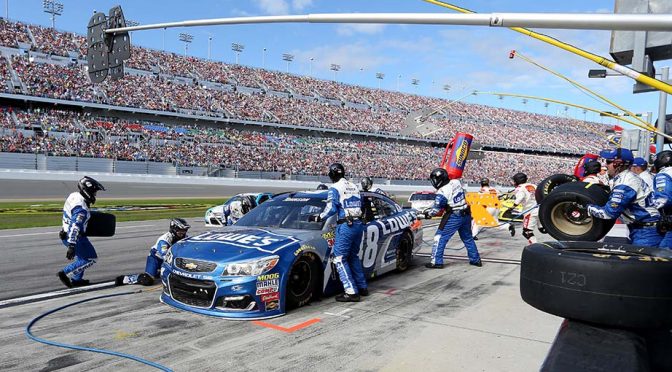
Sunday’s finish in the Daytona 500 didn’t just set a record for the closest finish. It also set a record for modern-day pit road infractions caused by pit crews, according to PitTalks.com data.
Each week, NASCAR notes penalties on pit road that occurred during the race, identifying if penalties were on drivers, teams or pit crews.
Sunday’s race in Daytona produced 12 penalties caused by pit crews. Since the inception of the camera system in 2015, the most penalties due to pit crews in a single race was nine (Fontana, Martinsville and Las Vegas).
Nine of the 12 pit crew penalties came from a crewman over the wall too soon, as teams seemingly seek to garner any advantage they can find during pit stops. The other three penalties were the result of an uncontrolled tire or as referred to on the infraction as outside half of the pit box tire violation/team member not in contact with the outside tires.
For more pit crew news, visit PitTalks.com.
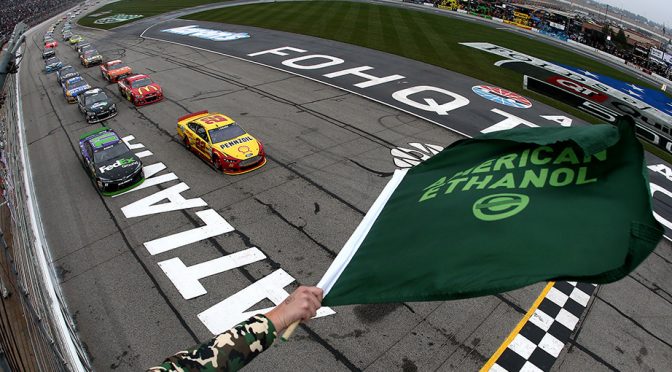
Chat with fans during the season-opening weekend at Atlanta Motor Speedway.
RELATED: Stewart gives health update | Full coverage of the ATV accident
Stewart-Haas Racing confirmed that Ty Dillon will be the interim replacement driver for Tony Stewart‘s No. 14 Stewart-Haas Racing Chevrolet for Sunday’s NASCAR Sprint Cup Series race at Atlanta Motor Speedway.
Another interim driver, Brian Vickers — who stepped in for Stewart during the Daytona 500 and finished 26th — will be behind the wheel at Las Vegas Motor Speedway, according to the team.
Stewart, who is out indefinitely with a broken back suffered in an all-terrain vehicle accident Jan. 31., called in to FOX’s pre-race show for the “Great American Race” to give a health update.
MORE: Listen to Stewart’s call here
“Honestly, every day just keeps getting better and better,” Stewart said. “I’m getting stronger and getting more mobile.”
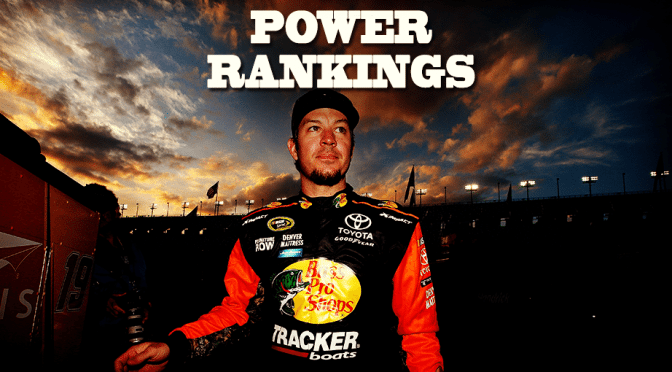

0
Joe Gibbs Racing
‘Rowdy’ led 19 laps and was integral to helping his teammate pick up his first Daytona 500 crown. Solid first day back at work for the champ.
Harvick was blocked by eventual Daytona 500 winner Denny Hamlin on the final lap, taking away any shot the 2014 champ had at a race win. Still came home with a top-five, though.

2
Joe Gibbs Racing
It was already starting to feel like it may be Hamlin’s year, then he went out and gave us one of the most dramatic finishes to a Daytona 500 in history. Thirty-five race to go, but things are looking good for No. 11.

-1
No back-to-back Daytona 500 wins for Logano, but he nearly had that outside lane going to propel him to the checkered. Emphasis on "nearly."
Any questions about the manufacturer change for the No. 78 team can now be dispelled. It’s clear Truex has the full support from Toyota and — perhaps more importantly — Joe Gibbs Racing, his technical partner.

-2

Hendrick Motorsports
Johnson didn’t manage a top-10, but he reminded us why he’s a six-time champ after leading 18 laps and having one of the best saves of the afternoon.
Tough break for Kenseth, who appeared destined in the closing laps to pick up another Daytona 500 win. His first 2016 win should come sooner than later, given how strong JGR is as a whole.

-2
Hendrick Motorsports
Arguably the driver to beat throughout Speedweeks, Junior had to say goodbye to "Amelia" after the duo wrecked toward the end of the race. But man, were they a power couple.
Quietly strong during most of Daytona on-track activity, it’s looking like another solid campaign for Kurt Busch is in the works.

-2

Team Penske
Keselowski and teammate Joey Logano weren’t able to hook up in the draft as planned and it certainly didn’t do them any favors.
We know Larson likes big, wide tracks, but it hasn’t materialized at Daytona — until Sunday. Could this be a sign that the third-year driver is ready to take the next step?
Edwards really, really had to battle to get back into the top five, and it worked. Many pegged the veteran driver, in his second year at JGR, to make major moves this season.
As fast as Junior was, as much experience as Jimmie Johnson has, and where Chase Elliott started (on the pole), it’s hard to believe Kahne was the highest-finishing Hendrick driver, but it’s true.

3
Richard Childress Racing
The No. 3 car seems to always find its way into the top 10 at Daytona. Funny how that happens, isn’t it?

-2
Hendrick Motorsports
Tough break for Elliott, who had high expectations going into his first Daytona 500, starting from the pole. He’ll bounce back.
Newman is a pretty excellent plate racer and nearly snuck his way into the top 10. His bread and butter needs to be the intermediate tracks if he wants to inch towards his first title, however. He’ll get a shot this weekend at Atlanta.
The 2010 Daytona 500 winner did not come up big when the stakes mattered most, as we’ve grown accustomed to him doing.
We’ll see a lot of 15th to 20th-place finishes for Menard this season. It’ll keep him on the Chase bubble all year long.
Look past the 19th-place finish. Blaney had that No. 21 Ford running near the front quite often and nearly pulled off his own Trevor Bayne-type moment.
Almirola has gone from the routine 20th-place finishes, to 18th, to 15th. If he can make top-12s stick more often, he could be onto something.
Complete news and notes on all 40 drivers from the Daytona 500.
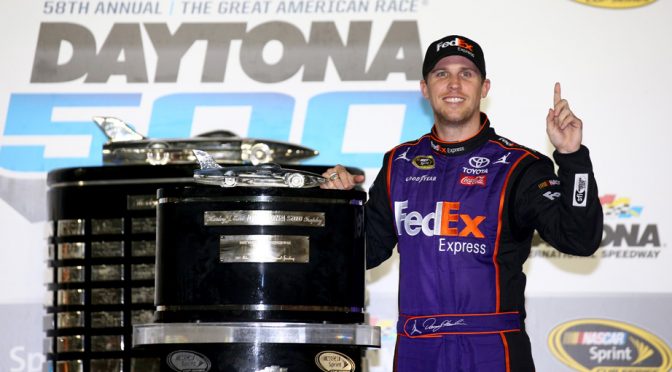
1. Denny Hamlin, No. 11 Toyota, Joe Gibbs Racing. The dominant car for much of Speedweeks, Hamlin was out front for 95 laps and used a huge last lap surge to clear his teammate Matt Kenseth, edge Martin Truex Jr. to the line and earn his first Daytona 500 victory in 11 tries. Grade: A+
2. Martin Truex Jr., No. 78 Toyota, Furniture Row Racing. Just inches away from his first Daytona 500 victory, Truex may be heartbroken, but he took his second-place finish in style and with class. Grade: A
3. Kyle Busch, No. 18 Toyota, Joe Gibbs Racing. One year after watching the Daytona 500 from the hospital, the defending Sprint Cup Series champion was a total team player and helped push the Joe Gibbs Racing charge to the front. Grade: A
4. Kevin Harvick, No. 4 Chevrolet, Stewart-Haas Racing. The 2007 Daytona 500 champion made an incredible save early in the race and provided the push that shoved Denny Hamlin to the front of the field on the last lap. Grade: A
5. Carl Edwards, No. 19 Toyota, Joe Gibbs Racing. The No. 19 Toyota looked like it went through 500 miles at Martinsville after getting caught in Brian Vickers‘ early race spin, but the team never gave up and Edwards was a factor late in the race. Grade: A-
RELATED: Edwards takes on damage
6. Joey Logano, No. 22 Ford, Team Penske. The 2015 Daytona 500 champion had a fast Ford, fought the handling for much of the race and helped form the high line late that won the race for Denny Hamlin. Grade: B
7. Kyle Larson, No. 42 Chevrolet, Chip Ganassi Racing. The quiet seventh-place finish for Larson was a huge improvement over his four previous Daytona starts, where he failed to finish better than 34th. Grade: B+
8. Regan Smith, No. 7 Chevrolet, Tommy Baldwin Racing. In his first start for Tommy Baldwin Racing, Smith overcame an early spin and an overheating engine in the closing laps to earn his first top 10 since Talladega Superspeedway in May 2013. Grade: B+
9. Austin Dillon, No. 3 Chevrolet, Richard Childress Racing.The driver of the No. 3 Chevrolet had a slow start to the day but was able to hang around and move through the pack when it mattered most to finish inside the top 10. Grade: B-
10. Kurt Busch, No. 41 Chevrolet, Stewart-Haas Racing. After missing last year’s Daytona 500, Busch was a factor toward the front of the field for much of the day and finished 10th. Grade: B
11. Ryan Newman, No. 31 Chevrolet, Richard Childress Racing. A dismal start of Speedweeks turned into an 11th-place finish for Ryan Newman, much better than they had performed all week. Grade: B
12. Aric Almirola, No. 43 Ford, Richard Petty Motorsports. The driver of the famed No. 43 ran mid-pack for much of Sunday’s Daytona 500, but was able to work his way to 12th in the final laps. Grade: B-
13. Kasey Kahne, No. 5 Chevrolet, Hendrick Motorsports. Kahne’s No. 5 Chevrolet showed speed throughout the day, but fell back when the field broke up off Turn 4 on the final lap of the race. Grade: B
14. Matt Kenseth, No. 20 Toyota, Joe Gibbs Racing. The driver of the No. 20 Toyota was leading the race in the final corner, tried to block Hamlin’s strong run and made an incredible save to avoid wrecking the field. The two-time “Great American Race” winner led for a total of 40 laps. Grade: A
RELATED: Kenseth reacts to heartbreaking ending
15. Michael McDowell, No. 59 Chevrolet, Circle Sport-Leavine Family Racing. McDowell stopped in the wrong pit stall, stalled the car, was pushed out by Ricky Stenhouse Jr., but was able to recover to finish inside the top 15. Grade: B-
16. Jimmie Johnson, No. 48 Chevrolet, Hendrick Motorsports. Starting in the rear with a backup car, the two-time Daytona 500 champion showed speed, led 18 laps, but fell back late after making an incredible save. Grade: B-
17. Jamie McMurray, No. 1 Chevrolet, Chip Ganassi Racing. The 2010 Daytona 500 winner was running mid-pack on the final lap and had to check up when Kenseth slowed off Turn 4. Grade: B-
18. Paul Menard, No. 27 Chevrolet, Richard Childress Racing. The Richard Childress Racing driver ran outside the top 20 for much of the race, ran inside the top 10 midway through the event, but then dropped back late in the going. Grade: C
19. Ryan Blaney, No. 21 Ford, Wood Brothers Racing. The highest-finishing rookie showed strength throughout the day, but faded late in the 200-lap event after a loose wheel mired him in the pack. Grade: B-
20. Brad Keselowski, No. 2 Ford, Team Penske. The Team Penske driver fought the handling of his No. 2 Ford throughout the race, tried to make the high line work on the final lap, but fell back. Grade: C+
21. AJ Allmendinger, No. 47 Chevrolet, JTG Daugherty Racing. Not the start to the season Allmendinger was hoping for, as he ran outside the top 25 for much of the race. Grade: C-
22. Ricky Stenhouse Jr., No. 17 Ford, Roush Fenway Racing. Stenhouse was stuck behind McDowell on pit road midway through the race, was in the wrong lane at the end, but was still the highest-finishing Roush Fenway Racing driver. Grade: C
23. Landon Cassill, No. 38 Ford, Front Row Motorsports. Starting 24th, Cassill ran midpack for much of the event and finished one spot ahead of where he started. Grade: C
24. Brian Scott, No. 44 Ford, Richard Petty Motorsports. The rookie driver took a conservative approach at the end of Sunday’s race, trying to avoid a wreck and finished outside the top 20 as a result. Grade: C
25. Ty Dillon, No. 95 Chevrolet, Circle Sport-Leavine Family Racing. Making his second Daytona 500 start, the younger Dillon worked his way to the top 10 just before halfway, but faded deep in the pack late in the race. Grade: C
26. Brian Vickers, No. 14 Chevrolet, Stewart-Haas Racing. Filling in for Tony Stewart, Vickers spun on Lap 56, avoided any damage and fought back to the top 10, but was caught in the high line late and fell through the pack. Grade: B+
RELATED: Vickers spins out, but rallies
27. Michael Annett, No. 46 Chevrolet, HScott Motorsports. Annett ran outside the top 30 for much of the day, but was able to make some moves and work his way to 27th by the end of the race. Grade: C-
28. Trevor Bayne, No. 6 Ford, Roush Fenway Racing. The 2011 Daytona 500 winner was involved in an early incident with Carl Edwards and was never able to make a charge to the front. Grade: C-
29. David Ragan, No. 23 Toyota, BK Racing. Ragan raced his way inside the top 20 throughout the race, but was never a factor and fell to the back of the pack on the final run to the checkered flag. Grade: C-
30. Michael Waltrip, No. 83 Toyota, BK Racing. The two-time Daytona 500 winner struggled throughout the day on pit road, receiving multiple penalties. Grade: D
31. Bobby Labonte, No. 32 Ford, Go Fas Racing. Starting 33rd, the 2000 series champion rarely broke out of the top 30, finishing the day 31st. Grade: D
32. Casey Mears, No. 13 Chevrolet, Germain Racing. Mears was hit with a pit-road speeding penalty under green and hit a large piece of debris with the hood and windshield. Grade: C-
33. Clint Bowyer, No. 15, HScott Motorsports. In his debut with HScott Motorsports, Bowyer struggled for speed throughout Speedweeks and received a pit-road penalty late in the going. Grade: D-
34. Greg Biffle, No. 16 Ford, Roush Fenway Racing. Biffle had high hopes for the Daytona 500, but when the team put left side tires on the right side of the car, it led to a blown right rear and late contact with Danica Patrick ended any hope of a recovery. Grade: D-
35. Danica Patrick, No. 10 Chevrolet, Stewart-Haas Racing. Problems on pit road, heated conversations with the team over the radio and a wild ride through the grass after contact with Biffle made her Daytona less than memorable. Grade: D
36. Dale Earnhardt Jr., No. 88 Chevrolet, Hendrick Motorsports. One of the strongest cars all of Speedweeks, Earnhardt was charging to the front when his car — penned “Amelia” — broke loose and slid into the inside wall with 31 laps to go. Grade: B-
RELATED: Junior’s day ends early after hitting wall
37. Chase Elliott, No. 24 Chevrolet, Hendrick Motorsports. After a strong start for the rookie pole-sitter, Elliott lost control of his No. 24 (off Turn 4) on Lap 18. The infield grass destroyed the front end of Elliott’s car and ended his hopes of a solid finish. Grade: C-
38. Robert Richardson Jr., No. 26 Toyota, BK Racing. The underdog story of Daytona ended up finishing two spots ahead of where he started, and Richardson stayed out of trouble throughout the day. Grade: D+
39. Chris Buescher, No. 38 Ford, Front Row Motorsports. Buescher’s rookie campaign did not get off to a great start as he was caught up in a Lap 91 incident with Matt DiBenedetto, taking a huge hit in the process. Grade: C-
40. Matt DiBenedetto, No. 93 Toyota, BK Racing. Making his first Daytona 500 start, the BK Racing driver had a hard hit into the Turn 1 SAFER barrier and took blame for the incident. Grade: D
RELATED: Full results from Daytona | Read Denny’s childhood Daytona note
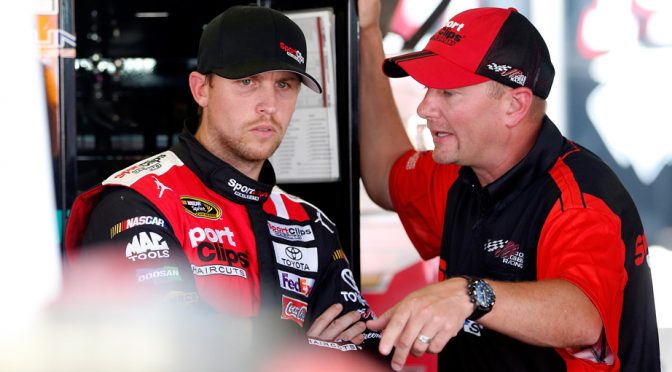
DAYTONA BEACH, Fla. – Denny Hamlin knew he wanted Mike Wheeler to be his crew chief, and Wheeler knew he wanted to be Hamlin’s crew chief. But until the 2016 season, neither got their wish.
Now, after winning NASCAR’s season-opening Daytona 500 on Sunday, folks might be asking, ‘What took so long?’
Wheeler is Hamlin’s fourth crew chief in the Sprint Cup Series, taking over the helm of the Joe Gibbs Racing No. 11 team in late December of 2015. The move came only after Wheeler, previously the lead engineer for Hamlin, served a year toiling in the XFINITY Series, heading up the No. 20 entry for JGR. The two were close, even if it wasn’t Wheeler on the box calling the shots on race day at the Sprint Cup level.
Close enough that Hamlin practically promised Wheeler the job. A bit prematurely, it seems.
“I said, ‘Down the line we’re going to work together,'” Hamlin recounted after Sunday’s win. “I knew he had aspirations to be a crew chief in the Cup Series. You can only be a great engineer for so long before other teams are going to come knocking.
“(Team owner) Joe (Gibbs) gave him that opportunity in the XFINITY Series. Even though I probably premature promised him the job a little soon, you know, I was happy that Gibbs said, ‘Let’s just take you through the same process that all of our other crew chiefs had.’
“I’m glad he was only gone for a year.”
Hamlin scored his 27th victory here on Sunday. He’s won with each of the crew chiefs with whom he has worked – Mike Ford, Darian Grubb, Dave Rogers and now Wheeler.
“When Mike Ford left (after 2011) and Darian came on board, it was a big timeframe there that Darian didn’t know the JGR stuff,” Wheeler said Monday during the annual champions’ breakfast at Daytona International Speedway. “So they put me in more of that kind of a deal. I got to do more and I was happy with that because I felt like I could show what I could do. I think Denny saw that. And that was the same timeframe that he was like ‘OK, Wheels knows what he’s talking about and can run this team, but Darian is the leader.’
“Year after year, I wanted to become a crew chief, but I was happy being with Denny Hamlin and Joe Gibbs Racing and with Darian running the team, we were winning races and competing for championships. You couldnt ask for much more than that.”
“It’s a pretty good story,” team owner Joe Gibbs said. “Really and truly, that’s been in play for probably four years. He obviously was the lead engineer with Denny. Really what would happen is many times at the race track, my understanding was, Denny would talk to the crew chief but he also would turn and talk to Wheels. They developed this relationship.”
But Gibbs wanted Wheeler to season a bit before handing him the reins of a Sprint Cup team.
“I was thinking maybe two years or something because what you worry about with an engineer, now they take over all the people stuff when you become a crew chief,” Gibbs said. “Now you’ve got to work with a lot of people; the job requirements take on a different (look).
“We’d had such good fortune with Jason (Ratcliff) and Dave, having those guys go through XFINITY, so it took some talking. But really, he thought about it I think for his career, he wanted to be a crew chief, he said OK.”
Going to the XFINITY Series was a risk, Wheeler said, admitting, “I wasn’t excited about doing it.”
While it was a way to further prove himself, he said it was also possible to get “lost in the program.
“If you get subpar results with average drivers, that’s what happens sometimes, I know you can get lost in the mix. So I was kind of scared doing that. But I knew Denny would have my back.”
The experience and the feedback from other drivers convinced Gibbs that Wheeler was ready to move up.
“When you go down there … he gets to work with almost all the Cup drivers,” Gibbs explained. “When Matt (Kenseth) went down there for one of the very first races with him, Matt got out of the car and came and told me ‘That guy’s good.’
“He’s worked with Kyle (Busch), he’s worked with Denny. And when you go through that process trying to please those guys that know what’s going on, and you start getting feedback from them that ‘hey, this guy’s really good,’ it gave us real confidence. I think it was a good year for him.”
David Wilson, President and General Manager for Toyota Racing Development, USA, said Wheeler is “the perfect example” of how JGR uses the ladder system to bring talent to the Sprint Cup level.
“A lot of people look at things like the XFINITY Series as just the XFINITY Series, but it’s also a means to an end,” he said. “And the end is to build the strongest Cup team possible. So they invest in their people. They invest in these young engineers who demonstrate their commitment, their work ethic. You go down the list – Mike Wheeler, Dave Rogers, Jason Ratcliff. All of these young, talented engineers, they came up through the ranks, first as race engineers and if they prove their capability then they’ll give them a shot at the XFINITY level.
“It’s their first chance to really not just engineer the race cars but engineer the team, build the team. What’s neat about Wheels is he has graduated now; he’s been a great leader and I’m so happy for him because he’s put in the work, paid the dues, the blood, sweat and tears to achieve this level of success.”
That he and Hamlin have similar backgrounds, are close in age and came into the series at roughly the same time helped build the foundation of their current relationship, Wheeler said.
“We grew up together,” he said. “(Denny) just came in in the same timeframe, we were both mid-20s and in a sport that had a lot of older people at the time so it was very easy to become buds.
“I don’t know if it’s who I am versus who he is or just a good solid match. But we have that mutual respect. He’s trusted my judgment for a long time now.”
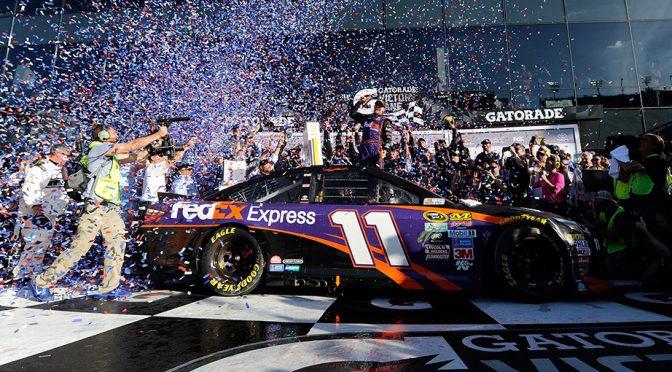
RELATED: Full race results | Hamlin celebrates in Victory Lane
DAYTONA BEACH, Fla. — There was the victory at Indianapolis Motor Speedway last season, the no longer lame Kyle Busch winning the Brickyard 400.
And the NASCAR Sprint Cup Series championship that followed at season’s end, once again courtesy of Busch and the Joe Gibbs Racing organization.
Another milestone was reached here Sunday as Denny Hamlin, also of JGR, made a last-lap pass of teammate Matt Kenseth to capture the season-opening Daytona 500.
Toyota. Toyota. And Toyota.
A first Brickyard title; a first Sprint Cup title; and now a first Daytona 500 title.
An automaker that admittedly struggled to find its footing when debuting in the Sprint Cup Series a decade ago suddenly is running out of accomplishments to cross off the list.
Not so fast, cautions David Wilson, President & General Manager, Toyota Racing Development, USA.
“I don’t think you ever stop checking the boxes,” Wilson said. “But today, the Daytona 500, the ‘Great American Race’ was the only race that Toyota had not won.
“We’re going to take a few hours to try and soak this in and live in the moment. But then it’s back to work tomorrow because we’ve got another season to start. This is the plate race, and now we go to Atlanta where we’ve got to run our new open stuff and see how we stack up.”
It was a significant victory for Toyota, which backs the four-team JGR effort (Busch, Hamlin, Matt Kenseth and Carl Edwards) and the single-car unit of Furniture Row Racing. Bigger than the Indianapolis 500 victory scored by Gil de Ferran in 2003 in a Team Penske entry powered by the automaker, according to Wilson.
RELATED: Truex Jr. inches away from win | Drivers react to thrilling finish
“This is very difficult for me to put in words,” he said. “I cannot articulate adequately what this means to Toyota. I’ll start by saying it’s our single biggest race in our company’s history. I’ll put it in front of the Indy 500, which was a pretty special one back in 2003.”
Toyota not only won the race, the first of 36 points races for the Sprint Cup Series this season, but its teams took four of the top five spots. For much of the race, those teams ran either 1-2-3 or 1-2-3-4. It was that kind of day.
Hamlin, Kenseth, Busch and Truex combined to lead 156 of the race’s 200 laps.
Until someone comes along to top it, history will show that the closest finish in Daytona 500 history featured a pair of Toyota Camrys crossing the finish line side-by-side.
MORE: Closest finishes in 500 history | See the finish | View from Harvick’s car
It was a far cry from 2007, when Toyota teams rolled out for the first time in a Sprint Cup event here. Of the eight teams carrying the nameplate in that year’s race, only four managed to qualify and none finished higher than 22nd.
Wilson called that debut “incredibly humbling.”
“But we didn’t expect to succeed either,” he said. “Obviously … when we started Cup racing, the fans were apprehensive. I think it was a polarizing issue, Toyota being here in the sport. I think our struggles — it so much humanized us and showed everybody that we’re going to have to work as hard as anybody.
“Nothing comes easy. The level of competition that this sport has amongst the teams and engineers is unlike anything we’ve ever seen, including CART and IndyCar.”
Sunday, the hard work and the long hours and the team alignments and everything else that you see and much of that which you don’t finally came together.
It came together for Hamlin, for Joe Gibbs Racing and for Toyota.
Another milestone achieved, another box checked.
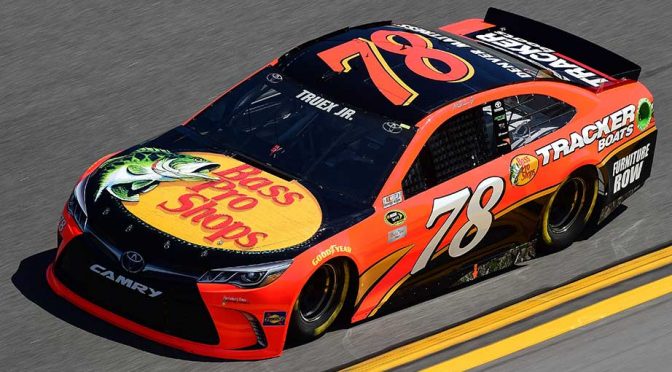
RELATED: Watch the live stream here
From 8-11 a.m. ET on Tuesday, NASCAR.com will live stream the post-race inspection process.
The three-hour look takes you behind the scenes as NASCAR officials inspect NASCAR Sprint Cup Series vehicles following Sunday’s Daytona 500 at Daytona International Speedway.
The cars being inspected this week are: the No. 78 Toyota of Martin Truex Jr. (finished second in Sunday’s race), the No. 4 Chevrolet of Kevin Harvick (finished fourth in Sunday’s race) and the No. 22 Ford of Joey Logano (finished sixth in Sunday’s race).
For more information on what the inspection process entails, click here.
EARNHARDT NATION is the story of one of NASCAR’s most famous families, from dirt-track racer Ralph to American legend Dale to NASCAR icon Dale Junior. The book is the first to trace the entire history of the Earnhardt family, from Ralph’s first days working under a hood to Dale Junior’s 2015 Sprint Cup campaign, and everything in between. EARNHARDT NATION is available at bookstores everywhere, or online at Amazon, Barnes & Noble and all other booksellers. Author Jay Busbee is on Twitter at @jaybusbee and on Facebook at facebook.com/jaybusbee.
In this excerpt, we get a look at the lighter side of Dale Earnhardt, the prankster side:
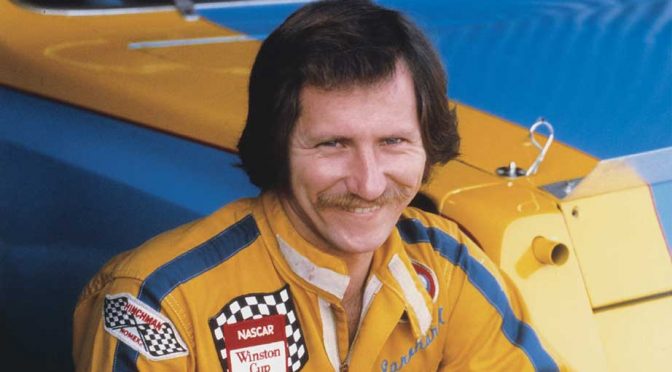
Woe to the reporter who entered Dale Earnhardt’s domain on anything less than high alert. He was an inveterate prankster, and the garage was his theater.
“You never knew what to expect from him, and that was deliberate,” Fox Sports’ Matt Yocum said. “He wanted you off balance around him. I would be interviewing him and he’d be stomping on my foot or poking me in the ribs, out of the camera’s view. I couldn’t let on, of course, and he was having a great time.”
Any cameraman who tried for the NFL Films-style “hero shot” — shot from below as the cameraman walked backward — was in for a treat. Earnhardt regularly walked those cameramen into people’s legs or the backs of cars. He’d throw balls of tape at the camera, he’d grab a headset from a pit reporter and begin berating whoever was back in the studio.
“Every time you’d start laughing,” Fox’s Steve Byrnes said, “he’d say, ‘Why aren’t you taking this seriously?’ “
ESPN reporter Ryan McGee found out the hard way that earnestness made you an easy target. As a young reporter in 1997, he was headed for a date when his bosses asked him to swing by Charlotte Motor Speedway for some interviews. Earnhardt asked McGee why he was dressed so sportily, and McGee made the crucial mistake of mentioning that he was on his way to a date. As McGee was leaving, Earnhardt gave him a hearty slap on the back and wished him good luck. During the date, McGee discovered Earnhardt had dipped his hand in oil and left smears down the back of McGee’s crisply laundered shirt.
In the early 1980s, Eddie Gossage, now the president of Texas Motor Speedway, was leaving Bristol, the track where he then worked as a promoter. He was driving 60 miles per hour down 11E, the Tennessee highway that runs past the track, when he someone slammed his back bumper. “I looked in the rear-view mirror, and I saw those beady eyes,” Gossage said later, laughing. “Earnhardt was right on me, an inch off my bumper. What was I going to do? I wasn’t going to brake-check him, and no way I could outrun him.” Earnhardt, grinning all the way, didn’t leave Gossage alone until he reached his driveway.
Once, Earnhardt, Richard Childress, Bill France Jr., and NASCAR president Mike Helton were on a trip to Monaco when Earnhardt decided he wanted to drive the famed Formula 1 course there. Problem is, the course runs on public roads, and those roads that day were very public. Even so, Earnhardt whipped their rental car through the streets of Monaco like some Southern-fried James Bond. “No matter how he would drive,” Helton recalled, “you always felt like he was in control. There was something serene about him behind the wheel.”
Earnhardt tossed a rubber snake at Helton on a camping trip. He threw country music star Kix Brooks into the ocean off the Bahamas. At one champions’ weekend in New York at the Waldorf, he and Kenny Schrader raided the maids’ closet and bricked up the doorway of then-NASCAR VP Jim Hunter with towels. He handcuffed Geoff Bodine to a hotel railing in Louisville. He left Budweiser on the bed of Rusty Wallace, who was devoted to his sponsor Miller Lite, every time Wallace stayed on Earnhardt’s boat. He dumped a can of sardines under Wallace’s seat just before the Southern 500 on a day temperatures reached the ’90s. He’d hang out in the Talladega credentials office and tell unsuspecting reporters who called in that Talladega didn’t need their coverage and they didn’t need to bother coming to the track.
He also loved tweaking the fans. Many hung around outside the walls of the Garage Mahal, waiting for a glimpse of Earnhardt. He’d ride back and forth on his tractor, working the land and waiting to see how long it would take the fans to pick up on his presence. He once did a promotion for Darlington right in front of Daytona International Speedway, holding up a sign that read NEED TWO TICKETS TO DARLINGTON as astonished motorists drove by. While on hunting trips, he’d walk into a remote gas station somewhere in the middle of Alabama, and people would say, “You know who you look like?”
“When you would hang out with Dale,” former crew chief Larry McReynolds recalled, “you didn’t need your brain. You could take it out and let it rest. I’d go have dinner with him, and it’d be, ‘Don’t sit there, sit over there. Eat more of that. Why do you eat that first? Teresa, get him some more of that. You need to drink water. Drink some more water.’ I’d come back from dinners with him exhausted.”
But probably his rankest prank came at Bristol, when Earnhardt spotted Childress entering a portable toilet in the infield. He climbed in his truck, quietly rolled up to the plastic-walled toilet, and began gently tapping the front bumper of the truck against the door. Then he started striking harder and harder, until the entire toilet itself nearly fell over.
“DAMMIT, DALE,” Childress shouted as he stormed out of the john, but soon he was laughing along with Earnhardt because, well, what else could he do?