NASCAR’s warm embrace of innovation was about to send out a pivotal trial balloon. The snazzy new Pit Road Officiating (PRO) system had been thoroughly tested and troubleshot, closing in on its goal of implementing technology to make officials’ jobs more efficient and safer and to better enforce pit-road penalties.
Still, there was a natural anxiety among the sanctioning body’s competition officials ahead of its grand debut.
“Just a common, normal apprehension,” Chad Little explained, adding with understatement, “and just a little thing called the Daytona 500.”
Little, named to the new role of NASCAR’s managing director in charge of technical inspection and officiating just 20 days ahead of last year’s season-opening Great American Race, wasn’t alone in sharing some mild anxiety. Media were given a tour of the then-nondescript trailer in the offseason, complete with a demonstration of the eight workstations where officials would cycle through double-time video footage to verify potential penalties against laser-mapped telemetry — all in close to real time. There weren’t vocal doubters, but uncertainty remained about how the system would work in real race conditions.
RELATED: See photos from that tour
Each event has its own importance, but with the maiden voyage taking place in stock-car racing’s Super Bowl, the stakes were plenty high.
“We’re going into Daytona every year for our biggest race with not necessarily on pins and needles, but we’re geared up, we know that we can do the job, but we’re always thinking about the ‘what-ifs,’ and I’d be lying if that wasn’t the case going into last year with the PRO system,” said Jim Cassidy, NASCAR Senior Vice President of Racing Operations. “But we had redundancies, we had a plan in place … for every scenario that we can imagine, but at the same time we know there’s also the unknown.
“Sometimes what we’re the best at is dealing with things as they come along. In that case, fortunately, we enjoyed the fruits of it and it was more fine-tuning than dealing with any major issues, which is a credit to everybody involved.”
The PRO technology, which returns for its second year with a much higher comfort level entering next month’s Speedweeks at Daytona International Speedway, was on display earlier this week at the NASCAR Summit, the industry’s annual preseason convention for track services, medical, safety and security workers. The record number of almost 900 attendees for the Summit’s 15th year had the opportunity to tour the PRO trailer firsthand and learn about its intricacies.
It turns out that many of those worries heading into 2015 were unfounded. All of the system’s fail-safes performed as expected, and fears that the Pit Road Officiating trailer would be especially nitpicky in identifying infractions never materialized: Last year’s Daytona 500 tallied 29 pit-road violations, compared to 31 for the previous season and 28 in the year before that. The races that followed took a similar pattern.
“We were pretty much really comfortable with everything, but going into Daytona, we were concerned that what if we have 100 penalties,” Little said. “We don’t want to bog down the race with a bunch of travelling calls. We were real mindful of that, but we didn’t know exactly what we had because it’s a brand-new system. Those things develop throughout the year, but thank gosh we didn’t have any stumbling blocks at Daytona.”
WATCH SYSTEM IN ACTION: Footage of over-the-wall penalty for No. 88
Learning logistics
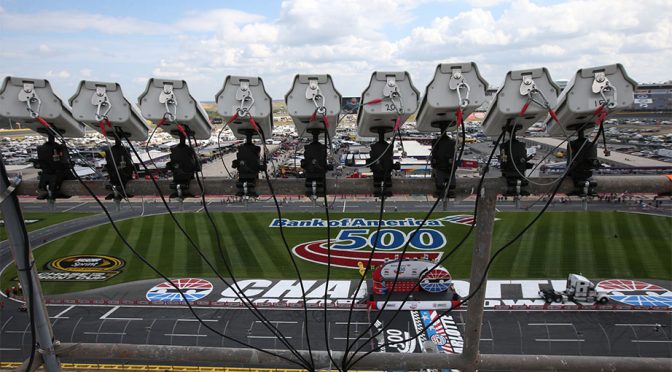
Attendees at Monday’s sessions at the NASCAR Summit received guidelines about how to best prepare their tracks for year two of the Pit Road Officiating structure. The seminar stressed the importance of uniformity in painting the bordering lines to pit boxes and the need to coordinate with NASCAR officials when mounting the 50 cameras that capture pit stop footage during the course of a race.
Adhering to those instructions tends to make life easier for George Grippo, NASCAR’s managing director of technology field and media operations. Beyond the PRO system, his responsibilities include the logistics of the trackside TV compound, timing and scoring, user support and maintenance and all the wiring, cables and power needed to make the technology go.
The biggest learnings from PRO’s first season, Grippo said, were that camera placement is paramount and that every track presents its own set of obstacles. Bristol Motor Speedway, for instance, had an accommodating roofline but cameras were mounted at much higher angles than a larger track such as Michigan International Speedway, where cameras were placed over the top row at the back of the grandstands at a greater distance. At Sonoma Raceway, cameras were located on a makeshift mount on heavy scissor-lift equipment aimed at pit road.
In each instance, working with tracks became imperative.
“Every time we went to a new place, it was a challenge,” Grippo says. “I think now we’ve kind of gotten that stuff dialed in, but first-year growing pains were all around, trying to figure it out on the fly — and you don’t have a lot of time.”
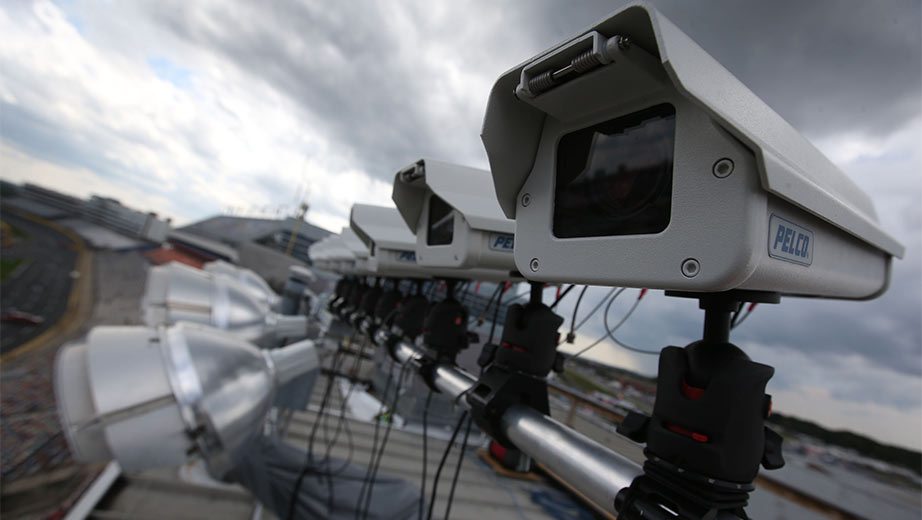
That part of the process figures to be easier in the second year; each eight-pound camera is packed up after a race weekend, but in most cases the custom-made mounts stay behind, ready for the next event.
But even as NASCAR officials learned more about the PRO system’s nuances, teams also picked up a few tricks of the trade. Among them, Grippo said, was the practice of wearing uniforms or shoes that matched the color of pit road — from off-white concrete to the darker grays from more freshly laid asphalt. The lack of contrast, Grippo explained, could potentially help crewmembers muddle officials’ task of determining whether a team member has come over the wall too soon.
“The teams are no dummies,” Grippo said. “They see the video, too, because we provide that video for them as a training piece. They can figure some of that stuff out. If I’m going to Dover, I’m wearing a white sneaker so that nobody can tell that I’m hitting the concrete versus a black shoe. They don’t do anything to help us, that’s for sure. They get smarter as we go along.”
One newfound advantage for officials is the use of footage to better explain to crew chiefs why certain rulings were made. Some calls, Little said, remain subjective but that video replays — delivered to teams atop the pit box in just a handful of minutes — typically help to clarify any disputed infractions. And the PRO system isn’t solely a watchdog; teams are able to download its pit-stop footage typically the day after a race for use as a training tool.
The system wasn’t without its fluky hiccups — the flyover pilot at one race who opened the back of a camera out of curiosity, the vapor-locked backup generator at another track and the occasional camera replacement to name a few — but because of the widespread use of redundant cameras, backup power generators and other safeguards, no race-altering issues crept up.
The goal for the new style of Pit Road Officiating was to seamlessly blend into the flow of a race, much like the adage of how the best referees are the ones you don’t notice. After 36 Sprint Cup points races last season, the system’s naysayers were relatively few.
“You’ve got the capability of our officiating team to take what they know and what they applied when they went over the wall and apply it to the PRO trailer in a way that buttons us up even further,” Cassidy says. “To get through season one and not have stories about it in any other way but to expose a positive approach, the tie-in with technology and letting our folks do what they are very good at but do it in a different way, it was impressive.”
Year two and beyond
With any remnants of 2015’s opening-day stage fright in the rear view, the Pit Road Officiating trailer enters its second year on steadier ground, thanks to a season’s worth of reps.
What’s next for 2016? Any advances in technical know-how as part of the never-ending search for enhancements at the NASCAR Research & Development Center may tell the tale.
“We get our best people that are available to manage the races from a pit-stop standpoint and we’ll continue to do that,” Little said. “From a technology standpoint, we continually look at faster and more efficient ways to look at the pit stops. But I think we’re entering the second year with more comfort in what we have to make it better and take advantage of that technology, because we just touched the tip of the iceberg.”
New challenges abound, especially at tracks where construction projects will make camera-mounting alterations necessary, but the strides made with the PRO system in its debut season have already secured a firm foundation.
“We were pretty fortunate,” Grippo says. “There were a lot of people that thought the thing wasn’t going to work. They were scratching their heads trying to figure out how we kept it going all year long. I think our greatest compliment was (NASCAR vice chairman) Mr. (Mike) Helton saying it looked like we’d been doing this thing for 10 years. If we can pull that off with all the technology we’re putting out there, we’re in a good spot.”