Final practice recap | Final practice results


Martin Truex Jr
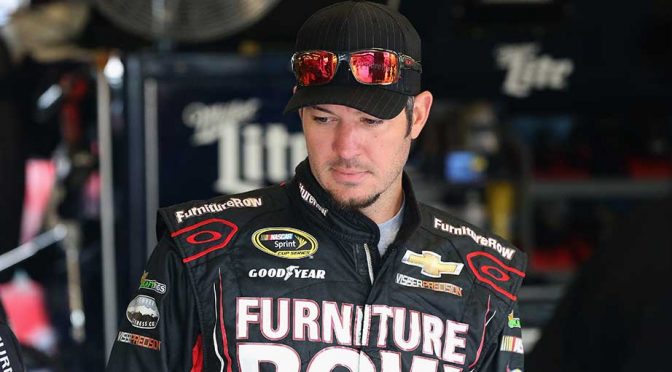
. topped the final Chicagoland Sprint Cup Series practice on Saturday with a top speed of 184.849 mph on Lap 1 of 35. Truex Jr. also led Saturday’s earlier practice session.


Brad Keselowski was second-fastest in the final session at the Illinois track (183.986 mph).


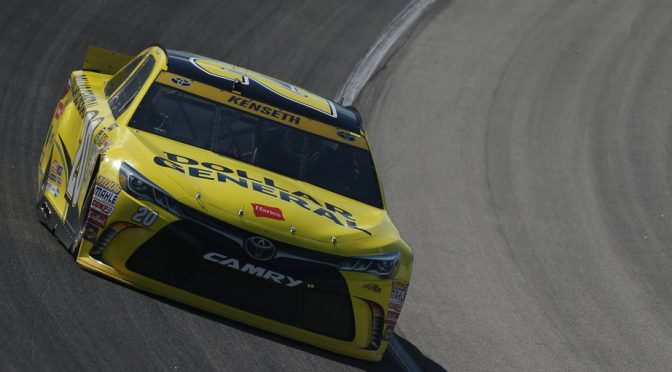
Matt Kenseth (183.949 mph), Carl Edwards (183.799 mph) and Kyle Larson (183.723 mph) completed the top-five fastest drivers.

Larson and Austin Dillon (183.020 mph) were the only non-Chase drivers in the top 10.

Polesitter for Sunday’s race Kevin Harvick was 14th-fastest (182.217 mph).


The slowest Chase driver in the field was Joey Logano who came in as 23rd-fastest (180.886 mph).


The Sprint Cup Series returns to the track Sunday at 3 p.m. ET for the myAFibRisk.com 400 (NBCSN/Live Extra, MRN, SiriusXM NASCAR Radio). 


Practice 2 recap | Practice 2 results


Martin Truex Jr
. topped the second-to-last Sprint Cup Series practice on Saturday at Chicagoland Speedway with a high speed of 183.312 mph. The Chase for the NASCAR Sprint Cup driver will start fourth in Sunday’s race.

Coming up short to the Furniture Row Racing driver was Denny Hamlin (182.389 mph).

Jeff Gordon (181.830 mph), Austin Dillon (181.616 mph) and Brad Keselowski (181.580 mph) completed the top-five fastest drivers.

Dillon and Sam Hornish Jr. (181.257 mph, seventh-place in practice) were the only two non-Chase drivers in the top 10.

Polesitter for Sunday’s race Kevin Harvick was 11th-fastest (180.977 mph).

The slowest Chase driver in the field was Jamie McMurray, who came in 23rd (179.665 mph).

The Sprint Cup Series returns to the track at 4:30 p.m. ET for final practice on NBCSN before Sunday’s myAFibRisk.com 400 (3 p.m. ET, NBCSN/Live Extra, MRN, SiriusXM NASCAR Radio).

RELATED: Full starting lineup

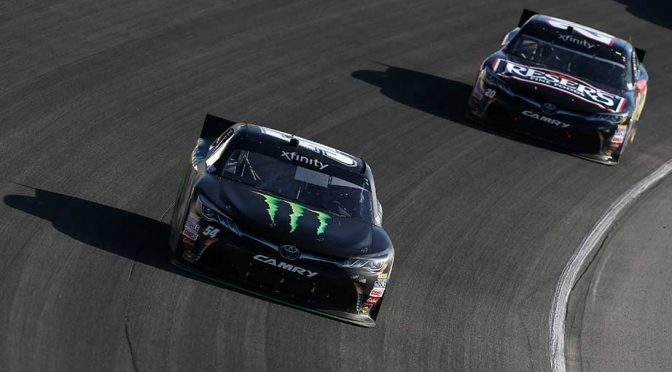
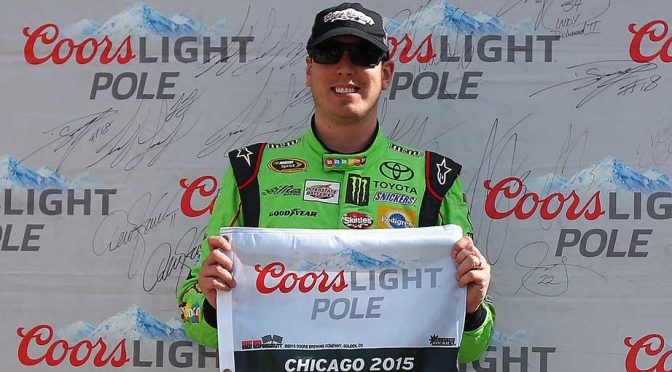
Kyle Busch used a fast lap of 180.959 mph in the final round of group qualifying for the NASCAR XFINITY Series to take the Coors Light Pole Award at Chicagoland Speedway for Saturday’s Furious 7 300 (6 p.m. ET, NBCSN, MRN, SiriusXM NASCAR Radio).

The pole is Busch’s third of the season in the XFINITY Series and the 46th of his career in the series. In 11 starts at Chicagoland, Busch has three wins, seven top fives and now two poles at the 1.5-mile track.

Busch is looking to make it Chicagoland sweep for the No. 54 team in the XFINITY Series. Erik Jones won the June standalone event at Chicagoland piloting the No. 54 Toyota to Victory Lane.

Busch’s Joe Gibbs Racing teammates Matt Kenseth and Daniel Suarez made it a clean sweep of the top three spots in the starting lineup. Kenseth (180.844 mph) will line up in the front row with Busch, while Suarez (180.542 mph) will line up in the third position.

Ty Dillon (179.922 mph) will join Suarez in Row 2 for the start of the race. Ryan Blaney (179.892) and Kyle Larson (179.736 mph) will comprise Row 3.

Entering Saturday’s race, Chris Buescher holds a 21-point edge over defending series champion Chase Elliott and a 27-point lead over Ty Dillon. Elliott did not advance to the final round of group qualifying and will start 17th, while Buescher will line up eighth.

Morgan Shepherd did not qualify for the race.

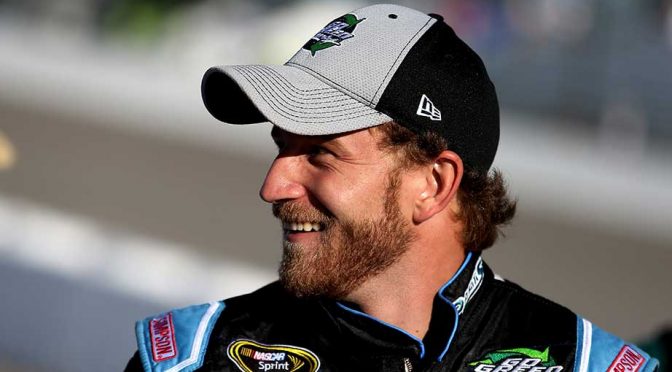
Jeffrey Earnhardt signed a multi-year deal starting with the 2016 season to drive in the NASCAR Sprint Cup Series with Go FAS Racing.

Earnhardt, 26, will pilot the No. 32 Ford Fusion and Can-Am will be on board to serve as a primary sponsor for 11 events and an associate-level partner for all other events in 2016.

“I’m really excited to join GFR,” Earnhardt said in a release provided by the team. “I’m thrilled to have Can-Am on board as our partner for 2016. I’m an avid outdoorsman and their products are the gold standard for outdoor sports, so it’s a perfect fit. With Can-Am supporting our team we’re certain to increase our competitiveness throughout the 2016 season.”

Earnhardt will compete for the NASCAR Sprint Cup Series Sunoco Rookie of the Year award.

Veteran driver Bobby Labonte will also drive several events in the No. 32 Ford.

“We are all really excited about this new partnership with Can-Am and Jeffrey Earnhardt for 2016″, team owner Archie St. Hilaire said in a release. “This deal will improve our program and make us much more competitive in the upcoming season while giving Jeffrey all the tools he needs to succeed at this level. 2016 can’t come soon enough for myself and everyone at GFR.”

The Mooresville, North Carolina native made his Sprint Cup debut at Richmond earlier this month, finishing 40th in the Federated Auto Parts 400. He was on the entry list for the Sylvania 300 at New Hampshire Motor Speedway (Sept. 27, 2 p.m. ET, NBCSN, PRN, SiriusXM NASCAR Radio).

For his career, Earnhardt has made 66 starts in the NASCAR XFINITY Series and 10 starts in the NASCAR Camping World Truck Series.

Earnhardt is the grandson of the late Dale Earnhardt, nephew of Dale Earnhardt Jr. and the son of Kerry Earnhardt. Kerry made seven starts in the Sprint Cup Series, 72 starts in the XFINITY Series and 27 starts in the Camping World Truck Series. The Richmond race that Jeffrey ran marked the first time two Earnhardts were competing in the Sprint Cup Series in over a decade.

The team also announced in a release that Go Green Racing will be competing under the Go FAS banner starting with Daytona Speedweeks in 2016.

RELATED: Complete Sunday schedule | Chicagoland starting lineup


Race day info


What:
15th annual myAFibRisk.com 400

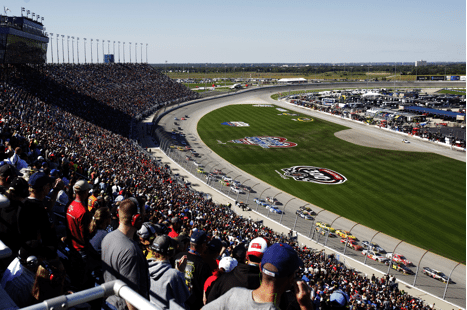
Where: Chicagoland Speedway, 1.5-mile oval in Joliet, Illinois. | Learn more about the track 

Green flag time: 3:16 p.m. ET (NBCSN, MRN, SiriusXM NASCAR Radio).

Forecast: Sunny, high of 71 degrees, 0 percent chance of rain, according to the National Weather Service.

National anthem: By tenor Jim Cornelison (@Anthem_Singer), longtime singer of “The Star-Spangled Banner” for the NHL’s Chicago Blackhawks.

Grand marshals: Billie Jean King, 39-time Grand Slam champion in women’s tennis; Jerry West, 14-time NBA All-Star.

Distance: 267 laps, 400.5 miles.

Pit road speed: 45 mph.

Caution car speed: 55 mph.

Fuel window: 54 laps.

On the front row


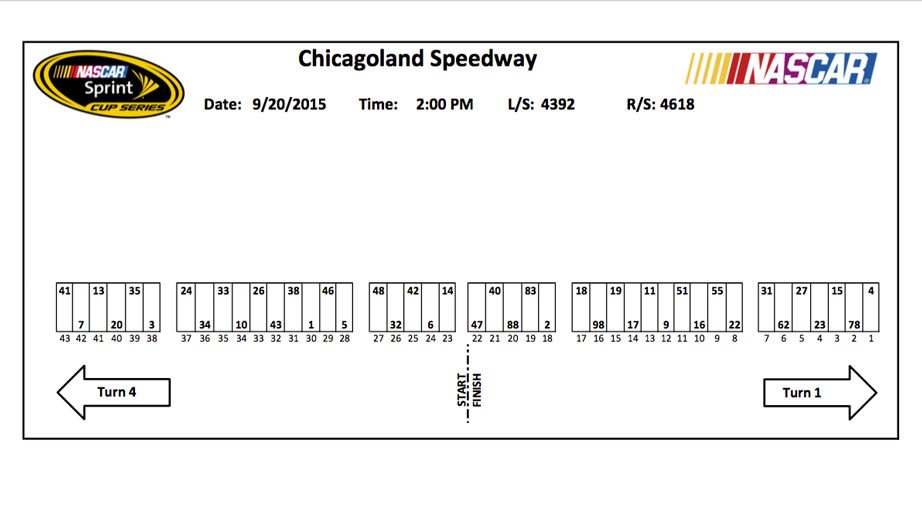
(no qualifying speed; starting lineup determined by NASCAR Rule Book, based on speeds in first practice)

1. Kevin Harvick, Stewart-Haas Racing No. 4 Chevrolet.

2. Joey Logano, Team Penske No. 22 Ford.


RELATED: See the full lineup

Fastest in practice


First practice:
Kevin Harvick, Stewart-Haas Racing No. 4 Chevrolet (188.317 mph). | Results

Second practice: Martin Truex Jr., Furniture Row Racing No. 78 Chevrolet (183.312 mph). | Results

Final practice: Martin Truex Jr., Furniture Row Racing No. 78 Chevrolet (184.849 mph). | Results

Key story lines


1. Jeff Gordon opens postseason with longevity record in sight

2. What teams, drivers learned from Chase’s new format in Year 1

3. NASCAR officials add camera, official dedicated to restart enforcement

4. Finding balance, Logano looking ‘at the big picture in life’

Former winners in the field


Tony Stewart
(3); Kevin Harvick, Brad Keselowski (2); Kyle Busch, Dale Earnhardt Jr., Jeff Gordon, Matt Kenseth, Ryan Newman (1).

They said it


“The best I know how to deal with things is to speak with your performance and with your car. I am not the wittiest guy out there so I decided to just drive the car and shut up. You just block it out and you drive your car.” — Joey Logano, on defending series champion Kevin Harvick‘s pre-Chase gamesmanship.

JOLIET, Ill. — NASCAR will govern restarts with assistance from an extra, dedicated set of eyes going forward in the Chase for the NASCAR Sprint Cup playoffs.

A NASCAR spokesperson confirmed Saturday that the sanctioning body will use an extra official to monitor a camera aimed at the restart zone in all three national series. The change went into effect Saturday at Chicagoland Speedway for the XFINITY and Camping World Truck Series, and will be in place Sunday for the myAFibRisk.com 400 (3 p.m. ET, NBCSN, MRN, SiriusXM), the opening race in the 10-race Chase postseason.

Restarts have been a hot-button issue in recent weeks, highlighted by two high-profile incidents. Last month at Bristol Motor Speedway, race leader Ryan Blaney was black-flagged for jumping a restart in a truck series event; he rallied from a lap down to win. Last weekend at Richmond International Raceway, Joey Logano cried foul after race winner Matt Kenseth was not penalized for gaining an advantage on the final restart.

Drivers are reminded about double-file restart procedures in every drivers’ meeting. The leader — also termed the “control car” — must restart the race between double red marks and the single red mark on the outside wall beyond Turn 4. In Friday’s Camping World Truck Series’ drivers meeting ahead of Saturday’s rain-delayed race, series director Elton Sawyer warned drivers not to put officials in a position to make a call.

Chase-eligible drivers voiced opinions about policing restarts as they made the media rounds at Chase Media Day in Chicago. Several offered up the idea of expanding the zone, but a common refrain was for NASCAR officials to be more proactive in enforcing the rule.

“They’ve got a tough job,” said Denny Hamlin, one of four Joe Gibbs Racing drivers with Chase berths. “If they want to officiate from above, that’s a very, very hard thing to do, especially as far away from the race track as they are. I think yeah, you try to make it as black-and-white as possible, but restarts are important and everyone’s always going to try to get an advantage, but I am a believer that the leader should have the advantage.”

It’s the second time in two years at Chicagoland that NASCAR has added a wrinkle to double-file restarts, which debuted as a standard procedure during the 2009 season. In the drivers’ meeting before the 2013 Chase opener here, NASCAR clarified the restart rules, stating that the second-place driver could beat the control car to the start-finish line once the green flag emerged.

Steve O’Donnell, NASCAR Executive Vice President and Chief Racing Development Officer, said in an appearance earlier this week on SiriusXM NASCAR Radio that restarts remain a “ball-and-strike” judgment call.

“It’s still one we want to leave in the drivers’ hands,” O’Donnell told SiriusXM. “If we have to get involved and make those calls with more video, we’ll do that. But we’d still like to see it play out the way it does through the final 10.”

RELATED: Lineup for today’s race (3 p.m. ET, NBCSN) | See Chase paint schemes

JOLIET, Ill. — When the Chase for the NASCAR Sprint Cup playoff system underwent its most dramatic overhaul in its 12-year history last season, the sanctioning body tried to make it easier to understand with all sorts of assists — infographics, explainers, educational videos and cheat sheets (with less emphasis on the “cheat” part).
 
With year two of the newfangled Chase about to dawn, teams and drivers may have a few years before all the format’s nuances come to light.
 
“You always learn something or you should learn something every day,” said Joey Logano, who marched through all three rounds of eliminations to qualify for the first Championship 4 last year. “I mean, they teach us that in elementary school, right? You’re supposed to learn something every day — that’s how you get better, and that still applies here, in racing and in life, that you need to go out there and say, ‘What did we learn last year? What did we learn yesterday? What did we learn last week at the race track?’ That’s how you get better, and that’s why I feel like my team’s getting better as well.”
 
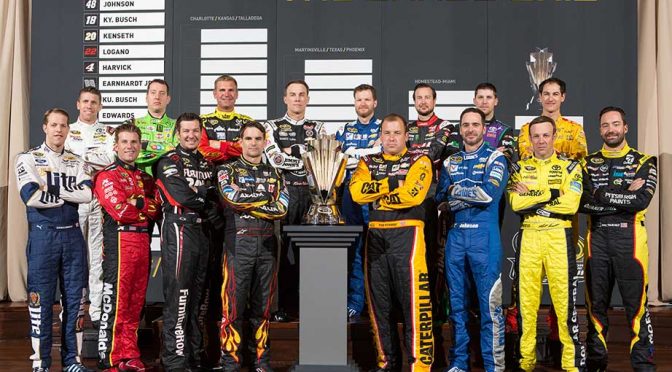
The 16 title-eligible teams will get their first shot at putting strategies into play in Sunday’s myAFibRisk.com 400 (3 p.m. ET, NBCSN, MRN, SiriusXM NASCAR Radio) at Chicagoland Speedway, site of the first of 10 races in the Sprint Cup Series’ postseason.
 
The sophomore season looks much like the first year in terms of the rules, with the playoffs broken into three three-race segments — rounds named Challenger, Contender and Eliminator that whittle the field from 16 drivers to 12, then to eight, all before four drivers vie for the championship in the Nov. 22 finale at Homestead-Miami Speedway. Drivers advance either automatically with a victory or by keeping themselves aloft in the points standings.

MORE: Chase explained | Get pumped up for the Chase

 
While the Chicagoland race offers a chance to make a solid first impression, the goal of avoiding elimination stretches beyond the Illinois plains.
 
“Obviously, you want to win, but I look at these — these are three races,” said Clint Bowyer, who observed the 2014 Chase as an outsider but returns this season after a one-year absence. “This isn’t one race. This is Chicago and every year I see it — everybody treats it as one race, ‘I’ve got to win this race or I’m not going to win the championship,’ and every single year somebody that should probably be there and go rounds and be a part of this on into it falters right there right off the bat. You’ve got to be solid. You’ve got to be consistent.”
 
Said Matt Kenseth, in a three-way tie for the Chase’s top seed with four regular-season wins: “I think it depends. I think to start off, you go out and you just – you go out and go hard every week, but there’s obviously things that can change when you get to all the cutoff races. One year is not a very big sample size of a championship format, so I think there’s going to be a lot of things that will still happen through the years as long as they keep this format that might surprise you or it might change your thinking.”

RELATED: JGR fleet competing against one another
 
The first year offered several examples of the importance of remaining mistake-free:
 
Aric Almirola‘s Chase hopes were derailed in the first round with engine failure and a 41st-place finish in the Chicago opener.
 
Kyle Busch‘s title eligibility ended in the Contender Round finale after a crash-related 40th place at Talladega nullified the positives from a pair of top-five finishes in the previous two races.
 
Jimmie Johnson, Dale Earnhardt Jr. and Brad Keselowski each finished outside the top 30 in a chaotic Contender Round opener at Kansas, forcing all three to scramble to advance with only Keselowski doing so thanks to his Talladega win.
 
But for all the emphasis that the new format placed on minimizing errors, it also produced several clutch moments. Both Brad Keselowski and eventual champion Kevin Harvick warded off elimination with wins in round-ending races, and Ryan Newman bumped his way past Kyle Larson in the final lap of the penultimate race, snatching away the single point needed to clinch a berth in the championship finale.
 
Which trend will show up in the 2015 edition? Probably a decent mix of both.
 
“It’s more of the potential and the possibility and the math that goes behind it,” Newman said. “There’s no guarantees in anything we do. You can look at our last lap at Phoenix and realize that. I mean, I was one spot out and had to do what I had to do. The ultimate thing is to go out there and enjoy it. There’s 30-plus guys who want to be in our situation. We have a great opportunity, and it’s as simple as that. We’ll make it real complex, but it’s really as simple as that.”

RELATED: Full race results | Series standings 

JOLIET, Ill. — In a race where teammates raced like archrivals to the checkered flag, Kyle Busch surged ahead of Matt Kenseth with a crossover move on the second-to-last lap and won the Furious 7 300 NASCAR XFINITY Series race by .791 seconds over his Joe Gibbs Racing teammate at Chicagoland Speedway Saturday night.

The two JGR cars were the clear top of the field, but after they swapped the lead three times on Laps 176 through 178, Busch pulled out to an advantage of more than one second over Kenseth. With Busch trying to save a half-lap of fuel, however, Kenseth closed the gap in the closing laps and surged past his teammate on Lap 199, as both drivers were trying to dodge the lapped car of John Wes Townley.

With Kenseth powering his No. 20 Toyota deep into Turn 3 after making the pass, Busch was able to cross over and retake the lead to the inside as Kenseth lost momentum.

Busch pulled away on the final lap to win his fourth XFINITY Series race of the season, his fourth at Chicagoland and the 74th of his career, extending his own series record.

Busch’s car, however, was too low on all four corners when the ride height was measured during post-race inspection. NASCAR is taking the car to its tech center in Concord, N.C., for further evaluation. If penalties are warranted, they will be announced next week.


RELATED: Busch’s car fails inspection at Chicagoland


Darrell Wallace Jr. used fuel-mileage strategy to perfection and earned himself a third-place finish, coaxing 67 laps out of his last tank of gas. Paul Menard ran fourth, followed by Ty Dillon, who moved into second place in the series standings, trailing leader Chris Buescher (seventh on Saturday) by 25 points.

Defending XFINITY Series champion Chase Elliott ran 14th and dropped one position to third in points, 28 behind Buescher.

Busch thought he had control of the race when he passed Kenseth for the lead on Lap 178 of 200 and began to pull away.

“I thought when I got to him and I cleared him and drove away by a second-plus, it was over, and I said, ‘OK. Thank you — I can breathe a little bit,” Busch said. “Then he started running us back down, and I tried to go back to the top and I was loose up there again when I went back there.

“Just had to battle through there. He was right there, though … Once he lost his momentum off of (Turn) 4, it was over. That was some fun racing, though.”

Kenseth, who thought he had the faster car, was understandably disappointed with the outcome.

“I had the best car tonight, and I got beat by a better driver,” said Kenseth, who also would have preferred for Townley not to have been in the mix when the outcome of the race was decided.

“It would have been nice if he’d gotten the heck out of the way, I’ll tell you that,” Kenseth said. “Chase (Elliott) was very courteous. He was already a lap down, and he moved down and gave us the top, because he knew that’s where we were racing.

“Clyde Torkel (a reference to Townley derived from the movie Stroker Ace), he just stuck it right between us. I got around him, and he passed me back when I was trying to race Kyle for the win. That was disappointing.”

Wallace’s third-place finish was a career best for the driver of the No. 6 Roush Fenway Racing Ford, who is battling sixth-place finisher Daniel Suarez for Sunoco Rookie of the Year honors.

“I try not to let (the rookie contest) worry me too much, but I would say it’s good seeing me pass that 18 (Suarez) on the restarts every once in a while,” Wallace said. “As long as we’re finishing ahead of him, it will be a close battle all the way to the end.”
RELATED: Full race results | Updated series standings

JOLIET, Ill.—One of the NASCAR Camping World Truck Series’ youngest drivers struck a blow for old-school racing on Saturday morning at Chicagoland Speedway.
 
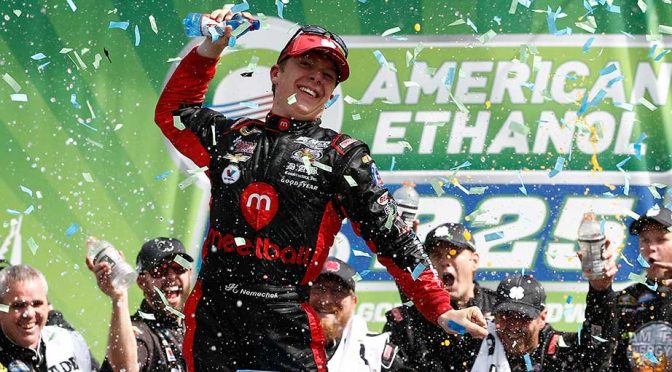
Stretching his fuel mileage beyond the capabilities of most of his of competitors, John Hunter Nemechek rolled across the finish line 12.014 seconds ahead of Tyler Reddick, who was also saving fuel, to score his first victory in the series in the American Ethanol e15 225.
 
At 18 years, 3 months and 8 days, Nemechek is the fourth youngest winner in the series, and he accomplished the victory with a skeleton crew working on a team owned by his father, Joe Nemechek.
 
Nemechek, a current member of the NASCAR Next class, came to pit road for the last time on Lap 94, topping off under caution one lap before the race returned to green, and managed to squeeze 56 laps out of his last tank of gas. Inheriting the lead on Lap 149 of 150 when Keystone Light Polesitter Kyle Larson ran out of fuel and brought his car to pit road, Nemechek ran out of gas off the final corner and coasted across the stripe.
 
“We got to top off there with one to go, and he (crew chief Gere Kennon) told me to save fuel, save fuel that last run, and that’s what we ended up doing,” John Hunter Nemechek said. “I ran out coming out of Turn 4. It was great strategy that he had worked up in his mind.
 
“I should know never to doubt him.”
 
When Nemechek took the green flag for the last time on Lap 96, Kennon figured the No. 8 Chevrolet was four laps short of finishing the race but didn’t give his driver the specific numbers.
 
“I just told him to save,” Kennon said. “It got to 10 (laps) to go, and I said, ‘Just slow down—just save.’ He didn’t say anything back, and I was like, ‘He may not know how to save.’ I told him to slow down even more, and it all worked out.’
 
Exclusive of Joe Nemechek and son, Kennon is one of nine full-time employees supporting the Truck Series operation.
 
“You have to think,” Joe Nemechek said. “Gere Kennon and myself—we’re thinkers. We’re old-school thinkers. You had to figure stuff out back in the past, not with engineering, but with the old-school way of thinking ‘How do you make it better?’ And we’ve been able to do that.”
 
John Hunter Nemechek is quick to acknowledge the financial and emotional commitment his father has made to his racing effort.
 
“He has everything invested in me, and he believes in me, so, without him, none of this would be possible, and I wouldn’t be here today,” John Hunter said.
 
With his runner-up finish, Reddick took over second place in the series standings, 10 points behind leader Erik Jones, who finished sixth. Two-time defending series champion Matt Crafton suffered two pit road penalties, ran out of fuel and finished 14th, three laps down, to fall to third in points, 11 behind Jones.
 
Timothy Peters led 41 laps and finished third, followed by Daniel Suarez, who overcame two pit road penalties to run fourth. Johnny Sauter led a race-high 52 laps and came home fifth.
 
The race was originally scheduled to take place Friday night but was postponed due to rain until this morning.

CHICAGO — From suggesting they need to start enforcing the rule to increasing the size of the restart zone, NASCAR Sprint Cup Series drivers offered a variety of suggestions Thursday as to how NASCAR officials could end questions surrounding restarts in the premier series.
 
The issue resurfaced in recent weeks, and came to light again during last week’s Federated Auto Parts 400 at Richmond International Raceway.

RELATED: See the restart everyone is talking about
 
This much is clear — many of the 16 drivers that comprise this year’s Chase for the NASCAR Sprint Cup field all of which were assembled in downtown Chicago Thursday for Chase Media Day said they felt there was still much uncertainty surrounding how NASCAR officials police the call.
 
“If you do the restarts by the book — the way they say to go at it — you’ll get passed by about four guys every restart, so nobody really knows what to do,” Joe Gibbs Racing driver Carl Edwards said.
 
“The restart is neat because it gives you an opportunity to get an advantage. It is tough and it’s a dynamic part of the race. It’s just where do you draw the line? Can I go 50 feet early or 100 feet early? If the leader doesn’t go, can I just go and beat him into Turn 1? I don’t know exactly what’s allowable.”
 
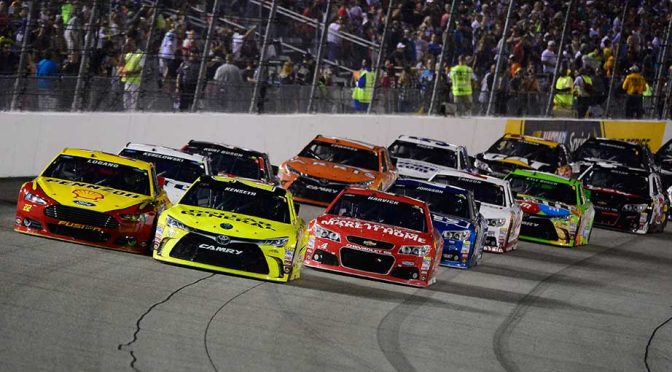
Restart zones are areas located before the start/finish line and are marked by lines painted on the track’s wall. The race leader may “start” the race at any point once his car has passed the first line of the two lines.
 
However, those behind often try to lay back and time their start to coincide with the leader’s so that they are already going faster as they enter the zone, thus gaining an advantage as the field heads toward the start/finish line.
 
To combat such moves, the leader will sometimes accelerate just before entering the zone, as Matt Kenseth did at Richmond.

RELATED: Kenseth makes no apologies for Richmond restart
 
“The first thing you’ve got to do is make the restart box bigger,” four-time series champion Jeff Gordon (Hendrick Motorsports) said. “I mean, we’ve been asking for this for a long time. It’s too small. We went from having it be way too big to now it’s way too small. So that’s No. 1. …
 
“Here’s what happens, the box is so small, the guy who’s in second place has and advantage. They can anticipate the start because they know you’re going to start in that box. Of course a driver is going to want to get any edge they can, they’ve earned that right being the leader and the leader is supposed to start the race. That’s why guys are jumping.
 
“The other side of it is, you’ve got to call it. If somebody deliberately jumps, you’ve got to call it … it’s got to be a black-and-white decision. To me, they have the technology to see it and make that call and when they don’t make the call, they’re going to get beat up on it.”
 
Michael Waltrip Racing driver Clint Bowyer agreed, saying that while officials do a good job, attempting to let drivers police the issue isn’t working.
 
“I really believe we have a rule and I understand their intent of not wanting to get involved with that,” he said, “but that’s not a good answer.
 
“Call them (on it) — whether it’s me or anybody else and if you do that once I won’t do it again.”

HERMAN UNPLUGGED: Was Kenseth right or wrong about the restart?
 
For some, it’s simply a part of racing, another situation to be dealt with accordingly.
 
“If we go back to the way it was and the leader is the leader and he got a better jump or somebody else got a better jump, if you’ve got a better car, you better race him back and pass him,” said Ryan Newman (Richard Childress Racing). “It’s not the end of the world.
 
“Way too much is getting talked about something that means so little. I mean, it means a lot in the moment, but in the grand scheme of things, we don’t need to micromanage that.”

Atlanta Test Added to Schedule
 
Atlanta Motor Speedway will host a single-day Goodyear tire test Tuesday, Oct. 27 as well as a two-day open test for Sprint Cup Series teams Oct. 28-29.
 
The test replaces the session originally scheduled for the same dates at Auto Club Speedway. That test, however, called for a two-day Goodyear tire test and single-day open test for teams.
 
The Sprint Cup Series competes at Martinsville Speedway later that weekend (Oct. 30-Nov. 1).
 
The Return of Multi-Zone
 
Sprint Cup, XFINITY and Camping World Truck Series teams will run the same tire combination this weekend at Chicagoland Speedway.
 
The right-side tire is a multi-zone tread piece, with the inboard two inches of tread built for endurance and heat resistance while the outer 10 inches is built for traction. The tire selection was confirmed at a tire test held July 13-14 at the 1.5-mile facility.
 
It marks the first time teams in the Camping World Truck Series will run the right-side tire at Chicagoland, although teams used it at Texas earlier this year.