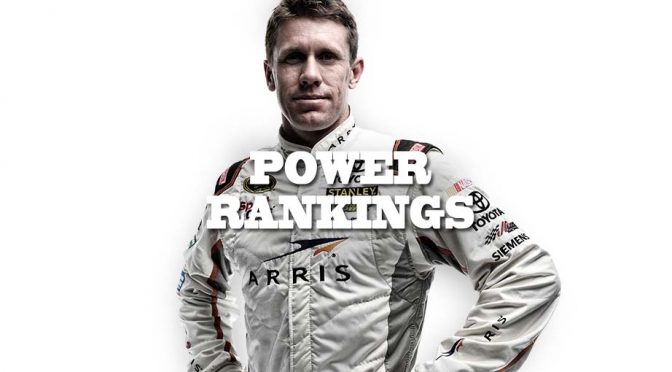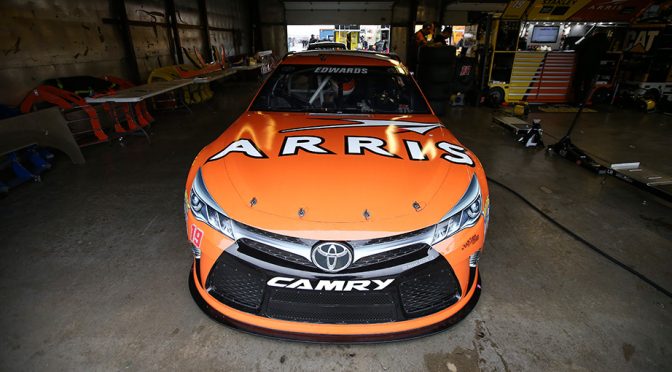
CONCORD, N.C. — Traces of confetti were still stuck to Carl Edwards‘ No. 19 Toyota and Dash 4 Cash bogus bills littered the hood of the entry of fellow Joe Gibbs Racing driver Daniel Suarez.
Crewmen that had arrived at the NASCAR Research and Development Center in Concord, North Carolina, earlier that September morning began their assigned tasks promptly at 8 a.m. ET.
Edwards’ group, along with those from the Team Penske Ford of Brad Keselowski and the No. 5 Hendrick Motorsports team for driver Kasey Kahne, were the first to begin.
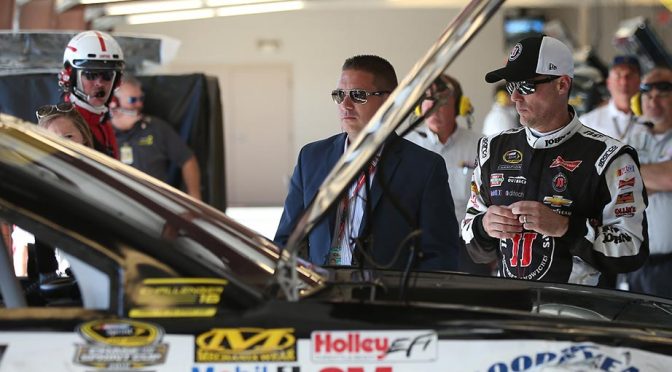
They worked quietly and efficiently, removing specific parts from each entry and delivering them to a predetermined area nearby. NASCAR officials then began the process of inspecting the individual pieces, measuring and examining each one before moving on to the next.
It’s the final stop in the inspection process for NASCAR’s Sprint Cup Series, and occasionally the XFINITY and Camping World Truck Series.
While entries that qualify for a NASCAR event typically go through four separate inspections the previous race weekend (pre-qualifying, qualifying, pre-race and post-race), the winning and second-place entry, as well as a randomly selected car, arrive here at the R&D Center, where a final teardown takes place.
“It’s primarily the suspension officials, which are chosen by their supervisor … and the same with the engine group,” NASCAR’s Chad Little, Managing Director, Technical Inspection/Officiating, said.
“Sometimes we do a detailed template inspection as well. But primarily it’s suspension and engine.”
According to Little, teams whose cars are taken to the R&D Center (the cars are transported by NASCAR employees) after an event are officially notified by email following the race.
The final post-race inspections are held on the following Tuesdays, and once teams arrive, they are given a detailed list of what specific parts are to be removed from each entry.
“The team will go to work in pulling the engine and pulling those parts off the car,” Little said. “The officials will inspect them and make sure they comply with the rules. It’s usually all done by about 10:30 a.m.
“We tear the car completely apart — all the primary suspension parts come out.”
Engines are completely disassembled, fuel cells are removed, measured and checked and the transmissions are inspected as well.
Before NASCAR began taking cars back to the R&D center, final post-race inspections were completed at the track following the event. Officials say bringing the cars back here provides a better environment and allows for a more detailed inspection. Weather is not longer a concern while officials and crewmen for the cars inspected no longer must spend hours after the race completing the various tasks.
There is no limit to the number of employees a team may bring to complete the teardown as the center, “as many as they need,” Little said. “And it’s an open-door policy.
“So any other team can come and observe. … They’re parked right next to each other just like they are in the garage; nobody covers anything up. When the parts come off they’re laid there for anybody else to see.”
If there is an issue, the series director is notified and the information moves up the management chain. “Before we issue (a penalty),” Little said, “it’s thoroughly thought out.”
Almost one hour after work began, Edwards’ Southern 500 winning car and Keselowski’s No. 2 Ford have been checked and are rolled out of the main area. Kahne’s entry isn’t far behind and joins the JGR entry in the chassis room, where officials go over each with a Romer Absolute Arm, a computerized device that takes precise chassis measurements at various points on each car.
It’s a slow process for those who have other items on their agenda. Darian Grubb, crew chief for Edwards, had already been in three meetings with various JGR personnel before the teardown process got underway.
Watching as crewmen went through their assigned tasks, he waited patiently until the inspection had been completed.
That the winning car would be in pieces when it finally returned to the team’s headquarters in nearby Huntersville wouldn’t be an issue.
“We’d normally go through all those things after getting the car back to shop anyway, so they’d have to come off,” Grubb said. “That car will be turned around and we’ll start to get it ready for Dover as quick as we get it back.”
By 10:40 a.m., the inspection process for Edwards’ car has been completed, Keselowski’s has already been loaded up and Kahne’s Chevrolet is nearly finished.
Meanwhile, on the other side of the building, the work had already begun on the XFINITY Series entries of Suarez and race winner Denny Hamlin.