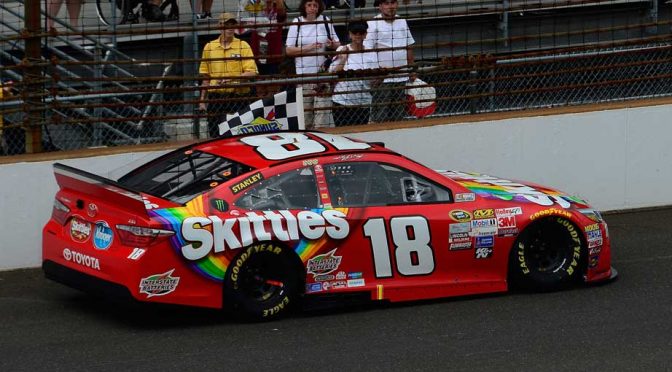
Former NASCAR driver died earlier this week at 74

RELATED: Baker passes away at age 74 | Drivers react to Baker’s passing

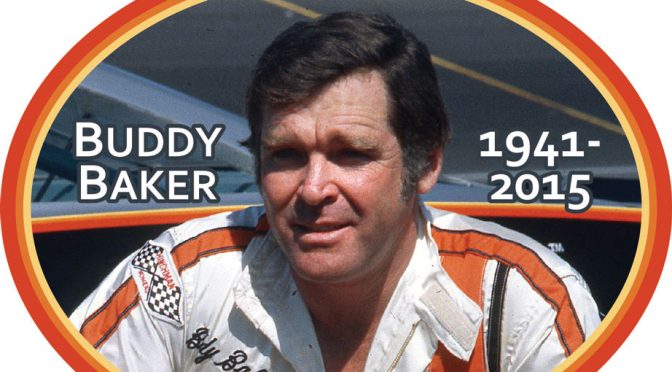
NASCAR will honor the late Buddy Baker in a special way this weekend in events for all three national series.

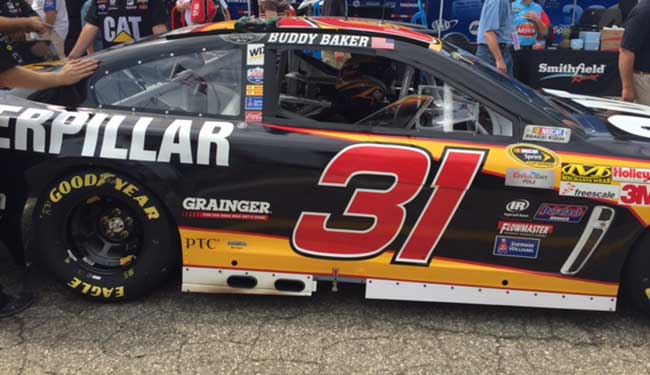
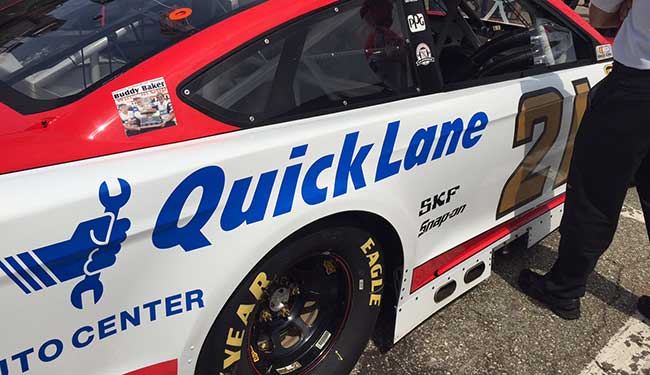
Vehicles will be affixed with a B-post decal (see below) honoring the former NASCAR driver.


Baker, 74, passed away Monday after battling lung cancer. The NASCAR racing legend’s career spanned more than three decades. His father, Buck Baker, was a two-time premier series champ.

Here’s where the decals will go on the vehicles:

The No. 31 of Ryan Newman had Baker’s name spelled out on the door frame, and the No. 21 of Ryan Blaney has an additional sticker on the C-post.

Photos by NASCAR.com’s Kathy Sheldon.

Dale Earnhardt Jr. knows all about growing up in the shadow of a legend. He knows where that path leads, where it ends and where the next one begins.
 
Buddy Baker did, too.
 
Both are the sons of famous racers. Both followed their fathers into the sport. It was a connection, a common thread leading away from two very uncommon individuals.
 
Baker, the son of two-time NASCAR premier series champion and NASCAR Hall of Fame member Buck Baker, passed away Monday following a brief battle with lung cancer.
 
The father, tough as an old boot, taught the son plenty.
 
A giant of a man inside and outside the car, Buddy won 19 times, including the 1980 Daytona 500. He’s been among the nominees for the Hall for the past two years.
 
Earnhardt Jr.’s father, Dale Earnhardt, was one of the inaugural members of the Hall selected in 2010. The elder Earnhardt won seven NASCAR premier series titles, tying Richard Petty’s formidable mark. He won 76 races.
 
For many, Earnhardt was NASCAR, helping to fill the void left by the departure of icons that had carried the sport on their shoulders through the 1960s and ’70s — men such as Petty, David Pearson, Bobby Allison and Cale Yarborough. And Buddy Baker.
 
The father-son connection question has been asked countless times of Earnhardt Jr. He is no longer surprised by it. His father’s shadow loomed large over the sport, even after his death on the race track in 2001.
 
The similarities to Baker’s own circumstances became more obvious to Earnhardt Jr. over time.

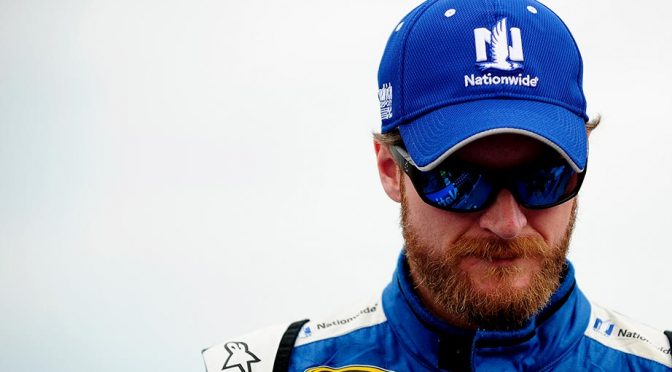
“When I was really young, I grew aware of his situation and I hadn’t become a driver yet,” Earnhardt Jr. said Thursday during an appearance on SiriusXM NASCAR Radio. “I didn’t feel like I could relate to him.

“I obviously knew just what growing up in household must have been like, the yearning to compete and get into the series and do what your father was doing and be a part of it to be more a part of his life.

“To be more of a part of your father’s life is one of the main reasons why you get involved. I maybe could understand that part of it.” 


Baker’s on-track accomplishments, and later his move into broadcasting, helped him shed the “son-of” label. Just as Earnhardt Jr.’s eventual success — he’s won 25 races, including a pair of Daytona 500 titles — helped him blaze his own trail.

“You almost forgot about that scenario and how similar it may have been to your own (situation) because of what he was able to accomplish,” Earnhardt Jr. said. “He created his own identity outside of Buck (Baker). He did so many things on his own, added to his own identity and legacy that you totally really forgot about having those similarities down the road.”

NASCAR hasn’t lacked for father/son combinations through the years — Lee and Richard Petty; Richard and Kyle Petty; Bobby and Davey and Clifford Allison; Ned, Glenn and Dale Jarrett; David and Larry Pearson; and more recently Ward and Jeb Burton just to name a few.

There are a lot, Earnhardt Jr. said, “that I feel that connection to, that know what that connection is like.”

The situation isn’t specific to racing, but racing is where both Earnhardt Jr. and Baker found themselves. Following in their fathers’ footsteps.

“Wanting to be in that shadow when you’re young and wanting to be a part of his life when you’re young and then trying to get out from under that shadow all the rest of the years of your life is definitely, I wouldn’t call it a struggle, but it’s just a unique situation that only a few of us can say we’ve been through,” said Earnhardt Jr., “and we can relate to each other through that.”

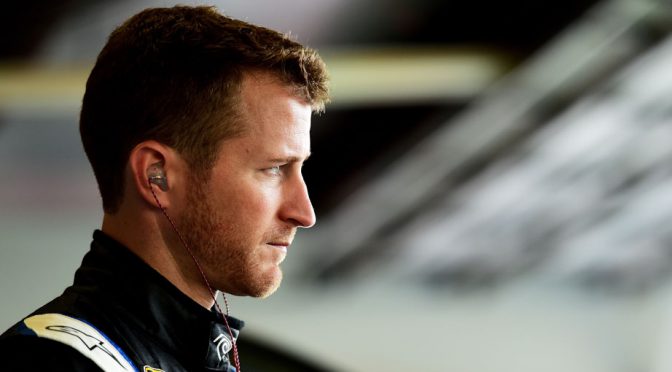
After wrecking out of the race for the second straight week at Watkins Glen and falling off the 16-driver Chase Grid last Sunday, Kasey Kahne knows what he has to do to make NASCAR’s playoffs — the Chase for the NASCAR Sprint Cup.

“At this rate we’re going to need to win,” Kahne said. “That’s the only way we’ll go into the Chase. We’ve got to get a little better. I need to get a little better.”

Kahne has four races left to get that win, starting with Sunday’s Pure Michigan 400 at Michigan International Speedway (2:30 p.m. ET on NBCSN, MRN, SiriusXM).

The No. 5 Hendrick Motorsports driver claims one victory at Michigan (June 2006) and believes he can adapt well to the high-drag track-specific rule package that will be used there this weekend.

“There were times at Indianapolis when we were really quick with that package,” Kahne said. “I know they’re working hard to bring a little less drag and more downforce there for us, all four of us (at Hendrick Motorsports). So hopefully we can run good at Michigan and maybe get a win there.”

Kahne finds himself in a similar position to where he was last year prior to the Chase. Too low in points to qualify without a victory, Kahne won the second-to-last race of the season at Atlanta to punch his ticket into NASCAR’s postseason.

While Michigan is not Kahne’s best track historically, he has proven he can win at a variety of loops, with victories at 11 different venues including short and intermediate tracks and road courses.

“The main thing is that all of the equipment we get at Hendrick Motorsports is good enough to win every weekend,” Kahne said. “We need to get on the ball here and do that, and I don’t see any better weekend to do that than the next one.”

More than 600 miles away from NASCAR hotbed North Carolina, Michigan surprisingly has produced two of NASCAR’s top current talents.

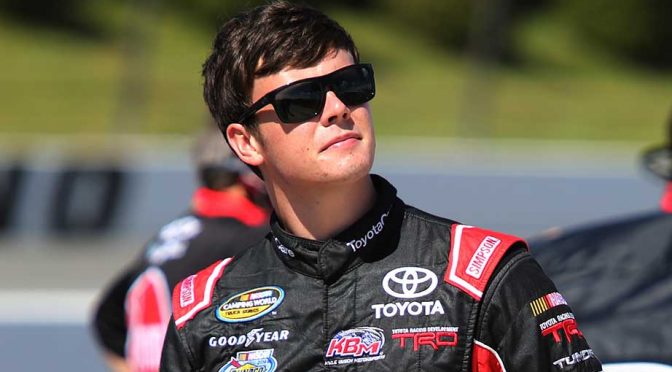
The Great Lakes State churned out 2012 NASCAR Sprint Cup Series champion Brad Keselowski and is also the home state of up-and-coming star Erik Jonesthe winner of the most NASCAR national series races before turning 19 with five victories.


Jones, following in Keselowski’s footsteps, will race in his native state for the first time in Saturday’s Careers for Veterans 200 Presented by Cooper Standard and Brad Keselowski‘s Checkered Flag Foundation at Michigan International Speedway (1 p.m. ET on FOX Sports 1, MRN, SiriusXM).

“It’s pretty special to me,” Jones said about racing in Michigan. “I’m proud of where I’m from and being able to race so close to home at this level is going to be special. For the last two years, everyone has been asking me when I’m going to get to race at Michigan and this is the first year that I’ve been able to tell them that I’ll be racing there.”

Jones enters the race vying for the NASCAR Camping World Truck Series championship. He ranks third in the series standings, trailing Tyler Reddick by 16 points. On the season, Jones claims one win, seven top-five and nine top-10 finishes.

The Byron native wants to put on a show for the home crowd.

“I think any time you are at a level in NASCAR, you want to race at your home track,” he said. “Michigan is obviously my home track and this will be the first time that I get to race there. It’s only about an hour from the house I grew up in and I went there quite a few times as a kid to watch races as a young fan. I’m excited that this time I’ll be out on the track — hopefully we can have a good run for all of my friends and my family that will be there to cheer me on.”

RELATED: Smith, Dillon get physical post-race

Regan Smith shared his view of the post-race fracas with Ty Dillon at Watkins Glen International last week, and he made no apologies for his actions.


“I was pretty fired up after the race, and I feel like rightfully so,” Smith said on “JR Motorsports Up Front” on Dirty Mo Radio. “That’s the passion of our sport, that’s why we do it. We don’t do it because we go there to be all happy-go-lucky. We do it because we want to go out there and race hard and win. When you feel like you’ve been wronged, then sometimes you’ve got to handle it.”

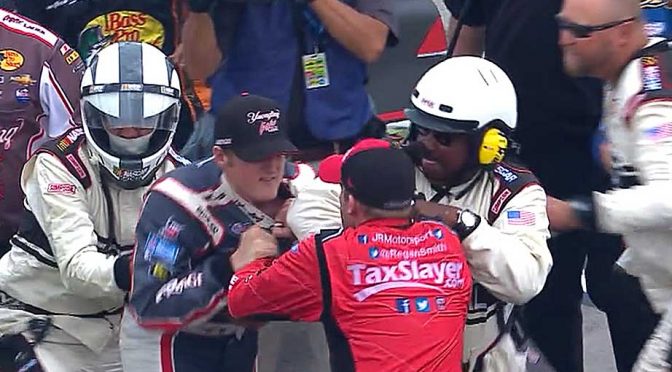
Last Saturday following the Zippo 200, Smith stopped at competitor Ty Dillon’s car, leaned in and grabbed Dillon by the front of his uniform, confronting him about an incident between the two in Turn 1 on a Lap 40 restart. The two NASCAR XFINITY Series championship contenders pushed and shoved and shouted angrily at each other, promising retaliation down the road before NASCAR officials and various team members stepped in to separate them. Smith eventually was pulled away and made his way back to the garage area still fuming. 


The JR Motorsports driver offered some insight into his history with Dillon and the on-track incident that sparked his ire.


”I think from my perspective I’ve been on the receiving end on more than one occasion from that car,” he said. “And that’s the frustrating part and that’s the part that really builds. I think this year for the most part we have done a good job of racing each other hard, racing each other clean and kind of had an understanding of how we were going to run each other. I didn’t take very nicely to the move that was made on Saturday.

“I feel like and I don’t mean to say this arrogantly, but there are certain guys in our series that are very good at braking and in braking zones 

… If you outbrake them, it probably means you have missed the corner, whether its a restart or whatever. For me to get in any deeper in that corner, I would have wadded the 22 (Brad Keselowski) up and wrecked him and the 33 (Paul Menard) likely. I don’t race that way. … On a road course, I feel like probably most of us, or the majority of the field has enough experience to understand that and realize that.”

RELATED: Dillon gets an interesting gift from Virginia Tech coach

The turn of events was even more frustrating for Smith because it was an example of yet another good run at a road course turned bad for circumstances out of his control.


“If you look back at my two-and-a-half-years here, we have run top five at every road course, and run strong enough to … potentially win all of them,” he said. “That’s the most frustrating for me. We’ve got nothing to show from any of them. And it’s not by our own hand of making mistakes on our own.

“It’s been of other things and other people just doing boneheaded stuff that makes absolutely no sense to you. We could be sitting here talking about almost 10 straight top fives on a road course instead of ‘Wow, Regan never finishes good at a road course.’ That’s not the case. We are always up there, in the hunt and maybe that, sometimes that can be the curse. A lot of times you look at the top fives when these races are over and its guys that didn’t run near the top five all day long and that’s just how these things shape out sometimes.”

Heading into Mid-Ohio for the Nationwide Children’s Hospital 200 (Saturday, 3:30 p.m. ET, NBCSN, MRN, SiriusXM) Smith is fourth in the points standings, 57 points behind championship leader Chris Buescher. Dillon is tied with Smith’s JRM teammate and defending series champion, Chase Elliott for second place in the standings. 

Smith says he thinks that circumstances will put he and Dillon together a bit this weekend.

RELATED: Latest series standings


”You can pretty much guarantee that we will qualify next to each other, ride on the same pack truck prior to the race. That’s how it works in NASCAR.”

And while Smith says he has not watched the incident, he is confident someone at JRM will make sure he sees it at some point.


“I haven’t watched it, nor will I,” Smith later jokingly added, “I’m sure I’ll be forced to watch it at the Christmas party or at some point. I know I am not going to be able to get away from it.”

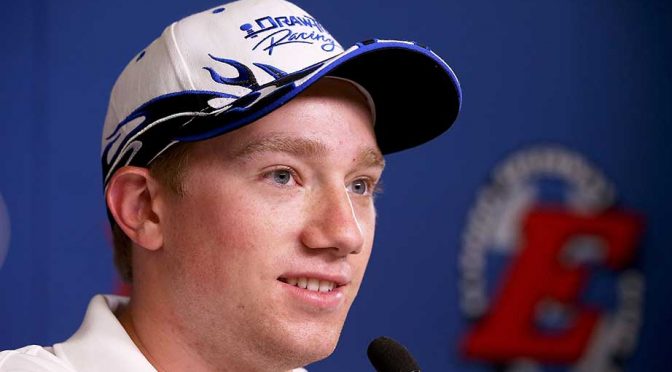
NASCAR Camping World Truck Series driver Tyler Reddick takes an 11-point lead into Saturday’s Careers for Veterans 200 Presented by Cooper Standard and Brad Keselowski‘s Checkered Flag Foundation at Michigan International Speedway (Saturday, 1 p.m. ET, FOX Sports 1, MRN, SiriusXM), an important race for his team and owner. But first before he looks ahead, he looked back Wednesday on SiriusXM NASCAR Radio at the race that put him back on top.

On Lap 6 of the Pocono Mountains 150, two-time defending champion Matt Crafton and Keselowski made contact, sending both trucks into the Turn 3 wall with finishes of 28th and 30th respectively. Crafton didn’t appreciate the former Sprint Cup champion’s actions and vowed Reddick wouldn’t win the 2015 title.

“That’s your Cup champion,” Crafton said. “That’s pretty much an idiot right there right-rearing the guy racing for a championship. I guess maybe hat’s the way he wants his 19 truck to win the championship, but they’ve got a long ways to come right now. I’m telling you that.”

Crafton later added, “He’s got another thing coming, I promise that truck won’t win it. If that’s the way he want to do it, we’ll get it done.”

RELATED: Crafton, Keselowski collide at Pocono

As Reddick reflected on the August 1 race that saw a 25-point swing at the top of the title table after this third-place run, he saw the incident between the two NASCAR champions differently.

“I think if Matt Crafton took a second to think about it just like anyone else has that has seen it, he’d realize that he’s wrong and that it definitely was not an incident caused by Brad but an incident caused by Matt, his own mistake,” Reddick said. “But you know what, it’s a championship battle. It’s been tight and so it’s going to get stressful, it’s going to get more stressful as the year goes on. It’s a battle for the championship in the Truck Series. It’s a big deal.

“Everyone on their side and our side is really pumped. We really want to get that first championship for Brad Keselowski Racing. We kind of want to dethrone ThorSport and keep them from getting three in a row so we’re going to try and do that.”

At Michigan, Ryan Blaney will take over the No. 29 ride run by Keselowski at Pocono. Like his BKR teammate this season, Blaney took a points lead into Michigan last year. After he and Joey Logano started first and second, both had problems with their noses and finished 21st and 18th, respectively.

RELATED: Nose problems for Blaney costs points lead

“Our trucks have been really good there,” Reddick said. “We had an unfortunate incident happen with our nose guards there last year, but our trucks are fast. We have speed about everywhere we’ve gone so far this year so we’ve just got to play it smart. It’s going to be a good race for us. We’ve got to stay out of trouble.”

It will be Reddick’s first race at the two-mile oval in the Irish Hills of Michigan, but with a win at Daytona to start the season and seize the points lead in the season opener before losing it to Crafton at Martinsville, he’s confident in his success on big tracks.

“I felt like most of my comfort came the fastest at the bigger tracks,” Reddick said. “Some of the smaller, technical tracks I felt like were going to be more difficult for me as I came into the Truck Series. So I feel like my strengths are on the bigger tracks, the plate and the mile-and-a-halfs.

“Michigan is a two-mile track (but) it’s a big mile-and-a-half, big really fast mile-and-a-half. But it is a two-mile track so we’ve been really good on the big tracks. Our guys have a really good package so I’m really excited to get there and feel it out for myself this time.”

While Reddick runs the DrawTite Ford, Blaney will sport the Cooper Standard Careers for Vets colors as the Cooper Standard Foundation and Brad Keselowski‘s Checkered Flag Foundation joins forces for the second year to sponsor the Michigan Truck race. This year, proceeds from the event will go to Macomb Community College in Keselowski’s home state as the institution looks to launch a veteran transition training program.

Cooper Standard has partnered with Inforum, the National Association of Manufacturers (NAM) and the Manufacturing Institute for the curriculum, which will combine Inforum’s Next4Vets training with the NAM and the Manufacturing Institute’s Get Skills to Work program and form the foundation for Macomb’s veteran initiative.

As Reddick battles Truck Series veteran Crafton, he’s confident that his BKR team will deliver a title to owner Keselowski, who already has driver titles in NASCAR’s other two national series XFINITY (2010) and Sprint Cup (2012).

“It would mean the world to me, and when I say that, I speak for my team as well,” Reddick said. “They’ve worked very hard for this, and this championship is definitely what they want and I’m going to do everything I can for my team that they are doing for me to get that championship for them. It’s a big team effort, and we’re working our tails off for it.

“We could have fell back a little bit here in these last few weeks, but we haven’t. We’ve stayed true. We’ve stayed strong, and we keep nailing away at it. That’s what it’s going to take all the way to Homestead, and our team is definitely capable of it.

“We had a big jump going from our moving shops in the middle of the race season which is very tough and our guys did an outstanding job. We didn’t falter during that period. They’re working really hard. They’re definitely putting their dedication into it so I’ve got to do my part as well on my end to pay back and reward them for their great hard work.”
Keep this handy guide by your side when watching your next NASCAR race and you’ll be on top of the game and might even impress your friends:

Camber: The amount a tire is tilted in or out from vertical. Described in degrees, either positive or negative.

Dirty air: Aerodynamic term for the turbulent air currents caused by fast-moving cars that can cause a particular car to lose control.

Downforce: A combination of aerodynamic and centrifugal forces. The more downforce, the more grip a car has. But more downforce also means more drag, which can rob a race car of speed.

Drafting: The practice of two or more cars, while racing, to run nose-to-tail, almost touching. The lead car, by displacing the air in front of it, creates a vacuum between its rear end and the nose of the following car, actually pulling the second car along with it.

Drag: The resistance a car experiences when passing through air at high speeds. A resisting force exerted on a car parallel to its air stream and opposite in direction to its motion.

Driving into the corner: When drivers say they are having problems driving into the corner it means the car is not performing how they want it to (too tight or too loose) at the point where the car is entering the corner. How a driver approaches a corner could depend on strategy: trying to pass, gain speed, save tires or drive the shortest distance through the corner.

Groove: Slang term for the best route around the racetrack; the most efficient or quickest way around the track for a particular driver. The “high groove” takes a car closer to the outside wall for most of a lap, while the “low groove” takes a car closer to the apron than the outside wall. Road racers use the term “line.” Drivers search for a fast groove, and that has been known to change depending on track and weather conditions.

Loose:
Also known as “oversteer.” When the rear tires of the car have trouble sticking in the corners. This causes the car to “fishtail” as the rear end swings outward during turns. A minor amount of this effect can be desirable on certain tracks.

Quarter-panel: The sheet metal on both sides of the car from the C-post to the rear bumper below the deck lid and above the wheel well.

Restrictor plate: A thin metal plate with four holes that restricts airflow from the carburetor into the engine. Used to reduce horsepower and keep speeds down. The restrictor plates are currently used at Daytona International Speedway and Talladega Superspeedway.

Round (of wedge): Slang term for a way of making chassis adjustments utilizing the race car’s springs. A wrench is inserted in a jack bolt attached to the springs, and is used to tighten or loosen the amount of play in the spring. This in turn can loosen or tighten up the handling of a race car.

Short pit: The strategy of pitting well before running out of fuel, getting fresh tires to make up time on the leaders and theoretically taking the lead once those lead cars need to pit. Short pitting puts a car on an alternate pit cycle and could be beneficial or not depending in part upon how cautions fall the rest of the race.

Side drafting: When a car races alongside another car and “dumps” air flow from that car’s nose to the spoiler of the other car, causing the other car to lose momentum and allowing the side-drafting car to pull away. It’s a strategy used on larger tracks such as Talladega, Daytona and Michigan.

Slingshot: A maneuver in which a car following the leader in a draft suddenly steers around it, breaking the vacuum; this provides an extra burst of speed that allows the second car to take the lead.

Splitter: Runs the entire width of the car at the front and sometimes appears as if it’s touching the ground. What the spoiler does for downforce in the back of the car, the splitter provides downforce to the front. Damage to the splitter can be difficult to overcome because of the important role it plays in the aerodynamics of the car.

Spoiler: A metal blade attached to the rear deck lid of the car. It helps restrict airflow over the rear of the car, providing downforce and traction.

Tapered spacer: A metal piece that limits how much air gets into the engine cylinder, which in turn limits how much fuel can go into the cylinder and reduces the amount of energy produced.

Tight: Also known as “understeer.” A car is said to be tight if the front wheels lose traction before the rear wheels do. A tight race car doesn’t seem able to steer sharply enough through the turns. Instead, the front end continues toward the wall.

Track bar: A lateral bar that keeps the rear tires centered within the body of the car. It connects the frame on one side and the rear axle on the other. Also called the panhard bar.

Wave around: Cars can take the wave around when there is one to go under caution and the pace car turns its lights off. Wave-around cars are not permitted to pit until after the green flag comes back out and the race resumes. Wave-around cars restart at the rear of the field, but they are put in front of cars that have received a penalty.

MORE TECH TALK: Inside Track presented by Mobil 1

Leads all 50 laps en route to back-to-back victories

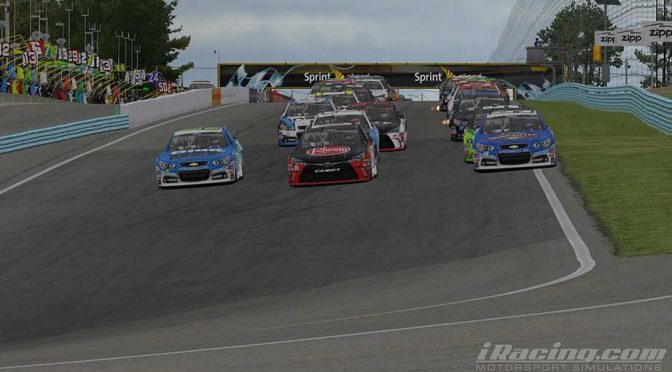
Nick Ottinger (Gale Force Racing) put on a show at Watkins Glen International on Tuesday night, leading every single one of the 50 laps en route to his second victory of the season in the 2015 NASCAR Peak Antifreeze Series Powered by iRacing. The TEAM’s Kenny Humpe finished second, more than seven seconds adrift of Ottinger. Last year’s winner Michael Conti (Drill Isle) was third, followed by Corey Vincent (Premere Motorsports Group) and PJ Stergios (Last Row Motorsports).

It only took a few laps after the drop of the green flag for the field to realize the fight would be for second unless Ottinger made a mistake. On fresh tires Ottinger was consistently two to three tenths a lap faster than every other driver in the field; quite the feat considering the competition.

Further back, the intervals between cars were closer but passing was not easy. Overcast conditions gave everyone’s car plenty of grip and made getting a run on the car in front all but impossible. The closest battle near the front during the first half of the race was between Conti and Stergios with Ray Alfalla (Slip Angle Motorsports) also joining the action.

During the first half of the race Conti appeared to be struggling with his race car as Ottinger and Humpe disappeared into the distance all while Stergios filled his mirror. As the halfway point approached, Stergios was the first of the frontrunners to make his pit stop in hopes of making up time on fresh tires. This brought Conti and Alfalla to pit road one lap later as they did not want to lose time to Stergios on their old tires. Conti led Alfalla by two car lengths onto pit road but Alfalla’s stop was faster and the two wound up side by side as they hit pit out. Neither Conti nor Alfalla wanted to give, and Alfalla ran wide on the access road and made hard contact with the wall.

Conti survived the pit road incident without any damage and set his sights on Stergios, who had passed him due to pitting a lap sooner. Conti’s one lap fresher tires were too much for Stergios to handle and Conti got the best of him under braking entering Turn One. Unlike the first half the race Conti’s car was running better and he began to pull away, comfortably in third. By pitting early, Stergios created another problem – a fuel shortage. In order to make it to the end he had to save fuel which allowed Vincent to take fourth near the end of the race.

Meanwhile, Alfalla was busy fighting his own battle with a damaged race car. Unable to keep pace with Conti due to the damage, Alfalla tried to salvage the best finish he could. Matt Bussa quickly caught Alfalla but could not complete the pass. Even with his damage Alfalla ran a smart, defensive line and came home sixth, just ahead of Bussa.

Back at the front it was clear sailing for both Ottinger and Humpe with little drama and lapped traffic. During the second half Ottinger continued his torrid pace even though he held a healthy margin while Humpe looked to maintain, knowing that with his points lead consistency is key at this point in the season.

Humpe’s second place finish combined with Alfalla’s minor trouble allowed the championship leader to further build his massive margin. With four races remaining Humpe’s lead is now 135 points over Alfalla and the championship is all but wrapped up. Chris Overland is third but fell to 27 points back of Aflalla due to a mediocre seventeenth place finish. Stergios is another 15 points behind, two markers ahead of Bryan Blackford who struggled much like Overland did on his way to a twenty-first place result.

Week 13 of the NPAS takes the drivers back to an oval as the series visits Phoenix International Raceway, the final short track of the season. The last short, flat track was Week Five at Richmond so it is anyone’s guess who will hit on the setup. Odds are Humpe will be quick, just as he has been all season. Can anyone challenge or will Humpe visit victory lane for the sixth time in 2015? Be turn to tune to iRacingLive and MRN.com in two weeks when the NPAS visits PIR!

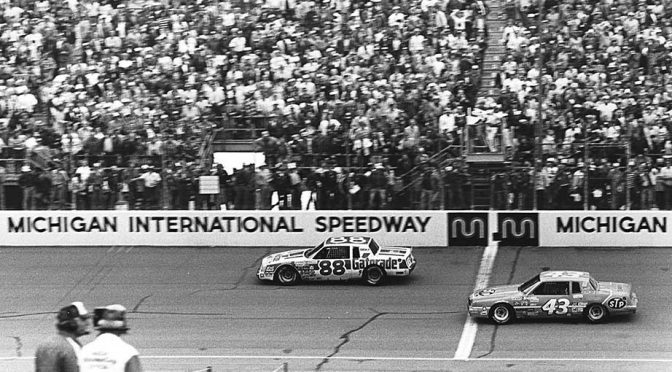
It was 1981 when the Gabriel 400 at Michigan International Speedway saw a total of 47 lead changes, ending with Bobby Allison winning — but there’s much more to the story. 


On Lap 196 out of 200, Allison jumped from seventh to first, stealing the lead from Darrell Waltrip. But this isn’t where the race’s craziness ended, it’s where it began.


Behind Allison on Lap 197, a six-car pileup occurred in Turns 1-2, involving Waltrip, Dale Earnhardt, Buddy Baker, Mike Potter, Cale Yarborough and Lake Speed. Waltrip had led a total of 54 laps, the race’s longest leader. Earnhardt had led a total of 37 laps. 


Since the wreck occurred with just three laps remaining and green-flag-checkered finishes didn’t exist in 1981, the event ended under caution, deeming Allison the winner. The Hall of Famer would go on to win at Michigan one more time in his Sprint Cup Series career in 1982, ending with a total of four wins at the 2-mile track. 


The 1982 victory was a thriller in which Allison outdueled Richard Petty to the stripe.

NASCAR Sprint Cup Series teams will have at least one slight change in their entries for this weekend’s Pure Michigan 400 at Michigan International Speedway.

On Wednesday, the sanctioning body issued a bulletin that, among other things, calls for the installation of an additional NACA duct to be mounted in the right-side window.

Such ducts, used for cooling purposes, are currently installed in other window areas, and allow for airflow inside the car.

The change was made in reaction to high heat build up inside the car generated by the high drag package when it debuted at Indianapolis Motor Speedway last month. The same package is scheduled to be used this weekend at MIS.

The platform includes a 9-inch spoiler with a 1-inch wicker bill; a 2-inch leading edge on the splitter, a 43-inch splitter extension panel (often called the radiator pan) and a rear fascia extension panel similar to those currently used for superspeedway events.

Excessive heat build up created by the package is a concern for the toll it can take on the drivers as well as the cars according to 2012 Sprint Cup Series champion Brad Keselowski.

“I would not be surprised to see a lot of car failures this weekend, specific to heat relation as it pertains to the aero package and its kind of cause and effects,” he said during a national teleconference Tuesday.

“And inside the car I would not be surprised to see a lot of hot and worn out drivers after the race. We all know we’re in for a handful of the race.”

Keselowski said the new package is expected to create more drafting, and that time lined up nose to tail will lessen the amount of air going over and around the car.

“And the speeds at Michigan are higher than they are at Indianapolis, which means the parts, specifically the drivetrain are going to be even hotter,” he said. “I know the team is very, very concerned about the drivetrain, everything from the engine all the way back to the axles because they’re really not made for these temperatures.”

Following the NASCAR XFINITY Series race at Indy, at least three drivers received treatment for heat-related issues following the event, including race winner Kyle Busch.

Wednesday’s bulletin also states that one additional NACA duct may be used to provide air to the engine control unit (ECU).