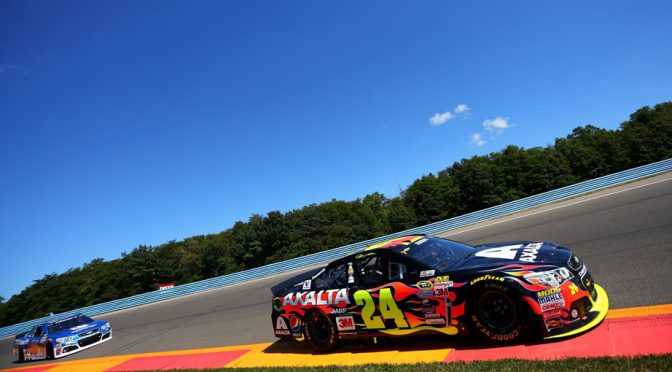
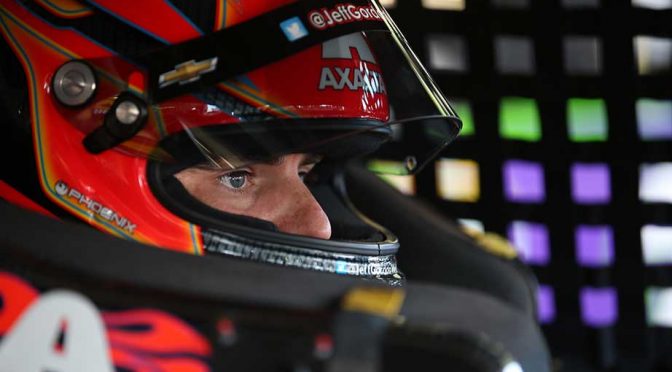
WATKINS GLEN, N.Y. — Jeff Gordon‘s rise to prominence in NASCAR didn’t begin with success on the Sprint Cup Series’ road courses.
In fact, the Hendrick Motorsports driver was well on his way to his second of four Sprint Cup championships in 1997 before he took the checkered flag as race winner on one of the series’ two winding, demanding layouts. That first win came at Watkins Glen International, site of Sunday’s Cheez-It 355 at The Glen (2 p.m. ET, NBCSN, MRN, SiriusXM) in 1997.
It was his 144th career start and his 27th career victory.
Today, he’s recognized as the most successful road-course racer in NASCAR, with nine career victories.
With retirement from full-time competition drawing closer with each passing weekend, it will be his last scheduled start on a road course.
No more turning left AND right, hairpin turns or elevation changes.
Success didn’t come easy.
“No, I remember going to Sonoma the first time and turning the car over on its side in the tire wall,” Gordon recalled Friday at WGI. “I felt like I was pretty lost.
“The second year I really felt a big progression and then the third year, which I think is when I won my first road-course race, I think in 1995 or 1996, everything just started to click. We worked hard at it. There is no doubt we worked hard at it. That hard work paid off.”
Gordon’s recollection was off only by a season, understandable for one who has won more races (92) than any other active driver and fewer than only two others all-time, Hall of Famers Richard Petty (200) and David Pearson (105).
He was, however, correct as far as what it took to become a constant threat on the unusual layouts that have fallen only twice annually on the NASCAR calendar during his career.
RELATED: Watkins Glen may produce a wild-card winner
“Early on I just remember wanting to take on every challenge as a team that we possibly could to improve to be a bigger threat for the championship,” he said. “Back then you had to try to be good everywhere because every track mattered for the championship. It was something that we really pursued heavily. I enjoyed it, even though I didn’t grow up road racing a lot.”
The field of drivers capable of winning on a road course wasn’t as deep as today, and the number of teams that expended the extra time and resources was fewer. Drivers such as Rusty Wallace, Ricky Rudd and Mark Martin thrived. Eventually, Gordon did as well.
“We had a team and a car that was capable of being very competitive,” Gordon, 44, said. “Especially Ray (Evernham, crew chief), back in those early days when the crew chiefs had more flexibility as to how you could find an edge over the competition, he worked hard on the transmissions, the braking, the set-ups and gave me everything that I needed to go out and push the limits of the car and get a lot out of it.
“We started excelling at them.”
While his team ratcheted up its efforts, Gordon did as well. Before he began his NASCAR career, Gordon said he “was pursuing everything.”
“If somebody gave me an opportunity to get in a race car or go to a driving school, then I was packing my helmet … and heading that way. I did it up at Mosport (now Canadian Tire Motorsports Park) in Canada. I did it with Skip Barber (driving school) and I think after I started NASCAR I did the one out in Sonoma and I also did the one in Phoenix with Bob Bondurant. …
“It was fun to do something different than ovals. I feel like ovals are what I’m best at and have been all the time, but I just was comfortable in going to a road course and doing something unique and different. Luckily I drove for a team that knew how to put good race cars underneath me not only on ovals, but (also) on road courses. That made the learning curve come much easier for me.”
Gordon has won at every active track on the NASCAR Sprint Cup Series schedule save one — Kentucky Speedway, which only came on board as a Sprint Cup venue five seasons ago. He won at tracks no longer on the schedule (Rockingham Speedway and North Wilkesboro Speedway) as well.
Excelling on road courses isn’t something he takes lightly as he prepares for his final Watkins Glen start.
“I think when you look at the drivers and teams that outsiders look at in our sport of who is at the top of the list, I think if you can add a road course win to it, it separates you from the norm and puts you into an elite group,” Gordon said. “When I look at my road-course wins and all the different tracks that I’ve won at, I think it just kind of adds to the stats of putting me into a unique category that I’m very proud of.”