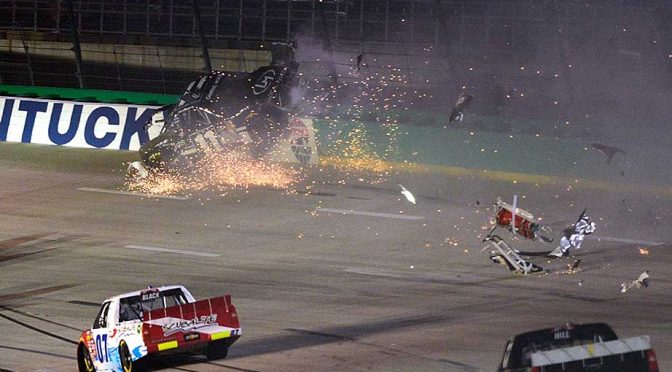
While safety — of both fans and drivers — always is a priority for the sanctioning body, it has been of particular concern this season after Kyle Busch suffered a broken leg and foot in the season-opening NASCAR XFINITY Series race at Daytona. And it has been a subject of much debate among drivers, officials, fans and analysts.
RELATED: Safety improvements at Daytona
Is the current course working? Kathy Sheldon and George Winkler discuss the issue for NASCAR.com this week. Post your own thoughts in the comments section below.
Sheldon: One would naturally think that speed is Job No. 1 for NASCAR, but really safety has been a primary concern for years. The sanctioning body has worked hard with tracks to identify problem areas such as the unprotected area where Kyle Busch wrecked in February. The Steel and Foam Energy Reduction (SAFER) barrier technology has been a huge success. And NASCAR has been quick to respond to all race-day safety issues, not just those affecting drivers. Catch fences have been improved to shield fans, and speedy action was taken after a pit road fire at Richmond to ensure fire retardant gear protects crew members effectively. Let’s not forget the HANS device, which was made mandatory following the horrific wreck that took Dale Earnhardt’s life in 2001. NASCAR is quick to address problems and is working effectively to ensure the safety of competitors and fans. The current method of assess, study and implement works quite well.
Winkler: Kathy, those are great examples of how NASCAR has reacted to situations with safety improvements that have made the sport better. But what tends to happen after these flashpoint moments like the Austin Dillon wreck at Daytona is there will be a segment of the population that perceives NASCAR isn’t doing enough to get ahead of the curve. However, as anyone who has ever stepped foot in the NASCAR Research & Development Center in Concord, North Carolina, can attest, the sanctioning body is continuing to look at potential areas of improvement even before incidents happen. Just this year NASCAR added a seventh safety belt to the driver’s seat, and now the belts connect to the seat instead of the car, providing a snugger fit. That seventh belt allows more head clearance for the driver if the car were to flip over like it did in the Dillon wreck. So sometimes it’s just a matter of getting the word out so people are aware of the improvements. Sorry for the plug, but we have an entire area of our site devoted to such information called Inside Track.
Sheldon: George, I agree that often the flashpoints tend to overshadow a lot of the work going on. The fact is, when safety measures are working, it’s what you don’t see that proves the improvement. Before the latest seat belt changes, we saw composite materials come in for seats. Now it’s common for drivers to tweet photos of their seats being "poured" — they are shaped individually for drivers and made of material much stronger than the old aluminum versions. And those seats are installed meticulously. Austin Dillon‘s team member Tommy Wallace talked to NASCAR’s partner NBC about safety after Dillon’s frightening wreck at Daytona, and his takeaway was everything worked: The only piece of equipment that broke loose in Dillon’s tumble down the frontstretch was the radio. It’s Wallace’s job to ensure Dillon’s seat is installed securely, and he explained that more than three dozen bolts inside the cockpit keep the seat leg braces steering column, seat belt mounts and other equipment in place during rough wrecks. Those pieces all worked at Daytona, holding Dillon safely in his belts and inside the roll cage, even after coming to rest upside-down.
Winkler: That’s amazing, all the work that goes into some of the things we take for granted when we’re watching the race. But with all the safety improvements that have evolved over the years, we’d be mistaken if we didn’t think more could be done. And NASCAR admits as much. As NASCAR Executive Vice President and Chief Racing Development Officer Steve O’Donnell said last week on SiriusXM Radio, in regards to the Dillon crash, you never want to see the car get in the air or into the catch fence. And he followed up by saying NASCAR would be working on it. That’s good, that the sanctioning body isn’t resting on its laurels and trying to say everything is fine. There’s always room for improvement, and as we’ve seen in other sports, too, nobody is immune to safety issues that crop up from time to time. The leagues that continue to work through these issues, and refuse to bury their heads in the sand, will be the ones that thrive.
Sheldon: The roof flap technology that helps keep cars on the ground is now 11 years old, and I agree more needs to be explored on that front. Keeping fans safe always must be a priority. It will be interesting to see how things like new see-through composite materials can be adapted for spectator safety. Some people have suggested Plexiglass at the tracks recently. Any hockey fan can attest, Plexiglass has its own issues. But the fourth generation of Gorilla Glass that soon will protect our smartphones, along with similar products, may spur bigger-scale uses. Part of NASCAR’s mission is staying at the forefront of technology. You can bet the sanctioning body will keep working to find better solutions, from design to materials, in every facet of the sport, including car interiors, rules packages, catch fences and barrier technology. Everyone in the industry got some scares this year, but the sky is not falling. Work is always underway to improve safety.
Winkler: No, the sky is not falling and thankfully nobody was seriously hurt in either of the crashes we recently witnessed. But it’s important that voices continue to be heard, from fans, drivers, teams, tracks, and even from people like us, journalists. There can never be too many voices when it comes to safety. So the next time somebody like Kyle Busch chimes in and gives an opinion that "there’s no sense in grass" at any of the tracks, don’t look at it as him stirring the pot, but rather as him feeling comfortable enough to speak his mind in a sport that is receptive to change. That’s the beauty of times like these, seeing people come together for the greater good. Now, if what you say comes true about the Gorilla Glass, you can bet I’ll race you down the steps to be the first to pound on the glass when my favorite driver whizzes past. Kathy, you better bring your running shoes for that.