Baker announced on Tuesday he has inoperable lung cancer

It’s difficult to write something personal about someone you’ve really only known professionally.

FULL SERIES COVERAGE

Latest news
Standings
Schedule

And that’s the case with Buddy Baker. I’ve known Buddy for years but truthfully I don’t "know" him. And the fault in that, if there is any, is mine.

Record books and media guides and the Internet can provide you with the following, that Baker won 19 times in NASCAR’s premier series and a slew of poles (38) in a career that ran the better part of three decades. You don’t need to know the man to know that he was a success on the race track.

You don’t need to know the man to know that he was equally successful in the television booth, where he ventured when his driving career had ended and The Nashville Network (TNN) as well as CBS came calling. Baker was folksy, he was genuine and he was a perfect fit.

Those same qualities helped him launch yet another career, this time on radio. Since ’07, he’s been heard on SiriusXM NASCAR Radio, most recently as co-host of the program "Late Shift."

Those broadcast efforts gave folks a glimpse into Buddy Baker. Fans who came to know Buddy through his TV and radio work probably feel as if they do know Buddy and they’re not entirely incorrect.

All of this comes to mind because on Tuesday evening he told listeners that he was stepping away from the microphone for health reasons. Baker has inoperable lung cancer.

I remember bits and pieces from the late ‘60s when Buddy’s run with Ray Fox was coming to an end and a new one with Cotton Owens was beginning. I remember the stops with Petty Enterprises, the K&K No. 71 Dodge and the No. 15 of Bud Moore, too. And all that took place before he hooked up with car owner Harry Ranier and engine builder Waddell Wilson and finally won the Daytona 500 after 18 years of trying.

He was "Leadfoot" and the "Gentle Giant" but until he finally pulled into the winner’s circle at Daytona, he’d also been "Bad Luck Buddy" due to the number of occasions when he won, as he often recalled "the Daytona 450" or some other number that always fell just short of the race’s 500-mile mark.

It was probably 1985 and Bull Frog Knits. That might have been the first time I met Buddy and he was every bit as big as we’d always been led to believe. At six-foot six, Buddy didn’t climb out of a race car. He came out in a collection of elbows and knees.

He and partner Danny Schiff had teamed up to field a green and white No. 88 Oldsmobile and for the next five years Baker made less than 100 starts. The results were mixed.

It was a particularly bad wreck at Charlotte that sidelined Baker, and in August of ’88 he underwent surgery to have a blood clot removed from his brain.

He not only recovered, but he raced again and in ’92 made what would be his final start in NASCAR’s premier series.

Highlights? He won the Coca-Cola 600 at Charlotte Motor Speedway three times with three different teams.

He won the Southern 500 at Darlington (S.C.) Raceway.

He won at Talladega on four occasions. He won at Atlanta and Texas World Speedway and Nashville and Ontario, Calif.

And in 1980, he won the Daytona 500.

His victories came with seven different organizations; more than half the owners for whom he drove are already enshrined in the NASCAR Hall of Fame.

He won before radial tires, power steering and engineers.

"We never had luxury of car that would turn in the corner, we had to make it turn … trial and error mostly," he once said. "We had to do that at the race track; we didn’t have the engineers and things like that."

Add "driver coach" to the list of items on Baker’s resume. It’s an often-overlooked part of his career.

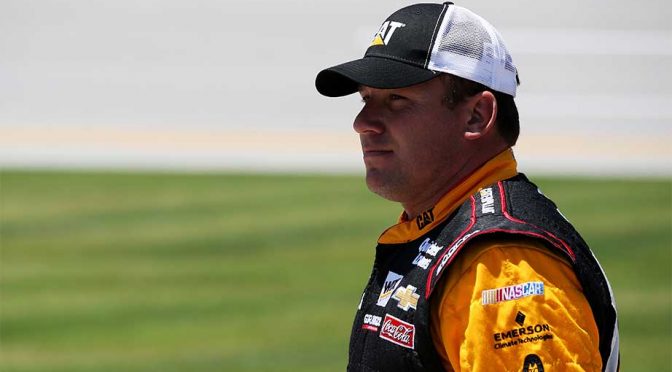
When team owner Roger Penske wanted someone to help a young Ryan Newman as he began to work his way into NASCAR, Penske turned to Baker.

When Brendan Gaughan was giving Sprint Cup a try in ’04, Baker got the call.

Baker proved to be an excellent coach; he didn’t get too excited when working with youngsters.

In ’04, Gaughan was making his first Sprint Cup start at Darlington. He hit the wall, by his own admission, roughly a dozen times.

Finally Baker came on the radio to provide a bit of advice.

"After I’d hit the wall like the 12th time," Gaughan said,  "… Buddy came over the radio and said, ‘Hey man, why don’t you give that wall a rest for a few laps?’"

"Do not shed a tear. Give a smile when you say my name," he told listeners Tuesday evening.

The smiles will continue to come easy. Baker often left listeners grinning, whether in person or across the miles and miles of airwaves.

You don’t need to know Buddy Baker to understand he had a lasting impact on the sport.

Here’s hoping we haven’t heard the last of him.
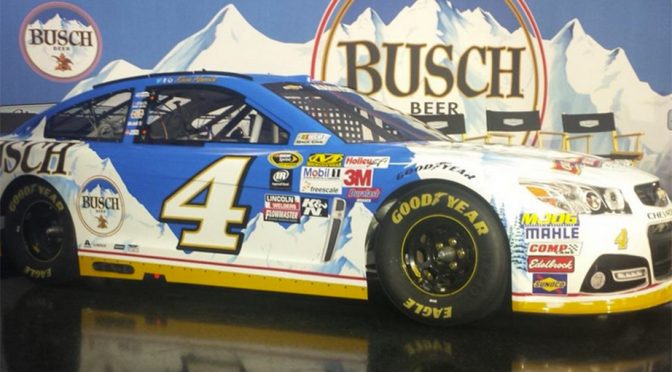
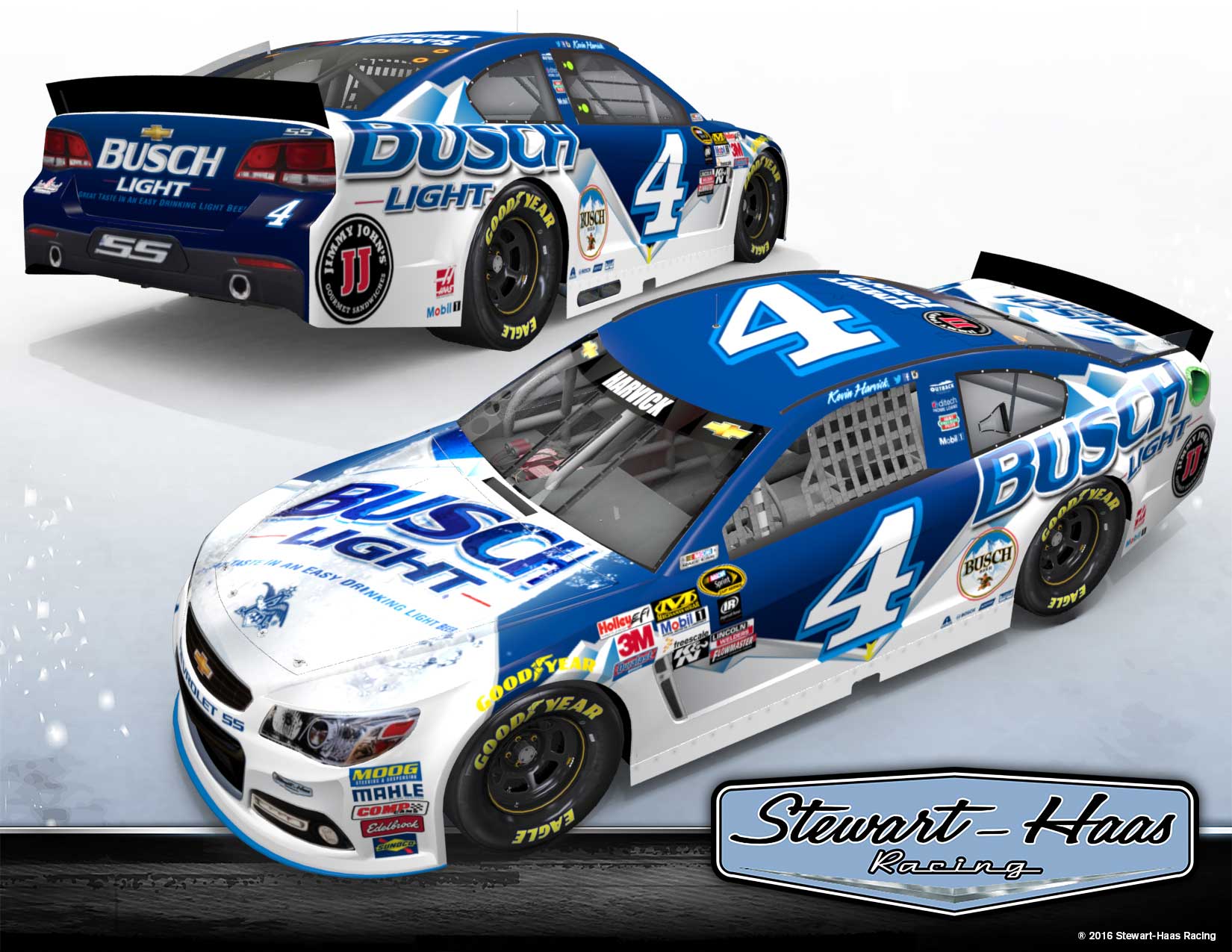
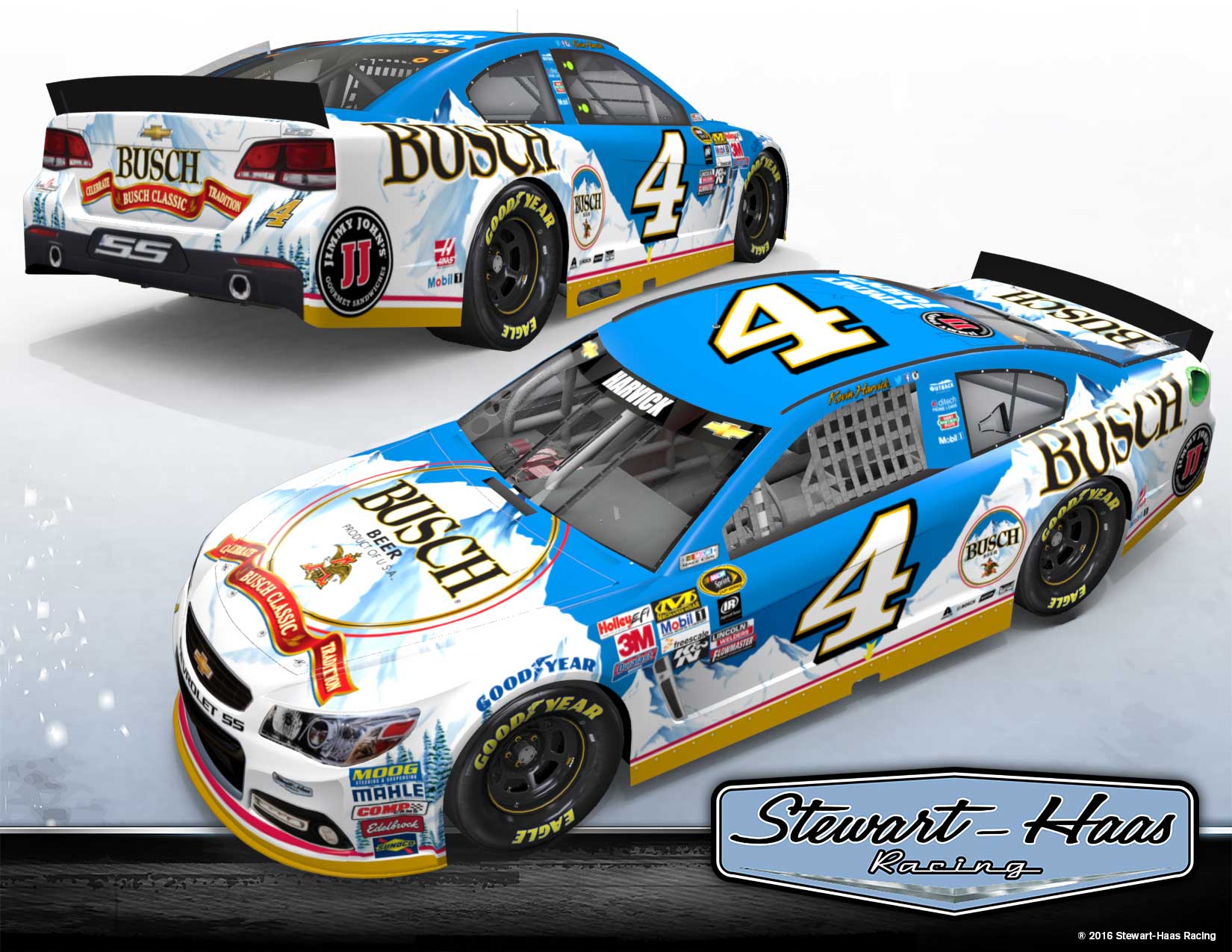
Stewart-Haas Racing and Anheuser-Busch revealed on Thursday morning a special paint scheme featuring Busch beer for Kevin Harvick‘s No. 4 Chevrolet for 12 races in 2016.

Anheuser-Busch has sponsored Harvick since 2011, when he was with Richard Childress Racing. The brand has been a team sponsor in NASCAR’s premier series since 1983.

“Busch beer belongs in NASCAR,” Harvick said at the reveal. “The entire Stewart-Haas Racing team and I can’t wait to have the Busch logo on the No. 4 car next season as we work toward another Sprint Cup championship.

“I saw the paint schemes evolve. I knew the history of the cars they were based off of. … It’s good to see them on real race cars. The first time I’ve actually seen them on a car, on the ground. It’s good to see it all coming to what it is today and be real.”

Busch was a series sponsor for the sport’s second-tier series from 1984 to 2007.

Ben Kennedy involved in spectacular wreck with five laps remaining

RELATED: Complete NCWTS results | Updated standings

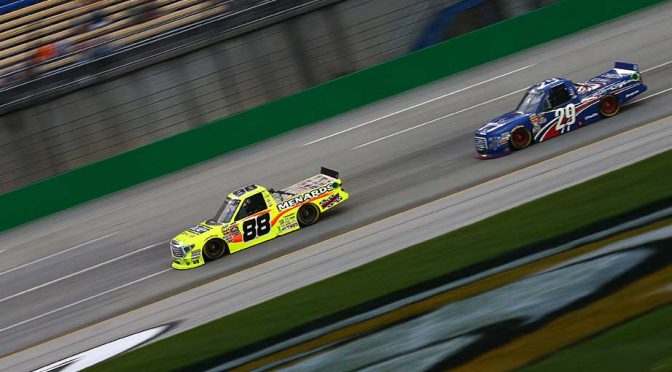
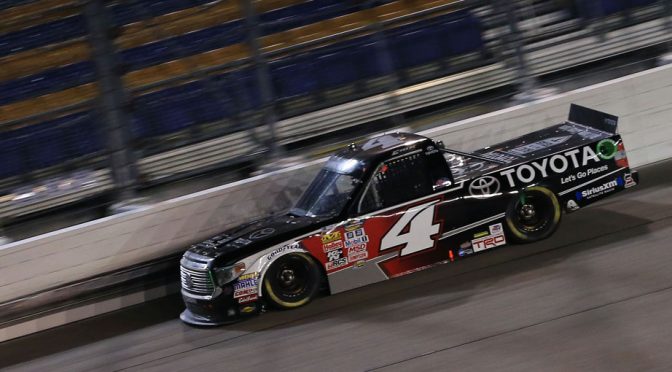
SPARTA, Ky. — In a race that ended five laps short of its scheduled distance, polesitter Matt Crafton was declared the winner of Thursday night’s UNOH 225 NASCAR Camping World Truck Series event after Ben Kennedy’s Toyota damaged the catchfence at Kentucky Speedway beyond the track’s capacity to repair it expeditiously.
 
With a shove from the Ford of Ryan Blaney, Crafton had taken the lead on Lap 145 moments before Kennedy was launched into the fence from contact with David Gilliland’s Ford.

FULL SERIES COVERAGE

Latest news
Standings
Schedule

The victory was the fourth of the season for the two-time defending series champion, who won for the first time at Kentucky and the ninth time in his career.
 
The race was slowed for the seventh time on Lap 140, when contact from the No. 05 Chevrolet of John Wes Townley sent the No. 23 Silverado of Spencer Gallagher hard into the outside wall.
 
NASCAR red-flagged the proceedings for 3 minutes, 28 seconds for track clean-up, leaving Jones in the lead for a restart on Lap 145.
 
But Gallagher’s wreck was nothing compared with the jolt Kennedy took on the restart lap after contact with Gilliland’s Ford sent Kennedy’s Toyota to the top of the SAFER barrier and into the catchfence.
 
"I thought I was clear," Kennedy said on his radio. The driver of the No. 11 Tundra had moved up the track into Gilliland’s Ford after being cleared by his spotter.

"I heard ‘Clear’ on the radio, so I moved up to the wall and as soon as I went to the wall," Kennedy said after leaving the infield care center.

"I guess Gilliland had a run on the outside and pretty much hit me in the right rear — and I went up. 

"I guess I was on top of the wall. I remember being on top of the wall for quite some time. I didn’t see much — just a bunch of dust and debris flying. Then came down. The ride from the wall to the ground was pretty hard. But I’m OK.

"Thank God for everything that NASCAR has done to keep this sport safe. ‘Cause for me to get out of my car on my own power after a hit like that is pretty incredible."

Blaney finished third, followed by Daniel Suarez and Timothy Peters.

Two support poles in the catchfence had to be replaced, a process that would consume 90 minutes. Accordingly, NASCAR called the race with five laps left.

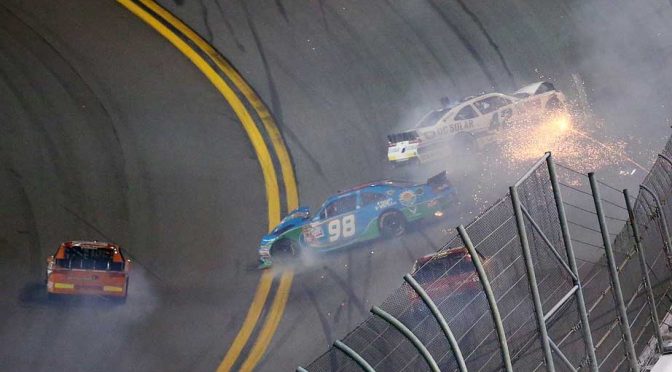
It was the second straight race in one of NASCAR’s top three touring series in which a car has hit the fence protecting the grandstands. In last Sunday’s Coke Zero 400 Sprint Cup Series at Daytona International Speedway, Austin Dillon‘s Chevrolet was launched into the fence during a last-lap wreck in the tri-oval. 

Erik Jones finished second, followed by Ryan Blaney, Daniel Suarez and Timothy Peters.

NASCAR.com’s Kenny Bruce and RJ Kraft debate this hot topic

RELATED: Kentucky to use new aero package | Several other tracks to use different packages

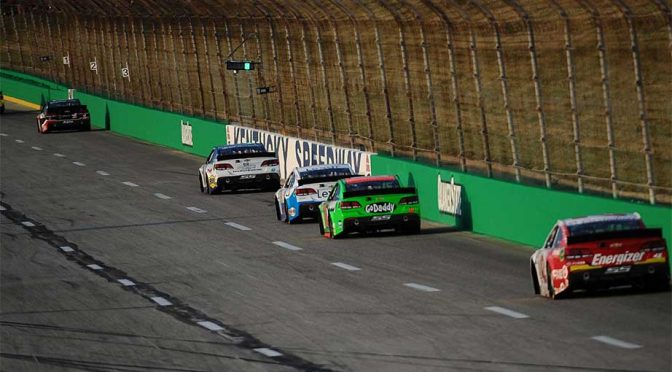
After weeks of discussion about new rules packages, NASCAR officials announced last month that new rules would be used for the NASCAR Sprint Cup Series Quaker State 400 Presented by Advance Auto Parts (July 11, 7:30 p.m. ET, NBC Sports Network, PRN, SiriusXM) at Kentucky Speedway.


The main focus is an aerodynamic package that will create less downforce on the cars and could help produce more side-by-side competition. The teams will get additional practice time today (Wednesday, July 8) — to get more time and comfort with the setup — as well as the usual practice time on Friday.

UPDATE: Cup practice canceled due to wet weather, moved to Thursday

According to NASCAR Executive Vice President and Chief Racing Development Officer Steve O’Donnell, the spoiler height will be reduced from 6 inches to 3.5 inches and the splitter extension panel (radiator pan) decreased from 38 inches to 25 inches. Additionally, the splitter will have 1.75 inches less overhang than the current splitter.

NASCAR announced on Tuesday that a similar package will be run in September at Darlington Raceway, although the spoiler will be bigger. Sprint Cup Series events in July at Indianapolis Motor Speedway and in August at Michigan International Speedway will use a different package with higher drag rules. The regular-season finale in September at Richmond International Raceway will use a new tire.

FULL SERIES COVERAGE

Latest news
Standings
Schedule

The fact that new packages are in place for points races is a hot topic. NASCAR.com’s Kenny Bruce and RJ Kraft debate whether this is a good or a bad thing.

Kraft: Excuse me while I dig into my bag of cliche phrases, Mr. Bruce. I am all for "change we can believe in" and I like that NASCAR is listening and making the product better to create more side-by-side racing and passing with different packages. But what I don’t like is how this is being implemented. This whole concept of "changing horses midstream," so to speak. The 2015 rules package isn’t impossible. Four teams have it figured out pretty well (the 4, 41, 78 and 48). And changing the rules setup even for one race, let alone multiple ones, in the middle of a season just seems like a bit of a panic move. Even if that’s not the intention, it could certainly be perceived that way. You have been competing a certain way for most of the season and now all of sudden, it’s different. Has any sport messed with the rules significantly midseason? This also feels a bit like a hurried effort to try to solve something that honestly looks not much different than last year’s racing, in which the end result was a thrilling 10-race postseason under the new elimination-style Chase format. For better or worse, the 2015 package should be used for the entire 2015 season, not tossed out for a race here or a race there.

RELATED: Lots to be learned at Kentucky

Bruce: I’ll ignore the "has any other sport" comment because anyone who has followed NASCAR for any length of time knows that it isn’t like "any other sport." You’re dealing with a competition that includes a car that weighs approximately 3,400 pounds and can travel in excess of 200 mph. And which, by the way, is made up of hundreds of parts. The fact remains that NASCAR officials believe changing the current package can produce better competition on the track. And even those you say have "figured it out" will tell you that the racing could be better. The teams themselves aren’t changing. The rules, as they pertain to how a race is contested, aren’t changing. It’s still the first one to the finish line wins. No, the current package isn’t impossible for some, but if there’s an opportunity to make it better, why wouldn’t you?

Kraft: Under the new Chase for the NASCAR Sprint Cup format every race takes on added significance as a win basically punches your postseason ticket. And now with new packages, these races could become wild cards, especially if one team finds something early in the extra practice time that they can use in a race. To me, you don’t test something out in an event that counts for plenty with postseason spots in play. You test something out in an exhibition like the Sprint All-Star Race, where they had hoped to do this. Again I’m all for the changes, I just don’t like implementing them in a race that means plenty and the uncertainty is great. What if the racing doesn’t improve, or takes a step backward or nothing changes as a result of the new package for the race? Making changes for Darlington, Indianapolis and Michigan, before we see how the Kentucky package plays out is an unnecessary risk in my view. See how that goes before making new packages for different tracks.

Bruce: NASCAR and the teams rely tremendously on the wind tunnel, simulation programs and testing to understand the effects of changes made to the cars. However, the only way to know for certain is to implement such changes in real-world race conditions with a full field of cars and something of value on the line. Sure, these races are now something of a wild card, but isn’t that a good thing? Aren’t the road-course races and the restrictor-plate races wild cards? Should we not count them toward the Chase? If these races with new packages provide a team with an opportunity that didn’t previously exist, I see that as a positive. For example, everyone will be relying solely on data before they hit the track for an extended practice leading into Kentucky; they’ll fine-tune that with what they learn on the track. But no one had all winter to tinker with the changes and gain any sort of advantage.

RELATED: Reactions to the new Kentucky package

Kraft: With the road courses and the restrictor-plate races, we knew they were wild cards from the get-go and that’s fine. You shouldn’t have the exact same type of tracks making up the schedule but you should have consistency in the rules over a season. 

NASCAR has been talking about trying to help keep the cost down for teams over the course of a lengthy season. Doesn’t changing the rules and what would be allowed on the car in terms of spoilers, splitters, etc., have an impact on how much money goes into the ride? Especially since teams are working on cars for particular races weeks in advance and the Kentucky package wasn’t given to them months in advance, since it was made official roughly four weeks out. I guess what I am saying Kenny is I don’t like immediate change when the uncertainty is great. Give me a gradual change that I can simmer on before it goes into effect.

Bruce: NASCAR has been cost conscious concerning the overall health of the sport, and not just "over the course of a lengthy season." It’s on-going. Teams are already doing R&D work. They likely aren’t adding more money or resources or personnel to what they’re already doing, they’re just focusing on something different. So I don’t think cost is a point you can argue. The uncertainly exists, for sure, but it isn’t as if they weren’t being told of the specific changes until they arrived in Kentucky. They’ve done some homework; they have a general idea of what to expect. Yeah, if NASCAR told them when they showed up to remove the spoilers completely, take off the splitters or something equally radical, it would be an issue. But this is gradual in that it’s not a hard and fast "here’s what you’ve got to have for the rest of the year so deal with it." Better to find out now, under real race conditions, than head into 2016 still uncertain of what lies ahead.

Dale Jr. was more concerned about Dillon than celebrating his win

RELATED: Dale Jr.: ‘That was terrifying to watch’

Dale Earnhardt Jr. is NASCAR’s perennial Most Popular Driver for many reasons. He’s a winner on track, he’s hip and engaging, he appeals to old-school and new generation fans and he’s got one of the most beloved pedigrees in the sport.

FULL SERIES COVERAGE

Latest news
Standings
Schedule

Here’s another reason, Earnhardt’s actions after winning the rain-delayed Coke Zero 400 at Daytona International Speedway speak to the kind of compassion and perspective fans want their cherished heroes to have. Dale does.

Even as Earnhardt claimed the checkered flag for his milestone 25th Sprint Cup Series victory in the early hours of Monday morning, there was no celebratory cheering on his radio — only raw fear and genuine concern as he watched a frightening wreck transpire in his rearview mirror.

"Oh my God. … that looked awful,” Earnhardt screamed into his team radio, his voice shaking.

"Oh no. Oh no. Did you see that?” He asked in disbelief watching Austin Dillon‘s car launch into the front-stretch catch fence, land back on track upside down and take another hard hit from Brad Keselowski‘s spinning car. The impact was so severe Dillon’s engine separated from the car and was still smoking yards away.

Earnhardt’s team assured him that help was on the way for Dillon and that included some of Earnhardt’s pit crew since they were close to the scene.

"Is everybody all right? Is everybody in the grandstands OK?” Earnhardt continued to press. Told that Dillon was out of the car and gave a thumbs-up, Earnhardt was still concerned.

"So all the drivers are good and everybody’s good in the grandstands?" he asked, still shaken. "Man, that looked scary."

Reassured again, that it looked like everyone was OK, Earnhardt finally praised his team for the win, but insisted, "I’m going to wait (on any victory celebration). I want to make sure everyone is good.”

It’s hard to listen to Earnhardt’s emotional radio transmission at the time of the accident.

It’s moments like this when you find out the true character of someone.

And for Earnhardt there was an immediate, instinctual priority shift. The trophy could wait.

Nearly an hour after the race had finished — long after Dillon and the other drivers had been checked and released from the infield car center — Earnhardt came into the Daytona media center still looking preoccupied and subdued, not like someone that had just earned a major victory.

"You’re just on the verge of tears, to be honest with you, because I think that the first thing that goes through your mind is — and I saw everything in the mirror pretty clearly — that car really went up in the air pretty high and I could just see that it was a black object that hit the fence and I’m assuming I’m looking at the undercarriage of the car,” Earnhardt said.

"I’ve never really seen a roll cage handle those catch fences very well and I just was very scared for whoever that was. I didn’t even know what car it was, so I was just very scared for that person.

"I didn’t care about anything except for just figuring out who was OK. We pulled down to pit road there and (teammate) Jimmie (Johnson) got out of his car, come around that’s the first thing we talked about. He was frightened as well and … we just really wanted some information about everybody.

"You imagine the news from the grandstands is going to come in a little slower, so you start thinking about that, waiting on that, seeing if everybody is OK there.

"I mean the racing doesn’t matter anymore.”

Although he didn’t specifically say as much, you have to imagine this kind of incident at Daytona is especially hard for Earnhardt. He lost his father and namesake, seven-time champion Dale Earnhardt, in a fatal crash here on the last lap of the 2001 Daytona 500. Earnhardt Senior drove a black No. 3 for Richard Childress Racing, as Dillon does now.

Although, in situations like this, it doesn’t matter if you have a special connection to the driver. Earnhardt explained how times are different now. As the sport has evolved and modernized, drivers actually spend more off-track time together now whether it’s promoting sponsors or sharing a barbeque in the motor coach lot.

"It’s an awful feeling,” Earnhardt said of watching a competitor be involved in such a serious crash. "We sit in those bus lots together, we all have become closer friends, I think, because of the environment.

"It aint’ like the old days where everybody is at different hotels and you never saw each other and you come to the track and run over each other and fight each other and not like each other.

"We all sort of live in this community and you may not like everybody, but you damn sure grow to respect them and don’t want to see anybody get hurt.”

And yes, Earnhardt conceded, this is the kind of thing that does cause you to question your mortality. This sport is like no other.

"I questioned it when I got my concussions and I’m sure I went through something when Daddy died,” Earnhardt reflected. "I think when I got injured a couple years ago I realized how close I came to not racing anymore and how quickly this can be taken away from you.

"I think turning 40 also helped me learn to appreciate this a lot more and try to really enjoy the opportunity I have because I’ve got such an amazing opportunity. I hate to go on about it but to be in these cars that I’ve got, to be with the team I’ve got, I feel so lucky and so blessed. When you get older, you definitely start to realize how fragile things are and how lucky you are to be able to be a part of it.”

Dillon’s crash and Earnhardt’s reaction to it is a not-so-gentle reminder that this sport is really much more about the people than it is the racing or the cars.

MORE: The reason behind Dillon’s wave

Erik Jones, Christopher Bell and Daniel Suarez looking for win

When the Kyle Busch Motorsports haulers rolls up to Kentucky Speedway on Thursday, it will arrive with trucks that will be driven by a trio of talented young drivers.

FULL SERIES COVERAGE

Latest news
Standings
Schedule

Erik Jones, 19, Christopher Bell, 20, and Daniel Suarez, 23, will try to capture the second consecutive KBM win in the Bluegrass State in Thursday’s UNOH 225 (7:30 p.m. ET on FOX Sports 1, MRN, SiriusXM). Team owner Kyle Busch took the checkered flag in last season’s event, leading a race-high 91 laps on his way to Victory Lane.

Jones enters the race coming off his first NASCAR Camping World Truck Series win of the season at Iowa. He has never competed in a NASCAR event at Kentucky, but finished sixth at an ARCA race there in 2013.

"Should be fun, Kentucky is a cool place with a lot of character," Jones said. "It’s getting rougher and I haven’t been there in a few years so it should be pretty good and rough now."

Jones’ crew chief Randy Fugle added, "We finally put it all together and collected our first win. Now, we need to go out and get five or six more."

Fresh off his NCWTS debut at Iowa where he finished fifth, Bell will make his first start at an intermediate track. The dirt standout is transitioning to stock cars and has already won four races in KBM’s Super Late Model.

"Obviously the top-five run at Iowa was awesome, so anything less is going to be a letdown, but we need to go there with realistic expectations of me never running at a track that size," Bell said. "First I need to finish the race, but also continue to be competitive as I gain more experience in these Tundras."

Suarez seems closer and closer to getting his first NASCAR national series win every time he straps into the No. 51 truck. He finished second in his last two NCWTS races, at Texas and Dover.

"Kentucky Speedway is a fun, interesting track that is really fast," Suarez said. "I’m excited about it, especially since I’m also competing in the NASCAR XFINITY Series race there. Running both events will help me figure the track out quicker and will hopefully lead to two positive results."

See what the No. 31 Chevrolet will look like Labor Day weekend

RELATED: Buy tickets for Darlington | Buy the die-cast

This year’s Bojangles’ Southern 500 at Darlington Raceway (Sept. 6, 7 p.m. ET, NBC, MRN, SiriusXM) will have a throwback feel to it with the track hosting the event again on Labor Day weekend.

And teams are going with that throwback theme in their paint schemes. Richard Childress Racing was the latest to reveal its throwback look with Ryan Newman‘s No. 31 Chevrolet for that weekend.


Newman will be looking for his first win at Darlington. He has seven top fives and 11 top 10s in 16 starts there.

Wet weather moves practice time to Thursday from 11 a.m. to 12:55 p.m.

NASCAR Sprint Cup Series practice for Wednesday at Kentucky Speedway was washed out by wet weather at the 1.5-mile track and will now happen on Thursday from 11 a.m. to 12:55 p.m. ET.

Originally, there were two two-hour sessions scheduled, one from 3-5 p.m. ET and another from 6-8 p.m. ET. However, wet weather delayed the start of the first session leading to a revised schedule that called for a three-hour practice to start at 5 p.m. ET or as soon as the track was ready.

However, a little after 7:20 p.m. ET, the planned practice was called.

FULL SERIES COVERAGE

Latest news
Standings
Schedule

Air Titans took to the track around 3:20 p.m. ET to begin drying the 1.5-mile oval but more rain close to the revised start time of 5 p.m. ET delayed practice some more and eventually was called. There are 10 Air Titans at the track, per a NASCAR spokesperson.

The extra practice time had been added to the schedule as the Quaker State 400 Presented by Advance Auto Parts (Saturday, NBC Sports Network, NBC Sports Live Extra, PRN, SiriusXM) will be the first race with a new aeropackage.

The Kentucky package will feature a shorter spoiler as well as changes to the splitter and splitter extension panel (radiator pan), moves that will lessen the amount of downforce on the cars by approximately 1,000 pounds, and, it is hoped, create more passing on the track.

Steve O’Donnell, Executive Vice President and Chief Racing Development Officer for NASCAR, told SiriusXM NASCAR Radio that officials believe the change will be effective for the 1.5-mile track.
 
"We’re going to look at the measurements we look at every day: were there more passes, who was able to compete, how did the field look throughout the race, obviously fan measurements post-race," he said.

Teams will also be on-track for two practices on Friday as well as Coors Light Pole Qualifying.

Kentucky is not the only track to see new rules packages this season. On Tuesday, NASCAR announced plans for a similar rules package in September at Darlington Raceway and new rules packages for the Sprint Cup races at Indianapolis Motor Speedway in July and Michigan International Speedway in August.

First-year XFINITY driver looking forward to familiar track at Kentucky

Brennan Poole’s car wasn’t launched into the fence in the middle of the night only to get hit by another car as it came to rest, upside down, on the racing surface.

FULL SERIES COVERAGE

That particular incident happened to NASCAR Sprint Cup Series driver Austin Dillon, and Dillon’s crash occurred during the Coke Zero 400 at Daytona International Speedway, just shy of 3 a.m. Monday morning.
 
Poole’s wreck occurred a day (and then some) earlier, in Saturday’s NASCAR XFINITY Series race at Daytona
 
A multi-car crash, the first of two in the final 14 laps, unfolded when driver Ryan Reed bounced off Brendan Gaughan. Twelve cars were eventually caught up, including the No. 42 Chevrolet of Poole.
 
By the time it was over, Poole’s car had slid through a portion of the infield, shot back onto the track and struck the outside wall nose first.
 
"I couldn’t really see what was happening in front of me," Poole, who was not injured, told NASCAR.com Wednesday. "The first thing I saw was the 18 car (of Daniel Suarez) get sideways. My spotter was telling me to get low. I moved low and I missed the first portion of the wreck and then when the 6 (of Darrell Wallace Jr.) got turned, he started to come back down the track to where I was … I had to move a little bit lower and when I jerked the car to the left … I missed the 6 by just a little bit.
 
"When I moved the car to the left so quickly, I got a little bit out of shape. Then I hit I think it was rumble strips for the road course — there are two big humps. I’m not sure if it was rumble strips or not, but I think it was. When I hit the first one I was already just a little bit out of shape … then I hit the second and I already had the car leaning on the left side. When it landed I was on the left-rear tire and (it) just went straight right. There was really nothing I could do at that point to save the car."
 
Poole, scheduled to compete in 17 races this season for the HScott Motorsports with the Chip Ganassi team this season, finished 36th.
 
It was a disappointing ending for the 24-year-old former ARCA winner who has had a mixed bag of results in his first year in the series.
 
"I feel like we had a pretty good car," he said. "I don’t know if we had a car that could have won the race but we definitely had one that would have been up there if not pushing the winner then right there with everybody. That was kind of a good felling, especially for a first-year team.
 
"We’re really trying to build this program; we’ve got all new guys … first (year) relationship with Ganassi. I really feel like we’re making some gains as a first-year team to really build for the future. Obviously, you want to be able to compete for wins and championships. It just takes time. We’re headed in the right direction. We’ve had some really good runs this year and there have been times we’ve struggled. I think that’s just part of racing, starting something new and learning."
 
Poole will make his 11th start of the season, as well as the 11th of his career in the series, this weekend at Kentucky on Friday night (7:30 p.m. ET, NBCSN, PRN). Five other races this season by the team have featured Sprint Cup Series driver Kyle Larson behind the wheel.
 
While he is seeing most tracks for the first time, Kentucky will be something of a "homecoming" for Poole – he won the ARCA race on the 1.5-mile track last season.
 
His best XFINITY Series finish this year came at Las Vegas, where he finished ninth. It was the first of five finishes of 13th or better for the driver from The Woodlands, Texas.
 
"I think it gives you some confidence going into the weekend knowing that you know how to get around the track and you’ve had success there in the past," he said of Kentucky. "I’m really looking forward to it because it’s the last time I was in another car that wasn’t an XFINITY car. Kentucky is really my last memory in something else. I’m really looking forward to seeing how it relates to the XFINITY car and seeing if there is anything I can pick up from and learn.
 
"The XFINITY car is just a lot different. … It’s really a momentum driven style race. It makes it a challenge, especially when you have guys around you that are so incredibly good at it. They really take you to school every now and then. Mostly I think it’s confidence but also just having been on the track before, knowing where the bumps are, knowing what to expect (is a plus)."