Insisting he didn’t have so much as a headache 24 hours after a heart-stoppingly wild crash on the last lap of Monday morning’s Coke Zero 400 at Daytona International Speedway, Austin Dillon spoke with the national media Tuesday morning having had a day to collect his thoughts and count his blessings.
Dillon said he’s watched multiple video views and replays of his crash since, ”I took a shower, cooled down and I was like, ‘all right, here we go, let’s start watching ’em.’ ”
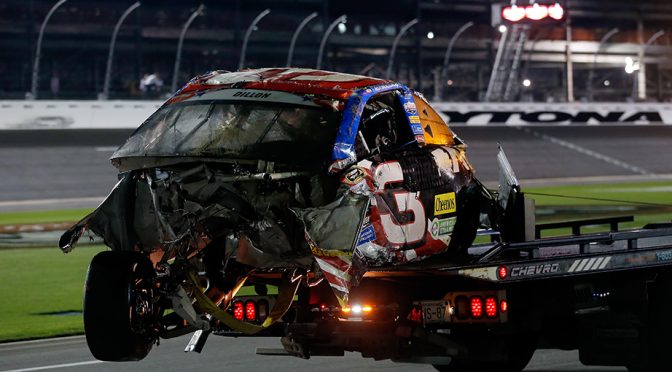
His No. 3 Bass Pro Shops Chevy was hit during a final lap green-white-checkered final run to the checkered flag and launched upward over two lines of cars and into the catch-fence in front of the frontstretch grandstands. After hitting the fencing, Dillon’s car repelled back on track upside down and was hit again by the spinning car of Brad Keselowski. Dillon’s car finally came to rest on a paved portion of the infield track between the end of pit road and the frontstretch; its still-smoking engine landed 20 yards or so away from the crumpled car.
Crew members left their pit road positions and ran over to Dillon’s car to offer aid. After a few gut-wrenching minutes, Dillon emerged and walked away on his own, stopping to wave to the crowd with both hands overhead.
The Speedway evaluated 14 fans in the grandstands for possible injury. Eight of them declined any treatment, one was transported to a local hospital in good condition.
"I watched a lot of videos and just watching it in live speed, it is violent looking,” Dillon said. "It’s a wicked crash."
RELATED: Dillon Shaken, but OK after massive wreck
The cord connecting Dillon’s radio to his team for communication ripped off during the various impacts. He could hear his team — including his grandfather, the team owner Richard Childress — ask repeatedly if he was OK but he had no way to communicate back and reassure them.
"I think it was way worse for everyone at home watching and for him [Childress] watching it,” Dillon said. "The worst part for family members is you want to let them know you’re OK after a wreck through the radio. I could hear them, but they couldn’t hear me so it was one of those deals where I knew they were upset and I felt bad because I couldn’t get to them.
"I was saying ‘I’m OK, I’m OK,’ but it wasn’t going through and I could hear in their voice how scared they were. Luckily, the guys had gotten there fast enough and gave everyone the thumbs up to let them know that I was fine.”
Perhaps most upsetting to Dillon was the eventual reaction from his younger brother, 23-year-old XFINITY Series racer Ty Dillon, who was home watching the race on television.
"When I talked to my brother, it was another level because he was upset and hearing him on the phone upset, it was like, ‘Man, I’m going to have to watch this,’ because he’s a tough guy and to hear him be upset about it and worried about me, it was like, ‘All right I need to look at this wreck.’ I did and you can see where a guy watching it from home not knowing how I was and the pit crew kind of running out to the car, it was pretty dramatic right there for 38 seconds or so.
"But I feel like it was the safety that made it possible for me to be here today.”
Dillon, who finished seventh in the race, said except for a sore tailbone and groin, he was remarkably fine considering the seriousness of the accident. He said he immediately thanked the team shop guys for "keeping all the bolts tight" on the car and said the carbon fiber seat and his own fitness level made a big difference in the positive outcome.
He also credited the safety improvements both NASCAR and the various tracks have made since the last driver of the No. 3 Richard Childress Racing entry, Dale Earnhardt, was tragically killed racing on the final lap of the 2001 Daytona 500.
"The way I look at it is I think from what I’ve learned from those crashes, for instance, what happened to Dale, our sport has taken a whole turn of 360 degrees and it’s all about safety and we’ve been able to learn from our mistakes in the past and that’s what you have to do,” Dillon said.
"You have to learn from history and develop and innovate new ways to make our sport safe. And technology has come a long way."
RELATED: France: ‘Working to make racing safer and better’
But, Dillon said he expects more to be learned from his incident, too, with more immediate remedies if necessary.
"The drivers themselves would like to see things done to make our cars stay on the ground,” Dillon said. "No one wants to see them put in the air and everybody wants to still walk away from wrecks like that.
"The good part is our cars are safe. It did its job. But I think we can keep things on the ground moving forward.
"For me, I think we can make subtle adjustments to improve by Talladega (the next restrictor plate race, Oct. 25). I’m not sure what they’ll be. I don’t know if we have to come back with the same package, but I’ll be ready for it. I think all the drivers will be, too."
Dillon started his day on Tuesday as a guest on NBC’s "Today" show, taking tough questions from host Matt Lauer about the dangers of restrictor plate racing. But the 25-year-old handled the line of questioning well.
Lauer reminded him that veterans such as Ryan Newman and Jeff Gordon were adamantly critical of the situation, voicing strong opinions after the race.
RELATED: Drivers react to wreck | Dale Jr: ‘It scared the (expletive) out of me’
"I have to make my own opinion, first of all,” Dillon said. "I have a lot of respect for NASCAR and the drivers. Going through something like that, there’s other drivers that have gone through wrecks similar.
"This is probably one of the most violent ones, obviously, and I feel like my opinion is I’m here today, talking to you guys and right now my groin is a little sore and my tailbone is a little sore but other than that, my head and my neck, which is the most important to me, I have no headache.
"I think it’s pretty impressive to see how far we’ve come after learning from other wrecks. … the roof — like like the cage itself — held up well. The catchfence did its job. It kicked things back into the track where we needed to.
"A lot of things have innovated to make everybody still safe today. Luckily the fans are all in good shape. We’re obviously going to probably enhance more safety after this and we’ll keep developing as our sport grows.”
Asked several times in different ways if — after this experience — he was still confident and comfortable suiting up for another round of speedway racing, Dillon consistently responded that he was.
"For me, I try and put it in the back of my head, forget about it and move on,” Dillon said. "You have to be able to move on and trust in the safety equipment. Like I said, if I can take a lick like that and feel as good as I do right now, I feel like I can do anything.
"You feel like Superman."