One by one, before the first engine has fired and the first car has hit the track, they gather in the NASCAR hauler parked inside the garage.
It’s a scene repeated every weekend when NASCAR rolls into town.
Their levels of experience often differ quite a bit. There are champions and those with numerous starts in lower series seated alongside those with limited experience and much less success.
Yet here everyone is treated the same. And everyone carries the same label — rookie.
Each driver has been given several sheets of paper showing diagrams that include the placement of timing and commitment lines, pit entrance and exit and the proper route to enter and exit pit road from the garage area.
It’s information that is track-specific. While the basic processes that take place during any given race weekend are relatively the same, there are certain details at each venue that those with limited experience need to know.
Proper procedures are explained and advice is doled out.
"Use your hand signals so you don’t start to slow down and get all jammed up and have somebody’s radiator in your backseat," Buck tells the drivers.
Each week, a veteran driver will also attend the meetings to offer pointers and answer any questions a rookie driver might have. At Martinsville, 2004 premier series champion Kurt Busch was on hand.
"Those of you that have made laps around here before, you know how quick it is," Busch said of the series’ shortest venue. "It’s an awkward track. There’s no other place that really compares to this. So the thing you have to do is to get comfortable with the surroundings."
Busch said he would often walk around tracks "even if I’ve been here before" to reinforce the information given during the meeting.
"Have your spotters communicate to you where the holes are when you pull out … your tires will be ice cold here … they won’t help you do much turning when you get into (Turns) 3 and 4 … but if you’re consciously making an effort to warm up your tires, somebody’s going to be right on your bumper and it’s going to be chaos," he said.
Busch also urged them to take note of the commitment and blend lines at Martinsville. "It’s the same Turn 2 line that’s painted at Bristol," he said later. "But at Bristol, you have two pit roads (one on the frontstretch and one on the backstretch). It’s the same line in the same place and it means two different things."
Drivers’ left-side tires must touch the blend line near Turn 2 at Martinsville before pulling up onto the track. A similar line at Bristol signifies the pit entrance on the backstretch — touching any portion of it without proceeding onto pit road will result in a commitment line violation.
"Now they’ll go to Bristol (in two weeks)," Busch said, "and they need to remember."
• • •
So what constitutes a rookie in the eyes of NASCAR?
In most cases, it’s up to the discretion of the series director and is based on the individual’s prior experience.
Matt DiBenedetto, 23, made his first Sprint Cup Series start this year after running the bulk of the races (29 of 33) in the XFINITY Series last season.
Brett Moffitt, 22, made seven Sprint Cup Series starts in 2014. Between 2009 and 2013 he made just one XFINITY Series start and two in the Camping World Truck Series.
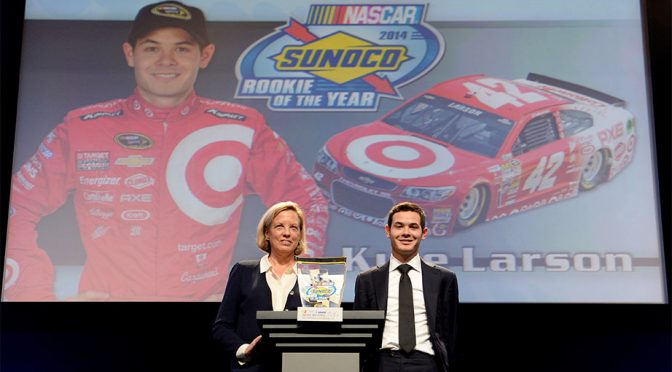
Both are among those competing for this year’s Sunoco Rookie of the Year Award in Sprint Cup, along with Jeb Burton, Tanner Berryhill and Alex Kennedy.
To be eligible for the Sunoco Rookie of the Year Award, a driver must attempt to qualify in at least eight of the first 20 points races. A 10-1 point system, separate from the NASCAR championship driver points format, is used for scoring rookies in each race. The highest finishing rookie receives 10 points, second highest receives nine, etc. Only the top 17 finishes by each driver count toward his or her points total at the end of the year.
Bonus points are also awarded for attempts, finishing inside the top 10 and upon the completion of the final race of the season.
A panel then grades each rookie on conduct with officials, conduct and awareness on the track, personal appearance and relationship with the media. Points awarded by the panel are then averaged and added to each driver’s total, and the driver with the most points is the Sunoco Rookie of the Year Award recipient.
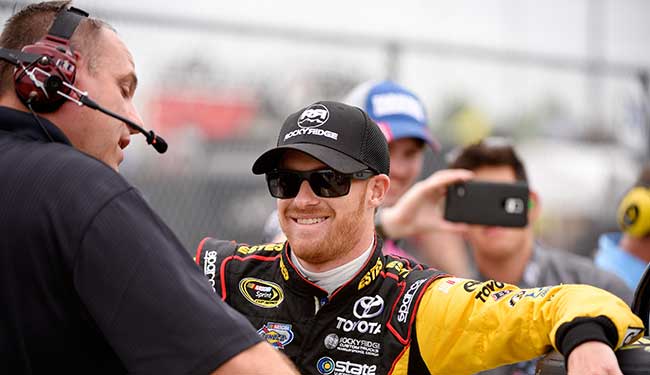
Jeb Burton is one of five rookies this year in the NASCAR Sprint Cup Series.
• • •
Of course, it wasn’t always that way.
In 1959, Darlington Raceway, in conjunction with sponsor Pure Oil (later to become Union 76), debuted the Darlington Record Club. Members were those that had qualified highest for each auto manufacturer during time trials for the annual Southern 500 at Darlington Raceway. Special recognition went to those that established track records there as well.
While NASCAR had been selecting a rookie of the year for nearly a decade — Rocky Mount, North Carolina’s Blackie Pitt was the first recipient in 1954 –- the Union 76/Darlington Record Club was eventually tasked with monitoring the progress of rookie drivers on the uniquely shaped, treacherous 1.366-mile track.
What began as an effort between driver Glenn "Fireball" Roberts and NASCAR official John Bruner Sr., to observe new drivers eventually evolved into a panel of Record Club members whose job was to either pass or fail those drivers attempt to make their Southern 500 debuts.
(It’s worth noting that the club also played a crucial role in requiring all drivers to complete a physical examination before being allowed to compete at Darlington. Today, a physical examination is mandatory for all three national series prior to the start of each season.)
Before the Record Club came into existence, "you just went down there and run," said NASCAR Hall of Fame member Richard Petty, a seven-time NASCAR premier series champion and winner of the 1967 Southern 500.
"(The Record Club) was good public relations. It gave those (rookies) something they had to do. Indianapolis (home of the Indianapolis 500) always had a rookie test you had to pass before you could go out and run. Well, we said if they can do it, we can do it, too.
"Back then, (Darlington) was a one-groove track through (Turns) 3 and 4, which is now 1-2. We’d explain what you had to do to pass people or let people pass you. Then you just said, ‘OK, now go out and run.’ "
To pass the test, drivers new to the series were required to run within a percentage of a pre-determined speed. "If we were running 130 mph," Petty said, "they would have to run 125 or something like that. Then they’d go out and run six or eight laps on the track by themselves."
"It was a little easier to show up at Daytona with a car even though you may not have that much experience and get in the race," three-time series champion and NASCAR Hall of Fame member Darrell Waltrip said.
"But they really observed you. If you were somebody new that they didn’t know and you showed up at the track, they’d have some drivers that would kind of see how you did, see if you could handle the track and the speed and all that. There was always somebody watching you, but Darlington was the only official test we took."
The panel would make its recommendations to NASCAR, but it was up to Bruner, a former flagman who eventually became Chief Steward for the sanctioning body, to make the final call.
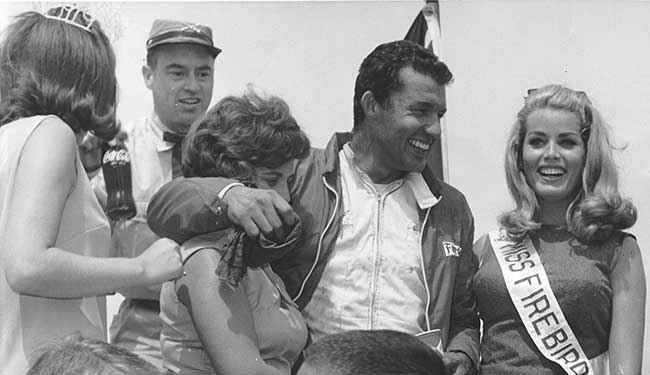
Richard Petty, who won the Southern 500 in 1967, used to show rookies the ropes at the iconic track.
• • •
In 1976, the Record Club’s competition panel began overseeing the rookie program.
Nearly a decade later, one of racing’s greatest figures found himself labeled a rookie, and was required to go through the orientation process.
Far from being a rookie, Anthony Joseph Foyt, better known simply as A.J., already had seven NASCAR premier series wins to his credit including a victory in the 1972 Daytona 500.
But Foyt, a four-time winner of the Indy 500 as well, had never raced at Darlington.
"I am going to Darlington as a bonafide rookie. I don’t want anything waived," Foyt told the press prior to his debut. "Why should I be different than anybody else? I know a lot of guys would have too much pride and ego to take the rookie test, but I’m not that type of person."
NASCAR driver Ricky Rudd was the president of the Record Club at that time. Among the members of the competition panel were fellow drivers Waltrip and Buddy Baker.
"Buddy and I and I forget who else, we observed A.J. Foyt and we flunked him his first day," Waltrip said. "Well, we told him we flunked him.
"I told Buddy, I said ‘Go down there and tell A.J. that we’re going to have to have a meeting about his test because I’m not sure he passed.’ Buddy looked at me and said ‘Do you think I’m crazy? You go down there and tell him.’ "
Foyt passed the test, eventually finishing 25th in his only Southern 500 start.
• • •
Ken Schrader, a four-time race winner in NASCAR’s premier series, was in that same rookie class with Foyt in 1985.
Schrader posted three top-10 finishes that year en route to winning the Rookie of the Year title, beating out Eddie Bierschwale and Don Hume.
Twice he served as president of the Record Club.
"Yeah, I got elected president one time, then got elected president another time because at the banquet in Darlington I sat in the back and drank with the wrong group," the fun-loving Schrader said. "I was sitting with, I think, Phil Holmer and T. Wayne (Robertson) and some Unocal folks."
Holmer was a Goodyear representative while Robertson headed up series sponsor R.J. Reynolds sports marketing arm.
"They threw my ass right in," Schrader said of his election. "My acceptance speed, I stood up and said ‘This is (expletive)!’
"But the rookie meetings were neat. We’d just go in there, talk about the do’s and don’ts for the tracks. Some of it was repetitious obviously but then there was so much about each individual track and it was the first time that some of those guys went to those tracks. Because back then not everybody then came through the Truck or (XFINITY) Series.
"Now, hell, you’re a rookie at a race, you’ve been to how many places (already)? You’ve probably raced there in some other series.
"So it’s a little different now."