Keep tabs on the activity at Daytona International Speedway

VOTE: Ultimate Daytona 500 Moment Challenge

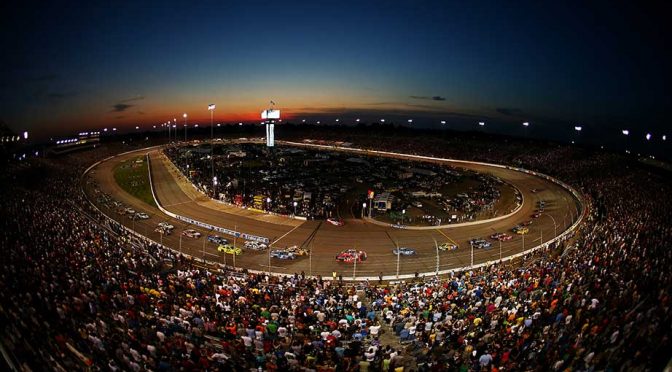
This week brings the NASCAR Sprint Cup Series, the NASCAR XFINITY Series and the NASCAR Camping World Truck Series to Daytona International Speedway for the Sprint Cup Series Budweiser Duels and the NASCAR national series season kickoff races at Daytona.

The Sprint Cup Series Budweiser Duels are held on Thursday, Feb. 19 at 7 p.m. ET with the second duel at approximately 8:30 p.m. ET; both are on FOX Sports 1. The Daytona 500 will be held Sunday, Feb. 22 at 1 p.m. ET with coverage on FOX. 

The XFINITY Series Alert Today Florida 300 is on Saturday, Feb. 21 at 3:30 p.m. ET with coverage on FOX Sports 1.

The Camping World Truck Series NextEra Energy Resources 250 is on Friday, Feb. 20 at 7:30 p.m. ET with coverage on FOX Sports 1.

For more information on track times, press conferences and GarageCam, you can check out the full weekend schedule

We know you may not have the time to watch the race action without any interruptions, so if you’re on the go, here’s how to keep up at Daytona.

FULL CHASE COVERAGE

Chase hub page
Chase Grid games
#MyChaseNation

NASCAR.com’s live Sprint Cup Series leaderboard, XFINITY Series leaderboard and Camping World Truck Series leaderboard update in real-time and offer constant text updates of lead changes, cautions, strategies, strong runs and everything in between. From the NASCAR Sprint Cup Series leaderboard, fans can also access live standings. On the go? Download the NASCAR Mobile app to follow the leaderboards live from your device.

Lap-by-Lap will keep you caught up even if you can only take a peek here or there. Check in to read back through all the laps you’ve missed, or keep an eye on the feed for real-time race updates.

We’ll also send race updates via Twitter through the official @NASCAR and @NASCARStats handles.

RaceBuddy will have enhanced views and coverage for the Sprint Cup Series and for most XFINITY Series races with 10 HD live race views, including six in-car cameras as well as a backstretch camera, pit road camera and more.

Haven’t tried RaceView yet? If you sign up, you’ll get virtual video of cars on the track from various angles and hear what your favorite team is saying over the radio in both the Sprint Cup and select XFINITY Series races. Use it as a second screen or as your only screen. Just want to scan the radios? You can have that too with Scanner (formerly RaceView Audio). On a mobile device? Get RaceView Mobile here.

If you want to be more involved in the on-track action, you can manage your fantasy team on NASCAR.com and follow your team’s performance in NASCAR Fantasy Live. Mobile users can also download NASCAR Connect, a game from OneUp Sports that allows users to play other fans with race predictions, for some off-track competition while drivers battle it out on the track.

Live Press Pass video streams will keep the NASCAR action rolling even after the winner goes in and out of Victory Lane. Catch interviews with the top finishers and series champions immediately following the checkered flag for all three national series events, and stay tuned to NASCAR.com throughout the week for the latest news.

Hamlin’s advice: ‘Take performance at Daytona with a grain of salt’

Play: NASCAR Fantasy Live

DAYTONA BEACH, Fla. — Shortly after his Joe Gibbs Racing hauler touched down near the sunny shores of Daytona Beach last year, Denny Hamlin’s No. 11 Toyota took on a bulletproof aura. Victories came with convincing style in the season’s first two preliminary events, and Hamlin came just one spot short of unseating race winner Dale Earnhardt Jr. in the Daytona 500.

FULL SERIES COVERAGE

Latest news
Standings
Schedule

But the air of invincibility left Hamlin with only vestiges and remembrances of his top-shelf performance the following week in Race No. 2, at Phoenix International Raceway. Suddenly, the Daytona front-runner was playing catch-up, a theme that recurred more than he would’ve liked.

"We hadn’t really talked about where our program was, and if you watched just those two races, you would’ve thought we were going to win every race in the entire season," Hamlin said of his wins in the 2014 Sprint Unlimited and his end of the Budweiser Duel 150-mile qualifying races. "We got to (the second race), what’s going to be Atlanta this year, and next thing you know, reality sets in and we’re like, ‘Uh oh, we’re behind.’

"You’ve got to take performance at Daytona with a grain of salt and know that last year’s success doesn’t equal success this year, nor does it mean it’s going to be success for the remaining race tracks. I can just take it year by year, and I’m thankful for the results I do get when they’re good."

Though it’s season-long accomplishments he’s after, Hamlin wouldn’t mind adding Daytona 500 laurels to his trophy case to get 2015 off a fast start. He avoided a major setback in Wednesday practice after contact with Danica Patrick caused little more than cosmetic damage to his primary car. 

Hamlin’s run through Speedweeks last year established his team as one of the pre-race favorites. Though the idea of NASCAR parity reaches its highest point at restrictor-plate tracks Daytona and Talladega, Hamlin insists the playing field can never quite be 100 percent level.

"It’s more the chess game if you’re going to have it all work for winning these races than it is the equipment," Hamlin said. "I think it’s a cliché when everyone says, ‘Anyone can win here,’ and anyone can if it’s just handed to you in your lap and everyone else crashes. If they don’t, you’ve got to figure out — you’ve got to be smarter than the rest of the guys."

Hamlin’s plate-track savvy was on display last May with a regular-season victory at Talladega Superspeedway, a triumph that launched him into the Chase for the NASCAR Sprint Cup playoffs, where he kept his championship hopes intact all the way to the final round.

But on the other tracks that make up the meat of the Sprint Cup schedule, Hamlin’s performance last year lacked his hoped-for consistency. The downturn prompted what Hamlin called JGR’s "first total revamp" in his 11-year career, with a shuffling of crew chiefs that paired him with Dave Rogers — formerly atop Kyle Busch’s pit box — for 2015. Hamlin said the Gibbs team essentially just changed the decals from Busch’s No. 18 to his No. 11 in making the swap, though Hamlin will keep his lickety-split pit crew going forward. 

Rogers, who has worked with Hamlin before in what is now called the NASCAR XFINITY Series, becomes just the third crew chief — following Mike Ford and Darian Grubb — to oversee the No. 11 since Hamlin joined the team in 2005. Though each crew chief during his tenure has brought their own approach, Hamlin said he’s eager to open the next chapter with Rogers on an up note — in Daytona and beyond. 

"They all have very different styles and they all work hard and they just do it a different way," Hamlin said. "I can’t really explain what way that is, but they get there in a different way, and I know I will have success with Dave (Rogers, crew chief) because I’ve driven for him before. We’ve had success before and our communication has been great ever since we worked together eight years ago. I’m confident that the changes that were made are all changes for the better."

MORE:

READ: Latest
 NASCAR news

PLAY: Sign up
 for Fantasy Live

WATCH: Latest
 NASCAR video

FOLLOW LIVE: Get
 RaceView today

Four others affected after she makes contact with Hamlin

Play: NASCAR Fantasy Live

DAYTONA BEACH, Fla. — Danica Patrick’s return to the track after a two-day hiatus lasted all of one lap and change in Wednesday’s NASCAR Sprint Cup Series practice at Daytona International Speedway.

FULL SERIES COVERAGE

Latest news
Standings
Schedule

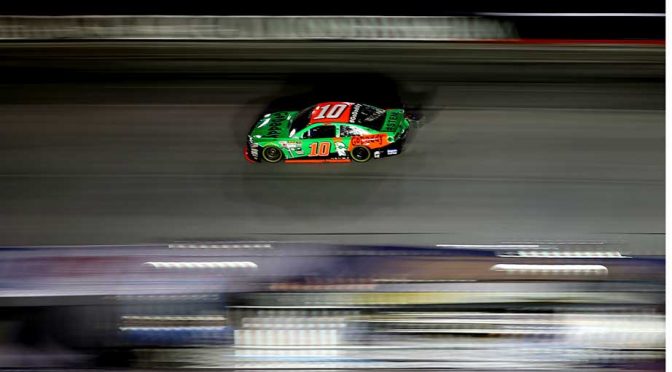
As her Stewart-Haas Racing team unloaded a reserve car, Patrick emerged physically unhurt from the infield care center, but distraught after crumpling her primary No. 10 Chevrolet for the Daytona 500 in the multicar melee.

"I’m fine," Patrick said. "I’m obviously disappointed and I know that it was a good car and it’s never a good thing to crash. But, I was just riding along and it turned, so it’s the nature of pack racing and that’s what makes it challenging, too. Sometimes there’s not much you can do about it. I could have collected more people and it wouldn’t have been anything that they were a part of. But that’s just group racing at Daytona. That’s the gamble that we all face. That’s what makes it exciting and very frustrating. So, we knew we were going to have to run hard in the Duels no matter what, and that just doesn’t change." 

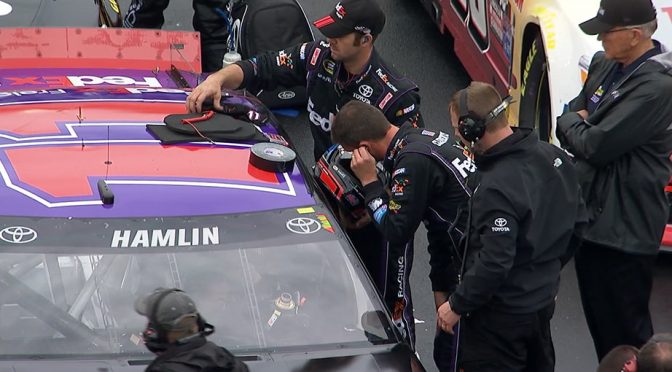
Patrick had completed just one full lap before jostling in the pack spoiled her day. The former Daytona 500 pole-starter was in the outside groove on the backstretch when Denny Hamlin pointed his No. 11 Toyota to the middle lane, making it three-abreast with Casey Mears on the low side. Patrick’s car darted left, making contact with Hamlin and turning her into the outside wall. 

In the aftermath, the cars of Michael Annett and rookie Jeb Burton were swooped up, both sustaining significant damage and forcing their teams to unload reserve cars. Hamlin continued with minimal impact to his Joe Gibbs Racing entry, but took his share of blame for the incident over the radio. 

"People say in practice that you can’t make aggressive moves, but we also have to put ourselves in decent positions where we’re going to have to figure out what our car is doing," Hamlin said. "I went through the middle and it was really wide — it just closed as soon as I had already got inside of her and the lane closed. It knocked me into the 13 (Mears) and we had some attrition after that." 

The incident means Patrick will start at the rear of the field in Thursday’s second Budweiser Duel qualifying heat, which will set the 43-car field for Sunday’s Great American Race (1 p.m. ET, FOX). She’ll need to finish in the top 15 in her Duel to make the 500 field without having to rely on a provisional starting berth.

"Well, I really don’t know the circumstances for the race and qualifying and back-ups," Patrick said. "I really don’t. I was fairly confused in and of itself just with what you’ve got to do to get in other than being in the Top 15 even without going to a back-up. So, I don’t know. I just know that I have to race hard and that’s the end of it." 

Hamlin’s team didn’t have to dispatch a backup car, but the 34-year-old driver was no less apologetic for bringing other drivers into the fracas.

"It’s nothing that we have to go to a backup car for, but it messed up other cars. That’s the tough part about it," Hamlin said. "You always have to give a little bit extra room in practice. There’s typically not a whole lot of blocking in practice and things like that – that you’ll see in the race. Also, you do have to go three-wide in those situations because you have to figure out what your car is going to do. That’s just a miscalculation one way or another on one of our parts. Unfortunately some cars got torn up."

Burton, aiming to compete in his first Daytona 500, said his team would likely steer clear of racing in big groups during the following practices. Though he had a front-row seat for the mix-up in front of him, he said he was helpless to avoid piling in. 

"That was the first time we actually got to get in the pack, and we were sitting there, just cruising," Burton said. "Those guys just weren’t using their noggins and wrecked in front of me, and I got run in from behind and put in the wall."

MORE:

READ: Latest
 NASCAR news

PLAY: Sign up
 for Fantasy Live

WATCH: Latest
 NASCAR video

FOLLOW LIVE: Get
 RaceView today

John Hunter Nemechek will split the 2015 NCWTS season with his father Joe

Play: NASCAR Fantasy Live | Vote: Ultimate Daytona Challenge

DAYTONA BEACH, Fla. — John Hunter Nemechek might not have years of experience propelling him into NASCAR’s national ranks, but he may have something better — the lessons handed down from his father, entering his 26th year competing in NASCAR’s top divisions.

FULL SERIES COVERAGE

Latest news
Standings
Schedule

But Joe Nemechek, 51, has shown he’s not just a grandstand-watching dad with a vested interest in his 17-year-old son’s budding career. He’s still getting his fingers dirty under the hood and taking his turn in the driver’s seat, making his father-son mentorship more hands-on than most.

"He’s the hardest worker that you’ll find around, the hardest-working driver, I should say," the younger Nemechek said. "Luckily, he’s passed that off to me and I’ve learned a great deal from him. If you want to do something, you’ve got to work hard at it and you can’t give up. I think his drive and motivation to win races and make me successful before he retires is something that he really wants me to do."

The elder Nemechek’s independent spirit hasn’t skipped a generation, as John Hunter Nemechek prepares for his third partial season in the NASCAR Camping World Truck Series. The father-son duo will split the schedule in 2015, with Joe Nemechek racing on the circuit’s larger tracks until John Hunter turns 18 on June 11, at which point his NASCAR-mandated age restriction to tracks 1.25 miles or shorter will be lifted.

That time frame would clear John Hunter Nemechek to get his first whirl at an intermediate track at 1.5-mile Kentucky Speedway on July 9.

"I definitely feel like I’m ready for it," he said. "I feel like getting to those bigger tracks is something I’ve wanted to do for a while. Last year, sitting on the sidelines when Dad was running the big tracks and I was running the short tracks was kind of frustrating, just because, ‘OK, I know I can do this. When am I going to get the chance?’ Definitely we’re counting down the days."

In the meantime, the younger Nemechek has methodically begun to add his name to a stellar group of second-generation speedsters such as Chase Elliott and Ryan Blaney, both a few years older and with more experience on their side. John Hunter’s 10-race slate on smaller tracks in the Camping World Truck Series last season yielded a career-best fifth place at New Hampshire Motor Speedway and four other finishes of sixth and seventh, efforts he hopes are building blocks to more strides in 2015.

Those first steps, plus an offseason victory in the prestigious Snowball Derby race for Late Model cars, have helped John Hunter exceed his father’s expectations thus far — sometimes surprisingly so.

"You look at a lot of the kids that are sons of dads that raced, they’ve all grown up around the sport," Joe Nemechek said. "I think the biggest thing that helps them is just listening to all of us dads just talk about what our cars are doing and this and that, and they learn all that. The first time he was in the car, he’s like, ‘yeah, it’s doing this, this and this,’ and I looked at him like, ‘how do you know that?’ They’ve heard us talk, our body language and all that other stuff, and they just know."

John Hunter Nemechek has certainly picked up on the mechanical know-how, helping his father in the shop by running parts, changing tires and becoming handy with a wrench around the family shop. But the influence has transcended the nuts-and-bolts side of things, as the teenager has also learned by example how to carry himself in the garage.

For that, John Hunter Nemechek is grateful.

"It means everything to me," the younger Nemechek said. "Without him, I wouldn’t be here right now. He’s put his time and effort and pretty much his life into making my career jump-start. I can’t thank him enough for it."

MORE:

READ: Latest
 NASCAR news

PLAY: Sign up
 for Fantasy Live

WATCH: Latest
 NASCAR video

FOLLOW LIVE: Get
 RaceView today

Michael Waltrip edges Denny Hamlin for driver honors vs. LPGA, PGA stars

Play: NASCAR Fantasy Live

DAYTONA BEACH, Fla. — Island greens are nothing new for LPGA golfer Paula Creamer.
 
But the 2010 U.S. Women’s Open champion admitted Wednesday she’d never tried to hit a green while race cars zoomed around the track nearby.

FULL SERIES COVERAGE

Latest news
Standings
Schedule

"Definitely not," Creamer said after warming up before Wednesday’s Daytona Tee-Off event, a FOX/NASCAR cross-promotional opportunity that was held in the infield of Daytona International Speedway.
 
"It’s fun. I think golf should be more exciting at times. You see it when we’re playing the Ryder Cup or Solheim Cup for the men and women; how excited everybody gets and that’s fun. It brings excitement to it.
 
"This is neat, just being able to come here and be with the guys, and have the cross (promotion)."
 
FOX begins its 15th season of NASCAR coverage Sunday with the running of the 57th Daytona 500. In June, the network will air coverage of the 115th U.S. Open golf championship from Chambers Bay in Washington.
 
Creamer and PGA golfer Marco Dawson were joined by Holly Sonders and Brad Faxon of FOX, several NASCAR drivers and members of the NASCAR on FOX broadcast crew inside Daytona International Speedway. Players were give three chances to hit a shot to a 20-foot x 20-foot island green situated approximately 85 yards out in Lake Lloyd.
 
With a hard left-to-right wind blowing across the lake, it wasn’t an easy task for most.
 
Dawson took the overall title to earn a $10,000 donation to the First Tee program.
 
"That shot? Honestly it’s not very hard at all," Dawson said.
 
What makes it difficult for the amateur, he said "is they put a lot more pressure on themselves.
 
"I did it for a charity today but this was just fun for me. I wasn’t really expecting a lot.
 
"I think these guys put a lot more pressure on themselves because it’s a lot harder for them to do. It’s not like them stepping into the car and riding around the track."
 
Michael Waltrip edged Denny Hamlin for the driver’s honors, managing to keep one ball from winding up in the water.
 
Although he has competed in several pro-am events and is an avid golfer, Hamlin said the combination of the wind and small green made it more difficult than it looked.
 
It was much harder, he said, than racing at 200 mph out on the high banks of DIS.
 
"Yeah, I mean as far as pressure is concerned because we’re out of our element," he said. "On the race track, we know what we’re doing half the time and here we know what we’re doing about 10 percent of the time. It’s different.
 
"I always get way more nervous before something like a golf tournament than I would any race. Definitely. Just because people are watching, staring at you, looking at your swing; they’re breaking you down. They really don’t analyze the way you drive when you’re inside the car that much."

MORE:

READ: Latest
 NASCAR news

PLAY: Sign up
 for Fantasy Live

WATCH: Latest
 NASCAR video

FOLLOW LIVE: Get
 RaceView today

From the feathers to the wins, driver has left lasting impression

Play: NASCAR Fantasy Live

CHARLOTTE, N.C. — A young Jeff Gordon preferred to let his No. 24 car do the talking for him.

Consequently, he didn’t have to tell his ’90s crew when he was ready to take the checkered. Instead, the crew interpreted the two simple signs.

First, Gordon would grow quiet on the radio, fading to eventual silence. The iconic No. 24 DuPont Chevrolet whirled around the track, providing plenty of nonverbal commentary with its vibrant, rainbow-colored exterior.

And when Gordon passed by his pit box seconds later, one final action let his crew know it was winning time.

FULL SERIES COVERAGE

Latest news
Standings
Schedule

“The story was, he had the feathers on his helmet, and when he would get really focused, he would lean over and you could see the feathers through the window net,” No. 5/24 Team Manager Brian Whitesell recalled. “And you knew he was getting serious. So you would always joke about ‘OK, we’re seeing the feathers, it’s about to get on now.’”

Gordon’s competitive nature and intensity in the car are two of the many qualities that Whitesell and other Hendrick Motorsports shop employees will miss when Gordon retires from full-time competition in 2016. Many No. 5/24 shop employees have called the sprawling campus of Hendrick Motorsports “home” for over 20 years, spending their days laboring Gordon’s race cars upon the spotless white floors of the shop.

And each of these veterans can recount stories about a young Gordon from a different era of racing.

“He’s changed the perception of the sport by his actions and by what he’s done,” Whitesell said while sitting in his office overlooking the No. 5/24 shop of Gordon and teammate Kasey Kahne. “I’m sure there will be stories 10 years from now on what this change manifested and what he’s able to do in his new role.”

Whitesell recalls Gordon’s career with fondness and familiarity — unsurprising, as he’s been with the No. 24 driver from the very beginning. The young engineer took a job with Hendrick Motorsports back in 1992 as the initial truck driver for the newly minted No. 24 team. Whitesell later served as Gordon’s engineer and transitory crew chief after Ray Evernham left the team midway through the 1999 Cup season. The pair won two back-to-back races in 1999 — at Charlotte Motor Speedway and Martinsville Speedway — following Evernham’s departure.

“Knew he was a very special, talented driver,” Whitesell said of his first impression of Gordon. “That’s what we knew. Now where it went from there, no one knew because a lot of talented drivers come in the series and for one reason or another, they don’t make it.

“The whole combination of (team owner) Mr. (Rick) Hendrick and it ended up being Ray and Jeff — the whole thing worked very well and obviously took off.”

For the shop workers, co-owner Gordon’s similarities to Hendrick help make the No. 24 driver an incredible leader.

“He’s like a miniature Rick,” said No. 5/24 Mechanic Darrell McDonald, who took brief break from the shop’s Daytona 500 preparations to offer his commentary on Gordon.

Moments later, the 24-year shop veteran found the perfect analogy: “… He brings this calm to everybody. He’s the first one to clap; he’s a good motivator.

“It’s like when you have a meeting with Rick, when he’s done…man, if I was in the military, we’d be taking over countries.”

So when their long-time fearless leader Gordon told his devoted army on Jan. 22 that he wouldn’t be competing full-time after 2016, it was a tough pill to swallow for the shop members.

“I don’t think it’s sunk in yet,” said No. 5/24 shop foreman Steve Hlinak, who has been with the team since 1998. “When you see a 24 on the track and they don’t say Jeff Gordon, it’s going to be weird.”

Gordon caught Hlinak’s eye even before he joined the Hendrick Motorsports family. He remembers watching Gordon nab his record-setting pole at Indianapolis Motor Speedway in 1995 in a fashion that was simply extraordinary.

“That’s one of my favorite memories of Jeff in years past,” Hlinak said. “I wasn’t even working on that team and it jacked me up. When he got sideways and got the pole, it was incredible. His dominance at Indy is pretty spectacular.”

Gordon’s supremacy at Indianapolis Motor Speedway is universally celebrated around the shop — last season, the shop’s non-traveling employees even participated in their own brick-kissing ceremony on the floors of the 5/24 shop following Gordon’s impressive Brickyard 400 victory. Naturally, it’s also the track where Whitesell immediately pinpoints his favorite memory with the No. 24 driver.

“The favorite memory was just that inaugural Brickyard,” Whitesell said, referring to Gordon’s renowned win in 1994. “It’s just hard to beat that. As we prepared for that race and did everything, it was just so special. And how well he drove that day. The determination of him doing that — it was a huge accomplishment for him and the team.”

Less than a year after that historic Brickyard 400 victory, Gordon was winning races like the shop employees had never seen before and bringing an unfamiliar feeling to the shop; a championship fever.

“That was the first championship we ever had,” McDonald said, referring to Gordon’s first Cup title in 1995. “Before him and Terry (Labonte) came along, we won one race a year.

“There are a lot of drivers that can win, but never win a championship. So it was great to see him put the whole year together as a driver and win the championship (in 1995). That’s basically what you’re here for.”

•   •   •

While legendary on the track, to these dedicated shop members, Gordon isn’t just a talented driver who has stacked their fingers with championship rings. He is someone they respect and care for both on and off the race track because of his character.

“At a very young age, he knew he had a lot of people depending on him,” McDonald explained. “This company depended on him to win. And he went out and performed. So I feel like that (first) year showed his maturity at such a young age and then (he) won a championship.

“It was a tough era back then … let’s face it, you can only do so much for him as a crew chief, pit crew — he’s got to drive that race car. Once you put them tires on there and put that thing full of fuel, it’s up to him.”

But the task of hoisting the 2015 Sprint Cup trophy at the end of the year is not one that solely rests on Gordon’s shoulders — everyone in the 5/24 shop has a fire lit under their bellies and is ready for battle on the race track.

“To me, it inspires us to do even better,” Hlinak said, referring to Gordon’s announcement. “A last chance to get him that championship here.”

“At the end of this year, we just want to say, ‘You know what? We’ve done all we can do.” McDonald said. “…That’s all we want to do right now — we’re not even thinking about when he’s done. We’ve got this year to race. We’re not done yet.”

And after watching him race last season, they know that Gordon will do all he can to make that #DriveforFive championship dream a reality.

“I think my favorite season was last year actually,” Hlinak said. “He showed his youthfulness now. We talked about showing his maturity back then, but now he’s showing his personality and his feelings. He’s still scrappy and youthful. He can get it done.”

“Little of a redneck side last year,” McDonald added.

“Yeah…” Hlinak said with a slight smile and a wink. “Everyone in this building has got his back.”

But after the 2015 season is in the books, don’t use the r-word in regards to Gordon around these veteran shop members. Because to them, he’ll still be just as big a part of the Hendrick Motorsports team.

“He’s not going to live in a some trailer park, living in a retirement home down in Florida,” McDonald said. “He’s not retiring, he’s just changing obligations.”

“Changing obligations” will put Gordon in a managerial role of Hendrick Motorsports. In this facet, he’ll still be heavily involved with the organization, closely supervising his replacement in the No. 24 car: Chase Elliott.

“I see a lot of Jeff (in Elliott), I really do,” McDonald said. “But I think Jeff’s going to be good for him because he’s going to let him know that he’s got to be Chase. He can’t be Jeff Gordon. He may be better than Jeff. He may win a lot of races, may win a lot of championships, we still don’t know yet. But Jeff will tell him to be him — ‘Don’t worry about my stuff, you just go out there and do what you’re supposed to do.’”

•   •   •

After a few more minutes of conversation, these shop employees are back to work on the floor, immediately busying themselves with Daytona 500 preparations. With a championship to win and a new driver sitting in the wings, breaks are few and far between around here.

But it’s that devoted mindset that has made them so successful in the past and will keep them whistling and working inside the gray and white walls of the championship-winning shop for years and years to come.

“I’m looking for my second (Rolex) watch,” said McDonald with a grin, referring to the gift Hendrick gives to employees on their 20-year anniversaries. “I’m hoping it’s the gold.”

The 1950s: From Sand and Dirt to Darlington and Daytona

Play: NASCAR Fantasy Live

"Big Bill: The Life and Times of NASCAR Founder Bill France Sr." is the first official biography of the man who organized the sport. In the second of four excerpts that will appear over the next four weeks leading up to March 3, the publication date of the book, author H.A. Branham explains what it took to build the World Center of Racing, the Daytona International Speedway.

RELATED: Big Bill Excerpt 1 on France’s induction into the NASCAR Hall of Fame

The brainstorm that became Daytona International Speedway always was linked to Indianapolis Motor Speedway. Bill Sr. had been a huge fan of IMS and the Indianapolis 500 since childhood. "Big-car racing" was the label attached to the open-wheel machines, a label that had to do not only with speed but status. Indy-style racing was by far the most popular form of auto racing in the United States in the 1950s. Bill Sr.’s motivation to build a track to rival the IMS 2.5-mile oval was understandable to begin with. But then you must factor in the potential added impetus he got during a 1954 trip to the Indy 500.

This is a story that compares favorably with the coming to Daytona tale in the unofficial book of Bill Sr. lore. Bill, accompanied by Annie B., did not have the proper credentials and reportedly was asked to leave the speedway by officials of the American Automobile Association, which sanctioned the 500. Different versions of the story have evolved, with most including a heated scene in Gasoline Alley, Indy’s garage area, with profanities all around. Senior himself would come to describe the experience as disappointing for him and Annie B., but by no means ugly. He chalked it all up to the AAA’s dislike for NASCAR as a growing sanctioning body based in the South. The Midwestern racing establishment’s prejudice against what was viewed as a crude redneck circuit showcasing many past and present moonshiners, plus assorted others from the Deep South, cannot be exaggerated. Juxtaposed against that prejudice was the reality that the racing NASCAR was selling was damn good — and getting better — fueled by stars who, when given a closer look, could rival anyone open-wheel had.

The episode strengthened Bill’s resolve to return to Daytona Beach and construct his own race facility — one that would rival Indianapolis Motor Speedway. The generally accepted stance is that he and Annie B. came back to Florida more determined than ever to build their own race track.

France may have admired Indy but he also saw flaws, which helped shape his vision for Daytona. He wanted his track to be big — not necessarily bigger — but he also wanted a design that would enable stock cars to chase unprecedented speeds, and for that, the flatness of Indy would not do. Doubtless he was influenced not only by Indy but by his youthful experiences at Laurel (Maryland) Speedway, where the wooden-plank racing surface was banked at 48 degrees. Bill Sr. envisioned extreme banks in the Daytona turns that would keep cars on the race track. But there was another reason for the banks; Bill envisioned a gigantic "cereal bowl" effect for his speedway, enabling fans in the grandstands to actually see what was transpiring on virtually all of the race track in front of them.

The first work began on November 25, 1957, starting with basic but intensive "site prep." To call the tract undeveloped would be courteous. It was a partial swamp. Much of that prep work involved moving dirt to build the banks, which ended up at 31 degrees, which was the steepest the dirt could be piled without it falling back down.

This was an unbelievably ambitious undertaking, a reality exacerbated by the timeline. Only 15 months were being allowed between the first shovel of dirt and the green flag waving for the very first Daytona 500.

A man named Charles Moneypenny was at the helm, and he drew upon some out-of-the-ordinary technology.

Bill Sr.’s desire to build unheard-of asphalt high banks required unheard-of thinking. But it was not merely the construction of the banks that challenged the project. The steepness of the turns had to work with the relative flatness of the back straightaway and the three-part, two-kink "tri-oval" that would pass for a traditional front straight. To make it work, Moneypenny drew upon an engineering approach utilized during railroad expansion in the 19th century. Early railroads featured low speeds and wide curvatures, but as train speeds increased to meet the demands of both a growing populace and burgeoning industry, a need developed for turns that could handle the churning locomotives at higher speeds. This led to more gradual increases in curvatures — an approach called a transition spiral, or a track transition curve. Daytona International Speedway was a perfect candidate for this technology; never had there been a paved race track so steeply banked.

Moneypenny was the city engineer of Daytona Beach; he sought help from Ford Motor Company’s engineers, who had built a test track in Detroit for the manufacturer. Moneypenny had no problems with piling the dirt in the turns or building the banks, but he needed expertise regarding the curvature transitions that would connect the banks to the back straight and the tri-oval. While Ford’s track was nowhere near the monstrous layout Bill Sr. was trying to build, it did offer up needed data regarding spiral transitioning. Moneypenny utilized that data and built turns that made sense — at least as much sense as possible. After all, we were talking about 31 degrees.

Bill France Sr.’s ambitious deadline was met. And so, in mid-February 1959, drivers rolled into Daytona Beach, entered the tunnel burrowed under the race track just out of Turn 4 — and recoiled. …

Intimidation regarding the 2.5-mile monster, though, was based in fact, the closest and hardest of facts. Bill Sr., eager to get his facility on the national sporting landscape, had scheduled an Indy-car race for April. What better way to one-up Indianapolis Motor Speedway than to have their stars bring their cars to his brand-spanking new speedway? To help the open-wheelers prepare while also giving his track a pre-Daytona 500 publicity boost, Bill Sr. hosted an Indy-car test session two weeks before the 500.

On February 11, 1959, the fourth day of Indy-car testing, old stock car hand and beach-road course veteran Marshall Teague, driving for Chapman Root, perished when his car lifted and flipped five times. The remainder of the test was cancelled but that did nothing to ease the trepidation of the stock car drivers facing the track for the first time.

So what to make of the very first Daytona 500? There are several paths to follow when assessing what those first-ever 200 laps of superspeedway racing were all about. Whatever path is chosen, both begin with the fact there were no caution flags. And so, you can pick the high road and say the drivers immediately became highly capable at the brand new, biggest stock car race track in the world. Or you can say they drove competently but cautiously. Or you can simply assume they were scared beyond belief. If those theoretical paths could somehow intersect, you might find the truth as to why the inaugural 500 proceeded in such an incredibly routine fashion.

Clint Murchison was accorded the honor of driving the pace car. He led a field of 59 cars in ’59 — 22 were convertibles. There were 33 lead changes. The race lasted three hours, 41 minutes and 22 seconds. Announced attendance was nearly 42,000. The winner’s average speed: 135 miles per hour.

The winner was Lee Petty, in spite of himself. He was one of the drivers who seemed especially spooked by the high banks.

So, you had a rather mundane race won by a driver who didn’t really care for the event to begin with. What to do?

Enter the era of the photo finish.

It is an iconic photo, maybe NASCAR’s most iconic of all. Three cars virtually abreast, crossing the finish line to wrap up the first Daytona 500. Lee Petty’s No. 42 Oldsmobile is in the middle, Johnny Beauchamp’s No. 73 Thunderbird is on the inside. High and outside is the lap-down No. 48 Chevrolet of future two-time NASCAR champion Joe Weatherly, his presence obscuring the finish from Bill Sr. and other officials.

Just before they crossed the stripe, Beauchamp appeared to have the edge. At the line, though, Petty drew even, or so it appeared. Beauchamp was declared the winner; Petty, the greatest disputer of decisions in the history of NASCAR, drove straight to Victory Lane, having of course declared himself the winner.

Confusion reigned.

Whereupon Bill Sr. soon put out an "all call" for photos and motion picture footage that could decide the finish once and for all. Joe Weatherly’s car was serving a purpose, blocking of a clear, indisputable view of the finish.

On February 22, 1959, the first Daytona 500 had been run, but it wouldn’t be complete for another 72 hours.

And so, on the early evening of February 25, Bill Sr. announced that conclusive evidence had surfaced showing that Lee Petty had indeed won.

Another piece of NASCAR lore had been created: three days of intrigue, following nearly four hours of less-than-enthralling racing. This situation has come to be viewed as the quintessential Bill Sr. stroke of genius.

"That was a PR deal," Richard Petty says, smiling slyly at the memory. "Bill Sr. knew my daddy had won that race."

No. 44 car headed back to Daytona after qualifying wreck

Play: NASCAR Fantasy Live | Vote: Ultimate Daytona Challenge

After wrecking Team Xtreme’s only speedway car in Coors Light Pole Qualifying on Sunday, Reed Sorenson didn’t know whether his dream of a sixth start in the Daytona 500 was over.

FULL SERIES COVERAGE

Latest news
Standings
Schedule

"I don’t know if we’ll try to get a car up here or what they’ll try to do," Sorenson said. "But as of right now, we don’t have a back-up car."

What the team did was called "a miracle" by team foreman Ben Leslie.

Fighting the clock and adverse conditions near the shop, the No. 44 Golden Corral Chevrolet SS was rebuilt.

"We worked pretty late (Monday) night, especially considering the weather that we had here in Charlotte, which was a challenge to say the least with some of the guys," Leslie told FOX Sports 1’s "NASCAR Race Hub. "And we were here fairly early (Tuesday) based off of the weather and the road conditions so it was again another challenge on top of the already daunting task of trying to put this car together to get it back down to Daytona.

"It’s fairly tough as far as going into a Thursday practice (noon ET, FOX Sports 1), knowing that’s your only practice for your only chance to get in the 500 so there’s definitely going to be some anxiety with the guys down there with Peter and Reed as well. These guys have really pulled off nothing short of a miracle of getting this car out of here."

Sorenson is slated to start 20th in Thursday’s first Daytona Duel (7 p.m. ET, FOX Sports 1), and the effort from the boys back at the shop has inspired him to make Sunday’s Daytona 500 (1 p.m. ET, FOX).

RELATED: Complete Daytona Duels lineups

"The wreck in qualifying was extremely disappointing but seeing the efforts of everyone on Team Xtreme as they get our backup ready — man, I am excited for Thursday’s Duels," Sorenson said in a team release. "There is a lot of pressure to race our way in to the 500 but after seeing the support of NASCAR fans on social media the past few days, we already feel like winners in their eyes."

Why did Team Xtreme have to rebuild its car and not have a backup in place?

"A good speedway car is hard to come by," team owner John Cohen said in a team release. "As a smaller team, we buy our cars from the mega teams and once they have a good speedway car, that car is kept and used many times."

Sorenson’s best finish in a Duel is a runner-up result in 2008. He’ll need a similar effort as he attempts to get a third top-10 in the Great American Race, including a top-five finish in in ’08.

MORE:

READ: Latest
 NASCAR news

PLAY: Sign up
 for Fantasy Live

WATCH: Latest
 NASCAR video

FOLLOW LIVE: Get
 RaceView today

Hyundai Construction Equipment Americas, Inc. to title February event

Play: NASCAR Fantasy Live | Vote: Ultimate Daytona Challenge

Atlanta Motor Speedway will have its first NASCAR Camping World Truck Series race in three years on Saturday, Feb. 28 (5:30 p.m. ET, FOX Sports 1). On Tuesday, it announced the sponsor for the event.

FULL SERIES COVERAGE

Latest news
Standings
Schedule

Hyundai Construction Equipment Americas Inc. will title sponsor the Hyundai Construction Equipment 200. The Norcross, Georgia, company is a leader in earth-moving and material-handling equipment manufacturing.

"We are pleased to welcome Hyundai Construction Equipment Americas, a Georgia-based company, as the title sponsor for our Feb. 28 NASCAR Camping World Truck Series race," Ed Clark, Atlanta Motor Speedway president, said in a track release. "Hyundai Construction provides industry-leading excavating and material-handling equipment, and we look forward to this new partnership that will showcase their unique products and provide an exceptional event for fans attending the Hyundai Construction Equipment 200."

The race will be the second of a rare NASCAR national series doubleheader. It follows the Hisense 250 XFINITY Series race (2 p.m. ET, FOX Sports 1). The trucks return to the Hampton, Georgia, facility for the first time since 2012.

"As a Georgia-based company, Hyundai Construction Equipment Americas is proud to support one of our state’s favorite pastimes at Atlanta Motor Speedway, one of the country’s greatest racing venues," said Curtis Goettel, North American marketing and dealer development manager, Hyundai Construction Equipment Americas. "Our partnership with NASCAR will give race fans at Atlanta Motor Speedway — and the millions watching on television across the country — even more reason to get excited about the Hyundai brand and our construction and material handling equipment."

MORE:

READ: Latest
 NASCAR news

PLAY: Sign up
 for Fantasy Live

WATCH: Latest
 NASCAR video

FOLLOW LIVE: Get
 RaceView today

NASCAR Next driver wins K&N Pro Series East opener for third straight win

Play: NASCAR Fantasy Live | Vote: Ultimate Daytona Challenge
MORE: Hill wins K&N Pro Series East opener | More coverage with Home Tracks

NEW SMYRNA BEACH, Fla. — Austin Hill has managed to do more with less as he tries to work his way up the NASCAR ranks. Though his family-run team has scrapped its way to a recent burst of success, it turns out he has a legendary ally working his corner.
 
The 20-year-old Hill continued his trend of stellar performances in Sunday night’s NASCAR K&N Pro Series East season opener at New Smyrna Speedway, notching his third straight win on the regional circuit dating back to last season’s late two-race sweep at Greenville-Pickens Speedway and Dover International Speedway to close out the campaign. Joining Hill in Victory Lane on the .48-mile track’s frontstretch was a NASCAR Hall of Fame nominee who has grown to become a family friend — engine-building marvel Robert Yates.
 
Yates, long affiliated with Ford, has provided engines for the K&N Series’ Ford teams for the past five years. But his connection with Hill runs deeper. When the NASCAR Next driver’s team came up empty looking for shop space, Yates took him in for part of last season, giving the family operation room to grow.

"Robert and those guys, they’ve been an awesome help," Hill said. "Ever since we ran our first race as a home-operated and family-operated team, they’ve just been really supportive of us. We kind of got in a pickle. We really couldn’t find a building for our car, and for two races — we were actually running out of their stable in the back of their shop. They’ve just been really supportive. Every time we hit the track, we have plenty of power. You never hear me come over the radio and say, ‘Hey, this motor just doesn’t feel right.’ They build awesome motors and I’m really glad I can run a Ford."
 
Yates was particularly pleased with watching a blue oval emblem show the way, as Hill led all 150 laps from the pole position and fended off a stout challenge from Dalton Sargeant, a 16-year-old hotshot finishing second in his first K&N appearance. The race also marked the debut of the K&N Series’ new generation of Five Star car bodies, meaning Hill’s No. 22 Fusion was easily identifiable at the front of the pack.
 
Though Hill’s recent surge has suddenly made him a force on the K&N tour, his search for sponsorship and his next big break continues. Yates said he sees plenty of potential from the NASCAR Home Tracks proving ground, with Hill near the top of that list.
 
"He’s definitely on the right step for now, but he’s just got to get that right opportunity," Yates said. "All these kids, there’s so much talent coming. … The young guys, I know they can do it, but nobody gives them a chance, and of course, look at this — the talent here."

Hill hopes his recent rise will open the door to more time behind the wheel in NASCAR national series. The Georgia youngster carries high hopes into Friday night’s NextEra Energy Resources 250 (7:30 p.m., FOX Sports 1), the season opener for the Camping World Truck Series at Daytona International Speedway.
 
Hill made two Truck Series starts last season, leading an impressive 21 laps at Martinsville Speedway in October, but racing in Daytona’s all-important aerodynamic draft is a far different animal. When the 2.5-mile track opens for practice Thursday, Hill hopes to earn some respect in the draft and create friendships that may ultimately benefit him in Friday night’s main event.
 
"It’s all about the luck of the draw," Hill said. "If you get the right push from somebody, the right draft, and you’re there at the end, then you’re certainly going to have a shot at it. If you want to pull out of line, though, you better make sure you’ve got somebody pushing you that’s good. Hopefully, I can talk to some of those truck guys and they can work with me and we can get to the front."
 
While he hopes more driving duties in the Camping World Truck Series arise, Hill’s season-long focus is on the K&N tour, where he hopes to improve upon his tie for fifth place in last year’s final standings. One race into 2015, he finds himself as the series points leader, a distinction that should help as he continues the quest for sponsorship.
 
In the meantime, Hill has derived ultimate satisfaction from turning in a dominant performance as his underdog family team competes against its more well-heeled rivals. Even though he continues to do more with less, it’s done nothing to diminish Hill’s competitive drive.
 
"Every time I hit the track, I want to win," Hill said. "It doesn’t matter if I’m racing out here in the parking lot with somebody. It’s just in my blood.

MORE:

READ: Latest
 NASCAR news

PLAY: Sign up
 for Fantasy Live

WATCH: Latest
 NASCAR video

FOLLOW LIVE: Get
 RaceView today