Sawyer to take over for Little, who moves to new managing director position

Play: NASCAR Fantasy Live

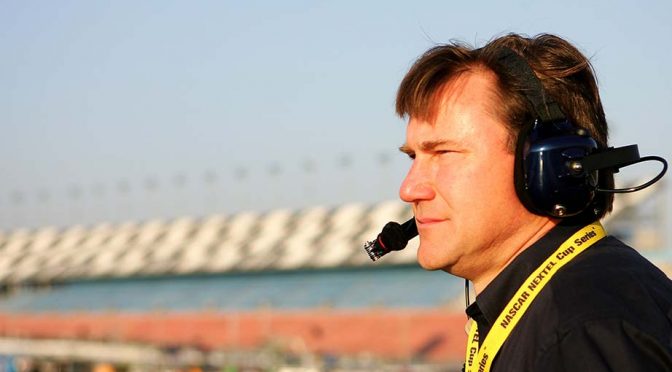
Chad Little, the former managing director for the NASCAR Camping World Truck Series, has been named Managing Director, Technical Inspection/Officiating, and Elton Sawyer has been named to Little’s previous position overseeing the Camping World Truck Series.

The moves come as NASCAR prepares to kick off its 2015 season later this month at Daytona International Speedway.

Little, a former driver with more than 200 career starts in NASCAR’s premier series, oversaw the Camping World Truck Series from 2013-14.

FULL SERIES COVERAGE

Latest news
Standings
Schedule

The reliance on technological resources and innovations has never been more evident in the sport, and it will be up to Little to help digest and direct the information gleaned from such advances.

The last two years have seen the use of a laser-guided measuring system for the inspection process as well as a paperless mobile inspection application that is faster and more detailed. For 2015, a new officiating process that will rely on cameras and video to help police pit road is set to come into play.

"I will work with the series directors and our managing supervisors of officials, and I’ll also be working with the vehicle section experts, our engineers, at the NASCAR Research & Development Center," Little told NASCAR.com Monday.

"We’ll try as hard as we can to button up our processes … look at all of our processes for inspection and officiating and see if we can continue to improve on all those. We spent a lot of time and effort the last several months on mobile officiating devices at the track, pit road technology, on our electronic rule book. We just wanted to make sure that we’re taking advantage of all that."

Little said he will be involved in overseeing all three national series — Sprint Cup, XFINITY and Camping World Truck series — but that his role will be focused on what occurs behind-the-scenes. Series directors will continue to manage their respective events.

Sawyer is also a former driver, and has held a variety of positions in the sport. That diversity, he said, should help him as he steps into his new role with the Truck Series.

"Patty and I actually owned an XFINITY team back in the early ’90s," Sawyer said of he and his wife, Patty Moise, who is a former racer as well, "so I had some experience on the ownership side.

"I’ve been a crew member … working for (team owner) Bill Davis on a Ford driven by a young competitor named Jeff Gordon. Now we go full circle, (Gordon’s) getting ready to retire."

Sawyer also worked with former owner Ray Evernham in bringing Dodge back into NASCAR and served as competition director for Red Bull Racing during its brief stock car experience. The past four years have seen him working in IMSA as director of race team operations for Action Express.

"Wayne Auton and Chad have done a tremendous job over the last 20 or so years with this series," Sawyer said of the two previous directors. "I went ahead and just put my rookie yellow stripe on."

Getting familiar with those he doesn’t know in the series will come in time, he said, but his past experiences with those in charge has given him a good jumping off point for his new position.

"It’s a high priority. I always appreciated that you could always approach John (Darby, Sprint Cup director), good or bad, you could ask him a question and you may not get the answer you were looking for, but he gave you an honest, upfront and I felt like, a fair answer.

"I think just being transparent, being open, being in the garage is a big part of that."
Group qualifying provides new twist to setting field for Great American Race

Play: NASCAR Fantasy Live | Vote: Ultimate Daytona 500 Moment Challenge

Qualifying for the Daytona 500 is unlike any other auto racing qualifying procedure. Drivers have multiple opportunities to qualify for the season-opening race, as opposed to the usual format of one qualifying session per event.

The first chance was via Daytona 500 Coors Light Pole Qualifying, held Sunday, Feb. 15 at 1 p.m. ET on FOX. For the first time, group qualifying was used to set the Great American Race field, and the new process changed the way positions 33-36 make the show. (See below.)

The other chance is the Duel at Daytona, two 150-mile qualifying races held on Thursday, Feb. 20 at 7 p.m. ET on FOX Sports 1.

Here is a breakdown of the Daytona 500 qualifying procedure:

Daytona 500 Coors Light Pole Qualifying

Qualifying will consist of three rounds with the first round divided into two groups based on a random draw. Vehicles drawing an odd number will be in the first group with even numbers in the second group. The first round is five minutes, and the 24 fastest cars advance to the second round. Following a 10-minute break, the second round will be five minutes with the fastest 12 advancing to the third and final round. A seven-minute break will precede the third round, which will last five minutes. The top two cars will make up the front row for the Daytona 500.

The Duel at Daytona, two 150-mile qualifying races, will determine starting positions for the Daytona 500 beyond the front row. The fastest qualifier in Coors Light Pole Qualifying will be on the pole for the first Duel at Daytona, and the second-fastest qualifier will be on the pole for the second Duel at Daytona. In the event of cancellation, the field will be set according to the NASCAR Sprint Cup Series Rule Book.

Duel at Daytona

Those cars earning odd-numbered positions from qualifying will be assigned to the first Duel race. Those cars earning even-numbered positions from qualifying will compete in the second race.

The starting positions for each Duel race will also be based on qualifying times.

Daytona 500 lineup

The two fastest qualifiers during Coors Light Pole Qualifying earn starting positions one and two.

The highest 15 finishers in each Duel race — excluding the already locked-in front row — will earn a spot in the Daytona 500, and fill positions 3-32.

Based on their finishing position in the first Duel race, the top 15 will line up on the inside row (odd-number starting positions).

Based on their finishing position in the second Duel race, the top 15 will line up on the outside row (even-number starting positions).

Positions 33-36 will go to the four fastest cars from any round of Coors Light Pole Qualifying that have not already earned a spot.

Positions 37-42 will be provisional positions, and go to the highest six cars in 2014 owner points that are present, have entered by the entry deadline and have not already qualified via the Duel or Coors Light Pole Qualifying.

The 43rd starting position will be assigned to any car owner who has the most recent eligible past NASCAR Sprint Cup champion who did not make the field by any other method, providing the driver had competed in the 2014 NASCAR Sprint Cup season. If the 43rd position remains unused, it will be assigned to the next highest car in 2014 owner points not already locked into the field.

Row Inside Outside Explained
1 Top two qualifiers (Final round of Coors Light Pole Qualifying)
2 Top 15 from Duel races (Inside: First race; Outside: Second race)
3 Top 15 from Duel races
4 Top 15 from Duel races
5 Top 15 from Duel races
6 Top 15 from Duel races
7 Top 15 from Duel races
8 Top 15 from Duel races
9 Top 15 from Duel races
10 Top 15 from Duel races
11 Top 15 from Duel races
12 Top 15 from Duel races
13 Top 15 from Duel races
14 Top 15 from Duel races
15 Top 15 from Duel races
16 Top 15 from Duel races
17 Four fastest qualifiers from any round
18 Four fastest qualifiers from any round
19 2014 owner points
20 2014 owner points
21 2014 owner points
22 xxxxxxxxxxxxxxx Past champion or 2014 owner points

Busch among Joe Gibbs Racing drivers with new crew chiefs

Play: NASCAR Fantasy Live

CHARLOTTE, N.C. — There were many decisions Joe Gibbs Racing‘s leadership had to make when weighing whether to add driver Carl Edwards — and subsequently, a fourth team — to its organization for the 2015 season.

Finding a new crew chief was not one of them.

FULL SERIES COVERAGE

Latest news
Standings
Schedule

The team’s familiarity with Adam Stevens essentially ensured that gap had already been filled. Team owner Joe Gibbs and team president J.D. Gibbs saw enough from Stevens in his four years calling NASCAR XFINITY Series races to know he would be a critical part of their plan to expand.

"To be completely honest with you, Joe and J.D. and the company as a whole made it clear to me whenever they went to a fourth team, that I was going to be high on their list," Stevens said last week at Charlotte Motor Speedway Media Tour presented by Technocom. "And that was a long time ago. I don’t even know for sure when the deals got done, but I was aware when that situation came up (of expanding to four teams) that it was going to be something they asked me to do."

The results back up that trust, particularly when Stevens worked with Kyle Busch over the past two seasons. In 26 XFINITY Series races last year, Busch had seven wins and 25 top-fives. His average finish was 2.8.

The pair had 52 total races XFINITY Series races together, with the following results: 19 wins, 46 top-fives and 47 top-10s. Snapping off top-five after top-five, the two made it look easy, although Stevens said that was hardly the case.

"I think if you were there with us every weekend, you’d have a different opinion," Stevens said. "You know, operating with Joe Gibbs equipment with Kyle Busch in the XFINITY Series, the only acceptable outcome is a trophy. No one would tell you that’s the case on the Cup side. The competition is too steep, too many people can win a race on any given weekend.

"Its difficult to be at the track and nothing’s good enough but a checkered flag, to have to carry that with you. Then to come up to the Cup side, there’s levels of success I guess. At the end of the day, you’re expected to win, but you’re not expected to win every time. So it’s going to be a little different."

With Stevens getting the promotion to the NASCAR Sprint Cup Series, it allowed JGR to make two additional crew chief swaps. Darian Grubb, who led the No. 11 team for three years, moves to the newly formed No. 19 team of Edwards.

Dave Rogers, who had helmed Kyle Busch‘s No. 18 team full time since 2010, slid over to Hamlin’s team to cover for the Grubb move and to make room for Stevens.

"We’re making some changes, and we believe we’re putting people in the right places," Joe Gibbs said. "And the great thing about our sport is that we’re going to find out if it works."

Busch and Rogers had a relationship that produced 13 wins and was mostly harmonious, with the cool-headed crew chief serving as the foil to the driver’s occasional tempestuous nature.

The 2014 season produced a handful of moments between the two, though, that were not idyllic. A blowup at Bristol Motor Speedway during the Irwin Tools Night Race saw Rogers rip Busch over the headset, although he insisted after the race there were no issues between the two.

Stevens and Busch may not have had a heated, public exchange over the headset during the past two years, but the crew chief knows the possibility of such an incident — with the stakes so high — comes with the territory.

"You know, it’s part of it," Stevens said. "The driver-crew chief communication is 30 percent of the battle. I feel like we have a good foundation to build off of there, but it doesn’t mean anything if you don’t have fast cars and make good decisions. The other two pieces of it are still yet to be determined."

Get full lineup of NASCAR programming for the week

All times ET

Monday, February 2
3:30 p.m., NASCAR America: Expect the Unexpected (re-air), NBC Sports Network
4 p.m., NASCAR Gridiron Challenge (re-air), NBC Sports Network
5 p.m., NASCAR America, NBC Sports Network
6 p.m., NASCAR Race Hub, FOX Sports 1
7 p.m., NASCAR Race Hub (re-air), FOX Sports 2
9 p.m., NASCAR Gridiron Challenge (re-air), NBC Sports Network

Tuesday, February 3
5 p.m., NASCAR America, NBC Sports Network
6 p.m., NASCAR Race Hub, FOX Sports 1
6:30 p.m., NASCAR Gridiron Challenge (re-air), NBC Sports Network
7 p.m., NASCAR Race Hub (re-air), FOX Sports 2

Wednesday, February 4
4:30 p.m., NASCAR America: NASCAR "In the News" 2014 (re-air), NBC Sports Network
5 p.m., NASCAR America, NBC Sports Network
6 p.m., NASCAR Race Hub, FOX Sports 1
7 p.m., NASCAR Race Hub (re-air), FOX Sports 2

Thursday, February 5
1 a.m., NASCAR Gridiron Challenge (re-air), NBC Sports Network
5 p.m., NASCAR America, NBC Sports Network
6 p.m., NASCAR Race Hub, FOX Sports 1
7 p.m., NASCAR Race Hub (re-air), FOX Sports 2

Friday, February 6
4:30 p.m., NASCAR America: 2014 Top Moments (re-air), NBC Sports Network
5 p.m., NASCAR America, NBC Sports Network
6 p.m., NASCAR Race Hub, FOX Sports 1
7 p.m., NASCAR Race Hub (re-air), FOX Sports 2
7:30 p.m., NASCAR Gridiron Challenge (re-air), NBC Sports Network

Saturday, February 7
9 p.m., NASCAR Gridiron Challenge (re-air), NBC Sports Network

Sunday, February 8
10 a.m., Continental Tire Sportscar Challenge: Daytona International Speedway, FOX Sports 1

Trailblazer becomes first African-American inducted into NASCAR Hall

Play: NASCAR Fantasy Live
RELATED: See the NASCAR Hall of Fame class by class

CHARLOTTE, N.C. — Wendell Scott often broadcast his do-it-yourself work ethic on his cars, which frequently sported hand-painted letters to read: "Mechanic: Me!" Though Scott’s automotive know-how was largely self-made, he usually had an audience of his seven children watching, begging to help the family cause within their Danville, Virginia shop.

Scott would often shoo his kids out, telling them to go play elsewhere. But for young Deborah Scott, she yearned to be in her father’s racing shop just a little while longer.

"I loved it when he would be on the creeper under the car working and he needed a tool," she recalled. "… It grew on me. I started liking to get dirty."

Now married as Deborah Scott Davis, 64, she was part of a vocal contingent of friends and family with Danville ties witnessing her father’s induction Friday evening as part of the 2015 class of the NASCAR Hall of Fame. On a night filled with stories pulled from NASCAR lore, Davis’ remembrances from her youth stood out.

As she joined her siblings to receive a proclamation from the town’s mayor late Friday night, her brother Frank remarked that Davis deserved credit as likely the best mechanic of the bunch. His comment came without exaggeration — Davis transferred a lifetime of automotive knowledge handed down from her father into a long career building cars for Ford Motor Company, first at an assembly plant in the Atlanta area and now near her Louisville, Kentucky home.

Davis still has fond memories of those days growing up, watching her father do more with less. And like her father, who died in 1990, she shouldered many responsibilities for the family-run race team, helping as a mechanic’s assistant, the team’s scorekeeper and — when she was old enough to get her driver’s license — a parts runner.

Davis said some of the most gratifying help she offered the family racing effort was as the official scorekeeper, back in the old-school days before electronic timing and scoring was even a dream. Back then, one person with a score sheet was assigned to each car. Each score sheet had a number of small boxes for each lap, and the scorekeeper dutifully marked the time from the scorer’s clock in each numbered box whenever their car came past.

By Davis’ estimation, she only missed one lap in her time as scorekeeper, which ended only when she left for college. That lap was early in the 1964 World 600 at Charlotte Motor Speedway, when a multi-car crash triggered a massive fire that eventually claimed the life of Fireball Roberts, a fellow member of the NASCAR Hall of Fame.

Scoring Roberts’ car that day was his daughter, Pamela, who Davis — also a teenager at the time — counted among her best friends.

"We sat there and were watching our fathers, and her dad didn’t come around," Davis recalled, "and we saw this black, rolling smoke behind us and when we turned back to look on the backstretch, I missed my dad going by. Her dad couldn’t come by."

Because events on the larger speedways of the era used backup scorers, Scott’s missed lap was restored and he remained credited with a ninth-place finish.

"I didn’t cost him any positions or any money," Davis said, "but that was one of the incidents where I promised never, no matter what happened, I would keep my attention."

MORE: Best photos from the NASCAR Hall of Fame induction | Scott among five inductees

Davis said the children wouldn’t travel to every race, mostly to those close enough to the family’s home and on dates that wouldn’t interfere with their school work. That’s why, she said, none of them were present when Scott posted his only victory in NASCAR’s top division on a school night — Sunday, Dec. 1, 1963 at Speedway Park in Jacksonville, Florida.

"Of course, we all wish we had been," Davis said. "Of all the races, we weren’t there."

When Scott came home as a winner, he received a warm welcome. But the politics of the time wouldn’t allow an African-American driver a celebration with the checkered flag or the trophy queen, tempering the family’s excitement. Scott was eventually credited with completing 202 laps in the scheduled 200-lap race, but that achievement wasn’t recognized on that Sunday night in Jacksonville.

"Mixed emotions because here it was, he had won, but not in the right honorable way that he should’ve been able to celebrate because as you know, he knew he was winning the race," Davis said. "He knew when he took the lead and how many more laps there were to go and as history tells it now, correctly, yes, he did go two laps extra to win the race and still not receive the honor at that time."

Race officials initially credited runner-up Buck Baker with the victory, claiming that a scoring error had taken place. If Davis had been there, she said, there would have been no dispute.

"They couldn’t have gotten around me," she said. "I really don’t believe they could have gotten around me."

Davis’ expertise with a wrench extended beyond helping on the race car. Frank Scott recalled a trip to Michigan International Speedway in the 1960s, traveling with his father, his sister and brother Wendell Jr. — four of them on the single bench seat — when the truck hauling the race car broke down.

Wendell Sr. and Jr. hitchhiked to the nearest township to get parts, leaving Frank and his sister to prepare the engine for the repairs.

"Daddy said to have the motor torn down by the time he got back," Frank Scott said. "Deborah got up under the hood, and I was breaking the bolts to loosen them and she would take them out. She was like a little grease monkey, and that kind of led her into her adult life when she joined the automotive division working for Ford in Atlanta. Even right then, she started cutting her teeth. She had a mechanical instinct and didn’t mind getting grease up under her nails."

Friday night in Charlotte, the Scott family had the largest delegation of supporters of any of the five inductees, with Frank Scott estimating the number to be "in excess of 100" and from all over the country. For Deborah Scott Davis, the wait to hear her father’s name called was a long time coming, but one made all the more satisfying because her mother, Mary, who could not attend the induction because of her health, was able to hear it as well.

"Deservingly so," Davis said. "I think the time aspect, I think our friends and some of the fans didn’t understand why he wouldn’t be in the first class, the second class — I’m OK with the timing of it. Just in the nick of time, I feel like, while our mom is still here. Couldn’t have happened in a better year.

"When the announcement was made, it just automatically lifted me out of the chair. Yes, finally — whew! Years before, you can’t be but so sad. At least he’s nominated, at least he’s getting closer and closer, and then it happened. It means so, so much."

1988 champion gets inducted, says Chase’s Cup news was the bigger deal

Play: NASCAR Fantasy Live
MORE: Five inducted into NASCAR Hall of Fame | Chase scores Cup ride

CHARLOTTE, N.C. – Bill Elliott often outran the competition, but recently the former NASCAR premier series champion has been trying to outrun his emotions.

It’s been quite the past few days for Elliott, the 1988 champ, and his family. On Thursday it was announced that his son, 19-year-old Chase, would make his first start in the Sprint Cup Series later this year. On Friday, the elder Elliott was one of five drivers inducted into the NASCAR Hall of Fame.

His son landing the ride with Hendrick Motorsports, where he will take over a car perhaps even more famous than that of his father was the bigger deal, Bill Elliott said.

"Let me tell you this little story," Elliott offered after he, along with Fred Lorenzen, Wendell Scott, Joe Weatherly and Rex White were officially inducted into the Hall. "I called Chase – I think it was Wednesday night and I was talking to him and he said ‘guess who called me?’

"I said ‘I don’t know.’"

Told it was someone named Jeff, the name didn’t register.

"He said, ‘Jeff Gordon called me.’ He was so excited that Jeff Gordon had picked up the phone and called him," Elliott said. "… That meant so much to him (to talk about) what his next step and what his next role was going to be."

Elliott made the No. 9 Ford Thunderbird one of the most recognizable cars on the track during his career. In addition to his championship, he won 44 times in premier series competition. He, along brothers Ernie and Dan, set qualifying records likely to remain unbroken as well.

Gordon, scheduled to end his driving career at the end of ’15, has won 92 times and four championships with Hendrick Motorsports. For fans that began following the sport in the early ’90s or later, Gordon’s brightly painted No. 24 Chevrolet quickly became just as recognizable and even more successful. He’s won on nearly ever track where the Sprint Cup Series competes, and several that are no longer on the schedule.

And now Chase Elliott prepares to step into the ride once Gordon steps aside.

MORE: Gordon calls Chase the ‘total package’

As much as the sport has changed since Bill Elliott arrived on the scene in the latter part of the ’70s, one thing has remained constant – the cycle of drivers that show up, make their mark and eventually depart.

Gordon is making plans to exit. Elliott’s son Chase is preparing to arrive. Not much different than when he and his family first showed up, the elder Elliott said.

"When I came in you had Cale (Yarborough), David Pearson, all those guys kind of winding down," Elliott said. "Then I watched Richard (Petty) retire and now it’s turning … again."

At that time such changes didn’t catch his attention, he said, explaining that with a limited budget and much to learn, "all I cared about was just trying to go race.

"There was so few of us, we really didn’t worry about anything else," Elliott said. "It was kind of like you were driving down the road with blinders on, you were really oblivious to anything else going on."

PHOTOS: Best moments from the NASCAR Hall of Fame induction ceremony

His son understands what lies ahead, Elliott said on a night he was honored for what took place in the past.

"He’s an incredibly good race car driver, and I’m not saying it’s because he’s my kid," Elliott said. "… I’ve said all along he’s better than I ever thought about being."

Maybe so, but the father was no slouch.

Among his 44 victories are four that came in the in the twilight of his career before he began to scale back his racing schedule. Driving for Ray Evernham, who had helped guide Gordon to three of his four titles, Elliott won at Homestead, Pocono, Indianapolis and Rockingham.

"There aren’t many names that transcend a sport," Evernham said. "If you’re not even a baseball fan you know the names Ruth or Mantle; even the most casual football fan knows Lombardi and Unitas.

"In our sport, in motorsports, they know Foyt and Andretti and Earnhardt and Petty and even casual fans know Bill Elliott because of the things he’s done.

"It’s an honor to have him as a friend, and it’s been a great ride."

Elliott, Lorenzen, Scott, Weatherly, White officially enshrined

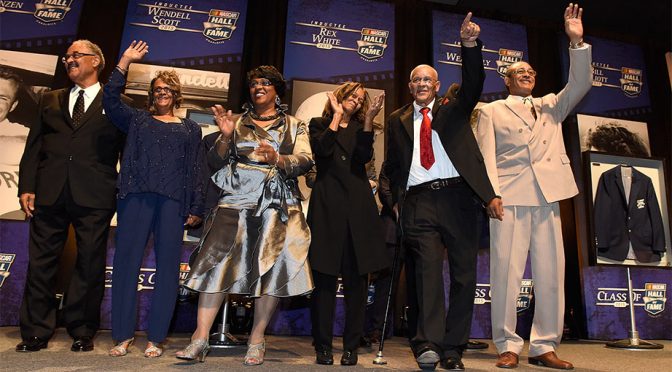
DAYTONA BEACH, Fla. (Jan. 30, 2015) — Five legendary drivers with distinct styles and contributions to NASCAR were enshrined into the NASCAR Hall of Fame in Charlotte, North Carolina tonight during the Induction Ceremony held in the Crown Ball Room at the Charlotte Convention Center.

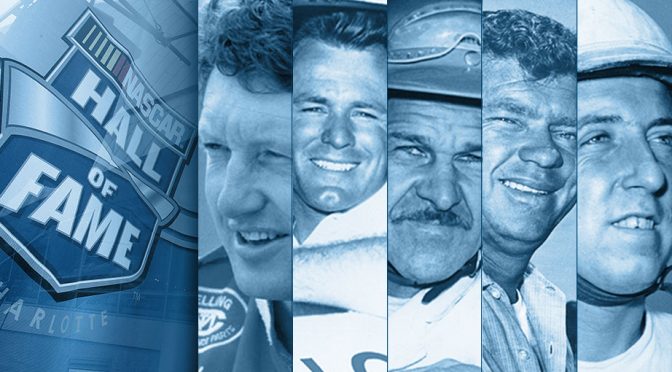
Those who added their names to the list of now 30 NASCAR Hall of Fame inductees, included: Bill Elliott, Fred Lorenzen, Wendell Scott, Joe Weatherly and Rex White.

The group makes up the Hall’s sixth class in its history.

Bill Elliott — a fan-favorite with a record 16 NASCAR Most Popular Driver Awards — compiled numerous accolades that put him near the top of many all-time NASCAR lists. In his 37-year driving career, "Awesome Bill from Dawsonville" notched 44 wins (16th in NASCAR history) and 55 poles (eighth), but his most prestigious accomplishment came when he won the 1988 premier series championship. Elliott always performed on the biggest of stages, winning the Daytona 500 twice and the Southern 500 three times.

"One thing I look at out here today is one common bond with all these racers, it’s the hard work and the dedication all these guys had," Elliott said. "I mean, for me to stand up here among the guys that have already been here, it’s just totally incredible."

Fred Lorenzen — one of the first "outsiders" to capture the fancy of NASCAR’s early southeastern crowds — was one of the sport’s first true superstars, even though he never ran more than 29 of the season’s 50-plus races. The Elmhurst, Illinois, native won 26 races from 1961-67, with his best overall season coming in 1963 as he finished with six wins, 21 top fives and 23 top 10s in 29 starts. The victor of the 1965 Daytona 500 and World 600, Lorenzen boasts the fifth-highest career winning percentage (16.86) in NASCAR history.

"Dad always said, ‘The sky is the limit and don’t let anyone tell you otherwise,’ " said Lorenzen’s son, Chris, who spoke on his behalf. "That has been dad’s most important saying in life, and he certainly lived by it. He also believed people made their own luck and that luck just doesn’t fall upon people."

A true trailblazer,Wendell Scott was the first African-American to race full-time in NASCAR’s premier series, as well as the first to win a NASCAR premier series race. Scott posted 147 top 10s in 495 starts, as well as finished four seasons in the top 10 of the championship points standings. He won more than 100 races at local tracks before making his premier series debut, including 22 races at Southside Speedway in Richmond, Virginia, in 1959 en route to capturing both the Sportsman Division and NASCAR Virginia Sportsman championships.

"The legacy of Wendell Scott depicts him as one the great vanguards of the sport of NASCAR racing," said the late Scott’s son, Franklin, who accepted the induction on his behalf. "Daddy was a man of great honor. He didn’t let his circumstances define who he was."

Joe Weatherly claimed consecutive premier series championships in 1962-63 and won 25 career races before his untimely death in January 1964 at Riverside (Calif.) Raceway. Known as the "Clown Prince of Racing" due to his jovial personality, Weatherly displayed impressive versatility beyond his premier series dominance. A decade earlier in 1952-53, he won 101 races in the NASCAR Modified division, capturing that championship in 1953. He even tried his hand in NASCAR’s short-lived Convertible Division from 1956-59, winning 12 times.

"He loved his family and he was very generous, but I am sure there are many memories the fans could share as well, maybe ones of the practical jokes he enjoyed playing on fellow drivers," said Joy Barbee, Weatherly’s niece. "He definitely had a sense of humor, he loved a good laugh and he loved to have a good time. He always had a big smile on his face; he was a character to be around and definitely lived up to the title given to him — the ‘Clown Prince of Racing.’ "

One of the greatest short-track racers ever, consistency was the hallmark of Rex White’s NASCAR career. He finished among the top five in nearly half of his 233 races and outside the top 10 only 30 percent of the time. Of his 28 career wins in NASCAR’s premier series, only two came on tracks longer than a mile in length. Driving his own equipment, White won six times during his 1960 championship season, posting 35 top 10s in 40 starts. He finished in the top 10 six of his nine years in the series, including a runner-up finish in 1961.

"Words can’t express how honored I am to be inducted into the NASCAR Hall of Fame along with the other Hall of Fame members, especially my 2015 fellow inductees," White said. "No driver wins a championship by himself and nobody enters the Hall of Fame alone. I am the symbol of a team effort."

Each of the five inductees had an inductor who officially welcomed them into the hall. The inductors for the five inductees: Ray Evernham for Bill Elliott; Amanda Gardstrom (daughter) for Fred Lorenzen; Wendell Scott Jr. for Wendell Scott; Bud Moore for Joe Weatherly; and James Hylton for Rex White.

Active drivers introduced each inductee during tonight’s program: Kasey Kahne for Bill Elliott; Tony Stewart for Fred Lorenzen; Jeff Gordon for Wendell Scott; Brad Keselowski for Joe Weatherly; and Kevin Harvick for Rex White.

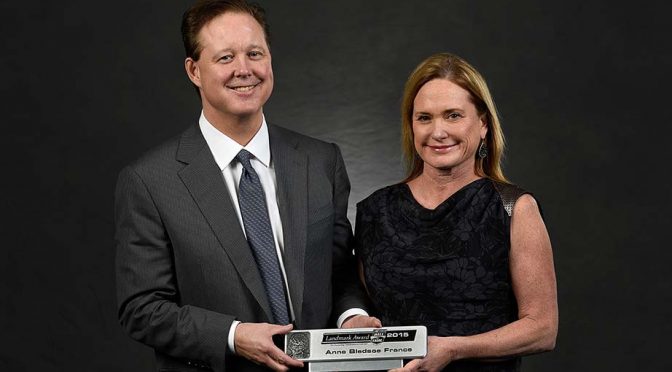
In addition to the five inductees enshrined on Friday night, Anne B. France was awarded the inaugural Landmark Award for Outstanding Contributions to NASCAR.

France, paired with her husband, NASCAR founder Bill France Sr., created what today is one of the largest and most popular sports in the world. Anne played a huge role in the family business. "Big Bill" organized and promoted races; she took care of the financial end of the business. She first served as secretary and treasurer of NASCAR, and when Daytona International Speedway opened in 1959, served in the same roles for the International Speedway Corporation. She also managed the speedway’s ticket office. France remained active in family and business life until her passing in 1992.

Prior to tonight’s Induction Ceremony, long-time Charlotte Observer reporter Tom Higgins was awarded the third Squier-Hall Award for NASCAR Media Excellence.

Higgins was the first beat writer to cover every race on the NASCAR schedule, a role he held from 1980 until his retirement in 1997. He started his journalism career in 1957 at the weekly Canton (N.C.) Enterprise where he covered racing for the first time. Higgins joined the sports staff at The Observer in 1964 as an outdoors writer and soon began covering stock car racing as well. He has continued to write motorsports nostalgia columns for the newspaper and its website ThatsRacin.com since his retirement.


Lesa France Kennedy accepts award on behalf of her grandmother

RELATED: NASCAR Hall of Fame hub

CHARLOTTE, N.C. — In one of the most emotional moments in Friday night’s NASCAR Hall of Fame Induction Ceremony, Lesa France Kennedy accepted the inaugural Landmark Award for Outstanding Contributions to NASCAR on behalf of her grandmother, Anne Bledsoe France.

Side-by-side with husband Bill France Sr., Anne B. France, affectionately known as "Annie B," played a pivotal role in the founding and growth of NASCAR racing. Where "Big Bill" ran the competition side of the business, Anne B. France handled the business side, keeping the books, managing ticket sales and making sure bills were paid.

"My grandfather was a visionary, but my grandmother was the one who kept everything together," Kennedy told the NASCAR Wire Service during a telephone conversation on Thursday. "Without her, NASCAR might not have succeeded the way it did."

To Kennedy, there could not have been a more fitting recipient of the first Landmark Award.

"I think it’s appropriate, in that it’s a unique award in the Hall of Fame," she said. "For her to be the first recipient is very special."

Anne B. France was the first secretary and treasurer of NASCAR, and with the construction of Daytona International Speedway, she filled the same roles with International Speedway Corporation and was active in the business of NASCAR racing until her death in 1992.

In accepting the award, Kennedy, the chief executive officer of ISC, revealed to the audience that Anne B. France actually kept two sets of books.

"There was the real set of books for the business, and then she had a set of books that she shared with my grandfather, Bill France Sr., just to make sure he didn’t spend us out of business," Kennedy said. "I think everybody in this room today should be thankful for that."

Kennedy had told the NASCAR Wire Service, "I don’t know exactly how I’m going to feel until I get up there — it’s going to be a very special night."

And when she began to describe her grandmother’s role in the growth of NASCAR, there was a catch in Kennedy’s voice as the emotion of the moment took hold.

"I was fortunate enough to know her and to call her ‘Grams,’ " Kennedy said, "and NASCAR will always remember her as that strong-willed, pioneering woman who helped build the foundation of our sport."


Annual ceremony pays tribute to five racing legends

RELATED: More NASCAR Hall of Fame coverage
HALL OF FAME PRESENTATIONS: Elliott | Lorenzen | Scott | White | Weatherly

CHARLOTTE, N.C. — On Friday night, in a particularly moving ceremony, the NASCAR Hall of Fame welcomed one of the most significant classes since the induction of its inaugural class in 2010.

Perennial most popular driver Bill Elliott headlined a five-member class that also included NASCAR trailblazer Wendell Scott, the first African-American driver ever to win at NASCAR’s highest level and the first ever to be inducted into the NASCAR Hall of Fame; Fred Lorenzen, a supremely talented driver who won 26 of his 158 career starts; two-time champion Joe Weatherly, who won 25 races in NASCAR’s premier series and 101 races in the NASCAR modified ranks; and 1960 champion Rex White, who started 233 races and finished in the top five in 110 of them.


Introduced by three-time NASCAR Sprint Cup Series champion Tony Stewart, Lorenzen, from Elmhurst, Illinois, was one of the first "northern" drivers to gain acceptance in what was, at the time, a predominantly Southeastern sport. Though Lorenzen never competed in more than 29 races in a single season, he won 26 times in 158 starts, a remarkable winning percentage of 16.46.

"One of the most pivotal moments of dad’s career came on Christmas Eve 1960, when Ralph Moody called dad and asked him to drive for Holman Moody," said Lorenzen’s son, Chris, in accepting induction on behalf of his father.

"Soon after, there he was at Darlington driving his Holman Moody Ford signature pearlescent white No. 28 to Victory Lane … Dad always said, ‘The sky is the limit, and don’t let anyone tell you otherwise.’ That has been dad’s most important saying in life, and he certainly lived by it."

Four-time NASCAR Sprint Cup Series champion Jeff Gordon introduced the late Wendell Scott, whose Dec. 1, 1963 victory at Speedway Park in Jacksonville, Florida, stands as the first win by an African-American driver in NASCAR’s top series.

In a career that included 495 starts, Scott recorded 147 top-10 finishes.

"We have been led to this great celebration and enshrinement tonight because of the character, tenacity and determination of Wendell O. Scott Sr.," Scott’s son, Franklin, said in accepting induction on behalf of his father. "I believe dad envisioned a night such as this comprised of his family, friends and fellow competitors. Unfortunately, the love of his life, Mary Scott, is not here physically because of health reasons, but her spirit is definitely here in a very profound way.

"The legacy of Wendell Scott depicts him as one of the great vanguards of the sport of NASCAR racing. Daddy was a man of great honor. He didn’t let his circumstances define who he was. The Bible teaches that before a person can have honor, they must first have integrity and humility. In addition another one of his great attributes was perseverance. There were two words that were forbidden for us to use growing up in the Scott household. Those words were ‘can’t’ and ‘never.’

"In spite of the many obstacles, struggles and hardships he faced, he persevered. What seemed to be insurmountable odds to others, daddy considered it an opportunity. His intestinal fortitude to follow his dreams has placed him among the greatest to ever compete in the sport he loved — racing."

Reigning NASCAR Sprint Cup Series champion Kevin Harvick took the dais to introduce the third new member of the Hall of Fame, 1960 champion Rex White, who collected 28 victories and 36 poles in his 233 starts in NASCAR’s premier series.

"Words can’t express how honored I am to be inducted into the NASCAR Hall of Fame along with the other Hall of Fame members, especially my 2015 fellow inductees," White said.

"No driver wins a championship by himself, and nobody enters the Hall of Fame alone. I am the symbol of a team effort. From my first race in 1953 until now, this effort spans 62 years."

Brad Keselowski, 2012 NSCS champion introduced Joy Barbee, niece of the late Joe Weatherly, who won championships in 1962 and 1963 before a crash in the fifth race of the 1964 season, at Riverside (Calif.) Raceway took his life.

Known as the "Clown Prince of Stock Car Racing" for his gregarious nature and proclivity for practical jokes (rubber snakes were a favorite), Weatherly won 25 races and 18 poles in 229 starts.

"Being the youngest of seven, I was only two-and-a-half when Joe was killed, so I really don’t remember him at all, but what I can share with you is a memory that I will hold forever in my heart and that is a memory about the love of a brother and a sister, Joe and my mother Betty.

"I feel like I knew Joe through her, through the stories she would tell us as kids, and the passion you could hear in her voice when she spoke of him … I must say that standing here tonight is such a great honor, and I can’t tell you how thrilled I am to be here accepting this award on behalf of my Uncle Joe."

Kasey Kahne, who took over the No. 9 car from Elliott, introduced his racing hero, "Awesome Bill from Dawsonville," the most prolific winner of the 2015 Hall of Fame class with 44 victories in NASCAR’s top series, 16th on the all-time list.

Elliott won the Cup championship in 1988 after becoming the first driver in series history to claim the Winston Million in 1985 with victories in the Daytona 500, Southern 500 at Darlington Speedway and Winston 500 at Talladega Superspeedway.

Champion crew chief Ray Evernham performed the official induction of Elliott, who advanced to NASCAR’s highest level from a small family operation in Dawsonville, Georgia.

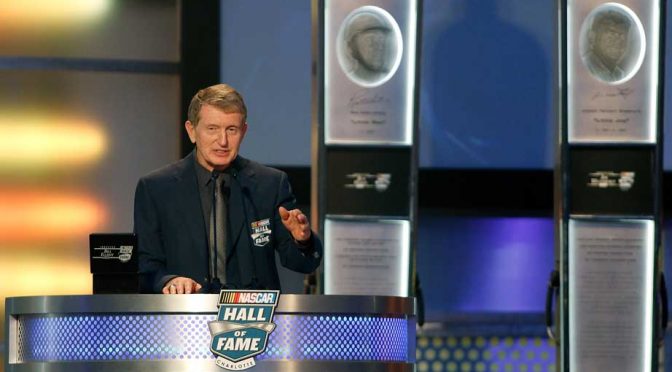
"It’s just an honor to be here, guys," Elliott said. "If you look on the walls here at the people who are already inducted into this great Hall of Fame, it’s just incredible … One thing that I look at out here today, guys, is one common bond with all these racers is the hard work and the dedication all these guys had.

"And for me to stand up here among the guys that have already been here is totally incredible."

Anne Bledsoe France, wife of founder and NASCAR Hall of Fame member Bill France Sr., was honored with the first Landmark Award for Outstanding Contributions to NASCAR. Familiarly known as "Annie B," Anne B. France handled the business end of NASCAR racing while "Big Bill" grew the sport into a national phenomenon.

Lesa France Kennedy, CEO of International Speedway Corporation, accepted the award on behalf of her grandmother.

Renowned Charlotte Observer racing writer Tom Higgins received the Squier-Hall Award for NASCAR Media Excellence, joining Ken Squier, Barney Hall and the late Chris Economaki. NASCAR Senior Vice President and Chief Communications Officer Brett Jewkes aptly referred to the quartet as the "Mount Rushmore" of motorsports journalism.

Second-year Sprint Cup driver spent rookie year at BK Racing

Play: NASCAR Fantasy Live
Related: Who the ‘F’ is Alex Bowman?

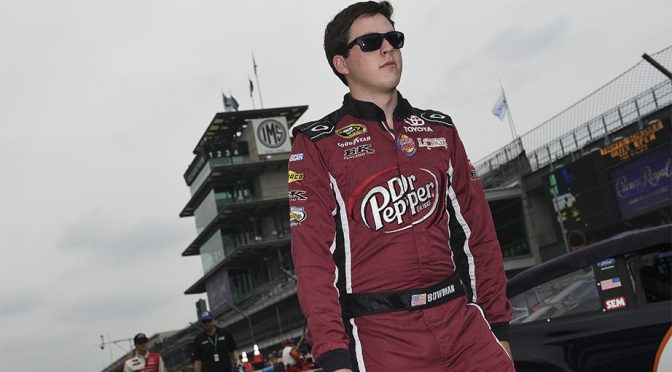
Alex Bowman‘s NASCAR Sprint Cup Series career will continue in 2015 with a new team in Tommy Baldwin Racing. The 21-year-old will drive the No. 7 Chevrolet this upcoming season, the team announced Friday.

FULL SERIES COVERAGE

Latest news
Standings
Schedule

Bowman had a full-time ride with Swan Racing last year, the team that was eventually incorporated into BK Racing. He ended the year with a best finish of 13th at Daytona International Speedway in July.

"I’m looking forward to working with TBR and the entire No. 7 team," Bowman said in a team release. "With Tommy’s experience and his drive to run competitively, I feel like we can run well this year."

Bowman made his NASCAR national series debut in 2012, with four starts in the NASCAR XFINITY Series. He drove full time for that series in 2013, netting six top-10s in 33 starts for RAB Racing.

"Alex is the future of TBR, and he will be a great representative of our team," owner Tommy Baldwin Jr. said. "He is a young driver who displayed a great talent in both the XFINITY and Sprint Cup Series the past few years. We are pleased to give Alex the opportunity to further showcase his skills behind the wheel of the No. 7 Chevrolet this season."

The team did not announce sponsorship or a crew chief. The team on Twitter promoted #TBR7in7, which promises seven team announcements in seven days.