Son of F1 champion Niki Lauda making his own name in NASCAR Whelen Euro Series

Photo credits: Stephane Azemard/NASCAR Whelen Euro Series
RELATED: Learn more about Lauda’s win | NASCAR Whelen Euro Series | Home Tracks

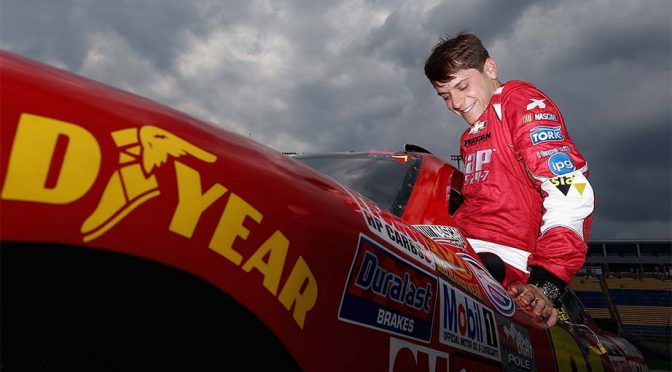
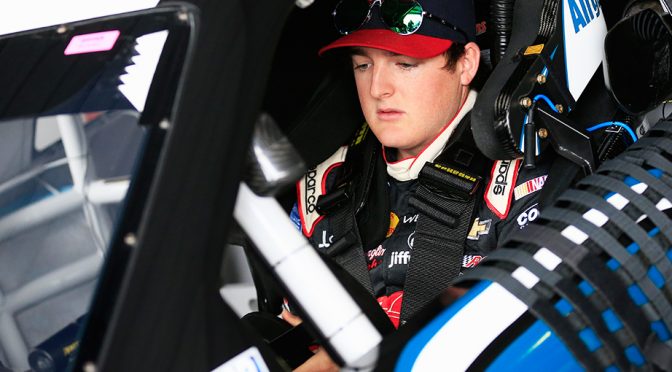
He may have been raised in Europe as the son of a three-time Formula One champion, but when it came to his own personal preferences, Mathias Lauda always gravitated toward a very different form of racing.

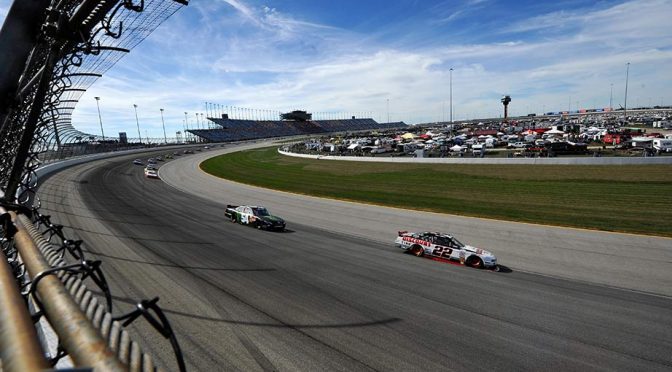
"To be honest, I was always a NASCAR fan," said the son of global racing icon Niki Lauda. Now the 33-year-old is getting the chance to put that passion into practice as a driver on the NASCAR Whelen Euro Series, where Lauda won a race on the Tours Speedway oval in France earlier this month. And this weekend brings another opportunity at the famed Nurburgring, a track not only immediately associated with his father, but where Lauda also has more experience than anywhere else on the circuit.

While it might seem an odd combination — the son of an F1 legend driving V8 stock cars on a continent typically obsessed with open-wheel racing — to the younger Lauda, it all seems natural. The native Austrian has always held an appreciation for the close competition in NASCAR, and attended the Sprint Cup Series finale in 2004 at the invitation of a friend who had connections with Kurt Busch, who clinched the championship on that day in South Florida. Even while competing in a variety of European circuits, Lauda always had one eye on stock cars in the United States.

"I was always a big fan of NASCAR," he said by telephone from his home in Barcelona, Spain. "I always followed the races. But I knew that for a European driver, it’s very hard to get to get into the U.S. and start in NASCAR. There was also a point in my career a couple of years ago where I tried to get into NASCAR in the U.S., but it is really tough for a European. You need to bring sponsors in the beginning, and it’s really hard to find a sponsor in Europe that wants to go to the U.S. But I was always a fan of NASCAR."

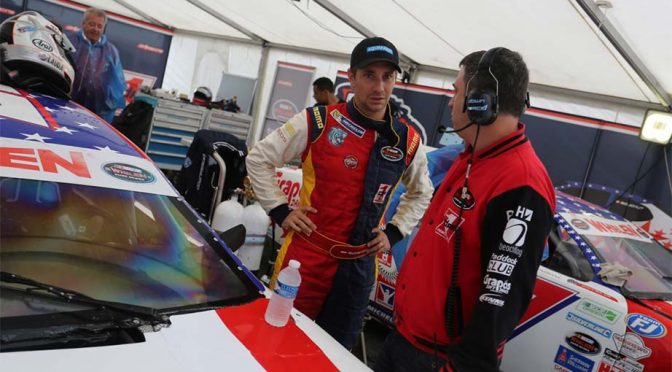
To the point where he jumped at the chance to compete this season in the Euro Series. Lauda had followed a rather typical career path for a European driver, driving in circuits like Formula 3000, its successor GP2, and the German touring car series DTM, where he raced for Mercedes. But from the very first test he felt comfortable in the stock car, and the Americanized nature of the Euro Series — "no politics, just pure racing," Lauda called it — was a refreshing change from what he had experienced before. So were the vehicles, which like their counterparts in NASCAR’s U.S.-based circuits, don’t offer all the driver aids available in other types of race cars.

"To be honest, I really like the style of racing, like how you have to drive the cars," he said. "All the cars I’ve driven before, they’ve always gotten more and more easy to drive. Like GT cars, they have traction control, they have ABS, they have pedal shifting. Every time, it makes it easier and easier, and they drive like PlayStation a little bit. It’s really hard to make mistakes, and it’s really hard to overtake. The first couple of races here in NASCAR, it’s like everything is back a couple of years, or 20 years, and everything is more basic, but it makes the racing much more interesting. You can start to overtake again, you can race really close to each other without losing all the downforce. And in general, it’s just a lot of fun, to be honest."

No wonder, then, Lauda took immediately to the stock car. In his first season in the Euro Series — which holds two races on each event weekend (an Elite 1 event and an Elite 2 event; Lauda competes in the Elite 1 division) — he has five top-10 finishes in six starts, including a somewhat unexpected victory in wet conditions July 6 at Tours. He enters the Nurburgring event third in the NASCAR Whelen Euro Series Elite 1 division point standings. Lauda used the outside position on a late restart to pass defending series champion Ander Vilarino with nine laps remaining, and won on the .333-mile oval as heavy rain began to fall.
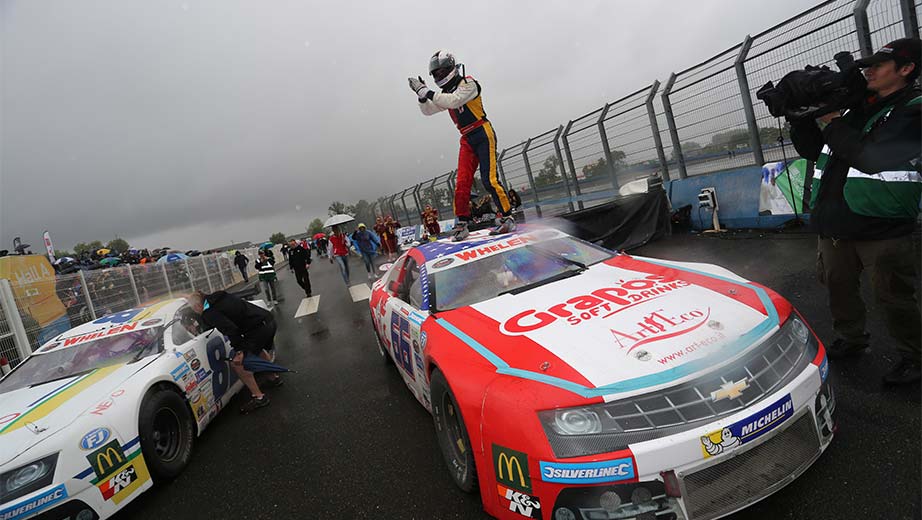
Mathias Lauda celebrates his NASCAR Whelen Euro Series victory at Tours Speedway.

"It was the first time that we raced an oval, and we couldn’t test before. It was all new," Lauda said. "So I came there with no expectations, and from the first practice on I had a really good feeling. It’s tough, because you can’t make any mistakes, and you have to drive really clean, and you have to be quick through the traffic because the laps are really short. But from the beginning on, it was really a lot of fun."

Prior to Tours, Lauda thought his best chance at a first Euro Series victory might be at another track — the famed Nurburgring, where the circuit competes Saturday and Sunday, and where Lauda has plenty of laps from his GP2 and DTM days. In many minds, the German road course is also deeply connected to the Lauda name — it was there in 1976 where Niki Lauda suffered the fiery crash that left him with severe burns and forced him to spend weeks in a hospital. Although the elder Lauda recovered and went on to win two more championships, the accident at Nurburgring has become as synonymous with the 65-year-old as his three titles and 25 race victories in F1.

For Mathias, though, that incident has no bearing on his return to the track.

"Not at all," he said. "First, it was a long, long time ago, even before I was born. And second, it was on the old track … and we run on the (grand prix) course. It’s like a different race track. I’ve driven in the old track — two years ago I did the 24 Hours of Nurburgring, and we raced on the old track, an it’s a really tough track. But I don’t have any feelings involved or anything, because this happened in the past, a long, long time ago, before I was born. What happened afterward with my father, everything was fine, and he’s now in great health, and everything is OK."

Niki Lauda recorded his final F1 victory when his son was 4, so Mathias has very few memories of his dad’s racing career. "I remember a little bit of him coming home, and things like that," Mathias said. Niki also has not played an active role in his son’s racing career, Mathias added.

"Not really. It was more the opposite," Mathias said. "He was always against it when I was young, when I was always asking to come racing. He was always against it. When I started my racing career, it was quite late compared to a normal career. I started racing when I was 21. Before that, I had a normal life — I went to school, I finished school, and I started racing without a plan. It just happened. Someone invited me for a test on the race track, and it was kind of fun event for me. I went there without telling my father. And then from the first day on, my lap times were OK, and I had a lot of fun, and I just started on my own without help from my father. I knew if I asked him, that he would say no. So I started by myself."

And that path has led him, oddly enough, to stock cars. While Lauda still hopes to one day compete in the United States, his time in the Euro Series — sanctioned by NASCAR since 2012 — has offered a refreshing change from the politics and pressure he dealt with earlier in his career. He’s simply having too much fun in NASCAR to do anything else.

"I enjoy racing now more than ever," Lauda said. "I hope I can keep racing here in Europe and in NASCAR Euro for many years. I’m pretty sure that the championship will grow a lot in the future, because it’s already taken a big step from last year to this year. So what I want to do is be here for many years, and hope the championship will grow and I can be part of it. And if there’s a chance for me to make a few races in the States, that would be a dream for me."

MORE:

READ: Latest
NASCAR news

WATCH: Latest
NASCAR video

PLAY: NASCAR
Fantasy Live

FOLLOW LIVE: Get
RaceView

Rule change allowed for ‘big gains right out of the gate’

RELATED: Play NASCAR Fantasy Live | Sign up for RaceView today

Kevin Harvick and Rodney Childers have been fast together from the start, including a test at Charlotte last December which foreshadowed the speed the No. 4 car would display in nearly every race weekend to come. After a first half to this season that included two victories, nearly 900 laps led and close to a secure berth in the Chase for the NASCAR Sprint Cup, the crew chief of Stewart-Haas Racing‘s best team knows it’s easy to draw an oversimplified conclusion.

"Everybody thinks that we went to Charlotte in December and hit on this magic setup," Childers said. "What we ran in Charlotte in December, we haven’t even raced this year. It has nothing to do with anything that we’ve done. I think it’s just focusing on each race track specifically, and what’s best at this place, and not, ‘Oh, what we had at Texas will work at Charlotte.’ Because it doesn’t really matter anymore."

FULL SERIES COVERAGE

Latest news
Standings
Schedule

Why not? Because of perhaps the biggest rule change for the 2014 season — the elimination of the minimum ride height for Sprint Cup cars. Teams have always worked to get their vehicles as close to the ground as possible, a tactic that improves aerodynamic performance. But prior to this year, there was a rule mandating a specific amount of front-end ground clearance in post-race inspection. Crew chiefs would use springs that would force down a car’s front end down in the turns, and hopefully rebound after a race to allow enough clearance to pass inspection. Penalties for vehicles being too low were common as crew chiefs worked to get their vehicles right on that allowable limit.

For 2014, that post-competition ground clearance standard no longer exists, allowing teams the freedom to get their cars as low as bumps in a race track’s asphalt will permit. While the goal remains the same — get the vehicle as low to the ground as possible — there are suddenly many more routes to get there, as crew chiefs can now experiment with a variety of height, shock and spring combinations that had been off limits to them as recently as last year. At the same time, the standard setup packages that many teams relied on at similar types of tracks have become somewhat outdated in the process.

"Everybody’s still trying to seal their splitter off in the corner, and skirts off in the corner, and all that kind of stuff. You’re just starting at a different spot," Childers said. "I guess before, there weren’t very many options. Your car started at one spot, you had to do certain things with springs to end up at another spot. Now, you can start wherever you want. You can start at a thousand different ride heights and have a thousand different springs, and end up in the same spot."

Getting there, though, has become the challenge, and the elimination of a rigid ride height standard has taken place in a season where a number of traditional powers — like Matt Kenseth at Joe Gibbs Racing, Greg Biffle at Roush Fenway Racing, and even Harvick’s teammate Tony Stewart at SHR — have struggled relative to their past performance. In media centers and in the grandstands, it’s often easy to point to ride height as being the difference, just as everyone assumes the No. 4 car hit on a magic setup at the Charlotte test. The reality of it all is a tad more blurred, like the colors on a Sprint Cup car zooming by at full speed.

Is adapting to the lack of a ride height standard the reason some teams are struggling, and others are ahead of the pack? Count Hendrick Motorsports mainstay Jeff Gordon, a winner earlier this season at Kansas and the current Sprint Cup points leader, among those who certainly thinks so.

"Oh, I definitely think it is," the four-time champion said. "If you look at teams that were strong last year that maybe are struggling a little bit this year, that ride height change has definitely made some significance, because it’s changed the aerodynamics a lot. It’s changed what kind of springs we run in the car, and I think that the teams that have really understood that well and got on top of it early on have been very successful. I contribute a lot of it, of what our team has done and that ride height rule, to the success that we’re having."

From the driver’s seat, Gordon can feel the difference — he likes to drive deep in the corner, so he wants that feeling of security as he enters the turn, and the rule change combined with a tweak to the spoiler "has definitely made me a little more comfortable getting into the car, (and) it’s given me more confidence," he said. That shows throughout the Hendrick camp, where Gordon and teammates Jimmie Johnson and Dale Earnhardt Jr. have six victories combined.

Up on the pit box, crew chiefs see things a bit differently. No question the elimination of the ride height rule is having an impact, but its true game-changing nature seems to lie in the options wrench-turners now have available to them. For more enterprising crew chiefs, there are immediate advantages to be had. "Guys have been working with the same bump stops and things for the past five, six, seven years. So you kind of get to the point where you try all these new things, and there are opportunities to make big gains right out of the gate," said Paul Wolfe, crew chief for Brad Keselowski.

For some teams — like Keselowski’s, which won for the third time this season Sunday at New Hampshire — those gains have been showing up on the race track, particularly when contrasted with others who may be still relying on base packages for similar types of tracks. Now, every venue demands "different ride heights, different springs, different everything," Childers said, and figuring that out is one reason the No. 4 car has been fast almost everywhere. "It’s not about a trick of the week anymore," he added.

But how much longer can those out-of-the-gate advantages last? It’s only a matter of time, Wolfe believes, before everyone else catches up.

"It’s always all about getting the splitter down, sealed up, and controlling that. With no ride height rule, and letting us use the different springs we can use now, you can pretty much get the car there easier," Wolfe said. "It was just a lot of changes to start the year. Some guys hit on it right out of the gate, and showed they have an advantage. But I think with the open garage policy like we have, guys talk throughout teams, and over time everyone figures out to a certain extent what other guys are doing if they do have an advantage, and that kind of closes up."

Indeed, we’ve seen that before — although it didn’t stem from a rule change, just two years ago Johnson appeared to have separated himself at midseason thanks in part to a yawed rear-end setup which every other contending team was soon emulating, and that 2012 campaign ended with Keselowski as champion. But then as now, it was the Hendrick teams — or Hendrick-affiliated teams, like SHR — which were ahead of the curve, and Michael Waltrip Racing driver Brian Vickers thinks that’s no coincidence.

"Hendrick is essentially an eight-car team. I know there’s a rule that says they’re only supposed to have four, but clearly that’s not the case," said Vickers, whose MWR team is winless this season. "I mean, they share chassis, they share engineering, they share setups, they share engines, they share pretty much anything with Stewart-Haas, so it makes them an eight-car team. For that reason, they adapt to changes the fastest. They have more tests, they have more time, they have more people working on one problem. And if one person figures it out, they can share that information among all of them. And for that reason, they tend to adapt the fastest and are able to push things the furthest."

On the other end of the spectrum? Kenseth, who won a career-best seven times last season, remains the highest-ranked driver yet to visit Victory Lane, and JGR in total has just two wins among its three programs at the halfway point. But as evidenced by this past Sunday at New Hampshire — where Gibbs entries finished second, fourth and eighth — the organization continues to field contending cars. There are also no cut-and-dry answers at Roush, where Carl Edwards has won twice and stands high in the points while his two teammates are searching.

But as even six-time champ Johnson showed earlier this season, the setups required under this rules package can take some getting used to, and some teams and programs adjust more easily than others. It seems fairly clear that the emphasis on creativity created by the change has opened areas in which deeper or more enterprising teams can benefit. But the elimination of the ride-height rule has also had a domino effect on other areas like suspension, aerodynamics and simulation, and for teams playing catch-up, the deficiencies could very well be hiding anywhere.

"When people start talking about it, and they’re like, ‘Oh, the 20 car (of Kenseth) hasn’t won a race this year, they’ve gotten behind on this new deal’ — is it that they’re really behind on this, or are they behind on aero or motor or chassis?" Childers asked. "There are so many things you can be behind on. … There are a lot of smart people. Everybody on say the 20 car, for instance, is plenty smart to figure out where they want to be on ride height and how they want to get there. I think there’s a lot more to it than just the ride height thing."

MORE:

READ: Latest
NASCAR news

WATCH: Latest
NASCAR video

PLAY: NASCAR
Fantasy Live

FOLLOW LIVE: Get
RaceView

CHARACTER COUNTS! to back the No. 66 car at Indianapolis Motor Speedway

RELATED: Play NASCAR Fantasy Live | Sign up for RaceView today

Brett Moffitt will be behind the wheel of the No. 66 car for next Sunday’s NASCAR Sprint Cup Series Crown Royal Presents The John Wayne Walding 400 at the Brickyard (1 p.m. ET, ESPN), Jay Robinson Racing announced on Friday.

"To race at Indianapolis Motor Speedway is a dream of any kid who’s ever gotten behind the wheel of any type of race car," Moffitt said in a team release. "Jay is helping make that happen for me. It’s just incredible."

FULL SERIES COVERAGE

Latest news
Standings
Schedule

Moffitt will have the primary partner of CHARACTER COUNTS!, a character-building initiative of the Josephson Institute. Founded in 1992, CHARACTER COUNTS! is a community-based and educational program that reaches over seven million kids across the nation each year. The program is used in schools across America to teach children ethics and values by using the six pillars of character: trustworthiness, respect, responsibility, fairness, caring and citizenship. This is the program’s first partnership in motorsports, according to the team release.

"I’m proud to bring a new sponsor into NASCAR but also to promote an educational program that is changing kids’ lives," Moffitt said in a team release. "It wasn’t that long ago that I was sitting in a classroom and I know how important life lessions are."

The start at Indianapolis will be Moffitt’s third in the Sprint Cup Series. He made his first career Cup start last month at Dover International Speedway and finished 22nd. He also drove the No. 66 car at Michigan International Speedway to a 34th-place finish last month as well.

Moffitt has a multi-year driver contract with Michael Waltrip Racing and serves as a test driver for Toyota Racing Development and MWR. He has nine career victories in the NASCAR K&N Pro Series East.

The No. 66 team competes in all Sprint Cup races, thanks to a partnership between MWR and Jay Robinson Racing.

MORE:

READ: Latest
NASCAR news

WATCH: Latest
NASCAR video

PLAY: NASCAR
Fantasy Live

FOLLOW LIVE: Get
RaceView

Brian Scott slows after leading Friday’s opening practice

RELATED: Play NASCAR Fantasy Live 

NATIONWIDE SERIES PRACTICE 1 (Results

With the Nationwide Series hosting the sole on-track activity in the world of NASCAR this weekend, Brian Scott topped opening practice for Saturday’s EnjoyIllinois.com 300 (8:30 p.m. ET, ESPN2) Friday at Chicagoland Speedway in Joliet, Illinois.

FULL SERIES COVERAGE

The Richard Childress Racing driver, currently fifth in points and seeking his first Nationwide victory, set the pace on his second of just five laps at 172.806 mph. Scott was followed by Chris Buescher (172.623 mph), Chase Elliott (172.568), Brendan Gaughan (172.342) and Kyle Larson (171.810), one of just two full-time Sprint Cup Series drivers in the race, to round out the top five.

Defending pole-winner Sam Hornish Jr. was next, placing sixth with a best speed of 171.723 mph on his first of 10 laps.

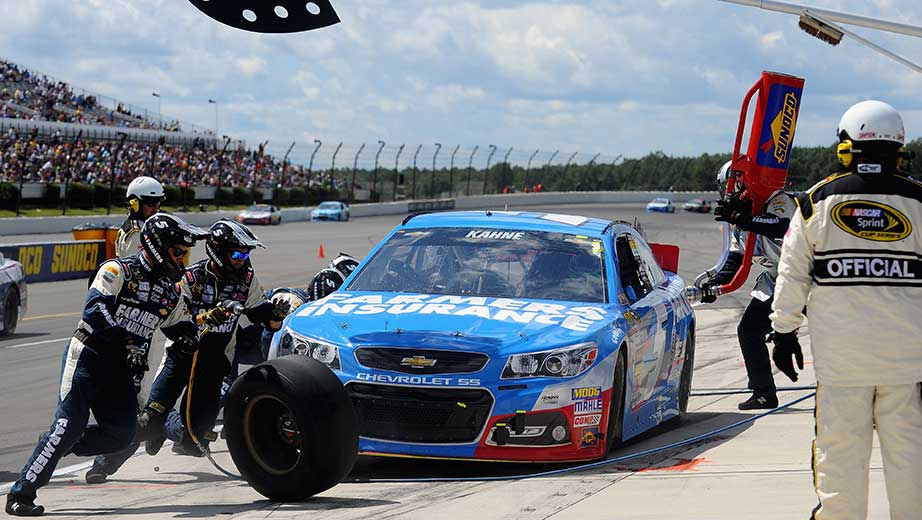
The other Cup driver in the field of 40 cars, Kasey Kahne, was seventh at 171.396 mph.

Ryan Blaney, driving the No. 22 Team Penske Ford that Joey Logano rode to victory in last season’s event, was 13th at 170.767 mph. Points leader Regan Smith (170.154 mph) was close behind in 15th.

NATIONWIDE SERIES PRACTICE 2 (Results)

NASCAR K&N Pro Series East regular Cale Conley soared to the top of the leaderboard during the NASCAR Nationwide Series final practice at Chicagoland Speedway on Friday.

Conley posted a high speed of 175.262 mph. The Richard Childress Racing part-timer was 11th-fastest in Friday’s opening practice.

Following Conley was Brendan Gaughan, posting a speed of 174.961 mph.

Rookie Ty Dillon, Trevor Bayne and rookie Ryan Reed rounded out the top five. 

Erik Jones, who is making his Nationwide Series debut with Joe Gibbs Racing at Chicagoland, came in at sixth-fastest and posted a speed of 174.064 mph. Jones drives for Kyle Busch Motorsports in the Camping World Truck Series.

Brian Scott was fastest in Friday’s opening practice, but was slower in the final session with an 11th-place speed of 172.667 mph.

The Nationwide Series’ Coors Light Pole qualifying will take place Saturday at 4:10 p.m. ET with coverage on FOX Sports 2. 

The EnjoyIllinois.com 300 will run Saturday at 8:30 p.m. ET with coverage on ESPN2. 

MORE:

READ: Latest
NASCAR news

WATCH: Latest
NASCAR video

PLAY: NASCAR
Fantasy Live

FOLLOW LIVE: Get
RaceView

26-time race winner’s inclusion in the Class of 2015 well-deserved

RELATED: Fred Lorenzen’s career in photos
MORE: NASCAR Hall of Fame coverage

To hear it told by those close to him, there are good days and bad days for NASCAR legend Fred Lorenzen. A trove of racing memories still resonates but advancing dementia has made recall of the most mundane everyday activities difficult.
 
May 21, 2014 was one of the good days, one of the best in years. Four names — all drivers — had already been called for the 2015 induction class into the NASCAR Hall of Fame that Wednesday afternoon, leading to an anxiety-ridden wait for Amanda Lorenzen Gardstrom, several hundred miles away. It wasn’t until NASCAR Chairman and CEO Brian France opened the fifth and final envelope that the suspense finally subsided.
 
"As the fifth one was announced, we were so nervous," Gardstrom said in the days after the announcement. "We thought it wasn’t going to be this year again, and when they said, ‘And from the North …,’ I think my heart skipped a beat and it was pure happy tears of joy. …"
 
Once her heart rate normalized, it was time to inform her father, who spends his days in an assisted living home in his home state of Illinois. Gardstrom had hesitated to tell her father to tune in to the announcement, knowing the years of disappointment the family had endured on past Voting Days.
 
Though Lorenzen still has trouble understanding certain concepts, hearing the news of his approaching enshrinement came with crystal clarity.
 
"It couldn’t have been more picture-perfect," Gardstrom said, mentioning that her father initially chuckled when receiving word. "I’d fantasized about what the moment would be like, to talk to my dad. I told him, ‘Dad, you are in the elite group of the NASCAR Hall of Fame now.’ It knocked his socks off. … My whole life, he’s always been very humble and quiet about his accomplishments and it hasn’t been until the last five or six years that I realized what a true legend and hero he is in NASCAR, a pioneer in the sport. To hear this news, it’s the icing on the cake. It’s the final victory, and just a huge, huge honor."
 
The memories of Lorenzen’s heyday will be more top of mind this weekend as the NASCAR Nationwide Series returns to Chicagoland Speedway, less than an hour from the Chicago suburb of Elmhurst, the racing legend’s hometown. Though he hailed from the Land of Lincoln, Lorenzen’s appeal broadened the sport’s reach beyond its Southern roots and spawned numerous nicknames — "Fearless Freddie" for his sheer speed, the "Golden Boy" for his matinee-idol looks and "The Elmhurst Express" in a nod to his hometown.
 
Though the Windy City holds many ties to Lorenzen’s legacy, it’s the hub of Charlotte, North Carolina where Fearless Freddie hung his shingle in NASCAR.

"The fans loved him. After the race was over, they’d flock around him for autographs." –Waddell Wilson

The beginning
 
In the southern outskirts of the Queen City sits a stately but otherwise nondescript brick warehouse in an industrial park. Venture inside the brick walls and there’s treasure to be found.
 
Just outside the office doors, an impeccably restored 1963 Ford Galaxie with Fireball Roberts’ name over the door. High-powered engines in various states of build. Low-slung Ford GT40 sports car chassis. A blood-red Ferrari roadster. A Shelby-striped vintage Mustang parked not far from special-edition current models.
 
The daily car show is all part of the surroundings at Holman-Moody, the company formed by mechanical masterminds John Holman and Ralph Moody that served as the Ford factory team as NASCAR transitioned toward its modern era. At its height, Holman-Moody had an estimated 450 employees, making it the Hendrick Motorsports of its day. Today, Lee Holman says that number is closer to "six or seven," all helping to carry on his father’s tradition by building engines, cars, parts and more.
 
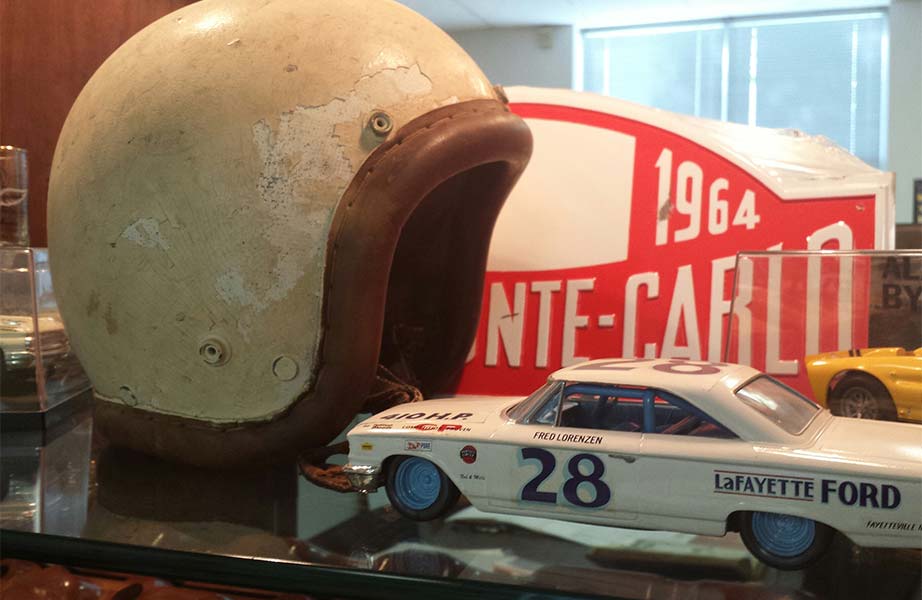
Holman-Moody fielded cars for some of the most famous names in racing — Pearson, Yarborough, Foyt, Weatherly, Allison, Unser, Jarrett, Andretti. But the name Lorenzen was most famously associated with the team’s powerful machines — ivory with a blue No. 28 — in the early to mid-1960s.
 
"All he’d ever done is race," said Lee Holman, a teenager working for his father at the time Lorenzen joined the team. "He was a famous Illinois dirt-tracker before he came to us and had done real well in other series, so it wasn’t like we trained him and made him what he was. We just gave him an opportunity to move into NASCAR."
 
That chance at stock-car racing’s big leagues came in the form of an early Christmas present in the winter of 1960.
 
"Ralph Moody, my dad had seen him race back in the day at a USAC race, I believe," Gardstrom said. "Ralph had gone, pulled up his car with his trailer about half an hour before the race was going to start, pulls up the trailer, takes his car out, runs 10 laps, sits on the pole and wins the race, puts his car back and gets out of there. My dad says, ‘Wow, well that guy’s pretty sharp. I want to be like him.’ They started talking and he says, ‘You’re a great driver, but I’ll tell you what’s wrong with your car. You need to get these springs.’ So my dad sent him $400, Ralph sent him some springs from Holman-Moody and that was the beginning of my dad really taking off. But Ralph had an eye on my dad for a while and on Christmas Eve, he called and said, ‘Hey, you wanna drive for us? We want you.’
 
Gardstrom said her father balked at first, lacking the money for travel, but Moody was insistent: "We’re paying for you. We’ll send a plane up there, you just get on it and that’s it.’ It was the best present my dad could’ve gotten his whole life was that call from Ralph Moody. Ralph Moody was like a dad to my dad."
 

Marvin Panch and Lee Holman look at a 1963 Ford Galaxie at the Holman-Moody shop.


The outsider turned fan favorite

 
What Holman-Moody got in Lorenzen was a far contrast from their past driver rosters. Curtis Turner and Joe Weatherly, two of the earliest and most swashbuckling stars in NASCAR, drove and partied with equally reckless abandon, abusing their equipment to the dismay of their mechanics and their competition.
 
"This race in Darlington, Dad had me sneak gin into Weatherly’s Thermos cooler because he was so hung over Sunday morning when he got to the track that he thought a little hair off the dog might help," Lee Holman said. "Lorenzen came to race and took racing very seriously and thought that he needed to do what it took to be ready for the race and go."
 
That included knowing his car frontward and backward as an active participant in making sure his car was in tip-top condition before it ever reached the track. Lorenzen’s perfectionist personality also meant that he expected a lot from his crew in return.
 
"(Other drivers) partied, they were out to go fast and live the life, but when my dad came in, he was business," Gardstrom said. "… After every time he won a race, he’d call the stock broker and want to know the best way to invest that. He insisted that his pit crew was ready to go at 7 o’clock in the morning every day — clean white suits and ready to work. They all worked and they planned and had strategies as a team."
 
While Lorenzen had the backing of one of Ford’s flagship operations, he was a stickler for doing a significant portion of the work himself. It helped forge a new level of respect for a young Waddell Wilson, who joined Holman-Moody as an engine builder and a jack man for Roberts and Lorenzen in the early 1960s. Wilson went on to become a Daytona 500-winning crew chief and team manager for decades to come, but he never forgot the lessons learned from Lorenzen.
 
"Before I ever went to Holman-Moody, Lorenzen was the one I pulled for," said Wilson, now a NASCAR Hall of Fame voting member. "It was all because of him and his ability to not just know about an engine, but know about a race car. He helped me in my career so much with what I learned being with him. A lot of times, he didn’t run wild at night like a lot of them did. We’d go to dinner and he’d be up for breakfast and that’s all that was on his mind was that race car. Nothing else. He was so dedicated. He was the first one I ever saw that would measure tires himself."
 
The analytical pre-race approach carried over to the race track, where his tactical mindset clashed with the prevailing go-for-broke style of the day. The new-fangled strategy helped Lorenzen stockpile wins in the biggest races on the circuit, never running a full season in accordance with his and Holman-Moody’s plan.
 
"He always had ‘What the hell’s the matter?’ or ‘What the hell are you thinking?’ — there were two different versions — painted on his dash," Lee Holman said. "The idea was that you really needed to think a little bit. Lorenzen was a lot like Pearson in that he liked to stay near the front but he didn’t have to lead every lap because by following the other drivers, you could see where they would fall down in the corner or have a handling issue. Sometimes you could push a driver a bit, and see where his weak spots were and plan your attack. With Pearson, they used to say with about four laps to go, he’d throw his cigarette out the window and you’d better hold on, because the race was about to happen. Lorenzen was the same way — he’d think about it and go."
 
In NASCAR, so much of success is built around chemistry, forging the right combination of driver and team. Through the early to mid-1960s, Lorenzen and Holman-Moody found it. Much of the history is documented in massive scrapbooks of newspaper clippings at Holman’s shop, where a curio in a side room contains many important artifacts from NASCAR’s earliest years.
 
Thumbing through the albums shows Lorenzen’s name again and again in the yellowing newspaper headlines, documenting how he became the first driver to surpass $100,000 in winnings in a single season in 1963 and recapping his frequent victories at storied speedways — Atlanta, Martinsville, Charlotte — including the 1965 Daytona 500.
 
"He had to race pretty smart to keep that car under him," said Neil "Soapy" Castles, a journeyman driver who predominantly competed as an independent in NASCAR’s top series from 1957 to 1976. "It’s difficult to run a factory car and be very careful with it to be aggressive. As far as the years I ran with him, we never had a problem. He was real easy-going. I don’t know of anybody that had any trouble with him. He came in and represented himself and the sponsor and the vehicle, so he was pretty well an all-around race driver."
 
Though he was still an outsider in what was still largely a Southern sport, Lorenzen quickly won fans and fellow drivers over not only with his performance but with his beaming smile and charisma. It’s part of why the "Golden Boy" nickname resonated most, thanks to the driver’s All-American looks.
 
"He was a crowd pleaser," Wilson said. "You could be at Bristol, at Martinsville, at Wilkesboro — places where you’d be right up next to the fans — and when they’d introduce drivers, he’d be the one getting the biggest cheer or at least as big. The fans loved him. After the race was over, they’d flock around him for autographs. He’s a good-looking man, you know, and he’d come in from the North and being a Yankee in that era and to have people love him like they did, it was quite amazing to me. He loved the fans and catered to them."
 
During a Friday morning visit to the current-day Holman-Moody shop, Lee Holman said that a longtime friend would be stopping by to say hello. In walked 1961 Daytona 500 winner Marvin Panch, all 88 years of him, spinning stories about when drivers routinely raced 50-plus times a year for winner’s checks of under $1,000.
 
"Yeah, Fearless Freddy was good," Panch said with a wink and a smile.
 

A die-cast of Fred Lorenzen’s No. 28 car at the Holman-Moody shop.


The Hall’s call

 
Aside from a smattering of races in the early 1970s, Lorenzen’s time in NASCAR drew to a close after a brief but overwhelmingly prolific window with 26 wins in 158 starts. His winning percentage of 16.456 slots him fifth on the all-time list, just behind King Richard Petty (16.892 percent) and just ahead of Fireball Roberts (16.019 percent). For comparison’s sake, six-time NASCAR Sprint Cup Series champion Jimmie Johnson — the top active driver on the list — ranks eighth at 15.198 percent (69 wins in 454 starts).
 
"He felt like he did everything he wanted to do and it was time to start his next thing that he wanted to accomplish in life, and that was settle down and have a family," Gardstrom said. "I think that played a role, too, in not wanting to travel every single weekend."
 
But the harsh nature of racing and the primitive state of safety in the era had clearly taken a toll on the racer’s mind. Lorenzen competed long before baseline concussion testing was any consideration in any professional sport. Living with the aftermath of the injuries that impacted her father’s later years played a pivotal role in Gardstrom penning an open letter to Dale Earnhardt Jr. in the fall of 2012, applauding his decision to sit out two races with post-concussion symptoms during the intense pressure of a championship fight.
 
The remembrances of racing provide comfort now for Lorenzen, offering a safe place from the disorder.
 
"It’s sad but it’s just age," said Lee Holman, who said he last visited Lorenzen two years ago. "The thing is, he could tell us what tire blew on what lap of what race 40, 50 years ago. He couldn’t tell you to save his life whether he’d had eggs or toast for breakfast. But he knew everything there was to know about his racing days, and that’s typical of people with dementia. They live in the past and love the memory."
 
The hope is that more memories could be created next winter if Lorenzen is able to attend the NASCAR Hall of Fame induction ceremony, not long after his 80th birthday on Dec. 30. Gardstrom remains noncommittal but optimistic that her father will be in the front row for the gala in Charlotte, right in Holman-Moody’s backyard.
 
"We’re going to see how he’s doing and based on that, we’ll make our call from there. But if it was tomorrow, I’d say we would definitely be there. I know my brother will be there. I will be there with my husband. We’ll definitely be there to represent our dad 100 percent. Hopefully, depending on how he’s doing, we’d love to have him share and be there to take it all in."
 
Perhaps the lack of championships kept Lorenzen from enshrinement in previous NASCAR Hall of Fame classes, or maybe the relatively brief career in the sport’s premier series. But last May, Wilson was among the strongest voices of support for Lorenzen on Voting Day, as was Jody Deery, the longtime promoter of Rockford (Ill.) Speedway who emphatically included the track’s hometown hero on her ballot. Enough others followed suit.
 
Though everyday remembrances remain difficult for Lorenzen, everything clicked in one final, crowning victory for the Elmhurst Express on May 21.
 
"As far as the good days and bad days … he knew. He knew 100 percent of this honor," Gardstrom said. "That was very important to us, but not only the Lorenzen family, but it was important to the fans and all the people who grew up backing my dad, loving him to know this honor while he’s still with us, it’s fantastic. It couldn’t have gone better."

MORE:

READ: Latest
NASCAR news

WATCH: Latest
NASCAR video

PLAY: NASCAR
Fantasy Live

FOLLOW LIVE: Get
RaceView

Race entries for the Subway Firecracker 250, 7:30 p.m. ET, Friday, ESPN

READ MORE:

READ: Kenseth wins
at Kentucky

WATCH: Wreck takes out
Biffle, Keselowski

WATCH: Johnson spins
on late restart

READ: Complete
Kentucky coverage


Click here for entry list for Saturday’s inaugural Nationwide Children’s Hospital 200 from Mid-Ohio (2:30 p.m. ET, ESPN)

FULL SERIES COVERAGE

View all articles
View all videos
View all photos

MORE:

WATCH: Tony Stewart
breaks right leg

WATCH: Preview Show:
Watkins Glen

WATCH: This week’s
Fantasy Showdown

WATCH: What Drives
the 5?

Cassill will roll off the grid first for Coors Light Pole Qualifying (Sat., 4:10 p.m. ET, FS2)

RELATED: Play NASCAR Fantasy Live

# Car Driver Team
1 01 Landon Cassill Gerber Collision & Glass Chevrolet
2 25 * John Wes Townley(i) Zaxby’s/The Identical Movie Toyota
3 17 * Tanner Berryhill # NationalCashLenders.com Dodge
4 20 Erik Jones(i) Narcolepsy Link Toyota
5 74 * Kevin Lepage The Thirty Days Foundation Dodge
6 6 Trevor Bayne AdvoCare Ford
7 44 David Starr Plan B Sales Toyota
8 19 Mike Bliss Tweaker Energy Shot Toyota
9 28 JJ Yeley Texas 28 Spirits Stage Dodge
10 42 Kyle Larson(i) Cartwheel by Target Chevrolet
11 54 Sam Hornish Jr. Monster Energy Toyota
12 70 * Derrike Cope Youtheory Chevrolet
13 4 Jeffrey Earnhardt teamjdmotorsports.com Chevrolet
14 87 Josh Reaume Colonial Countertops Chevrolet
15 2 Brian Scott Shore Lodge Chevrolet
16 14 Eric McClure Hefty Ultimate/Reynolds Wrap Toyota
17 60 Chris Buescher # Ford EcoBoost Ford
18 62 Brendan Gaughan South Point Chevrolet
19 39 Ryan Sieg # RSS Racing Chevrolet
20 43 Dakoda Armstrong # WinField Ford
21 52 Joey Gase Chevrolet
22 3 Ty Dillon # Red Kap Chevrolet
23 99 James Buescher Rheem Toyota
24 55 Jamie Dick Viva Auto Group Chevrolet
25 16 Ryan Reed # ADA Drive to Stop Diabetes presented by Lilly Diabetes Ford
26 10 * Blake Koch Supportmilitary.org Toyota
27 11 Elliott Sadler OneMain Financial Toyota
28 7 Regan Smith TaxSlayer.com Chevrolet
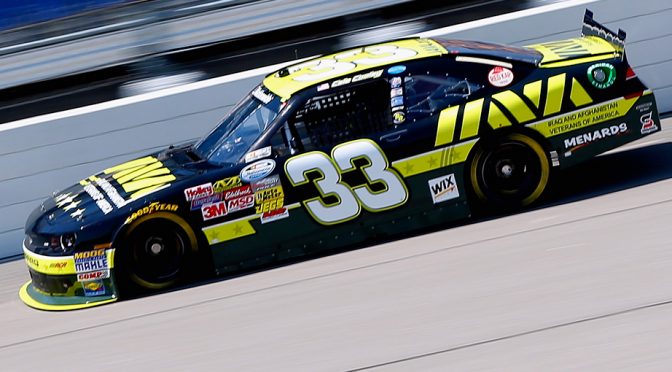
29 33 * Cale Conley(i) IAVA Chevrolet
30 93 Mike Harmon JGL Racing Dodge
31 9 Chase Elliott # Napa Auto Parts Chevrolet
32 5 * Kasey Kahne(i) Great Clips Chevrolet
33 31 Dylan Kwasniewski # AccuDoc Solutions/Rockstar Chevrolet
34 40 Matt Dibenedetto Curtis Key Plumbing Chevrolet
35 23 Richard Harriman Rick Ware Racing Chevrolet
36 46 * Ryan Ellis Curtis Key Plumbing Chevrolet
37 72 * Carl Long Crash Claims R Us Chevrolet
38 22 Ryan Blaney(i) Hertz Ford
39 51 Jeremy Clements Allsouthelectric.com/RepairableVehicles.com Chevrolet
40 84 * Chad Boat # Billy Boat Performance Exhaust/CorvetteParts.net Chevrolet

* Required to qualify on time, (i) Ineligible for driver points in this series

MORE:

READ: Latest
NASCAR news

WATCH: Latest
NASCAR video

PLAY: NASCAR
Fantasy Live

FOLLOW LIVE: Get
RaceView

Catch up quickly before Saturday’s running of the EnjoyIllinois.com 300

RELATED: Play NASCAR Fantasy Live

What: Fourth annual EnjoyIllinois.com 300
Where: Chicagoland Speedway, Joliet, Illinois
When: Saturday, July 18
TV/Radio: ESPN2, MRN, SiriusXM NASCAR Radio (8:30 p.m. ET)
Distance: 200 laps; 300 miles

Pit road speed: 45 mph
Caution car speed: 55 mph
Fuel window: 74 laps

Last July’s race winner
Joey Logano, Team Penske No. 22 Ford

Front row
1. Brian Scott, Richard Childress Racing No. 2 Chevrolet (177.807 mph)
2. Ty Dillon, Richard Childress Racing No. 3 Chevrolet (177.643 mph)

Fastest in practice
First practice:
Brian Scott, Richard Childress Racing No. 2 Chevrolet (172.806 mph)
Second practice: Cale Conley, Richard Childress Racing No. 33 Chevrolet (175.262mph)

FULL SERIES COVERAGE

He said it: "Nah, I’m not nervous. Not at all." — Erik Jones, 18, who will make his NASCAR Nationwide Series debut.

He said it II: "This is a cool stretch. A couple years ago I ran 28 races in 30 days or something, so I’ve been really busy before." — Kyle Larson, who will race in four NASCAR national series races in a span of eight days. 

The favorite?: The No. 54 Joe Gibbs Racing Toyota won here last September, and although the car is back, the driver is not. Kyle Busch is off this weekend, but don’t expect any sort of letup from this team or part-time Joe Gibbs Racing driver Sam Hornish Jr. In four series starts this year, Hornish has one win and three top-fives. His average Chicagoland finish of 4.8 over the past nine years is the best in the series.

Dillon’s day?: Ty Dillon is the only driver in the Nationwide Series to have finished in the top 20 of all 17 races this season. Can that streak continue? His speeds Friday would indicate yes, but the No. 3 team is searching for more. 

Smith playing catch-up: Regan Smith’s No. 7 team hasn’t had the same success on intermediate tracks that his JR Motorsports teammates have enjoyed. Admitting that was an area on which he could improve, Smith finished 15th and 17th in Friday’s two practices. 

Welcome, Cup friends: The spotlight is on the NASCAR Nationwide Series this week with the Sprint Cup drivers on an off week. Well, most of the Sprint Cup drivers. Kasey Kahne and Kyle Larson are in the field, and the NNS regulars are happy to see them.

On cloud nine: The past nine Nationwide Series races have yielded a different winner, a streak stretching back to Elliott Sadler’s win at Talladega on May 3.

Former Chicagoland winners in the field
Elliott Sadler (1)

MORE:

READ: Latest
NASCAR news

WATCH: Latest
NASCAR video

PLAY: NASCAR
Fantasy Live

FOLLOW LIVE: Get
RaceView

No. 3 driver looks for first win to unleash a surge of strong results

RELATED: Play NASCAR Fantasy Live

JOLIET, Ill. — The trio of Regan Smith, Elliott Sadler and Chase Elliott have jostled for positioning at the top of the NASCAR Nationwide Series standings over the past six weeks, like jockeys leading their horses down the backstretch at Churchill Downs. 

Their combined four wins and 16 top-fives have allowed for separation from the pack, but not enough to keep someone lurking on the outside from catching up.

FULL SERIES COVERAGE

Such is the situation Ty Dillon faces in the second half of the NASCAR Nationwide Series season, starting Saturday night at Chicagoland Speedway

The No. 3 Richard Childress Racing team can’t match the production of the top three guys in the points standings, yet Dillon remains in the championship picture due to a steadiness no other driver can equal. He’s 34 points behind leader Smith, 26 behind second-place Sadler and 21 behind fellow Sunoco Rookie of the Year contender Elliott.

"I think it’s very much a four-car race for the championship," Dillon said in his hauler prior to Friday’s opening practice. "We’re right up in it. We haven’t shown our full potential yet. Hopefully we hit it this second half of the season. We have the opportunity to get up there and make some things happen."

Dillon has zero top-fives this season and 11 top-10s in 17 races. He is one of just two drivers in the top 10 of the points standings without a top-five.

That’s the bad news, though. There’s some good as well. Dillon’s average finish this year of 10.2 is nearly the same as Elliott (9.6), and the 22-year-old driver of the No. 3 is the lone driver in the series to have finished inside the top 20 in every race.

"I think week in and week out, we’ve gotten stronger and stronger," Dillon said. "This can be a good weekend for us. It’s only a matter of time before we break through and get a top-five and then hopefully get our first win of the year."

He’s got a shot Saturday night in the EnjoyIllinois.com 300. At similar 1.5-mile tracks earlier this year, Dillon was fast in Texas and had among the best cars in the field at Kentucky.

His setup this week mirrors what his team used in the Bluegrass State, where Dillon drove his way into the top five on multiple occasions only to fall back in the field due to a couple of pit-road mishaps.

At the very least, he’s got speed this weekend. That much was evident when Dillon jumped to the top of the leaderboard during final practice, finishing the 90-minute session third. Is it enough for his first top-five this year? Maybe. Whenever that comes, though, Dillon thinks the dam would burst.

And just in time for the stretch run.

"I think it’ll take a little bit of pressure off our team, and we’ll be able to relax and really focus after the burden of getting the first win is off our chest," Dillon said. "I think we’ll be able to take off as a team and really do some good things."

MORE:

READ: Latest
NASCAR news

WATCH: Latest
NASCAR video

PLAY: NASCAR
Fantasy Live

FOLLOW LIVE: Get
RaceView