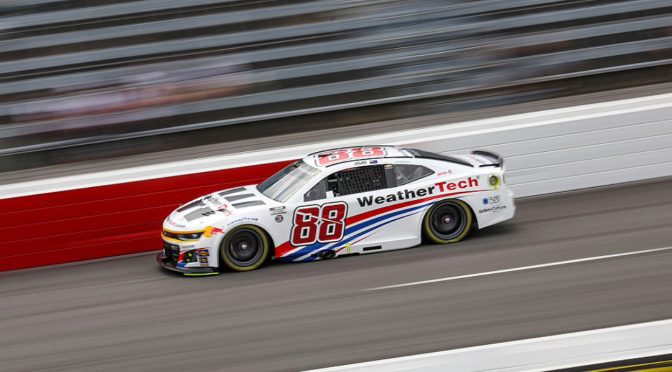
NORTH WILKESBORO, N.C. — A flawless entry into pit road during Friday’s time trials propelled Brad Keselowski to the pole position for Sunday’s NASCAR All-Star Race at North Wilkesboro Speedway (8 p.m. ET on FS1, MRN Radio and SiriusXM NASCAR Radio).
In a unique qualifying format that features three laps and a mandatory four-tire pit stop, Keselowski and his team posted a total time of 87.363 seconds (77.264 mph) to earn the top starting spot both for Saturday’s first of two heats and for the $1-million-to-win main event on Sunday.
RELATED: Live lineup tracker | At-track photos
In a major upset during the All-Star Open qualifying session that preceded time trials for drivers already qualified for the All-Star Race, Michael McDowell’s over-the-wall crew, composed of ex-football players, won the $100,000 Pit Crew Challenge. The No. 71 Spire Motorsports crew fired off a stop in 12.587 seconds, and that time stood up against the 20 All-Star crews that followed. Daniel Suárez’s crew came closest with a time of 12.600 seconds.
For Keselowski, the pole was a welcome high point in a season that has been difficult so far. He’s currently 33rd in the Cup Series standings, with no top 10s and five DNFs (did not finish) through 12 races.
“This event, this format pushes you to your limits, from a driver perspective, a team perspective, pit crew,” Keselowski said. “I stuck my part — I knew I stuck the entry (to pit road). The exit, I was like, ‘Maybe I left a little on the table’ — it’s really hard to tell.
“But it all came together for an excellent run. The pit crew, they didn’t try to be heroes. They just gave me a really solid stop. (Crew chief) Jeremy Bullins and the team gave me a car that was pretty fast. They just gave me the ball and said, ‘Go play,’ and that’s what we did.”
Christopher Bell and his No. 20 Joe Gibbs Racing team, the two-time defending winners of the Pit Crew Challenge, qualified second at 76.485 mph (88.253 seconds). Slight trouble on the left-front tire cost Bell’s crew a chance for a third straight $100,000 bonus.
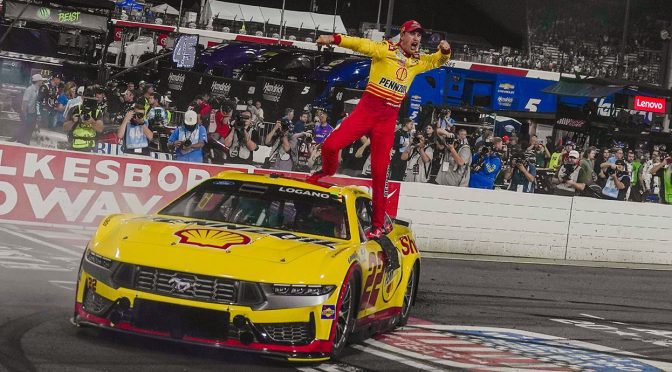
Alex Bowman was third-fastest, followed by Chase Briscoe, William Byron and defending winner and reigning NASCAR Cup Series champion Joey Logano.
Though Keselowski is guaranteed to start on the pole for the All-Star Race, Friday’s qualifying session set the order for the two heat races on Saturday. The first heat establishes the starting order for the inside row in the All-Star Race, while the second heat orders the outside row.
RELATED: Full All-Star schedule
Austin Dillon, Denny Hamlin, Tyler Reddick and Chase Elliott were seventh- through 10th-fastest, respectively.
Using his road racing prowess to get on and off pit road in the unique qualifying format, New Zealand’s Shane van Gisbergen won the pole position for the NASCAR All-Star Open, which precedes the All-Star Race on Sunday night.
The top two finishers in the Open transfer to the 21st and 22nd starting positions in the main event.
MORE: Full Open lineup
In his three-lap attempt with a four-tire pit stop, van Gisbergen recorded a time of 88.685 seconds (75.112 mph). That was good enough to edge Carson Hocevar (75.942 mph) for the top starting spot in the Open by 0.199 seconds.
Van Gisbergen’s total time was also 1.109 seconds faster than Logano’s pole-winning time for last year’s All-Star Race, which Logano won decisively, leading 199 of 200 laps.
“I did a decent job getting in and out of pit road,” Van Gisbergen said, “but my guys did a great pit stop, too (13.175 seconds)… It’s been difficult on the left-handed tracks, but I feel like we are getting better, though.
“I guess my actual lap was good, too, so things are starting to look up.”
Noah Gragson was third-fastest among Open qualifiers at 75.338 mph. Michael McDowell was fourth in time trials, thanks in part to his pit crew, which won the Pit Crew Competition and $100,000 bonus. Crew members on McDowell’s team are Dax Hollifield III (jackman), Max Marsh (front tire changer), Ty Boeck (rear tire changer), Luke Bussel (tire carrier) and Brandon Chapman (fueler).
RELATED: Hear from winning pit crew
Practice recap
All-Star racers and Open hopefuls shared the track for a combined 45-minute practice session Friday afternoon with Tyler Reddick pacing the 38-car group with a best speed of 123.640 mph.
Chase Elliott (123.403 mph), Bubba Wallace (123.376 mph), Christopher Bell (123.186 mph) and Erik Jones (123.146 mph) completed the top five. Wallace and Jones are not yet locked into Sunday’s All-Star Race but ranked fastest of the Open cars on single-car speed. Ross Chastain and Brad Keselowski, sixth and seventh respectively overall, were the next fastest cars locked into the All-Star Race.
Elliott scrubbed the wall between Turns 1 and 2 late in Friday’s session but avoided any significant damage. Joey Logano, the defending Cup Series champion and 2024 winner of the All-Star exhibition, posted the 10th-fastest lap in practice. Ryan Blaney, the 2022 All-Star Race winner, was 17th on the leaderboard ahead of Denny Hamlin in 18th.
In 10-lap averages, Reddick was fastest at 122.116 mph over Christopher Bell, Keselowski, Kyle Busch and Josh Berry, all All-Stars this weekend. The fastest Open car in 10-lap averages was Bubba Wallace in 11th at 121.328 mph. Below are the full results for best single-lap speeds in Friday’s practice session:
| POSITION | CAR | DRIVER | Time | Speed |
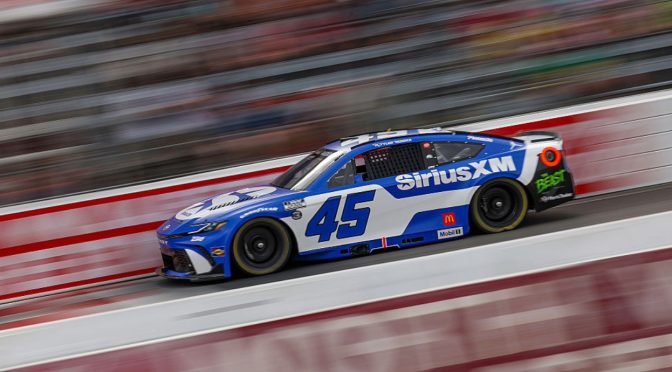
| 1 | 45 | Tyler Reddick | 18.198 | 123.64 |
| 2 | 9 | Chase Elliott | 18.233 | 123.403 |
| 3 | 23 | Bubba Wallace | 18.237 | 123.376 |
| 4 | 20 | Christopher Bell | 18.265 | 123.186 |
| 5 | 43 | Erik Jones | 18.271 | 123.146 |
| 6 | 1 | Ross Chastain | 18.274 | 123.126 |
| 7 | 6 | Brad Keselowski | 18.29 | 123.018 |
| 8 | 24 | William Byron | 18.294 | 122.991 |
| 9 | 8 | Kyle Busch | 18.307 | 122.904 |
| 10 | 22 | Joey Logano | 18.313 | 122.864 |
| 11 | 21 | Josh Berry | 18.32 | 122.817 |
| 12 | 54 | Ty Gibbs | 18.321 | 122.81 |
| 13 | 2 | Austin Cindric | 18.327 | 122.77 |
| 14 | 34 | Todd Gilliland | 18.349 | 122.622 |
| 15 | 99 | Daniel Suarez | 18.361 | 122.542 |
| 16 | 42 | J.H. Nemechek | 18.364 | 122.522 |
| 17 | 12 | Ryan Blaney | 18.373 | 122.462 |
| 18 | 11 | Denny Hamlin | 18.39 | 122.349 |
| 19 | 35 | Riley Herbst | 18.4 | 122.283 |
| 20 | 10 | Ty Dillon | 18.416 | 122.176 |
| 21 | 7 | Justin Haley | 18.42 | 122.15 |
| 22 | 60 | Ryan Preece | 18.421 | 122.143 |
| 23 | 47 | Ricky Stenhouse Jr. | 18.423 | 122.13 |
| 24 | 5 | Justin Allgaier | 18.434 | 122.057 |
| 25 | 19 | Chase Briscoe | 18.437 | 122.037 |
| 26 | 4 | Noah Gragson | 18.44 | 122.017 |
| 27 | 77 | Carson Hocevar | 18.441 | 122.011 |
| 28 | 88 | Shane Van Gisbergen | 18.447 | 121.971 |
| 29 | 38 | Zane Smith | 18.471 | 121.813 |
| 30 | 17 | Chris Buescher | 18.476 | 121.78 |
| 31 | 16 | AJ Allmendinger | 18.487 | 121.707 |
| 32 | 48 | Alex Bowman | 18.5 | 121.622 |
| 33 | 71 | Michael McDowell | 18.512 | 121.543 |
| 34 | 51 | Harrison Burton | 18.529 | 121.431 |
| 35 | 3 | Austin Dillon | 18.549 | 121.3 |
| 36 | 41 | Cole Custer | 18.58 | 121.098 |
| 37 | 15 | Cody Ware | 18.682 | 120.437 |
| 38 | 66 | Chad Finchum | 19.212 | 117.114 |
Contributing: Staff report