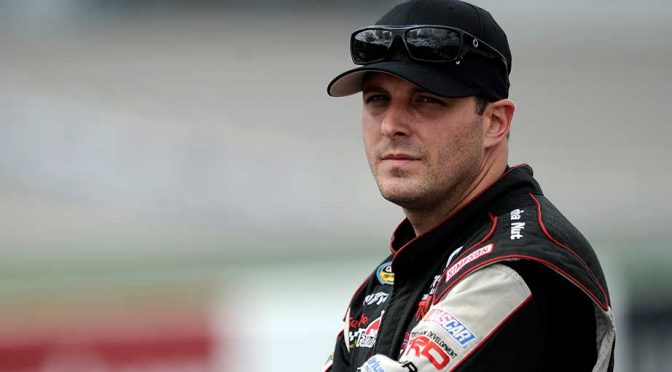
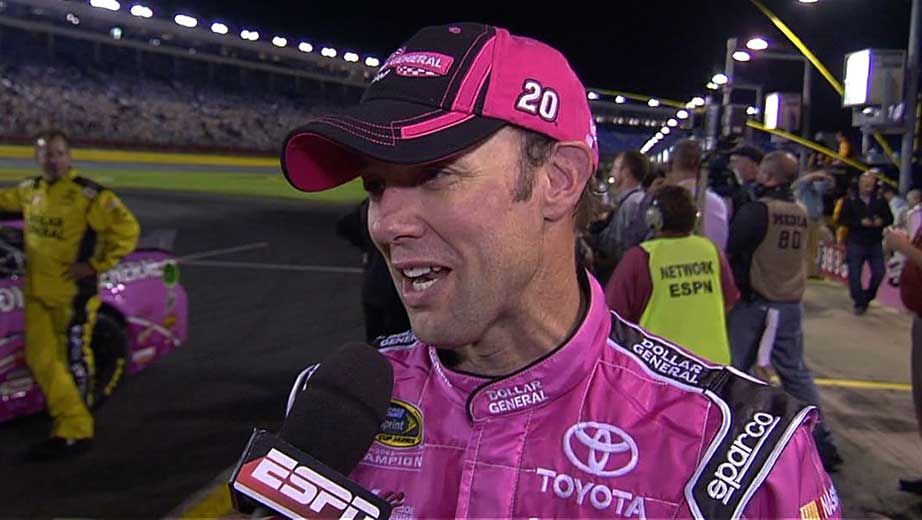
Matt Kenseth will qualify Saturday Oct. 19 at 12:10 p.m. ET, FOX Sports 2

RELATED: Full Chase for the NASCAR Sprint Cup coverage

# Car Driver Team
1 51 Justin Allgaier(i) Brandt Chevrolet
2 93 Travis Kvapil Dr Pepper Toyota
3 98 Michael McDowell Phil Parsons Racing Ford
4 14 Austin Dillon(i) Bass Pro Shops / Mobil 1 Chevrolet
5 12 Sam Hornish Jr.(i) SKF Ford
6 10 Danica Patrick # GoDaddy Breast Cancer Awareness Chevrolet
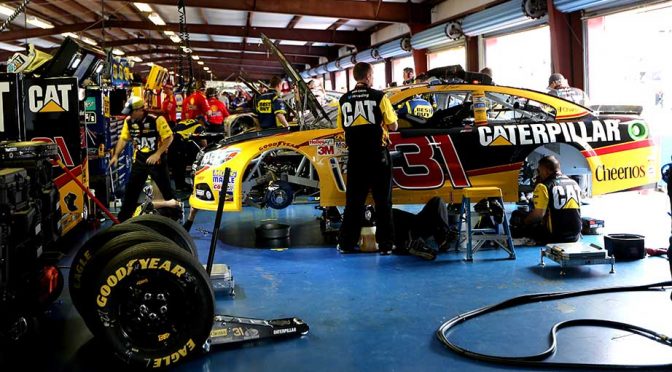
7 31 Jeff Burton Caterpillar Chevrolet
8 33 Landon Cassill(i) ERC Acquired TMone Chevrolet
9 38 David Gilliland Long John Silver’s Ford
10 42 Juan Pablo Montoya Target Chevrolet
11 24 Jeff Gordon Axalta Chevrolet
12 29 Kevin Harvick Jimmy John’s Chevrolet
13 17 Ricky Stenhouse Jr. # Nationwide Insurance Ford
14 9 Marcos Ambrose DeWalt Ford
15 30 Cole Whitt(i) Black Clover Toyota
16 7 Dave Blaney Tommy Baldwin Racing Chevrolet
17 88 Dale Earnhardt Jr. Mountain Dew / XBox One Chevrolet
18 83 David Reutimann Burger King / Dr Pepper Toyota
19 21 Trevor Bayne(i) Motorcraft / Quick Lane Tire & Auto Center Ford
20 47 Bobby Labonte Scott Products Toyota
21 99 Carl Edwards Subway Ford
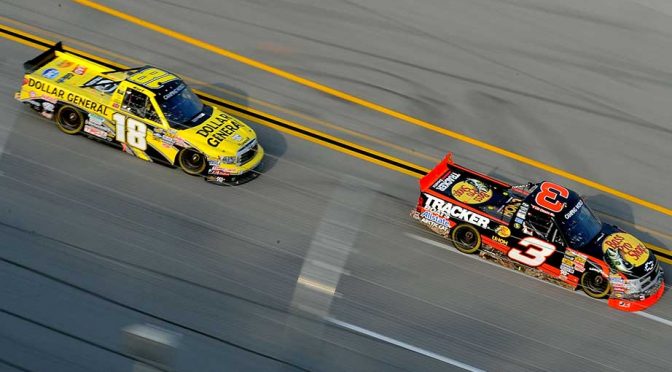
22 18 Kyle Busch M&M’s Halloween Toyota
23 40 Tony Raines(i) Hillman Racing Chevrolet
24 39 Ryan Newman WIX Filters Chevrolet
25 48 Jimmie Johnson Lowe’s Chevrolet
26 13 Casey Mears GEICO Ford
27 55 Michael Waltrip Aaron’s Dream Machine Toyota
28 5 Kasey Kahne Farmers Insurance Chevrolet
29 34 David Ragan Safecar.gov Ford
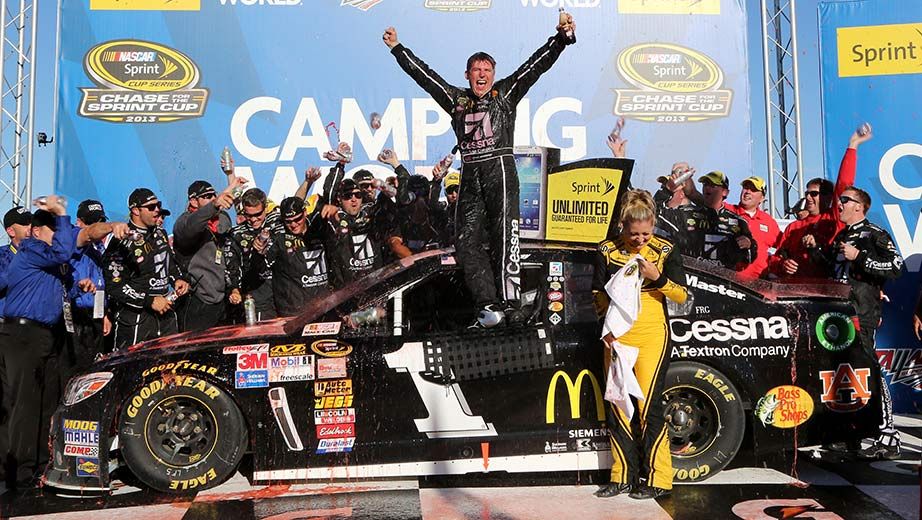
30 1 Jamie McMurray Cessna Chevrolet
31 35 Josh Wise(i) A&W All American Food Ford
32 2 Brad Keselowski Miller Lite Ford
33 22 Joey Logano Shell Pennzoil Ford
34 78 Kurt Busch Furniture Row / Wonder Bread Chevrolet
35 11 Denny Hamlin FedEx Freight Toyota
36 32 Terry Labonte C&J Energy Services Ford
37 16 Greg Biffle Scotch Blue Ford
38 36 JJ Yeley Golden Corral Chevrolet
39 27 Paul Menard Menards / Duracell Chevrolet
40 56 Martin Truex Jr. NAPA Auto Parts Toyota
41 43 Aric Almirola Charter Ford
42 87 Joe Nemechek(i) NEMCO – JRR Toyota
43 15 Clint Bowyer 5-hour Energy Toyota
44 20 Matt Kenseth Home Depot Let’s Do This Toyota
* Required to qualify on time, (i) Ineligible for driver points in this series

MORE:

READ: Smoke itching
to return

READ: ‘Dega: Wild Card
or ace up the sleeve?

WATCH: 2014 Cup Series
schedule release

READ: ‘Dega dynamics
present challenges

Ross Chastain will qualify Friday Oct. 18 at 5:10 p.m. ET, FOX Sports 2

# Trk Driver Team
1 84 Mike Harmon(i) WCIParts.com Chevrolet
2 10 * Jennifer Jo Cobb KOMA Unwind RAM
3 50 * Danny Efland(i) Stacker2 Energy Shot Chevrolet
4 93 * Chris Jones RSS Racing Chevrolet
5 57 Norm Benning WattsTruckCenter.com / Car-Mate Trailers Chevrolet
6 63 * Scott Stenzel Mittler Brothers Machine & Tool Ford
7 82 * Sean Corr Roush Yates Performance Products Ford
8 35 * Mason Mingus 811 Call Before You Dig Chevrolet
9 68 * Clay Greenfield ClutchDefense.com RAM
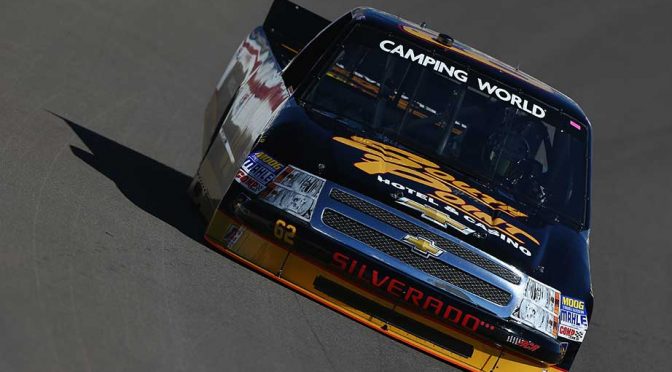
10 62 Brendan Gaughan South Point Hotel & Casino Chevrolet
11 20 * Parker Kligerman(i) BRG Motorsports Toyota
12 24 Brennan Newberry # Qore-24 Chevrolet
13 1 * Timmy Hill(i) Pocketfinder.com Chevrolet
14 6 * Justin Lofton Lofton Cattle Chevrolet
15 75 * Caleb Holman Food Country USA Chevrolet
16 27 * Jeff Agnew West Virginia Coal Association Chevrolet
17 39 Ryan Sieg Pull-A-Part Used Auto Parts Chevrolet
18 18 Joey Coulter Darrell Gwynn Foundation Toyota
19 83 * Chris Fontaine Glenden Enterprises Toyota
20 99 Bryan Silas SANY / Bell Trucks America Ford
21 4 Jeb Burton # Arrowhead / Kangaroo Express Chevrolet
22 32 Miguel Paludo Duroline Chevrolet
23 7 John Wes Townley Zaxby’s Toyota
24 07 Chris Cockrum Advanced Communications Group Toyota
25 54 Darrell Wallace Jr. # Camping World / Good Sam Toyota
26 88 Matt Crafton Menards / Slim Jim Toyota
27 51 Kyle Busch(i) ToyotaCare Toyota
28 81 David Starr BYF.org / Steely Lumber Toyota
29 8 Max Gresham Made in USA Chevrolet
30 98 Johnny Sauter Carolina Nut / Curb Records Toyota
31 60 Dakoda Armstrong WinField Chevrolet
32 9 Ron Hornaday Jr. Smokey Mountain Chevrolet
33 3 Ty Dillon Bass Pro Shops / Ducks Unlimited Chevrolet
34 31 James Buescher Rheem Chevrolet
35 17 Timothy Peters Parts Plus Toyota
36 77 German Quiroga # NET10 Wireless / OtterBox Toyota
37 29 Ryan Blaney # Cooper Standard Ford
38 19 Ross Chastain Carbon Forged Reese Towpower / Advance Auto Parts Ford
* Required to qualify on time, (i) Ineligible for driver points in this series

MORE:

READ: Smoke itching
to return

READ: ‘Dega: Wild Card
or ace up the sleeve?

WATCH: 2014 Cup Series
schedule release

READ: ‘Dega dynamics
present challenges

Live: Camping World Truck Series qualifying 5:10 p.m. ET

MORE:

READ: Smoke itching
to return

READ: ‘Dega: Wild Card
or ace up the sleeve?

WATCH: 2014 Cup Series
schedule release

READ: ‘Dega dynamics
present challenges

Watch: Sprint Cup GarageCam, 2 p.m. ET

MORE:

READ: Smoke itching
to return

READ: ‘Dega: Wild Card
or ace up the sleeve?

WATCH: 2014 Cup Series
schedule release

READ: ‘Dega dynamics
present challenges

Live: Camping World Truck Series practice on Friday, Oct. 18

MORE:

READ: Smoke itching
to return

READ: ‘Dega: Wild Card
or ace up the sleeve?

WATCH: 2014 Cup Series
schedule release

READ: ‘Dega dynamics
present challenges

Get event times, TV information and more as NASCAR action heats up in Talladega

This weekend, the NASCAR Sprint Cup Series and the NASCAR Camping World Truck Series are at Talladega Superspeedway this weekend.

The NASCAR Nationwide Series is idle this weekend.

All times ET

RELATED: Full coverage of the Chase for the NASCAR Sprint Cup

FRIDAY, OCTOBER 18:

ON TRACK
— 10:30 a.m.-12:30 p.m. ET, NASCAR Camping World Truck Series final practice, FOX Sports 1
 (Get results)
— 2:30-3:15 p.m. ET, NASCAR Sprint Cup Series practice, FS1
 (Get results)
— 4-5 p.m. ET, NASCAR Sprint Cup Series final practice, FS 1
 (Get results)
— 5:10 p.m ET, NASCAR Camping World Truck Series Keystone Light Pole Qualifying, Fox Sports 2 (Get results)

PRESS CONFERENCES:
WATCH LIVE
— 10 a.m. ET Richard Childress Racing announcement
— 12 p.m. ET Talladega/Wonder Bread annoucement
— 12:15 p.m. ET David Ragan
— 12:45 p.m. ET Danica Patrick announcement
— 1:30 p.m. ET Matt Kenseth
— 1:45 p.m. ET Dale Earnhardt Jr.
— 6:15 p.m. ET Post-NCWTS Qualifying

GarageCam
WATCH LIVE
Camping World Truck Series: 10 a.m. ET
Sprint Cup: 2 p.m. ET

BUY TICKETS
 FOR TALLADEGA

Click here to purchase Sprint Cup tickets.

Click here to purchase Camping World Truck Series tickets.

SATURDAY, OCTOBER 19:

ON TRACK
— 12:10 p.m. ET, NASCAR Sprint Cup Series Coors Light Pole Qualifying, FS2 (Lineup)

— 4 p.m. ET, fred’s 250 powered by Coca-Cola (94 laps, 250.4 miles), FS1 on air at 3:30 p.m. ET (Get results)

PRESS CONFERENCES:
WATCH LIVE
— 11:40 a.m. ET Talladega Announcement
— 2:30 p.m. ET Post-NSCS qualifying
— 6:30 p.m. ET Post-NCWTS race

BUY TICKETS FOR TALLADEGA

Click here to purchase Sprint Cup tickets.

Click here to purchase Camping World Truck Series tickets.

SUNDAY, OCTOBER 20:

ON TRACK
— 2 p.m. ET, Sprint Cup Series Camping World RV Sales 500 (188 laps, 500.08 miles), ESPN on air at 1 (Get results)

PRESS CONFERENCES:
WATCH LIVE
— 5:30 p.m. ET Post-NSCS race

MORE:

Note: Links will be added as information becomes available.

Sprint Cup: Season schedule | Standings | Entry list | Qualifying order | Lineup | Pit stall assignments | Results

Nationwide: Season schedule | Standings
Camping World Truck: Season schedule | Standings | Entry list | Qualifying order | Lineup | Pit stall assignments | Results

MORE:

READ: McMurray rules
with late Talladega surge

WATCH: Final Laps:
McMurray wins; Dillon spins

READ: Points lead
changes hands

WATCH: Busch misses
pit stall

After giving up the lead to Crafton, Sauter looks to improve his standings at Talladega

With five races remaining in the 2013 season and 103 points behind leader Matt Crafton, Johnny Sauter’s chances at a championship this year are slim. That, however, shouldn’t slow him down from trying to finish the season in the same fashion he started it and carry his late-season success over into 2014.

The NASCAR Camping World Truck Series will be at Talladega Superspeedway this weekend for Saturday’s fred’s 250 Powered by Coca-Cola, the second restrictor-plate race of the year. Sauter, who currently ranks eighth in the standings, started the 2013 season off with a bang by winning the season-opening restrictor-plate race at Daytona and then following that up with a win at Martinsville in the second race of the year.

FULL SERIES COVERAGE

View all articles
View all videos
View all photos

At Daytona, he held off a hard-charging Kyle Busch. He followed those victories up with fourth- and fifth-place finishes at Rockingham and Kansas. Since then, he’s cooled down a bit.

After the fourth race he gave up his spot atop the standings to Crafton, who has held it since. Sauter finished outside the top 10 in seven of the next 10 events dropping him from second to 10th in points twice (after Michigan and once again after Canadian Tire Motorsport Park) before rebounding with three consecutive top-10 finishes in the last three races.

This weekend, he will be looking for another strong finish at the 2.66-mile Alabama track. In four series starts, he’s never finished lower than 15th. His best finish came in this event last season where he finished second to first-time series winner Parker Kligerman. Sauter’s first three trips there resulted in finishes of 14th, third and 15th.

MORE:

READ: Smoke itching
to return

READ: ‘Dega: Wild Card
or ace up the sleeve?

WATCH: 2014 Cup Series
schedule release

READ: ‘Dega dynamics
present challenges

Mammoth track has seen speed records fall, legendary Earnhardt showings

It’s a myth, a legend, a race track and an enigma all rolled into one.

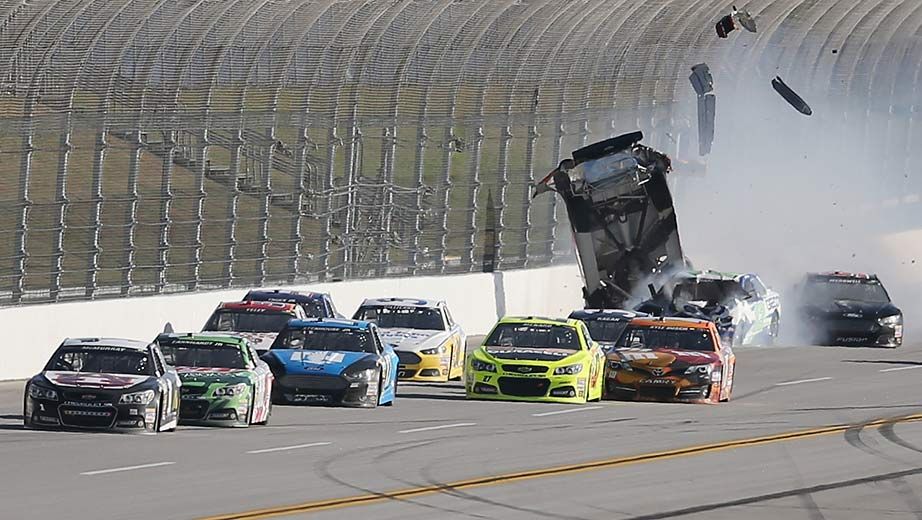
Just a mention of Talladega Superspeedway‘s name conveys images and memories that so many other venues find difficult to match. It’s always been fast, it’s sometimes been controversial and it’s often presented moments that have led spectators to dig their fingernails into the armrests of their seats — if they’re even sitting in them at all. That big 2.66-mile race track in the Alabama hills is a beast unto itself, a track that seems capable of generating physical forces unseen anywhere else.

Before the advent of restrictor plates, it was probably the fastest race track on the planet. Even now, it can force you to hold your breath for 188 laps. It sends cars charging out of the turn four-wide and eight deep, in a pack so dense that a driver could probably touch the vehicle next to him if he dared stick his arm out of the window. The sight, the sound, the hair-raising experience — Talladega is simply unlike any place else on earth.

And goodness has it had its share of moments, which have often epitomized the risk and reward of auto racing at the same time. From surprise winners to record-breakers to incidents that changed the sport forever, Talladega has seen it all. Sunday’s pivotal Chase for the NASCAR Sprint Cup event promises to produce another heart-in-your-throat finish decided by a fraction of a second.

Until then, here are the top 10 moments at Talladega Superspeedway.

10. Bouchard’s stunner, August 1981

Talladega has hatched its share of surprise winners over the years — just look at David Ragan earlier this season, or Brad Keselowski back in his Phoenix Racing days — but none stand out more than Ron Bouchard, who shocked NASCAR’s greats in just his 11th start on the sport’s premier circuit. Entering the tri-oval for the final time, Darrell Waltrip and Terry Labonte were side-by-side. Labonte went high to pass, and Waltrip went high to squeeze him toward the wall. Neither of them noticed the No. 47 Buick charging along the bottom, making it three-wide. By the time they did, it was too late. Bouchard won in a photo finish to claim what would be the lone victory of his Cup Series career.

9. Everything that could go wrong, May 1981

The previous event that season featured a winner somewhat more predictable, a member of the Alabama Gang prevailing on his home track. But the road Bobby Allison took to Victory Lane that day was anything but conventional. Relationships on his race team were strained to the point where he hardly visited his own shop. Rule changes led his team to deem the Pontiac they had been using less than competitive, and switch to a Buick the week of the Talladega race. And then there was the event itself, where Allison lost a rear bumper after getting hit by Morgan Shepherd, lost a lap with a flat tire, and suffered a cracked windshield in an accident. Somehow, he overcame it all and outraced Buddy Baker by a car length to win.

8. Record 88 lead changes, April 2010

Talladega has always been known as a record-breaking race track, but not all of those marks involve raw speed. That was certainly the case in the spring of 2010, at the height of the brief tandem drafting era, when Kevin Harvick edged Jamie McMurray at the line to win a race that featured 88 lead changes, the most ever at any track. The previous mark had been 75, set at Talladega in May of 1984. There were also 29 different leaders, another record, breaking the previous mark of 28 set — where else — at Talladega in 2008. To top it off, the margin of victory was one-hundredth of a second. It was so good the field did it again a year later, with Jimmie Johnson nipping Clint Bowyer by two-thousandths of a second in another race that featured 88 lead changes.

7. Brickhouse and the boycott, Sept. 1969

Talladega has been polarizing from its very first race weekend, when a number of top drivers were hesitant to compete at a facility then called Alabama International Motor Speedway. The place was bigger and faster than anything they’d ever seen, and there were real concerns that tires wouldn’t hold up under the tremendous speeds the track produced. So they boycotted the race, even forming a driver’s association — the closest thing the sport has ever seen to a union — that would prove to be short-lived. NASCAR founder Bill France Sr. filled the field with drivers from a secondary circuit, and the show went on as scheduled. Richard Brickhouse claimed what would be his lone NASCAR victory, and the authority of the sanctioning body would not be challenged again.

6. Breaking the 200 mph barrier, May 1982

At its essence, Talladega has always been about pure speed. The 200 mph barrier was actually broken there fairly early on, in a test by Buddy Baker in 1970, one year after the facility opened. But fans wouldn’t see that magic number approached officially on a race weekend until 1982, when Benny Parsons qualified on the pole at 200.176 mph. The race came down to a four-man scramble between Parsons, Waltrip, Labonte and Kyle Petty, and the finish was electric — Parsons led on the final lap, but he left the high lane open as the cars barreled through the final turn, and Waltrip surged past to win. Parsons faded to third, but his qualifying lap had set a new standard at NASCAR’s biggest race track, and the speeds would only go higher from there.

5. Four in a row, April 2003

There was a time in the early 2000s when no team was better at restrictor-plate tracks than Dale Earnhardt Inc., and no driver was better at Talladega than Dale Earnhardt Jr. The culmination of it all came in the spring of 2003, when Earnhardt started at the rear of the field due to a last-minute engine change, drove through the grass to avoid a 27-car wreck that damaged his vehicle’s front end, and used a controversial pass for the lead to become the first driver ever to win four straight races at NASCAR’s biggest track. Some claimed the No. 8 car was below the yellow line when it overtook Matt Kenseth for the lead. NASCAR determined otherwise, and Earnhardt celebrated once again in Victory Lane with 160,000 of his closest friends.

4. 212.809 mph, May 1987

After Parsons broke down the 200 mph barrier at Talladega in 1982, pole speeds would continue to rise — to over 202 mph in 1984, to over 209 mph in 1985, to finally the apex: 212.809 mph, a number stripped across countless headlines after Bill Elliott reached it in qualifying for the track’s spring event in 1987. Stock cars at Talladega were beginning to approach the speeds of open-wheel cars at Indianapolis, a concept both dizzying and white-knuckle all at the same time. But the line between fast and too fast had been crossed, as was evident on the 21st lap of the race when Allison’s car turned, lifted off and sailed into the catchfence. The crash led NASCAR to implement restrictor plates, and Elliott’s pole speed, still a record, stands as a monument to the limits of man and machine.

3. Beating the heat, Aug. 1977

Sometimes, Talladega could be too much for even one of its native sons. That was certainly the case in the mean summer of 1977, when the mercury on race day approached 100 degrees and the temperature in the car on the race track was considerably more than that. Not even Donnie Allison, charter member of the Alabama Gang and native of Hueytown, was immune. In the late stages of the event, Allison started to feel faint. He chugged soda during a pit stop, but to no avail. The heat had him, so with 24 to go he climbed out and turned his Matador over to Waltrip, whose engine had blown earlier in the event. A broken water cooler on Skip Manning’s car with three laps left helped Waltrip secure a victory that technically went to Allison — although to this day, ‘ol D.W. will argue otherwise.

2. Awesome Bill, May 1985

Though it would take three more seasons for him to claim the championship, the year that truly gave Bill Elliott his nickname was 1985. That was when he won three of the sport’s four biggest races to earn the first Winston Million, a $1 million bonus from the circuit’s title sponsor. But to get there, he had to pull off something truly awesome — win Talladega after falling two laps down with an oil leak. The No. 9 car began belching smoke, and the pit stop to fix the problem took nearly two minutes. With no wave-around or free pass, Elliott had to come back the hard way — using raw speed. He had plenty of that, as he showed in winning the pole, and would prove again in record-setting fashion two years later. Turning laps about 5 mph faster than everyone else, Elliott gradually made up the difference. In the end only three cars remained on the lead lap. One of them belonged to Elliott, who won by more than a second in a comeback that was awesome, indeed.

1. The legend grows, Oct. 2000

To this day, people wonder how he did it. Yes, the draft on a restrictor-plate track is capable of slinging cars from the back of the field to the front, but on that fall day in 2000 there just seemed too many vehicles ahead of Dale Earnhardt, and too few laps remaining. On what would prove the final restart with 15 to go, the black No. 3 car was mired in 15th place. With 11 left, he had fallen back to 18th. With eight remaining, he was still in 15th. But Earnhardt hooked up with Kenny Wallace in the draft, and the two began an amazing race up through the pack, one that still seems impossible today. With two laps left, seemingly out of nowhere, he was contending for the lead. At the white flag, he had it.

From there it was over, and the black No. 3 streaked to the checkereds. The lead paragraph in a Charlotte newspaper account the next day summed it up: "The legend grows." It was Earnhardt’s 10th victory at Talladega and the 76th of his career, and easily among the most memorable in either category. Five months later came that dark day at Daytona, a blue-sky afternoon that began so much pain and sorrow. It all added more significance to that previous autumn in Talladega, where Earnhardt claimed what would be his final race victory in a manner only the Intimidator could.

MORE:
READ: Smoke itching
to return

READ: ‘Dega: Wild Card
or ace up the sleeve?

WATCH: 2014 Cup Series
schedule release

READ: ‘Dega dynamics
present challenges

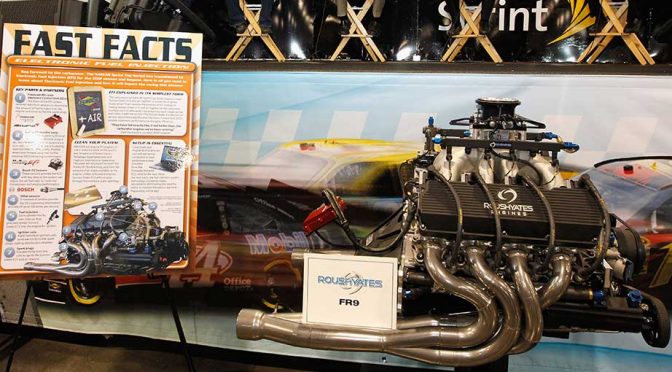
Electronic fuel injection marks NASCAR Sprint Cup Series milestone

When Dale Earnhardt Jr. crossed the start/finish line to lead Lap 34 last Saturday at Charlotte Motor Speedway, there was no special fanfare beyond the standing ovation Earnhardt gets every time he leads a lap.

Race control didn’t stop the action to give Earnhardt the NASCAR equivalent of a game ball. There was no announcement of a competitive milestone.

Yet when Earnhardt led Lap 34 in the Bank of America 500, he logged the one-millionth mile in NASCAR Sprint Cup Series competition since the transition from traditional carburetors to electronic fuel injection (EFI).

UPS

It should come as no surprise that the milestone was decidedly under the radar, given that the switch to EFI itself has been smooth, almost seamless and virtually invisible.

Yes, there were issues with fuel pickup, pump configurations, sensors and throttle linkages as teams adjusted to a new computer-based method of supplying fuel to the immensely powerful engines used in NASCAR Sprint Cup racing.

But not once in a million miles has the brain of the EFI system, the electronic control unit (ECU), failed, from the electronics supplied by McLaren to the computing power supplied by chip maker Freescale.

"The good news is, when it’s a non-event, we tip our hat to it, because that means that it’s done its job," NASCAR Vice President of Competition and Racing Development Robin Pemberton said of the successful transition to EFI. "A million racing miles is one thing, but it’s probably almost equaled in test miles, and to my knowledge, we haven’t had any failures."

With its frequency and length of races, NASCAR Sprint Cup racing arguably puts more stress on the engine and the EFI system than any other competitive series.

"We run the most races, our teams build the most vehicles, and we run the longest races," Pemberton said. "Granted, you can have Le Mans, the Rolex 24 Hour race, you can have a lot of those endurance races, but we run 400, 500, up to 600 miles every weekend on our mile- and mile-and-a-half tracks).

"Our short races are 250 miles, which is what other series run as their big races. With the full-bodied cars, with the minimal tires that we have, the brake heat and the (engine) heat that’s generated, we put anything through its paces."

As a driver puts a car through its paces, the ECU records a wealth of data that can be downloaded and analyzed. In fact, the most visible difference between a carbureted system and EFI may well be the banks of laptop computers teams now set up in their garage stalls.

"I think the big benefit has really been for the teams, because they’ve been able to pinpoint times when there’s been a failure (in the engine) and understand that," said Steve Nelson, director of marketing for Freescale. "And it’s helped them when they go back and look at data to build engines that are more reliable.

"They can go right back to the event that happened. They can identify over-revs, missed shifts, all types of things. And there have been times when drivers have been able to help each other with their lift points getting into the corner and their RPM traces, things like that… Racing is always about data, being able to get more data out of the car."

You don’t have to convince rookie driver Kyle Larson, who will move up to the NASCAR Sprint Cup Series full-time in 2014, taking the place of Juan Pablo Montoya in Earnhardt Ganassi Racing’s No. 42 Chevrolet. In the meantime, however, Larson is learning from Montoya, and from future teammate Jamie McMurray, by studying their EFI data.

"They show me Juan’s and Jamie’s throttle and braking and all that," Larson said before his NASCAR Sprint Cup debut last Saturday at Charlotte. "It helps out quite a bit. I know (from a Charlotte test) I wasn’t getting in the corner quite as hard as they were.

"You can tell different driving styles apart pretty well through that stuff, too. Like here (at Charlotte), Juan never really gets out of the throttle. I’m out of it for just a split second and back in it. That helps a lot. When I look at my data versus theirs, I can really tell what I need to do to get better."

Interestingly, the computer chips Freescale supplies for the EFI systems aren’t custom-made for racing. You’ll find the exact same thing in your street car.    

"The little chips we put into those engine computers are the exact same ones we put into passenger cars," Nelson said. "We don’t special-test them. They come right off the shelf. In our business, we ship things in very, very large volume, literally in the millions and billions. Something like racing is such a small market, there’s no way financially we could ever do a custom version of a device.

"So, to take what is literally in the passenger cars in the parking lot — the same parts that are in those engine computers — McLaren buys the same ones. To do a million miles with zero failures with non-racing-specified parts is a really nice story for us."

Four-time champ in a class by himself on Whelen Southern Modified Tour

Related: Full coverage of the NASCAR Whelen Southern Modified Tour | Vote for favorite drivers

CONCORD, N.C. — Dynasties are rare these days, but George Brunnhoelzl III is working on just that on the NASCAR Whelen Southern Modified Tour.

On Oct. 10, Brunnhoelzl secured his fourth title in five years simply by taking the green flag at the start of the UNOH Southern Slam 150 on the quarter-mile track at Charlotte Motor Speedway, the Southern circuit’s season finale. The 30-year-old, who will turn 31 on Oct. 28, finished third in the race.

The titles aren’t the only things that tell the story of his dominance on the Southern Modified Tour, though.

Consider this: Over the past three seasons, Brunnhoelzl has had the points lead for all but one race. During that same stretch of 37 starts, he has won 14 races. He is the all-time wins leader on the tour with 20 victories in 79 career starts. His four titles (2009, 2011, 2012, 2013) are a tour record and he is the only driver in modified racing history to win three consecutive championships. The latter was a fact Brunnhoelzl was surprised to learn when it was brought to his attention at a post-race press conference.

"I would love to climb the ladder and go higher, but in the same respect, I am very thankful and happy to do what I do now."

— George Brunnhoelzl III

"That’s pretty amazing," he said. "I didn’t realize that ’til just now. That’s definitely pretty cool to hear that. There’s a lot of great modified racers throughout the years and to be able to be there with three consecutive championships and to be there in the same conversation as some of those people is pretty cool."

In short, Brunnhoelzl is the Southern Modified Tour’s version of Jimmie Johnson. And his follow drivers are well aware of just how tough he is to race.

"George is really hard to beat. He’s one of the fastest every week," said Kyle Ebersole, who finished second in points for the season and second in the UNOH Southern Slam 150. "I wish we could have applied a little more pressure to him."

The lone title Brunnhoelzl did not win in the past five years was in 2010, when Burt Myers won the championship. Brunnhoelzl competed in only three races on the circuit that year.

Myers, who won the Charlotte finale, conceded that to win the title you have to beat Brunnhoelzl.

"The 28’s been really laying it down on the tour," Myers said. "I hope to beat them all but to beat the 28 or to win a championship, you are going to have to beat the 28 to do it."

Yet, despite the end result of the title, this season wasn’t as easy as it may have appeared for Brunnhoelzl.

"We struggled a bit at the start of the year, just the first couple races," Brunnhoelzl said. "We went back to our own family team (Brunnhoelzl Racing) from where we were the past two years at Ideal Racing and hadn’t really been using our equipment, so the first couple races we kind of had a little struggle to just re-learn our own equipment."

The team also had to build a new race car after his winning car at Caraway Speedway in April was destroyed from a late-race tangle with Tim Brown following the checkered flag. The car was rebuilt during the nearly three-month break between races and at the following race, which was also at Caraway, Brunnhoelzl won again.

With the numerous challenges and obstacles, the fact that this title was with his family team made it all the more satisfying for Brunnhoelzl.

The family team, Brunnhoelzl Racing, is owned by his father, George Jr., who also serves as the crew chief. 

Racing is in the Brunnhoelzl’s family DNA. Brunnhoelzl III is a third-generation driver. His father ran 105 races on the NASCAR Whelen Modified Tour and won twice. The family runs Brunnhoelzl Racing Inc., which is a racing performance business that primarily makes and develops equipment for pit stops in Mooresville, N.C.

In fact, it was his family’s racing history up north (he is from North Babylon, N.Y.) that led to Brunnhoelzl to race primarily on the Whelen Modified Tour in 2010, right after he won his first championship on the Whelen Southern Modified Tour in 2009.


"One of my dreams was always to run the Northern tour," Brunnhoelzl said. "My dad, my grandfather, all my family had run at those tracks, so we really wanted to do it. And then we did it and had limited success but for our first time there, did fairly well."

But logistical concerns (he had relocated to North Carolina in 2000) and the desire to start a family led Brunnhoelzl to go back to the Southern circuit.

So, Brunnhoelzl returned and dominated. With his success on the Southern Modified Tour, could a move up be in Brunnhoelzl’s future?

"I would love to climb the ladder and go higher, but in the same respect, I am very thankful and happy to do what I do now," he said.

For now, Brunnhoelzl is focused on staying atop a circuit that is getting tougher and tougher.

"Each year, the competition has gotten stiffer and stiffer and we have had to improve our performance and step up our game to stay on top. We are looking to develop some new ideas over the offseason and hopefully, step it up another notch for next year."

MORE:

READ: Keselowski fills
winless void at Charlotte

WATCH: Final Laps:
Keselowski outruns Kahne

WATCH: No. 2 car exits
pits with jack along for ride

WATCH: Post-race
reactions from Charlotte