Drive for Diversity program showing big impact on NASCAR

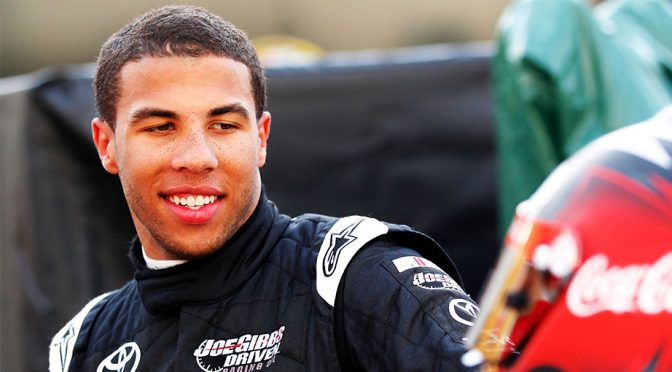
The news that Darrell Wallace Jr. will compete fulltime for Kyle Busch Motorsports in NASCAR’s Camping World Truck Series this season underscores the value and potential for NASCAR’s Drive For Diversity program.
 
The program, now in its 11th season, seeks to provide opportunities for minorities and women to participate in NASCAR.

Rev Racing is the Drive for Diversity’s primary platform, fielding four teams in the K&N Pro East Series as well as two Whelen All-American Series teams.

Wallace is currently a development driver for Joe Gibbs Racing. Earnhardt Ganassi Racing officials recently announced that development driver Kyle Larson, who also came through the Drive For Diversity program, would compete fulltime in the Nationwide series this season through an agreement with Turner Scott Motorsports.

"I wouldn’t say I’ve made it. I mean, I’ve got my foot in the door right now."

Darrell Wallace Jr.

Wallace is one of nine black drivers to compete in one of NASCAR’s top three series. While he has raced for several years on his family-owned team, he said the diversity program provided him the opportunity to advance through the various NASCAR support series.
 
“They helped us out a lot, running with Rev Racing in 2010 and 2011, having a successful two years with those guys,” he said. “That kind of opened up doors for the Nationwide side. I got the opportunity to run four races with JGR and a full season in the East Series with (Rev Racing.)”
 
Team President J.D. Gibbs said that it’s been encouraging to watch Wallace progress through the various series.
 
“I think what is special for us is when we started this years ago with Reggie White … the idea was kind of handed off to him,” Gibbs said of the NFL Hall of Famer who died in 2004.
 
“The sport just needs more diversity. It happens naturally in other sports. It’s not going to happen naturally (here) because racing is just expensive.”
 
“As you know, Reggie passed away, but Joe and J.D. kept that energy alive and were really at the heart and soul of NASCAR’s efforts," NASCAR President Mike Helton said at Saturday’s news conference announcing Wallace’s ride.

“Darrell is a great example of that opportunity turning into a progression of his career."

For Wallace, the 2010 K&N East Rookie of the Year, there’s still much work to be done, however.
 
“I wouldn’t say I’ve made it. I mean, I’ve got my foot in the door right now,” Wallace said of the one-year agreement with KBM. “But I think it’s showing people that they can do it, so it’s up to me to go out there and have a great year in this, to do the best I can to open up the door a little bit more and let me step in a little bit farther.”

Rusty rallied through trying times throughout his entire career

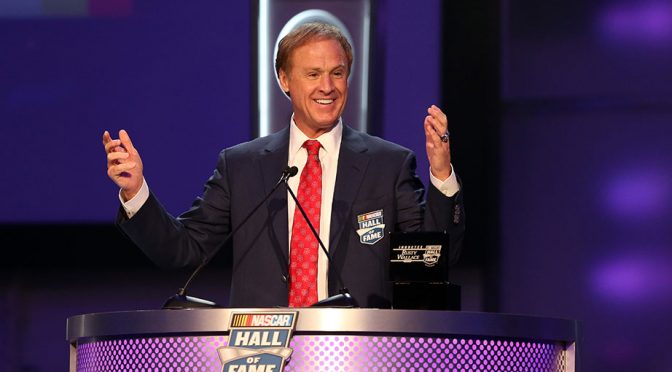
CHARLOTTE, N.C. — Rusty Wallace stood in a hotel room across the street from Daytona International Speedway, leveled a finger, and with anger rising in his throat delivered a terse message to his car owner.

“Don’t spin out me now,” he told Roger Penske in 1992. In the midst of a trying season, Penske had shown up unexpectedly at a Daytona test session to deliver a shocking message — that he wanted to get out of NASCAR. Penske told his driver he would sell his interest in the organization to Wallace and team vice president Don Miller, and go focus on his open-wheel efforts.

Wallace wouldn’t hear of it.

“I got mad,” he remembered Friday night during his induction speech into the 2013 class of the NASCAR Hall of Fame. “I was in disbelief. I took my right hand, and I shook it and I pointed and I said, ‘Dammit, I want to be a Penske driver. Don’t spin out on me now.’ ”

Friday marked the apex of Wallace’s long and illustrious career, one in which he won 55 events and the 1989 title in what is now the NASCAR Sprint Cup Series. But there were so many moments where it could have come undone, where one circumstance or another could have intervened, and Wallace could have been left as a driver with a good record rather than a great one and ultimately watched someone else join Leonard Wood, Buck Baker, Herb Thomas and Cotton Owens on NASCAR’s grandest stage.

Penske’s indecision. Financial struggles, even in the midst of what would become a championship campaign. Violent crashes that resulted in injuries — and in one instance, a near-death experience. Wallace overcame them all and went on to enjoy one successful season after another, and as a result took his place in the Hall of Fame in the first year in which he was eligible.

“I feel so happy,” he said after his induction. “I feel like my career has a period on the end of it. I feel like my career has a legitimized feeling. I said something about being in the club. And talk about being in the club. When I look at who I’m standing with up there … it just blew me away. I can’t believe I’m standing next to these guys.”

It didn’t come easy, or without difficulties to overcome. Even as he was running for his 1989 championship with car owner Raymond Beadle, finances were an issue. “I was running Raymond out of money,” Wallace said in his speech. “I was saying, ‘We’ve got to have this, we’ve got to have that.’ He was always, ‘No problem, no problem.’

“We even said, ‘Hey, we don’t know if this Pontiac is good enough, we want to build a Ford.’ He said, ‘Go do it.’ … He just wanted to satisfy us by letting us do what we wanted to do. It was incredible. There were a couple of close calls there, but they all hung in here.”

But not without some help from a friend. By the end of a 1989 season in which Wallace edged Dale Earnhardt for the title by 12 points, his Blue Max team was running out of money. In stepped Rick Hendrick, who was close friends with Beadle, and pitched in cash to help the team complete the year. Wallace estimates that Hendrick spent about $400,000 to aid an organization he didn’t even own.

“So Rick Hendrick right now will tell you that he’s got, I don’t know how many championships, and a half of one,” Wallace said of the 10-time championship car owner. “Rick paid for that last part of that to keep us going. So I really have kind of driven for Rick Hendrick, too.”

The big scare had come a season earlier, and in a much different form. Wallace was practicing at Bristol Motor Speedway, a track that in his day he dominated, when he crashed and his No. 27 car went end over end. In an era before today’s safety advances, Wallace was knocked out. He was drifting in and out of consciousness when he noticed the form of Earnhardt ripping the windshield away of his damaged vehicle, trying to pull him out. Then he felt a hand around his neck — which he would discover later belonged to television pit reporter and trauma physician Dr. Jerry Punch.

“He saved my life,” said Wallace, who would later break his leg in another airborne crash, at Talladega Superspeedway. “I was dead, not breathing, and he got me going.”

Wallace was allowed to continue the career goal he had worked toward — a ride with Penske, for whom he had driven briefly in ARCA before the car owner decided the effort was too much of a drain on his open-wheel teams, and his young driver needed more seasoning. Wallace’s Cup championship convinced Penske the time was right, and the two joined forces for the 1991 campaign. Their first season together, Wallace won twice — but also failed to finish 10 times. The next year, there were more crashes and mechanical failures. All of which led Penske to drop in on the Daytona test and tell his driver he was moving on.

Wallace had always dreamed of racing for Penske, and turned down a ride in Junior Johnson’s No. 11 car — which would instead go to Geoffrey Bodine — to do it. So when the Captain broached the idea of abandoning his NASCAR effort, the future Hall of Famer would hear nothing of it.

“I just wanted to stay with him because I knew what kind if operation he ran,” Wallace said. “The operation was so first class and so polished. He had a real defined mission — he wanted to be the best, he wanted to have the best equipment, all that. When he brought me in that hotel room that day in Daytona and said, ‘Hey, I want to quit,’ it made me mad, because I had turned down Junior Johnson. … I said, ‘No, I want to go with Penske.’

“I think it shocked him,” Wallace added. “He said, ‘OK, I’m not going to spin out.’ ”

Wallace would go on to have his best season the next year, rewarding Penske’s faith with a 10-win campaign. It was the most Wallace ever won in a single season, and he finished second to Earnhardt in the championship race.

“We got everything back on track,” Wallace remembered. And in the process, he set himself on a path that would result in a place in the NASCAR Hall of Fame.

Some Nationwide, Camping World Truck venues see test days, additional seat time

CONCORD, N.C. — Drivers competing at Eldora Speedway will get an extra night to play in the dirt, and teams in the Nationwide and Camping World Truck series will receive additional track time at several venues this coming season.

"I think Eldora is going to look like a typical dirt race.That’s what’s important to their fans up there."

NASCAR Camping World Truck Series Director Chad Little

As part of a competition update provided to media members Thursday at NASCAR’s Research and Development Center, officials said Nationwide teams would receive extra track time at four facilities, while Truck Series operations will be able to gather more information at five venues — including Eldora, which this summer will host the sport’s first national event on dirt since 1970.

On the Nationwide side, new series director Wayne Auton said teams would receive additional practice time at four tracks — Las Vegas Motor Speedway, Richmond International Raceway, Charlotte Motor Speedway and Mid-Ohio. The last circuit, a road course, is a new addition to the tour’s schedule this season. The extra practice at Las Vegas will be on the Friday morning of that race weekend while the extra session at Richmond will be on Thursday morning.

Auton added that on the Thursday before the spring Charlotte race, Nationwide teams will be able to use data acquisition as on a test day. The garage area would then be open for inspection on that Friday, which is traditionally a dark day on the Memorial Day weekend schedule. Teams will also be able to use data acquisition on a test day slated for the Thursday before the event at Mid-Ohio, which the Columbus-based series sponsor has christened the Nationwide Children’s Hospital 200.

Under NASCAR’s more relaxed testing guidelines, Nationwide teams will be allowed two private tests per organization. Former series director Joe Balash surveyed the garage prior to the end of last season and found that Charlotte, Las Vegas, Richmond and Mid-Ohio would be the most likely targets so NASCAR opened up extra track time at those venues to save teams from having to go on their own.

The same thing is occurring in the Truck Series, where teams will also be allowed two private tests per organization. New series director Chad Little said Charlotte and Iowa Speedway weekends would be extended for a test day, allowing teams to use data-gathering tools not permitted on a normal race weekend. Both tours are staying in step with the Sprint Cup Series, which allows four tests per organization this year.

“It helps save them money, because we opened up testing,” Little said. “They’ll get to pick two private tests this year, which is new. But this is a way to save them some money. All the teams got together and chose those two places to test at.”

Additional practice will be added at Kansas Speedway, Eldora and Canadian Tire Motorsports Park, the first of which has been repaved since the series last visited there while the other two venues are new on the Truck schedule. Little said trucks will first take to the half-mile Eldora oval on the day before the July 24 Mudsummer Classic, although it’s not yet certain in what capacity. Qualifying for that event, he added, may have a dirt track feel.

“I think Eldora is going to look like a typical dirt race,” he said. “That’s what’s important to their fans up there. So they’ll be qualifying most likely in some type of a heat race format.”

Eldora announced Thursday that it had sold out general admission as well as reserved seats for its inaugural Truck Series event, and roughly 20,000 people are expected for the race. The format is still a work in progress, in large part because the facility lacks a traditional pit road.

“We’re still working through it,” Little said. “It won’t be too much longer, but I think we’ll allow some time and get through that. Because of the way the pit road is laid out, we’re trying to figure out what’s the best way to accomplish a traditional dirt type of look, and at the same time, have our (pit) stops.”

And if the Eldora race is delayed by inclement weather? That would bring up a host of issues, both due to the track’s dirt surface, and the fact that the Nationwide and Sprint Cup tours are slated to compete in the Super Weekend at Indianapolis Motor Speedway days later. Some drivers almost certainly will be competing at both venues.

“I guess it would be like any other event,” Little said. “Truck Series concerns would come first, and the race track’s in trying to reschedule it. But if we do have weather, it’s going to make it interesting. You know how dirt racing is. It changes the complexity of the race quite a bit.”

In that eventuality, there would be only one certainty, according to John Darby, NASCAR’s managing director of competition. “I don’t think,” he said, “we’ll be using our new track drying equipment on that.”

Former crew chief-driver duo both believe spark is still there

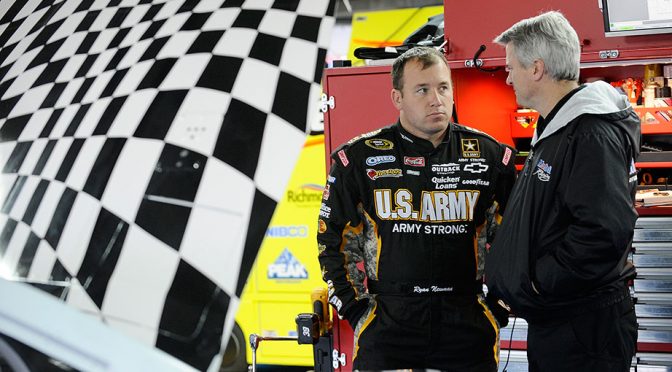
When Stewart-Haas Racing needed a crew chief to oversee Ryan Newman’s program for what might be only a one-year basis, the organization knew just who to turn to — the man who would have the most difficult time saying no.

So what made Matt Borland come back?

“Insanity. I’m not sure,” he said. “It was a good opportunity, a good time to do it, a good opportunity to work with Ryan again at that level versus more of a management standpoint. So it’s kind of exciting from that standpoint, getting to work with him again.”

And with that, the duo that won 12 races over a lightning-in-a-bottle span at Penske Racing is together again at SHR, where they will compete not just to get Newman back in the Chase for the NASCAR Sprint Cup, but to keep him behind the wheel at his current organization beyond 2013.

"Sometimes it’s simple changes like that that make a huge difference."

 Tony Stewart, team owner

The driver of the No. 39 car is working under a one-year contract, and with Kevin Harvick due to arrive next season, Newman and Borland need all the performance they can muster.

Which, from a SHR perspective, made this the ideal time to reunite a driver and a crew chief who burned brightly during much of their five full years together on Roger Penske’s No. 12 car. The pair split up following the 2006 season but remained close friends. In recent years they’ve worked together in a more indirect capacity, with Borland — who joined the Haas team well before Tony Stewart became co-owner — overseeing SHR’s engineering department and Newman wheeling the No. 39.

After last season, when Newman won a race but finished 14th in points, former crew chief Tony Gibson was shifted to Danica Patrick’s program. With Newman on a one-year deal and a relatively new crew assembled around him, SHR wanted a crew chief who could bring some familiarity, and hopefully get that unit off the ground quickly. Borland was the natural choice, even though the Generation-6 car is very different from the one he and Newman won all those races in, and even though he hadn’t been on the box since 2008.

“They won’t have to learn each other,” said Greg Zipadelli, SHR’s competition director. “Matt knows what Ryan is looking for and how to communicate with him. He doesn’t necessarily know what he needs in this car, but that part of it will hopefully speed things up. But now there’s a lot of people on that race team who are new and young and haven’t been to the race track, so they’ll all have to jell and do their job in order for it to be successful.”

Of course, there are no guarantees, particularly given that Newman and Borland’s last stint together ended with a thud. The two parted after a winless 2006, having used up whatever magic generated eight wins and 11 poles just three years earlier. But the personal relationship remained and SHR is betting that if anyone can pull a big year out of Newman when he most needs it, it’s the guy who was best man at his wedding.

“I think Ryan has a lot of confidence in Matt, and vice versa,” Stewart said. “I think it’s a renewed spark in Matt, and at the same time a renewed spark in Ryan, and sometimes it’s simple changes like that that make a huge difference. We’ll wait and see.”

There certainly were flashes at the end of last season, when Borland came on board to call Newman’s final four events. The result was one of the better stretches Newman had in all of 2012, closing with a third-place result at Homestead-Miami Speedway that was bettered only by his victory at Martinsville Speedway in April. Now the car may be changing, but not the relationship between two engineers who approach things in a very similar way.

“We think a lot alike. Sometimes it’s scary,” Newman said “… Obviously, I lost some of my relationship with Matt when we separated at Penske, but I always stayed in contact with him. We had such a good time, a bad experience wasn’t going to ruin it for us. We’ve done a lot of good of things at the race track, and had some fun, and succeeded many, many times, and we look forward to rekindling that together.”

Even Newman’s old boss, who toyed with the idea of rehiring his former driver before bringing Joey Logano aboard after last season, likes the combination.

“Borland is a smart guy, and I think they’ll find out that Borland on the box will be a big asset to him,” Penske said, “because they like each other, they trust each other, and they’ve won together.”

Hanging above it all, though, are questions about what happens after 2013. Newman has backing for much of this season thanks to an 18-race commitment from Quicken Loans, but Harvick’s looming presence casts everything into uncertainty. Zipadelli indicates the Borland-Newman arrangement isn’t long term.

“Matt was leading up our group of engineers, and for him to come back and do this for a year would allow us to tie engineering and racing back together a little bit,” he said.

As far as Newman is concerned, all he can do is drive the car.

“It’s not a distraction to me. I don’t think it’s a distraction,” he said. “It’s something I have to work on, but it’s nothing different from what I’ve had to work on my entire life. You just never know. It’s not like something is going to fall out of the sky and land in your lap. You have to work at it. And my goal this year is to work at what I need to do for this year. It will all come together.”

Ultimately, results on the race track will go a long way toward determining Newman’s fate.

“As with all these guys, it’s going to be the scoreboard. What kind of results can you generate?” Penske said.

No wonder Borland feels a sense of urgency, given all the No. 39 team has at stake.

“Absolutely, a lot of pressure,” he said. “We fully expect to run well again, we fully expect to be challenging for poles, be challenging for leading laps, be challenging for winning races. Ryan is very driven to succeed. I’m the same way, and we’re trying to build people around that group with the same mindset. So anything less than that will be definitely a failure in my mind.”

Newman, though, takes it all in stride. “If I go I go, if I stay I stay,” he said of his future at SHR. The level of pressure he feels at this career crossroad is no different than at any other time.

“I think every year is a make it or break it year for all of us, and obviously I have it more on the line right now with a one-year contract, and I’d like to think that after 10 or 11 years of doing this, I wouldn’t be in this position,” he said. “But I am for a reason, so it’s up to me personally as well as my team to be successful, and success answers all questions.”

Champions, innovators recognized as Class of 2013 officially inducted

CHARLOTTE, N.C. — One of NASCAR’s legendary hard chargers, a mechanic of unparalleled genius, a pioneering car owner, the sport’s first two-time champion, and a prolific winner with the gift of gab — those five men make up the fourth class of inductees into the NASCAR Hall of Fame.

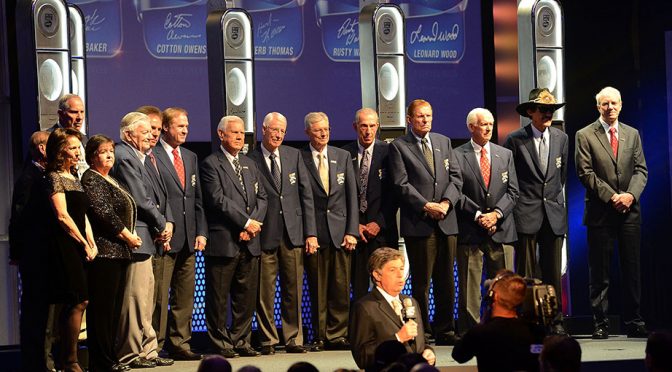
At Friday night’s induction ceremony in the Crown Ballroom at the Charlotte Convention Center, Buck Baker, Leonard Wood, Cotton Owens, Herb Thomas and Rusty Wallace took their places beside the 15 legends of the sport who have preceded them into the Hall.

Baker, Owens and Thomas were inducted posthumously.

OFFICIAL INDUCTION VIDEOS: Herb Thomas Cotton Owens | Leonard Wood | Buck Baker | Rusty WallaceSquier-Hall Award

Ned Jarrett, a member of the second Hall of Fame class, inducted Thomas, who won titles in NASCAR’s foremost series in 1951 and 1953 and finished second in the standings in 1952, 1954 and 1956. With 48 victories in 228 starts, Thomas has the best winning percentage in the history of what is now NASCAR’s Sprint Cup Series (21.053).

Thomas also was the first three-time winner of the Southern 500 at Darlington and the first owner/driver to win a championship.

“I truly believe that this is the greatest honor a driver could receive,” said Thomas’ son Joel, who accepted induction on behalf of his father, the first of the 2013 class to be recognized on Friday night. “Thanks to all his fans for cheering him on and keeping his memory alive.

“I wish he could be here right now so that I could see the expression on his face.”

Owens’ grandson Kyle Davis accepted the induction on behalf his grandfather from another member of the second Hall of Fame class, driver David Pearson, who won 15 races in a car fielded by Owens in his 1966 championship season.

“I appreciate the Owens family picking me to put Cotton into the Hall of Fame,” said Pearson, who acknowledged that Owens had been perhaps his best friend. “Every Sunday after church, I’d go and pick him up and take him and Dot (Owens’ wife) to eat, and it (was) that way for years.”

Known as the “King of the Modifieds” based on more than 100 wins in that type of race car, Owens also posted nine victories as a driver in NASCAR’s elite series before making his reputation as a car owner. All told, Owens collected 38 wins fielding cars for star drivers such as Pearson, Junior Johnson, Bobby Isaac, Jim Paschal and Buddy Baker.

“I’m honored to be here tonight on behalf of my grandfather and my hero,” Davis said of Owens, who last year lost his battle against cancer within weeks of learning he had been voted into the NASCAR Hall of Fame. “My grandfather was the most loyal, hard-working man I’ve ever met.

“He was a wizard turning wrenches and behind the wheel.”

Leonard Wood was ushered into the Hall by his nephew Eddie Wood, who with brother Len Wood currently operates Wood Brothers Racing, an organization that has been an integral part of NASCAR racing since its founding in 1953.

The original Wood brothers were Leonard (the crew chief) and Glen (the driver). After Glen retired as a driver, the team fielded cars for a litany of the motorsports’ greatest wheel men — Pearson, Cale Yarborough, Dan Gurney, A.J. Foyt, Curtis Turner, Marvin Panch and Bill Elliott among them.

All told, the Wood Brothers have won 98 Cup races, the last victory coming in the 2011 Daytona 500 when Trevor Bayne shocked the racing world with his unlikely triumph in the Great American Race.

In 1965, the Wood Brothers also revolutionized pit stops in the Indianapolis 500, where they were hired to pit the Lotus-Ford of eventual race winner Jim Clark. To this day, Leonard Wood is a fixture in the Cup garage, and to this day, other mechanics still seek his counsel.

“It’s a good thing they did the ring size and not the hat size — I wouldn’t have been able to get it on,” said Wood, whom ceremonies host Mike Joy called the “Leonardo da Vinci of NASCAR.” “I’m proud to go in the Hall of Fame with legends Buck Baker, Herb Thomas, Cotton Owens and Rusty Wallace.”

Wood remarked how special it was to follow his brother Glen into the Hall. “We learned together, and we won together,” he said.

Buck Baker, whose toughness matched the era in which he drove, was inducted by his son Buddy, himself a legendary charger. Like Thomas, Baker was a two-time champion, winning back-to-back titles in 1956 and 1957 — part of a run of eight straight top-five finishes in the standings.

Baker, a three-time Southern 500 champion, won 46 races in NASCAR’s top division, with 24 victories coming in his two championship seasons combined. His wife, Susan Baker, accepted induction on his behalf.

Buck’s son, 19-time Cup winner Buddy Baker, raised his fist in satisfaction as he performed the official induction.

“I only wish that Buck were here tonight, because he would have something very witty to say,” Susan Baker said. “But I know that he’s here in spirit. Buck always made an impression on people — whether it was good or bad. If you met him, you never forgot him.”

Wallace, the 1989 Cup champion, entered the Hall through induction by his son Greg. With the addition of Wallace, all eligible drivers with 50 or more Cup victories are now are members of the Hall of Fame.

In a career that spanned 26 years, Wallace won 55 times at NASCAR’s highest level, including nine times at Bristol Motor Speedway.

Since leaving the seat of the No. 2 Penske Racing car after the 2005 season, Wallace has performed double duty as a broadcaster for ESPN and a Nationwide Series car owner.

“I’m humbled that I’ve made it here, I’m humbled that I’m standing up here, and I just can’t thank everybody enough for selecting me to be in the Hall of Fame — I just can’t,” said Wallace who went on to thank his uncle Gary for firing him from his job at a vacuum cleaner store in St. Louis and thereby launching his racing career.

At the induction dinner preceding the ceremony, NASCAR chairman and CEO Brian France presented Ken Squier and Barney Hall with medals commemorating their selection as the first two recipients of the Squier-Hall Award for NASCAR Media Excellence.

As a new wrinkle to the induction ceremonies, current Sprint Cup drivers introduced each new member of the Hall of Fame. Carl Edwards did the honors for Thomas, Mark Martin for Owens, Bayne for Wood, Jeff Gordon for Baker and reigning champion Brad Keselowski for Wallace.