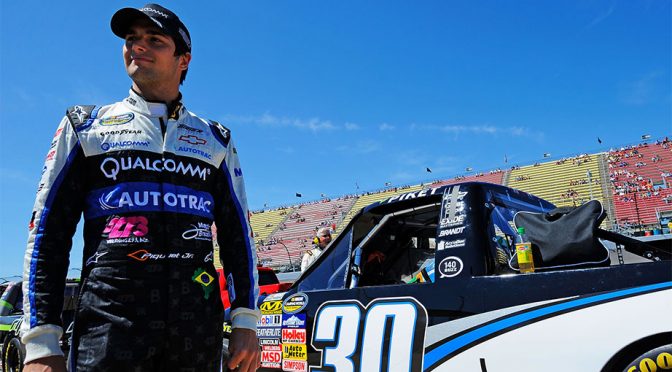
Driver to run in No. 30 Chevrolet for Turner Scott Motorsports
Nelson Piquet Jr. will drive full time in the NASCAR Nationwide Series this year, Turner Scott Motorsports announced Friday. Piquet will run in the team’s No. 30 Chevrolet Camaro, with Chris Carrier staying alongside Piquet as crew chief.
The 2013 campaign will not only mark Piquet’s first complete season in the series, but also the first time a Brazilian native competes in the full circuit.
"I am very happy to be returning with Turner Scott Motorsports in 2013, and incredibly excited to be making the move to the NASCAR Nationwide Series," Piquet said. "I said from the very beginning of my NASCAR career that I wanted to go about it the right way and progress through the ranks when the time was right; that I wouldn’t rush. I feel that 2012 was a really fantastic season for me and it provided me with the opportunity to go to the next level."
Piquet has four races under his belt in Nationwide, including one victory at Elkhart Lake, Wis. He has raced two complete seasons in the truck series, with two wins at Michigan International Speedway and Las Vegas Motor Speedway, and 15 top-five finishes, all with Carrier atop the pit box.
"We are proud to continue our relationship with Nelson [Piquet Jr.] in 2013, and we are pleased to be the team where he will take his career to the next level," said team co-owner Harry Scott Jr. "Nelson was tremendously successful last season and he has proven to be an asset to Turner Scott Motorsports. He and Chris Carrier are a really good match, and we’re glad we can give them a chance to bring that chemistry to the Nationwide Series."
Piquet will start off the season in the Worx-sponsored Chevy on Saturday, Feb. 23 at the DRIVE4COPD 300 at Daytona International Speedway.
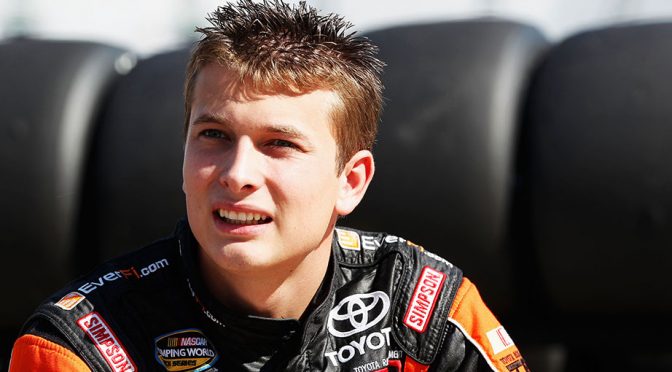
21-year-old driver to enter five races in 2013 for Childress
Richard Childress Racing has signed Dakoda Armstrong to a partial NASCAR Nationwide Series schedule for 2013, the team announced Friday.
The 21-year-old driver, a competitor in the Camping World Truck Series last season, will drive the No. 33 Chevrolet Camaro in five races, beginning with Auto Club Speedway in Fontana, Calif., on March 23. His other races include Charlotte Motor Speedway (May 25), Chicagoland Speedway (July 21), Kentucky Speedway (Sept. 21) and one race to be named later.
"I’m really looking forward to driving for a proven winner such as Richard Childress Racing," Armstrong said. "We feel NASCAR’s American Ethanol partnership through RCR and my family’s extensive farming background makes a great fit. We are excited to show how a fourth generation farmer can activate a great marketing strategy to the agricultural industry to help grow their business."
Armstrong drove in 14 truck events for ThorSport Racing’s No. 98 team last season before a lack of sponsorship forced a parting of ways in September. A best finish of third place at Michigan in August was his lone top-five.
Armstrong has just one previous Nationwide series start; he qualified 19th and finished 25th in the season finale at Homestead in a car owned by Turner Scott Motorsports.
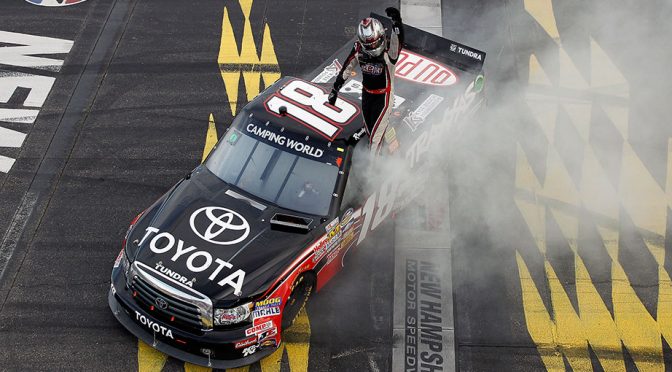
Toyota Care to be primary backer in 10 races in 2013
Kyle Busch Motorsports announced Wednesday that it has secured a 10-race sponsorship deal with Toyota Care for the NASCAR Camping World Truck Series this season.

Busch, who competed in three truck series events last season, will expand his schedule in 2013 in the No. 51 Toyota Tundra, beginning with the season-opening NextEra Energy Resources 250 at Daytona International Speedway on Feb. 22.
"I’ll be starting the season off with a triple at Daytona, which gives me the opportunity to try and collect three milestone wins for Toyota — their 100th truck series win on Friday night, their 75th Nationwide Series win on Saturday and their 50th Sprint Cup Series win on Sunday," Busch said. "I was able to get Toyota’s first Cup Series victory back in 2008 and that was pretty special. Hopefully we can add a few milestone victories for them at Daytona to start the season and many more across all three series in the years to come."
The rest of Busch’s truck series schedule: Kansas Speedway, April 20; Charlotte Motor Speedway, May 17; Dover International Speedway, May 31; Kentucky Speedway, June 27; Michigan International Speedway, Aug. 17; Bristol Motor Speedway, Aug. 21; Chicagoland Speedway, Sept. 13; Texas Motor Speedway, Nov. 1; Homestead-Miami Speedway, Nov. 15.
Toyota Care is the maintenance plan that comes free with the purchase or lease of a new Toyota. Of Busch’s 30 victories in the truck series, 24 have come in Toyotas, the most by any driver for the Japanese automaker.
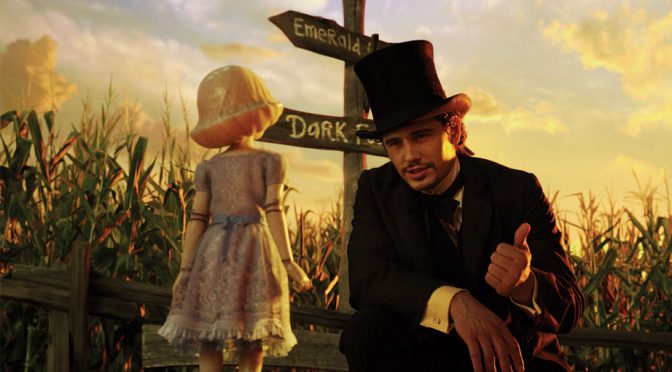
Actor will take part in 55th Daytona 500
James Franco, the actor known for roles in "Pineapple Express" and "127 hours," will serve as Grand Marshal in the Daytona 500.
“We’re excited to welcome James Franco and have him take part in the pre-race festivities for the Daytona 500,” Daytona International Speedway President Joie Chitwood III said. “In front of thousands of race fans and millions more watching on FOX, we’re looking forward to hearing James’ enthusiastic starting command to kick off the Daytona 500 and the new NASCAR Sprint Cup Series season.”
Upcoming events at Daytona International Speedway
Feb. 16: Sprint Unlimited
Vote on the race format
Tickets | Schedule
Feb. 16-24: Budweiser Speedweeks
Tickets | Schedule
Feb. 17: Daytona 500 Qualifying by Kroger
Tickets | Schedule
Feb. 18-19 | Unoh Battle at the Beach
Tickets | Schedule
Feb. 21 | Budweiser Duel
Tickets | Schedule
Feb. 22 | Nextera Energy Resources 250
Tickets | Schedule
In his role as Grand Marshal, Franco will tell drivers in the Sprint Cup race to start their engines. The race is scheduled for Sunday, Feb. 24 at 1 p.m. ET and will be aired on FOX, FOX Deportes, MRN Radio and SIruis XM Radio. Former Grand Marshals for the race include stars such as John Travolta, Ben Affleck, Jane Lynch and Matthew McConaughey.
Franco’s latest movie, the Disney film "Oz The Great and Powerful," co-stars Mila Kunis, Rachel Weisz and Michelle Williams as three witches who aren’t impressed by Franco’s character, Oscar Diggs, and his wizarding ability. The movie hits theaters March 8.
NASCAR Hall of Fame inductee honored through grandchildren’s memories
CHARLOTTE, N.C. — Cotton Owens found out he was to be inducted into the NASCAR Hall of Fame two weeks before his death.
“It was the last time he smiled,” Owens’ grandson, Brandon Davis, said Feb. 8.
Owens, a noted driver, car builder and team owner, was one of five inductees who made up the 2013 class, a group that also included Buck Baker, Herb Thomas, Leonard Wood and Rusty Wallace.
He passed away in June of 2012, shortly after this year’s class was announced.
HONORING NASCAR LEGENDS
• Wallace had to persevere
• To family, Owens was ‘pop’
• Class full of stock car titans
• Wood’s replica comes to life
EXCLUSIVE INTERVIEWS
• One-on-one with Rusty Wallace
• One-on-one with Leonard Wood
VIDEO COVERAGE
• Wallace comes full circle
• Owens’ grandson accepts award
• Honoring Herb Thomas
• Wood’s acceptance speech
• Buck Baker remembered
VIDEO: FAMILIES REACT
• Herb Thomas
• Cotton Owens
• Buck Baker
“To my whole family it means the world,” granddaughter Cari Spanton said, “because this is what he has done his entire life; this is a culmination of everything. This is the icing on the cake.
“Even though he is gone, and some of these other pioneers and legends are gone, they’ll be remembered here in the Hall of Fame.”
Owens, one of several legendary figures who cut their racing teeth on dirt tracks in and around Spartanburg, S.C. well before NASCAR became a staple, earned nine career wins as a driver, and 38 as an owner. He enjoyed the bulk of his success with David Pearson, another Spartanburg native, winning the 1966 Cup title. Twenty-seven of Pearson’s 105 victories came at the helm of an Owens’ prepped car.
In his later years, Owens provided a helping hand to his grandchildren as they tried their hands at racing, “and I know personally he would tell you those were some of the best years of his life,” Davis said.
“He was as proud of one of our victories as he was his 1970 win with Buddy Baker at the Southern 500 and took it just as serious.
“It’s pretty telling that three of the first 20 members (of the Hall) are from Spartanburg. It was the hub city of racing back in that day. He had 13 of NASCAR’s 50 greatest drivers (that) drove for him and then my grandfather was one of those 50.”
Owen’s 1957 win on the Daytona Beach road course was the first such victory for Pontiac in NASCAR. Two years later, Owens finished second to fellow Hall of Famer Lee Petty in the points battle.
He also is credited with more than 100 victories in NASCAR’s Modified division.
But to his family, he was simply Cotton. Or Pop.
“Going to races as a youngster,” Spanton said, “we knew he was big to NASCAR. He was big to the fans. But to us he was just Pop. He was an extremely humble person.
“As big as he was to everybody to us on the outside, he was our granddad who always had time for us.
“We knew how big he was (to everyone else), but to us he was much bigger than NASCAR.”
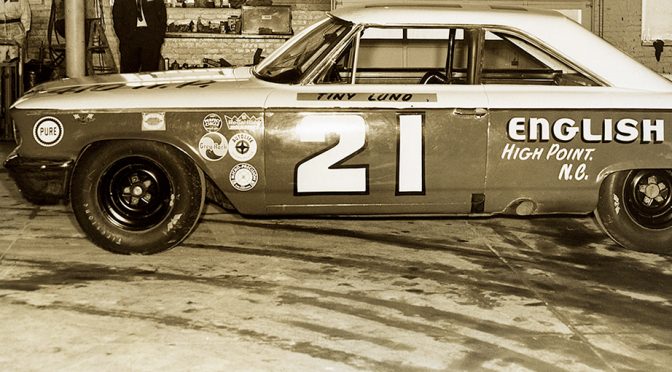
Replica project to be unveiled at Hall of Fame induction
There’s a tall spindle inside the right-front wheel well, made to look just like the one on the genuine article. The bars in the back window are covered in black electrical tape — one wrapped in one direction, the other in the opposite — exactly as they were five decades ago. There’s a gap in the tape coating the support bar next to the bucket seat, and the foam underneath sticks out just like it did in 1963. The car is hand lettered and painted in its original colors, Rangoon red and Corinthian white.
At first glance, it appears to be the exact Ford Galaxie that Tiny Lund drove — in a substitute role, no less — to win the 1963 Daytona 500 for the Wood Brothers. This one is a reproduction built by Leonard Wood, and it will be a centerpiece of his exhibit after the famed mechanic and innovator is inducted into the NASCAR Hall of Fame on Friday. But the detail is so exacting, the specifics so precise, that Lund himself would feel right at home if he were behind the wheel.
“It’s no problem to make it like it was,” said Wood, whose brother Glen was inducted into the Hall of Fame last year. “Since we made the first one, we should be able to make the second one. But it’s been a great experience. It’s just bringing back all the memories again. With the car and everyone who’s involved with it, it’s just like you’ve won the race again.”
RELATED: Hall of Fame hub

PROFILES OF INDUCTEES
Ceremony set for Feb. 8
• Buck Baker
• Cotton Owens
• Herb Thomas
• Rusty Wallace
• Leonard Wood
Lund won the Daytona 500 a half-century ago, even though he came to Speedweeks without a ride. The Wood Brothers had enlisted 1961 Daytona winner Marvin Panch for the event, but he crashed his Maserati in a preliminary sports-car race, and it was Lund — a giant of a man who also ran a fish camp in rural Cross, S.C. — who pulled him from the flaming wreckage. As a show of gratitude he was offered the No. 21 car, and he pulled away in the waning laps to give the Woods their first victory in the Great American Race.
The Woods aren’t certain what happened to that original car; they once met someone who claimed to have it, but Leonard and Glen were unable to verify that it was the same vehicle. Glen’s sons Len and Eddie were at Indianapolis waiting for the garage to open two years ago when they noticed a red and white vehicle that turned out to be a replica of Lund’s Ford. It gave them the idea to build their own, which became a mission when they realized the 2013 Daytona 500 fell on the 50th anniversary — right down to the day, Feb. 24 — of their 1963 triumph.
“Then you’re committed,” Eddie said.
The stars aligned even further in May, when Leonard was elected to a 2013 Hall of Fame class that also includes Rusty Wallace, Cotton Owens, Buck Baker and Herb Thomas. The 18-month project was shepherded by Leonard, who built the vehicle along with cousin Butch Markle. “Everybody in the shop worked on it, but it’s really Leonard’s baby,” said Eddie, who now runs the race team along with his brother Len and sister Kim Hall. “And he built this thing exactly like he built the one in ’63, as he remembers it.”
They pored over photographs, from the family collection — “My mom kept every picture that was ever taken of anything,” Eddie said — as well as those from the NASCAR archives in Daytona Beach, Fla. The deeper they got into it, the more they wanted the details just right. The foam had to stick out of the tape covering the bucket seat support bar, because that’s how was in 1963. They had an instrument dash cast exactly like that from the original car. After they wrapped both rear-window support bars in electrical tape, they realized from photos that each bar had been wrapped in a different direction, so they did one over again.
The positioning of the tailpipes, the size of the spindles, the type of tires, even Lund’s name written on a strip of tape, covering Panch’s on one side of the car — no detail was overlooked. “If there’s any question, just look at the picture,” Leonard said. “It’s right there.” To hand-letter the vehicle, the Woods called on Hall of Fame historian Buz McKim, who did just that for years in Daytona Beach. McKim visited the Wood Brothers shop in Harrisburg, N.C., over a period of two weekends to apply finishing touches.
“It’s just tremendous,” McKim said of the vehicle. “I’m absolutely in awe of what they’ve been able to accomplish with this car. I mean, they have the same type of tires, the same everything. It’s in a time warp.”
Not everything could be matched perfectly. Under the hood is a 427 engine that would have been used in 1967 or ’68, but the Woods will try to match the car with its correct engine after it comes out of the Hall of Fame next year. The paint is acrylic enamel from the 1970s, because the original enamel paint is no longer available. Still, it’s close enough. Two weeks ago, the Woods brought the car to their first shop in Stuart, Va., so some of the people who worked on the original vehicle could see it. Among those on hand was 91-year-old Ophus Agnew, who painted the Galaxie at the Ford dealership there in 1963.
“That was the coolest sight,” Eddie said. “That was worth the whole thing, right there.”
As it will be when the car goes into the Hall of Fame as part of Leonard’s exhibit. The vehicle will also be brought down to Daytona for Speedweeks, where McKim said it will appear in the track’s FanZone, and be driven by Leonard in a parade along the beach. The reproduction of the red and white Ford might make it feel like 1963 all over again, at least for a little while.
“It’s very, very close to the exact same thing,” Leonard said. “I used to drive the car into the trailer, up on the truck or whatever. Crank ’em up, drive ’em to the gas pumps. Well, I drove it into the trailer just the other day, and it was very familiar.”
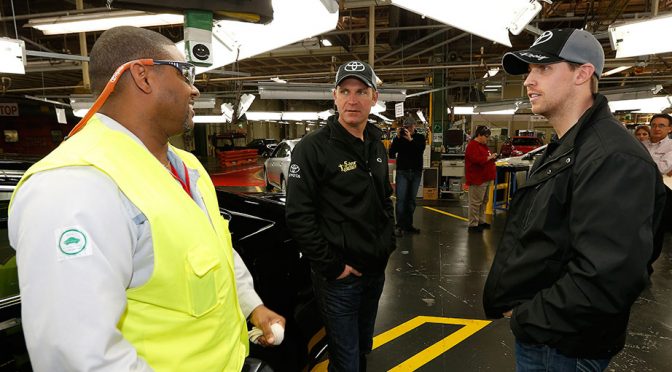
Plant tour has Toyota drivers revved up to race
GEORGETOWN, Ky. — Clint Bowyer stood mesmerized, as if he were witnessing one of the great wonders of the modern world. And as far as he was concerned, he was.
Before he hit it big in racing, the NASCAR driver had worked in a body shop at a dealership in his hometown of Emporia, Kan. He knew what it was like to watch new cars arrive — but had never seen where they came from. Until Wednesday.
“Un-freaking-believable,” he said as he glanced around a mammoth Toyota manufacturing facility that was more a city than a factory. At one end were large rolls of steel. At the other was a freshly minted red Camry that Bowyer himself drove off the assembly line. The three miles of conveyor belt connecting them provided a tangible link between vehicles at the showroom and those at the race track, which this season will once again look like siblings rather than distant cousins.
Amid the clash and bang of a plant that turns out a car every 55 seconds, the relationship was easy to see. In an effort to heighten brand identity, the three manufacturers which compete in the NASCAR Sprint Cup Series redesigned their entries for 2013, carrying over many more physical characteristics from their production models. Toyota’s 7.5 million square-foot Kentucky operation brought it all home — there were those snarling front ends, there were those long side creases, there were those same rocker panels, chugging down the assembly line just as they’ll soon speed around the race track.
"There’s no doubt our Camrys look like those Camrys. And that’s so important. It got our sport to where it is today."
— Clint Bowyer
“I didn’t realize until you really look at the car that came off the line, and then they had a (Sprint Cup) car out there, and it’s like, wow — it is really, really similar,” Denny Hamlin said. “I think it’s going to be exciting for all these thousands of employees who work here to see the car on the race track that they build every single day.”
Surely, those who work at Ford and Chevrolet production plants will say the same thing when they see the NASCAR versions of the Fusion and the SS dueling for the victory. It all harkens back to the days when race cars looked more like passenger cars, a longstanding tradition that was strained by advancing technology and the need to enhance driver safety. The new vehicles, which will debut in next week’s Sprint Unlimited at Daytona International Speedway, are the biggest step yet toward bridging that gap.
“For years it was, win Sunday, sell Monday,” said Kentucky native and NASCAR Hall of Famer Darrell Waltrip. “Because what you saw Sunday, you could buy Monday. We didn’t have that. We do now. … I think when you go into the showroom now, you’ll go, ‘I want this car, I saw it win the race yesterday.’ And I think this car, this fast car — it’ll be, ‘I saw this on the track yesterday, and I want one of these.’ Unlike in the past, where you just went in and took whatever they had. So I think there are some bragging rights. I think there’s some pride. When you buy a car … you want to buy something special. That’s special.”
Wednesday, when Toyota’s NASCAR drivers and team owners visited a behemoth of a plant that employs 6,600 people and turns out roughly 2,000 cars in 24 hours, the connection came to life in vivid detail. Men who compete at 200 mph were awed like schoolchildren at a theme park as they saw giant stamping presses, massive spot-welding robots that looked like extras from a Terminator movie and assembly-line workers who had 55 seconds to do their jobs before the next unfinished car came rolling in.
“I’m thinking this might be where they want to produce my Chase cars,” quipped Hamlin, whose championship bid last year for Joe Gibbs Racing was hampered by mechanical issues. Georgetown has been the home of the Camry since 1988, and the significance wasn’t lost on drivers who will compete in the revised racing model on NASCAR weekends.
“That’s definitely unbelievable to see the identity, the recognition, between the two cars,” Bowyer said. “There’s no doubt our Camrys look like those Camrys. And that’s so important. It got our sport to where it is today. The manufacturer support got our sport to where it is. So to be able to get back to that, and to give these manufacturers their identity aspect back … hopefully, they’re winning on Sunday and selling on Monday. Hopefully that correlates more like it did back in the day. I know it does, and I know they’ve always had a return on it, but this car is going to benefit the manufacturers more than the last one did, for sure.”
Judging from the reaction at the Kentucky facility, it’s clear the feeling is mutual. “Y’all have caused a frenzy at the plant,” community services specialist Kim Sweazy told the NASCAR group upon meeting it at a nearby airport. A few employees had their names drawn and were able to eat lunch with the drivers — among them Kenneth Burk, who does third-shift body welding, and got off work at 7:15 a.m. but stuck around to meet his favorites from the Gibbs team.
That kind of allegiance was everywhere, only strengthened now by the closer bonds between the production cars and the more brand-identifiable models on the race track. “It gives us great pride in what we do,” said Greg Good, who works in the paint department. “It’s going to be a great attribute for the sport. I’m glad to see it. It’s awesome.”
Co-worker Joe Robinson agreed. “I think it’s going to be good for all the teams, all the manufacturers,” he said. “It will bring some of that manufacturer pride back. Win on Sunday sell on Monday, that’s what it’s always been about. Maybe it will bring some of that back.”
At Chevrolet and Ford as well as Toyota, that’s certainly the hope — that the car model once again becomes as relevant to the spectator as the driver behind the wheel. “I think it’s going to help the neutral race fan decide what car he likes,” Hamlin said. “… I think it’s definitely going to help the new race fan coming in to say, ‘Wow, that’s a cool looking car.’ And it’s going to add some excitement for that new race fan.”
There was plenty of excitement in the cavernous Georgetown plant, with workers riding oversized tricycles from one end to another, automated vehicles ferrying parts between stations and welding robots throwing off showers of sparks. The NASCAR drivers couldn’t get enough of it, capturing every moment on their cell phones like tourists on vacation. It was one overwhelming sensory experience preceding another, the next not under a roof but on an oval of asphalt, with a vehicle comprising the link between the two.
“We’re always looking for driver rivalries. I think this gives us a manufacturer rivalry, which was so important back in the day,” Waltrip said. “… We lost that. They had no role. Now they’re all involved in developing the car, they all have their fingerprints on the car, they all have their name on the car, and they have a dog in the fight, and not just a motor under the hood.”
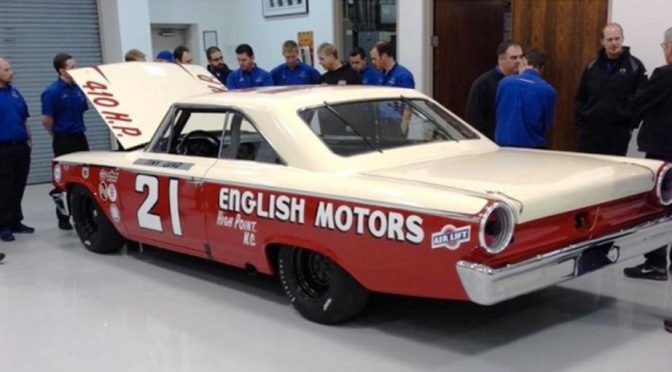
Ahead of Hall induction, Leonard Wood replicates Tiny Lund’s 500 winner
There’s a tall spindle inside the right-front wheel well, made to look just like the one on the genuine article. The bars in the back window are covered in black electrical tape — one wrapped in one direction, the other in the opposite — exactly as they were five decades ago. There’s a gap in the tape coating the support bar next to the bucket seat, and the foam underneath sticks out just like it did in 1963. The car is hand lettered and painted in its original colors, Rangoon red and Corinthian white.
At first glance, it appears to be the exact Ford Galaxie that Tiny Lund drove — in a substitute role, no less — to win the 1963 Daytona 500 for the Wood Brothers. This one is a reproduction built by Leonard Wood, and it will be a centerpiece of his exhibit after the famed mechanic and innovator is inducted into the NASCAR Hall of Fame on Friday. But the detail is so exacting, the specifics so precise, that Lund himself would feel right at home if he were behind the wheel.
"I’m absolutely in awe of what they’ve been able to accomplish with this car. I mean, they have the same type of tires, the same everything. It’s in a time warp."
—NASCAR Hall of Fame historian Buz McKim
“It’s no problem to make it like it was,” said Wood, whose brother Glen was inducted into the Hall of Fame last year. “Since we made the first one, we should be able to make the second one. But it’s been a great experience. It’s just bringing back all the memories again. With the car and everyone who’s involved with it, it’s just like you’ve won the race again.”
Lund won the Daytona 500 a half-century ago, even though he came to Speedweeks without a ride. The Wood Brothers had enlisted 1961 Daytona winner Marvin Panch for the event, but he crashed his Maserati in a preliminary sports-car race, and it was Lund — a giant of a man who also ran a fish camp in rural Cross, S.C. — who pulled him from the flaming wreckage. As a show of gratitude he was offered the No. 21 car, and he pulled away in the waning laps to give the Woods their first victory in the Great American Race.
The Woods aren’t certain what happened to that original car; they once met someone who claimed to have it, but Leonard and Glen were unable to verify that it was the same vehicle. Glen’s sons Len and Eddie were at Indianapolis waiting for the garage to open two years ago when they noticed a red and white vehicle that turned out to be a replica of Lund’s Ford. It gave them the idea to build their own, which became a mission when they realized the 2013 Daytona 500 fell on the 50th anniversary — right down to the day, Feb. 24 — of their 1963 triumph.
“Then you’re committed,” Eddie said.
The stars aligned even further in May, when Leonard was elected to a 2013 Hall of Fame class that also includes Rusty Wallace, Cotton Owens, Buck Baker and Herb Thomas. The 18-month project was shepherded by Leonard, who built the vehicle along with cousin Butch Markle. “Everybody in the shop worked on it, but it’s really Leonard’s baby,” said Eddie, who now runs the race team along with his brother Len and sister Kim Hall. “And he built this thing exactly like he built the one in ’63, as he remembers it.”
They pored over photographs, from the family collection — “My mom kept every picture that was ever taken of anything,” Eddie said — as well as those from the NASCAR archives in Daytona Beach. The deeper they got into it, the more they wanted the details just right. The foam had to stick out of the tape covering the bucket seat support bar, because that’s how it was in 1963. They had an instrument dash cast exactly like that from the original car. After they wrapped both rear-window support bars in electrical tape, they realized from photos that each bar had been wrapped in a different direction, so they did one over again.
The positioning of the tailpipes, the size of the spindles, the type of tires, even Lund’s name written on a strip of tape, covering Panch’s on one side of the car — no detail was overlooked. “If there’s any question, just look at the picture,” Leonard said. “It’s right there.” To hand-letter the vehicle, the Woods called on Hall of Fame historian Buz McKim, who did just that for years in Daytona Beach. McKim visited the Wood Brothers shop in Harrisburg, N.C., over a period of two weekends to apply the finishing touches.
“It’s just tremendous,” McKim said of the vehicle. “I’m absolutely in awe of what they’ve been able to accomplish with this car. I mean, they have the same type of tires, the same everything. It’s in a time warp.”
Not everything could be matched perfectly. Under the hood is a 427 engine that would have been used in 1967 or ’68, but the Woods will try to match the car with its correct engine after it comes out of the Hall of Fame next year. The paint is acrylic enamel from the 1970s, because the original enamel paint is no longer available. Still, it’s close enough. Two weeks ago, the Woods brought the car to their first shop in Stuart, Va., so some of the people who worked on the original vehicle could see it. Among those on hand was 91-year-old Ophus Agnew, who painted the Galaxie at the Ford dealership there in 1963.
“That was the coolest sight,” Eddie said. “That was worth the whole thing, right there.”
As it will be when the car goes into the Hall of Fame as part of Leonard’s exhibit. The vehicle will also be brought down to Daytona for Speedweeks, where McKim said it will appear in the track’s FanZone, and be driven by Leonard in a parade along the beach. The reproduction of the red and white Ford might make it feel like 1963 all over again, at least for a little while.
“It’s very, very close to the exact same thing,” Leonard said. “I used to drive the car into the trailer, up on the truck or whatever. Crank ’em up, drive ’em to the gas pumps. Well, I drove it into the trailer just the other day, and it was very familiar.”
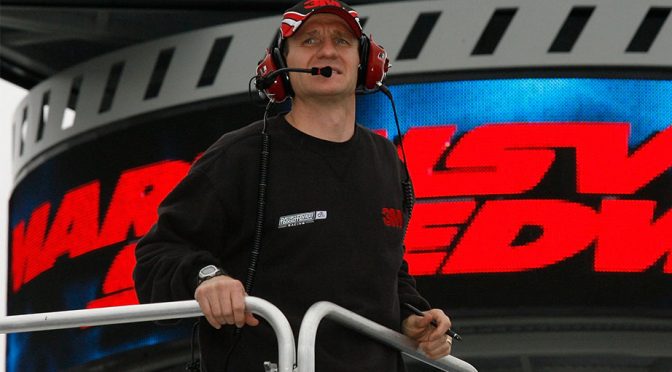
Five-time winner joins Sam Hornish Jr. as a refreshed man
After he split with Richard Petty Motorsports in April of last season, Greg Erwin took two months off. He reconnected with his family. He thought about his future. And the crew chief — who had won five races and three times qualified a car for the Chase for the NASCAR Sprint Cup — asked himself if he could exist in any industry other than motorsports.
These days the answer is clear, encapsulated by Erwin’s presence at Penske Racing overseeing the organization’s No. 12 car on the Nationwide Series. A crew chief who helped turn Greg Biffle into a championship contender at Roush Fenway Racing, Erwin will now try to do the same for former Indianapolis 500 champion Sam Hornish Jr., who enjoyed his best season in NASCAR by finishing fourth in the final Nationwide points standings last year.
“I want to win,” Erwin said. “I don’t want to collect a paycheck in this business riding around. That’s not my goal. You can collect a paycheck doing plenty of other things. If you’re not going to be competitive to win races, with the thrill of race day and all the fanfare and prepping the car and working all the hours it takes to put this thing on the race track … you’re missing the final chapter in the book. I wanted to put myself in a position where I could win again, and I think I found it.”
It’s been a while since Erwin was able to feel that way. He enjoyed four very good years with Biffle, finishing third in championship points in 2008. But midway through the 2011 season and with Biffle lagging 16th in points, Roush made a change, and Matt Puccia was called up from research and development to oversee the No. 16 team. Erwin wound up at Roush-affiliated RPM, and enjoyed some nice runs with AJ Allmendinger before that driver was chosen by Penske to replace the outgoing Kurt Busch.
"We’ve got a guy here who we think can be a winner…"
— Roger Penske
From there, it went downhill. Erwin was paired with Aric Almirola, things never really clicked and nine races into the 2012 campaign he was replaced by Mike Ford. Erwin has been around long enough to understand events like that are the nature of his profession.
“It was probably the first time in 16 years I’ve been without a job in racing,” he said. “There are moves people have to make in this business. Managers have to mix things up occasionally. It’s no different than a football coach pulling a starting quarterback and putting another one in, trying to make something happen. And so I understand that goes on. I think it’s just what you sign up for when you take this job. You’re not going to have the long-standing relationship with an owner, with a team, that a lot of guys in this industry have been fortunate to have.”
So he started making phone calls, looking for a job. How his name surfaced at Penske, he isn’t exactly sure. He knew a lot of people who worked for the team, including some who worked for him when he was crew chief for Robby Gordon. There was a Ford connection — Penske switched this season to Roush’s longtime carmaker — but he doesn’t know if anyone with the manufacturer recommended him. Regardless, the car owner thinks Erwin’s a good fit, particularly since Penske continues to evaluate expanding to a third Sprint Cup team.
“I think getting Erwin was a real plus for us,” Roger Penske said. “I don’t know all the circumstances that went over with Biffle, but Biffle was very successful with him for quite a while. And the fact that he would come with us — we said to Greg Erwin, ‘OK, you’ve got to come into the organization and show us what you can do. You have all the tools. We’ve got a guy here who we think can be a winner, and I think together, we’re going to see that.’ Plus, we’ve got a crew chief there who can move up. … Now we’re putting a third person in line.”
Hornish thinks he and his new crew chief have much in common, given that both had their careers interrupted by circumstances, and faced real decisions on how to continue. For Erwin, it was the split with Biffle and seven months away from the track after his break with RPM. For Hornish, it was a reduced Nationwide slate in 2011 mandated by a sponsorship shortage.
“You sit down, and he says, ‘Oh, I was sitting at home watching races on TV and working on a car.’ And I was like, ‘Oh, I was sitting at home watching races on TV and building a tree house,’ ” Hornish said. “I think there’s a lot of people who work in the racing business, and there are a lot of people who are racers. The guys who are out of a job, and they’re like, ‘Oh, I can’t find anything, I’ll go do something else.’ Those are people who are in racing. … But the people who fight though the adversity of it to get where they want to be? Those are racers.”
And that’s Erwin, to the core. Since coming on board with Penske, he’s watched video of more than 20 of Hornish’s events from last season, and noticed that his new driver was often in the top five toward the end of races, but not always able to close them out. “The opportunity now is to try and build what I’ve been calling a stronger ‘red zone’ offense,” Erwin said. “They can get there. They need to be able to get the ball in the end zone.”
Erwin said he bears no ill will over how his tenure ended with Biffle, and thinks that crew chief and driver ultimately helped make one another better. He understands the possibility of change arises anytime there’s a decline in performance like the one he went through with the No. 16 team in 2011. But he also believes he’s learned from that experience, and will be better at his new job as a result.
“When you have time to look back over it, clear-headed and clear-minded and without the pressure of the weekly performance kind of bearing down on you, there are things that become very clear,” said Erwin, who replaced Chad Walter, now at Michael Waltrip Racing. “And there are some things I’m certainly going to do a better job of going forward.”
His driver can certainly relate — after all, they’ve both been there.
“I feel like Greg has a lot to prove,” Hornish said. “He’s a race-winning and a Chase-making crew chief, and I’m going to put a lot on his shoulders this year. I’ve already had so much interaction with him, I start to see what some of the differences might be, and I’m looking forward to it.”