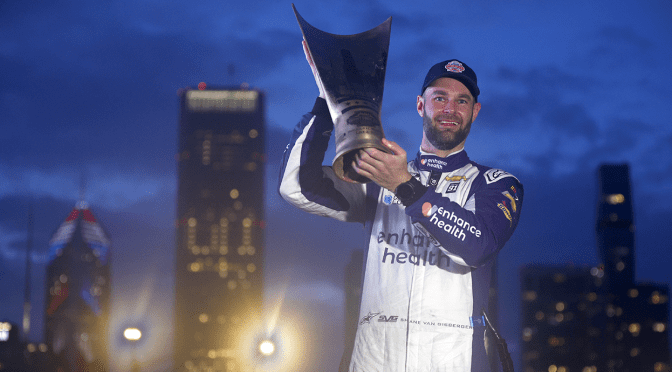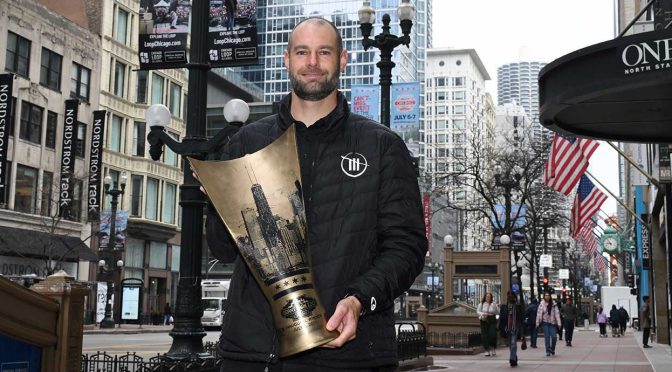
Shane van Gisbergen recently got his first real taste of Chicago.

During a media tour to leverage hyping the most stunning victory of the 2023 season, van Gisbergen also played Windy City tourist. He visited the Art Institute, Motor Row District and State Street. He checked out the Centennial Ferris wheel on Navy Pier. He attended Opening Day at Wrigley Field (Cubs win!) for his first Major League Baseball game.

It was an illuminating whirlwind for the driver who swept Chicago (and NASCAR) off its feet but barely explored its vast charms and wonders on his first weekend there.

RELATED: Learn more about the Chicago Street Race

“I’ve never seen buildings that big and close to each other before,” said the Auckland, New Zealand native, absorbing a metropolitan area whose population is nearly twice that of his home country.

But this isn’t some tale of being overlooked in the big city. Nearly a year after showing up as a relative unknown, it was van Gisbergen who now was getting recognized in a town famous for sports idolatry.

“It’s funny because we get questions about SVG and what he’s doing,” Chicago Street Race president Julie Giese said. “He has a fan base in Chicago.”

As he should, considering his milestone victory was a game-changing event with repercussions far beyond becoming the first driver in six decades to win in their Cup debut.

It was life-changing for van Gisbergen, who made his fame on Australia’s Supercars circuit but returns this week for the second annual Cup race through the Loop as a full-fledged stock-car star in the making (and with a rivalry among NASCAR’s best this year). After multiple victories in his full-time Xfinity season — as well as a new signature celebration — he is making steady progress on ovals and on track for a potential Cup ride as early as 2025.

And the “SVG” initials moniker has become ubiquitous — an amusing development considering his surname was butchered by countless Americans right up until he won the first street race in the 75-year history of the Cup Series.

That literally put SVG in the NASCAR Hall of Fame via a new exhibit unveiled three months ago.

“To have something like that here after my first race, it’s pretty hard to put that into words yet,” said van Gisbergen, who was inducted into New Zealand’s motorsports Hall of Fame two years ago.

It’s uncertain if the phenomenon will continue to blossom into full-time Cup Series stardom, but van Gisbergen unquestionably still is having a moment.

He has won the past two Xfinity Series races on road courses (and might be unbeaten on right-turn tracks in 2024 if not for his entertaining feud with Austin Hill erupting on the last lap at Circuit of The Americas).

Sunday will mark only his sixth Cup start, but SVG is being hailed a favorite to repeat on the course through the heart of downtown — and arguably as the most feared road-course driver in NASCAR with a heel-toe technique for braking and shifting essentially impossible for even Cup champions to emulate (though some have pondered it).

“I rate him as one of the top 10 drivers in the world for that reason, no different than when he came into the race last year,” said Team Penske’s Austin Cindric (who speaks with some authority having tested in Supercars). “I think everybody just learned who he is and how good he is.”

Several Cup champions weren’t shy with slathering praise after van Gisbergen’s victory last year.

Chase Elliott said van Gisbergen “made me look bad and the rest of us, too. He’s going to go home and tell all of his friends how bad we are.”

Kyle Busch said van Gisbergen was “four (to) eight years ahead of us” on street courses. Kyle Larson wondered if van Gisbergen “thinks we all suck or if we could actually compete, if we weren’t really that bad.”

They’ll get another chance to prove their worth this weekend. While all are expecting to be better, SVG is regarded as the gold standard.

“I think he’ll be super good, again, for sure,” Elliott said. “And he’s had even more time driving (the Next Gen), which I think ultimately is just gonna make him better.

“Last year, he was lights out by far the best. But I do think everyone else will be better. I’m curious to see how we stack up against a guy that has that much experience with the second try.”

Shane van Gisbergen gives a thumbs-up sign after winning in 2023 at the Chicago Street Course.
Chris Graythen | Getty Images

He emerged like a lightning bolt in a race that started as a record-breaking monsoon receded, but there never was a master plan for van Gisbergen, 35, taking NASCAR by storm.

After winning his third Supercars championship (and second consecutive) in 2022, he had signed an extension with plans to remain long-term in the Australian-based series. But Supercars switched to a new Gen3 model, and the platform didn’t suit van Gisbergen.

“I would have been racing in Supercars probably another 10 years until I was 45,” he said. “And then the way the car changed, I was like, ‘Oh, maybe I’ll do something else,’ and I had just signed a new contract, although I had second thoughts about it. But I had no intention of coming (to NASCAR).”

Meanwhile, NASCAR veteran Boris Said had given SVG a glowing recommendation that put him on the short list of Trackhouse Racing owner Justin Marks, who was seeking candidates for the team’s Project 91 aimed at showcasing international stars in NASCAR.

While attending Australia’s Formula One race in April 2023, van Gisbergen got a call in Melbourne from Marks that confirmed he’d race Chicago.

“And then my life’s taken a 180 since,” van Gisbergen said with a laugh. “It’s been a pretty amazing opportunity and pretty thankful to Justin. I haven’t stopped smiling since Chicago and coming back over here. It’s been awesome. It’s just perfect timing.”

Though he “doesn’t really like talking that much,” van Gisbergen has seemed loose and relaxed in the States this year. He rents a house in Mooresville, North Carolina, and has found American culture appealing aside from commercial air travel and the Charlotte Douglas baggage claim. (“Airports suck; that’s the worst part of being here. I’ve never had a flight on time all year. But it’s first-world problems; everything else is cool.”)

It’s a minor nuisance compared with the fishbowl existence he had come to dread in Supercars. In the absence of fellow three-time champion Scott McLaughlin (who departed for IndyCar in 2021), van Gisbergen was the unwitting focus of a series in transition.

“The cars have been awesome for years and then last year there just was so much negativity, and every news story was bad,” van Gisbergen said. “Everyone’s trying to get a bad quote, and I just always was thinking about how to say the right thing.

“It feels like a fresh start, and sometimes you just need that. I’m loving my racing and loving the challenge of all new tracks, new people and new cars every week.”

Austin Hill leads Shane van Gisbergen around a turn at Sonoma Raceway.
Logan Riely | Getty Images

Perhaps most surprising is how van Gisbergen has been comfortable in the controversy with Austin Hill that started at COTA and carried over to Sonoma. “Here I feel like just a different person who can jump out the car and be myself,” van Gisbergen said. “Everything I said kind of came across the right way, whereas people would nitpick all your quotes in Australia, and you’d look like the bad guy.”

The hardest part has been learning the rules of engagement that are less polite than the “avoidable contact” decorum of Supercars and other road-racing series. Van Gisbergen’s fender-banging battle with Hill in Austin marked “the first time I hit someone on purpose like that, so it’s really weird. People saying, ‘You probably should have hit them here instead of there.’ It’s stuff I’ve never had to think about before or consider, but I guess I got to get better at it.”

His first two Xfinity victories both featured rough and tumble moments. At Portland, SVG unintentionally cleaned out pole-sitter Sam Mayer in the first corner.

“I thought, ‘Oh (crap), that’s a penalty straight away,’ and obviously it’s not here,” van Gisbergen said with a laugh. “But then I spent the whole race feeling bad about spinning him. He was the first guy I went to apologize. Everyone’s like, ‘Just forget about it.’ If it was in Australia what I did to Sam, I would have been sent straight to the back.”

Contending for wins has brought other teachable moments (he nearly drained the battery after accidentally toggling off the alternator at Sonoma), but his education largely has been on the ovals, where van Gisbergen still is learning the nuances of aerodynamics (“my bum’s telling me I’m about to spin out but that’s how they set the cars up to skew through the corner”), double-file restarts and racing mid-pack (after 81 wins and 176 podiums in 508 Supercars starts).

His progress is being tracked to a captivating degree Down Under. Xfinity and Cup races now are available on major networks, and media outlets from Auckland to Sydney are paying attention to the exploits of van Gisbergen and other Supercars drivers — 2023 champion Brodie Kostecki, 2024 points leader Will Brown and race winner Cam Waters have started Cup races since van Gisbergen’s Chicago breakthrough.

“To have the races broadcast back home, it’s awesome to help us get sponsors to be able to come over here and do these races,” Waters said. “Before Shane was even coming over here, I was trying to talk to teams and get a foot in the door. When he (won) at Chicago, it definitely sparked a bit more interest from this side of the world.”

Shane van Gisbergen poses behind home plate at Wrigley Field with the skyline in the background.
Daniel Boczarski | Getty Images

There is general appreciation among Cup stars for van Gisbergen opening the door to Australia for NASCAR. But some also still bristle with wounded pride at The Kiwi Who Conquered in his Cup debut.

William Byron said the Chicago dominance was “a little embarrassing,” spurring the Hendrick Motorsports driver to work hard on braking and shifting to match van Gisbergen’s techniques to position his car with the last few inches of the concrete barriers lining Balbo Drive and Michigan Avenue.

“I think his awareness and feel for the walls and how close he can be is probably the biggest advantage,” Byron said. “I think our setups have evolved, and we’ve probably learned some things, so I’m sure the competition will be that much better and prepared to race against him. But he’ll still be good.”

Denny Hamlin said van Gisbergen would be “starred on your timing and scoring” this weekend. “He’s got the potential to be the fastest (again),” Hamlin said. “I heard during the (Cup) test for Chevrolet (at Sonoma) he was running ridiculously fast times. So I don’t think it’s ever been a question whether he’s going to be one of the best on road courses.”

And van Gisberen’s advantage might be permanent because of his lifelong aptitude for the “heel-toe” method — using his right foot to control the accelerator and brake while relying on his left foot for shifting.

A craft employed by nearly all Supercars drivers, it’s been a lost art for 30 years in Cup. NASCAR drivers predominantly have used their left foot exclusively for braking since transmission technology eliminated the need for the clutch while changing gears. The heel-toe helps modulate engine braking, allowing the car to “free roll” and giving a driver more options and better handling in the turns.

It’s a technique that could take years to master the necessary muscle memory. Joey Logano and crew chief Paul Wolfe discussed whether it would be worth attempting before concluding it was virtually impossible with limited practice and testing.

“All of us are going to catch up in our own ways,” Logano said. “You try to take things that he’s doing and apply it to your craft. But he’s been doing (the heel-toe) really well his whole life. It’d take me forever to learn that. … I think we can still figure out how to beat him, no doubt, but we’ve just got to do it in our way.”

Having experience with heel-toe downshifting, Cindric said he “put a lot of thought” into trying it in Cup but noted it wasn’t a plug-and-play decision. “Am I going to be right foot braking on ovals? No,” he said. “Am I going to have a specific package in my car for road courses to where I can actually get my pedals to where I can right foot brake? It would take a large commitment from just an interior design standpoint. I don’t feel like it’s as much of an advantage as it is more of a comfort thing.”

Unfortunately for the competition, van Gisbergen might be uncomfortable only in Victory Lane, where he has been trying out a new celebration. Inspired by the unique winning trademarks of Trackhouse teammates Ross Chastain (watermelon) and Daniel Suarez (pinata), SVG booted a celebratory rugby ball after Portland and Sonoma.

It’s a nod to New Zealand’s All Blacks, the national rugby team with three world championships. Once an amateur blindside flanker, van Gisbergen loves the sport but is less confident in his chances at reaching the crow.

“I’m worried at a proper track when they have the high fences if I can get the ball over,” he quipped.

If he can clear Buckingham Fountain after another win, it’ll prove Chicago really is SVG’s kind of town.

Nate Ryan has written about NASCAR since 1996 while working at the San Bernardino Sun, Richmond Times-Dispatch, USA TODAY and for the past 10 years at NBC Sports Digital. He is the host of the NASCAR on NBC Podcast and also has covered various other motorsports, including the IndyCar and IMSA series.
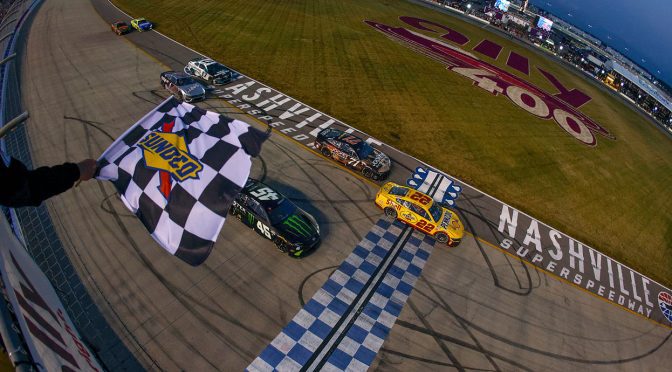
This past weekend’s five-overtime finish at Nashville was certainly one way to end a race. After a Cup Series record number of OT restarts — producing 31 extra laps — and with much of the field either wrecked or running out of gas, Joey Logano outlasted the competition to cross the start/finish line first on fumes.

For some, it made for an exciting conclusion to a race with plenty of twists and turns. But there was also plenty of chatter about whether the rule around unlimited green-white-checkered finishes needed tweaking. While it’s true that Sunday’s extended OT was historic — not exactly something that happens every week, as Dale Earnhardt Jr. pointed out — it is also true that overtimes are generally on the rise in the Cup Series over the past few seasons:

A graphic depicting the rise of overtimes in the NASCAR Cup Series

If overtime affects the outcome of nearly a third of races now, it might be worth looking back at what has been tried before, as well as looking around at what other options might be to provide the best balance between a thrilling finish and what’s fair (while also making safety a top priority). So in that spirit, let’s see what kind of cues NASCAR might take from its own history, as well as what a hypothetical — and possibly quite silly! — adaptation of other sports’ overtime rules to racing might look like.

NASCAR’s history

NASCAR itself used to simply have races finish under yellow if there was a late-race caution, which is the most straightforward — but perhaps also the most unsatisfying — way to handle the end of a race in the event of a late flag. The old policy also used to provide for racing back to the line on a caution, which is exciting but potentially very dangerous. This led us to the modern green-white-checkered rules in 2004, which initially began with a cap on attempts before moving to unlimited tries in 2017.

The old-school policy is clearly untenable for safety reasons alone, but there is an argument to be had for returning to a limit of three restarts — as the Cup Series’ rules dictated from 2010-15 — to avoid situations where running out of fuel becomes a widespread problem like it was on Sunday. Of the six races that have gone to OT this season, four only involved one restart, one involved two restarts (the Autotrader EchoPark Automotive 400 at Texas Motor Speedway) and one involved five. So most of the time, a cap on OT restarts wouldn’t have made much of a difference anyway, but it would provide the crew chiefs with a measure of certainty about exactly how much fuel their cars will need to finish the race.

NFL

The Rule: One 10-minute OT during the regular season, continuous 15-minute OTs in the playoffs. Each team gets at least one possession (unless, in the regular season, the first team on offense scores a touchdown). If the game is still tied after those first possessions, the next score wins.

Possible NASCAR variant: The NFL rules place an emphasis on touchdowns over field goals, and rightly so — putting more distance on the scoreboard between yourself and the opponent is a good thing. So a NASCAR version might involve the race ending early if the leader is able to build a lead of a certain interval (in seconds, perhaps varying by track) by the time they cross a particular scoring loop, regardless of whether they’ve taken the white flag yet. And like the NFL, NASCAR could also experiment with different rules for playoff races versus the regular season.

College Football

The Rule: Each team gets possession at the opponent’s 25-yard-line; the leader after those possessions wins. Otherwise, they alternate possessions until a winner is determined, with teams having to attempt a 2-point conversion after TDs starting with the third OT.

Possible NASCAR variant: For better or worse, college football’s OT policy shrinks the game (and the field) down to its most exciting essence. Racing’s version of that might be a drag race to the start-finish line over less than a full lap — whether that is a point on the backstretch, or somewhere else — with the winner claiming the spoils no matter what (since nobody would be racing through any carnage created behind them).

Kyle Larson leads a restart at Richmond

MLB

The Rule: A runner is placed on second base at the start of each extra inning, to encourage additional scoring and determine a winner more quickly.

Possible NASCAR variant: The so-called “ghost runner” rule may be among baseball’s most unpopular tweaks under commissioner Rob Manfred, but it does achieve its desired effect of reducing the number of mega-long (13+ inning) games. Racing’s version might involve “ghost laps” — having the leader restart OT further down the track than the driver in second place (and second place starting ahead of third, etc.) to give them a better chance of taking the white flag and ending the race.

NBA

The Rule: Continuous 5-minute overtime periods until a winner is determined.

Possible NASCAR variant: Basketball probably has the most normal OT rules of any sport, which makes sense — it’s also the highest-scoring game, so the odds of one team being ahead of the other after an extra period are pretty high. Because these rules are so basic, they probably most closely mirror NASCAR’s current system of continuous green-white-checkered restarts, or even the original method of finishing under yellow if necessary.

NHL

The Rule: Continuous 20-minute, sudden-death 5-on-5 OT in the playoffs. Five-minute 3-on-3 sudden death OT in the regular season, followed by a 3-round shootout if tied after OT. 

Possible NASCAR variant: Like NASCAR, hockey’s overtime rules have changed a lot over the years. Originally, the NHL allowed ties, but they moved to the shootout in 2005 and further tweaked the rules to reduce the number of skaters on the ice for OT. Following that trend, NASCAR’s version of this might limit the number of cars on track for an OT restart — say, only involving the Top 10 at the end of regulation and sending the rest of the drivers to the pits. This would ensure that the winner was among the late leaders and reduce the number of rear-of-the-field cars that might bring out a yellow flag, though the battle to be among the Top 10 at the end of regulation could be desperate enough to cause unintended negative consequences.

Soccer (World Cup)

The Rule: Teams play two extra 15-minute periods if tied after 90 minutes of regulation. If they are still tied, the winner is determined through a five-shot penalty shootout.

Possible NASCAR variant: The big complaint about shootouts (whether in soccer or hockey) is that they reduce the main actions of the sport down to a glorified mini-game competition. But if NASCAR were to go the same route, they might have the two leading drivers after regulation engage in dueling qualifying-style laps, with the fastest time earning the victory. Or, to really lean into the gimmickry, they might also have the speed of the team’s pit crew factor into the result. Embrace the shenanigans!


Should NASCAR enact any of these changes wholesale? Ummm, probably not. But there may yet be some interesting twists worth thinking about by making comparisons with other sports. And whatever happens to the OT rules, one thing is for sure: They will always create conversation, no matter what the powers-that-be decide to do.

Neil Paine is a freelance writer whose work also appears at ESPN.com, The Philadelphia Inquirer, Sherwood News and Substack. He is the former Sports Editor at FiveThirtyEight, and was also a consultant for the NBA’s Atlanta Hawks.

Here’s what’s happening in the world of NASCAR with Nashville in the rearview and the Chicago Street Race (Sun., 4:30 p.m. ET, NBC) right around the corner.

THE LINEUP ️

1️⃣ The intensity only ramps up from here

2️⃣ Can anybody beat SVG?

3️⃣ How Joey Logano’s fuel-saving efforts won Nashville

4️⃣ How do you get to the playoffs? Stage points, stage points, stage points

5️⃣ Catch the pack — news and notes from around the garage

joey logano celebrates at nashville
Getty Images

1. The intensity only ramps up from here

It’s hard to believe a two-time champ’s win could shake up the playoff situation so much, but plenty of drivers are feeling the heat after Nashville.

Take a hard look at the photo above of Joey Logano after climbing out of his No. 22 Team Penske Ford, moments removed from outlasting the field through a record five NASCAR Overtimes for his first victory of 2024.

That’s a two-time NASCAR Cup Series champion and 33-time Cup race winner who’s about as fired up to claim a checkered flag as anybody we’ve seen this year in any series.

Winning just meant that much right now.

There was legitimate, somewhat unspoken concern among the No. 22 group, one of the most heralded in the sport, that a playoff miss was on the table. Instead, “Sliced Bread” rose to the occasion and delivered for his team, which is now well positioned as we enter July.

Logano’s Nashville triumph ensured that Team Penske — an organization that hadn’t won in 2024, period, until just five races ago — became the first team to land all of its full-time drivers in the playoffs with a win. While the other powerhouse teams in Hendrick Motorsports and Joe Gibbs Racing currently slot all four of their drivers in, Roger Penske’s bunch is the only one sleeping tight at the moment. The pressure and intensity are only going to increase every week from now until Darlington, and anybody without a win isn’t sitting comfortably at the moment, including JGR’s Martin Truex Jr. and Ty Gibbs and Hendrick’s Alex Bowman, who all looked like playoff locks a few weeks ago.

With Logano leaping off the elimination line all the way to ninth in the playoff standings, that moves Bowman down to last in the provisional playoff grid despite what, in some facets, is shaping up to be a career-year numbers-wise as he’s one of just five drivers with double-digit top 10s. He’s relatively safe for now at 51 points above the bubble, but if any of the drivers below him find their way into Victory Lane over the next seven races,  we could be looking at the No. 48 Hendrick Chevrolet — a car that once won five straight titles — missing the playoffs for a second year in a row. (And if Bowman does make it, it’s worth noting he’s the only driver currently in the provisional field without any playoff points.)

Bowman isn’t the only one who would be in serious trouble, however. Spots 13th to 16th in the standings are separated by just 19 points, so a new winner outside the top 16 would send shockwaves throughout.

With the unpredictable nature of almost every track remaining before the field of 16 locks in, it feels inevitable that there will be.

shane van gisbergen celebrates at chicago
Getty Images

2. Can anybody beat SVG?
<
Shane van Gisbergen put on a clinic — in his NASCAR debut — to win the inaugural Chicago Street Race. Has the field caught up to him, though?

It’s always funny when listening to sports prognosticators talk about whether an athlete “can” accomplish a goal or beat a particular opponent, etc., when more often than not the correct word should be “will.” Of course it can happen. It’s sports, just about anything can happen — the question is really “will this happen” or “won’t it happen?”

For the above question, I very specifically mean “can.” Literally — can anybody beat Shane van Gisbergen this weekend? Like, is it actually possible?

It’s been a year, and plenty more incredible things have happened since, but let’s please remember just how ridiculously impressive SVG’s outmaneuvering of the field in the inaugural Chicago Street Race was. It was his first taste of action in any NASCAR series, with extremely limited seat time before the green flag flew, with a team/project in its infancy driving for a group of essentially strangers to the New Zealand native and he still rode to Victory Lane after biblical storms blew through the Windy City.

Given that set of circumstances still produced a win, it feels fair to question if SVG is just going to be untouchable on this track — the only one of its kind on the circuit — for the foreseeable future.

Even the drivers, themselves, aren’t so sure if he’s beatable.

“I don’t know. It’s going to be interesting to see,” defending Cup champion Ryan Blaney said last month at New Hampshire Motor Speedway. “Obviously, he’s really talented. I’ve been enjoying watching his inaugural Xfinity season. He’s a good guy. I’ve gotten to talk to him a good bit, and he loves the sport and really enjoys it. I don’t know if he’ll have as much of an advantage this year because everyone was kind of in the same boat last year as far as first time there, but he raced on a lot of street courses, and the V8 (Supercars) stuff and the rain and all that craziness that went on. He probably had a little bit of a leg up on everybody and it showed, and he took advantage of it and won the race. Hopefully, we can all draw a little bit closer to him at that place to where he doesn’t embarrass us like he did last year. We’ll see, though.”

Van Gisbergen now has an additional four Cup starts — two of which were road courses — under his belt, along with two victories in the 17 Xfinity Series races he’s run this year as he seeks a title there. He’s now an official American resident as well, and he’s no doubt more comfortable on the general NASCAR side of things than he was a year ago. And a comfortable driver is a fast driver, especially on a type of track that he knows especially well and certainly better than anybody else in the field.

The rain was a clear factor in last year’s race, with SVG looking like a duck amongst cats as he splished and splashed around the tight, 12-turn city streets with ease while the other 36 cars tip-toed cautiously.

Should Sunday’s race be run in the dry, however, it could tighten things up.

“I don’t think it will be as much of an advantage (if it doesn’t rain), but there’s no doubt that street courses seem to be his wheelhouse,” Logano said at NHMS. “There’s no doubt he’s good on road courses as well, like the typical road courses. He’s great at those as well, but it did seem like a street course he felt way more at home when we all felt like a fish out of water going around that race track. Then you added rain. It was perfect for him and he capitalized as he should. For 99% of the field that was the first time for any of us to do anything like that and we all have very limited experience of racing in the rain.

“We also had a lot to lose where he had nothing to lose. … Like, you look at those walls and it is like, whoa, there are a lot of points in those walls. For him, who cared? I think all those things weighed into it for sure. I think this year, now that we all have a general idea of what we’re going into, we can prepare for it. It’s hard to prepare for something when you’re blind and you don’t know what it’s going to be like. I’m sure he’s still going to have a lot more experience with this stuff than we do, but I think we’ll close the gap a lot.”

3. How Joey Logano’s fuel-saving efforts won Nashville

NBC’s Steve Letarte and MRN’s Todd Gordon break down how Joey Logano won at Nashville Superspeedway by saving fuel.

4. How do you get to the playoffs? Stage points, stage points, stage points

Obviously, the best path to the postseason is with a race victory — but a look at the elimination bubble shows the importance of maximizing stage points, too.

RankDriverTotal points+/- to elimination lineStage Points
12Martin Truex Jr.591+143141
13Ty Gibbs518+7093
14Ross Chastain514+6666
15Chris Buescher504+5662
16Alex Bowman499+5170
17Bubba Wallace448-5176
18Chase Briscoe421-7833
19Kyle Busch395-10459
20Josh Berry368-13146
21Todd Gilliland367-13235

5. Catch the pack — news and notes from around the garage

Paint Scheme Preview: Chicago

NASCAR betting: Opening odds for Chicago

Risk vs. reward runs high on Chicago Street Course, where hazards, SVG loom

Chicago Street Course comes to life ahead of race weekend

NASCAR official explains Kyle Busch’s restart placement in Nashville OT

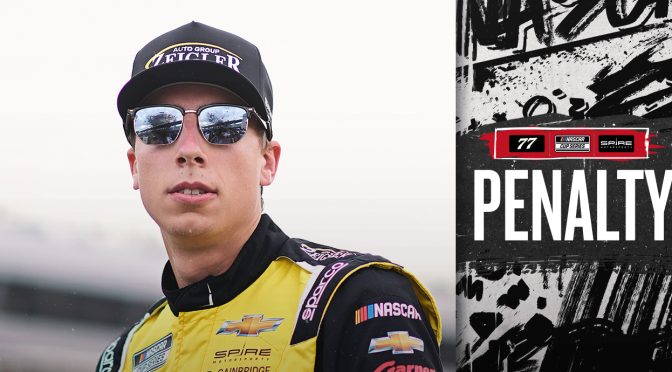
Penalty report: Carson Hocevar, No. 77 team issued loss of 25 driver points

AM Racing taps Joey Logano as Xfinity fill-in for Hailie Deegan at Chicago

Shane van Gisbergen isn’t sneaking up on anyone this year.

Ahead of the inaugural NASCAR Cup Series race on the Chicago street course last year, the New Zealander opened at 100-to-1 odds to win it. SVG drew immediate action from bettors and rewarded his backers with a first-place finish.

For Sunday’s version of the event, the Grant Park 165, van Gisbergen opened at 10-to-1 odds at the Westgate SuperBook in Las Vegas. Despite that drastically shortened price, bettors remain interested.

In fact, by the time the SuperBook was ready to take bets outside of Nevada, a customer in Vegas had already placed a wager on the No. 16 Wendy’s Saucy Nuggs Chevrolet. That bet prompted a move to +800, and the SuperBook took another bet at those odds.

RELATED: Chicago schedule | Opening odds

Ed Salmons, vice president of risk management at the SuperBook, understands the SVG sentiment. A crash on the last lap and a 30-second penalty at the Circuit of the Americas on March 23 kept van Gisbergen from sweeping this year’s three Xfinity road course races so far. He led 20 of the 50 laps that day in Austin.

“There’s no doubt” SVG should be among this week’s favorites, Salmons told NASCAR.com. “There have been three road course races in the Xfinity Series (this year), and he’s won two of the three (Portland, Sonoma). And he should be three-for-three.”

Jim Sannes, managing editor of digital media at FanDuel Research, understands van Gisbergen’s position near the top of the Chicago oddsboard, but the driver is priced too short for Sannes’ tastes.

“It’s just hard for me to get there, given he’s not in the highest-end equipment, even if we know the driver matters a bit more here,” Sannes said in a DM. “I have SVG at 5.6% to win (which translates to about +1690 odds), which could very well be too low. I just respect the Cup Series regulars enough to think they’ll improve as they head back to the track for a second time.”

A different-looking oddsboard

Beyond van Gisbergen, the Grant Park 165 oddsboard features a handful of other drivers adept at road racing who are priced ahead of Cup superstars from top garages. We see names like Chris Buescher, AJ Allmendinger and Michael McDowell with shorter odds than Denny Hamlin, Joey Logano and Ryan Blaney.

Here are odds, as of Wednesday, from three top sportsbooks – the SuperBook, BetMGM and DraftKings:

DriverSuperBookBetMGMDraftKings
Kyle Larson+600+600+600
Tyler Reddick+600+600+650
Christopher Bell+600+600+600
Shane van Gisbergen+700+550+500
Chase Elliott+1000+750+800
Martin Truex Jr.+1400+1200+1200
William Byron+1400+1400+1400
Chris Buescher+1400+1400+1600
AJ Allmendinger+1400+1400+1400
Michael McDowell+1600+1200+1200
Ty Gibbs+1800+1600+1600
Ross Chastain+3000+2500+2800
Denny Hamlin+3000+2000+3000
Daniel Suárez+3000+3000+2800
Kyle Busch+3000+3000+2800
Ryan Blaney+4000+2500+3500
Austin Cindric+4000+3000+4000
Joey Logano+5000+5000+4000

Driver skill, of course, gets weighted more heavily on road courses than it does on ovals.

“I agree with the betting markets in putting guys like McDowell and Allmendinger ahead of the regular contenders,” Sannes said. “Back in the day, when there were only two road-course races per year, it was fine to let overall form play a bigger role in trying to predict who would excel. But now that we have bigger samples on road courses, we can see that expectations for guys like McDowell genuinely should be higher than they are for the others, so my model fully agrees with the market in that regard.”

McDowell, per Salmons, is among the drivers drawing early bets at the SuperBook.

However, the increased emphasis on road course racing on the Cup circuit has helped create a more wide-open field. This year’s schedule includes five road/street races.

In seasons past with just two such events, “you could pick your six guys that could win the race,” Salmons recalls.

Chase Elliott was tops among that select group, automatically priced as the favorite every time Cup drivers were about to go around more than four turns. As drivers gained road racing experience, the field caught up, and Elliott can be found this week at 10-to-1 odds.

Around the track

Here are some other drivers to watch on the Chicago streets on Sunday:

• A poorly-timed caution likely kept Christopher Bell from winning this race in 2023. He could be had at +2500 ahead of last year’s event, but nothing near that juicy is available for Bell this year. Still, he’s among the most popular bets at the SuperBook this week.

• Sannes has McDowell and Kyle Busch both circled this week. McDowell wins 7.9% of Sannes’ simulations (a play at +1200 or better), and Busch is at 4.6% (+2100 or better). “Not only have they raced really well on road courses the past two years, but both must win if they want to make the playoffs,” Sannes said.

• Some bettors can’t seem to stay away from Hamlin, and Salmons is just fine with that. “It’s funny, every time we have one of these road course races, literally the first bet is Denny Hamlin at 30-to-1, and it didn’t fail to happen again.” Salmons wrote bets on Hamlin at the same price for COTA and Sonoma. Hamlin remains +3000 at the SuperBook as of Wednesday.

• While bookmakers and bettors are armed with more road racing data, including that from a run over this course last year, expect the odds to shift on Saturday. “Obviously where they qualify and what practice looks is going to dictate the odds really strongly,” Salmons said.

Marcus DiNitto is Senior News Editor at Gaming Today. He’s been covering sports business for 25 years and sports betting for 12. NASCAR is among the many sports Marcus enjoys betting but often loses on. Follow him on Twitter.

Melissa Fifield operates both Pine Knoll Auto Sales and her NASCAR Whelen Modified Tour race program out of New Hampshire.

Elizabeth Nelson operates Farm Fueled Nutrition out of Montana.

Thanks to their shared values as female business owners, their mutual passion for nutrition and a little twist of fate, the women who were complete strangers five months ago are now operating as partners as Fifield works through her 11th Modified Tour season.

Their connection is a warming success story in a sport fueled by the often cold business of promotion.

RELATED: All the latest Modified Tour news

Melissa Fifield is honored for her 150th Modified Tour start, which occurred at New York’s Riverhead Raceway earlier this season. (Photo: Adam Glanzman/NASCAR)

Fifield’s expedition through the world of racing is defined by perseverance. On the heels of a childhood full of karting competition, the 31-year-old Wakefield, New Hampshire native continues to race her own Modified full-time on the Tour despite a relative lack of resources. She does so because she’s addicted to the adrenaline a Modified race provides. “Everything slows down. I’m in my own world. I love that moment,” she explained earlier this year.

When she’s not working on her race program, Fifield can be found operating the car dealership that funds her life both inside and outside a race car. In other words, she’s always working.

Fifield’s story is what resonated when Nelson received a random outreach in January.

Elizabeth Nelson
Elizabeth Nelson of Farm Fueled Nutrition

Fifield’s health journey prompted her to seek out a dietary supplement that would provide whole nutrition with real ingredients. Her search led her to Farm Fueled Nutrition, a brand-new product. Upon researching the superfueled greens, she realized Nelson’s status as the owner and operator.

“I discovered it was another female-owned business,” Fifield said. “I wanted to reach out to her to see if there was anything we could do to work together.”

Added Nelson: “I didn’t know her from anything, to be honest. Of course I know NASCAR, but being this far North and West away from it all, I [had to search] what she raced.”

Nelson’s research into Fifield’s career left her nothing to consider.

“I was on board pretty much from the start,” Nelson said. “I just love that she’s going after her dreams; it’s similar to my vision of Farm Fueled Nutrition. I love sponsoring someone like that. It’s what my business stands for.

“What it takes to be in that arena, in a sport dominated by men. The amount of work that has to be done; just a lot that goes into doing what she does. I’m super proud of her.”

Nelson agreed to partner with Fifield heading into the 2024 season, and the black-and-pink No. 01 Modified has displayed a Farm Fueled Nutrition decal all season. When the Modified Tour races at New Hampshire’s Monadnock Speedway on July 20 and at New York’s Lancaster Motorplex on Aug. 3, Farm Fueled Nutrition will be the primary featured sponsor on Fifield’s car.

Fifield is hoping to host Nelson in person for the first time at either of those races, if not an event later in the season. Nelson’s hectic schedule makes travel to the East Coast a little difficult to manage.

“It’s been a great partnership so far,” Fifield said. “It just kind of came together as something really unique that just happened. We had a similar story with both of us being on a journey. She had just gotten this product launched, and she loved being able to support another female-owned business.”

Melissa Fifield
Melissa Fifield (Photo: Adam Glanzman/NASCAR)

Nelson said she’s open to continued support of Fifield’s program beyond this season, though the two have not yet discussed a longer-term partnership.

Fifield, of course, wants to continue racing as long as she can. She’s in the process of moving both her life and her business to the Charlotte, North Carolina area, where her fiancé lives and works. She doesn’t expect the relocation to impact her ability to continue full-time on the Modified Tour.

As her career progresses, Fifield will need more partners.

Few, though, will be as special as the association she’s forged out of the blue with a business owner located more than 2,000 miles away.

CONCORD, N.C. — Josh Berry’s future in the NASCAR Cup Series is plenty safe.

The 33-year-old rookie will pivot to the No. 21 Wood Brothers Racing Ford on a multiyear deal beginning in 2025, the team announced Wednesday at the Ford Technical Center. Berry, the current driver of the No. 4 Stewart-Haas Racing Ford, immediately began searching for a new opportunity at the Cup level once SHR announced May 28 it would shutter its four-car operation at the conclusion of the 2024 season.

What he found was a team that was keen on him, his abilities and which improvements he could bring to the storied Wood Brothers program.

“I think Josh was the obvious choice,” team president Jon Wood said.

RELATED: Josh Berry driver page | Wood Brothers team page

“This really feels like a great fit for me,” Berry said. “I feel like I fit their brand and who they are and how I got here, how they got here. I feel like this is a great fit. I really enjoyed our relationship with Ford and to continue that on was something that’s important to me, and I appreciate and I’m thankful to have that opportunity. And it really just means a lot to drive an iconic car like the 21.”

Berry leaps to a Wood Brothers team affiliated with Team Penske, featuring two-time Cup champ Joey Logano, defending series champion Ryan Blaney and 2022 Daytona 500 winner Austin Cindric. Having those drivers as resources as well as the data shared between the four teams — three at Penske in addition to the Wood Brothers’ 21 — excited Berry as he considered what options were on the table to remain in the Cup Series.

“I have a great opportunity to come in here and help be a part of getting them back to running where they want to run and where they expect to run,” Berry said, “and I have the same expectations. I feel like that between everyone here at the Wood Brothers, between the affiliation with Team Penske and Ford, I think we have the pieces in place to be competitive. And I think where I’m at with the Next Gen car, I think we’ll be able to hit the ground running.”

Before meeting with Berry, the organization met with his current teammate Chase Briscoe, whose relationship with Ford dates back to 2018 when Briscoe joined the manufacturer’s development program. But once it became clear Briscoe would instead be heading to Joe Gibbs Racing in a Toyota next year, Wood made it clear Berry was who the team had primarily targeted.

“The steps with Chase, that was — I’m not gonna call it a formality, but we had to we had to talk to Chase because of our relationship and Ford’s relationship with Chase,” Wood said. “It was very clear from the beginning that he already had either an offer or a deal in place, so we just completed those steps, checked all those boxes. And as soon as we knew that we were ready to move on to the next driver, Josh was the obvious choice.”

With Berry’s arrival comes the departure of Harrison Burton, who has driven the No. 21 Ford since 2022. In 91 starts with the Wood Brothers, Burton has one top five and five top-10 finishes. Burton has a 26.7 average finish through 19 races in 2024, two spots lower than his 2023 average, and ranks 33rd in points ahead of Sunday’s race at the Chicago Street Course (4:30 p.m. ET, NBC, MRN Radio, SiriusXM NASCAR Radio, NBC Sports App).

“We need to be better. There’s no secret,” Wood said. “This is a business that’s based on chemistry, and it’s a sport that’s based on results, and right now, we’re just not having those results. You know, Harrison shares some responsibility. If it’s on us — we’re not pointing fingers. We’re not here to say this one’s at fault; that one’s at fault. We’re just not where we need to be, and so finding that right chemistry and balance to have those results and performance, that’s what we’re looking for.”

MORE: All of Wood Brothers Racing’s Cup wins

Berry and his current team on the No. 4 Ford have impressed consistently over the past two months despite what has become a lame-duck season as the organization around them will close by the season’s end. Berry has one top five and two top 10s in the past three races, including a strong showing at Iowa Speedway in which he led 32 laps before finishing seventh. He also scored third-place finishes at both Darlington Raceway in May and New Hampshire Motor Speedway in June, in addition to a 10th-place showing in the Coca-Cola 600 at Charlotte Motor Speedway.

While all of that is worthy of recognition itself, Wood also pointed to his 2023 performances as a substitute racer for Hendrick Motorsports’ Nos. 9 and 48 Chevrolets as Chase Elliott and Alex Bowman were each sidelined by injuries — putting Berry’s adaptability on full display.

“He ran arguably as good or better in that short time in the two Hendrick cars that he has now — as a rookie with never even sitting in (a Next Gen car),” Wood said. “And that was a completely different manufacturer, a completely different team, a completely different crew chief. So you can’t really say it was one crew chief that made that difference.”

A crew chief for next year’s No. 21 team with Berry has not yet been determined. Berry’s current crew chief, Rodney Childers, has expressed a desire to stay with Berry if those opportunities exist moving forward.

“Rodney and I’ve had a great relationship, for sure, but this opportunity jumped out, and they came to me and said, ‘Hey, we want to get you signed up first,’” Berry said. “’We want to get our driver that we want, and then we’re going to go to work with you and whoever else that we’re going to meet with, whether that’s at Team Penske or wherever, and try to iron this out and figure out what’s the best fit.’ That’s what I have learned this year is … how important the culture is in the fit and the belief between the driver and the crew chief, ownership, management and the team.”

Wood said sponsorship for the 2025 season is still being worked through but noted Motorcraft and Quick Lube will be back as a primary partner for roughly half the season and as an associate sponsor for the whole campaign.

“The thing that’s encouraging is people consider Josh a driver that you hire that doesn’t bring any funding. But that was past tense,” Wood said. “Like, the way he’s running, now, you don’t know what’s going to happen from this point to the end of the season that he brings some that have changed their mind that weren’t previously going to follow him that maybe do.

“But to answer that question, it has never been about a driver with funding. I know that was mentioned. But that has never been a consideration.”

Ultimately, Berry knew he was wanted as the Wood Brothers’ next driver of its iconic No. 21 Ford, kickstarting a new chapter of the Wood Brothers’ 70-plus year history as they seek the company’s 100th Cup win.

“It came together quickly because they were very sure of what they wanted, and that was they wanted me to drive their race car,” Berry said. “And in this day and age, that gets harder and harder to do — you know, worrying about funding and sponsorship and everything that goes along with that. So they were they were very clear. I met with them and had something to look at within a week. And that made it pretty clear that they wanted me to drive their car, and it felt like a great fit for me.”

On Wednesday, NASCAR announced the following penalty has been issued:

Name: Clifton Yarbrough
Rules infraction:
Penalty Level: Behavioral
12.6.1 Member Conduct Guidelines
B.1. Disparaging the sport, leadership and/or a NASCAR Home Track or the tracks representatives.
E.1. Statement and/or communication made public (including social media platforms) that demeans, criticizes, ridicules, or otherwise disparages another person based upon that person’s race, color, creed, national origin, gender, sexual orientation, marital status, religion, age, or handicapping condition.

Penalty:
$1,000 fine. Suspended from all NASCAR until the fine is paid. Probation until December 31, 2024.

NASCAR officials issued penalties Tuesday for infractions in the Cup Series and Craftsman Truck Series in last weekend’s events at Nashville Superspeedway.

Carson Hocevar, driver of the Spire Motorsports No. 77 Chevrolet, was fined $50,000 and assessed a loss of 25 driver points for violating Sections 4.4B: NASCAR Member Code of Conduct Penalty Options And Guidelines during Sunday’s Ally 400. Hocevar’s No. 77 Chevy made contact with Wood Brothers Racing’s No. 21 Ford driven by Harrison Burton under yellow, causing the latter to spin out.

RELATED: Cup Series standings | Weekend schedule: Chicago

In post-race inspection after Christian Eckes’ victory in Friday’s Rackley Roofing 200, Matt Mills’ No. 42 Niece Motorsports Chevrolet and Matt Crafton’s No. 88 ThorSport Racing Ford were each found with one unsecured lug nut. This violates Sections 8.8.10.4a: Tires and Wheels of the NASCAR Rule Book. As a result, crew chiefs Jon Leonard (No. 42) and Jeriod Prince (No. 88) were each fined $2,500.

The Cup Series next races on Sunday in the streets of Chicago in the Grant Park 165 (4:30 p.m. ET, NBC, MRN Radio, SiriusXM NASCAR Radio, NBC Sports App). The Truck Series, meanwhile, will next compete on July 12 at Pocono Raceway in the CRC Brakleen 175 (5:30 p.m. ET, FS1, MRN Radio, SiriusXM NASCAR Radio).

MORE: Cup Series schedule | Truck Series schedule

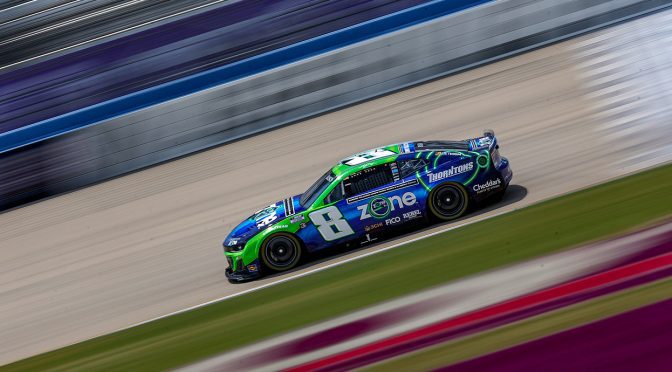
Richard Childress Racing driver Kyle Busch was not deemed to be involved in Sunday’s NASCAR Overtime restart wreck at Nashville Superspeedway, NASCAR Cup Series Managing Director Brad Moran explained Tuesday in a radio appearance with SiriusXM NASCAR Radio.

Though his No. 8 RCR Chevrolet did make contact with the wall in the aftermath of an incident between Kyle Larson and Ross Chastain on the second of a series-record five overtimes, Busch was lined up in the fourth position for the ensuing green flag despite slowing to avoid the incident and getting passed by other cars as a result.

RELATED: Nashville results | Playoff standings

“It’s not so much getting his spot back. His spots weren’t taken away,” Moran said. “Our rule clearly states that you must maintain a reasonable speed — reasonable speed for what track conditions are at the time. We don’t want to encourage drivers to stay on the gas and just bang their way through. What he did was he avoided the incident. We deemed him not involved in that incident. He didn’t stop. If he stopped, he probably would have ended up toward the back of the field.

“He was scored in the fourth-place position when that caution came out, and he didn’t get into the 1 (of Chastain) or the 5 (of Larson). Made very sight contact with the wall. We would deem that as not being involved in the incident, and that’s why he was able to restart where he was scored.”

The determination was also based on scoring-loop data, which NASCAR officials monitor in real-time during the race and showed Busch in fourth place at the time of the incident.

“That was right off the scoring loop; loop No. 4,” Moran said. “That was the last loop that the leaders were scored on. It really came down to, do we view him as being involved in the wreck? We determined he avoided being involved in the wreck.”

Later in the race, Larson’s No. 5 Hendrick Motorsports Chevrolet ran out of fuel in front of Busch, collecting the No. 8 in a separate incident and saddling the two-time Cup Series champion with a 27th-place finish.

NASCAR Cup Series drivers came away with two major learnings from last year’s Chicago Street Race — one, that the strict demands of street-circuit racing presented a challenge, and two, how much Shane van Gisbergen was up for it.

Cup Series regulars — and the defending race winner who made the initials “SVG” a summer sensation in 2023 — are back for Round 2 in Sunday’s Grant Park 165, scheduled for Sunday at 4:30 p.m. ET (NBC, MRN Radio, SiriusXM NASCAR Radio, NBC Sports App). There’s still some novelty for NASCAR’s top division in the street-circuit discipline, but most of the field now has at least a one-off experience after last year’s inaugural.

RELATED:  Weekend schedule: Chicago | Street course takes shape

That doesn’t mean it’s any easier, with crisis potentially looming at each corner.

“How many turns are there … 20? Then 20 of them,” Trackhouse Racing’s Ross Chastain said with a laugh last weekend, nearly doubling the 12-turn total for hyperbolic effect on where treachery can be found. “I swear, I didn’t have a comfortable corner there last year. I just couldn’t get comfortable … like I wasn’t right off the bat, and it never came throughout the race. So yeah, looking for a lot more there and just being comfortable with it. I’ve had a year to wrap my head around what that was like; those concrete cannons between the walls. Yeah, all were difficult.”

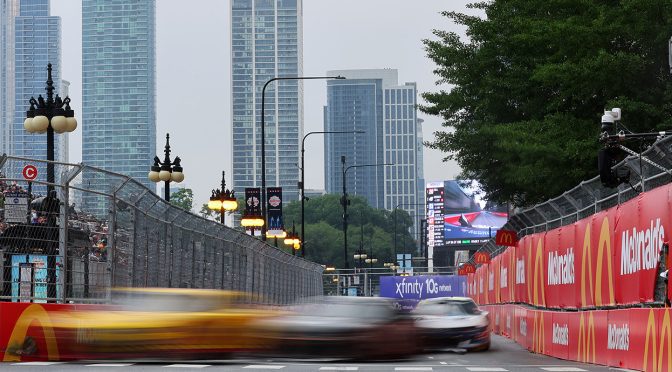
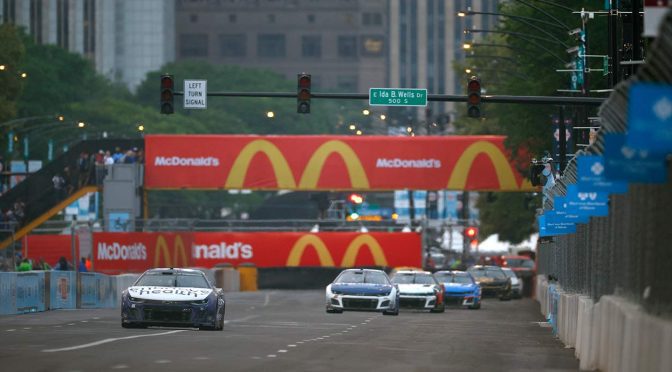
Comfort was in stingy supply during last year’s first go-round, in large part due to the confines of the circuit’s design. The borders around Chicago landmarks and thoroughfares shape a 2.2-mile course lined with barriers and tire packs, providing few areas where on-track miscues are easily forgiven.

Then there are the bumps from the heavily trafficked streets in the heart of a major metropolitan city of 2.6 million people, another hurdle that complicates how drivers hustle their cars in and out of the turns.

“Headache in a bottle,” Joey Logano, last weekend’s winner at Nashville, said with a laugh. “I mean, it’s just a tough one — lots of bumps, a very risky feeling. A lot of it’s just walls everywhere. There’s no runoff. So you overshoot a corner, as bumpy as it is, you lock up a tire, you slide, there’s no runoff, right?”

“It’s just super narrow,” said fellow Ford driver Chase Briscoe. “I say it’s narrow — it’s narrow for a lot of places we go, but for a street course, I thought it was honestly probably pretty wide. I just remember it being tighter in some areas than others. It was rough, really rough into some braking zones and just really unique. For a street course, you don’t think of having elevation but you come over that bridge a couple of times and the downhill braking, it’s just a hard place to pass, but it was really well done, I thought. It’s a track where you don’t get any break.”

MORE: Concert info, tickets, FAQs for Chicago

Pressed to single out one sector of the course that proved most technical last year, more than one driver mentioned the combination of Turns 3, 4 and 5 — the circuit’s closest point to Lake Michigan. The slight, faster bend of DuSable Lake Shore Drive feeds into tighter turns at Roosevelt, then Columbus before it heads back toward the course’s center.

“It’s the largest bumps, high-speed area, and the tightest and most unforgiving wall,” said Austin Cindric, a sixth-place finisher in last year’s Chicago debut, “and maybe I say that because I crashed there twice last year on Saturday, but definitely a big risk/reward section. Street-course racing is all about risk/reward — a lot of reward for being able to maximize the width of the race track, but obviously, that comes with a lot of risk when you’re dealing with concrete walls.”

The driver who dealt with the mouse-maze barriers most effectively was van Gisbergen, who launched into the stock-car consciousness with his rousing victory last year in his Cup Series debut. The New Zealand-born road-racing ace had built a fan following Down Under as a three-time champ in the Repco Supercars Championship circuit; his Windy City triumph last July came in the Trackhouse Project 91 entry that showcases international stars, and he more than delivered, becoming a bit of an overnight sensation.

The victory altered the trajectory of his racing career, and Trackhouse snapped him up for a NASCAR campaign this year in the States as part of a partnership with Kaulig Racing. He’s already scored two wins so far in his rookie Xfinity Series season, and he’ll be making his fourth Cup Series start of the year in Sunday’s Chicago showdown, driving the Kaulig No. 16 Chevy.

Chastain’s efforts to increase his comfort level on the Chicago streets have a natural input point with van Gisbergen, through their shared Trackhouse connection. Any and all tidbits about his technique have proved helpful.

“There’s just so much data we can look at, so I can learn just as much hearing from him as I can looking through his stuff, how he made speed compared to me,” Chastain says. “And it’s confidence, a lot of it is confidence. It’s intentionally placing the car where he wanted to place it, and I was trying to place it kind of between the walls and he was placing it at the wall, maximizing left and right. Easy to say it, but really hard to do it.”

That task was made even more treacherous last year, once the skies cleared after historic race-day rain. Van Gisbergen excelled in the damp conditions left by Sunday’s torrent, with his fancy heel-toe footwork on the pedals making the difference in his battle down the stretch with runner-up Justin Haley.

It’s what earned him a nod of recognition when Logano was asked if Chicago’s unique challenge was somehow fun.

“Kind of, if you’re Shane. Everyone else in the field might not agree,” Logano said. “I mean, it just fell right into his wheelhouse really, really well. And he’s just really good at clipping the corners right at the edge. I mean, he didn’t leave any room for error, and he can hit it really well.”