With eight NASCAR O’Reilly Auto Parts Series races officially in the books, the 2026 regular season is a third of the way complete. What have we learned in that span? Plenty — Justin Allgaier (and JR Motorsports as a whole) remains a victory machine. Jesse Love is holding strong in the hopes of defending his 2025 crown. And a NASCAR Cup Series regular (or two) can still hop behind the wheel and leave a winning message.
These storylines, plus new surprises, have shaken up the rankings since our preseason installment. So where does the full-time field currently stand? Let’s dive into it, with NASCAR.com’s John Crane ranking the top 10 drivers in the O’Reilly Auto Parts Series following action at Rockingham Speedway.
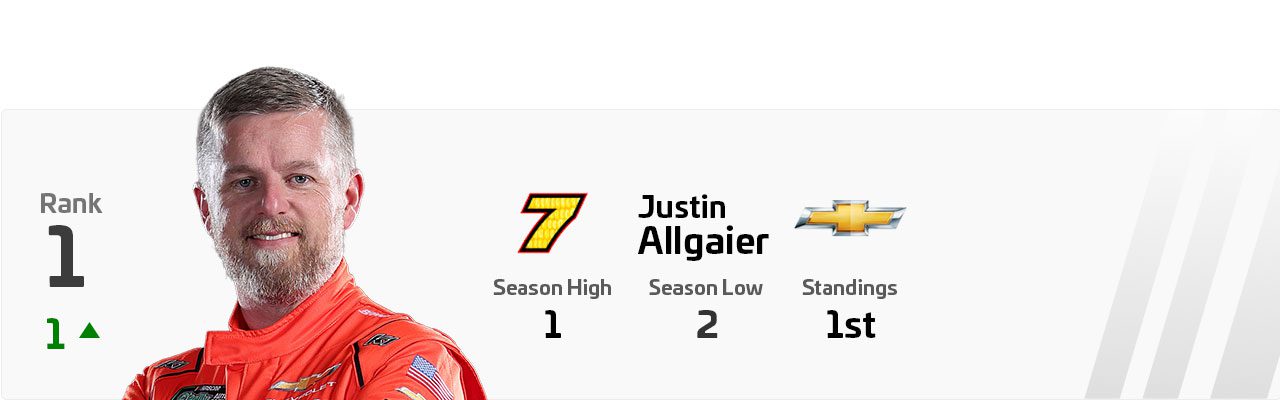
Analysis: With a 126-point lead in the driver standings following Rockingham, the 2024 O’Reilly champion Allgaier is the slam-dunk No. 1 in this installment. Let the box score do the talking: Allgaier has finished eighth or better in seven of eight races this season, with six of those results being top fours. It’s worth noting again that this is all in only eight races, and with his career high in wins in a single season at five (2018), it’s not entirely out of the realm of possibility that Allgaier doesn’t just beat that mark, but shatters it.
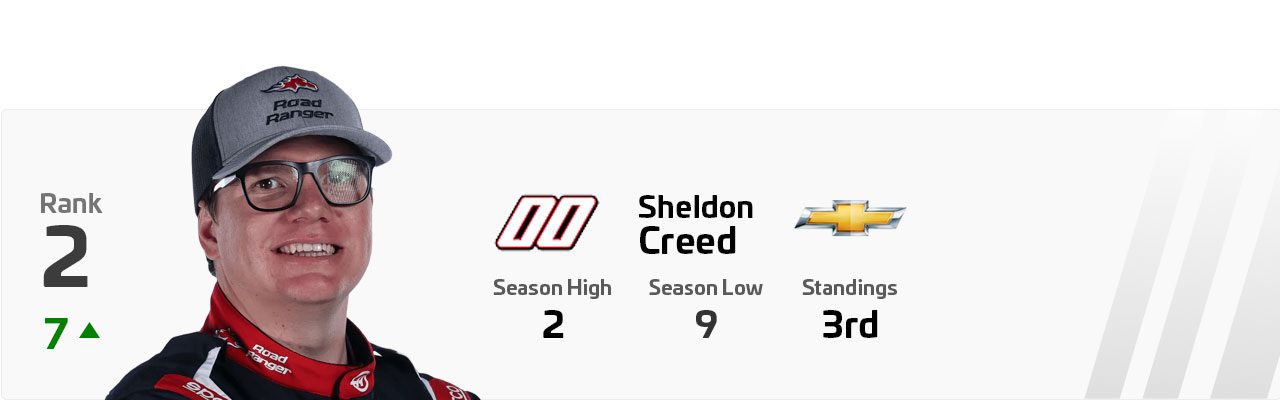
Analysis:At last! After so many close calls since his full-time leap to the circuit in 2022, the 2020 NASCAR Craftsman Truck Series champion finally captured his first career O’Reilly victory, doing so at EchoPark Speedway in thrilling, last-lap fashion. Though that remains Creed’s only victory so far this season, the winless monkey is off his back, and it’s been nothing but consistency since, with top-11 finishes in the six contests that have followed. Currently P3 in the driver standings with a ridiculous 7.5 average finish (second among full-timers), Creed isn’t going anywhere.
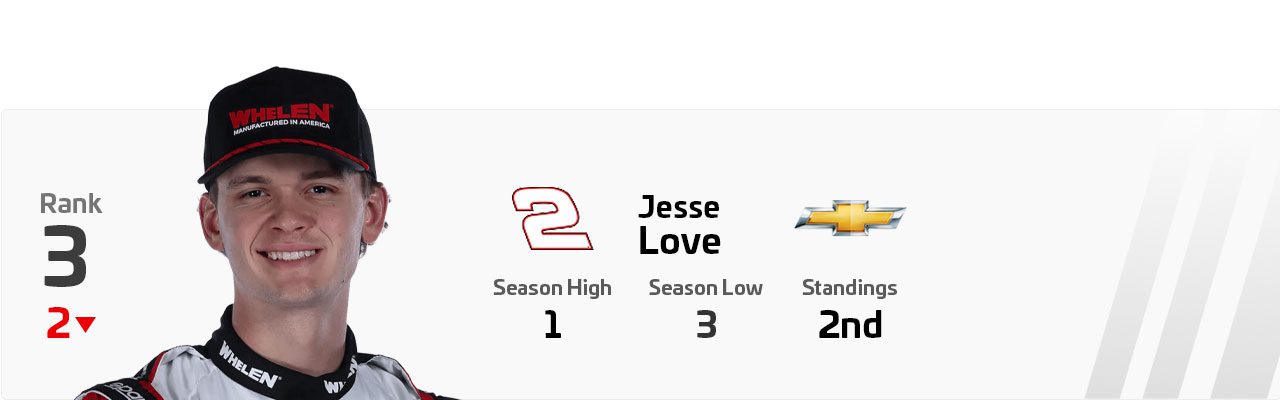
Analysis: After starting the campaign with five straight top 10s and seven finishes of 12th or better, Love’s steady stretch to begin 2026 came to a grinding halt at Rockingham, finishing two laps down in 27th. While the defending champion has yet to clinch a victory, Love has compiled excellent points performances, averaging 37 markers per race. As such, even with a rocky Rockingham, Love still ranks second in the driver standings. With a league-best 223 laps led, Love will be just fine.
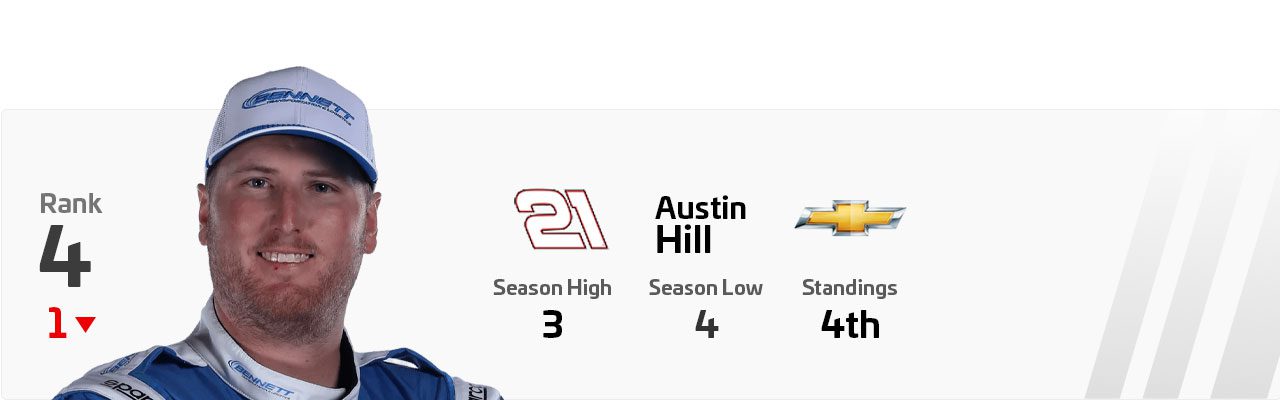
Analysis: Hill was up to his usual superspeedway tricks, winning at Daytona International Speedway to open an O’Reilly season for the fourth time in five years. Aside from a Darlington Raceway dud (which resulted in a 35th-place finish), Hill has been among the best in staying at the front, with a league-leading four stage wins and results of 12th or better in every other contest. There are areas to improve, though; after leading 112 combined laps at Daytona and EchoPark to begin the season, the 31-year-old Georgia native has led only 13 circuits since.
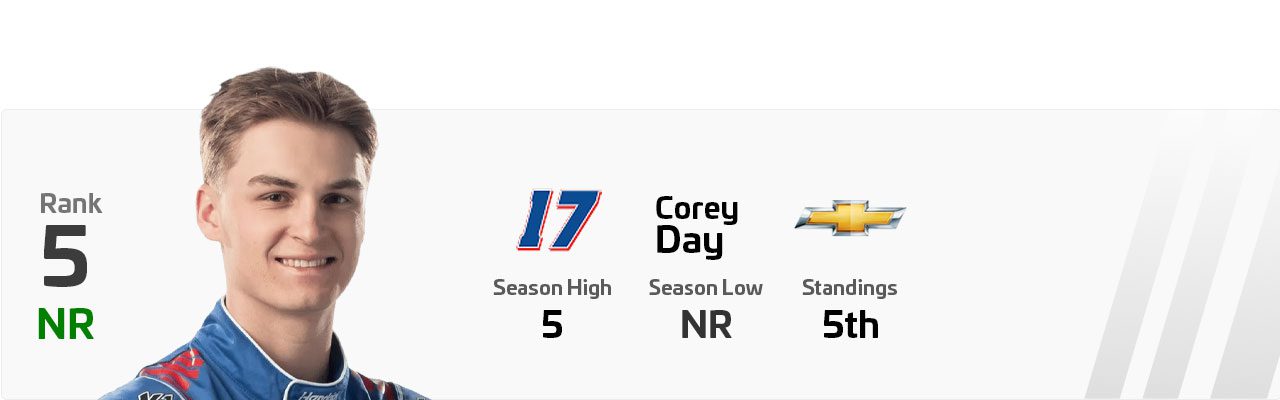
Analysis: Welcome to the club, Day. The 20-year-old Hendrick Motorsports farmhand has made his name known through the opening eight races, with seven consecutive top 10s after wrecking and finishing 27th at Daytona to begin the season. Starting from the pole at Rockingham and leading 118 laps has further illustrated Day’s ability to find and maintain race-day speed. Such a brisk — and, at times, aggressive — driving style by the O’Reilly rookie has drawn criticism from competitors, so this is worth monitoring.
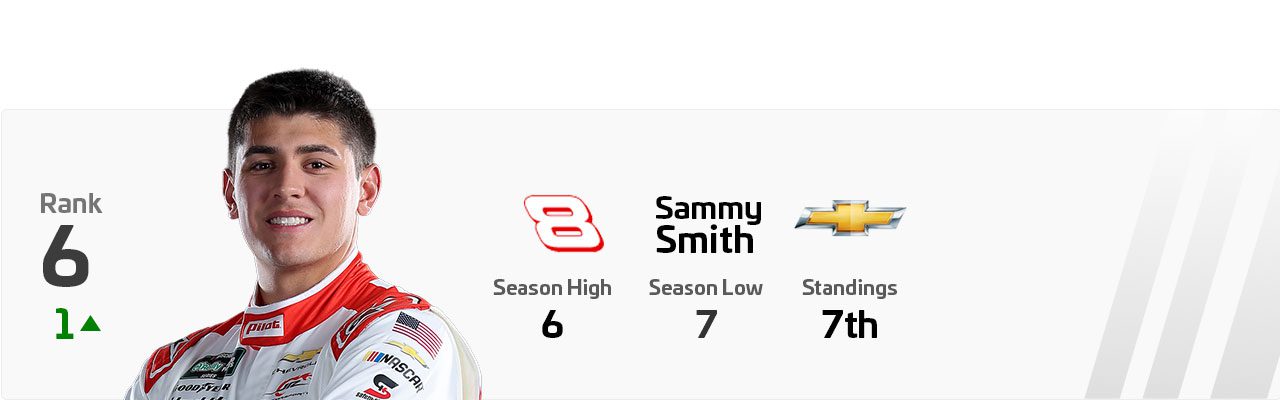
Analysis: After Allgaier (6.6), Creed (7.5) and Day (8.9), you’re looking at the driver with the best average finish among all full-timers (9.1). This is good! Now for the not-so-good: His 11 laps led rank 14th among all full-time drivers. The No. 8 driver is on pace to lead 45 laps this season, continuing a downtrend since leading 334 in 2023. Currently seventh in the standings, Smith will need to contend for more points (and wins) if he wishes to break into the upper echelon.
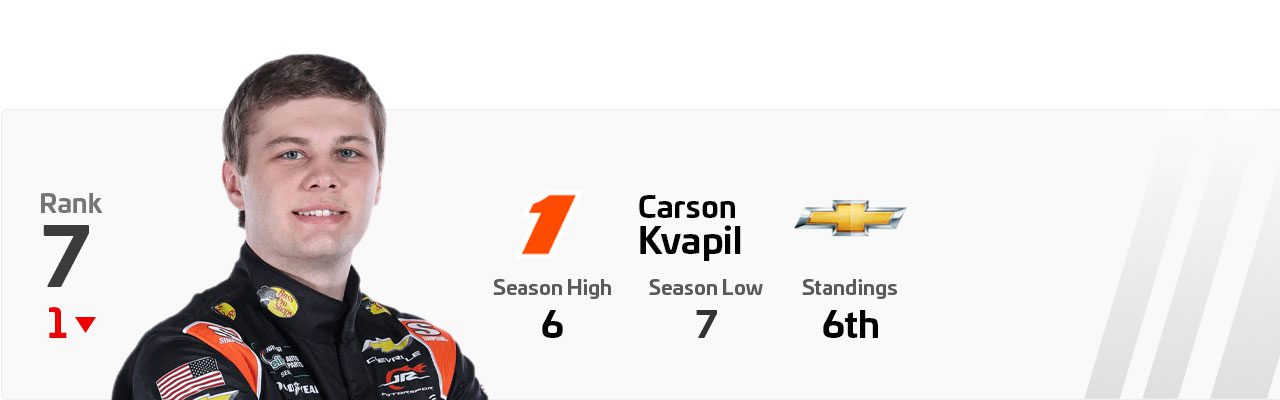
Analysis: Splitting time between JR Motorsports and DGM Racing has gone off without a hitch for the 22-year-old. The North Carolina native is currently sixth in the driver standings, and his 81 stage points rank second among the field. (Allgaier ranks first with 120.) Accumulating such a substantial total is largely thanks to starting every race within arm’s reach of the top 10; Kvapil’s 8.0 average start is tied for fifth (Allgaier) among full-timers. Two DNFs are a blemish, but if that is mitigated, Kvapil will continue his contending ways.
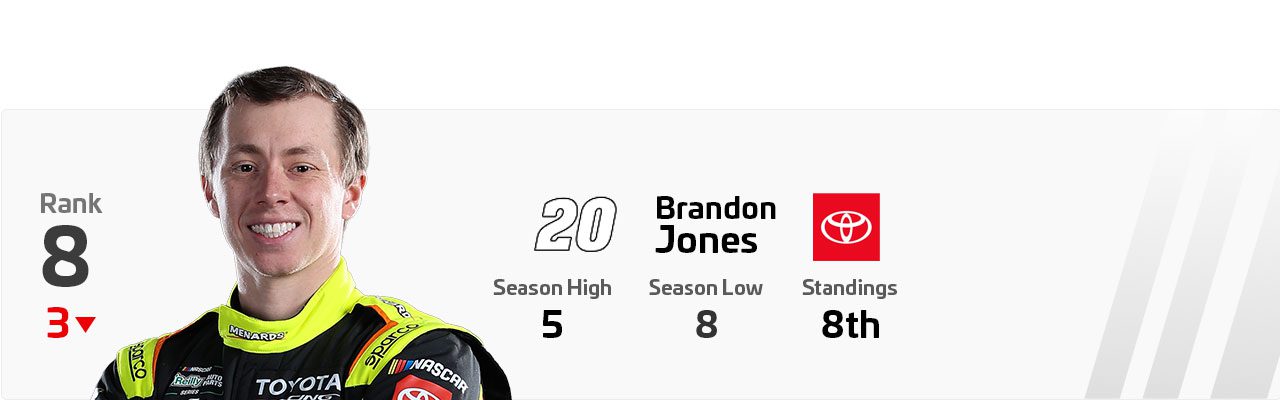
Analysis: Remember what I said about Kvapil? That rings a notch louder for Jones, whose 7.6 average start sits fourth. Despite starting every race inside the top 15 (and starting inside the top eight in the last six contests), the 29-year-old Georgia native only has three top 10s. OK, but not stellar. That said, Jones seems to be on an upswing, with two runner-up finishes in the last three races, with Rockingham the most recent.
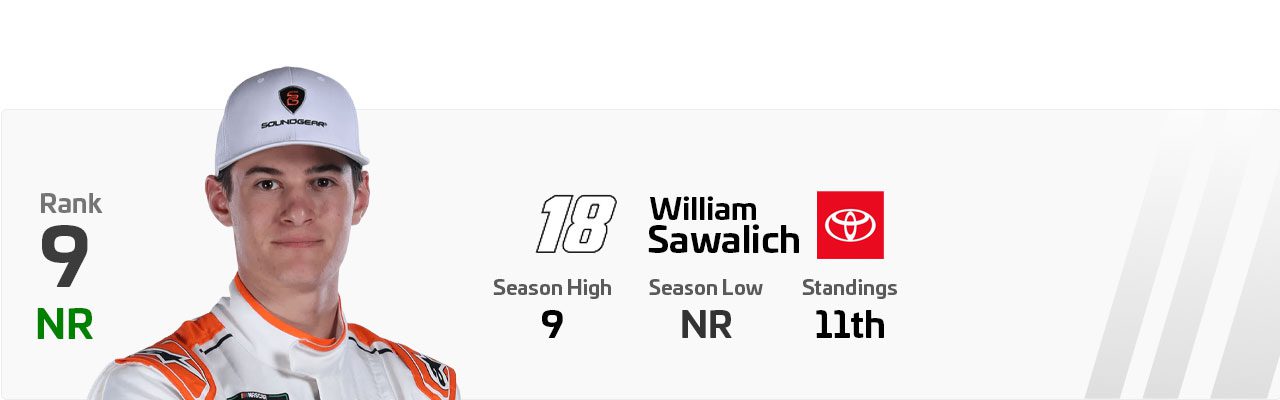
Analysis: Sawalich’s mastery at “The Rock” resulted in capturing his first career O’Reilly win and jumping into this ranking installment. There is no better momentum than a race win, with the 19-year-old on the cusp of cracking the top 10 in the driver standings thanks to the 71-point performance. (Rajah Caruth, who sits 10th in the table, is one point ahead of him.) Sawalich will need to keep this momentum going should he wish to make another dent in the standings … and stay in this ranking.
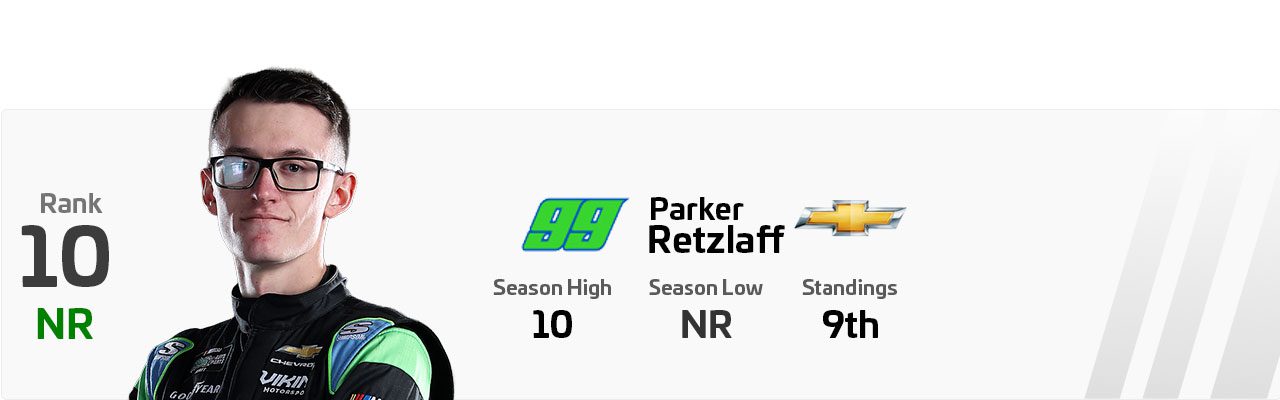
Analysis: A touch more consistency in finishing races has Retzlaff (who has a 12.4 average finish) in this ranking over Caruth (who, comparatively, has a 16.0 average finish). So far, 2026 has been relatively fruitful for the 22-year-old Retzlaff, who is continuing to find his footing with Viking Motorsports. Like Sawalich and others in the latter half of this ranking, there is no letting up, with drivers who just missed out — Caruth, Sam Mayer and Taylor Gray, among others — licking their chops.
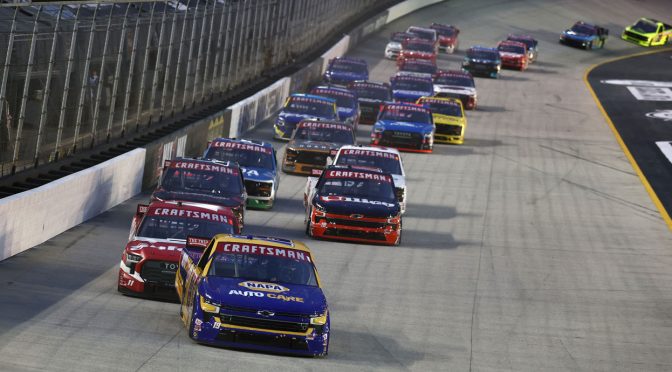
The NASCAR Craftsman Truck Series travels to Bristol Motor Speedway for a Friday feature (7:30 p.m. ET, FS1, NRN Radio, SiriusXM NASCAR Radio).
The Tennessee Army National Guard 250 will serve as the final race of this year’s Triple Truck Challenge. Corey Heim, the defending series champion, has won each of the last two races to collect a $150,000 bonus from “The Trip.” A win Friday at Bristol would award him a total of $500,000 if he can complete the three-race sweep. Chandler Smith is the defending race winner.
Cup Series regular Ricky Stenhouse Jr. will also make an appearance in the No. 4 Niece Motorsports Chevrolet, saddling up for just his third career Truck Series start, all of which have come this year. Two-time Cup Series champion and prolific Truck Series winner Kyle Busch is also in the race, set to pilot the No. 7 Spire Motorsports Chevrolet. Cup Series drivers Chase Briscoe, Ross Chastain and Daniel Suárez are also in the field.
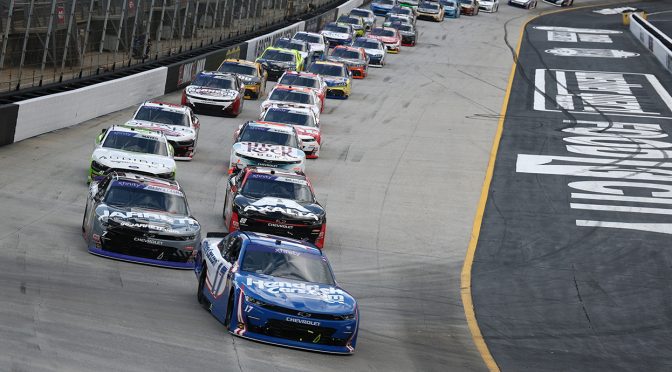
The NASCAR O’Reilly Auto Parts Series heads to the Tennessee-Virginia border for a thriller at the 0.533-mile Bristol Motor Speedway on Saturday (7:30 p.m. ET, The CW, PRN Radio, SiriusXM NASCAR Radio).
The Suburban Propane 300 will also serve as the opening race for this season’s Dash 4 Cash. William Sawalich, winner of last week’s race at Rockingham Speedway, is up for the $100,000 bonus alongside Brandon Jones, Justin Allgaier and Rajah Caruth. Whoever finishes highest among the four racers will take home the prize money. Cup Series regular Kyle Larson is the defending race winner at Bristol.
The NASCAR Cup Series returns from its off week with a trip to Bristol Motor Speedway on Sunday (3 p.m. ET, FS1, HBO Max, PRN Radio, SiriusXM NASCAR Radio).
Kyle Larson is the defending race winner. Larson dominated the Food City 500 a year ago but enters on a 31-race winless streak.
There was one overriding theme that emerged from the NASCAR weekend at Rockingham Speedway: youth was served.
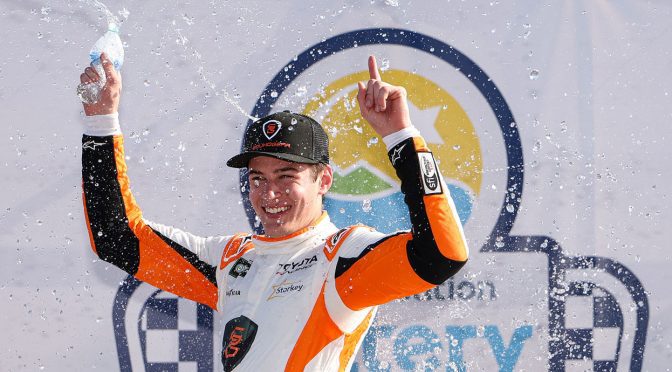
After a rough 2025 rookie campaign and a lackluster start to the 2026 season, 19-year-old William Sawalich scored a convincing breakthrough win in Saturday’s North Carolina Education Lottery 250 presented by Black’s Tire.
In that same NASCAR O’Reilly Auto Parts Series race, 20-year-old Corey Day led the field to the green flag after scoring the first pole position of his burgeoning career.
Brent Crews, who turned 18 on March 30 and is now eligible to compete in the O’Reilly Auto Parts Series on the full array of NASCAR tracks, celebrated by leading 30 laps and scoring points in the first two stages. But for an unnecessary two-tire call late in the race — when other contenders took four — Crews might have been battling for the win with Sawalich, his Joe Gibbs Racing teammate.
In Friday’s Black’s Tire 200 NASCAR Craftsman Truck Series race, 23-year-old Corey Heim did what he invariably does — scoring two stage wins, setting the fastest lap and winning the race to record the first “perfect” 76-point race of the season in any of NASCAR’s top three national series.
And in the ARCA Menards Series East race that preceded Saturday’s O’Reilly Auto Parts Series event, 15-year-old Tristan McKee started from the pole and led all 125 laps in a dominating win.
For Sawalich and Day, Saturday’s race provided career milestones.
Neither Sawalich’s performance nor his racing luck had matched the quality of his Joe Gibbs Racing equipment — until Saturday. After starting 14th, he advanced through the field, finishing fifth in Stage 1 and second in Stage 2.
In what could represent a breakout accomplishment, Sawalich led the final 79 laps after charging to the front after a restart on Lap 172 of 250. The victory was a culmination of lessons learned.
“I think just resetting every week was probably the toughest part, and not to carry a bad finish over to the next week, because that definitely mentally impacts you,” said Sawalich, the first Minnesota-born driver to win a race in any of NASCAR’s top three touring divisions.
“So just, honestly, forgetting about last week and anything that happened that was bad and taking the positives and applying it to the next week. Confidence is a huge thing as a driver, I think, and I learned that over the last year.”
Though the statistics won’t say so, Saturday’s race was Day’s best so far as a NASCAR driver. Yes, he scored his seventh straight top-10 finish, but the 10th-place result was his worst in that streak.
On the other hand, Day dominated the first half of the event. His two stage wins were the first and second of his career. He led a race-high 118 laps. And when two snafus on pit road forced him to the rear of the field, Day didn’t panic. Methodically, he worked his way up to 10th and settled for a less-than-satisfying outcome.
Most important, however, was his lengthy time at the front of the field in the No. 17 Hendrick Motorsports Chevrolet.
“I don’t know what the exact turning point is,” Day said afterward. “I felt really good at Las Vegas this year, felt really good there last year and then this year, with more experience and having the experience of leading laps.
“And kind of that same thing I did today. But that was the first time I had got it. So just trying to keep building off of that.”
Earlier this season, Day drew criticism for on-track mistakes that jeopardized the results of Hendrick affiliate cars at JR Motorsports. His performance at Rockingham, however, is emblematic of the progress he has made.
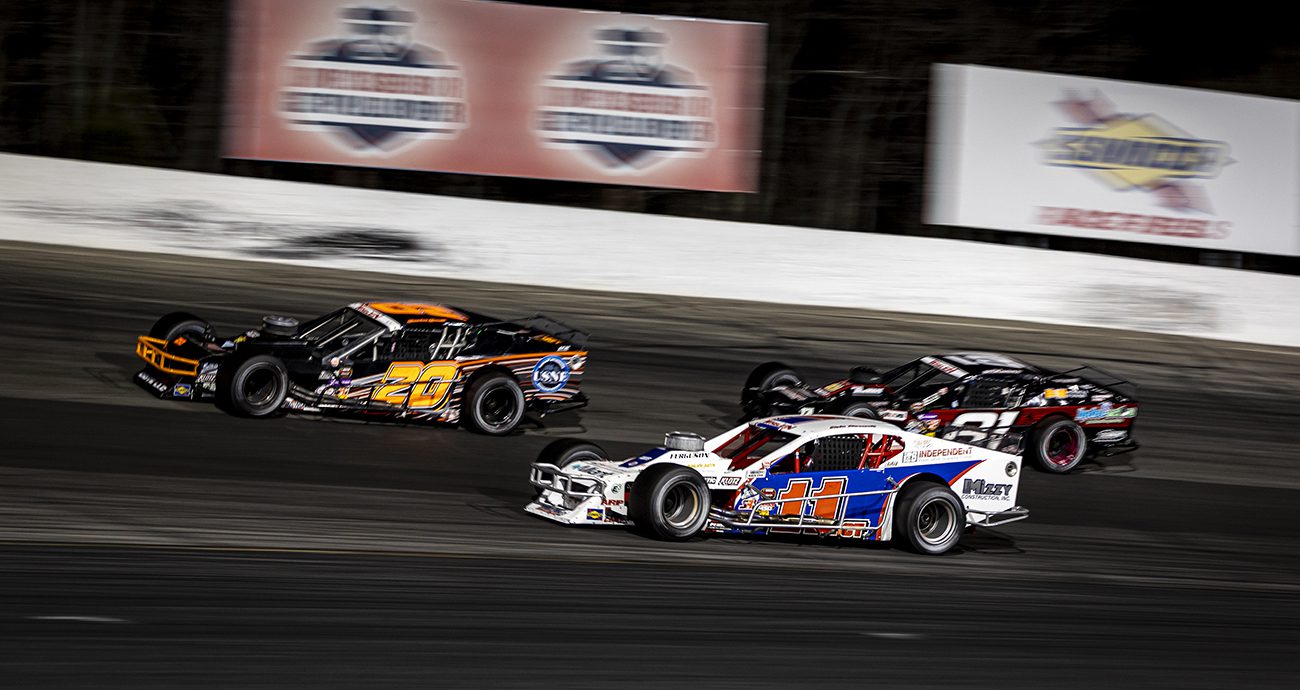
No race track has held more NASCAR Whelen Modified Tour races than Connecticut’s Thompson Speedway Motorsports Park. The 0.625-mile asphalt oval will welcome the series for the 159th time Sunday for the running of the Icebreaker 150 (4:30 p.m. ET on FloRacing).
Winning at Thompson is no easy task, which is why of the previous 158 Modified Tour events at the track, only 38 drivers have found their way to Victory Lane. Among those are legends like Mike Stefanik, Ted Christopher, Jeff Fuller, Rick Fuller and Tony Hirschman, as well as modern drivers like Justin Bonsignore, Ron Silk, Doug Coby and Patrick Emerling.
In fact, in the last eight Modified Tour events at Thompson only Silk, Bonsignore and Emerling have found Victory Lane. Silk has won four times, while Bonsignore and Emerling have each won twice.
Tickets to Sunday’s Icebreaker 150 will be available at the track. Below is everything you need to know about the third race of the 2026 NASCAR Whelen Modified Tour season.
Thompson Speedway Motorsports Park has hosted more NASCAR Whelen Modified Tour events than any other track. (Photo: Rob Branning/NASCAR)
Icebreaker 150 at Thompson Speedway Motorsports Park
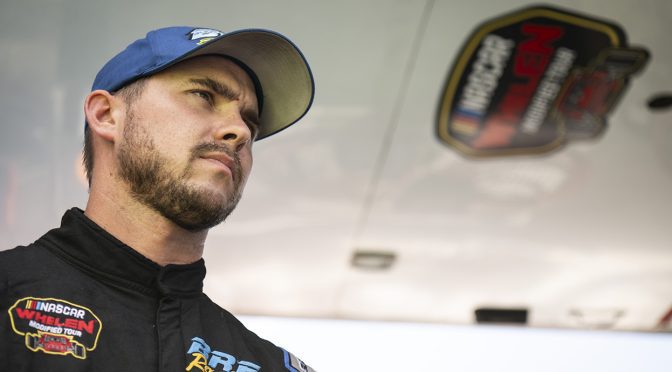
It’s been nearly 10 years since Boehler Racing Enterprises and the Ole Blue No. 3 have been on top of the NASCAR Whelen Modified Tour standings.
That drought is over thanks to a strong start by the team and driver Tyler Rypkema, who find themselves on top of the standings following finishes of second at Florida’s New Smyrna Speedway and third at Martinsville Speedway to launch the 2026 season.
Rypkema, who is in his second full season as the driver of the legendary Ole Blue No. 3, earned his first Modified Tour win last season at New Hampshire Motor Speedway. Now, for the first time in his career, he leads the standings. He’ll be looking for another strong run Sunday at Thompson to keep himself and Ole Blue on top of the heap.
Speaking of the top of the heap, Victory Lane at Thompson is a very exclusive club. Since the 2023 season, only three drivers have scored Modified Tour wins at Thompson. Those drivers — Ron Silk, Patrick Emerling and Justin Bonsignore — are all entered Sunday, and each hopes to add another victory to his resume.
Another driver looking for continued success is Austin Beers, who is riding an incredible 32-race top 10 streak entering the Icebreaker 150. His streak began in 2024 at Thompson during the Icebreaker 150, meaning the reigning Modified Tour champion hasn’t finished outside the top 10 in a series event in two years.
One notable driver joining the Modified Tour field for the first time this year is six-time series champion Doug Coby, who will be making the first of nine scheduled starts for Jett Motorsports in the No. 28 entry. Coby, who enters the event tied with five-time Modified Tour champion Tony Hirschman for fifth on the all-time wins list, is a six-time Thompson winner.
Other notable entries include Ronnie Williams, who will be making his first Modified Tour start in two years, Martinsville winner Stephen Kopcik, Matt Hirschman, Jon McKennedy, Craig Lutz, Chase Dowling, Eric Goodale and Matt Swanson, among others.
The full entry list for Sunday’s Icebreaker 150 will be available later this week.
Only three drivers — Ron Silk, Patrick Emerling and Justin Bonsignore — have visited Victory Lane at Thompson Speedway Motorsports Park since 2023. (Photo: Rob Branning/NASCAR)
SCHEDULE: Sunday, April 12: Practice from 12 – 12:50 p.m. ET … Final practice from 1:25 to 1:55 p.m. ET … American Racer Pole Award qualifying at 3:30 p.m. ET … Start of the Icebreaker 150 at 4:30 p.m. ET (150 Laps / 93.75 Miles)
QUALIFYING: Two consecutive qualifying laps. Faster lap determines qualifying position. Adjustments or repairs may not be made on the vehicle after the vehicle has taken the green flag at the start/finish line. NASCAR reserves the right to have more than one vehicle engage in qualifying runs at the same time. Starting field for the 52nd Annual Icebreaker 150 is limited to 30 starters including Provisional Positions.
TIRE ALLOTMENT: The maximum tire allotment available for this event is eleven (11) tires per team. All tires used for qualifying and the race must be purchased at the track and scanned by NASCAR Officials, unless otherwise approved in advance by the Series Director. Four (4) tires must be used for qualifying and to begin the race. All qualifying tires must remain in impound until released by NASCAR Officials. The remaining tire allotment may be used for practice and/or change tires during the event. A maximum of three (3) tires of the allotment may be used as change tires. The tire change rule is two (2) tires per stop. This includes “swapping” tires front to back.
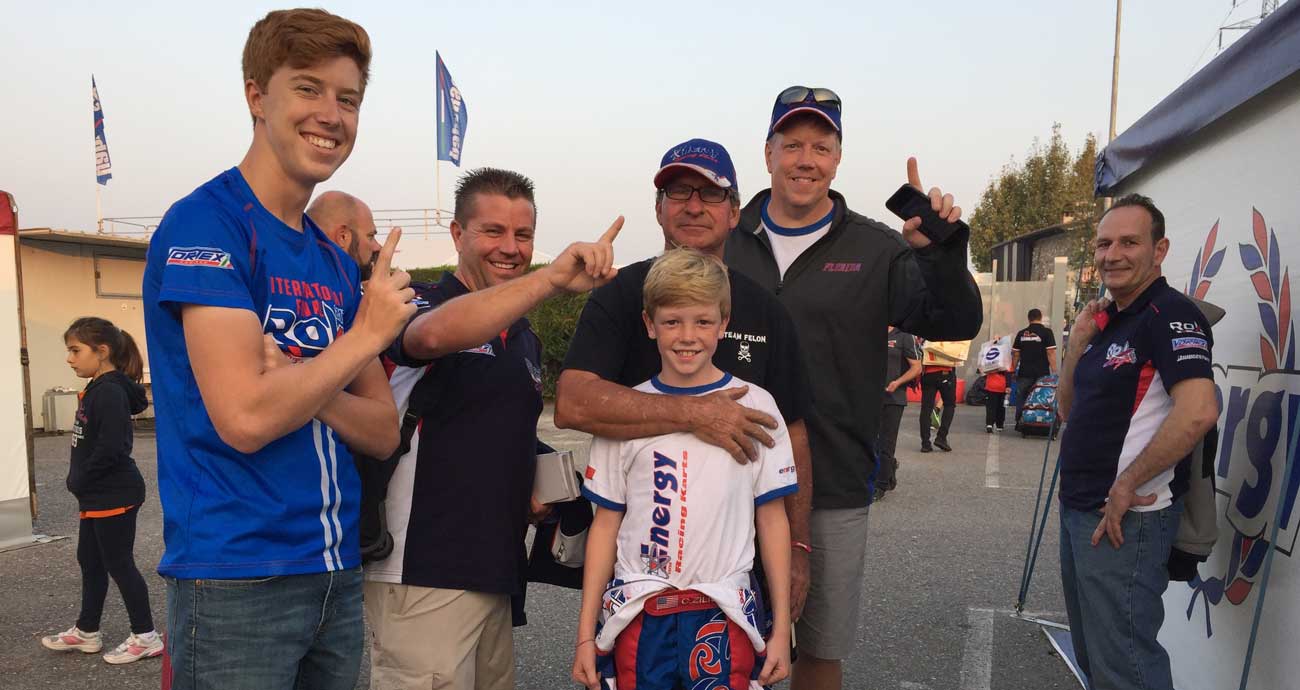
Before Connor Zilisch was Connor Zilisch, next big thing, winner of 10 races in his rookie O’Reilly Auto Parts Series season, and the bad-fast and most-anticipated Cup Series rookie in a generation, he was a rail-thin 11-year-old kid with a flop of strawberry blond hair practicing a go-kart in Italy.
He was slow, like, not competitive slow, like he might as well have just gotten out of the way slow. Zilisch didn’t know race-craft, at least not like he does now, he didn’t know car control, at least not like he does now, and he didn’t know how to drive deep into corners, at least not like he does now.
Those lightning-quick Euro brats schooled this American upstart, dive-bombing him at every opportunity.
Zilisch spent that unimpressive session under the tutelage of an accomplished driver and coach, who first approached other drivers to offer specific instructions on how to get faster before turning to Connor. He wasn’t good enough for that kind of instruction to matter. She tried to breathe life into this cherubic tween from the suburbs of Charlotte.
“Connor!” she called to him.
He looked up at her.
“Do you want to go for a Sunday drive?” she asked in her thick Italian accent. “What are you doing? You need big balls!”
And thus began the world-class racing education of Connor Zilisch.
School of hard knocks
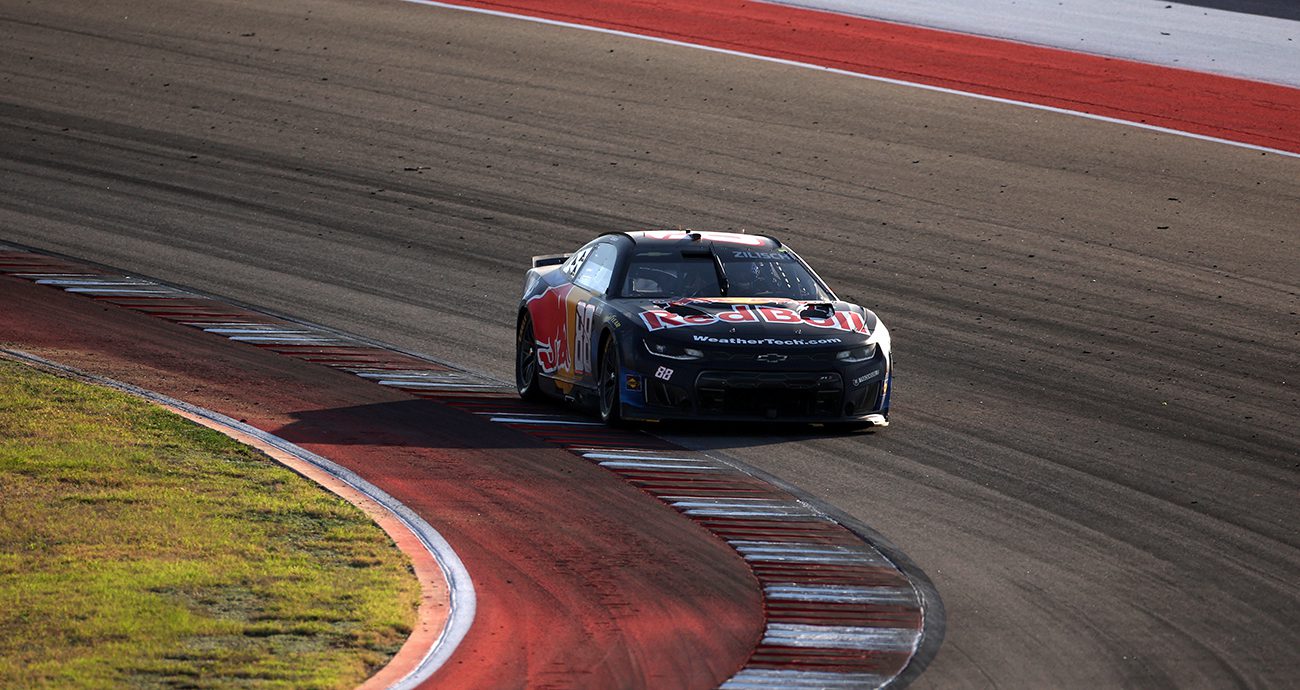
That education is coming in handy during a challenging start to his rookie season in the No. 88 Chevrolet for Trackhouse Racing.
Two weeks into this season, Zilisch joined the NASCAR media for a video conference. He appeared to be in the bedroom he still lives in at his parents’ house in suburban Charlotte. Yes, he lives with his parents. He’s only 19, he loves them, they love him, what sense would it make to move out? He’s got the rest of his life to live the rest of his life. Anyway, he looked young, hopeful, fresh, as full of energy as any teenager whose future awaits him.
Sean Gardner | Getty Images
He declared himself accurately, sitting in dead last in points, and he did it with what appeared to be a smile on his face. What’s he going to do, mope about it? There are thousands of drivers who would kill to explain to a Zoom call full of reporters why they are dead last in Cup points.
Five weeks later, his position in the field has barely changed, as he has managed only one top-15 finish in the first seven races. His attitude hasn’t changed much, either. He’s annoyed and frustrated, of course, but he also recognizes that a season is long, a career is longer, and he’s just getting started. “I knew I was going to have a learning curve,” he says.
Most NASCAR fans know about Zilisch’s record-breaking rookie season last year in the O’Reilly Auto Parts Series. They think he’s been fast in every car he’s ever been in, and that’s mostly, but not entirely, true. As part of his development, he drove unfamiliar cars on unfamiliar tracks in unfamiliar series, all to make him comfortable being uncomfortable.
That’s paying off now.
No, he’s not having fun putting up bad finishes every week. But he is better prepared than most young drivers for this part of the experience.
“We talk about that a lot,” says Eric Warren, General Motors’ executive director for global motorsports competition. “What are the elements we’re looking for (in a driver)? It’s how they handle adversity.”
European history
Zilisch’s journey to the Cup level is unparalleled in NASCAR history. His background has uniquely prepared him to handle the ups and downs of the biggest and most competitive circuit in the country.
From his mom, Janice, who qualified for the 1984 Olympics as a Canadian gymnast but missed them due to injury, he learned competitive fire and the hard work necessary to compete at the highest level. From his dad, Jim, he learned to love racing and not take life too seriously. From his coach, Josh Wise, he learned that what looks like failure and success often aren’t and that knowing the difference between the two lights the path to success.
And from a gruff Italian coach, he learned to drive hard into corners.
A hallmark of Zilisch’s elite road-course performance today is his ability to drive deep into corners, brake hard and late, keep his car straight and under control, and zoom out ahead. NASCAR Hall of Famer Kevin Harvick, who helped discover Zilisch, has been telling people for years — since long before Zilisch got anywhere near NASCAR — that Zilisch is the best braker he has ever seen.
James Gilbert | Getty Images
That skill is both natural and learned. To some degree, he was born with it. And to some degree, his development of it can be traced to that haranguing in Italy. After that coach — a former world champion, Jim Zilisch says — got in his face, he went out in the next practice session and was quite a bit faster, and a few weeks later, he won a world championship by beating the drivers who had dusted him in practice.
That transformation was as much mental as it was physical. He figured out quickly that the American style of racing and the European style of racing are very different. “Here, people do things that are aggressively stupid,” Connor Zilisch says. “It was more aggressively smart (in Europe), like putting you in a bad spot.”
Drivers in America work together. Drivers in Europe don’t. “There’s a lot more finesse and technique there,” he says. “It’s a lot harder to make moves. You have to think it out a lot more. Which I think helped me a lot. Here, it’s easy having to pass a guy. If I want to, I can just hit him out of the way.”
Computer science
Seemingly everyone has a story about Connor Zilisch that starts with him getting in a car or driving at a track for the first time and quickly setting a speed record. The speed is, of course, impressive. But the way he produces it might be even more so. He has an uncanny understanding of where the speed comes from and how to get more.
Darian Grubb, the director of performance for Trackhouse Racing, saw this in Cup testing last season. “In his first 15 minutes in the car, he’s able to articulate exactly what it is that he’s chasing, what he’s feeling in the car, what he’s not feeling in the car. He’s learning everything around him, and his feedback loop — what he’s able to describe — is pretty amazing.”
That skill is a blend of old-school savvy and a new-school way of attaining it. Decades ago, drivers like Rusty Wallace studied the geometry of the car and used that knowledge to diagnose problems. Zilisch studies the data that his laps produce, and he uses that to explain what the car is doing.
“He’s teaching us how to use our own tools, in some cases, because it’s obvious that he starves for that type of information,” Grubb says. “He is doing studying at home, at nights and weekends, before we come in for a Monday or Tuesday meeting. He says, ‘Oh, just click this. Do that,’ and I’m like, ‘Oh, I haven’t even used this tool nearly as much as you have.'”
Parenting
Talk to anyone who knows him well about why Zilisch is the way he is — grounded, intelligent, mature — and the conversation immediately turns to his parents and the environment in which they raised him.
Connor’s mom, Janice, grew up in Toronto with the aforementioned Olympic-caliber credentials. If Connor ever even thinks to complain to her about how difficult his training is … well, she silences that.
His dad, Jim, is a retired banker with an MBA and a delightful sense of humor. After Zilisch fell off his race car in Victory Lane last year and broke his collarbone, Jim posted this: “Silver lining. Pooping himself is no longer his most embarrassing moment.”
Jim Zilisch bought Connor and his two older brothers go-karts when they were young, and they raced first in Charlotte, then the Southeast, then the country and eventually the world.
Starting when he was 11, Zilisch spent several months for four summers racing across Europe without his parents. He traveled with an American mechanic, called home occasionally and otherwise was out on his own in the world, all before he could legally drive.
Courtesy of the Zilisch family
That is, to put it mildly, outside the norms of modern-day parenting, in which we barely let our kids out of our sight and helicopter over their every step, their every playdate, their every race, that is, for those few among us who can loosen our grip enough to let them race.
Janice and Jim Zilisch both said they knew from the time he was very young that Connor was different from most kids — more mature, more intelligent, more relationally courageous. Sending him off to Europe didn’t seem like a big deal.
Plus, there’s this: If Connor ever wanted advice from someone who had traveled around Europe competing in high-stakes sporting events without their parents, all he had to do was ask his mom.
Lesson plan
Before she was Janice Zilisch, executive for a biotech company who holds a PhD in pharmacology and mom of the bad-fast, most-hyped Cup Series rookie in a generation, she was Janice Kerr, superstar Canadian gymnast and All-American at the University of Florida who traveled behind the Iron Curtain to compete in international meets, without her parents, as a teenager.
That experience gave her life depth and breadth, just like it did for her son. “I remember sitting in a Romanian hotel, and they didn’t have enough electricity to keep the lights on all night, and it would get cold, and it would get dark,” she says. “And it was just amazing to me to watch the Romanian girls accomplish all they could accomplish with so little resources.”
There’s a parallel between an underfunded gymnastics team and an underfunded race team, and she tried to instill that idea in Connor. “He didn’t always have the best equipment under him. (But) he always said, ‘I’ve got to make the best of what’s beneath me.'”
It’s tempting to hear a story like that, add it to the one in Italy and see Connor’s time in Europe as part of a master plan to groom him for a career as a superstar in NASCAR.
Courtesy of the Zilisch family
But nobody had any master plan back then. Nobody thought Zilisch was being molded into anything. Says Jim Zilisch: “It was much more me being competitive with my little toy kid that I could put out and beat the other dads than it was we’re going to be a professional race car driver.”
Still, Zilisch’s experiences in Europe worked on him like a sculptor working on a piece of marble. Imagine how big a person’s dreams will be if his real life as a kid is that big. Imagine how fearless a person will be if he dares to do that as a kid.
That little toy kid had a blast gallivanting across Europe. He spent a day on a rented bike pedaling around Amsterdam, toured the Vatican and visited Venice so many times he’s like, meh, let’s go somewhere else next time. He learned about other cultures and other languages and other histories.
All of which has nothing — and everything — to do with being bad fast in a stock car. It’s not so much what he learned as how he learned it — wide-eyed, quickly, enthusiastically. Apply those attributes to driving and it’s no surprise his career has taken off since then.
He was a sponge for culture then.
He’s a sponge for speed now.
Grading on a curve
Asked to name the toughest challenge he has faced in his life and how he overcame it, Zilisch does not mention breaking his back in a wreck at Talladega, falling off his car in Victory Lane and breaking his collarbone or winning 10 races but losing the O’Reilly championship in 2025, which left him sobbing.
Instead, he travels back to earlier this decade, when his career rise was, temporarily, on hold for lack of funding. Then he learned racing’s dirty little secret: Talent, speed, intelligence and maturity don’t matter if you don’t have a car to drive. A driver’s potential is too often tied to their parents’ bank account. When their money dries up, so do the kid’s chances.
As Zilisch wondered if he would have a racing career, two things happened in quick succession: He was blazing fast in a 2021 Trans-Am test, which his dad saw as the point at which his son’s NASCAR career seemed possible; and he met Josh Wise, who completely changed his life.
This is when Zilisch’s racing education really took off. In 2021, Wise, a former developmental driver, was in the beginning phases of creating Wise Optimization, the company he runs that has become, essentially, a driver’s academy for General Motors.
Wise was looking for a young driver to groom into a champion. He saw Zilisch drive and was impressed, and then met him and was even more so.
“I brought Jim and Connor into my office, and I asked him if he wanted to become the youngest Cup champion in history,” Wise says. “And they kind of looked at each other and said, ‘That sounds like it’d be pretty good.'”
The path they have taken to achieve that goal is unique. Wise set out to teach Connor the things he wished he had known during his driving career. Among those topics were success, failure, how to deal with them and how to discern which is which.
Courtesy of the Zilisch family
Racing is a maddening sport because a win isn’t always a sign of great performance, and a 15th-place finish is not always the result of a poor performance. This might be the hardest lesson for drivers to learn, and some never do. Zilisch has learned this twice already this season — first at EchoPark Speedway near Atlanta in a crash and again at Circuit of The Americas when he drove from the back to the front, then got spun on the way to a potential top five.
NASCAR history is littered with hyped drivers who failed to live up to expectations. All they ever drove was fast cars. To borrow an old Molly Ivins joke, they were born in Victory Lane and thought they won the race. They never learned to wrestle a bad car. They never learned that some wins are unimpressive and some 15th-place finishes are phenomenal.
Wise knows all that because he lived it, and he designed Zilisch’s development so that he would learn it, but in a controlled way with an eye toward growth.
Wise wanted Zilisch to “under-specialize,” so he sent him out to drive as many different cars as possible. That’s why Connor spent a season learning to drive a dirt car. He considered it a good week if he made the A-main at a local track. Yes, the generationally great driver could barely hang with the locals. That alone gives him context for struggling in Cup against the best stock car drivers in the world.
And there’s more.
Wise had Zilisch dabble in different series, different tracks and most interestingly, different qualities of car. In one example, Wise told his staff to put Zilisch in a 10th-place car. Not so Zilisch could show off his talent, but so Zilisch could learn how to drive the car he has, not the car he wishes he had.
Wise could have put him in the fastest ARCA Menards Series car money could buy. But what good would that do? That would produce, as Wise put it, cheap results and give Zilisch a low ceiling. Zilisch would win, learn nothing and grow not at all.
But put Zilisch in a slow car and force him to “lose,” and he’d learn a ton. Seven weeks into the NASCAR season, when Zilisch has needed those lessons week after week, it sounds like a brilliant tactic. But at the time, Zilisch didn’t understand. He saw himself as a young hot shoe on the fast track to the top, and yet he was forced to drive a car that would not take him there. That Wise would do that on purpose was, to Zilisch’s mind, baffling.
“By no means were we going to compete for wins,” Zilisch says. “It was basically, if I can finish in the top 10, it’s a good day. And they told me that. But I didn’t really understand. I’m trying to make a name for myself, and I’m being put in these cars where I can’t.”
What he didn’t understand — yet — is that learning how to drive a car like that was more important than driving a race-winning car because in Cup, he will drive far more 10th-place cars than he will race-winning cars.
Today, Zilisch calls those races crucial for his development. He named them when Wise asked him for races he learned most from in his development, and he brought them up himself in an interview with NASCAR.com. And it’s easy to see how those struggles prepared him to deal with poor finishes to start this season.
“I’m in the deep end,” Zilisch says. “I’m coming back up to the top and trying to breathe for air. This Cup Series thing is no joke. I knew that coming into it. But I knew that I wanted to do this, and I wanted to do it so I can learn and figure it out.”
Zilisch has had to learn and figure out more than he wanted already this season. He completed every lap only twice in the first seven races. When he finished 14th at COTA, a track where he was expected to contend for a win, it was a disappointment. But that’s not the same as a poor performance, and Zilisch called that 14th-place finish one of the best races he has ever run — proof his racing education is doing exactly what it was built to do.
ROCKINGHAM, N.C. — First-time winner William Sawalich led the final 79 laps of Saturday’s North Carolina Education Lottery 250 NASCAR O’Reilly Auto Parts Series race at Rockingham Speedway.
Pursuing Sawalich for much of that period were Brandon Jones and Justin Allgaier, both of whom appeared to have a shot at testing the leader in the closing laps. On a day when passing in the front group was a major challenge on a recently paved track where grip remains strong, the followers made sporadic gains on Sawalich but couldn’t close the transaction.
Jones was 0.863 of a second behind in the runner-up spot, and Allgaier was a close third, 2.075 seconds behind Sawalich.
The chances to make gains, Jones said, were few.
“I was pushing so hard that I was making little mistakes here and there,” Jones said. “I missed the corner one lap, and then I was about a tenth-and-a-half (of a second) better the next lap. The track is so finicky. This place is very high grip, and that means you’re going to be on edge at times. I’m doing all the things I can do inside the car to adjust, but there’s not much you can change. There are just little things you can try to improve your balance on.”
Jones said Sawalich had better speed out of the gate on restarts.
“His short-run speed was great,” he said. “He took off really well. We were a little bit worse than them to take off, but if you look at it like a graph it’s like my car would get a little better and his would get a little worse over the long run. But he was able to build such a big lead early that it was hard to get back to him.”
Jones said he was adamant about being “super aggressive” Saturday after running what he called a disappointing race the previous week at Martinsville Speedway, where he finished 18th.
“I left Martinsville a little frustrated at myself last week,” he said. “I am going to take all of the runs I can get. I’m going to put people in bad situations, if I can, and just move forward. I think we did a really good job of it. We kept fighting both sides of it with balance today. Sam (McAuley, crew chief) did a great job taking all of my feedback and making a car, I think, capable of winning. It was just a matter of trying to get some track position, and he (Sawalich) got such a big restart on that last restart that it was hard to catch him.”
Jones has scored two runner-up finishes in the past three races. “I’ll take that,” he said. “I like the momentum we’ve got.”
Allgaier, the series’ dominant driver this year, missed a shot at a fourth seasonal win but expressed satisfaction with a fifth consecutive top-five run and sixth of the season.
He echoed Jones’ frustration at trying to catch Sawalich.
“We were all fighting the same thing,” Allgaier said. “When we got to lapped traffic, it would slow the 18 (Sawalich) and then we’d catch him and then it would all kind of accordion back and forth.
“Track position made all the difference in the second half. When you were able to get some clear air and get separated some, that was so important. I was loving the fact that the track kind of widened out and we were able to move around a lot. But when you caught the cars in front of you, you had to have clean air. If you couldn’t get to that point, you couldn’t do much with it.”
Along pit road after the race, there was talk that passing conditions between mostly equal cars would improve significantly as the track surface ages.
“You had to make the moves when you could and get past those guys when you could,” Allgaier said. “I just didn’t do a very good job of that today. But when you get out of here with a bunch of stage points and finish third, it’s hard to be really upset about it.”
Allgaier leads the points by 126 over Jesse Love, who finished 27th, two laps down.
Cleetus McFarland left his NASCAR O’Reilly Auto Parts Series debut at Rockingham Speedway with plenty of experience under his belt.
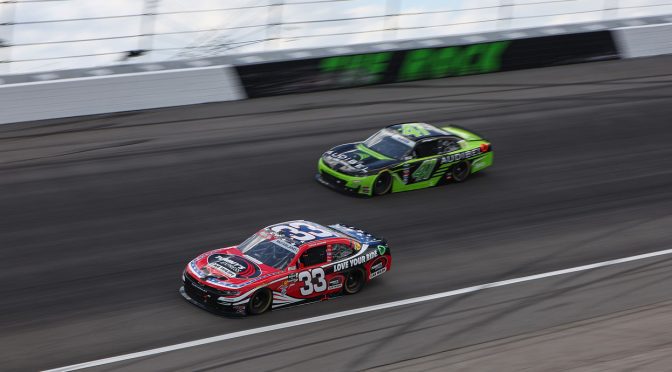
The YouTube sensation finished 32nd, six laps down, but he made his biggest splash at Lap 206 when his No. 33 Richard Childress Racing Chevrolet broke loose in Turn 3, sliding to the bottom of the track before spinning back into traffic to draw the seventh caution flag of the day.
The adventure began early for McFarland, who ran both the O’Reilly Auto Parts Series race and the ARCA Menards Series East event Saturday at Rockingham. A daring move at Lap 4 put his car on the bottom of a three-wide situation entering Turn 1. McFarland slid sideways and made a remarkable save, but immediately lost significant ground to the leaders.
Another close call occurred at Lap 49. Blake Lothian spun in Turn 2 just ahead of McFarland. As Lothian wandered down the track, McFarland barely avoided his No. 55 Chevrolet, diving to the apron and missing the car by inches.
McFarland finished fourth in the ARCA East race, combining to complete 369 of his scheduled 375 laps around Rockingham on Saturday.
ROCKINGHAM, N.C. — Grabbing the lead and control of the race after a restart on Lap 172, William Sawalich pulled away over the final 79 laps to win Saturday’s North Carolina Education Lottery 250 Presented by Black’s Tire at Rockingham Speedway.
The victory was the first in the NASCAR O’Reilly Auto Parts Series for the 19-year-old Sawalich, the youngest driver to win at the 0.94-mile track in any of NASCAR’s top three series.
Sawalich, who led 80 laps, crossed the finish line 0.863 seconds ahead of Joe Gibbs Racing teammate Brandon Jones to end the five-race winning streak of JR Motorsports and preserve the series record of six straight victories for JGR.
“It means everything,” said Sawalich, who gained three positions to 11th in the series standings. “Honestly, it was a tough year last year and a tough start to the year this year. Gosh, it feels good to get it done here at Rockingham in front of an awesome crowd.
“Our Supra was on rails today, obviously. Good in Stage 1 (fifth), Stage 2 (second) and obviously amazing in clean air. Lapped traffic took me out last year (in a 25th-place finish), so that was running through my head a little bit, but, man, I just studied the race last year, calmed down — and everything’s fine.”
With the win, Sawalich earned eligibility for the first Dash 4 Cash race next Saturday at Bristol Motor Speedway (7:30 p.m. ET, The CW, PRN Radio, SiriusXM NASCAR Radio). The top four finishers at Rockingham — Sawalich, Jones and third- and fourth-place finishers Justin Allgaier and Rajah Caruth — will compete for a $100,000 bonus in that event, with the top finisher among them claiming the prize.
Caruth, in fact, made a spectacular three-wide pass of both Sheldon Creed and Carson Kvapil with nine laps left to grab the last Dash 4 Cash position. Kvapil finished fifth and Creed sixth, followed by Taylor Gray, Parker Retzlaff, Ryan Sieg and pole winner Corey Day.
For the first half of the race, Day appeared to have the dominant car. The 20-year-old led a race-high 118 of the 250 laps and swept the first two stages — the first stage wins of his career.
But Day lost five positions on a slow pit stop during the second stage break and never recovered. On Lap 174, he pitted out of sequence for a loose lug nut and charged from 24th over the final 70 laps to post his seventh straight top 10.
“We had a couple of bad pit stops,” Day said. “We got behind there, and it was hard to dig ourselves out of the hole.”
Jones was pleased with the progress his runner-up finish represents.
“I left Martinsville a little frustrated at myself last week (after finishing 18th),” Jones said. “We weren’t quite aggressive enough at times, so today, I was super adamant on being super aggressive. I am going to take all of the runs I can get. I’m going to put people in bad situations, if I can, and just move forward.
“I think we did a really good job of it. We kept fighting both sides of it with balance today. Sam (McAulay, crew chief) did a great job taking all of my feedback and making a car, I think, capable of winning. It was just a matter of trying to get some track position, and he (Sawalich) got such a big restart on that last restart (after the seventh caution on Lap 206) that it was hard to catch him.”
Allgaier had the consolation of leaving Rockingham with a lead of 126 points over second-place Jesse Love in the O’Reilly Auto Parts standings. Love hit the outside wall after a shove from Caruth, lost track position on a subsequent unscheduled pit stop on Lap 153 and finished 27th, two laps down.
Additionally:
Sawalich is the first Minnesota-born driver to win a race in any of NASCAR’s top three national series.
Caruth’s fourth-place finish in the No. 88 JRM Chevrolet was a career best. He’ll drive the No. 32 Jordan Anderson Racing Chevrolet at Bristol while Kyle Larson will take a turn in the No. 88 Camaro.
JR Motorsports put three drivers (Allgaier, Caruth and Kvapil) in the top 10, extending the organization’s streak of at least one driver in the top 10 to 65 races — second in the series all-time to RFK Racing, then known as Roush Fenway Racing (79 straight top 10s).
Note: Inspection in the O’Reilly Auto Parts Series garage was completed without issues, confirming Sawalich as the Rockingham winner. The Nos. 20, 7 and 00 will return to the NASCAR R&D Center in Concord, North Carolina, for further inspection.
Stage 2 recap
Corey Day won Stage 2 to earn a clean sweep of the stages in Saturday’s NASCAR O’Reilly Auto Parts Series race at Rockingham Speedway.
William Sawalich was second over Justin Allgaier, Brent Crews and Brandon Jones. Rajah Caruth, Parker Retzlaff, Sheldon Creed, Jeremy Clements and Carson Kvapil completed the top 10.
The stage started with familiar fireworks as Caruth and Jesse Love collided at Lap 71. Love slid ahead of Caruth exiting Turn 2, but Caruth darted left as Love went right. Caruth’s front bumper caught Love’s rear and sent Love into the SAFER barrier.
The two drivers also converged in the closing laps of last week’s race at Martinsville Speedway, leading to a prolonged post-race conversation and a confrontation between Love’s crew chief, Danny Stockman, and Caruth. In Stage 2 on Saturday, Love finished as the final car on the lead lap in 27th place.
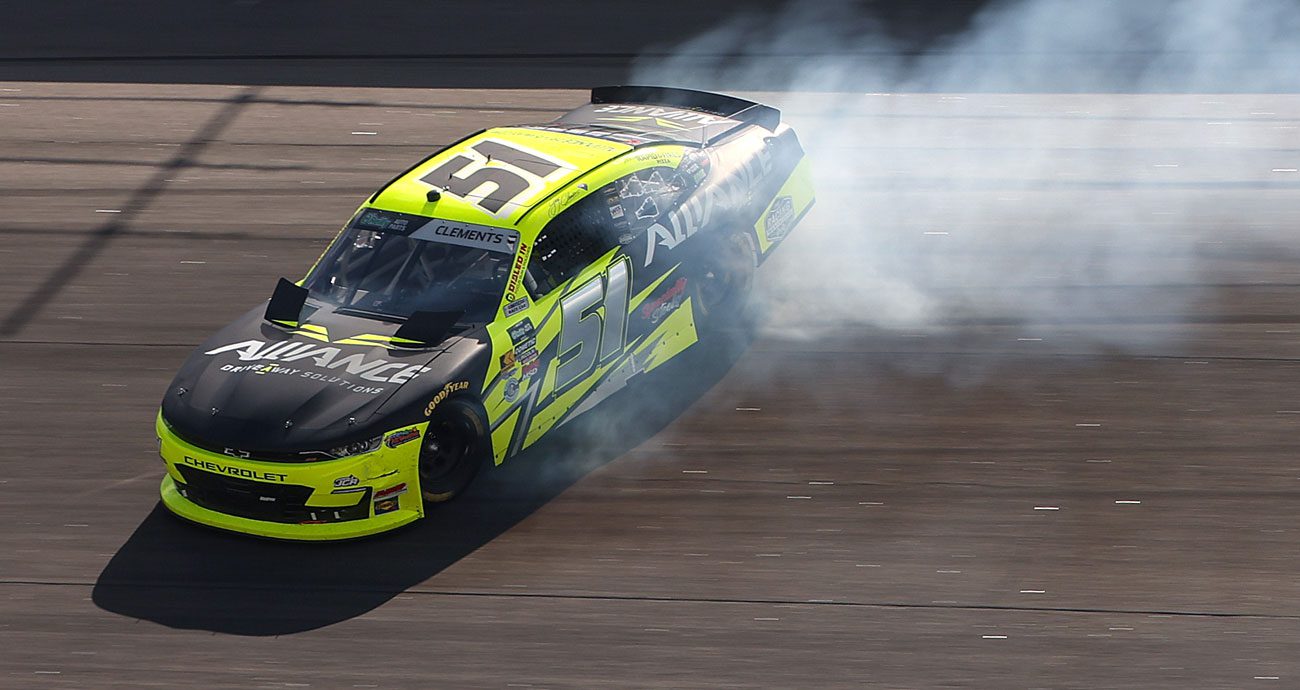
Clements was running eighth at Lap 94 when he spun in Turn 1 for the third caution of the day. His No. 51 Chevrolet wiggled on entry and washed high before the right rear stepped out, sending Clements for a slide. Clements stayed on the lead lap, and after pitting for fresher tires, rebounded to earn two stage points despite the incident.
Finishing the stage in 10th, Kvapil reported a potential brake issue on his No. 1 JR Motorsports Chevrolet.
During the stage break, Day lost the lead after a slow pit stop by the No. 17 crew, costing the Hendrick driver five positions.
Cleetus McFarland, in his O’Reilly Auto Parts Series debut, finished the stage 33rd in the No. 33 Chevrolet, two laps down.
Sam Mayer, driver of the No. 41 Haas Factory Team Chevrolet, ran 38th — last — due to an engine issue.
Meg Oliphant | Getty Images
Stage 1 recap
Corey Day surged past Taylor Gray with three laps left in the stage to win Stage 1 in a frenzied finish to the opening stanza of Saturday’s race.
Day led 54 of the opening 60 laps en route to the stage victory over Gray, Brandon Jones, Justin Allgaier and William Sawalich. Jesse Love, Sammy Smith, Brent Crews, Rajah Caruth and Parker Retzlaff concluded the top 10.
The caution flag waved at Lap 49 for the first time Saturday after a spin by Blake Lothian. YouTube sensation and O’Reilly Auto Parts Series debutant Cleetus McFarland barely avoided catastrophe by diving left to avoid Lothian’s spinning No. 55 Chevrolet.
Under the caution, Gray and Smith stayed out as well as Anthony Alfredo and Kyle Sieg. All other lead-lap drivers hit pit road at Lap 51.
McFarland found early adversity in his series debut. At Lap 4, McFarland entered Turn 1 on the bottom of a three-wide situation with Josh Bilicki and Nathan Byrd. McFarland’s No. 33 Richard Childress Racing Chevrolet slid sideways through the corner, but the Nebraska native maintained control and saved the vehicle. McFarland finished the stage in 35th, one lap down after falling off the lead lap at Lap 27.
At the front of the field, third-place qualifier Retzlaff nearly crashed on Lap 1. Exiting Turn 2, his No. 99 Viking Motorsports Chevrolet broke loose and caught the left-rear corner of Justin Allgaier’s car. Both drivers held on and settled into the race despite the dicey start.
 It’s been nearly 10 years since Boehler Racing Enterprises and the Ole Blue No. 3 have been on top of the NASCAR Whelen Modified Tour standings.