CHICAGO — Kyle Larson said he hasn’t spoken to Denny Hamlin since the latest installment in their series of on-track run-ins last weekend at Nashville Superspeedway, saying that their rules of engagement boil down to a matter of trust.

Larson enters this weekend’s Chicago Street Race festivities as the NASCAR Cup Series points leader, and he’s tied with Hamlin, Christopher Bell and William Byron with a series-best three wins each this season. Larson and Hamlin have had a friendly relationship that’s been tested by an almost magnetic tendency for their fenders to connect in recent years.

Getting back to a healthy — or even fun — ability to race each other aggressively but cleanly is something Larson says is achievable in time.

RELATED: Chicago weekend schedule | At-track photos

“Just feeling like you can trust, maybe trust the moves that somebody’s gonna make on you, and I feel like that’s when you have close racing and trust what they’re going to do, I think that’s fun to me,” Larson said, making note of a significant flare-up last summer at Pocono Raceway. “I’ve always enjoyed racing him a lot, you know, before, I guess, middle of last year. I’m sure we can get back to that point, and we’ve had fun racing each other since Pocono. There’s just been a few incidents where I feel like I’ve just been ran out of space a little more than maybe somebody else would put me in, in a situation. But yeah, I mean, I guess that could just be considered racing sometimes.”

The two battled hard for third place at the conclusion of Stage 2 during last weekend’s Ally 400 in Nashville, with Larson’s No. 5 Hendrick Motorsports Chevrolet carrying momentum that moved Hamlin’s No. 11 Joe Gibbs Racing Toyota up out of the groove through Turns 1 and 2. Larson took the spot, and Hamlin delivered a handful of irate bumps as the cars slowed after the green-checkered flag.

The speculation that Larson may have taken a different tack if another driver had been in that position was real.

“I’m not sure because I didn’t have somebody in front of me to know how I would have raced,” Larson said. “I would have ultimately known that I would need clean air on the nose, no matter who’s in front of me, but yeah, I guess you’d be less likely to be as dumb and aggressive as I was maybe, but again, you don’t really know until you are put in that situation.”

That Larson and Hamlin are among the most successful drivers of the past few years is perhaps a key culprit for the rise in on-track run-ins. The two are battling for both wins and position at the front of the field, putting their cars — each with an aggressive-minded driver behind the wheel — consistently in close proximity.

“I think a lot of it comes from just running in the same position most times,” Hamlin said. “I mean, when it comes down to it, we’ve raced each other for a lot of wins over the last few years. And really, no matter what team he’s driven for, he’s competed for race wins and so yeah, I think a lot of that is because we’re running in the same place at the same time.”

The extracurricular bumps on the cooldown heading into the stage break, however, drew a stern rebuke from No. 11 crew chief Chris Gabehart, a team leader typically not prone to raised voices.

“It was not as intense after (the race), for sure,” Hamlin said of their post-race discussion. “But in the moment, he’s trying to relay some information to me, and I don’t think he feels like he had my attention at that exact moment. So that’s why the volume probably turned up when it did.”

Larson drew a parallel to his dirt-track racing background, where slide jobs in front of another competitor are more commonplace in a short-track setting. Getting just a sliver more room in his battles with Hamlin, he said, would help matters.

“If you’re talking about like dirt when you have an option to crossover, that’s, you know, fair and fun,” Larson said. “But when you aim at somebody’s nerf bar, the other guy’s not having much fun. So that’s where the moves that I’ve been a part of that I didn’t really feel like I’ve had much of an option sometimes, so if I can just … I’m talking like two inches more space, that would be great.”

Contributing: Staff reports

CHICAGO — Julie Giese held the microphone at the top level of one of Chicago’s famed double-decker buses on a sun-splashed Friday afternoon, pointing out the landmarks and the second-year revisions to the street course that weaves its way through Grant Park’s downtown greenery. She is in her second year as the president of the Chicago Street Race Weekend and its many logistical challenges, but she doubles as a knowledgeable tour guide.

Concluding the low-speed lap of the circuit, she made the almost obligatory nod to the one thing that loomed over last year’s inaugural race that no one could control.

“It’s gonna be a fantastic weekend. The weather looks great; I probably just jinxed it,” Giese said with some sarcasm, adding on a quick up note, “but I’m going with it.”

Rolling into Year 2, a sense of optimism prevails over the Chicago Street Race’s early proceedings, replacing the uncertainty and skepticism that cloaked the event’s first running, the question being, “could NASCAR pull this off?” That answer ended up being yes, with an official race in the ledger and a surprising, storybook first-time Cup Series winner in Shane van Gisbergen, but also with history-making rain and storms that soaked and washed out a significant portion of the festival fanfare on the schedule.

RELATED: Weekend schedule: Chicago | At-track photos

The fingers are still crossed on the weather element holding steady for the second edition, but Giese says there’s plenty of motivation to carry out every facet of this year’s plan.

“I think rather than a do-over, I just feel like we have unfinished business,” Giese told NASCAR.com. “That’s something I’ve said, I feel like there’s a lot that we had planned last year that we just weren’t simply able to do. So really, that’s what our eye has been on this year is being able to execute that. Obviously, there’s things out of our control that there’s nothing we can do about it, but just making sure we’re ready for that. I think again, there’s a lot of … hopefully you can feel it within the city, this tangible excitement. People are excited the race is here and really look forward to the weekend.”

The final prep was still bustling Friday afternoon, with Cup and Xfinity Series teams setting up shop on Chicago’s otherwise busy commuter roads. The temporary 2.2-mile course will again host Saturday’s The Loop 110 (3:30 p.m. ET, NBC, NBC Sports App, MRN Radio, SiriusXM NASCAR Radio) for the Xfinity Series, culminating in Sunday’s Cup Series Grant Park 165 (4:30 p.m. ET, same networks) for the Cup Series.

Joe Gibbs Racing crew members push the No. 20 Toyota back to the Xfinity Series garage at the Chicago Street Race weekend
Zack Albert | NASCAR

The main thoroughfares of Michigan Avenue and DuSable Lake Shore Drive shut down at 12:01 a.m. Friday, and the final placement of those streets’ remaining barriers, fencing and tire packs was among the finishing touches. That activity buzzed around the high-top bus, some 18 hours before the track was set to open for practice, but Giese said track officials were able to shave six full days off the timetable for this year’s set-up and teardown, finding efficiencies in the process from last year’s notes.

“I think again, we knew last year we were going to learn a lot,” Giese said. “Putting the barriers in, it was our first time doing it, it was the city’s first time doing it, so working closely with the city after the event, to be able to do an after-action plan and say, ‘here’s some ideas,’ and starting to work through it. Tightening that window was probably our biggest learning.”

The circuit’s layout itself is virtually unchanged, save for adjustments to the lane-choose location and spotter-stand locations. The same 2,000 concrete barriers line the course — 10,000 pounds each and transported in four at a time in 500 truckloads. But the other educational moments helped to shape some tweaks to the course’s amenities around those walls. Prominent among those:

  • A new, taller three-story Skyline structure for hospitality on the circuit’s main straightaway, replacing the wider, two-story building — constructed over a line of crabapple trees — from Year 1.
  • New frontstretch reserved seats that replace the Congress and garden suites from a year ago, plus expanded Turn 1 club seating.
  • More pedestrian bridges over the course to ease foot-traffic flow.
  • New harbor suites after the exit of Turn 2.
  • Three spotter locations, including a makeshift stand through Turns 3 and 4 that uses the top level of double-decker buses as a viewing platform.
  • An expanded NASCAR 101 learning experience in the Butler Field area, prompted by feedback from last year’s attendees — 85% of which were first-time visitors.
  • The addition of youth admission pricing and expanded single-day tickets.

Those enhancements complement the return of a full concert slate both days inside the park boundaries, which should provide the festival feel that was only partially realized last year.

“I think, you know, from a team aspect, from a driver aspect, and then selfishly as an Illinois native, right, the vibe is still really, really good,” said Xfinity Series veteran Justin Allgaier. “It is very different this year. I think that there was a lot of uncertainty last year amongst fans, amongst teams. I feel like a lot of those questions were answered pretty quickly throughout the course of the weekend last year. I was super-bummed at how everything ended, but I’m excited to get back up here. Beautiful weather, all the right things that I wish we would have had last year.”

MORE: NASCAR Chicago fan info

One aspect that’s already proven easier — finding your way around. Joey Logano — last week’s winner at Nashville Superspeedway — admitted to using his GPS to navigate to his hauler, the drivers’ lounge area, and other points along the circuit in 2023.

This year, the surroundings are more familiar, but Logano also sees a path toward a better Year 2 experience.

“It’s nice to have a lay of the land. I’m sure everyone could probably agree with that sitting in here, too,” Logano said. “That part’s great, but I think also, you talk to some of the fans, you’re just walking over here from the hotel and everyone seems to be very excited and the weather’s great, so the energy is much better. I feel like just last year everyone was so excited about it, like they are this year, but it just was kind of, yeah, but it’s going to rain. You know, everyone just kept talking about that, which this year everyone’s talking about how great the weather is. So, I think that really is going to give us a fair shake. I could see everything play out the way it’s supposed to on time with the schedule and the concerts and all that. Like everything can go the way it’s supposed to and be fun to see.”

NASCAR.com’s 36 for 36 continues at the Chicago Street Race.

With 36 races and 36 full-time Charter cars, our players select one car per race, but there’s a simple twist: once they’ve made the pick, they can’t choose that car again for the rest of the 36-race season. Yes, that means every car will be selected exactly once … a survivor pool, by another name. 

Follow along weekly as our panel of pickers — Dustin Albino from Jayski, along with Steve Luvender and Cameron Richardson from NASCAR.com — embarks on a season-long journey to think like strategists and prove their picking prowess. 

We’ll also feature a fourth “community” 36 for 36 pick each week, as decided by fan vote on the r/NASCAR subreddit. Can the collective vote topple our trio of full-timers?

Current Standings:

  1. Steve Luvender: 474 
  2. r/NASCAR Community: -35
  3. Dustin Albino: -40
  4. Cameron Richardson: -67

Race 20 of 36: Chicago

It was a tough one for our pickers last week in Nashville. Dustin Albino and Cameron Richardson selected defending race winner Ross Chastain, who led 45 laps Sunday and appeared to be a threat to win … until late-race chaos took the No. 1 Trackhouse Racing Chevrolet out of the race. The r/NASCAR community pick didn’t fare much better — Austin Dillon finished 32nd — while Steve Luvender’s selection of Daniel Suárez netted just 15 points. 

The Chicago Street Race is an opportunity for our pickers to make a bold choice. Racing Insights favors Chase Elliott, Kyle Larson and Tyler Reddick to have strong days, but road-course experts like Michael McDowell and last year’s race winner Shane van Gisbergen might find themselves in the mix, too. How did the panel handle this one? 

Jayski’s Dustin Albino: No. 16, Shane van Gisbergen
Dustin Albino's pick for Chicago.

Dustin’s pick last week: No. 1, Ross Chastain (4 points)

Total season points: 434 (third place)

Dustin: I feel like I’ve been interacting too much with Kyle Busch at race tracks in recent weeks. We have about the same amount of luck, though he has a little bit more at stake than I do. Ross Chastain managed to find a way to be up front late at Nashville until he was dumped on an overtime restart. UGH! The goal this weekend is to get back on track, so let’s go with van Gisbergen, who became the seventh driver in Cup history to win in their series debut last year in Chicago. Whether the city streets are damp or not, SVG knows how to get it done on street courses.

NASCAR.com’s Steve Luvender: No. 34, Michael McDowell
Steve Luvender's pick for Chicago.

Steve’s pick last week: No. 99, Daniel Suárez (15 points)

Total season points: 474 (first place)

Steve: It’s really, really difficult to not pick Shane van Gisbergen this weekend, but hear me out. As I’ve said before, 36 for 36 is a game of points, not necessarily finishing position. So, while somebody like SVG who’s not a points-collecting Cup driver might plan a strategy to ensure track position late in the race — think pitting before a stage break at the expense of meaningless-to-him stage points — I suspect a driver on the playoff bubble like Michael McDowell might take a more conservative approach and cash in during the stages Sunday. Either that, or being a contrarian will come back to bite me and I’ll miss a lay-up. We’ll see. 

NASCAR.com’s Cameron Richardson: No. 16, Shane van Gisbergen
Cameron Richardson's pick for Chicago.

Cameron’s pick last week: No. 1, Ross Chastain (4 points)

Total season points: 407 (fourth place)

Cameron: Given my picks so far this season, I’m not feeling great about SVG this Sunday but it’s the most obvious as he’s the defending winner. SVG finished 10th in his second Cup appearance on the Indy road course last year. While he’s only competed on one road course this season, I’m banking on SVG to put the No. 16 Kaulig Chevy out front all race long. Hopefully, Mother Nature stays away all weekend so we can get a fair shake of delivering a weekend full of entertainment in the Windy City.

r/NASCAR Community: No. 16, Shane van Gisbergen
r/NASCAR Community's pick for Chicago.

r/NASCAR’s pick last week: No. 3, Austin Dillon (5 points)

Total season points: 434 (second place)

From the voting thread

u/Dont_hate_the_8: “Either SVG here or AJ at the Roval, take your pick. I’m saying here because I think SVG is more likely to start at the front, and hence avoid trouble, then AJ at the Roval.”

A Reddit user: “We’ve been saving this car for this race so any other choice is foolish”

Check back next week to see how our pickers fared as the season-long 36 for 36 journey continues.

And, if you’ve got a competitive itch beyond meticulously managing your Fantasy Live lineup each week, feel free to save or print your own 36 for 36 sheet and see if you can beat our pickers and the Reddit community!

NASCAR’s second trip into the Windy City to run the Chicago Street Course comes with a handful of changes to competition procedures from 2023.

What hasn’t changed: the course itself, which you can see in the above photo. The 12-turn course remains at 2.2 miles, same as last year.

What has changed? Drivers will choose their lanes on restarts, for starters. See below for the full list of procedure adjustments heading into this weekend’s NASCAR Cup Series and NASCAR Xfinity Series races.

RELATED: Weekend scheduleDrivers weigh in on risk vs reward

Spotter locations

There are three designated locations, each denoted by the “S” symbol outlined in yellow on the map below.

Restart Zone

Like last year, the restart zone will be located before Turn 12.

Choose V

The Choose V will be at the entry of Turn 6. Last year, this location was in Turn 9.

One To Go Location

The field will be given the “one to go” at Turn 5. Last year, this location was in Turn 7.

Stay In Lane Line

Located at the start of the “frontstretch,” drivers must stay in their lane until they cross this line.

A competition overview of the Chicago Street Course

Throughout the 2024 NASCAR season, Ken Martin, director of historical content for the sanctioning body, will offer his suggestions on which historical races fans should watch from the NASCAR Classics library in preparation for each upcoming race weekend.

Martin has worked exclusively for NASCAR since 2008 but has been involved with the sport since 1982, overseeing various projects. He has worked in the broadcast booth for hundreds of races, assisting the broadcast team with different tasks. This includes calculating the “points as they run” for the historic 1992 finale, the Hooters 500 at Atlanta Motor Speedway.

The following suggestions are Ken’s picks to watch before this Sunday’s Grant Park 165 at the Chicago Street Course (4:30 p.m. ET, NBC, MRN Radio, SiriusXM NASCAR Radio, NBC Sports App).

Shane van Gisbergen stands atop his No. 91 Trackhouse Racing Chevrolet in Victory Lane as his pit crew celebrates around him following his 2023 Chicago Street Race victory.
Sean Gardner | Getty Images

2023 Grant Park 165 at Chicago Street Course:

The inaugural race on the Chicago Street Course had a little bit of everything as drivers had to face multiple obstacles they were not normally used to while simultaneously chasing the checkered flag.

Rain delayed the start of the hyped-up event for almost two hours. Once the green flag finally waved, fans needed two hands to count how many drivers went off the track or ran into a barrier over the first few laps.

From Brad Keselowski and Kyle Busch to Denny Hamlin and Erik Jones, it was almost a case of who didn’t have an issue at the start of the race.

Quite possibly the biggest story besides the new course itself was Trackhouse Racing’s Project 91 car driven by three-time Supercars champion Shane van Gisbergen.

The Auckland, New Zealand driver put the No. 91 car third in qualifying, just behind Hamlin and his driver, Tyler Reddick.

As the race quickly progressed past its weather issues, NASCAR shortened it from 100 to 75 laps, shuffling the strategy of the entire field.

This put van Gisbergen and others at the front of the field, and it was enough as he took the checkered flag in his first career NASCAR race.

Justin Haley, Chase Elliott, Kyle Larson and Busch rounded out the rest of the top-five finishers.

Chase Elliott stands atop his No. 9 Hendrick Motorsports Chevrolet and waves the checkered flag to the crowd following his NASCAR Cup Series victory at Road America.
James Gilbert | Getty Images

2021 Jockey Made in America 250 Presented by Kwik Trip at Road America:

The week of July 4th, normally reserved for the traditional race at Daytona International Speedway, saw the Cup Series race at Road America for the first time since 1965.

It wasn’t the first time a NASCAR national series raced through the twists and turns of Wisconsin since that lone race 65 years beforehand. The Xfinity Series had raced at the track since 2010, with most drivers in the Cup Series field hoisting some type of experience at the track.

The story of the day was reigning series champion Chase Elliott and his Hendrick Motorsports organization. He was relegated to a 34th-place starting position following two separate caution flags while he was out for qualifying.

Elliott worked his way through the field to lead 24 laps and captured his second Cup victory of the season. It was the seventh victory over the previous eight races for Hendrick Motorsports and the 10th victory for the team over the season’s 20 races.

He outlasted Christopher Bell, Kyle Busch, Kurt Busch and Denny Hamlin for the victory.

Kyle and Chase Briscoe, who finished sixth, each also worked their way through the field for a great finish. Busch started last in 40th, while Briscoe rolled through the field from 35th.

A general view of NASCAR Cup Series cars racing during the inaugural running at Chicagoland Speedway with signage in the background.
Jonathan Ferrey | Allsport

2001 Tropicana 400 at Chicagoland Speedway:

The inaugural trip to the brand-new Chicagoland Speedway in Joliet, Illinois, saw the Haas-Carter Motorsports teammates of Todd Bodine and Jimmy Spencer capture the front-row for the event in qualifying.

Four rookies in the field also had solid qualifying showings as Kevin Harvick, Andy Houston, Jason Leffler and Ron Hornaday Jr. all qualified in the first 16 positions.

As the laps dwindled down, it appeared that drivers and their crew chiefs were set up for a fuel mileage battle for the victory. That was until the caution came out for a cut tire from Jeff Burton’s No. 99 Ford.

Harvick, who led the most laps on the day, was shuffled back to seventh after several drivers stayed out instead of pitting.

However, the fast GM Goodwrench Chevrolet was back out front in less than 10 laps and sailed to his second-career victory.

Robert Pressley came home second behind Harvick, while the Robert Yates Racing cars of Ricky Rudd and Dale Jarrett followed.

The series standings were shuffled as Jarrett and Jeff Gordon left the race tied for first in the standings, with Rudd just 18 points behind.

Editor’s Note: Racing Insights’ playoff projections use a combination of current standings and historical performance at upcoming tracks to determine the probability of each driver winning or making the playoffs on points.

With the Cup Series Playoffs on the mind throughout the season, what if there was a way to project how the 16-driver field could look before each race weekend?

It now exists via Racing Insights. From now until the start of the 2024 NASCAR Cup Series Playoffs, “The Field of 16” will give fans a weekly look at where their favorite drivers could potentially land in the postseason field — and the likelihood of having a shot at the Bill France Cup.

Here’s this week’s update on the projections heading into the Chicago Street Race.

NOTABLE PROBABILITY SHIFTS POST-NASHVILLE

DRIVERBEFORE NASHVILLEENTERING CHICAGODIFFERENCE
Joey Logano52.83%99.99%+47.16
Ross Chastain98.40%89.07%-9.33
Ty Gibbs90.08%77.66%-12.42
Alex Bowman70.11%49.81%-20.30
chicago playoff predictor
PROBABILITY CALCULATED BY RACING INSIGHTS AHEAD OF GRANT PARK 165, JULY 7, 2024

DRIVERS SOLIDLY IN PLAYOFF PICTURE

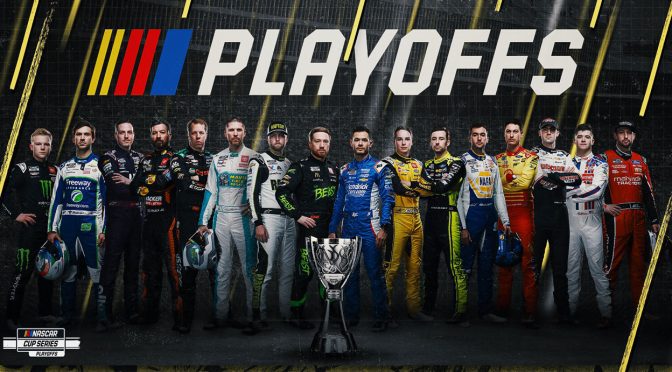
Eleven drivers are provisionally locked into the 2024 Cup Series Playoffs, with four of those guaranteed as Denny Hamlin, Kyle Larson, William Byron and Christopher Bell have all won multiple times this season.

With seven races remaining in the regular season, Hendrick Motorsports teammates Kyle Larson and Chase Elliott are separated by just 20 points, respectively, at the top of the Cup Series standings that will award 15 playoff points to the regular-season points leader after the Southern 500 at Darlington Raceway.

Elliott, Tyler Reddick, Brad Keselowski, Austin Cindric, Daniel Suárez, defending champ Ryan Blaney and most recently, Joey Logano, each have a win in 2024. With just five spots remaining and multiple surprise winners already this year, there’s no telling who could get in and which big-name drivers will be left without a postseason bid.

LAST 4 IN

Just a few weeks ago, you could be comfortable locking in Ross Chastain, Ty Gibbs and Alex Bowman into the 16-driver playoff field. After Logano’s stunning victory last weekend at Nashville, the playoff bubble is as tight as ever in its 10-year history.

Despite having 10 top-10 performances this season, Bowman is now the last driver provisionally in the top 16, holding a 51-point advantage over Bubba Wallace. Bowman’s probability also saw the biggest drop-off, from 70% to under 50%. The No. 48 did not finish last year’s Chicago race and was scored last.

Ross Chastain looked prime for a top-three finish at Nashville after pit strategy put him in the lead during the final stage. However, an aggressive restart from Larson resulted in the No. 5 shooting up the track in Turn 1, spinning and wrecking Chastain in the process. Chastain now only sits 66 points above the elimination line.

Ty Gibbs continues to slump in the early weeks of summer. He hasn’t scored a top-10 finish since the Coca-Cola 600 and is now just 70 points to the good above Wallace.

With three top-five finishes in the last four races, Chris Buescher continues to grind his way to a potential playoff spot. His probability now stands just under 88%, and with the speed the No. 17 RFK Racing Ford shows on a weekly basis, Buescher is due for a win before the postseason field is set.

FIRST 4 OUT

Everyone still outside the top 16 is about a race behind Bowman points-wise if that’s how they plan to make the postseason. Hence, it’s not an efficient plan to try to make the playoffs solely on points. It’s likely going to take a victory, and I have more confidence in the Front Row Motorsports duo of Michael McDowell and Todd Gilliland than I do in the two above them in Wallace and Kyle Busch.

Busch seemed to finally have good fortune at Nashville. Despite getting caught up in the Chastain incident in the first of a record five — yes, five overtimes last Sunday — Busch was given his spot back inside the top five. However, bad luck has always found “Rowdy” this season, and he was spun and wrecked during the third OT after Larson ran out of fuel and stacked the outside line right in front of the No. 8 Chevy.

His first top-10 at Nashville since Darlington was a mere consolation for Wallace, who probably wanted Logano to win the least. Road courses are still a learning process for the No. 23 driver, and he’ll need to tread lightly around the close-quartered street course to earn a solid points day on Sunday.

Front Row should be licking their chops this weekend as both McDowell and Gilliland could steal playoff points on Sunday. McDowell is coming off a runner-up result at Sonoma and finished seventh last year in Chicago. Gilliland was 10th at Sonoma and hasn’t finished outside the top 20 since Dover.

WHO CAN SHAKE UP PLAYOFF PICTURE AT CHICAGO?

Everyone who has yet to win this season is rooting for a repeat victor on Sunday. But there are so many question marks entering a weekend, especially if the weather plays nice. Shane van Gisbergen will be the most popular driver in the garage as he looks to defend his thrilling inaugural Chicago triumph. Of those going for a playoff spot, it has to be McDowell. If he’s able to put on another great qualifying run and score his fourth pole of 2024, the No. 34 driver is going to have everyone sweating on Sunday.

MORE: Racing Insights predicts Chicago | 2024 Cup Series schedule

Before each race weekend, check back into The Field of 16 to see the latest projections of the 2024 Cup Series playoff field.

Shane van Gisbergen recently got his first real taste of Chicago.

During a media tour to leverage hyping the most stunning victory of the 2023 season, van Gisbergen also played Windy City tourist. He visited the Art Institute, Motor Row District and State Street. He checked out the Centennial Ferris wheel on Navy Pier. He attended Opening Day at Wrigley Field (Cubs win!) for his first Major League Baseball game.

It was an illuminating whirlwind for the driver who swept Chicago (and NASCAR) off its feet but barely explored its vast charms and wonders on his first weekend there.

RELATED: Learn more about the Chicago Street Race

“I’ve never seen buildings that big and close to each other before,” said the Auckland, New Zealand native, absorbing a metropolitan area whose population is nearly twice that of his home country.

But this isn’t some tale of being overlooked in the big city. Nearly a year after showing up as a relative unknown, it was van Gisbergen who now was getting recognized in a town famous for sports idolatry.

“It’s funny because we get questions about SVG and what he’s doing,” Chicago Street Race president Julie Giese said. “He has a fan base in Chicago.”

As he should, considering his milestone victory was a game-changing event with repercussions far beyond becoming the first driver in six decades to win in their Cup debut.

It was life-changing for van Gisbergen, who made his fame on Australia’s Supercars circuit but returns this week for the second annual Cup race through the Loop as a full-fledged stock-car star in the making (and with a rivalry among NASCAR’s best this year). After multiple victories in his full-time Xfinity season — as well as a new signature celebration — he is making steady progress on ovals and on track for a potential Cup ride as early as 2025.

And the “SVG” initials moniker has become ubiquitous — an amusing development considering his surname was butchered by countless Americans right up until he won the first street race in the 75-year history of the Cup Series.

That literally put SVG in the NASCAR Hall of Fame via a new exhibit unveiled three months ago.

“To have something like that here after my first race, it’s pretty hard to put that into words yet,” said van Gisbergen, who was inducted into New Zealand’s motorsports Hall of Fame two years ago.

It’s uncertain if the phenomenon will continue to blossom into full-time Cup Series stardom, but van Gisbergen unquestionably still is having a moment.

He has won the past two Xfinity Series races on road courses (and might be unbeaten on right-turn tracks in 2024 if not for his entertaining feud with Austin Hill erupting on the last lap at Circuit of The Americas).

Sunday will mark only his sixth Cup start, but SVG is being hailed a favorite to repeat on the course through the heart of downtown — and arguably as the most feared road-course driver in NASCAR with a heel-toe technique for braking and shifting essentially impossible for even Cup champions to emulate (though some have pondered it).

“I rate him as one of the top 10 drivers in the world for that reason, no different than when he came into the race last year,” said Team Penske’s Austin Cindric (who speaks with some authority having tested in Supercars). “I think everybody just learned who he is and how good he is.”

Several Cup champions weren’t shy with slathering praise after van Gisbergen’s victory last year.

Chase Elliott said van Gisbergen “made me look bad and the rest of us, too. He’s going to go home and tell all of his friends how bad we are.”

Kyle Busch said van Gisbergen was “four (to) eight years ahead of us” on street courses. Kyle Larson wondered if van Gisbergen “thinks we all suck or if we could actually compete, if we weren’t really that bad.”

They’ll get another chance to prove their worth this weekend. While all are expecting to be better, SVG is regarded as the gold standard.

“I think he’ll be super good, again, for sure,” Elliott said. “And he’s had even more time driving (the Next Gen), which I think ultimately is just gonna make him better.

“Last year, he was lights out by far the best. But I do think everyone else will be better. I’m curious to see how we stack up against a guy that has that much experience with the second try.”

Shane van Gisbergen gives a thumbs-up sign after winning in 2023 at the Chicago Street Course.
Chris Graythen | Getty Images

He emerged like a lightning bolt in a race that started as a record-breaking monsoon receded, but there never was a master plan for van Gisbergen, 35, taking NASCAR by storm.

After winning his third Supercars championship (and second consecutive) in 2022, he had signed an extension with plans to remain long-term in the Australian-based series. But Supercars switched to a new Gen3 model, and the platform didn’t suit van Gisbergen.

“I would have been racing in Supercars probably another 10 years until I was 45,” he said. “And then the way the car changed, I was like, ‘Oh, maybe I’ll do something else,’ and I had just signed a new contract, although I had second thoughts about it. But I had no intention of coming (to NASCAR).”

Meanwhile, NASCAR veteran Boris Said had given SVG a glowing recommendation that put him on the short list of Trackhouse Racing owner Justin Marks, who was seeking candidates for the team’s Project 91 aimed at showcasing international stars in NASCAR.

While attending Australia’s Formula One race in April 2023, van Gisbergen got a call in Melbourne from Marks that confirmed he’d race Chicago.

“And then my life’s taken a 180 since,” van Gisbergen said with a laugh. “It’s been a pretty amazing opportunity and pretty thankful to Justin. I haven’t stopped smiling since Chicago and coming back over here. It’s been awesome. It’s just perfect timing.”

Though he “doesn’t really like talking that much,” van Gisbergen has seemed loose and relaxed in the States this year. He rents a house in Mooresville, North Carolina, and has found American culture appealing aside from commercial air travel and the Charlotte Douglas baggage claim. (“Airports suck; that’s the worst part of being here. I’ve never had a flight on time all year. But it’s first-world problems; everything else is cool.”)

It’s a minor nuisance compared with the fishbowl existence he had come to dread in Supercars. In the absence of fellow three-time champion Scott McLaughlin (who departed for IndyCar in 2021), van Gisbergen was the unwitting focus of a series in transition.

“The cars have been awesome for years and then last year there just was so much negativity, and every news story was bad,” van Gisbergen said. “Everyone’s trying to get a bad quote, and I just always was thinking about how to say the right thing.

“It feels like a fresh start, and sometimes you just need that. I’m loving my racing and loving the challenge of all new tracks, new people and new cars every week.”

Austin Hill leads Shane van Gisbergen around a turn at Sonoma Raceway.
Logan Riely | Getty Images

Perhaps most surprising is how van Gisbergen has been comfortable in the controversy with Austin Hill that started at COTA and carried over to Sonoma. “Here I feel like just a different person who can jump out the car and be myself,” van Gisbergen said. “Everything I said kind of came across the right way, whereas people would nitpick all your quotes in Australia, and you’d look like the bad guy.”

The hardest part has been learning the rules of engagement that are less polite than the “avoidable contact” decorum of Supercars and other road-racing series. Van Gisbergen’s fender-banging battle with Hill in Austin marked “the first time I hit someone on purpose like that, so it’s really weird. People saying, ‘You probably should have hit them here instead of there.’ It’s stuff I’ve never had to think about before or consider, but I guess I got to get better at it.”

His first two Xfinity victories both featured rough and tumble moments. At Portland, SVG unintentionally cleaned out pole-sitter Sam Mayer in the first corner.

“I thought, ‘Oh (crap), that’s a penalty straight away,’ and obviously it’s not here,” van Gisbergen said with a laugh. “But then I spent the whole race feeling bad about spinning him. He was the first guy I went to apologize. Everyone’s like, ‘Just forget about it.’ If it was in Australia what I did to Sam, I would have been sent straight to the back.”

Contending for wins has brought other teachable moments (he nearly drained the battery after accidentally toggling off the alternator at Sonoma), but his education largely has been on the ovals, where van Gisbergen still is learning the nuances of aerodynamics (“my bum’s telling me I’m about to spin out but that’s how they set the cars up to skew through the corner”), double-file restarts and racing mid-pack (after 81 wins and 176 podiums in 508 Supercars starts).

His progress is being tracked to a captivating degree Down Under. Xfinity and Cup races now are available on major networks, and media outlets from Auckland to Sydney are paying attention to the exploits of van Gisbergen and other Supercars drivers — 2023 champion Brodie Kostecki, 2024 points leader Will Brown and race winner Cam Waters have started Cup races since van Gisbergen’s Chicago breakthrough.

“To have the races broadcast back home, it’s awesome to help us get sponsors to be able to come over here and do these races,” Waters said. “Before Shane was even coming over here, I was trying to talk to teams and get a foot in the door. When he (won) at Chicago, it definitely sparked a bit more interest from this side of the world.”

Shane van Gisbergen poses behind home plate at Wrigley Field with the skyline in the background.
Daniel Boczarski | Getty Images

There is general appreciation among Cup stars for van Gisbergen opening the door to Australia for NASCAR. But some also still bristle with wounded pride at The Kiwi Who Conquered in his Cup debut.

William Byron said the Chicago dominance was “a little embarrassing,” spurring the Hendrick Motorsports driver to work hard on braking and shifting to match van Gisbergen’s techniques to position his car with the last few inches of the concrete barriers lining Balbo Drive and Michigan Avenue.

“I think his awareness and feel for the walls and how close he can be is probably the biggest advantage,” Byron said. “I think our setups have evolved, and we’ve probably learned some things, so I’m sure the competition will be that much better and prepared to race against him. But he’ll still be good.”

Denny Hamlin said van Gisbergen would be “starred on your timing and scoring” this weekend. “He’s got the potential to be the fastest (again),” Hamlin said. “I heard during the (Cup) test for Chevrolet (at Sonoma) he was running ridiculously fast times. So I don’t think it’s ever been a question whether he’s going to be one of the best on road courses.”

And van Gisberen’s advantage might be permanent because of his lifelong aptitude for the “heel-toe” method — using his right foot to control the accelerator and brake while relying on his left foot for shifting.

A craft employed by nearly all Supercars drivers, it’s been a lost art for 30 years in Cup. NASCAR drivers predominantly have used their left foot exclusively for braking since transmission technology eliminated the need for the clutch while changing gears. The heel-toe helps modulate engine braking, allowing the car to “free roll” and giving a driver more options and better handling in the turns.

It’s a technique that could take years to master the necessary muscle memory. Joey Logano and crew chief Paul Wolfe discussed whether it would be worth attempting before concluding it was virtually impossible with limited practice and testing.

“All of us are going to catch up in our own ways,” Logano said. “You try to take things that he’s doing and apply it to your craft. But he’s been doing (the heel-toe) really well his whole life. It’d take me forever to learn that. … I think we can still figure out how to beat him, no doubt, but we’ve just got to do it in our way.”

Having experience with heel-toe downshifting, Cindric said he “put a lot of thought” into trying it in Cup but noted it wasn’t a plug-and-play decision. “Am I going to be right foot braking on ovals? No,” he said. “Am I going to have a specific package in my car for road courses to where I can actually get my pedals to where I can right foot brake? It would take a large commitment from just an interior design standpoint. I don’t feel like it’s as much of an advantage as it is more of a comfort thing.”

Unfortunately for the competition, van Gisbergen might be uncomfortable only in Victory Lane, where he has been trying out a new celebration. Inspired by the unique winning trademarks of Trackhouse teammates Ross Chastain (watermelon) and Daniel Suarez (pinata), SVG booted a celebratory rugby ball after Portland and Sonoma.

It’s a nod to New Zealand’s All Blacks, the national rugby team with three world championships. Once an amateur blindside flanker, van Gisbergen loves the sport but is less confident in his chances at reaching the crow.

“I’m worried at a proper track when they have the high fences if I can get the ball over,” he quipped.

If he can clear Buckingham Fountain after another win, it’ll prove Chicago really is SVG’s kind of town.

Nate Ryan has written about NASCAR since 1996 while working at the San Bernardino Sun, Richmond Times-Dispatch, USA TODAY and for the past 10 years at NBC Sports Digital. He is the host of the NASCAR on NBC Podcast and also has covered various other motorsports, including the IndyCar and IMSA series.

This past weekend’s five-overtime finish at Nashville was certainly one way to end a race. After a Cup Series record number of OT restarts — producing 31 extra laps — and with much of the field either wrecked or running out of gas, Joey Logano outlasted the competition to cross the start/finish line first on fumes.

For some, it made for an exciting conclusion to a race with plenty of twists and turns. But there was also plenty of chatter about whether the rule around unlimited green-white-checkered finishes needed tweaking. While it’s true that Sunday’s extended OT was historic — not exactly something that happens every week, as Dale Earnhardt Jr. pointed out — it is also true that overtimes are generally on the rise in the Cup Series over the past few seasons:

A graphic depicting the rise of overtimes in the NASCAR Cup Series

If overtime affects the outcome of nearly a third of races now, it might be worth looking back at what has been tried before, as well as looking around at what other options might be to provide the best balance between a thrilling finish and what’s fair (while also making safety a top priority). So in that spirit, let’s see what kind of cues NASCAR might take from its own history, as well as what a hypothetical — and possibly quite silly! — adaptation of other sports’ overtime rules to racing might look like.

NASCAR’s history

NASCAR itself used to simply have races finish under yellow if there was a late-race caution, which is the most straightforward — but perhaps also the most unsatisfying — way to handle the end of a race in the event of a late flag. The old policy also used to provide for racing back to the line on a caution, which is exciting but potentially very dangerous. This led us to the modern green-white-checkered rules in 2004, which initially began with a cap on attempts before moving to unlimited tries in 2017.

The old-school policy is clearly untenable for safety reasons alone, but there is an argument to be had for returning to a limit of three restarts — as the Cup Series’ rules dictated from 2010-15 — to avoid situations where running out of fuel becomes a widespread problem like it was on Sunday. Of the six races that have gone to OT this season, four only involved one restart, one involved two restarts (the Autotrader EchoPark Automotive 400 at Texas Motor Speedway) and one involved five. So most of the time, a cap on OT restarts wouldn’t have made much of a difference anyway, but it would provide the crew chiefs with a measure of certainty about exactly how much fuel their cars will need to finish the race.

NFL

The Rule: One 10-minute OT during the regular season, continuous 15-minute OTs in the playoffs. Each team gets at least one possession (unless, in the regular season, the first team on offense scores a touchdown). If the game is still tied after those first possessions, the next score wins.

Possible NASCAR variant: The NFL rules place an emphasis on touchdowns over field goals, and rightly so — putting more distance on the scoreboard between yourself and the opponent is a good thing. So a NASCAR version might involve the race ending early if the leader is able to build a lead of a certain interval (in seconds, perhaps varying by track) by the time they cross a particular scoring loop, regardless of whether they’ve taken the white flag yet. And like the NFL, NASCAR could also experiment with different rules for playoff races versus the regular season.

College Football

The Rule: Each team gets possession at the opponent’s 25-yard-line; the leader after those possessions wins. Otherwise, they alternate possessions until a winner is determined, with teams having to attempt a 2-point conversion after TDs starting with the third OT.

Possible NASCAR variant: For better or worse, college football’s OT policy shrinks the game (and the field) down to its most exciting essence. Racing’s version of that might be a drag race to the start-finish line over less than a full lap — whether that is a point on the backstretch, or somewhere else — with the winner claiming the spoils no matter what (since nobody would be racing through any carnage created behind them).

Kyle Larson leads a restart at Richmond

MLB

The Rule: A runner is placed on second base at the start of each extra inning, to encourage additional scoring and determine a winner more quickly.

Possible NASCAR variant: The so-called “ghost runner” rule may be among baseball’s most unpopular tweaks under commissioner Rob Manfred, but it does achieve its desired effect of reducing the number of mega-long (13+ inning) games. Racing’s version might involve “ghost laps” — having the leader restart OT further down the track than the driver in second place (and second place starting ahead of third, etc.) to give them a better chance of taking the white flag and ending the race.

NBA

The Rule: Continuous 5-minute overtime periods until a winner is determined.

Possible NASCAR variant: Basketball probably has the most normal OT rules of any sport, which makes sense — it’s also the highest-scoring game, so the odds of one team being ahead of the other after an extra period are pretty high. Because these rules are so basic, they probably most closely mirror NASCAR’s current system of continuous green-white-checkered restarts, or even the original method of finishing under yellow if necessary.

NHL

The Rule: Continuous 20-minute, sudden-death 5-on-5 OT in the playoffs. Five-minute 3-on-3 sudden death OT in the regular season, followed by a 3-round shootout if tied after OT. 

Possible NASCAR variant: Like NASCAR, hockey’s overtime rules have changed a lot over the years. Originally, the NHL allowed ties, but they moved to the shootout in 2005 and further tweaked the rules to reduce the number of skaters on the ice for OT. Following that trend, NASCAR’s version of this might limit the number of cars on track for an OT restart — say, only involving the Top 10 at the end of regulation and sending the rest of the drivers to the pits. This would ensure that the winner was among the late leaders and reduce the number of rear-of-the-field cars that might bring out a yellow flag, though the battle to be among the Top 10 at the end of regulation could be desperate enough to cause unintended negative consequences.

Soccer (World Cup)

The Rule: Teams play two extra 15-minute periods if tied after 90 minutes of regulation. If they are still tied, the winner is determined through a five-shot penalty shootout.

Possible NASCAR variant: The big complaint about shootouts (whether in soccer or hockey) is that they reduce the main actions of the sport down to a glorified mini-game competition. But if NASCAR were to go the same route, they might have the two leading drivers after regulation engage in dueling qualifying-style laps, with the fastest time earning the victory. Or, to really lean into the gimmickry, they might also have the speed of the team’s pit crew factor into the result. Embrace the shenanigans!


Should NASCAR enact any of these changes wholesale? Ummm, probably not. But there may yet be some interesting twists worth thinking about by making comparisons with other sports. And whatever happens to the OT rules, one thing is for sure: They will always create conversation, no matter what the powers-that-be decide to do.

Neil Paine is a freelance writer whose work also appears at ESPN.com, The Philadelphia Inquirer, Sherwood News and Substack. He is the former Sports Editor at FiveThirtyEight, and was also a consultant for the NBA’s Atlanta Hawks.

Here’s what’s happening in the world of NASCAR with Nashville in the rearview and the Chicago Street Race (Sun., 4:30 p.m. ET, NBC) right around the corner.

THE LINEUP ️

1️⃣ The intensity only ramps up from here

2️⃣ Can anybody beat SVG?

3️⃣ How Joey Logano’s fuel-saving efforts won Nashville

4️⃣ How do you get to the playoffs? Stage points, stage points, stage points

5️⃣ Catch the pack — news and notes from around the garage

joey logano celebrates at nashville
Getty Images

1. The intensity only ramps up from here

It’s hard to believe a two-time champ’s win could shake up the playoff situation so much, but plenty of drivers are feeling the heat after Nashville.

Take a hard look at the photo above of Joey Logano after climbing out of his No. 22 Team Penske Ford, moments removed from outlasting the field through a record five NASCAR Overtimes for his first victory of 2024.

That’s a two-time NASCAR Cup Series champion and 33-time Cup race winner who’s about as fired up to claim a checkered flag as anybody we’ve seen this year in any series.

Winning just meant that much right now.

There was legitimate, somewhat unspoken concern among the No. 22 group, one of the most heralded in the sport, that a playoff miss was on the table. Instead, “Sliced Bread” rose to the occasion and delivered for his team, which is now well positioned as we enter July.

Logano’s Nashville triumph ensured that Team Penske — an organization that hadn’t won in 2024, period, until just five races ago — became the first team to land all of its full-time drivers in the playoffs with a win. While the other powerhouse teams in Hendrick Motorsports and Joe Gibbs Racing currently slot all four of their drivers in, Roger Penske’s bunch is the only one sleeping tight at the moment. The pressure and intensity are only going to increase every week from now until Darlington, and anybody without a win isn’t sitting comfortably at the moment, including JGR’s Martin Truex Jr. and Ty Gibbs and Hendrick’s Alex Bowman, who all looked like playoff locks a few weeks ago.

With Logano leaping off the elimination line all the way to ninth in the playoff standings, that moves Bowman down to last in the provisional playoff grid despite what, in some facets, is shaping up to be a career-year numbers-wise as he’s one of just five drivers with double-digit top 10s. He’s relatively safe for now at 51 points above the bubble, but if any of the drivers below him find their way into Victory Lane over the next seven races,  we could be looking at the No. 48 Hendrick Chevrolet — a car that once won five straight titles — missing the playoffs for a second year in a row. (And if Bowman does make it, it’s worth noting he’s the only driver currently in the provisional field without any playoff points.)

Bowman isn’t the only one who would be in serious trouble, however. Spots 13th to 16th in the standings are separated by just 19 points, so a new winner outside the top 16 would send shockwaves throughout.

With the unpredictable nature of almost every track remaining before the field of 16 locks in, it feels inevitable that there will be.

shane van gisbergen celebrates at chicago
Getty Images

2. Can anybody beat SVG?
<
Shane van Gisbergen put on a clinic — in his NASCAR debut — to win the inaugural Chicago Street Race. Has the field caught up to him, though?

It’s always funny when listening to sports prognosticators talk about whether an athlete “can” accomplish a goal or beat a particular opponent, etc., when more often than not the correct word should be “will.” Of course it can happen. It’s sports, just about anything can happen — the question is really “will this happen” or “won’t it happen?”

For the above question, I very specifically mean “can.” Literally — can anybody beat Shane van Gisbergen this weekend? Like, is it actually possible?

It’s been a year, and plenty more incredible things have happened since, but let’s please remember just how ridiculously impressive SVG’s outmaneuvering of the field in the inaugural Chicago Street Race was. It was his first taste of action in any NASCAR series, with extremely limited seat time before the green flag flew, with a team/project in its infancy driving for a group of essentially strangers to the New Zealand native and he still rode to Victory Lane after biblical storms blew through the Windy City.

Given that set of circumstances still produced a win, it feels fair to question if SVG is just going to be untouchable on this track — the only one of its kind on the circuit — for the foreseeable future.

Even the drivers, themselves, aren’t so sure if he’s beatable.

“I don’t know. It’s going to be interesting to see,” defending Cup champion Ryan Blaney said last month at New Hampshire Motor Speedway. “Obviously, he’s really talented. I’ve been enjoying watching his inaugural Xfinity season. He’s a good guy. I’ve gotten to talk to him a good bit, and he loves the sport and really enjoys it. I don’t know if he’ll have as much of an advantage this year because everyone was kind of in the same boat last year as far as first time there, but he raced on a lot of street courses, and the V8 (Supercars) stuff and the rain and all that craziness that went on. He probably had a little bit of a leg up on everybody and it showed, and he took advantage of it and won the race. Hopefully, we can all draw a little bit closer to him at that place to where he doesn’t embarrass us like he did last year. We’ll see, though.”

Van Gisbergen now has an additional four Cup starts — two of which were road courses — under his belt, along with two victories in the 17 Xfinity Series races he’s run this year as he seeks a title there. He’s now an official American resident as well, and he’s no doubt more comfortable on the general NASCAR side of things than he was a year ago. And a comfortable driver is a fast driver, especially on a type of track that he knows especially well and certainly better than anybody else in the field.

The rain was a clear factor in last year’s race, with SVG looking like a duck amongst cats as he splished and splashed around the tight, 12-turn city streets with ease while the other 36 cars tip-toed cautiously.

Should Sunday’s race be run in the dry, however, it could tighten things up.

“I don’t think it will be as much of an advantage (if it doesn’t rain), but there’s no doubt that street courses seem to be his wheelhouse,” Logano said at NHMS. “There’s no doubt he’s good on road courses as well, like the typical road courses. He’s great at those as well, but it did seem like a street course he felt way more at home when we all felt like a fish out of water going around that race track. Then you added rain. It was perfect for him and he capitalized as he should. For 99% of the field that was the first time for any of us to do anything like that and we all have very limited experience of racing in the rain.

“We also had a lot to lose where he had nothing to lose. … Like, you look at those walls and it is like, whoa, there are a lot of points in those walls. For him, who cared? I think all those things weighed into it for sure. I think this year, now that we all have a general idea of what we’re going into, we can prepare for it. It’s hard to prepare for something when you’re blind and you don’t know what it’s going to be like. I’m sure he’s still going to have a lot more experience with this stuff than we do, but I think we’ll close the gap a lot.”

3. How Joey Logano’s fuel-saving efforts won Nashville

NBC’s Steve Letarte and MRN’s Todd Gordon break down how Joey Logano won at Nashville Superspeedway by saving fuel.

4. How do you get to the playoffs? Stage points, stage points, stage points

Obviously, the best path to the postseason is with a race victory — but a look at the elimination bubble shows the importance of maximizing stage points, too.

RankDriverTotal points+/- to elimination lineStage Points
12Martin Truex Jr.591+143141
13Ty Gibbs518+7093
14Ross Chastain514+6666
15Chris Buescher504+5662
16Alex Bowman499+5170
17Bubba Wallace448-5176
18Chase Briscoe421-7833
19Kyle Busch395-10459
20Josh Berry368-13146
21Todd Gilliland367-13235

5. Catch the pack — news and notes from around the garage

Paint Scheme Preview: Chicago

NASCAR betting: Opening odds for Chicago

Risk vs. reward runs high on Chicago Street Course, where hazards, SVG loom

Chicago Street Course comes to life ahead of race weekend

NASCAR official explains Kyle Busch’s restart placement in Nashville OT

Penalty report: Carson Hocevar, No. 77 team issued loss of 25 driver points

AM Racing taps Joey Logano as Xfinity fill-in for Hailie Deegan at Chicago

Shane van Gisbergen isn’t sneaking up on anyone this year.

Ahead of the inaugural NASCAR Cup Series race on the Chicago street course last year, the New Zealander opened at 100-to-1 odds to win it. SVG drew immediate action from bettors and rewarded his backers with a first-place finish.

For Sunday’s version of the event, the Grant Park 165, van Gisbergen opened at 10-to-1 odds at the Westgate SuperBook in Las Vegas. Despite that drastically shortened price, bettors remain interested.

In fact, by the time the SuperBook was ready to take bets outside of Nevada, a customer in Vegas had already placed a wager on the No. 16 Wendy’s Saucy Nuggs Chevrolet. That bet prompted a move to +800, and the SuperBook took another bet at those odds.

RELATED: Chicago schedule | Opening odds

Ed Salmons, vice president of risk management at the SuperBook, understands the SVG sentiment. A crash on the last lap and a 30-second penalty at the Circuit of the Americas on March 23 kept van Gisbergen from sweeping this year’s three Xfinity road course races so far. He led 20 of the 50 laps that day in Austin.

“There’s no doubt” SVG should be among this week’s favorites, Salmons told NASCAR.com. “There have been three road course races in the Xfinity Series (this year), and he’s won two of the three (Portland, Sonoma). And he should be three-for-three.”

Jim Sannes, managing editor of digital media at FanDuel Research, understands van Gisbergen’s position near the top of the Chicago oddsboard, but the driver is priced too short for Sannes’ tastes.

“It’s just hard for me to get there, given he’s not in the highest-end equipment, even if we know the driver matters a bit more here,” Sannes said in a DM. “I have SVG at 5.6% to win (which translates to about +1690 odds), which could very well be too low. I just respect the Cup Series regulars enough to think they’ll improve as they head back to the track for a second time.”

A different-looking oddsboard

Beyond van Gisbergen, the Grant Park 165 oddsboard features a handful of other drivers adept at road racing who are priced ahead of Cup superstars from top garages. We see names like Chris Buescher, AJ Allmendinger and Michael McDowell with shorter odds than Denny Hamlin, Joey Logano and Ryan Blaney.

Here are odds, as of Wednesday, from three top sportsbooks – the SuperBook, BetMGM and DraftKings:

DriverSuperBookBetMGMDraftKings
Kyle Larson+600+600+600
Tyler Reddick+600+600+650
Christopher Bell+600+600+600
Shane van Gisbergen+700+550+500
Chase Elliott+1000+750+800
Martin Truex Jr.+1400+1200+1200
William Byron+1400+1400+1400
Chris Buescher+1400+1400+1600
AJ Allmendinger+1400+1400+1400
Michael McDowell+1600+1200+1200
Ty Gibbs+1800+1600+1600
Ross Chastain+3000+2500+2800
Denny Hamlin+3000+2000+3000
Daniel Suárez+3000+3000+2800
Kyle Busch+3000+3000+2800
Ryan Blaney+4000+2500+3500
Austin Cindric+4000+3000+4000
Joey Logano+5000+5000+4000

Driver skill, of course, gets weighted more heavily on road courses than it does on ovals.

“I agree with the betting markets in putting guys like McDowell and Allmendinger ahead of the regular contenders,” Sannes said. “Back in the day, when there were only two road-course races per year, it was fine to let overall form play a bigger role in trying to predict who would excel. But now that we have bigger samples on road courses, we can see that expectations for guys like McDowell genuinely should be higher than they are for the others, so my model fully agrees with the market in that regard.”

McDowell, per Salmons, is among the drivers drawing early bets at the SuperBook.

However, the increased emphasis on road course racing on the Cup circuit has helped create a more wide-open field. This year’s schedule includes five road/street races.

In seasons past with just two such events, “you could pick your six guys that could win the race,” Salmons recalls.

Chase Elliott was tops among that select group, automatically priced as the favorite every time Cup drivers were about to go around more than four turns. As drivers gained road racing experience, the field caught up, and Elliott can be found this week at 10-to-1 odds.

Around the track

Here are some other drivers to watch on the Chicago streets on Sunday:

• A poorly-timed caution likely kept Christopher Bell from winning this race in 2023. He could be had at +2500 ahead of last year’s event, but nothing near that juicy is available for Bell this year. Still, he’s among the most popular bets at the SuperBook this week.

• Sannes has McDowell and Kyle Busch both circled this week. McDowell wins 7.9% of Sannes’ simulations (a play at +1200 or better), and Busch is at 4.6% (+2100 or better). “Not only have they raced really well on road courses the past two years, but both must win if they want to make the playoffs,” Sannes said.

• Some bettors can’t seem to stay away from Hamlin, and Salmons is just fine with that. “It’s funny, every time we have one of these road course races, literally the first bet is Denny Hamlin at 30-to-1, and it didn’t fail to happen again.” Salmons wrote bets on Hamlin at the same price for COTA and Sonoma. Hamlin remains +3000 at the SuperBook as of Wednesday.

• While bookmakers and bettors are armed with more road racing data, including that from a run over this course last year, expect the odds to shift on Saturday. “Obviously where they qualify and what practice looks is going to dictate the odds really strongly,” Salmons said.

Marcus DiNitto is Senior News Editor at Gaming Today. He’s been covering sports business for 25 years and sports betting for 12. NASCAR is among the many sports Marcus enjoys betting but often loses on. Follow him on Twitter.