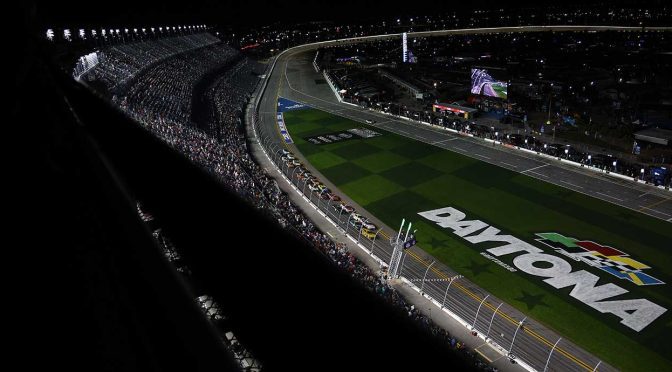
DAYTONA BEACH, Fla. — Layne Riggs took a moment to bask in the scenery and reflect on his journey when the Front Row Motorsports hauler pulled into Daytona International Speedway for the opening weekend of the 2024 season.
There were many days when Riggs was unsure whether he would ever make a trip to Daytona as a driver. His time in short tracks around the southeast was always a fight for survival with a finite number of resources, but Riggs never wasted an opportunity to showcase his talent.
A long, meticulous grind finally translated into Riggs earning a ride with Front Row Motorsports’ NASCAR Craftsman Truck Series program for the entire 2024 season. The feeling of a secured future is new for Riggs, but one he cherished in the hours leading up to his first Daytona start.
“I just can’t believe I’m here,” Riggs said. “It’s amazing. I’m in awe to just be at Daytona. That’s where I’ve wanted to be the past 10 years of my racing career, and I’m so thankful and fortunate everything worked out for me to get my first full-time ride.”
The one factor that always held him back from progressing through the developmental ladder was finances.
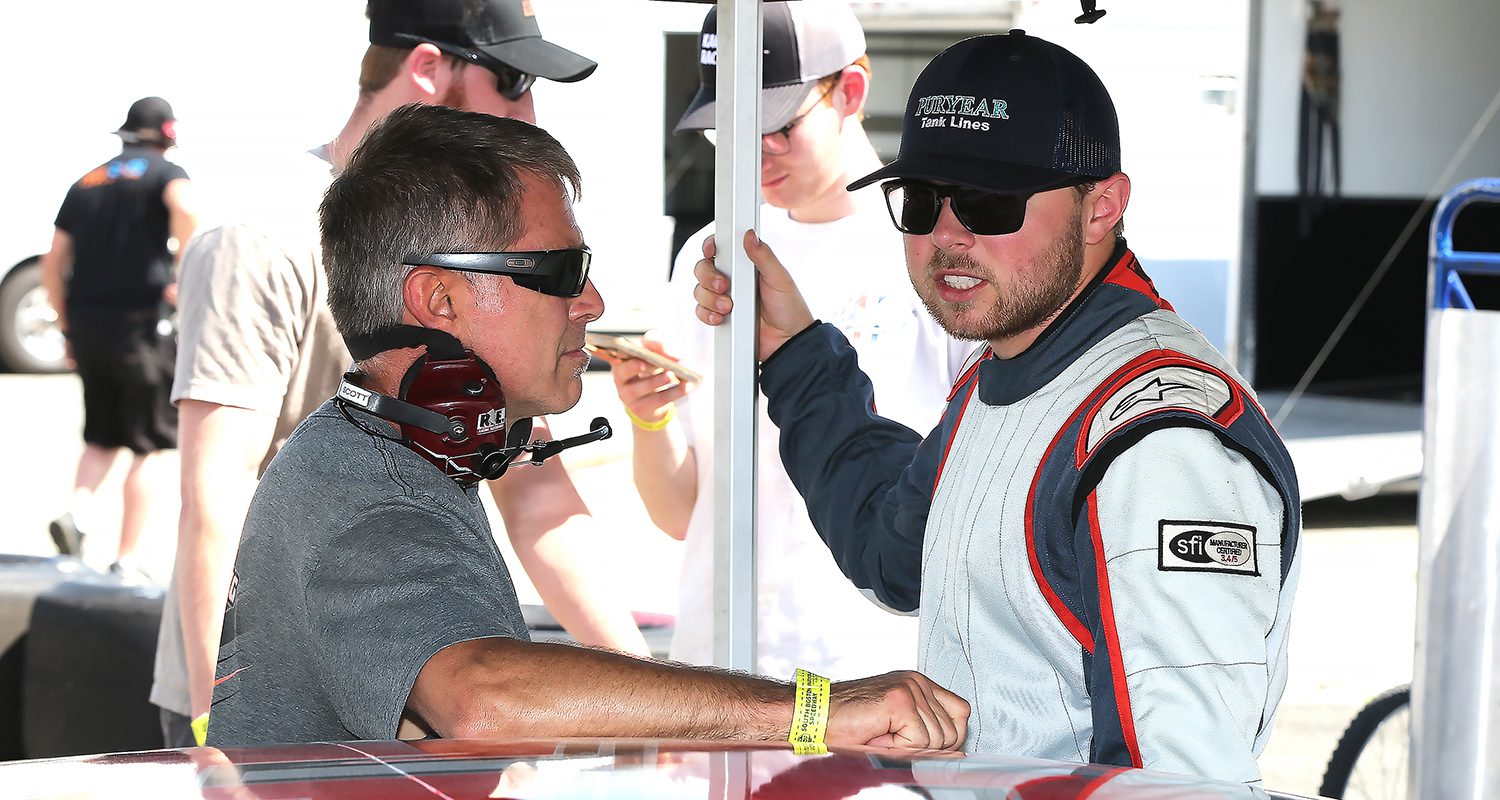
Riggs worked tirelessly alongside his father in former NASCAR Cup Series driver Scott Riggs to maintain a competitive edge against Late Model Stock programs with more funding. Despite their success together, Riggs knew he would need to branch out if he wanted to keep his NASCAR dreams alive.
Layne Riggs’ path to NASCAR started in Late Model Stocks, where he worked on his own cars alongside his father Scott Riggs. (Photo: Joe Chandler/South Boston Speedway)
A handful of starts with Halmar Friesen Racing in the Truck Series near the end of 2022 season gave Riggs his first major national exposure. He earned a top 10 in his debut at Lucas Oil Indianapolis Raceway Park and led laps in the season finale at Phoenix Raceway, but the opportunity did not materialize into a ride for the following year.
Riggs resigned himself to running Late Model Stocks again after a grueling campaign for the national championship, determined to keep working hard with the goal of earning at least a part-time ride in top-tier equipment.
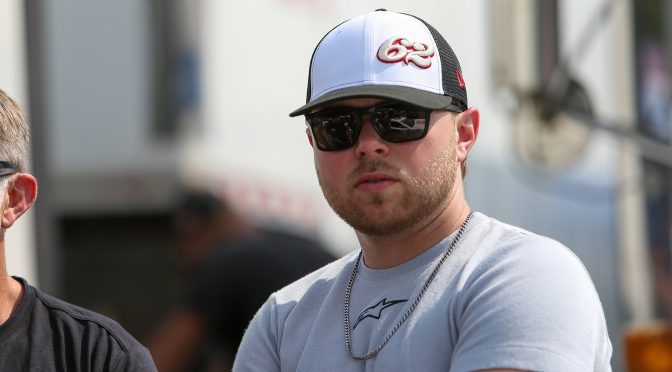
That opportunity manifested in the form of 2014 NASCAR Cup Series champion Kevin Harvick, who took notice of Riggs’ driving ability when he bested him in a CARS Tour race at North Wilkesboro Speedway.
“Kevin Harvick called me the morning after North Wilkesboro and told me that I ran pretty good,” Riggs said. “He said he wouldn’t be able to run the late model a lot to get it better for when he was going to build a full-time team. He wanted me to take it to Caraway [Speedway] the following weekend and see what I could do.”
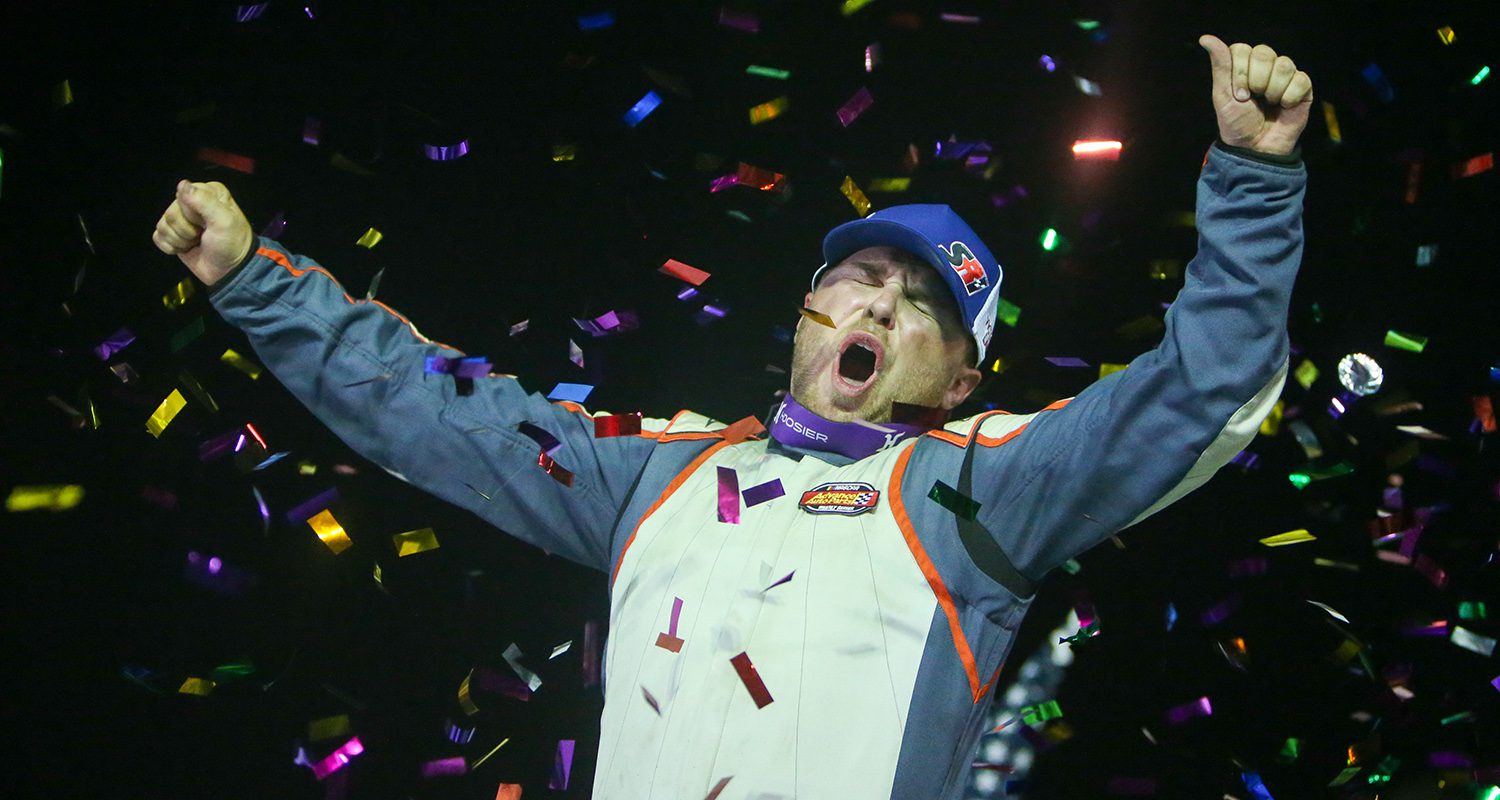
Just like he did so many times before, Riggs took full advantage of the chance provided to him by parking Harvick’s No. 62 in Victory Lane at Caraway. A technical infraction led to Riggs getting disqualified, but his performance from that evening served as validation as to why Harvick selected him for that car.
The overturned victory still served as a major turning point for Riggs’ 2023 season. Along with getting three more Late Model Stock races lined up with Harvick, Riggs returned to IRP in the Truck Series with Spire Motorsports while also procuring a three-race deal in Kaulig Racing’s NASCAR Xfinity Series program.
The mindset was clear for Riggs during that stretch, nothing was guaranteed, but everything could be earned.
“It was all about fighting for the next opportunity, even if it’s a part-time ride,” Riggs said. “You could get another one-off deal just because you did well in the last one. That’s how I’ve always had to do things at the national level. Every race could be your last.”
Although his CARS Tour win at Caraway Speedway was erased in post-race inspection, it still provided Layne Riggs a jolt of momentum over the second half of 2023. (Photo: Adam Fenwick/NASCAR)
Riggs bested his top 10 at IRP from 2022 by recording a third-place finish with Spire. The Xfinity Series starts were far less procedural, as Riggs was involved in multiple incidents at Texas Motor Speedway and Martinsville Speedway but still did not tally a finish outside of the top 20.
The determination displayed by Riggs to persevere through adversity at Texas and Martinsville was paramount toward his future. Each of those races highlighted Riggs’ best attributes as a driver while simultaneously showing just how valuable he could be to a team owner looking for a well-rounded competitor.
Closing out on the deal to race full-time with Front Row Motorsports in the Truck Series after years of tribulations was one of the most cathartic moments of Riggs’ life.
“There was excitement, but more relief than anything else,” Riggs said. “There was all this stress, tension, and unknowns we’ve had for so many years over whether or not we were going to make it. When I finally realized I had signed my first deal, it was a dream come true.”
Now that he has achieved his lifelong goal of making it to NASCAR’s top ranks, Riggs has no intention of growing complacent.
The first laps for Riggs in the draft at Daytona were a completely new experience. Despite having some drafting laps at Atlanta Motor Speedway, Riggs said being in a pack at Daytona taught him to be light on the gas and how to turn into the corner.
Riggs knows he’s more than capable of picking up where Zane Smith left off in the No. 38 for Front Row Motorsports. He does not expect anything to come easy with the competitive depth in the Truck Series, but Riggs said he can obtain a second title for Front Row Motorsports if he builds momentum with every race.
A full year of racing is ahead Riggs after Daytona, and he intends to do everything possible to showcase his gratitude to Front Row Motorsports owner Bob Jenkins and general manager Jerry Freeze for allowing him to drive their truck.
Riggs extended his gratitude to everyone in his life that supported him through all the positives and negatives from the moment his career began. The journey to NASCAR might have been slightly longer than he expected, but getting rewarded for his relentless effort made the entire process worthwhile.
“Hard work does pay off,” Riggs said. “Everything they say about ‘don’t give up’ is true. I was getting close to graduating college, and things weren’t culminating the way I wanted them to, so I was debating on stepping away from driving for a while. When you’re at the lowest of lows, something like this can just pop up out of nowhere.
“Keep your nose down, and things will pay off if you show the work.”
Daytona might not have ended in a trip to Victory Lane for Riggs, but he departed the facility with plenty of pride knowing his once uncertain outlook in motorsports had been replaced with a promising future.
The Daytona 500 is the most prestigious race on the NASCAR Cup Series circuit, but a victory in the event is also the most elusive for top-tier drivers. While Brad Keselowski, Ryan Blaney, Kyle Busch, Kyle Larson and Chase Elliott have all won a Cup championship, a “Great American Race” win remains absent from their resumes.
Those five drivers reside at or near the top of the odds board for the 2024 edition, set for Monday at Daytona International Speedway (4 p.m. ET, FOX, MRN Radio, SiriusXM NASCAR Radio).
Joey Logano and Denny Hamlin, both of whom have won Cup titles and the Daytona 500 (Hamlin three times in the latter, in fact), are also in the mix.
Betting odds for superspeedway races, though, are unlike others we see in the Cup Series as “favorites” are priced in double-digit territory. On shorter tracks and road courses, favorites are given much shorter odds than Logano’s 9-to-1 price at DraftKings.
Here are the Daytona 500 odds as of Friday morning at DraftKings and SuperBook USA. We always advise to shop at multiple sportsbooks to find the best prices for the bets you wish to make.
DRIVER
DRAFTKINGS
SUPERBOOK
Joey Logano
+900
+1000
Brad Keselowski
+1000
+1200
Denny Hamlin
+1000
+1200
Ryan Blaney
+1100
+1200
Kyle Busch
+1200
+1600
Kyle Larson
+1400
+2000
Chase Elliott
+1400
+1400
Chris Buescher
+1800
+1600
Bubba Wallace
+1800
+1800
William Byron
+1800
+1800
Michael McDowell
+1800
+2500
Ty Gibbs
+2000
+2000
Martin Truex Jr.
+2000
+2500
Christopher Bell
+2500
+1400
Ross Chastain
+2500
+3000
Tyler Reddick
+2800
+2500
Alex Bowman
+2800
+3000
Erik Jones
+3000
+2500
Chase Briscoe
+3500
+5000
Austin Cindric
+3500
+3000
Ricky Stenhouse Jr.
+3500
+3000
Austin Dillon
+4000
+4000
Ricky Stenhouse Jr., Austin Cindric and Michael McDowell, meanwhile, are the three most recent Daytona 500 winners, and took the checkers at odds of +3300, +3300 and +10000, respectively.
So, while the opportunity to bet on a top driver at relatively long odds may be tempting, the betting prices imply how random superspeedway racing can be.
“This, along with the other superspeedways, needs to be handled with kid gloves, given the unpredictable nature of pack racing,” Todd Fuhrman, a NASCAR bettor, former Las Vegas oddsmaker and CBS Sports analyst, said in an email to NASCAR.com, “… even with prices that appear attractive on the surface.”
“So much of these races is just being at the right place at the time and having the right guy behind you to push you,” said Westgate SuperBook VP of Risk Management Ed Salmons, one of the most influential NASCAR oddsmakers in the sports betting industry. “There’s just so much luck involved.”
To Salmons’ point, five out of the last seven Daytona 500 winners led only one lap — the final one.
We can’t blame you if you want some action on this race, but because of the unpredictability of Daytona, it’s wise to bet lightly.
“Despite the level of excitement for the first points-paying race of the season, this is one of the races (along with Daytona-2 and Talladega Superspeedway) where I’ll wager a fraction of what I would on the intermediate or short tracks,” Fuhrman said. “There’s some upside to be gleaned but the amount of good bets that go up in smoke after 199 laps make me tread carefully with 35+ races left to maximize an edge.”
Worthy long shots
We’ve established that this race is ripe for a fat potential payout, so which long shots deserve a look from bettors?
Fuhrman has Corey LaJoie circled. LaJoie has posted back-to-back top 10s on superspeedways and seven top 20s over the last 12 of these races.
“I’m a sucker for Corey LaJoie on plate tracks, and at a number of 50-1 or higher, he makes sense as a worthwhile dart throw,” Fuhrman said.
Austin Cindric may also jump off the page at underdog bettors. While his Penske Racing teammates are priced among the favorites, he’s available at +3500 at DraftKings. He piloted the No. 2 Ford to a Daytona 500 win two years ago, and he finished second in the Bluegreen Vacations Duel 2 on Thursday night.
“He’s (priced) two-and-a-half times higher than (Logano and Blaney), and he fits the profile of everything that could go right in a certain race when he won the 500 (in 2022),” Salmons said when we spoke on Tuesday. “(He hasn’t) won since, but sure, if you’re looking for a longer shot, he definitely offers value.
“Part of the reason he’s that high is just because no one wants to bet him. I don’t have a penny on him, so I went from 25-to- 1 to 30.”
What drivers are being bet early?
While betting on the Daytona 500 opened shortly after Blaney claimed the 2023 Cup title in Phoenix in November, Salmons anticipates 90% of the action coming Friday through race day.
Based on some of the early money, Salmons adjusted Kyle Busch from +2000 to +1600, and he also said Denny Hamlin, Austin Dillon and Erik Jones drew pre-Speedweeks interest from his customers.
At BetMGM, Busch accounts for 8.3% of the bets placed and 12.5% of money wagered, leading in both categories, according to figures released by the sportsbook on Thursday.
Hamlin has also been popular at BetMGM, attracting 5.3% of bets (second most) and 6.7% of handle (third most). Kyle Larson is third in ticket count at 5.0%, and Keselowski is second in money wagered at 7.3%.
66th Daytona 500 at Daytona International Speedway
(⏰ Monday, 4 p.m. ET | FOX | MRN, SiriusXM)
Everything you need to know for Monday’s NASCAR Cup Series race at Daytona International Speedway, the first points-paying event of the 2024 Cup Series season.
Daytona 500 build-up is its own animal, with an expanded qualifying process and extra practice. Ford drivers had the upper hand early on in pole qualifying, with Joey Logano (Team Penske) and Michael McDowell (Front Row Motorsports) sweeping the front row. Toyota flexed its muscle late in the Bluegreen Vacations Duel qualifying races, with Tyler Reddick (23XI Racing) and Christopher Bell (Joe Gibbs Racing) converting last-lap passes to divide the victories. Drivers learned plenty about how their cars push and handle in the aerodynamic draft in the Duels and in Friday’s practice, which was led by Denny Hamlin at the head of a top-eight sweep by Toyota drivers. | Read qualifying recap | Friday’s practice recap | Saturday session canceled
Big story line
Who gets a career-altering moment? Weighing favorites and the long waits
There are a couple of camps of drivers who fall into the category of “Great American Race” favorites — former winners with a special superspeedway savvy and those still missing a Harley J. Earl Trophy in their collection — some with an agonizingly lengthy wait time. Denny Hamlin is first and foremost in the former category, aiming for his fourth victory in the 500, and Joey Logano sets up from the first starting spot in search of a second Daytona crown to match his 2015 triumph.
Among the long-suffering drivers without a Daytona 500 win are big-name standouts and future Hall of Famer material. “I mean, it’s missing, right? There’s no checkmark there,” said Kyle Busch, who said that a 500 win doesn’t necessarily validate a career — citing HOF members Mark Martin, Rusty Wallace and Tony Stewart among that group. Busch is 0-for-18 in the “Great American Race” and joins Brad Keselowski (0-for-14), Cup Series champ Ryan Blaney (a stealthy but always contending 0-for-9), and Martin Truex Jr. (0-for-37 at Daytona overall) among those pining for a victory in NASCAR’s most prestigious event.
History tells us…
Going the extra mile(s)?
Five of the last six runnings of the Daytona 500 have gone into overtime, including last year’s record 530-miler that went 12 extra laps. “Statistically, I think you have to plan on it,” said Chris Buescher, with Daytona International Speedway’s most recent winner noting the tendency toward multicar crashes in the closing laps.
Those overtime attempts have been the frequent result of late-race crashes, sparked by a combination of aggression, poorly executed aerodynamic pushes or both. Blaney, after yet another heavy hit at the World Center of Racing in Thursday night’s qualifying races, has had his fill of it. | Blaney: ‘It’s just guys not being smart’
He may not be the betting favorite to win, but watch out for…
Jimmie Johnson. It feels funny to think of a seven-time Cup Series champion as anything less than a sure-fire contender, but there Jimmie Johnson sits at 70-1 on the odds board. The driver and minority owner for Legacy Motor Club eked out a qualifying berth in Thursday night’s Duels, but as a two-time Daytona 500 winner, he rises into the conversation of potential underdogs. His team’s switch to Toyota this year also gives the automaker reinforcements in its superspeedway numbers in the aerodynamic draft. | Daytona 500 odds
Speed reads
Our biggest pieces of the week — get covered for race day from all angles.
• Daytona 500 postponed until Monday: Get ready for a historic Xfinity-Cup doubleheader | Read article
• Dale Jr. retrospective: Next-level stardom after second Daytona 500 win | Read article
• Blaney’s next act: 2023 champ braces for title defense, responsibility | Read article
• Berry’s new journey: “Our team will surprise a lot of people” | Read article
• Ride of passage: Turn 4’s tunnel a special Daytona original | Read article
• Manufacturer mix: New-look Fords, Toyotas to challenge Chevy’s reign | Read article • Daytona debate: Racing Insights projects the final race results | Read article • At-track photos: Sights and scenes from Daytona Speedweeks | Photo gallery • Fantasy Fastlane: Setting your Daytona 500 lineup | See fantasy tips • Paint Scheme Preview: New designs to kick off the season | Pick a favorite • Power Rankings: Hamlin rises in preseason pecking order | Latest driver rankings
Fast facts ⏩
Race-relevant statistics, brought to you by the experts at Racing Insights.
• Ford notched its 30th Daytona pole, sweeping the front row in the Daytona 500 for the first time since 2012. • Kyle Busch leads all drivers in laps led among drivers that are winless in the Daytona 500 with 330.
• Only once has a stage winner in the Daytona 500 gone on to win the race (Denny Hamlin in 2020 after winning Stage 2).
The 2024 NASCAR Cup Series season is inching closer by the day. If the 2023 campaign was any indicator, 2024 promises to be an exciting one from start to finish.
With 2024 in mind, it is that time of the year to delve into season previews as NASCAR.com analyzes team and driver outlooks for the upcoming season. View the full release schedule below:
DAYTONA BEACH, Fla. — Aggression was on full display throughout the NASCAR Craftsman Truck Series season opener on Friday night at Daytona International Speedway.
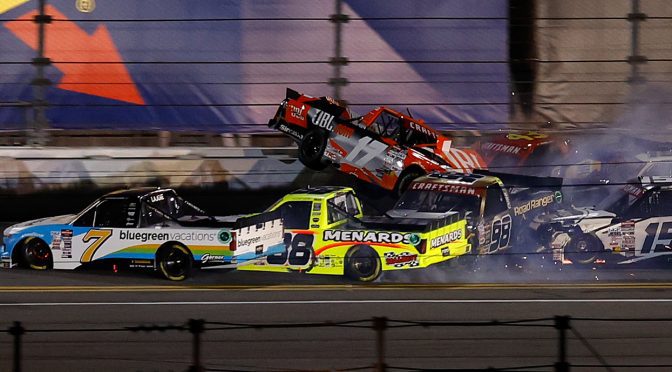
A multi-truck wreck at Lap 6 proved as a foreshadow of what was to come in the Fresh From Florida 250, which featured a record 12 caution periods, including a last-lap crash that collected most of the field as Taylor Gray went airborne and flipped over his competitors.
All drivers involved in incidents in the 101-lap contest emerged unharmed after being evaluated and released from the infield care center. But the junkyard of race trucks sitting in the garage area told a story of eager drivers making aggressive moves in ill-handling vehicles.
Ty Dillon, driver of the No. 25 Rackley W.A.R. Chevrolet, was involved in the first melee of the night, which involved 13 trucks. A 13-year veteran of NASCAR’s national series, Dillon said all he saw in his short six laps of competition was “chaos.”
“Nobody really drafts anymore in practice. We don’t really put rookies in a good spot to learn. They just kind of get thrown into the fire,” Dillon said. “And that’s kind of what it looked like. I’ve never seen anything look like that from behind the wheel four laps into a race. With my experience, I knew something was gonna happen. That’s why I got myself back to the bottom to hopefully have a spot to bail. And sure enough, it happened.”
The calamity on the final lap to end the race was triggered when Rajah Caruth’s No. 71 truck pushed up off the exit of Turn 2 running third on the inside line. That slide led him to the left rear of Jack Wood’s No. 91 Chevy and spun him into Gray, triggering the 12-truck crash.
Zack Sturniolo | NASCAR.com
“I like Rajah a lot; I just don’t know what he was doing,” Gray said. “There’s no hole to get in. The 91 is obviously still at his right front. And I don’t know if he’s trying to stall the lane and just misjudged it or what. But he just got the 91 in the left rear and obviously you guys saw it from there.”
Corey LaJoie, a regular in the NASCAR Cup Series, was involved in the last incident of the day. He attributed much of what was displayed Friday night to poor handling on a slick Daytona surface.
“The trucks handled like absolute garbage, so that’s what makes the trucks fun to drive,” LaJoie said. “Guys’ handling goes away (so) you can make big runs. They punch such a big hole in the air.”
Daniel Dye had nowhere to go when Gray’s truck sat sideways in front of him midway down the Daytona Superstretch back straightaway, piling into Gray nearly driver-side and sending the No. 17 Toyota airborne. He reiterated the handling woes, but also stressed circumstances dictate aggression late in the event.
“Yeah it was a definitely a little slick out there,” Dye said. “But a move like that happened on the backstretch — I mean you’re a mile away from a win. So yeah, I mean … it’s gonna happen. It’s Daytona. But trucks are harder to drive on the straightaway because they’re not sucked down and and you’re not loaded up as much. So yeah, then you can see it coming from a mile away.”
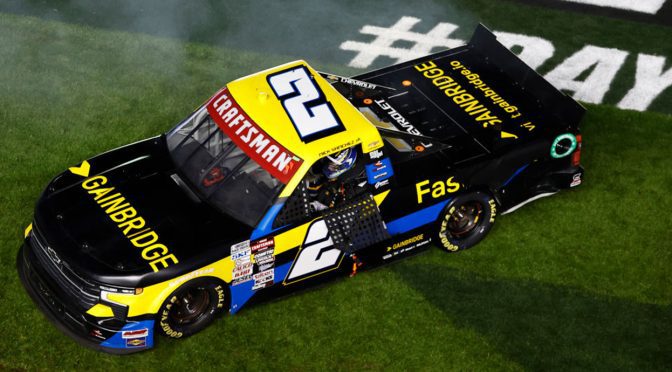
DAYTONA BEACH, Fla. — With cars wrecking and flipping behind him in overtime, Nick Sanchez claimed the first NASCAR Craftsman Truck Series victory of his young career in Friday night’s Fresh From Florida 250 at Daytona International Speedway.
The race ended under caution on the second lap of the overtime after Rajah Caruth, running fourth, moved up the track and turned the No. 91 Chevrolet of Jack Wood in front of the field.
Sanchez and runner-up Corey Heim were clear of the chaos, and Caruth escaped with minimal damage and finished third. But behind them, the Chevy of Daniel Dye launched the Toyota of Taylor Gray, which flipped in mid-air and landed upright on its tires in a gaggle of mangled cars.
All told 12 trucks were involved in the wreck, which caused the record 12th caution of the evening.
Coincidentally, Sanchez rallied from a 12-truck crash on Lap 6 to score the victory for his No. 2 Rev Racing Chevrolet team in his sophomore season.
“It’s huge,” Sanchez said. “We spent all of last year trying to get a win. I knew coming into this year I knew that I had to, right? What better race than to do it than Daytona? Honestly, out of every race, if I was going to do it, this would have been the last one (I expected), but happy to do it. It’s awesome.
“I just knew I had to lead at the white flag, because they were probably going to wreck. I’m glad they wrecked — if everyone is OK. I’m just happy.
“It’s huge. Obviously, we have a new technical partner in Spire (Motorsports) — our first race with them. What a better way to start a partnership. (Sponsor) Gainbridge has stuck with me. They were winless last year. They all deserve it, and they’re going to celebrate with me.”
Caruth was thankful for his third-place finish, but he rued the wreck that ended the race.
“I’m trying to play it back differently in the last laps, but thank you to everybody at Spire Motorsports, HendrickCars.com, the Hendrick Automotive Group, and Mr. H (Rick Hendrick) for what they’ve done for me along with everybody at Spire and Chevy,” Caruth said.
“Man, I felt like I got a bad push there, and you’re already getting tight off of the corner, and everybody is going for all they have on the last lap. I feel terrible to see trucks like that torn up. I hope Taylor (Gray) is all right. But a good night to start the year.”
Fifty-one of the 101 laps were run under caution, and it didn’t take long for the action to start. The first major incident KO’d a handful of drivers.
On the backstretch on Lap 6 of a scheduled 100 circuits, a shove from Christian Eckes’ Chevrolet turned the Ford of three-time series champion Matt Crafton into the Ford of Layne Riggs, igniting a 13-truck accident that eliminated Ty Dillon, Thad Moffitt and Jake Garcia.
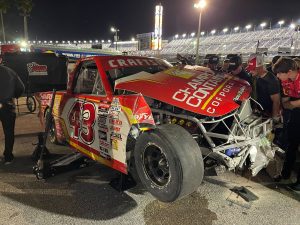
With his team unable to make repairs on his No. 38 Ford F-150, Riggs took his truck to the garage under caution on Lap 17.
“Chaos, a lot of craziness — everybody was just kind of all over the place,” Dillon said after a mandatory trip to the infield care center. “I’ve never seen anything look like that from behind the wheel four laps into a race.
“With my experience, I knew something like that was going to happen. That’s why I got myself to the bottom to hopefully have a spot to bail. And sure enough, it happened. I thought I got through … I hit the grass and it knocked the tires out of my hand, and I was trying to catch it with the throttle …
“Just hate to be taken out so early and not have a chance.”
The Lap 6 incident was a harbinger of the chaos to come.
Defending series champion Ben Rhodes saw a good night turn bad when Tyler Ankrum door-slammed his Ford on Lap 68. Rhodes pitted with a flat tire a lap later, but after leaving the pits, he spun and crashed as the lead pack tried to dodge the No. 99 Ford in the center of the track.
Rhodes exited the race, and soon after, Johnny Sauter was an innocent victim of a four-truck wreck off Turn 4 — after leading 24 laps, second only to Sanchez’s 26.
Bret Holmes finished fourth, followed by Spencer Boyd. Stefan Parsons, Crafton, Timmy Hill, Bryan Dauzat and Eckes completed the top 10.
NOTE: Post-race inspection in the Truck Series garage was completed with no issues, confirming Sanchez as the winner.
Denny Hamlin topped the leaderboard in Friday evening’s NASCAR Cup Series practice session at Daytona International Speedway with a 197.477 mph lap in the No. 11 Joe Gibbs Racing Toyota.
Erik Jones’ No. 43 Legacy Motor Club Toyota was second fastest at 197.468 mph. Christopher Bell (197.429 mph), Ty Gibbs (197.394 mph) and John Hunter Nemechek (197.377 mph) rounded out the top five.
The rest of the top 10 included Tyler Reddick (197.364 mph), Jimmie Johnson (197.282 mph), Bubba Wallace (197.126 mph), Michael McDowell (194.569 mph) and Austin Cindric (194.523 mph).
Daytona 500 pole winner Joey Logano ended practice in 14th at 194.070 mph in the No. 22 Team Penske Ford.
Final practice for the “Great American Race” was canceled for Saturday morning due to inclement weather. The 66th running of the Daytona 500 will run Monday at 4 p.m. ET on FOX, MRN Radio and SiriusXM NASCAR Radio.
See where your favorite driver will pit for the 66th running of the Daytona 500 at Daytona International Speedway on Monday (4 p.m. ET, FOX, MRN Radio, SiriusXM NASCAR Radio).
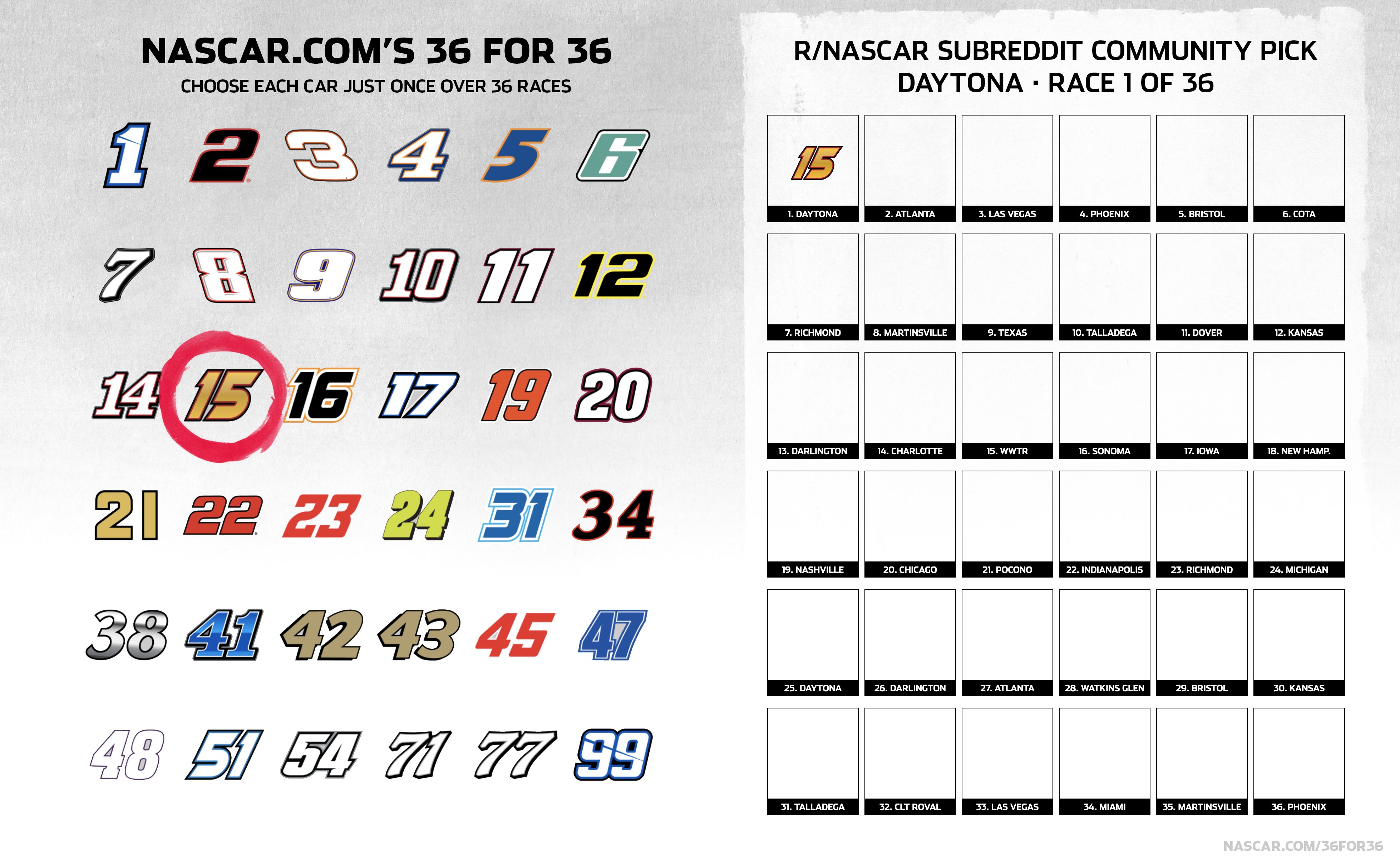
Introducing “36 for 36,” a season-long friendly competition that mixes the excitement of the NASCAR Cup Series season with a dose of strategy.
With 36 races and 36 full-time Charter cars, our players select one car per race, but there’s a simple twist: Once a pick is made, the player can’t choose that car again for the rest of the 36-race season. Yes, that means every car will be selected exactly once … a survivor pool, by another name.
This contest demands strategic foresight as pickers earn points based on the performance of their chosen cars each week. The most points earned over the Cup Series season wins, requiring players to carefully plan their picks, considering factors like track types and driver performance. Opting for underdogs at unpredictable drafting-heavy tracks like Daytona and saving top performers for crucial playoff races could be key strategies.
Follow along weekly as our panel of pickers — Dustin Albino from Jayski, along with Steve Luvender and Cameron Richardson from NASCAR.com — embarks on a season-long journey to prove their picking prowess.
We’ll also feature a fourth “community” 36 for 36 pick each week, as decided by a weekly group vote of fans on the r/NASCAR subreddit. Can the collective vote topple our trio of full-timers? (Hivemind, assemble!)
Race 1 of 36: Daytona
Ah, Daytona! There’s nothing like that new-season smell. Our pickers have a fresh slate of 36 cars for the first race of the season — who will they choose first? Remember, each picker will select each car exactly once throughout the year. So, these selections aren’t necessarily picks to win the “Great American Race” — rather, they’re cars our pickers have chosen with the year-long scope of the game in mind.
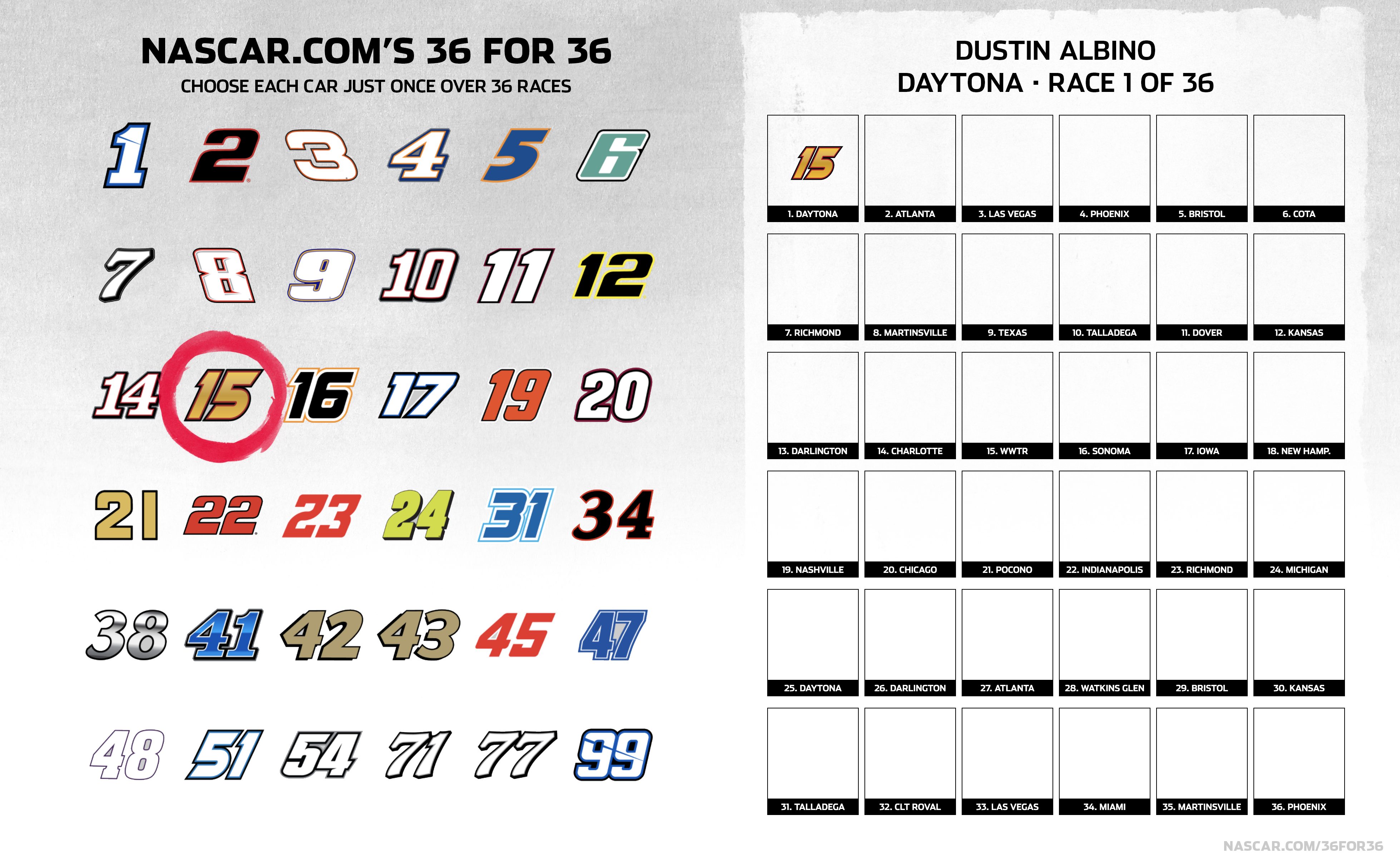
Jayski’s Dustin Albino: No. 15, Riley Herbst
Dustin: “Daytona is an equalizer, and Herbst has an excellent track record on superspeedways in four Cup Series starts. In his series debut in last year’s Daytona 500, he overcame an early spin entering pit road and finished 10th. He backed up that performance in August with a fast car, even making a late move to try to win the first stage. Ryan Blaney also gave Herbst credit for pushing the No. 12 car to the win at Talladega last fall. Herbst is a solid underdog choice this weekend.”
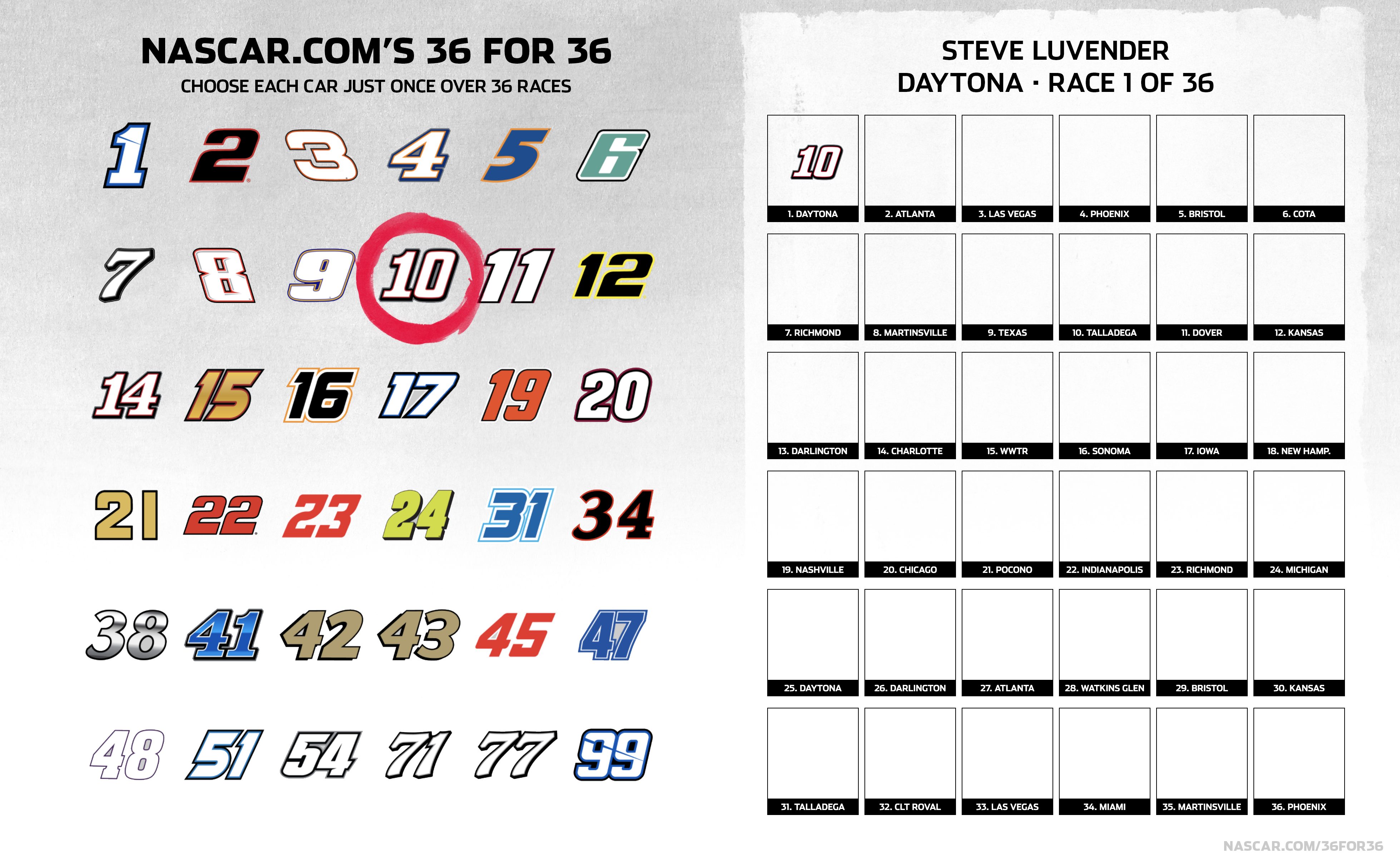
NASCAR.com’s Steve Luvender: No. 10, Noah Gragson
Steve: “There’s something to be said about the excitement of a new team and the biggest race of the year that I think plays into the persona of Noah Gragson. Gragson has won at Daytona in the Xfinity Series, and it’s the site of his best Cup finish (fifth in the 2022 summer race), so he understands his way around the draft. Nobody knows how Stewart-Haas Racing will fare on the bulk of the schedule this year — they went winless last year, after all — so, to me, it’s not worth keeping a question mark on the board. Ready to start off this season with a perfect 10.”
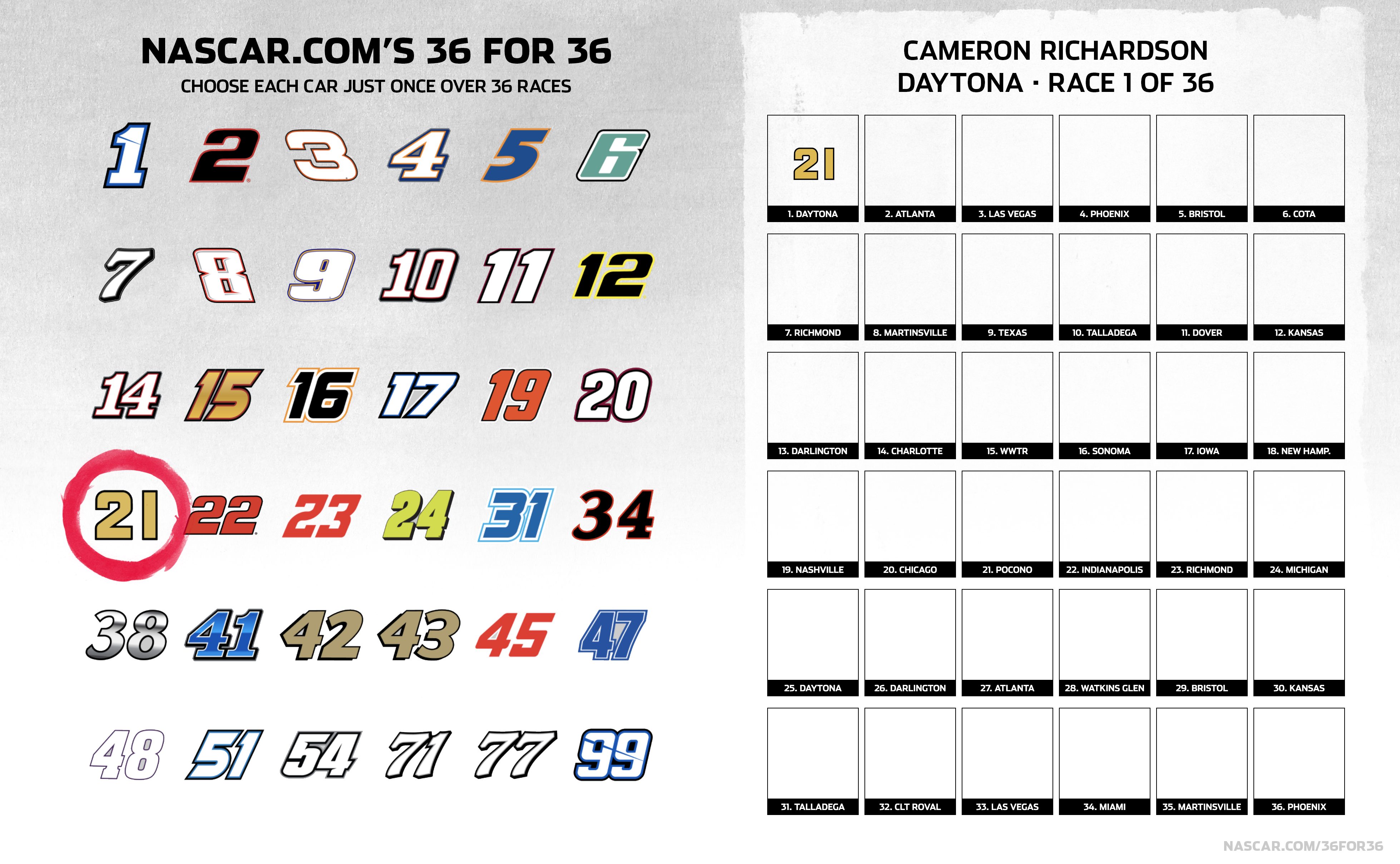
NASCAR.com’s Cameron Richardson: No. 21, Harrison Burton
Cameron: “Wood Brothers Racing is still chasing win No. 100, and there would be no better venue to reach the milestone than Daytona. Burton may not be the first name that comes to mind to be at the front of the field, but he’s led laps in both of his starts in the Daytona 500. The third-year driver will enter 2024 with a chip on his shoulder and I genuinely believe he could make enough noise to score a strong finish.”
r/NASCAR Community: No. 15, Riley Herbst
The NASCAR subreddit went with Riley Herbst as the first community-chosen 36 for 36 pick of the season, receiving a majority of votes in the weekly voting thread on Reddit. Herbst’s No. 15 outranked Justin Haley (No. 51) and Austin Dillon (No. 3) as popular choices, but the latter two will be used in later weeks — the people have spoken.
u/Blue8844: “I’m going with this… Riley has showed he can drive on the plate tracks, and will be about 1/6 tracks I’d even consider picking the 15 on.”
u/Mr-T14: “This is the right thinking. Honestly, any one of the 40 drivers has a relatively equal shot at being in a wreck OR running in the top 10. It’s not smart to burn a regular from a top team like Dennis when he’s much better used at Richmond for example”
u/LeapsFrog: “As the only r/NASCAR Fantasy Champion I endorse this pick.”
Check back next week to see how our pickers fared at Daytona as we begin the season-long 36 for 36 journey.
And, if you’ve got a competitive itch beyond meticulously managing your Fantasy Live lineup each week, feel free to save or print your own 36 for 36 sheet and see if you can beat our pickers and the Reddit community!
The skies opened up, and the cars shut off. Dale Earnhardt Jr. climbed out of his No. 88 Hendrick Motorsports Chevrolet and ascended the stairs to the top of his pit box, where the roof protected him from the rain.
His car in the 2014 Daytona 500 was not great to that point; it certainly wasn’t a race-winning car. As the rain continued, Earnhardt and crew chief Steve Letarte discussed the race, the car and what they thought they needed to do to win.
The rain let up briefly enough for them to scatter and wait out what became a 6-hour, 22-minute delay. Letarte retreated to his motorhome, where he tried to keep his mind sharp by playing Scrabble with his wife. Earnhardt hustled to his own motorhome, where he behaved like it was a normal Sunday and not one in which he might win the biggest race in the country for the second time. He put on sweatpants, ate junk food, played Crazy 8s and talked to his girlfriend (now wife), Amy.
He had long loved staying up until all hours of the night, so it didn’t bother him to wait. In that downtime, he decided that when the race restarted — late that night, early the next morning, whenever — he was “going to race as hard as I can — be a jerk.”
It was rare for him to race that way, especially with so much of the race left. “For whatever reason,” he says, “I was like, ‘Nope, I’m leading every (expletive) lap. If I can lead it, I’m going to lead it. I’m going to fight for every single inch.’ ”
When the race restarted, he sliced from the top of the track to the bottom and back again, pinched drivers into the wall, blocked passes before they happened and squeezed his car into holes he never otherwise would have tried to.
It worked.
When he roared under the checkered flag at 11:18 p.m. ET, 10 years ago, it was more than just NASCAR’s favorite son triumphing on the sport’s most hallowed ground. It was Earnhardt’s moment of long-sought redemption, his emergence from the wilderness, his reclamation of lost years in which he wondered if he’d ever win again.
He keyed his microphone and yelled, “We’re going to burn this (expletive) down!” And NASCAR Nation warmed itself by that fire.
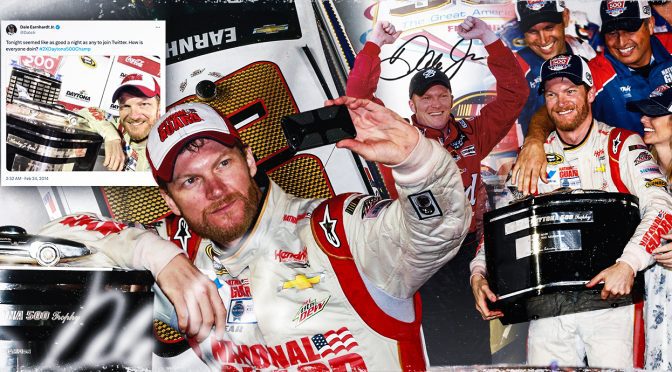
It’s a cliché that happens to be true that winning the Daytona 500 changes your life, and so it was for Earnhardt in 2014. Amid the unbridled joy as Sunday night became Monday morning, Earnhardt used his phone to take a selfie with the Harley J. Earl Trophy, signed into his dormant and unused Twitter account, keyed in a message and hit send at 2:32 a.m. ET: Tonight seemed like as good a night as any to join Twitter. How is everyone doin? #2XDaytona500Champ
That simple message set his life on a course nobody saw coming, Earnhardt included. But it has turned out to be a crucial step in his journey from a shy, introverted driver who hid in his motorhome most weekends into an outspoken media personality whose podcast, social media presence and race commentary dominate the NASCAR media world.
To understand how profound of a change it was, you have to go back to his first Daytona 500 win, 20 years ago.
Chris Trotman | Getty Images
In 2004, Earnhardt entered the Daytona 500 as NASCAR’s unrivaled superstar. He was amid 15 straight seasons of being named the sport’s most popular driver. Racing the No. 8 Budweiser Chevy for the team that bore his late father’s name, he had won at least two races each of the previous four years and finished third in the points the previous season, a career high. He opened 2004 on the short list of championship contenders.
The Daytona 500 is always the biggest race of the year. In 2004, with a new title sponsor at the Cup level in Nextel and a new points format in The Chase, the attention was as high as it had ever been.
Like his father before him, he was always the driver to watch at the high-banked, 2.5-mile, restrictor-plate track. To that point in his career, he had won two qualifying races, the 2003 Bud Shootout and the 2001 Pepsi 400 but never the Daytona 500.
The 2004 Daytona 500 was something short of spectacular. After a 12-car wreck on Lap 71, the race ran green for the final 120 laps. Earnhardt and Tony Stewart were the class of the field, leading a combined 156 of 200 laps. They agreed early in the race to work like teammates — draft together, pit together, stay on the same sequence, and when it came to the end, they would battle for the win.
As the race wound down, Stewart held the lead as Earnhardt chased him. Earnhardt played with the throttle, letting way out of the gas and then hammering down to try to catch Stewart at the exit of the corner, practicing for what he hoped would be the race-winning move.
On Lap 181, he pulled side by side with Stewart — a more aggressive position than he had envisioned, essentially engaging the pass without having intended to. To complete the pass, he needed to side-draft Stewart. He had a five-inch window to make that move happen, otherwise Stewart would maintain his position as the leader. As Earnhardt inched into position, the two touched, and that contact created a perfect slingshot to catapult Earnhardt to the lead.
Earnhardt waited and waited for Stewart to attempt a similar move to pass him back, but he never did. With about five laps left, Earnhardt realized Stewart didn’t have the car to pass him. The race was his … as long as nothing broke, as long as there was no caution. Every engine noise sounded like a gremlin chewing on wires, every tire felt like it was going down, every roar seemed to be the last gasp of an engine blowing up, but that was all in his head.
The end came uneventfully except for the screaming — in his ears, out of his mouth, from the crowd, across living rooms throughout the country.
“It’s a great, great feeling that you can’t replicate anywhere else in the rest of your existence,” he says. “Getting married and having kids are first and second to everything else that I’ve ever done, sure. But I didn’t come running out of the room at the hospital screaming in the hallways and into the arms of people.”
That high gives context to the lows that followed — and makes his return to that mountaintop 10 years later even more remarkable.
NASCAR Research & Archives Center | Getty Images
Earnhardt won five more times in 2004, and he had a shot at the championship before he was docked points for swearing in a live TV interview after a win at Talladega and wrecked a few races later. He entered the final race of the season mathematically in the hunt for the championship. He ultimately finished fifth in the standings.
Though 2004 had a disappointing ending, Earnhardt appeared poised to be a yearly contender for championships.
That never happened.
He won only four more times in the next nine seasons. His life turned into a Jerry Springer episode, as one person close to him put it. He escaped a fire in a sports car crash, feuded with his stepmother and had a falling out with Uncle Tony Eury Sr., who had been his crew chief.
His confidence — always a crucial barometer for Earnhardt, in the car and out — cratered, and so did his performance. He stopped saying he was the best driver in the sport because he stopped believing he was the best driver in the sport.
Even a switch to the powerhouse Hendrick Motorsports before the 2008 season failed for years to produce results expected of the sport’s favorite son. In 2009, 2010 and 2011 combined, he managed just nine top fives and 25 top 10s with an average finish of 18.8.
“You just can’t get out of your own way. It affected his confidence,” says Mike Davis, who has worked with Earnhardt since 2004 and is now president and executive producer of Earnhardt’s Dirty Mo Media. “Those years were no small thing. A lot of people don’t come back from that.”
But Junior did. He had solid seasons in 2012 and 2013, with one win, 20 top fives and 42 top 10s, and he entered the 2014 Daytona 500 with expectations higher than any year since 2005. Would this be the year he finally emerged as a star again?
In the first race, he answered with a resounding yes.
Brad Keselowski said it was the hardest-raced Daytona 500 in history. Apparently, everyone else decided to “be a jerk,” just like Earnhardt had. Earnhardt’s battle with Greg Biffle illustrates that point. They traded the lead 34 times on Laps 153 through 159 and eight times on Lap 169 alone.
Earnhardt describes restrictor-plate racing as like using a set of tools that aren’t always the same. Sometimes the tools work slightly differently, or you get a new tool entirely. You don’t know how the tools will work, or even that some of them exist, until the race starts, and you only discover them at 200 miles per hour with cars in front, behind and beside you.
“Dale Jr. did better than everyone in my opinion — he used every single moment every lap to continue to fill his toolbox with what he needed to win the race,” Letarte says.
That’s what happened as he raced against Biffle. As they fought for the lead, Biffle had more cars behind him, which should have given him the advantage. But Earnhardt discovered if he squeezed Biffle very close to the wall, Biffle’s car would slow ever so slightly. That tool had never worked exactly that way before, but it did that night.
He used it to win the race.
Patrick Smith | Getty Images
The words in that fateful tweet — “Tonight seemed like as good a night as any to join Twitter” —make it seem like a spur-of-the-moment decision. It wasn’t.For years, Earnhardt’s marketing people, friends, even Twitter (now rebranded as “X”) officials pushed him to join the platform. But he resisted. He doubted anyone cared what he had to say, and he had misgivings about the nature of conversations on social media.
He wanted to join; he didn’t want to join. He thought he would; he thought he wouldn’t. Some friends told him he should do so; other friends told him hell no don’t do that. He visited the White House with fellow drivers, and they talked about Twitter there. Like an angel on one shoulder and a devil on the other, Kevin Harvick told him he should join, and Denny Hamlin advised him not to.
In late 2013 or early 2014, in something between a bet and a promise, Earnhardt told Hendrick Motorsports teammate Jimmie Johnson (by that point already a Twitter ace) that if he (Earnhardt) won the Daytona 500, he would join Twitter.
The tweet exploded in the NASCAR and broader sports social media world. By that morning, he already had more than 300,000 followers, and he soon became an avid user of the app. He delighted in learning the lingo, the do’s and don’ts, and he spent countless hours experimenting.
Joining the platform was like restrictor-plate racing in that the tools he used were largely the same as he used in his personal life but a little different. He didn’t become opinionated and witty when he joined Twitter. He was already those things. He didn’t learn to tell stories there; he already knew how. The tools he lacked were the confidence to share his opinions, wit and stories outside of a small circle of friends, and the belief that anybody cared what he had to say.
Twitter gave him both of those tools, and the more he played with the app, the more he liked it, not least because it got him out of his own head. After a bad race, he felt “ashamed to show my face anywhere.” Twitter showed him the rest of the world had moved on, so should he.
Some Sunday nights after races he would arrive home in North Carolina unable to sleep because he was still caked with adrenaline. He’d grab a beer, go downstairs to his computer and jump on Twitter. Soon he’d be answering questions of whoever asked them, an unannounced AMA session that ran deep into the night.
Occasionally, he woke up the next day and wondered what dumpster fire he might have started. But it was always innocuous. He enjoyed wishing strangers happy birthday, reminiscing about old photos and connecting with musicians whose work he loves. It was like sitting on his couch talking to his buddies about any and all topics, up to and including banana-and-mayonnaise sandwiches.
Looking back, he calls that time “practice” for his roles hosting the Dale Jr. Download podcast and analyzing races on NBC. As he got more comfortable on Twitter, that led to him being more comfortable on the podcast. He’s a ubiquitous presence now, but when it launched, he wasn’t. He wasn’t even a regular in-studio guest, never mind the host and star as he is today.
He would instead record audio clips and send them to Davis. As with everything in his life, confidence bred confidence. “I just kept dipping my toe deeper and deeper into the water,” Earnhardt says. “And so then I walked into Mike’s office and said, ‘Hey, I’m ready to host.’ He’s like, ‘Really?’ He never thought I was ever going to do that.”
Meg Oliphant | Getty Images
“Twitter changed Dale Jr.’s life,” is true, but it’s also too reductive. None of this happened in a vacuum, rather it was part of a transformation of Earnhardt from a shy introvert into a still shy but less so, still introverted but less so and now confident and vibrant media personality.
Earnhardt met his wife, Amy, in 2008. They married in 2016 and now have two children. She coaxed him out of his self-created shell. She taught him about sacrifice and commitment and how to be unselfish, inside the car and out.
In 2011, he started working with crew chief Letarte, who, by refusing to let Earnhardt spend all race weekend locked in his motorhome playing video games, demanded accountability from him in a way nobody else had. Letarte insisted Earnhardt show up at the hauler an hour before practice and stay after practice until he didn’t need Earnhardt anymore. The conversations those meetings generated led to a deep friendship and fast cars.
“The more he was out and about the more comfortable he became with it, but it was still in an environment you can control,” Letarte says. “And I look at Twitter as the next step.”
All of that together made Earnhardt more comfortable with the idea of becoming a media personality, even if it wasn’t intentional and is obvious only with hindsight. From Twitter to the podcast to broadcasting was a natural progression, albeit an astonishing one to those who know him: Earnhardt, who spent many years uncomfortable even going out to eat in public, is now willing to put himself out there in front of the world all the time.
Said Davis: “I would have bet every dollar I had that he wasn’t going to go into broadcasting. I would have lost everything. The fact that he’s not only doing it but is extremely good at it is mind-blowing.”
Sean Gardner | Getty Images
Earnhardt’s first taste of broadcasting came when he missed races in 2016 due to a concussion and NBC invited him to the broadcast booth at Talladega. Wearing dark-framed glasses, sneakers, jeans and a blue and gray plaid shirt — Amy stopped him from wearing his preferred hoodie — he sat on a stool between NBC analysts Letarte and Jeff Burton, against whom he raced hundreds of times.
They lapsed into a conversation like old friends. His eyes darted from the track to the TV screen in front of him. He smiled often and at one point raised his hand when he wanted to interject a point.
While Earnhardt was still in the booth, NBC announced he would return there for the following week’s race at Martinsville. Producer Matt Marvin told him what a great job he had done. Marvin paused for just a second and said, “Next time, if you’re not as good, we’ll kick you out early.”
When Earnhardt retired after the 2017 season, his arrival in NBC’s booth full-time for the 2018 season seemed like a foregone conclusion, even if four short years before, the idea would have been laughable.
For his first few years as a broadcaster, anxiety followed him to every race, sat with him and whispered critiques. He felt like he was taking a test he wasn’t prepared for, and that the racing community would give him a failing grade. He obsessively read reviews of his performance on social media. He eventually realized that was doing more harm than good and stopped.
“Learning the art of being a sports broadcaster involves talking, but it also involves listening,” says Jeff Behnke, NBC’s vice president of NASCAR production. “It takes years to refine not only your ability to speak on air but also to listen to what others are saying. Dale works to improve both of those aspects of broadcasting, along with his storytelling, every time he puts the headset on.”
Perhaps his best work of storytelling was just two words long.
At Earnhardt’s first Cup race as a full-time broadcaster, Kyle Larson and Kyle Busch engaged in one of NASCAR’s all-time great finishes at Chicagoland Speedway. As Larson attempted a “slide job” in front of Busch on the last lap, Earnhardt yelled that expression — twice.
He said he felt like he was sitting on his couch talking to his buddies — a “tool” he has used countless times — only this time, he was being watched by millions — the same tool, only much, much louder.
“Slide job!” immediately entered the NASCAR lexicon. By the time Earnhardt got to the airport after the race, his phone was full of texts parroting that phrase back to him. At Daytona the following weekend, fans shouted it to him everywhere.
And, of course, Earnhardt’s call blew up on Twitter.