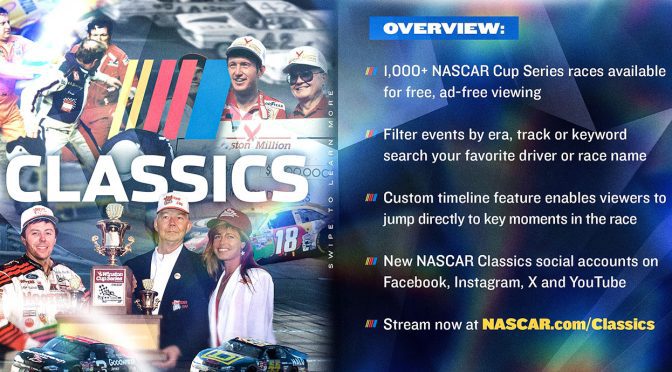
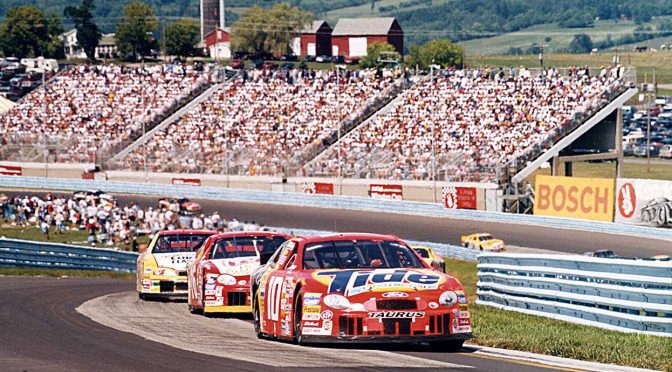
DAYTONA BEACH, Fla. — NASCAR is introducing a new way for fans to explore its rich racing history well into the future. NASCAR Classics is now live on nascar.com (www.nascar.com/classics), offering free, ad-free viewing of more than 1,000 full race replays, condensed broadcasts and recap packages spanning eight decades of speed in the NASCAR Cup Series.
Anchoring the extensive archive is a new anniversary capsule: NASCAR’s Top 75 Greatest Races. The unranked collection, selected by the sanctioning body, showcases some of the most exciting on-track action, important milestones and enduring memories throughout NASCAR’s first 75 years, bookended by 1951’s Motor City 250 in Michigan and Ross Chastain’s “Hail Melon” move at Martinsville in October of 2022. (A more detailed rundown of NASCAR’s Top 75 Greatest Races is available here on nascar.com.)
NASCAR also launched dedicated NASCAR Classics accounts on Facebook, Instagram, X (formerly Twitter) and YouTube, extending the brand beyond the digital video destination to engage fans with a variety of throwback content on an ongoing basis.
“NASCAR Classics is a significant addition to our digital content offerings that for the first time ever gives fans around the world free, uninterrupted access to enjoy decades of past NASCAR Cup Series action whenever and wherever they’d like,” said Tim Clark, senior vice president and chief digital officer at NASCAR.
Visitors to NASCAR Classics can easily choose their own journey through history via navigation dropdowns that filter races by era and by track, or through a keyword search that lets them look for specific drivers and race names in addition to individual years and venues. Once a video is selected, a custom timeline tool enables viewers to jump directly to key moments throughout the race.
The increased interactivity comes courtesy of software company Twizted Design, with whom NASCAR partnered to build Classics on Twizted’s next-gen video streaming and management platform for OTT channels, called Videoflow.
NASCAR Classics includes most Cup Series race broadcasts available to date, and NASCAR will continue to add recently run Cup Series races to the online archive within weeks of their conclusion.
NASCAR rolls into Watkins Glen International this weekend with only two races remaining in the regular season. Fans can tune in to the Go Bowling at The Glen Cup Series race Sunday, Aug. 20 at 3 p.m. ET on USA, MRN and SiriusXM NASCAR Radio.
For many fans, immense memories immediately flood their brains when thinking back on the first 75 years of NASCAR’s existence.
As NASCAR celebrates its milestone anniversary throughout 2023, those moments are bound to come to the surface more frequently. Sometimes they are moments shared at home with our loved ones, some of whom have since passed on. They might have been made in the grandstands of a track alongside thousands of other passionate NASCAR fans, cheering their favorites to the checkered flag.
No matter where your memory was made or who it was with, your mind will quickly recall every little aspect of it: who was there; who the drivers were on the track; what paint schemes graced the cars; the sounds of the voices from the broadcast booth.
All of these things create everlasting memories and moments that helped shape NASCAR into what it is today.
For NASCAR’s 75th Anniversary, the sanctioning body has named a list of the 75 Greatest Races as a way to honor the legends and moments that helped build each and every one of us into the race fans that we are today.
There’s more. All of these races are now available to watch in full at NASCAR Classics, a newly launched website by the league, for the fans, dedicated to preserving and displaying the sport’s rich history for you to enjoy and remember again and again and again.
From the 1951 Motor City 250 in Michigan to Ross Chastain’s iconic “Hail Melon” move at Martinsville in 2022, here are the 75 Greatest Races in NASCAR history in chronological order. (Spoiler alert: We talk about race winners here, so if you want a surprise, please focus on the dates and tracks and not the subtext.)
1. Detroit, Aug. 12, 1951
As part of the 250th anniversary celebration of the city of Detroit, NASCAR runs a 250-mile event at the Michigan State Fairgrounds. The race was won by Tommy Thompson, the only victory of his Cup career.
Four months after suffering serious injuries in a crash at Charlotte, Herb Thomas wins his third career Southern 500. The race was a complete sellout, with 50,000 tickets sold.
Paul Goldsmith captures the final race on the Daytona beach course. He led all 39 laps in the event and held off Curtis Turner by just a few car lengths.
The inaugural Daytona 500 ends in a photo finish between drivers Lee Petty and Johnny Beauchamp. It took Bill France Sr. three days to officially crown a winner of the event.
Nelson Stacy pulls off the upset, passing Marvin Panch with less than 10 laps remaining and holding on to win the Southern 500. Panch was relieving Fireball Roberts in the No. 22 car after dropping out of the race early in his No. 42 for Petty Enterprises.
After winning his Daytona 500 qualifying race, as well as the Daytona 500, Fireball Roberts returns to Daytona in July and captures the 250-mile event at the track.
Marvin Panch, driver of the Wood Brothers No. 21 Ford, misses the Daytona 500 after suffering injuries in a fiery crash. Panch was pulled out of the wreckage by Tiny Lund and was replaced in the 500 by Lund, who promptly went out and won the race.
Curtis Turner captures the checkered flag in a race that sees 14 lead changes among seven drivers. It was the 17th and final victory of Turner’s career.
David Pearson backs off to allow Richard Petty to take the lead as the two drivers take the white flag. Pearson then uses his horsepower to slingshot past Petty for the win.
The thrilling conclusion to the Daytona 500 sees race leaders Richard Petty and David Pearson crash in Turn 4, with Pearson limping past Petty’s demolished car for the victory.
Richard Petty wins the Daytona 500 in the first flag-to-flag coverage of a 500-mile race. His win is overshadowed by a late-race crash that ends with Cale Yarborough and the Allison brothers, Donnie and Bobby, brawling on the backstretch.
Dale Earnhardt passes race leader Terry Labonte on the high side on the final lap at Talladega to grab the checkered flag. The race features an insane 68 lead changes.
Bill Elliott makes history by becoming the first driver in series history to capture the Winston Million, a $1 million bonus to any driver who could win three of the four crown jewel races in a season.
The thrilling finish to the third annual All-Star Race sees race leader Geoffrey Bodine spin late. This sets up a battle that leads to the “Pass in the Grass,” with Earnhardt holding on as his car slid through the grass, keeping the lead in the process.
After missing the first 11 races of the 1987 season due to an illness, Tim Richmond returns at Pocono, leads the final 47 laps and grabs the checkered flag.
It’s a special Valentine’s Day for the Allison family as Bobby Allison holds off his son Davey to win the Daytona 500. The duo celebrates together in Victory Lane.
Alan Kulwicki wins his first career Cup Series race. He celebrates with a “Polish Victory Lap,” which sees him drive counterclockwise around the track as he waves to the fans in the grandstand before taking his car to Victory Lane.
Contact from Rusty Wallace sends Darrell Waltrip around, as Wallace goes on to capture the All-Star event. This led to a brawl between the two teams in the pit area following the on-track incident.
Late-race contact between leaders Dale Earnhardt and Ricky Rudd allows Geoffrey Bodine to get by to take the checkered flag and leaves both Earnhardt and Rudd trading words in the pits and through the broadcast following the race.
One of the most important races in NASCAR history sees Alan Kulwicki win the title over Bill Elliott and four other drivers who entered the race with a chance to win it. The race also marks the final start for Richard Petty and the debut of Jeff Gordon.
“The Dale and Dale Show” sees Dale Jarrett hold off Dale Earnhardt to capture his first Daytona 500 triumph, as his father Ned Jarrett calls him home to the finish from the broadcast booth.
Pittsboro, Indiana’s Jeff Gordon captures the inaugural Brickyard 400 in front of more than 250,000 fans, after race leader Ernie Irvan cuts a tire in the final laps.
Dale Earnhardt holds off a last-second charge from Rick Mast to win at Rockingham, in turn clinching his record-tying seventh Cup Series title with two races left on the schedule.
Terry Labonte limps his damaged and smoking No. 5 Chevrolet to Victory Lane after contact with Dale Earnhardt sends Labonte spinning across the start/finish line. Earnhardt is involved in a post-race altercation with Rusty Wallace that sees Wallace toss a water bottle at Earnhardt.
Jeff Gordon joins Bill Elliott as the only drivers to capture the $1 million Winston Million bonus with his win in the Southern 500. Elliott leads the most laps in the event and finishes fourth.
For the second time in four years, a last-lap battle at Bristol between Dale Earnhardt and Terry Labonte leaves with a damaged race car. This time though, it is Earnhardt taking the checkered flag.
Dale Earnhardt moves through the field, driving from 17th to first in the final six laps to capture what would be his 76th and final Cup Series victory.
As the NASCAR community was still shocked after losing Dale Earnhardt the previous week, his driver Steve Park captures the checkered flag at Rockingham. Park and his Daytona 500-winning teammate honor Earnhardt on the frontstretch following the race.
Kevin Harvick holds off Jeff Gordon in a photo finish to capture his first Cup Series victory. Fittingly, it was just Harvick’s third career start after taking over the car following the passing of Dale Earnhardt.
Using lessons learned from his father, Dale Earnhardt Jr. goes from sixth to first to win the first race at Daytona after his dad passed away at the track in February.
An issue with Kurt Busch’s wheel leads to a tight battle for the championship, with Busch edging Jimmie Johnson and Jeff Gordon for the title by eight and sixteen points, respectively. This concludes the first Chase playoff format in series history.
One of the most dramatic Daytona 500 finishes ever sees Kevin Harvick edge Mark Martin at the line by 0.020 seconds, as Clint Bowyer slides across the start/finish line on his roof to finish 18th.
Jeff Gordon’s 76th Cup Series victory ties Dale Earnhardt on the all-time wins list. Gordon honors Earnhardt after the race with a victory lap while holding a No. 3 flag.
The first win of Brad Keselowski’s career comes in wild fashion, as he takes the checkered flag while Carl Edwards’ car crashes into the catchfence behind him.
Tony Stewart and Carl Edwards enter the season finale separated by just three points in the season standings. The race didn’t disappoint as the two drivers finish first and second in the race, creating a tie in points. Stewart captures the title thanks to a tiebreaker earned for winning more races than Edwards throughout the season.
Race leader Kyle Busch is turned by Brad Keselowski in the esses on the final lap, leading to an intense battle between Keselowski and Marcos Ambrose. The two drivers trade sheet metal on and off the track in a remarkable last-lap fight for the victory.
Jeff Gordon’s retaliation against Clint Bowyer leads to Bowyer sprinting across the garage to try to catch Gordon before a big scrum breaks out between the two teams. This overshadowed a green-white-checkered finish that sees Kevin Harvick win and multiple cars destroyed as they cross the start/finish line.
Race-leader Jimmie Johnson is penalized for jumping the restart, setting up an intense late-race battle between Juan Pablo Montoya and eventual race winner Tony Stewart.
Dale Earnhardt Jr. was the leader on the final restart and thanks to a handful of big blocks, he holds off the field to capture his second Daytona 500 victory.
The first winner-take-all championship battle in series history sees Kevin Harvick hold off a late charge from another championship contender, Ryan Newman, to win his first Cup Series title.
In a season that starts with Kyle Busch watching the Daytona 500 from a hospital bed, he overcomes a broken leg and shattered left foot to capture his first Cup Series championship.
Matt Kenseth leads the field into Turn 4 on the final lap before Denny Hamlin and Martin Truex Jr. make it three-wide, setting up the closest finish in Daytona 500 history.
The championship finale is full of drama, capped off by Carl Edwards crashing with just 10 laps remaining. This allows Jimmie Johnson to take control and capture his record-tying seventh Cup Series title.
Kyle Busch and Martin Truex Jr. leave Turn 4 on the final lap side-by-side as just about everyone wrecks behind them. Busch comes out victorious in the first race at the track under the lights.
Race leaders Martin Truex Jr. and Jimmie Johnson spin right before the finish line, as Ryan Blaney sneaks by to win the first race at the Charlotte Roval.
Denny Hamlin’s second career Daytona 500 victory comes after holding off his teammates Kyle Busch and Erik Jones in overtime. The 1-2-3 finish is bittersweet for the Joe Gibbs Racing team, as they were dealing with the loss of J.D. Gibbs, team owner Joe Gibbs’ son who passed away in January 2019.
Kyle Larson’s win is overshadowed by the drama created by Chase Elliott and Kevin Harvick. The two drivers have disagreements both on the track and in the pits before discussing things further in the No. 9 hauler.
The second race at Circuit of The Americas sees a thrilling last-lap battle between Ross Chastain, Alex Bowman and AJ Allmendinger, with Chastain coming out on top for his first career victory.
Christopher Bell captures a walk-off win to keep his championship hopes alive. Ross Chastain’s dramatic “Hail Melon” move on the final lap moves him on to the next round.
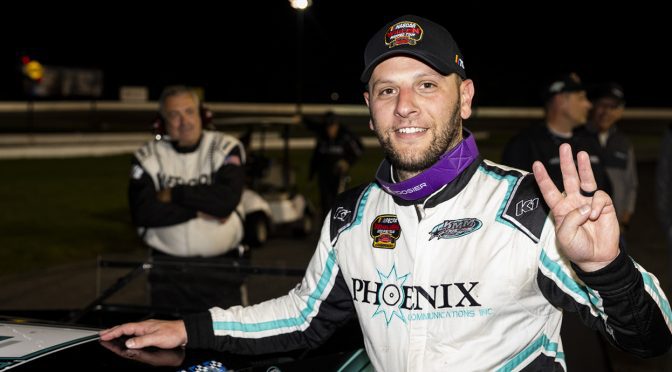
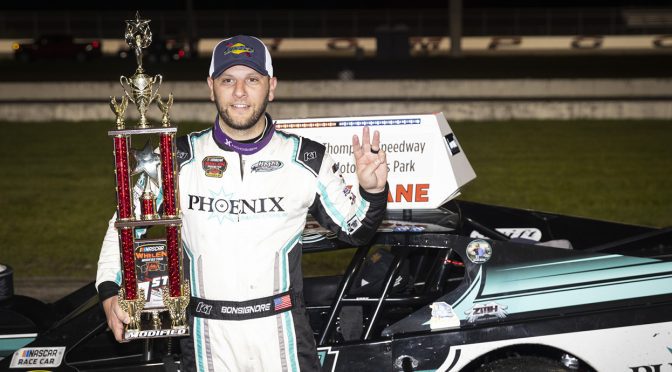
THOMPSON, Conn. — Wednesday evening saw three-time NASCAR Whelen Modified Tour champion Justin Bonsignore reach an important milestone at Thompson Speedway Motorsports Park.
By dominating the second half of the Thompson 150 presented by FloSports.com, Bonsignore earned an impressive 13th NASCAR Whelen Modified Tour victory at the facility. This puts him in a tie with Tour legend Ted Christopher on the series’ all-time list for Thompson victories.
As has been the case in many races this year, Bonsignore had to battle 2011 champion Ron Silk all the way to the checkered flag to bring home the historic win.
“It feels amazing to tie Ted Christopher on the all-time wins list [at Thompson],” Bonsignore said. “It’s something we had been wanting to do for a couple of years now. I was just trying to mind the gap with Ron [Silk], and I didn’t know how much he had left in the tank.
“On that last restart, he gave me a lot of respect.”
Bonsignore admitted matching Christopher’s Thompson win total was a moment that was long overdue.
During the late 2010s, Bonsignore was an unstoppable force at Thompson back when the track was featured four times on the NASCAR Whelen Modified Tour schedule. From 2018-19, Bonsignore won seven of eight races, including six in a row.
The turn of the decade featured diminishing returns for Bonsignore around Thompson. He gradually fell down the running order with each appearance, which culminated into an abysmal showing last October that saw him finish two laps down in 14th.
Bonsignore was initially unsure if he would shake off a streak of inconsistency at the start of Wednesday’s Thompson 150 after struggling to gain track position in the opening stint. Once he got fresh tires and clean air, nothing could stop Bonsignore from adding another accomplishment to the NASCAR Whelen Modified Tour record book.
“For a place where we had so many wins, we really lost our confidence in the last year and a half,” Bonsignore said. “We got lapped a bunch of times in October, but [Ryan] Stone went to work on this car and tried something really different today. We missed it a little bit on the first set [of tires], but it was really good on the second set.”
Silk tried everything to keep pace with Bonsignore in the closing stages of the Thompson 150 and even found a couple of good looks underneath him for the lead. A late-race caution failed to provide Silk another opening, and he was forced to watch Bonsignore take the checkered flag.
“I don’t think I could have gotten [Bonsignore] anyway,” Silk said. “He was a little bit better than we were. He could roll the center better, but it was still a good effort. I was loose during the first run and made some aggressive changes to tighten us up for the second. We just got it a tiny bit too tight.”
Although Wednesday’s outcome means he will lose some of his advantage in the NASCAR Whelen Modified Tour point standings, Silk was proud of the hard work his team put in to improve his car and minimize the damage from a Bonsignore win.
For Bonsignore, who now has 38 NASCAR Whelen Modified Tour to his name, Wednesday carried more significance than just tying Christopher’s record at Thompson.
As Bonsignore embarked on a Polish victory lap around Thompson, he took an extra moment in Turn 1 to honor the late John Blewett III, who earned one of his 10 NASCAR Whelen Modified Tour victories at the facility before tragically passing away in a crash at the track in 2007.
“I left the [checkered] flag up in Turn 1,” Bonsignore said. “That’s where John Blewett III was killed. I saw Doug Coby do that years ago, and I had always wanted to do that. [Wednesday] was the day we lost John all those years ago, and he was the biggest badass there was.
“If we could do anything to honor him, that’s pretty cool.”
With one more visit to Thompson scheduled on the 2023 NASCAR Whelen Modified Tour calendar in October, Bonsignore has an opportunity to inch closer to another late series legend in Mike Stefanik, who holds the record for most Thompson wins with 15.
Regardless of whether he is able to eclipse Stefanik’s total, Bonsignore’s triumph on Wednesday further cemented him as one of the greatest to ever race at Thompson alongside the many he idolized growing up.
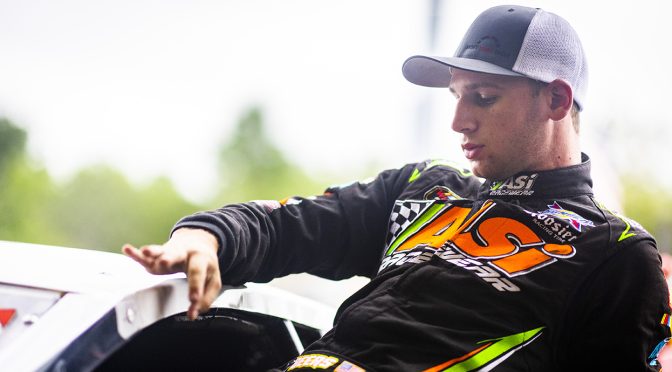
Following Silk in the finish order was the most recent Thompson winner in Eric Goodale, with Austin Beers and Craig Lutz completing the top five.
Rounding out the top 10 finishers were Bobby Santos III, Patrick Emerling, Doug Coby, Anthony Sesely and Tyler Rypkema.
A replay of the Thompson 150 at Thompson Speedway Motorsports Park can be seen on CNBC on Aug. 26 at 12 p.m. ET.
The NASCAR Whelen Modified Tour gets 10 days of rest before it makes another trip down south, this time to Langley Speedway in Hampton, Virginia for the CheckeredFlag.com 150. The green flag flies at 8 p.m. ET, with FloRacing providing the coverage.
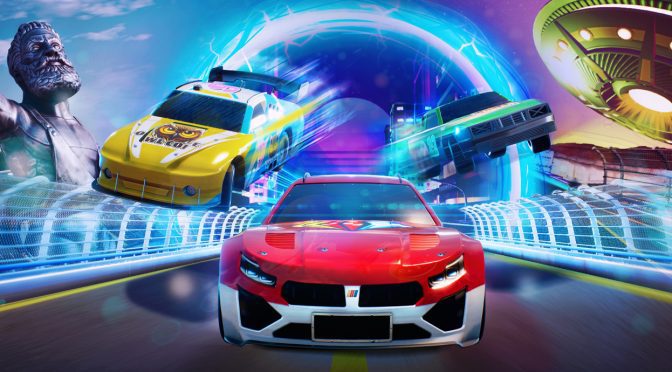
MINNEAPOLIS — The countdown has begun! NASCAR Arcade Rush revealed today will launch on Sept. 15, 2023, for PlayStation 5, PlayStation 4, Xbox Series X|S, Xbox One, Nintendo Switch and PC via Steam. Get your first look at the action with the new gameplay reveal trailer, showcasing heart-pumping competition, wildly reimagined spins on iconic, real-world tracks and high-speed NASCAR excitement like you’ve never seen before.
Experience the thrill of NASCAR racing in a completely new way with intense arcade races on iconic NASCAR tracks, totally reengineered with jaw-dropping twists, hair-raising turns, gravity-defying jumps, nitro boosts and other surprises. Customize your car and driver as you compete to take the top position across a variety of game modes, including the Career NASCAR Cup Series plus online and local multiplayer.
Key Features
Iconic Tracks, Wild Twists: Experience real-world NASCAR tracks like Talladega Superspeedway, Daytona International Speedway, Darlington Raceway, Martinsville Speedway, Homestead-Miami Speedway and more in all-new ways that will thrill your imagination and deliver a new level of playability within the vaunted NASCAR video game franchise.
Race Your Way: Choose from a full array of vehicles spanning 75 years of stock car racing history and horsepower. Customize your car and driver to suit your style with new paint schemes, rims, spoilers, visual effects, suits, helmets and more, with thousands of combinations to discover.
Robust Racing Modes: NASCAR Arcade Rush features expansive single-player modes, including the Career NASCAR Cup Series, Quick Race and Time Attack. Take on your friends in thrilling head-to-head local multiplayer*, or race rivals worldwide in 12-player online multiplayer.
NASCAR Arcade Rush is available to preorder now for $49.99 at major retailers.
Fans can also look forward to the NASCAR Project-X Bundlefor NASCAR Arcade Rush for $59.99. This digital exclusive will include not only the full base game but also comes loaded with extra NASCAR Project-X playable content featuring:
A hovercraft car model developed as part of Project-X
Project-X paint scheme, rims, wheels and spoiler
Project-X-themed drivers suit and helmet
Project-X team sponsorship option
Project-X vehicle FX package
A set of four additional in-game emojis to showcase your style
NASCAR Arcade Rush is published by GameMill Entertainment. For more information, visit NASCARArcadeRush.com
*Local multiplayer available only on PlayStation 5, PlayStation 4, Xbox Series X|S and Xbox One.
In back-to-back weeks, the NASCAR Cup Series is competing on a pair of the United States’ most historic racing venues. After a run at the Indianapolis Motor Speedway Road Course last weekend, the best stock-car racers in the world will now test themselves on the iconic Watkins Glen International road course in upstate New York.
The bucolic countryside near the famed Finger Lakes, site of Sunday’s Go Bowling at The Glen (3 p.m. ET, USA, MRN, SiriusXM NASCAR Radio, NBC Sports App), has been a racing “go-to” for decades in various forms and fashions and is a most-fitting host during NASCAR’s celebrated 75th Anniversary season.
And the track’s place in NASCAR history is certainly not lost on its modern-day competitors.
“Watkins Glen is kind of a road-racing treasure in our country, just because of all the history and things that it has between the town and the track,” said 2006 Watkins Glen winner Kevin Harvick, driver of the No. 4 Stewart-Haas Racing Ford. “That venue has held some great races throughout the years, and our races up there during the last decade have been full of fans and a lot of fun to see how road racing has progressed through the years. It’s fun to go up there.”
A Pennsylvanian named Frank Griswold drove an Alfa Romeo to victory in the very first road race, an amateur event called the “Watkins Glen Grand Prix” in 1948 – an eight-lap affair on a 6.6-mile course made up of paved and dirt roads about town. Years later, engineering professors from nearby Cornell University helped develop a proper 2.3-mile road course on 550 acres that didn’t require sharing the actual city streets.
That relocation into the peaceful hillside hosted a one-off NASCAR race in 1957 won by Buck Baker – his margin of victory measured in distance, 0.46 miles over Fireball Roberts.
Soon upgrades were made to the facility, and it played host to the Formula One World Championship season finale in 1961 – a race won by Innes Ireland by a slight 4.3 seconds over American legend Dan Gurney and featured NASCAR Hall of Famer Roger Penske with an eighth-place showing that day.
The grand prix road course was so popular – both stateside and abroad – that Watkins Glen played host to F1 until 1980, boasting a winner’s list including Graham Hill, Jackie Stewart, Emerson Fittipaldi and Gilles Villeneuve.
During that time, NASCAR hosted another pair of races at The Glen, with Billy Wade (1964) and Marvin Panch (1965) hoisting trophies for America’s burgeoning and beloved stock-car series.
The NASCAR Cup Series returned to Watkins Glen to stay in 1986 and has been a steady and hugely popular sporting event ever since – for almost four decades, the track was one of only two annual road course events on the NASCAR Cup Series schedule, compared to the half dozen road or street courses the series visits today.
The late Tim Richmond won that 1986 race around the now 2.45-mile, 11-turn course that has presented a lot of compelling stock-car history.
NASCAR Hall of Famer Rusty Wallace and the great road racer Ricky Rudd exchanged trophies for four consecutive years from 1987-90. Mark Martin was the first NASCAR driver to win three consecutive races there (1993-95) – a feat matched later (1997-99) by fellow NASCAR Hall of Famer Jeff Gordon.
It is a NASCAR Hall of Famer who holds the all-time record for NASCAR Cup Series victories on the Watkins Glen road course. Tony Stewart has five wins – winning four times in a six-year span between 2002-07. Gordon is second on the all-time list with four victories.
If you add in achievement in the NASCAR Xfinity Series races – the all-time winningest NASCAR driver on the track is Australian Marcos Ambrose, who earned a total of six trophies with a pair of NASCAR Cup Series wins (2011-12) and four victories in the NASCAR Xfinity Series (2008-10 and 2014). Canadian Ron Fellows won three NASCAR Xfinity Series races at the track (1998, 2000-01) and twice (1999 and 2004) finished runner-up in the NASCAR Cup Series event.
Interesting in the track’s history is that it is one of the rare venues where seven-time NASCAR Cup Series champion and inaugural class Hall of Famer Richard Petty did not earn a trophy. The family name, however, is still a part of the laurels as his son Kyle Petty – now a popular broadcaster for NBC Sports – won in 1992.
Eight NASCAR Cup Series drivers who will be competing this weekend have won at the track – Harvick, Kyle Busch, AJ Allmendinger, Joey Logano, Denny Hamlin, current championship points leader Martin Truex Jr., Chase Elliott and Kyle Larson.
Elliott won back-to-back races in 2018-19, and his Hendrick Motorsports teammate – and fellow NASCAR Cup Series champion – Larson has won the last two races (2021-22). Larson (2022) and Logano (2015) are the only drivers to sweep a NASCAR weekend, winning both Xfinity Series and NASCAR Cup Series races at Watkins Glen.
Watkins Glen – the fifth of six road courses on the schedule – is now one of the last two regular-season races on the NASCAR Cup Series schedule, making this weekend’s event a potential “season-maker” for the race winner and leaving only next week’s Coke Zero Sugar 400 at Daytona International Speedway to firm up that 16-driver playoff field.
“[Watkins Glen] is a track where you can definitely play some strategy and do some things,” said Harvick’s Stewart-Haas Racing teammate Chase Briscoe, who still needs a win to secure a playoff position.
“I’m looking forward to it. I always feel like it’s always a beautiful weekend up there, so it should be good.”
SPEEDWAY, Ind. — Michael McDowell woke up Sunday morning with a nervous feeling, an eggshell-walking vibe that spoke to how much potential he and his team had entering the NASCAR Cup Series race at the Indianapolis Motor Speedway Road Course. It was also telling that McDowell was mildly disappointed the day before in qualifying fourth — one of his best starting spots of the year.
But his No. 34 Front Row Motorsports Ford kept showing up atop the charts — both the single-lap speed and 10-lap averages in practice — and McDowell’s confidence grew. Hence, the apprehension on race-day morning.
“I think I have a race-winning car here,” McDowell recalled thinking, “and I’ve just got to go do my job and not look like an idiot.”
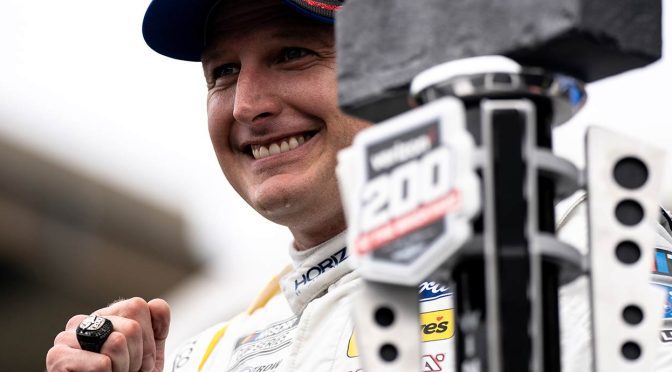
There was no Sunday afternoon idiocy and no late-race lunacy to derail his hunch. McDowell went to bed Sunday evening as a winner at the famed Brickyard, having driven the race of his life in the Verizon 200. He had led 54 of 82 laps — setting a personal best — and scored his second Cup Series victory to go along with his triumph in the 2021 Daytona 500.
This win felt different — for the journeyman driver who first broke into NASCAR’s big leagues in 2008; for Travis Peterson, the first-year crew chief who challenged his driver to buck the industry norm in hiring him; and for his Front Row Motorsports organization, which had achieved its three previous Cup Series wins by capitalizing on right-place, right-time scenarios but has gradually blossomed into a scrappy mid-major team capable of busting up postseason brackets.
McDowell’s victory was his first in 2 1/2 years but didn’t feel like an upset.
“To basically dominate the weekend is hardly a Cinderella story,” said Jerry Freeze, Front Row’s longtime general manager. “We’ve been fortunate. This is the fourth Cup win that Front Row Motorsports has had, and I think you could say that the first three, circumstances kind of played their way into being in the position to get the checkered flag at the end, but this one was just a real butt-kicking, and so I’m especially proud of this win.”
The triumph also helped reduce any stress about McDowell’s recent weeks on the bubble of the Cup Series Playoffs. The postseason appearance is the second in McDowell’s career and the third for Front Row, which joined NASCAR’s top series in 2005 and labored just to qualify and run full races in some of its earliest efforts.
But McDowell also dispelled the underdog narrative of Sunday’s win, touting the team’s road-course strength in the era of the Next Gen car with statistical proof.
“Is it a Cinderella story from a lot of different aspects? Maybe,” McDowell said. “But off of pure performance, like, I feel like we’ve been nailing it and having a shot at it. But I also look at it as, like, we’re going up against some really big teams with a lot of resources, and to do what we did today is pretty awesome.”
Alejandro Alvarez | NASCAR Studios
McDowell was quick to credit Peterson for his share in the team’s turnaround and for what he saw in the former RFK Racing engineer when he interviewed for the job in the offseason. The conversation over lunch between driver and crew chief was direct, and McDowell was honest in revealing who some of the other candidates were, including some with longer tenures atop the pit box. Peterson was matter-of-fact about why he deserved at least equal consideration.
“I can’t speak to how I convinced him, but I do remember making one comment to him about why do guys keep hiring experienced crew chiefs instead of taking a risk on a guy who knows what his potential could be,” Peterson said. “I do feel like that might have resonated with him because he liked that comment, and he felt that about himself at times throughout his career.”
McDowell recognized that passion in how the two interacted and in how Peterson reacted when tested. He needed an engineering-minded multi-tasker with a strong work ethic and believed he’d found one. Now two-thirds of the way through their first season together, they’ve continued to challenge each other in their approach.
“All I was doing was just to see if he had the fire because if you don’t have fire, you’ll never make it at Front Row Motorsports. You just won’t,” McDowell said. “You have to be a fighter because it’s hard. You’ve got to do a lot more stuff than most of the people around you have to do, and you’ve got to put in more hours, and you’ve got to be willing to do more with less. So I was just seeing if I could piss him off a little bit, and he was fiery, and that’s what I wanted. I wanted somebody that was fiery. I met with five or six guys, and I left that lunch like this is my guy. If I can get him, this is my guy. I just felt it in my gut, felt it in my heart. ”
The Bob Jenkins-owned team had won just three times before Sunday’s victory. Two were on superspeedways — McDowell’s Daytona win and the team’s breakthrough with David Ragan at Talladega Superspeedway in 2013 — and one came on a fog-shrouded day at Pocono Raceway in 2016 when Chris Buescher emerged as the victor of a weather-shortened event. He squeaked into the playoffs by reaching the top 30 of the points standings, an eligibility requirement at the time.
Front Row today is much better than the top 30 team of yesteryear. McDowell’s Indianapolis victory clinched the No. 34 group’s playoff ticket automatically, but the 38-year-old driver said they planned to still keep tabs on the team’s stature in the standings, using it as a measuring stick for how consistent the organization has been this season.
“We started off with a team that it was just an accomplishment to make the field for a race, and it’s just kind of grown from there, just incrementally,” Freeze said. “That’s what Bob Jenkins, he kind of challenged us with that from the start, let’s just get a little bit better from year to year to year, and I feel like we’ve accomplished that.”
So has McDowell, who enters the postseason field for the second time in a three-year span but as a greater threat to contend. The playoff pressure had taken a toll in recent weeks on the No. 34 team, which had slipped below the provisional elimination line with a strategy misfire at Richmond and front-end damage at Michigan. But McDowell said he saw opportunity in the moment.
“I wasn’t so much thinking about the must-win of the playoffs, I was thinking of the must-win of you might not ever get another chance like this where your car is that good. You’d better make it count,” McDowell said. “Like I said, I felt that this morning. I felt that pressure and that angst. Then the race started, and that angst went down, and I just got laser-focused on what I had to do and felt like I had all the things to do it.”
McDowell also has a distinctive claim now, visiting Victory Lane at Daytona and Indy — two long-revered venues in the motorsports world.
“You only get rings for certain races,” McDowell said. “I got the two best rings you can get.”
SPEEDWAY, Ind. — A Goodyear tire test is scheduled Monday and Tuesday on the Indianapolis Motor Speedway oval layout. Three Cup Series teams are set to participate, helping Goodyear and NASCAR officials evaluate the 2.5-mile Brickyard circuit for possible inclusion in future schedules.
The test comes after this weekend’s racing on the 2.439-mile Indianapolis road-course circuit, which the Cup Series has competed on since 2021. The series previously ran on the oval configuration for 27 annual events, starting with the inaugural Brickyard 400 in 1994.
No. 14 Stewart-Haas Racing Ford with driver Chase Briscoe
No. 48 Hendrick Motorsports Chevrolet with driver Alex Bowman
No. 54 Joe Gibbs Racing Toyota with driver Ty Gibbs
The 2024 NASCAR schedule release date has not been revealed, but Elton Sawyer — NASCAR’s senior vice president of competition — acknowledged “ongoing conversations” about which Indianapolis layout will be used. “I think it’s fair to say that it’s always on the table,” Sawyer said last week about the oval configuration, in remarks made to SiriusXM NASCAR Radio.
If the schedule reverts to the Indy oval, Goodyear officials will want to be ready, said Greg Stucker, the tiremaker’s director of race tire sales.
“We just feel like there’s enough discussion around potentially going back to the oval in the future, let’s go ahead and take the opportunity to get on that race track in the old configuration with the Next Gen car,” Stucker told SiriusXM. “We haven’t run the Next Gen car on the oval, we’ve only run the road course.”
Sawyer said that Monday and the first half of Tuesday will be used for tire testing and that the second half of Tuesday’s session will be allotted for NASCAR competition officials to evaluate aerodynamic components for possible inclusion in future Cup Series rules packages. Six teams tried out a new splitter and additional aero adjustments July 31-Aug. 1 at Richmond Raceway, and NASCAR officials plan to use the time at Indy to collect more data and feedback.
Bowman was the highest finisher of the test participants in Sunday’s Verizon 200 at the Brickyard, placing fifth with Briscoe sixth and Gibbs rallying to take 12th. Of the three, only Bowman has raced a Cup Series car on the Indianapolis oval.
“I don’t know if a stock car around this place ever really feels natural, but it’s definitely going to be cool,” Bowman said, noting the venue’s role as the ancestral home of IndyCar racing. “So, excited for it. I haven’t really thought about it much, honestly. We were going to try to get some laps in the sim for it before we came here, and we kind of just decided to focus on the road-course stuff. So I don’t know what to expect, but hopefully we have a good test and learn as much as possible.”
Briscoe won the first NASCAR race on the Indy road course — the Xfinity Series’ 2020 inaugural — but the Indiana native has long held a certain reverence for the oval, which has origins dating back to 1909.
“It’s crazy to think that I’ll be one of three guys to drive this Next Gen car on the oval,” Briscoe said. “So, if we get a race on it, the significance of what the Brickyard 400 is, it’s a crown-jewel. There’s no other way to say it.”