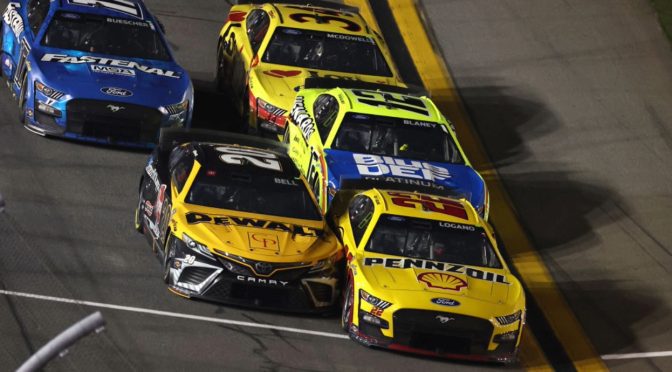
Six drivers have won three or more NASCAR Cup Series races in 2023 – William Byron, Martin Truex Jr., Denny Hamlin, Kyle Busch, Kyle Larson and Chris Buescher.
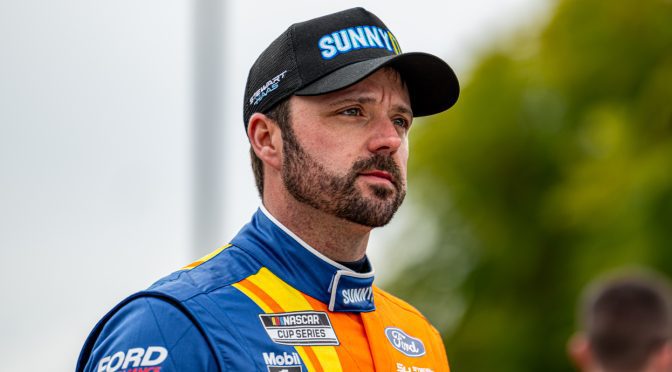
Buescher, an eighth-year driver in the midst of his second postseason run, might be the outlier on that list that features three former champions, the series’ win leader this season and a 51-time winner overall. But his resume speaks for itself in 2023 alone with three wins, eight top fives, 15 top 10s and an average finish of 12.3 that ranks third among full-time racers behind only Byron and Chase Elliott.
There is little doubt RFK Racing’s Buescher belongs in the Round of 8 of the NASCAR Playoffs.
“I think we’re not at a point where we can be ignored anymore,” Buescher said in a Wednesday media teleconference. “We’ve made it a long way this season. We’ve outrun a lot of what were considered favorites from the get-go on the year, and we’ve outrun them very consistently through the second half of the season – even a little more so.
“To me, like I said, I don’t know what everyone else is feeling. But I would say you’re gonna have a hard time finding somebody that’s not aware that we’re in this round and that we have an opportunity to make it to the next one.”
The only other time Buescher was a member of the NASCAR Playoffs was 2016, the result of a weather-shortened victory at Pocono Raceway during his rookie campaign while driving the No. 34 Front Row Motorsports Ford.
Mother Nature has nothing to do with the Texas native’s success these days. Buescher stormed to Victory Lane in three of the final five races of the regular season, a stretch that included back-to-back wins at 0.75-mile Richmond Raceway and 2-mile Michigan International Speedway before snagging another checkered flag at the 2.5-mile Daytona International Speedway. Not bad for a driver who snapped a 222-race drought at Bristol in 2022.
In fact, that win was key in encouraging the No. 17 Ford’s pilot that he and his crew were capable of a deep playoff run this season.
As one of eight competitors left fighting for the NASCAR Cup Series championship, that belief has manifested into something tangible.
“This started last year for us,” Buescher said. “I was pretty confident where we got to at the end of the season that if we could improve upon where we ended, we would have a very good shot at this. It was set as a goal for our entire company at the beginning of the year was to take both of our cars deep into the playoffs – certainly an expectation for us.
“I think that we figured we were capable of this very early on. Our West Coast Swing was a little rocky to start the season. But it didn’t take but about four or five weeks, maybe six weeks, to start finding some momentum and get in a decent place. We got to the point where two and a half months into the season in, really started feeling like we were in the hunt.
“It came up pretty quickly for us this season. It wasn’t always probably apparent to a casual fan, but we measure our week in so many different ways internally that we could certainly see the progression and the opportunity ahead of us. And finally being able to really grab those wins later in the season really cemented it for everybody in the industry to see.”
With his sudden jolt of wins came well-deserved kudos from his competitors, who have seen the soon-to-be 31-year-old grind in the Cup Series over the past eight years. But performing at this stage of the season with so much on the line? Those congratulatory messages may not be as frequent as they were in August.
“I think at this point, we’ve probably worn out our welcome,” Buescher said. “… A lot of people that would have given advice before now probably aren’t going to at this point as we’ve been able to get this far. So you know, in a lot of ways we’re keeping with the status quo, what we know has gotten us to this point. Again, we’ve been in a good spot through every cutoff through the playoffs thus far. And I think we’re very capable of making it into this next one.”
Buescher will need to improve some stats if he wants to advance to Phoenix based on points. In a combined 36 career starts at Las Vegas, Homestead-Miami and Martinsville — the three ovals scheduled for the Round of 8 — Buescher has just two top-10 results with a best finish in the Next Gen era of 13th last year at Homestead.
But setting new milestones is what Buescher has done all season. His eight top fives and 15 top 10s, 15.1 average starting spot and 12.7 average finish are all career bests with still four races remaining in 2023.
“This is not coming as a surprise to us whatsoever,” Buescher said. “We’re thrilled to be here. And I’m happy to be halfway there on our goals for the season and our expectations. But we’ve got work to do yet. We’re not done.”
Everything you need to know for Sunday’s NASCAR Cup Series race at Las Vegas Motor Speedway, the 33rd points-paying race of the 2023 Cup Series campaign.
Christopher Bell hit the jackpot again in qualifying by earning his sixth pole of the 2023 NASCAR Cup Series season at Las Vegas Motor Speedway. It is also Bell’s fourth pole in seven playoff races. Hendrick Motorsports driver Kyle Larson will line up alongside Bell on the front row. William Byron, Martin Truex Jr. and Chris Buescher complete the top five. | Read the full practice, qualifying recap
Big story line
Can Martin Truex Jr. rediscover his regular-season mojo and become a championship favorite again?
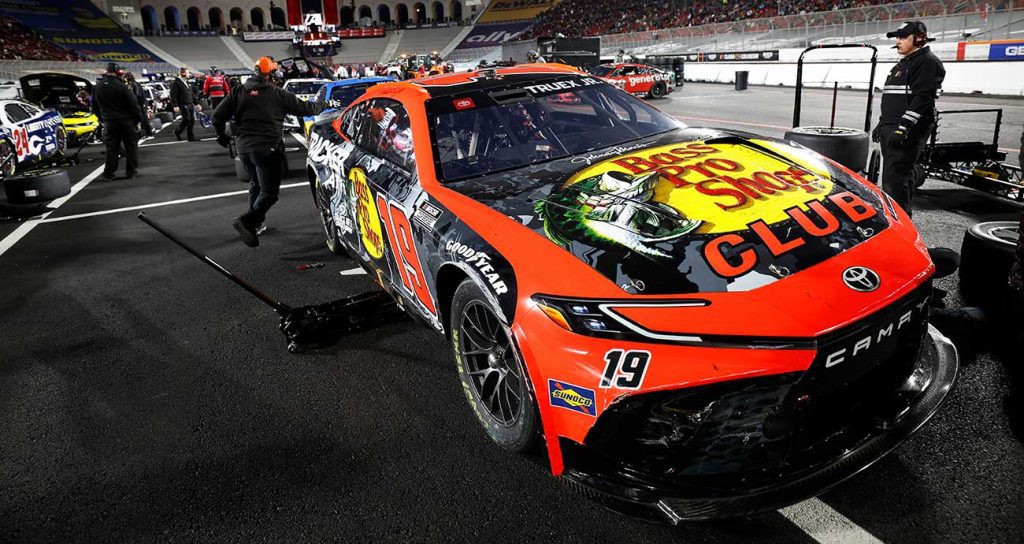
To say the least, after a strong regular season, it has been shocking to see Truex’s dip in performance since the start of the 2023 NASCAR Cup Series Playoffs. Despite all the bumps along the way, the Joe Gibbs Racing driver still managed to make a deep playoff run into the Round of 8, thanks to the 36 playoff points earned on the way to the Regular Season Championship. While Truex advanced to the Round of 8 by 12 points after finishing 20th at the Charlotte Roval, he does not have a top-10 finish in any playoff race so far. In the last seven races, he has finished 17th or worse.
The No. 19 team will aim to snap out of this cold streak on Sunday at Las Vegas Motor Speedway. In 11 of the last 12 races at the 1.5-mile track, Truex has two victories and just one result outside the top 10, including six consecutive finishes of eighth or better. With the current playoff format, winning can solve a lot of problems. If Truex wins at Las Vegas and earns another Championship 4 berth, that string of disappointing finishes will quickly become a distant memory. | Kyle Petty: Can Martin Truex Jr. rediscover early-season success?
History tells us…
William Byron may sweep Las Vegas in 2023 and make his first Championship 4 appearance.
Byron continues to enjoy a career year in the Cup Series, scoring six victories, most of all drivers. In the Round of 12, he finished no worse than second place and picked up the win at Texas to punch his ticket to the Round of 8. The driver of the No. 24 Hendrick Motorsports Chevrolet has seven top 10s in the last eight races. In the last 23 races, the remarkable consistency is clear with 15 top-10 finishes and four wins during this stretch.
Looking at Byron’s Las Vegas stats, the 25-year-old led a total of 255 laps in the last seven of nine races in Sin City. In the previous five races, he finished eighth or better three times, including winning the Las Vegas spring race earlier this year. Based on the No. 24 team’s momentum, there is a good chance that he may end up sweeping both Las Vegas races in 2023 and advance to Phoenix to square off for his first Cup title. | Relive Byron’s OT win in the Vegas spring race | Watch the race on NASCAR Classics
He may not be the betting favorite to win, but watch out for…
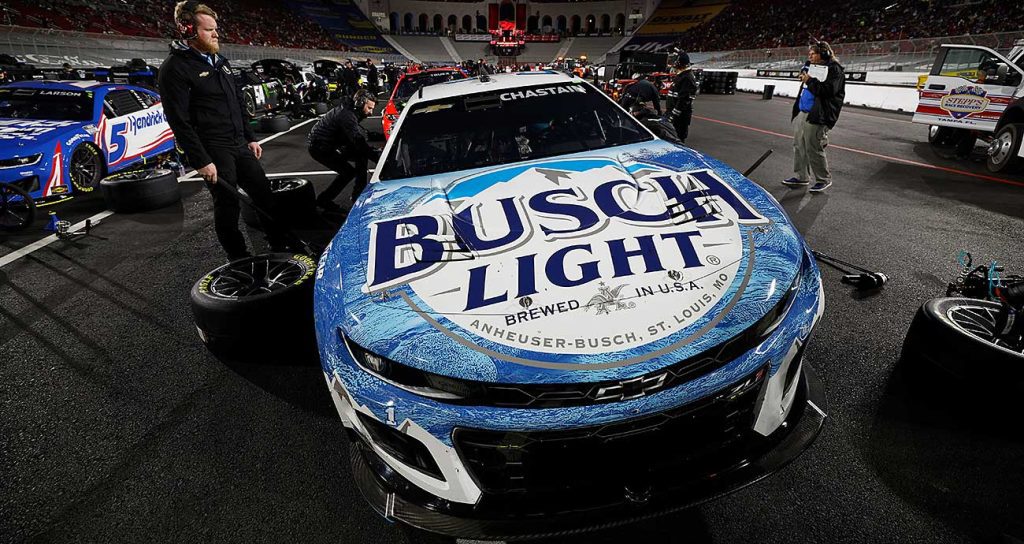
Ross Chastain. While the Trackhouse Racing driver will not be a part of this year’s Championship 4, there will still be opportunities for the No. 1 team to end 2023 with some solid results heading into next year. Most of 2023 has been hit or miss for Chastain, in a season filled with ups and downs. Chastain enters Las Vegas with 22-1 odds of winning Sunday’s South Point 400 (2:30 p.m., NBC, PRN, SiriusXM NASCAR Radio, NBC Sports App).
Chastain’s last six races resulted in three top 10s and finishes of 13th or worse three times. In the last three Las Vegas races, Chastain finished in the top three twice. Based on the No. 1 Chevrolet’s inconsistent finishes throughout the year, there is no telling which Chastain will show up to Vegas, but his recent history at this track suggests a respectable day could be a possibility despite no longer being in playoff contention.
The early returns on Saturday were favorable — the Trackhouse Racing driver qualified 10th and was fastest in practice.
Familiar favorites ⭐️
Our biggest pieces of the week — get covered for race day from all angles.
• At-track photos: Sights and scenes from Las Vegas | Photos • Bubble Watch: High stakes in the desert | See the analysis • Fantasy Fastlane: Will MTJ hit the jackpot in Sin City? | See the picks • Paint Scheme Preview: See the schemes for Las Vegas | Pick a favorite • Power Rankings: Which Martin Truex Jr. will we see in the Round of 8? | Latest driver rankings
• Stacking Pennies: Ben Kennedy joins Corey LaJoie to talk about the 2024 schedule and marquee moments in NASCAR and his career. | Listen to the podcast
💎 NASCAR 75: Learn more about the history of the sport, from pioneers to current stars | Visit NASCAR 75 hub
Get in on the action 💰
Think you know NASCAR? Put your mettle to the test with gaming, fantasy and Fan Rewards.
• Fantasy Live: Participate in interactive gameplay from week to week | Choose your lineup • Fan Rewards: New in 2023, get rewarded for your participation | Learn more • NASCAR BetCenter: Don’t miss your chance to make picks each week | Visit the BetCenter
• Going the distance: 2023 Cup Series championship odds | See them here
The first clue to solving the mystery of Josh Wise came at dinner. I told him to pick his favorite restaurant, and I would meet him there. Wise, whose company, Wise Optimization, counts as clients some of NASCAR’s top drivers, chose Masala Mastee in Davidson, North Carolina, where he lives, and then checked and double-checked with me to make sure I like Indian food.
I arrived a few minutes early and bounded up the stairs to find him already there. Tall and lanky, with a shaved head and blue eyes, he rose to greet me, clearly recognizing me even though we had never met. Starting with that dinner, I spent two days around Charlotte with Wise in pursuit of the secrets that have led his drivers to Victory Lane and the head table at the champion’s banquet. This was no easy task. Wise is simultaneously well-known in the NASCAR garage and an elusive Svengali shrouded in mystery.
He rarely gives interviews and would rather talk about his team of drivers and coaches and their results on the track than himself or the specific methods he uses to mold his clients into drivers capable of those accomplishments. His clients love working with him so much some won’t talk about him for fear of revealing the advantage he gives them. They’ve even resorted to subterfuge, with at least one driver giving others credit in interviews while privately acknowledging Wise actually deserved the praise.
What, I wanted to know, is Wise doing to create that mystique?
I flew to Charlotte to find out, and in several hours of conversation, I started to wonder who was profiling who. Wise asked me nearly as many questions as I asked him, and he listened to and engaged with my answers.
We discussed taking our daughters to see Taylor Swift, the Dunning-Kruger effect, how fear self-selects drivers out before they reach the Cup level, Comanches, glasses that track where drivers are looking, what he learned visiting with the Los Angeles Dodgers during spring training, and when we got around to it, racing, including the Hail Melon, Chili Bowl (we discovered he raced in it and I covered it in 2003), F1, and how the entire sport is maddening because the relationship between performance and results is not 1 to 1, a fact that, as much as anything, explains the need for Wise’s services.
He is Aristotle of the asphalt, Socrates of stock cars, a simmering stew of a man who is best known for racing, endurance sports and coaching but whose interests run far wider. A world-class driver himself, he brings to Wise Optimization the listening ear of a therapist, the resilience of an endurance athlete and the wisdom gained by on-track failure. He has become NASCAR’s Driver Whisperer, a man whose background in racing and fitness, education in psychology and deep study on optimization have given him unique insight into the human condition that he channels into teaching drivers how to go fast, turn (mostly) left, and live their best lives all the while.
But how does he do it?
The answer, it turns out, is as simple as passion, as complicated as human relationships, and as profound as redeeming pain.
Rey Del Rio | Getty Images
A superstar in open-wheel cars in the 2000s, Wise arrived in the NASCAR Cup series in 2011 with a world of opportunity laid out in front of him. But from outside the garage it looked like his racing career turned hard right into the retaining wall. In 156 races across six Cup seasons, he had one top 10 and led just seven total laps. He spent untold mental, physical and emotional energy and gathered nothing to show for it.
That’s what he thought at the time, at least. Because the second clue in solving the mystery of Josh Wise is that what he once viewed as failure he now sees as preparation.
When he decided to stop driving after the 2016 season, he dreamed up a business to help drivers optimize their results — to redirect their careers away from the proverbial retaining wall. He would become for others what he had needed himself. As an accomplished triathlete, he already had a reputation for marbling physical fitness with driver preparation. He pitched the idea to Max Jones, a friend and mentor who was an executive with Chip Ganassi Racing at the time.
“I’m going to build a program to help these guys be way better than they even know they’re capable of,” he told Jones as they talked in the garage area.
“Wait right here,” Jones said, and he hustled to the team hauler to round up other Ganassi officials so Wise could pitch them, too. That led to a formal presentation at Ganassi headquarters a few weeks later. Wise was soon working with Ganassi drivers Kyle Larson (now with Hendrick Motorsports) and Jamie McMurray.
Even in those early days, when Wise’s one-man program was a faint shadow of the eight-person operation it is now, there were signs that something was changing, something deeper than Wise doling out lessons about fitness, braking points and resilience. Racing has had psychologists and exercise coaches and performance experts for many years. But nobody had ever done all of that in one holistic program, let alone the way Wise does — with a singular blend of 30,000-foot view expertise, barrel-through-the-corner-sideways experience and put-his-arm-around-you-and-say-man-it-sucks-to-try-so-hard-and-lose compassion.
“It comes down to his empathy and ability to connect with a driver as a person,” says Eric Warren, GM’s executive director of global motorsports competition.
“I don’t know how he’s doing it, but he’s convinced them and next thing you know, they’re more into it than he is,” Jones says.
“Josh’s most important goal is to read each driver and ask, where does he need help, and how can I help him the most?” said McMurray, who is now retired from racing and works as an analyst for FOX Sports.
Wise follows the answers to those questions wherever they lead. With McMurray, it was toward fitness. When Wise first suggested McMurray run to get in shape, McMurray gave him all the excuses in the world why he couldn’t.
Just run for five minutes, Wise suggested, like a fisherman choosing the exact right fly and casting it to the exact right spot, then walk home.
Five minutes — that’s it? McMurray thought, a trout unaware he was about to be hooked. I can do that.
McMurray tried it.
It wasn’t so bad.
He did it again.
And again.
And again.
Five minutes became 10, then 20, and by the end of that year McMurray had ran a marathon. Now McMurray says he doesn’t feel right on days he does not run.
“It changed my life getting to be a part of that program,” said McMurray, who ran 10 miles the morning I interviewed him. “Forever.”
All of Wise’s clients have stories like that, each marked by the fact that whatever change Wise initiated started with his passion for optimizing their lives. This is the third clue to solving the mystery of Josh Wise: No client of Wise Optimization ever has to wonder whether Wise cares. Helping other drivers has become his true calling.
“I love this more than I ever loved driving a race car,” Wise says. “Driving a race car is a very selfish activity. You are alone. It’s all about you. I absolutely love making it about other people. It’s the most fulfilling years of my life, for sure.”
It’s that passion that’s allowed Wise to look back on his racing career with new perspective.
“I feel like I only raced cars to prepare me to do this. That’s really how I feel,” he says. “It was an important part of my life experience that allowed me to do something that I really love, and I feel like I’m just made to do.”
He paused. He knows how that sounds, so he answered the obvious question before I asked it.
“Try telling me that 12 years ago when I was a race car driver,” he says. “I would have laughed in your face.”
Alejandro Alvarez | NASCAR Studios
As Wise’s reputation grew, so did demands for his business, his sense of what was possible and his recognition of what more he could offer. His drivers shared with him problems from their personal lives, issues he was unqualified to comment on, let alone solve. He believes it’s better to not say the right thing than to say the wrong thing.
“So I was just quiet a lot,” Wise said. “But in that silence, I knew, I couldn’t help you if I wanted to.”
If he was going to optimize their lives, Wise realized, he had to help the whole person, not just the driver. So he earned a degree in psychology.
He also hired former F1 and NASCAR driver Scott Speed to teach driving skills, Olympic gold medal winning speed skater Dan Jansen to run Wise Optimization’s physical training and former soccer coach Matt Spear to oversee mindfulness and resilience. All of that, he says, has energized his business and the quality and diversity of what it offers. The operation expanded beyond just Ganassi drivers: Wise now works with two dozen Chevrolet drivers ranging from Kyle Larson to aspiring young drivers he shepherds in a program akin to a driver academy.
That growth yielded stunning results for his clients. Larson won the Cup Series championship in 2021, and Sheldon Creed won the Craftsman Trucks championship in 2020. Tyler Reddick won the Xfinity Series championship in 2018 and 2019, though Wise doesn’t count Reddick’s titles because Wise “only” served as a consultant for Reddick back then and was not working with him full-time.
The morning after dinner, I met Wise at GM’s Charlotte Tech Center, also the home of Wise Optimization headquarters. He gave me a tour of the pristine 130,000-square-foot facility that sits close to both Hendrick Motorsports and Charlotte Motor Speedway. I peeked into one room and saw a NextGen car painted with NASCAR’s 75th anniversary logo sitting on a shaker rig. In another, Wise client Austin Dillon and others worked on simulators. In a third, mechanics fiddled with an open-wheel chassis.
Inside his headquarters, which Chevy provides as part of his deal to work exclusively with its drivers, a rowing machine and treadmills lined one side, with weights stacked along the other. The sauna contained books by Anthony de Mello (an Indian Jesuit priest), John Maxwell (an American pastor and business writer) and Don Miguel Ruiz, who writes about Toltec wisdom (the Toltecs ruled Mexico 1,000 years ago). Wise proudly pointed out a collage of pictures — one each of all the drivers who have won a race while working with him.
Inspirational quotes were also displayed prominently at the headquarters.
There was one from Danish-American journalist Jacob Riis: “When nothing seems to help, I go look at a stonecutter hammering away at his rock perhaps a hundred times without as much as a crack showing in it. Yet at the hundred and first blow it will split in two, and I know it was not that blow that did it, but all that had gone before” …
It shared space with a quote from basketball superstar Kobe Bryant: “Everyone wants to be a beast, until it’s time to do what beasts do” …
And there was one attributed to Albert Einstein that Wise says sums up his philosophy about racing and life and his attempts to optimize both: “Energy is everything. That’s all there is to it.”
We talked far more about striving, failure and achievement in the context of racing than we did about the actual nuts and bolts of driving. Which makes sense, because the service he provides goes far beyond simple driving instructions. He seeks to optimize the whole person, starting with the space between their ears.
Before he works with a driver, he asks them to fill out a 13-page questionnaire, from which he builds a psychological profile that is at least as important as the person’s ability to wheel a race car. He translates those questionnaires based on his formal education and his own ongoing quest to understand what makes drivers good at their jobs.
Reading is an important part of the process for Wise. He reads three times a day, including scientific literature three times a week, and writes at least once a week. He prefers to own hard copies of books and likes to keep them in sight because their presence sometimes kick-starts some serious deep-thinking sessions.
“I’ll see it, and it’ll bring a thought back to my mind — all these concepts and thoughts will come flooding in,” he says. “I like that experience.”
Wise is insatiably curious, and open to new ideas. During our interview he pulled out his phone and bought a book I recommended moments after I brought it up. He delights in discovering questions to ask at least as much as answering them. Let’s assume, for simplicity’s sake, that the most important question he asks in pursuit of driver optimization is, “What makes a driver good?”, an important but ultimately unanswerable question. But Wise loves trying anyway.
“I could scroll like this for four minutes and not run out,” he says, showing me a document on his phone that contains questions he wants to chase the answers to. “Every one I answer, I get three new ones.”
The fourth secret to solving the mystery of Josh Wise was sitting right across from me all this time. Our conversations about life and curiosity and passion and longing for that which is temporarily out of reach reveal at least as much about why he’s successful as his coaching secrets would.
As Jones told me: “There’s a lot of people who have tried to copy what he’s doing. But the key to it is Josh.”
Or this from Warren: “I’m here to tell you, I don’t think (his coaching skill) is unique to just racing. I think he has a skill set to encourage any athlete.”
———-
After the tour of the tech center, Wise and I jumped in his SUV and drove to GoPro Motorplex in Mooresville, North Carolina, a karting track owned by Justin Marks, co-owner of Trackhouse Racing. There we met Speed and Creed, an Xfinity Series driver who won the 2020 Truck Series championship with a dash from ninth to first in the final three laps of the last race of the season.
Speed instructed Creed to run three kinds of laps: “wide-ass open,” in which he should push himself to the limits of control; “no slip” in which the car and tires should always be pointed in the same direction; and in between those two. I watched Speed and Wise as they watched Creed. Wise watched with an all-but blank mind, trying not to let any preconceived notions of what Creed should or shouldn’t do cloud his assessment. Speed watched more like a batting coach assessing a hitter’s swing.
During the “no slip” portion, Creed’s squealing tires suggested there was plenty of slipping going on. His sawing of the wheel offered more proof. Creed’s background is in off-road racing. He drove as if he defined “no slip” as in control, which he surely felt he was, as opposed to the more literal definition of the tires not slipping. No slip to him might be damn near rolling over for someone less experienced in off-road racing.
Making that discovery, and learning from it, was the point of this drill. As Creed prepared for another set of laps, Speed told him to over-exaggerate the no slip — to lean in to being deliberate about it. “If it’s 7/10ths slower a lap, it doesn’t matter,” Speed told him. “I want it to look like a slot car.”
“Slot car,” Creed repeated back, like a child ordered to eat broccoli.
It was at least as much of a mental exercise as it was a physical exercise for Creed. But the point was not that a no slip lap is fast or slow or that a wide-ass open lap is fast or slow. The point was for Creed to expand what he believes he is capable of. There should be a huge gap between no slip and wide-ass open. For Creed, before the exercise, there wasn’t. Sometimes that gap is similarly narrow but it’s the other way around, and a driver has to be pushed to be more wide-ass open.
“That’s the beautiful thing about what we do,” Speed says. “Every one of our drivers has their own perspective on everything. I can tell them all the same thing, and they’re all going to have their own perception on what that means. If they’re biased in one direction, I try to build something that they can explore on the other side.”
Alejandro Alvarez | NASCAR Studios
Wise says he doesn’t like to have his life depend on external input, so he occasionally quits drinking coffee. He told me on the way to a coffee shop that he ended his most recent fast the day before. “I had like three sips, and I was calling people, telling them how much I love them,” he said.
From this, he extrapolated deep meaning.
“I have this simple philosophy. Everything comes at a cost,” he says. “If I drink coffee, the cost to me is I become dependent on it. If I don’t drink coffee, I miss the joy of drinking coffee.”
In a different form, he explores this topic when he meets with a new client.
“We have that talk right out of the gate: ‘What do you want? Be specific. What do you think that costs — your time, your energy, what do you have to give up, what do you have to be uncomfortable with?’ There are a lot of things that spiral off of that conversation.”
He asks himself those same questions and builds his life around the answers. He has a system for everything — from where he puts his keys to the clothes he wears (only black, white, gray and blue). He created those systems to free his brain energy. He never has to think, what should I wear, or where did I put my keys, because he knows the answer to both questions.
“I want to do as little thinking about things that don’t matter as possible so I can use my brain for things I care about,” he says.
What he cares about most in his professional life is right there in the name of his own company: optimization. And perhaps the best proof of the power of his program came when he became his own client.
One day a few years ago, two of his clients, Alex Bowman and Larson, pestered him about driving again. He had slammed that door shut … but left it unlocked. The most fun he ever had racing was a pavement midget at Indianapolis Raceway Park. Maybe — maybe — he’d do that, but only that, he told Bowman and Larson. It was, he admits, a dodge. Pavement midget races at IRP were, as he put it, “extinct,” so it didn’t matter.
And then they came back to life.
Bowman called to tell him he had ordered a midget for him before Wise had even heard the announcement.
He tried to back out but eventually decided to do it. He saw it as a chance to have fun, to show his kids what he used to do, and to validate his ideas about optimization. He wrote a system to prepare himself physically, mentally and technically, just like he would for any driver. That system called for him to study video of himself at IRP. One night, he watched an old race on YouTube while in bed. Like a seasoned artist aghast at an early painting, he recognized right away that he entered the corners all wrong.
He added to his system a plan to work with Speed — who has world-class braking and cornering skills — to learn how to drive deep into corners. After starting in the back during his first race, Wise used braking skills he learned as part of his system. Wise knifed his way to the front, dive-bombing the leader with four laps left to win the race.
For Wise, it was a mic-drop moment. He proved to his kids, and to himself, that he could still wheel a race car, and also that his systems work. And here, then, is the final clue to solving the mystery of Josh Wise.
He has become for his clients what he wished he had for himself.
The NASCAR Xfinity Series begins its all-important push to the 2023 championship with Saturday afternoon’s Alsco Uniforms 302 (3:30 p.m. ET on the USA Network, PRN, SiriusXM NASCAR Radio, NBC Sports App) — the first race in this final three-race round to set the Championship 4.
JR Motorsports driver Sam Mayer closed out the last round with one of the most clutch performances of the season. The 20-year-old led 50 of 67 laps to claim victory in what was a “must-win” race for him at the Charlotte Motor Speedway road course and earn him a position in this vital next round of competition. Not only did it send him to the penultimate playoff round, but it also vaulted him into the fourth-place bubble position two points up on Stewart-Haas Racing driver Cole Custer in fifth.
Only two drivers in Saturday’s field have won an Xfinity Series race at Las Vegas — Richard Childress Racing’s Austin Hill, who is ranked second in the playoff standings 21 points above the elimination line — and JR Motorsports’ Josh Berry, who was eliminated from the playoffs last weekend.
Hill won at Vegas this spring and a repeat performance would place the Georgia native in the NASCAR Xfinity Series Championship 4 for the first time in his career. The driver of the No. 21 RCR Chevrolet could also become only the second driver in track history to win back-to-back races — matching a mark by Chase Briscoe, who swept the 2020 season races there.
As has been the case all season, Hill can expect stiff competition from Joe Gibbs Racing’s John Hunter Nemechek. The driver of the No. 20 JGR Toyota has a notable history in Round of 8 opening races wherever they may be, winning that race on the schedule twice — when he was not playoff-eligible.
Nemechek shows up in Vegas with a series-best and season-high seven victories and 22 top-10 finishes through the opening 29 races. His 956 laps led is nearly three times that of any other driver. He has three top 10s in five series starts at Las Vegas with a best showing in his first series race there — a runner-up in 2019.
JR Motorsports veteran Justin Allgaier is ranked third in the championship. He’s also a multi-time winner in 2023, claiming three victories and holding a reasonable 17-point cushion inside the top-four standings. He has yet to win at Vegas but has four runner-up showings, including one in March.
Also, championship-eligible this weekend are Stewart-Haas Racing’s Cole Custer, Kaulig Racing rookie Chandler Smith, RCR’s Sheldon Creed and JGR rookie Sammy Smith. Chandler Smith, in particular among those four, boasts a promising Vegas resume — winning the pole position and leading 118 of the 200 laps to claim a third-place finish in his March debut there.
Practice for the Alsco Uniforms 302 is slated for 7:05 p.m. ET on Friday, followed by qualifying at 7:35 p.m. ET — both televised on the USA Network.
Throughout the 2023 NASCAR Cup Series Playoffs, Advance Auto Parts is spotlighting a series of Home Track Heroes from NASCAR-sanctioned short tracks around the country. Each Home Track Hero, nominated by his or her peers as a result of contributions made to the race track, will have his or her name appear on the C-Post of Ryan Blaney’s No. 12 Team Penske Ford Mustang in a Cup Series Playoff race. Erika Bills, the Pit Boss at Alaska Raceway Park, is the Home Track Hero whose name will appear on Blaney’s car during the South Point 400 at Las Vegas Motor Speedway.
Those at Alaska Raceway Park have a simple word to describe Erika Bills: “Invaluable.”
A banker by trade, Bills serves as the NASCAR Home Track’s Pit Boss, working mostly in concessions and sales. But, more or less, she does it all.
Bills keeps Alaska Raceway Park’s pits in order, assisting new drivers, training other track officials and assisting wherever else needed. She even trains other employees across the state of Alaska.
Bills handles sales during Alaska Raceway Park’s offseason, and on the drag strip side, she recently took over concessions management. Perhaps her most important role at the track, though, is her ability to serve as a mentor and coach to Alaska Raceway Park’s young drivers.
A former Legend Car driver herself, Bills is the perfect role model for kids who look to race in Alaska.
Bills is not only a Home Track Hero at Alaska Raceway Park; she’s a hero in the community.
She helps with seemingly everything, from the Food Bank, delivering meals to the youth during the summer, to volunteering with the local baseball league and assisting with the Special Olympics.
She’s famous for her peanut butter balls, many of which she donates for fundraisers.
Kyle Larson turned his first official laps in an Indy car on Thursday, passing his Rookie Orientation Program (ROP) test at Indianapolis Motor Speedway and checking off the first requirement for his 2024 Indianapolis 500 bid.
Larson drove a No. 6 Arrow McLaren/Hendrick Motorsports entry on the 2.5-mile oval, successfully completing the three phases of his rookie test — 10 laps between 205-210 mph, 15 laps at 210-215 mph and 15 laps faster than 215 mph. The 31-year-old driver, a 22-time winner as a regular and former champion in the NASCAR Cup Series, will attempt to qualify for his first Indy 500 start next May.
Larson’s best lap speed in the final session was recorded at 217.898 mph, and his best clocking through the speed traps at the end of both straightaways was 221.187 mph.
“Building up to that speed and pace and confidence was nice to do in ROP, but yeah, just getting to feel what an Indy car feels like, being low to the ground, feel the acceleration through the gears was pretty crazy,” Larson said. “All of that was eye-opening and an experience that I know for sure I’ll never forget, and now I look forward to kind of getting around cars and feel how the dirty air affects things.”
Larson is set to become the fifth driver to attempt the Memorial Day Weekend double on May 26, 2024, aiming to compete in the Indianapolis 500 before traveling to Charlotte for NASCAR’s Coca-Cola 600. The designs of the cars and “Hendrick 1100” branding for Larson’s two-race effort were unveiled at the Indianapolis track on Aug. 13, seven months after the Indy 500 bid was confirmed.
A full delegation of Hendrick Motorsports dignitaries made the trip, including team owner Rick Hendrick, vice chairman Jeff Gordon and team president and general manager Jeff Andrews. For Gordon, the visit was partly a reconnection to his Indiana roots and the site of some of his biggest stock-car successes – with the inaugural Brickyard 400 triumph counted among his five IMS wins.
The track’s historic significance was one focal point, but the task of getting Larson up to pace was the primary thrust.
“On the other hand is just Kyle, watching him in his craft and his element,” Gordon said. “I could tell he was a little bit nervous. Heck, my palms were sweating before he got out on track myself, but then immediately you just see it click when he made those first few laps, and he just went into Kyle Larson mode of, ‘all right, now how do I get up to speed and go fast.’ … He doesn’t want to just come here and compete. He wants to come here and compete competitively.”
The moment also held a surreal feel for Hendrick, who stood alongside Larson for the reveal of the liveries back in August.
“It didn’t really hit me until I saw him,” Hendrick said. “We had the car here when we had the unveiling, but when you hear it and see it come by, and he’s in it, that’s when it really … it was goosebumps. It was goosebumps, it was pride, happy for him because it’s a bucket list for him and probably Jeff and I, too. But just to hear it, see it and watch the speed when it came then, that brought it all to life.”
The test was conducted under the watch of IndyCar officials but also Arrow McLaren sporting director Tony Kanaan, who hoisted the Indy 500 trophy in 2013. Larson’s next on-track steps at the Speedway will come in an Indy 500 open test next April. Kanaan said that so far, Larson’s talent has made his coaching and consulting role an easier job.
“I don’t think Kyle Larson needs evaluation as an IndyCar driver,” said Kanaan, an IndyCar champion in 2004. “He’s a complete race car driver. It’s probably, out of his generation, the best I’ve seen. I’ve tasted a little bit what these guys do, like he does trying different cars lately, and I know how much I struggle, and he wins in everything. … He’s just one of the best race car drivers in the world right now, and I’m very fortunate to actually get the chance to work with him.”
As for Larson’s next steps on the NASCAR side, his quest for a second Cup Series championship continues this weekend at Las Vegas Motor Speedway with Sunday’s South Point 400 (2:30 p.m. ET, NBC, PRN, SiriusXM NASCAR Radio, NBC Sports App). The race is the opener for the postseason’s Round of 8.
At first blush, the transition from an Indy car at Indianapolis to a full-bodied stock car at Las Vegas might seem like a tight and potentially jarring turnaround. But Gordon brushed off the suggestion that rookie testing at Indy might stretch the team thin, noting Larson’s penchant for extracurricular racing of all types of vehicles – including a drive to a championship two days ago in the High Limit Sprint Car Series at Lincoln Park Speedway in Putnamville, Indiana.
“For Kyle, I mean, that guy’s off racing all the time. He’s all over the place,” Gordon said. “So the team is well prepared. He and Cliff (Daniels, crew chief) have been prepping and planning for this weekend, and they’re very well prepared for this next round. Feel very good about this next round. It was this last round that was the nerve-wracking one, and we saw it all the way down to the final lap at the Roval.
“So from our standpoint, we’re fortunate to have enough great people and depth at our organization to be able to prepare for what’s ahead and really make sure that’s the priority, and the focus for the company is to go win a championship this year, get through this next playoff round and go to Phoenix, but also be up here and be able to enjoy a day like today.”
For most drivers, a 21.3 average finish through six playoff races would mean that their title hopes ended in the Round of 16 or last Sunday at Charlotte Motor Speedway.
Not the case for Martin Truex Jr.
The 2023 Cup Series Regular Season Champion scrapped and clawed through the opening rounds of the postseason. Survive and advance is rarely a superlative slung at someone who performed the best out of anyone through the first 26 races of the year, but when you look at the numbers, it’s stunning that Truex is one of eight drivers eligible to hoist the Bill France Trophy at Phoenix.
Off the bat, Truex didn’t record a single top-five or top-10 result in the first two rounds. His best finish in the postseason so far is a 17th-place effort to open the Round of 12 at Texas Motor Speedway.
Looking deeper into Truex’s current slump, he ranked 17th in points scored among all Cup drivers during the Round of 12, below Brad Keselowski, Ross Chastain and Bubba Wallace, who were all eliminated in the round. Truex currently ranks 24th in total points scored in the playoffs and is averaging 17.7 points per race in the playoffs after averaging 34 points during the regular season. (Stats provided by Racing Insights.)
The most jarring numbers show just how much of an outlier this performance has been for the driver of the No. 19 Joe Gibbs Racing Toyota.
Truex has finished outside the top 15 in the last seven races, which is his worst streak since 2009 — his fourth full-time Cup season. Given how his outings have been, it’s no surprise Truex is just the first driver to advance to the Round of 8 despite not having a top 10 through the first two rounds.
One could make the argument that Truex benefitted off the mistakes of his fellow competitors, and there’s a case to be made for that.
It seemed as though the writing was on the wall for Truex after crashing in the opening laps at Kansas put him below the elimination line heading into the Bristol Night Race. While not having the best of races himself with a 19th-place showing, Kevin Harvick finished 29th and 2022 Cup champion Joey Logano crashed out, allowing Truex to overtake Logano to put him through to the Round of 12.
Texas and Talladega were Truex’s ticket to the Round of 8. Kyle Busch wrecked out at Texas in the closing laps of Stage 1, and Ross Chastain wrecked at a near-identical point of the race at Talladega after Ricky Stenhouse Jr. spun entering Turn 3.
Despite capitalizing on the downfall of others, Truex’s strong regular season is more the reason why he’s currently on a never-before-seen playoff run — never before has being the Regular Season Champion been so valuable and important to a playoff run.
What also flies under the radar is Truex Jr.’s ability to finish races. It’s not always the top 10s, top fives and wins that get the job done.
During the regular season, Truex failed to finish only once after getting involved in a late-race crash at Darlington in the spring. On the other hand, Kyle Busch — who also has won three races — DNF’d on five different occasions (Daytona 500, Bristol Dirt, Kansas spring, New Hampshire, Michigan).
The DNFs and stage points were the biggest difference as to why Truex’s title hopes are still alive and why Busch was eliminated at the Roval.
With Truex still in the hunt, he’s arguably still among the favorites to win his second championship despite the woes — he has, after all, won at all four tracks remaining on the Cup Series calendar in Las Vegas, Homestead, Martinsville and Phoenix.
At Las Vegas specifically, Truex has finished inside the top 10 in the last six races at the Nevada oval, and is the only driver to finish top 10 in all three races there in the Next Gen car.
Truex can only go up after how he’s fared in the playoffs so far, but no better time to start the turnaround than at Sunday’s race in Vegas (2:30 p.m. ET, NBC, PRN, SiriusXM NASCAR Radio, NBC Sports App).
He’s made it this far on the strength of his regular-season title. If he finds himself back on the right side of results this weekend, the championship still looms for the No. 19 team.
Last year’s Round of 8 opener at Las Vegas Motor Speedway was a wild one that saw half of the playoff drivers at the time finish outside the top 10 while the other half finished inside the top five. If drivers want their shot at the title at Phoenix in three weeks, they will need to perform well in the high desert.
Before the green flag drops for Sunday’s South Point 400 (2:30 p.m. ET, NBC, PRN, SiriusXM NASCAR Radio, NBC Sports App), see how the race is trending for drivers still vying for the Bill France Trophy, trends to watch, Goodyear tire info and interactive ways to follow all the weekend’s action.
It’s no exaggeration to say that the Round of 8 field is trending to dominate Sunday at Las Vegas. The door is open for any one of the eight remaining title-eligible competitors to punch their ticket to a Championship 4 berth as Homestead-Miami Speedway and Martinsville Speedway offer more challenges and have been dominated by only a handful of drivers in recent years.
Reverting to the spring race at Las Vegas, the lowest finish by a current playoff driver was Chris Buescher in 21st. Everyone else finished inside the top 15 with half of the Round of 8 scoring top-10 results.
Vegas will pay the points to most of the playoff drivers on Sunday, and teams are going to need to hit their setups perfectly right off the hauler in practice and qualifying to find any advantage they can entering the race.
Goodyear will run the same tire setup at Las Vegas that was introduced in last year’s playoff race. Teams will be allotted one set of tires for practice, one set for qualifying, and an additional eight sets for Sunday’s race.
Along the right-side door bars and extending toward the rear clip, teams are mandated to run a steel plate in addition to the chassis adjustments made for the Coca-Cola 600 at Charlotte Motor Speedway. The right-side door bar gussets and the removal of the front clip V-brace are changes that remain, in addition to the removal of other front-clip components, to create a softer and larger crush zone for frontal impacts.
Also included in the updates are front-bumper strut softening (modifications to existing parts), the requirement of an empty front ballast box, and a modified cross brace. NASCAR incurs the cost of all these updates.
In the event of a lost wheel that is contained to pit road, the offending team will be subject to a pass-through penalty under green-flag conditions. If the infraction occurs during a caution period, the offending team will restart at the tail end of the field.
If the wheel breaks free outside of pit road, the new rules guidelines mandate a two-lap penalty plus a two-race suspension for two crew members. Each penalty is series-specific: Violations in one series will not impact those crew members’ eligibility to participate in other series.
Fans can get in on the action all season long with NASCAR Fan Rewards, a free program that rewards fans for participating in the action when they watch races and play NASCAR Fantasy.
There’s no cost to join. Fans must be 18 years or older to participate in the program.
Earn points by checking into a race from home or at the track, setting your Fantasy Live lineup, making purchases on the NASCAR.com shop, and more. Points can be redeemed for race tickets, merchandise, and VIP experiences at the track, including pace car rides and waving the green flag at qualifying.
NASCAR Mobile has now added support for fans to “Follow the Race” and access live leaderboard and race information from Live Activities in the current app release (v13.2.0), available now. Android users, we didn’t forget you — the same functionality has been custom-built for Android devices, as well.
How to access Live Activities on iPhones:
Make sure your iOS device has been updated to 16.1 or higher.
Available on the leaderboard of all NASCAR Series races.
Click on the three-dot menu near the top right of the screen.
Select “Follow the Race.”
Swipe up to access the home screen, and you will see the Live Activities at the top.
Lock the device, and you will see Live Activities on the Lock Screen.
To turn it off, simply visit the leaderboard, click the three-dot menu, and “Unfollow the Race.”
FANTASY LIVE 🏆
Want to manage a team and race your way to the top of the leaderboards? Check out NASCAR Fantasy Live, which resets for the playoffs. The free-to-play game lets you choose your drivers each week and show off your crew-chief instincts by garaging a driver by the end of Stage 2, and there is a $10,000 prize for the winner.
During the 2023 NASCAR Cup Series Playoffs, fans have the opportunity to compete in The Playoffs Grid™ Challenge presented by Ruoff Mortage. Fans can enter by visiting The Playoffs Grid™ Challenge page and registering for a free NASCAR.com account before filling out a bracket. From there, choose from a list of playoff-eligible drivers round by round, and you’re on your way to compete for prizes!
Get additional camera views by logging on to NASCAR Drive, where each week, a select number of in-car cameras will be available — as well as a battle cam and an overhead look.
NASCAR has partnered with LiveLike to add fan engagement to the NASCAR Mobile App. Log in to the mobile app during the race for polls, quizzes, the cheer meter, and more — and see instant results from NASCAR fans like you.
During NASCAR race weekends, shows cars are common sites at gas stations, home improvement stores and fast-food restaurants. The displays provide fans opportunities to take close looks at the machines wheeled by their favorite drivers.
In some cases, they serve as inspiration.
For Vicente Salas, a 21-year-old from Temecula, California, a chance encounter with a show car at his local Home Depot as a child helped set him on his path in motorsports.
“Racing has absolutely always been my dream,” Salas said. “Really the day it came to me and I figured that out was we went to Home Depot. My dad would always take me with him to run his errands. Tony Stewart’s No. 20 Home Depot car was sitting outside. We asked the guy if I could sit in it, and he was like, ‘You know, we normally don’t do this, but sure, go ahead.’
“The moment I got to sit down in that car and the wheel was put on, I just knew that this is what I wanted to do.”
Salas was just 3 when he sat in that car, but the moment became a core memory and created the foundation for what has quickly become a budding career.
Motorsports is not something that has always been a part of Salas’ family heritage, which has roots in Mexico and Latin America. Salas is the third generation of family to be born in the United States after they immigrated to the country and settled in Southern California.
“My mom’s side is from Europe, but it’s my dad’s side that is from Mexico and Latin America,” Salas explained. “I’m the third full generation to be here in the U.S. They actually had a big ranch down in León, Mexico, and basically it got taken from them during the drug wars down there. It forced them to move up here. They made a life up here, and now we’ve all settled here.”
Salas is the first member of his family to race stock cars, but he’s not the first to be part of the motorsports community. His father Don spent a little more than a decade as a motorsports photographer and even did a bit of motocross racing. Both helped fuel his son’s passion for the sport.
Vicente Salas (55) during a Late Model Stock Car event at North Carolina’s Hickory Motor Speedway earlier this year. (Photo: Gardner Street Photography/Hickory Motor Speedway)
Salas spent almost a decade of his childhood trying to convince his family to take his motorsports obsession seriously.
“It was kind of one of those things where some kids are like, ‘I want to be a football player or I want to be an astronaut,’” Salas said. “I think that’s kind of what they thought of me and how I wanted to drive. From the age of 3 or 4 all the way until I was 14 or 15, I would ask them constantly, ‘Can I go race? Can I get a go-kart? Can I get a bando? Can I get a Legend car?’
“I was just trying to find things to do that I could drive.”
When Salas was around 11, his father began taking him to local karting tracks in California, which helped scratch the racing itch. Eventually even that wasn’t enough, and Salas began begging his parents to let him race in a professional event.
As luck would have it, Salas’ best friend in high school ended up being the one to make the connection that would change the rest of his life.
“[He] met an incredible go-kart team,” Salas said. ‘He was like, ‘I’m going to go drive these go-karts at Auto Club Speedway.’ I was like whoa, that sounds really, really cool. So one day I went out there, and I got to test a shifter kart, and from there on it was kind of on.
“My parents, once they saw me on the race track on more of a competitive platform, they were like, ‘OK, now we understand. He really wants to do this.’”
Salas was 15 when he started racing shifter karts, much older than most start-up racers in the modern era. By his third season racing karts, he was competing nationally. His family quickly realized he needed to make the jump from karts to full-sized stock cars.
At nearly the same time, Salas began making inroads on the digital level by attempting to qualify for the eNASCAR Coca-Cola iRacing Series. During the COVID-19 lockdown of 2020, Salas worked toward earning a spot in the series in 2021.
“That’s when I raced for Elliott Sadler. He helped me a ton,” Salas said about the 2020 iRacing season. “He was an awesome mentor. That was such a good time of learning.”
Salas successfully qualified for the eNASCAR Coca-Cola iRacing Series in 2021 and stunned his competitors early in the year by leading every lap and winning at Richmond Raceway as a rookie.
That win, Salas said, put him on the map as an iRacer and helped him secure opportunities to test and later race a Pro Late Model with the CARS Tour in 2022.
“That win at Richmond in 2021 I think is what really helped open the doors for the late model opportunities I had later that year and to race the next year,” Salas said. “My first race was pretty much from a shifter kart to a Pro Late Model with the CARS Tour in 2022.”
Salas, driving for noted team owner Donnie Wilson, made his Pro Late Model debut at Hickory Motor Speedway on March 26, 2022 with the CARS Tour. He qualified third and finished fourth that day in a field that included the two drivers that battled for the ARCA Menards Series East championship this year, William Sawalich and Luke Fenhaus.
In fact, Sawalich and Fenhaus were two of the three drivers who beat Salas that day. The other was Caden Kvapil, son of 2003 NASCAR Craftsman Truck Series champion Travis Kvapil.
Vicente Salas poses in Victory Lane following his first victory at Hickory Motor Speedway earlier this year. (Photo: Gardner Street Photography/Hickory Motor Speedway)
After getting his first taste of racing a stock car, Salas knew he wanted more. This season he was able to secure enough funding to race a Late Model Stock Car regularly for team owner Justin Carroll at Hickory Motor Speedway, where he earned his first victory with a daring, last-lap pass on March 25.
He also continued to compete in the eNASCAR series for Williams eSports.
“That victory meant a lot, because it was another one of those solidifying moments for not just me and the people around us, but especially for my family,” Salas said. “This is all that I’ve wanted to do. We worked very, very hard to make the Late Model opportunity happen and get me out here. It wasn’t just me by any means.
“That [win] honestly was just a dream come true.”
Salas’ goal is to race in the NASCAR Cup Series, and he’s already in the process of planning for what he is hoping will be a busy 2024 season.
While he isn’t yet sure what his schedule will look like, Salas is hopeful he’ll not only be able to take the next step in his racing career, but also continue to set an example for others.
“I’ve had a lot of kids come up to me and ask me how does this happen or how to do this,” Salas said. “It was cool to show them absolutely anything is possible regardless of who you are or where you come from or what your background is.
“If you work hard, you’re dedicated and you know what you want, you can make it happen.”
While Christopher Bell will look to prime his No. 20 Joe Gibbs Racing Toyota to his second consecutive Championship 4 berth, the 28-year-old additionally acknowledged how aware he will need to be when it comes to Daniel Suárez.
During Sunday’s Bank of America ROVAL 400 at the Charlotte Motor Speedway road course, Bell and Suárez’s No. 99 Trackhouse Racing Chevrolet made contact several times throughout the race, including on a Stage 2 restart. The final incident came during the final stage with less than 15 to go, where Bell clipped Suárez’s left-rear quarter panel and caused the No. 99 to spin out. Bell went on to claim a 15th-place result, while Suárez finished 33rd.
“Certainly, I didn’t mean to get into him [Suárez], and you know, he and I have had run-ins in the past, so that’s the last guy I wanted to get into and have a problem with moving forward,” Bell said during a virtual teleconference with the media on Wednesday. “I reached out to him and told him that it wasn’t intentional, but I’m sure he’s going to be coming after me, which is not ideal going into the next four races, but it’s a mistake, and I’ll have to keep that in the back of my head moving forward.”
Bell, a NASCAR Cup Series Playoffs driver, currently sits below the elimination line (-8) as the Round of 8 begins at Las Vegas Motor Speedway this weekend. In addition to racing playoff competitors on the track, Bell mentioned how he would need to be cognizant of Suárez, should they both be in each other’s vicinity.
“I think it really just depends on where we’re at on track. If we’re not around each other, then it’s something that is pretty easy to put away, but I just have to be smart whenever it comes time to whenever I’m around him,” Bell said. “Certainly give him as much room as possible, and it is what it is. It was not a smart move on my behalf to … It was a mistake. It wasn’t like that was a move I was trying to do, but I should’ve been more mindful of the position I was in and where we were at in that race. Not ideal, I’ll just have to pay attention moving forward and do the best I can.”