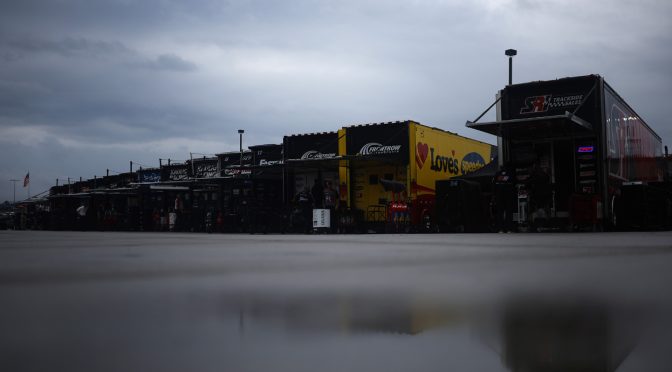
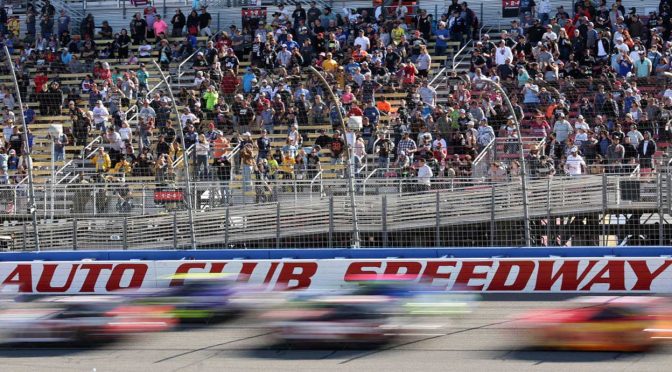
Inclement weather has adjusted the schedule for on-track action at Auto Club Speedway on Saturday.
Rain lingered over the 2-mile speedway in Fontana, California, canceling NASCAR Xfinity Series practice and qualifying for Saturday afternoon’s Production Alliance Group 300. The 300-miler was initially scheduled for a 5 p.m. ET start time (FS1, MRN, SiriusXM NASCAR Radio), but track-drying procedures have pushed driver introductions to 5:40 p.m. ET, with the race scheduled to take the green flag at 6:07 p.m. ET.
Per the NASCAR Rule Book, the starting lineup for the Xfinity race will be set by performance metrics based on last week’s season opener at Daytona, a formula that factors driver’s fastest lap time position (15%), driver’s final race position (25%), owner’s final race position (25%) and owner’s points position (35%). With 40 cars entered, two cars will head home following the qualifying cancelation due to the series’ 38-car maximum.
Additionally, Saturday’s Cup Series practice and qualifying sessions for Sunday’s Pala Casino 400 (3:30 p.m. ET, FOX, MRN, SiriusXM) were also canceled. The starting lineup will be set using the same metric formula used to set the Xfinity grid, putting Christopher Bell’s No. 20 Joe Gibbs Racing Toyota in the top starting spot for Sunday’s 400-miler.
In the late laps of last year’s NASCAR Cup Series race at Auto Club Speedway, Hendrick Motorsports teammates Kyle Larson and Chase Elliott found themselves jockeying for the lead and potential victory.
It ended with Larson putting Elliott in the wall as the duo ran three-wide with Joey Logano down the frontstretch with 21 laps remaining. Larson darted high, unaware Elliott had a full head of steam heading to the outside lane. Elliott was walled, and his race ruined. Larson went on to win the race.
The collision triggered a meeting of the minds of all four Hendrick drivers and team owner Rick Hendrick himself.
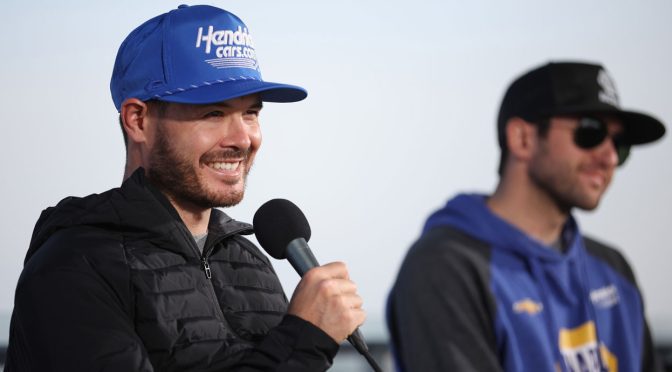
The Cup Series returns to Fontana, California on Sunday (3:30 p.m. ET, FOX, MRN, SiriusXM NASCAR Radio), one year since the incident, which left Elliott stewing in the immediate aftermath. Larson says their relationship is in decent shape these days — despite being frayed again in an August battle at Watkins Glen International.
“I think Fontana was easier to get over for him because it was the first time something happened,” Larson said at Daytona 500 Media Day. “I think Watkins Glen was tougher to get over because it happened a second time. But I think since then — I mean, it took weeks, I would say, to get moved on from it. But I feel like we’re in a good, an OK spot right now.
“You know, we both did an appearance together, you know, a few weeks ago in California, and we were playing on a golf simulator together. So I feel like like everything’s OK.”
At Watkins Glen, six months after their Fontana kerfuffle, Larson lined up to Elliott’s right on the front row with five laps to go. Heading into the 90-degree, right-hand first turn, Larson ran Elliott wide to escape with the lead and eventual win. Elliott stumbled to fourth at the checkered flag.
“Fontana was a mistake. Watkins Glen was not a mistake,” Larson said at Daytona. “You know, we were battling for the win. But you don’t want to make those moves, and it was a rough few weeks for me in my seat. So I don’t want to be a part of that ever again. So yeah, I think, I think we’re OK. And our teams continue to work well together, which I think was the most important piece of it.”
SOUTH BOSTON, Va. — The busiest pre-season testing day of the new year at South Boston Speedway ended late Wednesday afternoon with something of a surprise.
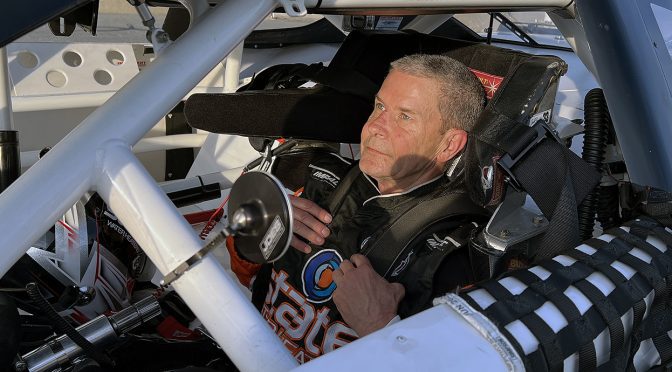
Former NASCAR Cup Series star and 2002 Daytona 500 winner Ward Burton took a brief turn behind the wheel of a late model stock car co-owned by his son, NASCAR Xfinity Series driver Jeb Burton, and H.C. Sellers.
“It was really fun,” the elder Burton said with a smile. “I appreciate Jeb and H.C. Sellers allowing me to play for a moment. It brings back a lot of memories because I was immediately telling them what I need to get myself comfortable and feeling right. I know what I need to go faster.”
Burton, the winner of two of NASCAR’s most prestigious Cup Series races, the 2002 Daytona 500 and the 2001 Southern 500 at Darlington Raceway, admitted it had been quite awhile since he last piloted a late model stock car.
“I think it was 1991,” he replied when asked when he last drove a late model stock car. “The late ‘Goo’ Fallen had me go to Orange County Speedway with him. Eddie Hatcher was still working for him. He wanted me to drive the car. The car was fine. It was just the motor wouldn’t run.”
Burton explained it was hard to compare the experience of driving a late model stock car years ago with driving one on this afternoon.
“I raced once (NASCAR) Busch Series race here in 1995 when the front pit wall was built,” noted Burton. “The track has been reconfigured a little bit since then.”
It was Burton’s son, Jeb, that persuaded him to climb behind of the wheel of the late model stock car.
“Jeb has been after me pretty hard to get back racing and run some races somewhere,” Burton explained. “We’ll see what it leads to down the road.”
Jeb Burton and Sellers had spent the day at South Boston Speedway working with driver Andrew Patterson. Patterson is scheduled to drive the car in the twin 75-lap Sentara Healthcare Late Model Stock Car Division races that will headline the Danville Toyota ’23 Opener racing program on Saturday afternoon, March 18, at South Boston Speedway.
Patterson is a member of the Jordan Anderson Racing Team, the NASCAR Xfinity Series team for which Jeb Burton is driving this season.
The season-opening event will also include twin 30-lap races for the Budweiser Limited Sportsman Division, a 25-lap race for the Southside Disposal Pure Stock Division and a 20-lap race for the Virginia State Police HEAT Hornets Division. The first race of the day will get the green flag at 2 p.m.
Sunday’s race will be the final race on the 2-mile template at Auto Club, with a storied history dating back to the track’s inaugural Cup Series race in 1997. While uncertainty surrounds its place in the future, one thing is certain — Sunday’s winner will forever be known as the last to conquer this configuration. It may seem small, but that, on top of a playoff berth, is a lot to race for. The majority of drivers in the current premier series field have never won here, and West Coast drivers like Kevin Harvick and Kyle Busch will be eager to add to their impressive legacies in the region. Winning any race is big, but the farewell makes this one that much bigger. | More on Auto Club’s 2-mile finale
History tells us…
Hendrick Motorsports thrives at Auto Club Speedway. The organization has won an astounding 38% (12 of 32) of the races run at the track, including three of the last six dating back to Jimmie Johnson’s win in 2016. Among their active stable, Kyle Larson has two victories (winning last year’s race), and Alex Bowman has one.
Kyle Larson is the betting favorite to win, but watch out for…
Aric Almirola. At 50-1 odds, some people may have already written off the Stewart-Haas Racing driver — but you shouldn’t. Though he may not be among the top picks to find Victory Lane on Sunday, Almirola has a strong case for garnering attention. He has three consecutive top-10 finishes at Auto Club, including a career-high sixth-place finish last season. Despite struggling at this track throughout his career, Almirola is trending in the right direction and should have increased confidence after winning the Bluegreen Vacations Duel 1 at Daytona International Speedway. Without practice and qualifying to gauge a setup, if he can start on the right foot, he may very well be in the mix for a statement win on Sunday. | The Action Network: Why Almirola is Sunday’s best bet
Familiar favorites ⭐️
Our biggest pieces of the week — get covered for race day from all angles.
💎 NASCAR 75: Check out exclusive NASCAR content throughout the anniversary season | Learn more, explore
Hot off the press 📰
Key stories and breaking news from the week leading up to the race.
• Fontana’s 2-mile finale: Sunday’s upcoming race stirs key memories | Read more
• Kevin Harvick: Veteran to make 750th consecutive start Sunday | See where he ranks
• Hendrick Motorsports: Larson, Elliott return to site of teammate tension | Read more
• History out west: NASCAR western roots almost as deep as south’s | Read more
• NASCAR 75: Creative campaign launched to commemorate anniversary | Read more
• Victory lap: Stenhouse visits Chicago with Harley J. Earl trophy | See the photos
• All-Star update: Look at the construction progress at North Wilkesboro | See the photos
• Back to Daytona: JTG team owner Brad Daugherty reflects on historic win | Read more
• NASCAR Roots: Behind the scenes from 2023 World Series of Asphalt | See the photos
Get in on the action 💰
Think you know NASCAR? Put your mettle to the test with gaming, fantasy and Fan Rewards.
• Fan Rewards: New in 2023, get rewarded for your participation | Learn more • Fantasy Live: Still time to get on the leaderboard and win big this season |Tips for 2023 • NASCAR BetCenter: Don’t miss your chance to make picks each week | Visit the BetCenter
• Going all the way: 2023 Cup Series championship odds | See them here
Two-mile finale in Fontana 🫡
Relive the best memories at Auto Club before the final race on the current configuration.
• Winner, winner: All-time wins at Auto Club | See who has the most
• Pace out front: Top 10 lap leaders in Auto Club’s history | See them here
• Do you remember?: Memorable moments at Auto Club | Relive them here
• There’s a fight!: Tony Stewart and Joey Logano fight at Auto Club in 2013 | Watch the video
• Jimmie looks back: Jimmie Johnson talks about his first Cup Series win | Watch the video
• Race Rewind: Kyle Larson holds off Austin Dillon, Erik Jones | Highlights from 2022
Take some notes 📝
Five hard-hitting, race-relevant statistics, brought to you by the experts at Racing Insights.
• Kyle Larson and Cliff Daniels are the only current driver/crew chief combo who have won together at Auto Club. • West Coast drivers won 20 of 32 Auto Club races, including 12 from California. • Kevin Harvick is making his 750th consecutive Cup Series start, ranking third on the all-time chart. • Ford only has one Auto Club win in the last 14 races there — Brad Keselowski in 2015. • Nine teams made up the top 10 finishers at Auto Club in 2022.
A notable quote from one star of the sport heading into Sunday’s race.
“When you look at the racetrack’s shape and size, it’s very similar to Michigan – very Penske-ish in how it was built. But for California, I think a lot of people don’t realize how much racing there is in that state. Obviously, it’s been a big hit throughout the years, and when they brought the Cup Series out there, they were probably the biggest moments that the race track will ever have from start to finish. But racing in general, in California, is always well-supported. It’s in its sweet spot right now with one date and getting everybody there.” — Kevin Harvick, driver of the No. 4 Stewart-Haas Racing Ford Mustang
After a busy Speedweeks, NASCAR shifts its focus to the West Coast for the three-week swing that begins at Auto Club Speedway in Fontana, California.
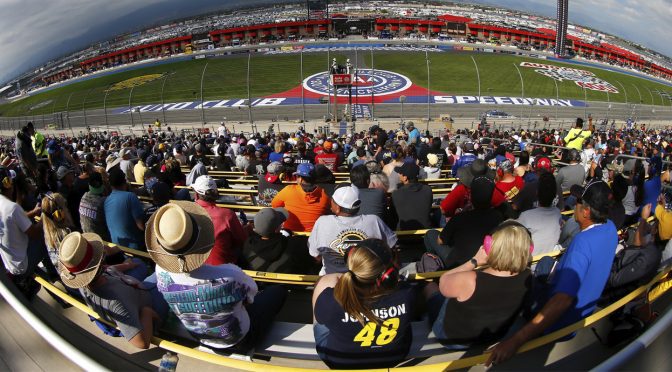
Sunday’s Pala Casino 400 (3:30 p.m. ET, FOX, MRN, SiriusXM NASCAR Radio) marks the final race weekend that the current 2-mile configuration will be used before renovations take place.
While the timeline for Auto Club after this weekend is unknown, there’s much to look forward to and information to keep an eye on after a thrilling open to the season at the Daytona 500.
‘LET’S GROOVE’
Legendary music group Earth, Wind & Fire once said “let this groove, get you to move,” and while it wasn’t referencing Auto Club, it’s a good line to have in your mind when watching the 200-lap event. With flatter corners and an older surface than other ovals on the circuit, Auto Club allows multiple grooves to work throughout a run. A driver on fresh tires can utilize the bottom lane early and then work the top to maximize tear wire, but all lanes, including the middle, can be used to make passes.
WEST COAST BIAS
In the 32-race history at Auto Club, 20 drivers from western states (California, Oregon, Washington, Arizona and Nevada) have won at the 2-mile oval, including the last three with Kyle Busch (2019), Alex Bowman (2020) and Kyle Larson (2022). Busch currently owns the most wins (four) at the track by an active driver.
TRENDS TO WATCH
— Kevin Harvick is set to make his 750th consecutive start in the Cup Series.
— Chevrolet owns four of the last six wins at Auto Club with two of those coming from Larson.
— Nine different teams finished in the top 10 in 2022 with the Next Gen debut at Auto Club.
— Matt Kenseth was the last Cup driver to win the first two races of the season (2009).
— The Stage 1 winner at Auto Club has gone on to win four of the five races since the introduction of stages.
(Via Racing Insights)
MEMORABLE MOMENTS
1997: California native Jeff Gordon wins inaugural race in Fontana | WATCH
2011: Kevin Harvick outduels Jimmie Johnson on final lap | WATCH
2013: Logano, Hamlin collide in final turn; Kyle Busch wins | WATCH
2013: Logano, Stewart fight post-race on pit road | WATCH
2022: Larson, Austin Dillon, Suárez battle for win | WATCH
ON-TRACK SCHEDULE
Saturday, Feb. 25
— Cup practice: 2:05 p.m. ET [FS1, MRN, SiriusXM NASCAR Radio]
— Cup qualifying: 2:50 p.m. ET [FS1, MRN, SiriusXM NASCAR Radio]
Due to the abrasiveness and age of the asphalt surface at Auto Club, teams will have 14 sets of tires for the weekend, including 12 for Sunday’s race.
The tire codes will be different compared to the 2022 race as the left-side tire features construction and mold shape changes while the right-side tire features a construction update to align with what is run at other speedways.
Entering the 2023 season, competition officials have revised the penalty structure for detached wheels, shifting away from the four-race crew chief suspension that had been in place since 2015.
In the event of a lost wheel that is contained to pit road, the offending team will be subject to a pass-through penalty under green-flag conditions. If the infraction occurs during a caution period, the offending team will restart at the tail end of the field.
If the wheel breaks free outside of pit road, the new rules guidelines mandate a two-lap penalty plus a two-race suspension for two crew members. Each penalty is series-specific: Violations in one series will not impact those crew members’ eligibility to participate in other series.
Fans can get in on the action all season long with NASCAR Fan Rewards, a free program that rewards fans for participating in the action when they watch races and play NASCAR Fantasy.
There’s no cost to join. Fans must be 18 years or older to participate in the program.
Earn points by checking into a race from home or at the track, setting your Fantasy Live lineup, making purchases on the NASCAR.com shop and more. Points can be redeemed for race tickets, merchandise and VIP experiences at the track, including pace car rides and waving the green flag at qualifying.
Want to manage a team and race your way to the top of the leaderboards? Check out NASCAR Fantasy Live, which is open now. The free-to-play game lets you choose your drivers each week and show off your crew-chief instincts by garaging a driver by the end of Stage 3, and there is a $25,000 prize for the winner.
Get additional camera views by logging on to NASCAR Drive, where each week, a select number of in-car cameras will be available – as well as a battle cam and an overhead look.
NASCAR has partnered with LiveLike to add fan engagement to the NASCAR Mobile App. Log in to the mobile app during the race for polls, quizzes, the cheer meter and more — and see instant results from NASCAR fans like you.
It’s only fitting that the track that for so long stood as NASCAR’s connection to Hollywood (until we started racing at the Los Angeles Memorial Coliseum last year, that is) was home to so many blockbuster-worthy moments in just a quarter-century of racing.
Naturally, the “California Kid” Jeff Gordon won the inaugural race at Auto Club Speedway in 1997, already his seventh victory in just the 15th race of the season en route to his second championship and second-best season of his career.
Four years later, almost like it was scripted in a smoky writers’ room 50 miles west in Los Angeles proper, Rusty Wallace held Gordon off on the final lap to pick up his only win of the year — and second-to-last win of his career — just two months after the death of Dale Earnhardt in the 2001 Daytona 500. Wallace, a close friend of “The Intimidator,” took his victory lap holding a black, white and red No. 3 flag out his window to a standing ovation. The day was April 29 — what would have been Earnhardt’s 50th birthday.
A year later, Gordon’s fellow Californian and teammate picked up his first career NASCAR Cup Series victory … and then, as it turned out, a whole lot more after that. Jimmie Johnson dove into the team’s arms like Superman that day, a move dripping with foreshadowing as we reflect on it two decades later.
As we’d come to learn, Auto Club is just different. For whatever reason, big things seem to happen there, and it’s shown to have a knack for being a spot for landmark victories, with Johnson later passing Earnhardt on the all-time Cup wins list at the track in 2016 en route to his seventh championship. It also stands as the site of Kyle Busch’s first Cup win — at just 20 years and 125 days old, which stood as the record for youngest series winner ever at the time — and later for his record-tying 200th national series victory to pull neck-and-neck with Richard Petty.
It’s also no stranger to friction, with this year marking the 10-year anniversary of one of NASCAR’s wildest finishes, followed by one of its most notorious fracases that stemmed from a deluge of current and former teammates Kyle Busch, Denny Hamlin, Joey Logano and Tony Stewart battling late. There was blocking, there were slide jobs, there was pushing and shoving and water bottles tossed and, oh, you better believe there were soundbites.
Keep in mind — this track has held 32 total Cup Series races, and that wasn’t even an exhaustive list of everything that’s happened there.
Just a few short years ago in 2017, Auto Club Speedway was celebrated for all of this rich history as we looked back on 20 years of racing on the 2-mile oval. Now, as the corner has turned on a quarter century of racing in the LA market, it’s time to look ahead to the future.
Sunday’s Pala Casino 400 (3:30 p.m. ET, FOX, MRN, SiriusXM NASCAR Radio) marks the final race on Auto Club’s 2-mile layout. Planning continues for construction of a state-of-the-art short track to be built on site, pending approval, but even with the most aggressive construction timeline, the proposed half-mile track won’t be ready for the 2024 season.
“What we’re working on is really exciting,” said track president Dave Allen last month. “The fact that we race at a half-mile at Martinsville (Speedway) and Bristol (Motor Speedway), it’ll be cool to have another half-mile, especially out here on the West Coast with so much racing history here.”
As Allen iterated, there really is so much history there. Those are some of the sport’s biggest names over the last quarter century, every single one of them a current or future Hall of Famer, each of whom without question shaped American motorsports as it entered and eventually staked a significant claim in the mainstream fray.
But in many ways, NASCAR is entering/has already entered a new era, with last year’s Next Gen racer clearly ushering in a revamped dynamic throughout the series, bold schedule shakeups like this year’s Chicago Street Race and the pair of Clash events at the Coliseum exposing the sport to new markets and with the next generation of champions ready to claim the crown from the old guard.
Getty Images
It’s hard to give up a track configuration that has worn its surface out in just the right way and has given us just so many historical pinpoints in the sport over the years.
It’s even harder, however, to not get antsy about adding another short track to the schedule on the opposite coast, especially given how often NASCAR’s bold moves have continued to pay off in recent years.
“I love that race track as-is. I feel like it produces amazing racing, but at the same time, I think we need more short tracks,” said Kyle Larson at Daytona 500 Media Day, himself a former Fontana winner as well. “I feel like … short tracks produce exciting racing, exciting finishes, tempers, stuff like that. I’m a proponent of making it a short track, and I think we need more of them.”
He also mentioned earlier this month while in LA for the Clash that he “love(s) the 2-mile track. But I think the more short tracks we can have, the better off our sport’s going to be. It’s neat that they’re investing that money to try and grow the racing in California, but also help NASCAR.”
Drivers have clamored for years about wanting more short tracks on the schedule, and the transition may not be perfectly seamless, but it’s one drivers hope to have an imprint on the process by offering input to ensure the finished product is one that has just as much potential as what we’ve seen in the past.
“If it’s a half mile, I hope that (NASCAR takes) some considerations from the drivers about what the configuration should look like,” Corey LaJoie said at Media Day. “Hopefully, they can lean into the driver’s advisory council a little bit and get our input on what a track layout would look like and be the best racing. A lot of challenges, but I think they’re going to figure it out, whether it’s a 2-mile oval or a reconfigured short track.”
“I love that race track. I love that place. The community there always makes me feel like home,” said the Mexican native Daniel Suárez at Daytona 500 Media Day. “With that being said, I hope everything is to make things better, make the sport better. Another hope is that we come back soon because that’s an amazing place for me. Personally, those fans, that community makes me feel like home. The Hispanic community there is huge.”
Nothing stays the same — in this sport, in life, in anything. NASCAR has undergone significant evolution just since the time Auto Club (née California Speedway) was a glimmer in the eye of Roger Penske, who broke ground at the facility in 1994. And the sport has only sped up its evolution over the past several years with outside-the-box ways to move forward.
So, as we raise our glasses to the first iteration of Auto Club Speedway and say thanks for the memories, let us keep in mind this weekend isn’t some sad Hollywood ending for one of the most distinct and loved tracks on the schedule.
This will be the final race at Auto Club Speedway on the 2-mile track before it undergoes renovations, so we start this week’s projections by celebrating some of the special moments that have taken place there.
Multi-time champions Jimmie Johnson and Kyle Busch got their first career NASCAR Cup Series wins at Auto Club, with Johnson’s coming in 2002 and Busch landing his in 2005. Meanwhile, four-time champion Jeff Gordon won the inaugural premier series race in 1997.
The wide, well-worn racing surface lends itself to multiple-groove strategies and plenty of stops on pit road for fresh tires. Active drivers with victories at Auto Club include Busch, with a series-leading four, Kyle Larson with two and one each for Kevin Harvick, Brad Keselowski, Martin Truex Jr. and Alex Bowman.
Larson is the defending winner of this race and opened atop the odds board at BetMGM.
To figure out what it all means, we’re back with another edition of Advance to Victory Lane, sponsored by Advance Auto Parts. Our partners at Racing Insights will predict the winner and entire finishing order for Sunday’s Pala Casino 400 (3:30 p.m. ET, FOX, MRN, SiriusXM NASCAR Radio). Racing Insights utilizes an advanced statistical formula that weighs factors such as current track, current track type, recent performance, team data and pit-crew data to arrive at a winner and full race results.
NO BRAINER? Larson has finished in the top two in four of his eight starts at Auto Club Speedway, including two wins. He has five career wins on 2-mile tracks.
USUALLY RELIABLE: Denny Hamlin had a streak of three straight top-10 finishes at Auto Club before coming in 15th last year because of an overheating issue.
POINTS, POINTS, POINTS: Joey Logano earned 103 points on the West Coast swing of races in 2022, which was third to Larson (113) and Tyler Reddick (109).
Projections updated on Sunday, Feb. 26:
RACING INSIGHTS’ PROJECTION FOR THE PALA CASINO 400
Jimmie Johnson had the good fortune and talent to score 83 victories during the course of his NASCAR Cup Series career. He still carries deeply fond recollections about his first — which came nearly 21 years ago in his home state — and the memorable celebration that came with it.
The seven-time champion made his first entry into the Cup Series win column on April 28, 2002, at what was then called California Speedway. The 2-mile Fontana track — now called Auto Club Speedway — is the site of this Sunday’s Pala Casino 400 (3:30 p.m. ET, FOX, MRN, SiriusXM NASCAR Radio), the second race of the Cup Series season.
The victory was not just a homecoming affair, but the moment also helped validate Hendrick Motorsports’ and team co-owner Jeff Gordon’s decision to stamp Johnson as a rising star in its new No. 48 Chevrolet ride after a moderately successful Xfinity Series tenure. For Johnson, it provided him with a sense of security that would last for two more decades.
“So to cross the finish line and win, the big exhale that I had when I finally crossed the finish line was really more about knowing I’d be employed,” Johnson said as part of a series of NASCAR 75th anniversary interviews. “Jeff just won the championship the year before in this equipment that I was driving that day, and the team, they never put that pressure on me, but in my heart, I felt like if I didn’t win, I wasn’t going to be back in ’03. So to win 10 races into my rookie season, 13th race ever, that was a huge moment, and I felt like I’d keep the job for a few years.”
Johnson had already started strong in his rookie campaign before Auto Club arrived on the 2002 schedule. He landed his first pole position in the season-opening Daytona 500 and followed that performance with another pole (at Talladega) and six top-10 finishes in the first nine races.
Heading home to Southern California came at the right time.
Robert Laberge | Getty Images
“Of course, I’m back home, first time there as a Cup driver, friends, family in the stands,” Johnson recalled. “I think we stopped through San Diego, see some people and hit my favorite taco stand before I went up to the race. Just a good check-in at home. I hadn’t been there in a while, so to have all that energy and excitement to go to the race track, to perform and run well all race long.”
Even with his early season momentum and that energetic vibe, Johnson recalls that his No. 48 Monte Carlo wasn’t the fastest car that day. He led 62 of the 250 laps, but the top front-runner was Kurt Busch, who led a race-high 102 in the Jack Roush-owned No. 97 Ford.
The outcome boiled down to a bold late-race strategy call by young crew chief Chad Knaus, who opted for fuel only while Busch’s team changed two tires in the final pit stop.
“I’ll never forget being off the front of the field and leading that thing,” Johnson said, “knowing that Kurt was going to be there at some point and somewhere near the end of that stint, I had a sense of understanding that, that’s as close as he was going to get. …
“I had track position, the track was paved not long before that. So the groove was kind of moving around in some different spots, and I recall finding a nice lane in the middle of the track … and just trying to be sure I didn’t mess it up, it was 5 or 10 to go, I really felt like it was my race to win. And having that pressure of your first win, your home track and not throw it away was all riding on my shoulders.”
After leading the final 14 green-flag laps to the end, that big exhale came with a burnout and a first visit to Victory Lane. The celebration extended beyond the “boom, confetti” moments and post-race press conference. At Gordon’s suggestion, a road trip was involved.
“When I look back, this was that window of time where personally there wasn’t a lot going on for Jeff or myself,” said Johnson, who was 26 at the time. “We weren’t married, we didn’t have kids. He looked at me and said, ‘We should probably go to Los Angeles tonight.’ I said, ‘That’s a great idea.’
“So he had rented a motor home to use for the weekend and talked the motor driver into filling the bus up full of my team and some various friends we had in the area. And once my media obligations finished up, west we went, ran up the Interstate 10 to Los Angeles and we were definitely out of place, but we had a big time. It was a lot of fun.”
It also helped forge what’s been a long-lasting friendship between the two. Gordon was a key investor in Johnson’s team and his career at Hendrick Motorsports, where the four-time Cup champ is now the organization’s vice chairman. Their bond, however, reached beyond the formation of their business partnership.
“So there’s just this crazy conversion of personal and professional life coming together, and when I look back on it, just how much fun we had,” Johnson said. “I mean, life was so simple and so basic — free kids just traveling the country, driving race cars on the weekends and going off to cool places after that. So I look back and think that was certainly a special period of time personally and professionally.”
Brad Daugherty had spent Sunday morning at Daytona International Speedway, talking over the Daytona 500 plan with driver Ricky Stenhouse Jr. and the rest of his JTG Daugherty Racing team. Patience was one of the messages he preached to his driver, now in his fourth season with the single-car operation. The message resonated, he said.
Daugherty’s day at the track also included a visit with Hall of Famer Richard Petty, whose No. 43 he wore on his jersey in tribute to NASCAR’s king as a five-time NBA All-Star with the Cleveland Cavaliers. He also talked shop with JTG Daugherty competition director Ernie Cope to get a sense of what the day would hold.
Then, ironically because of the abundant Florida sun that blessed Daytona with mostly pleasant weather through the week leading up to Sunday’s 500, Daugherty had to head home.
“I had eye surgery last week, and I had gotten some fluid in my eye and had it drained out of my eyeball, which was a lot of fun,” Daugherty said in a Tuesday morning phone interview. “And so I had a tough time seeing. … Everything got going, and I’ve got a home in Orlando. I just went home because I couldn’t see real well. And so I got in where I could get in the dark and get the man cave fired up, and I sat and watched it on TV, which was great because nobody could bother me and I could watch the whole thing.”
“Made in the shade” was about to take on a new meaning. What Daugherty buckled in for was the longest Daytona 500 in history and a moment of triumph for the underdog team from Harrisburg, North Carolina. Like the rest of the viewing audience, Daugherty had to wait briefly for an official review of the overtime finishing order once the field was frozen by a race-ending crash. Even then, once the ruling came in, it still took a beat for the magnitude to sink in.
“I sat there for a second. And I was like … We just won the Daytona 500. I realized I was by myself, but I was like, ‘OK, this is really great, because you’re talking to yourself,'” Daugherty recalled. “And then I just went nuts. So then my phone started ringing — people from NASCAR calling me, the team was calling me … everybody. I was just like, this is unbelievable. This is an unbelievable moment in NASCAR history, for a little race team at Harrisburg, and for a team that just doesn’t quit.”
Two days later, Daugherty says he’s still trying to sort his way through the more than 200 texts and phone calls from well-wishers, and he’s also soaking in the history he made and shared with his fellow team owners. Daugherty became the first Black primary team owner to win the Daytona 500, and co-owner Jodi Geschickter – who launched the team with her husband, Tad, as an Xfinity Series operation in 1995 – became just the second woman to claim victory in the “Great American Race” from the team-ownership side.
Daugherty was quick to acknowledge the contributions of Black team owners and drivers in his peer group who had built the foundation alongside him – Tinsley Hughes, Bill Lester and Sam Belnavis, who had a partial stake in the Miller-sponsored Stavola Brothers entry that Hall of Famer Bobby Allison drove to his final Daytona 500 victory in 1988. That group includes longtime friend and fellow NBA legend Michael Jordan, who is now with him among the NASCAR team ownership ranks with 23XI Racing and driver Bubba Wallace.
Chris Graythen | Getty Images
“I get to stand here as the first African-American owner to get to hoist that Harley J. Earl trophy. Man, we’ve made history. This is historical, and nobody can take that from us or take that from me,” Daugherty said. “I’m so proud, and I look forward to hoisting more trophies with my race team. And as we move forward, just a lot of pride. We’re not one of these big, massive race teams. We’re a little, small group of about 50 people, and we just go out every day and beat and bang, and grind and hustle, and there’s a lot of times a lot of days, a lot of nights, man, we get our teeth kicked in. It’s just absolutely what happens. But on days like Sunday, man, it’s all worth it. It’s all worth it. This has all been worth it.”
Stock-car racing had always captured the attention of Daugherty, who was raised in the small town of Black Mountain in western North Carolina. As he grew into his 7-foot frame and became a basketball star first at Charles D. Owen High School and later at the University of North Carolina, his passions were shaped by the picturesque outdoors of the surrounding Blue Ridge hills and the complexion of his community.
“I grew up there with 5,000, 6,000 people, maybe 100 African-Americans, and they’re all my cousins,” Daugherty said. “So, my friends I played basketball with and played baseball with, were always Caucasian males who were my best friends, and so, my life just emulated their life to a certain degree. You know, I’m a country kid, and I like to hunt, I like to fish. I’ll even listen to country music every once in a while, and so I love racing.
“But when I came along and got involved, I mean, it was very stark. And I realized a lot of days that my face was the only face of color at the entire track. And that was always, it was humbling in some respects, but it was never a deterrent. I was never going to let anyone tell me where I couldn’t go, because of the color of my skin, and I’m always going to do whatever I want to do. And so I think that attitude served me well.”
Daugherty was introduced to the Geschickters by Robert Pressley – a longtime Xfinity Series standout and fellow western N.C. resident – in 2008, which turned out to be a pivotal year for the organization. Daugherty eventually became a part of the ownership group, and the team transitioned to a full-time Cup Series entrant the following season.
Daugherty’s involvement came on the early edge of NASCAR’s increased focus on making the sport more accessible and inclusive for minorities. It’s made strides since those stark days that he initially referenced, and his fellow team owners have sought to further those efforts.
“I mean, America doesn’t just look like the people in the garage have looked like for 55 years,” Tad Geschickter said. “It’s diverse and everyone has different points of view and different talents and treasures. Brad certainly adds a different element to what we do and different thinking and a different background, and I think it’s the same from engineering to tire changers to drivers. It’s sorely needed.
“NASCAR has done the heavy lifting to really call that out as a priority, and we’re going to keep digging in that direction. It’s good for the sport. We need to look exactly like the cross-section America is to continue to build our fan base, so it’s awesome.”
Daugherty says his respect for the Geschickters and their business savvy was mutual.
“They’ve been doing this for 29 years, and just tremendous sacrifice,” Daugherty said. “You hear Tad talk about it all the time, just bootstrapped it along and have put together a pretty remarkable organization. They’re workers. Tad hustles on that marketing side. He’s got a great acumen for marketing and business. And Jodi is just a fantastic businessperson. She’s very, very smart. I mean, there’s times we’ll have meetings and I’m all over the map, and I’ve got OCD real bad and I’ve had two cups of coffee and I’ve got all these grandiose ideas. Tad, he’s a non-conflict guy, so he kind of goes along with things. And so the bridge in the road is Jodi. She will bring my rear end right back into the bull’s eye very quickly while I’m just all over the map, and I love it.”
While Daugherty works to clear his phone of new texts and missed call notifications, one notable interaction has already generated some buzz. Jodi Geschickter relayed during the winning team’s post-race press conference that she spoke with Daugherty by phone after the Daytona 500 victory, and that his conversations with Jordan involved “talking trash.”
Daugherty said Tuesday that outside of his own No. 47 team, he frequently roots for the success of Wallace and Jordan’s No. 23 group. The notion that any playful jabs he sent Jordan’s way were anything more than light-hearted banter made him laugh.
“Aw, man, Michael and I are best friends. He’s awesome,” Daugherty says. “I saw all that today, and that unfortunately becomes clickbait because of Michael’s name, and everyone wants it to be some old NBA rivalry. That’s just garbage. I’ve known Michael since I was 17. I consider him a good friend, and I admire him, and I’m thankful for Michael Jordan. I’m so thankful because without him, a guy like Bubba Wallace doesn’t get a chance, and that’s gonna be long-term.
“So, no trash talk. I’m pulling for MJ, man. I hope these guys win a bunch of races and I hope they win a championship soon. They’re capable.”
According to conventional wisdom, NASCAR stock car racing was a regional sport born in the Southeast and confined to that geographic area until its explosion of popularity in the late 20th century.
That conventional wisdom, however, ignores the flourishing activity in the sport on the West Coast, activity that closely paralleled the rise of NASCAR in the South.
The official “born-on” date of NASCAR is Dec. 14, 1947, when Bill France Sr. called the sanctioning body’s formative meeting in the Streamline Hotel’s Penthouse Club in Daytona Beach.
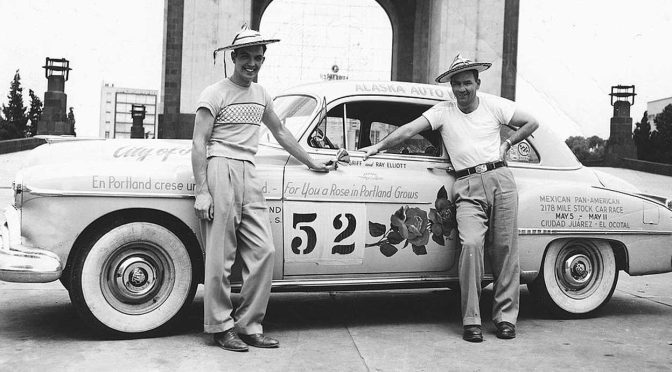
But France was widely traveled, and in 1950 — a year after NASCAR ran its first season in what was then called Strictly Stock — he met Oregonian Hershel McGriff at the Pan-American Road Race in Mexico.
“He (France) was there with Curtis Turner to run the race,” McGriff recalled in his induction speech at the NASCAR Hall of Fame in January. “My neighbor had bought me a 1950 Olds for that five-day, 2,132-mile race through Mexico. I found a sponsor to pay the $600 entry fee …
“Bill noticed me because I was competitive throughout the race with him and Curtis. I think out of 132 entries, at 22 years old, I ended up winning the race. There were other NASCAR drivers there, too — Red Byron, Raymond Parks, Fonty and Bob Flock, and Johnny Mantz …
“After the race, Bill invited me to come to the first Southern 500 at Darlington, which was four months later. We drove the car from Portland (Ore.) to Darlington, raced 500 miles and then we drove it back home.”
The race attracted a field of 75 drivers competing for the $5,000 winner’s share, a colossal prize at the time. Driving the 1950 Oldsmobile, McGriff started 44th and finished ninth, 26 laps down. Mantz won the inaugural crown-jewel event by nine laps.
McGriff’s presence at the Southern 500 was more than just cross-pollination between East and West. It fueled France’s vision of creating a national — even international — sport.
By 1951, NASCAR’s top series, by then known as “Grand National,” had California on its schedule. Marshall Teague won the debut Golden State race in front of 9,000 fans at Carrell Speedway in Gardena, a half-mile dirt track.
France’s vision also included the establishment of a West Coast series that could serve to develop the talents of drivers unable to make costly trips to the South.
The Pacific Coast Late Model Circuit, founded in 1954, has evolved into what is now the ARCA Menards West Series after competing under the NASCAR Winston West Series label from 1971 through 2003 (though there were variations of the nomenclature during that period).
During the inaugural season, McGriff won the Pacific Coast Late Model Race at Bay Meadows Speedway in San Mateo. From a nine-race schedule in 1954, the series grew.
France entrusted two key figures with the health and prosperity of the West Coast racing — Les Richter, an all-pro linebacker with the Los Angeles Rams who managed Riverside International Raceway and later became vice president of special projects for International Speedway Corporation; and Ken Clapp, now-retired NASCAR vice president who, by his own estimation, promoted more than 4,800 single-day racing events during his illustrious career.
As the West Series was growing, so was the presence in California of NASCAR’s top division. The NASCAR Cup Series raced 48 times on the road course at Riverside, starting in 1958. From 1970 through 1981, the Riverside race was the opening event on the NASCAR schedule.
From 1971 through 1980, Cup drivers plied their trade at Ontario Motor Speedway, a 2.5-mile behemoth touted as the “Indianapolis of the West.” Appropriately, perhaps, A.J. Foyt won the first two races at Ontario, in 1971 and 1972.
Clearly, NASCAR had established a strong presence in California long before the opening of Auto Club Speedway in 1997. In celebrating NASCAR’s 75th anniversary this season, it’s prudent to remember that NASCAR’s association with the West Coast is almost as venerable.
It wasn’t until 1995, however, that the NASCAR Cup Series had its first West-Coast-born champion — Jeff Gordon. But in the 21st century, drivers born in the Pacific Time Zone have won 13 of 22 series titles.
Racing in the Los Angeles area continues to evolve. Riverside and Ontario are defunct, with Ontario Mills Mall now occupying the site of the large oval. The 2.0-mile configuration at Fontana will leave the Cup schedule in 2024, as NASCAR contemplates its conversion to a half-mile short track.
Anticipating that change, the Busch Light Clash at the Coliseum already has brought two years of no-holds-barred short-track racing to Los Angeles proper — and has brought NASCAR racing to a new, broader audience in the process.