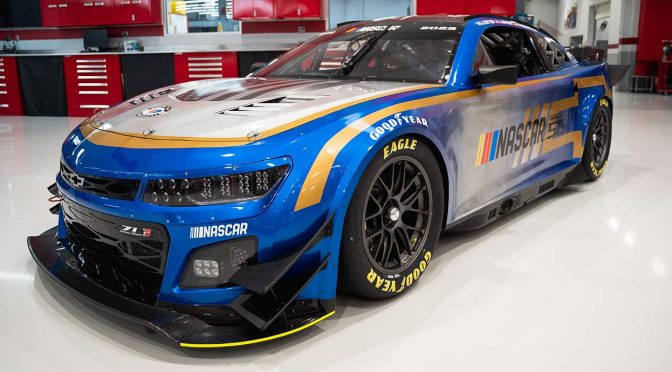
DAYTONA BEACH, Fla. – Garage 56 officials unveiled the look of the Chevrolet Camaro ZL1 that’s planned for a special entry into the 100th-anniversary edition of the 24 Hours of Le Mans.
The design was revealed Friday in Victory Lane at Daytona International Speedway, with dignitaries from all of the project’s collaborators – NASCAR, Chevrolet, Goodyear and Hendrick Motorsports – in attendance.
The livery – or “paint scheme” for the state-siders – features a dominant bright blue with contrasting gold accents and a pearlescent hood. Logos of the Garage 56 contributors are featured prominently, including branding for the NASCAR 75th anniversary and an American flag design up front.
“That’s a beautiful work of art,” said Jim France, NASCAR Chairman and CEO. “The fans will love it. I got to watch it when they were testing here a couple of weeks ago, watching it run through the chicane with the lights on and everything at night. It’s spectacular.”
The names of the three co-drivers – Jenson Button, Jimmie Johnson and Mike Rockenfeller – arc across the top of the driver-door window. The trio was officially added to the Garage 56 personnel roster on Jan. 28 during IMSA’s Rolex 24 weekend at Daytona.
The project has undergone extensive development and testing since its launch last March at Sebring International Raceway. The car intends to compete at Le Mans as a designated class of one in the June 10-11 endurance event, showcasing those innovations as an invitation-only entrant.
“Everybody in our company has touched this car,” said team owner Rick Hendrick. “So it’s been a major undertaking, but I’m really proud of it, and it’s gonna be fun to watch it over there. I’m gonna be nervous; we’ve got to run 24 hours, but I’m super excited.”
Some of the car’s specifications, based on the Next Gen vehicle that races in the NASCAR Cup Series, were revealed Friday as part of the design unveil. The total weight of the Garage 56 car tips the scales at 2,960 pounds, significantly less than the 3,485 pounds of the current Cup Series racer. Chad Knaus, Hendrick VP of competition, said the target horsepower figure for the car is rated in the “high seven hundreds.”
The G56 entry also carries project-specific Goodyear Eagle racing tires and special aerodynamic devices – dive planes, plus a more robust front splitter and rear diffuser – which have been featured on the test car. That includes a taller rear spoiler – 6 inches vs. the 4-inch spoiler on the current Cup Series configuration. The fuel cell is also larger – 32 gallons for Garage 56, compared to 20 gallons for the Cup Series.
Knaus said trimming weight from the car was a cumulative effect of measures taken from top to bottom. He added that with a full fuel load, the car weighs in near the 3,250-pound range.
“Everywhere, honestly,” Knaus said. “We’ve worked with all of our partners, all of the single-source parts providers from NASCAR, whether it be BBS, AP with the brakes, you go all the way to the shocks, it’s all the way across the board. Everybody pitched in, and we got to work on this program. Everything on the car has been lightened up to the best of our ability – Dallara and us and the folks at NASCAR worked really hard on just about everything. It’s got composite disc brakes. The wheels are lighter than what the NASCAR Cup wheel is. So really front to back. Five Star stepped up, they got us lighter body panels. It’s everywhere. It’s not just one thing, it’s the whole thing.”
The next step in the testing comes a day after Sunday’s Daytona 500 (2:30 p.m. ET, FOX, MRN, SiriusXM NASCAR Radio), with the Garage 56 team loading in for two days at Sebring. The test car made extended on-track stints during the Jan. 31-Feb. 1 sessions at Daytona, but next week’s plan is a first go at a 24-hour run.
“Monday, we’re going to run through first thing in the morning, all the drivers, just to get them in the car, get them comfortable really quick. And then our intention is to start what we’re going to consider a 24-hour test at about 10 o’clock in the morning or maybe 11. We’re going to have one break for lunch right straight away, and then from there on out, we’re going to go until 11 o’clock the next day, so all through the evening and all the next morning.”
Friday afternoon’s unveiling wasn’t as big of a surprise to those who have been working on the project for nearly a year now and had already seen the car wrapped. But for Knaus & Co., it provided a chance for a sneak preview of what’s planning to be a unique entry added to the Le Mans field.
“It’s not as awe-inspiring for me because I’ve had my hands on it the whole time,” Knaus said. “So you guys are seeing it for the first time, but when they flicked the lights on there and pulled the cover off of it, I was like, ‘Man, that’s a proper race car right there.’ With the way Greg (Ives, crew chief) and Ben (Wright, G56 program manager) and the whole group are working together on this project, I think the folks in Europe are really going to be impressed what the NASCAR community’s capable of putting on the race track. It’s a really clean race car.”
DAYTONA BEACH, Fla. – Growing up, Elton Sawyer had an interest in multiple sports during his high school years, including the three majors of baseball, basketball and football. His appetite for those athletic pursuits fed grand aspirations. But a chance visit to a historic short track near his home led to his life’s calling.
“I think the deciding factor was I had this dream to go to Notre Dame and play defensive back for Coach Lou Holtz,” Sawyer says from a meeting room in the NASCAR Cup Series hauler parked at Daytona International Speedway, “but he wasn’t recruiting like 5-7, 155-pound defensive backs.”
Loosely reenacting the plot of the movie “Rudy” took a back seat to stock-car racing and eventually a long career in what’s now the NASCAR Xfinity Series. Sawyer, now 63, starts the next phase of that career this season, taking on a prime leadership role as NASCAR’s Senior Vice President of Competition.
Experience from his driving days and his later work with racing teams have prepared Sawyer for this moment as he enters his ninth season with NASCAR’s competition department. But the lessons learned from his childhood stick-and-ball background still provide Sawyer with a reference point.
“Take football, it’s what you do at the race shop, that’s kind of your defense, right?” Sawyer explains. “And then you get to the race track, and you’re on offense. You practice, and then you qualify and then you race; you’re always trying to get to the next position or lead the most laps. And then you’ve got your pit crew, which is kind of your special teams. So you know, I like team sports. I’ve always enjoyed, whether it’s high school basketball, high school football, or baseball, I enjoy being on the team. Now, as I’ve gotten older, I enjoy being part of the management of the team. …
“The best way I can describe it is I enjoy the process. I enjoy, again, our team, just watching everybody really work hard to prepare and then go out and execute.”
Setting the foundation
Elton Sawyer recalls being a high school junior when his father, Everett, first took him to Langley Speedway, a .395-mile bullring not far from the family’s hometown of Chesapeake in the Tidewater area of Virginia.
Interest grew quickly, and soon the family was occupying Langley’s garage and pit area instead of the bleachers. Everett Sawyer began racing there in 1976, and Elton followed suit two years later as he wrapped up his time at Great Bridge High School. Elton’s younger brother, Roger, and a cousin named Earl also raced there.
“We all kind of came along, and it was a family event,” Sawyer says, noting their start in the entry-level Street Division. “We’d go work on cars behind the house in the garage, and then it just continued.”
NASCAR Research & Archives Center | Getty Images
Elton Sawyer quickly laddered up to become one of Langley’s hotshots. His season tally of wins regularly tripped double digits, and he was the speedway’s track champion for three consecutive years from 1983-85. In two of those years, Sawyer’s accomplishments earned him the Mid-Atlantic regional championship in what’s now called the NASCAR Advance Auto Parts Weekly Series.
By then, Sawyer had started to explore the Late Model Sportsman ranks – a circuit that later was called the Busch Series and has evolved into today’s Xfinity Series. Sawyer made that tour his home as a series regular starting in 1986, and his career spanned a who’s who of legends from that golden era who made their mark there.
Sawyer rattles off the stellar names from his earlier days in that national tour – Jack Ingram, Sam Ard, Tommy Ellis, Tommy Houston, L.D. Ottinger – and then adds some of the regular visitors from the Cup Series in that era – Dale Earnhardt, Darrell Waltrip, Terry Labonte, Harry Gant, Morgan Shepherd. “You put that group there, and then you go to an event and you have success,” Sawyer said, “you can walk out of there with your head pretty high.”
The names changed for Sawyer’s later years in the series, but the quality of competition remained high, and he listed Jason Keller, brothers David and Jeff Green, Bobby Labonte and Chad Little as just a handful among the many standouts. During that time, he often raced alongside his wife, Patty Moise, a veteran of 133 Xfinity starts, and he collected two victories – his 1994 breakthrough at the old Myrtle Beach Speedway and later in 1999 at New Hampshire Motor Speedway.
“He kind of mirrored what my brothers and I kind of went through growing up. We worked on our cars, we kept them up and we also got to drive,” said David Green, the 1994 Xfinity Series champion who now works alongside Sawyer as a chief safety official. “But I can remember Elton the most being the Mr. Nice Guy. Of course, Bobby Labonte, who I drove for, he for years accused me of being a nice guy and said nice guys didn’t win all the time. But Elton won, and I was able to win some, so I think nice cars do win.
“But that’s the biggest thing with Elton is he was always very professional on the race track. You kind of knew who you were racing against, whether it’s Daytona or Hickory or whatever fell in between. So that’s what I remember the most.”
New era at R&D
David Green hadn’t been working at NASCAR for long when Sawyer joined the team at the Research & Development Center in 2015, but he remembers fondly his feelings at hearing the news. Sawyer had spent time working with race teams, serving as competition director at the former Red Bull Racing organization as one of his stops along the way.
Sawyer’s first appointment with NASCAR was as director of the Craftsman Truck Series, but it also meant that Green was getting a colleague who was cut from the same racing fabric.
“I went from feeling very comfortable with the company prior to this announcement to feeling extra comfortable, meaning that was just another guy that was joining our forces that we all grew up doing the same and have seen every side of it,” Green says, noting the tenures of former drivers Chad Little and Brett Bodine with the R&D Center. “The list goes on, right? Now all of a sudden, we’re getting some racers in there, and we kind of talked the same language. Not that the rest of us weren’t talking the same language, but there’s just a really good feel for me in also knowing Elton’s background. …
Doug Benc | Getty Images
“But when he joined us, it was such a good feeling for me internally to know that I had somebody that was going to be a true supporter and understood everything we deal with within the garage on a day-to-day basis.”
As for the even-keel demeanor that Green referenced during their racing days, Sawyer says he’ll carry that same straightforward style into this role rather than adopting an iron-fist approach.
“I would look at it more as we hold all the cards, we as NASCAR, so we know what all the teams are doing,” Sawyer says. “It’s a fact-finding exercise a lot of times — here’s the topic of discussion, gather the facts and then we make a decision. So the teams are our customers, and we want to treat them with respect. There’s going to be some tough decisions, and we’re going to tell them, here’s what we’re doing, and we’ll make those decisions as the sanctioning body, and that’s what we’re going to do.
“In our meetings, the things we talk about are we want the level playing field to be equitable across the board for all competitors. We want it to be a safe environment to the best of our abilities; we’re inherently a dangerous sport. And we don’t want to over-officiate. So when we can check the boxes on those three things when we leave an event, then we kind of feel like we’ve done our job and we’re not the story on Monday.”
Sawyer officially took the post Jan. 18, replacing Scott Miller, who was tapped for a new role as competition strategist. Sawyer previously served as vice president of officiating and technical inspection, a position where he helped shape the rules and penalty procedures and other elements of the week-to-week scrutineering of race vehicles.
It’s experience that’s bolstered by his involvement in multiple facets of the sport – as a longtime driver, a team principal and now as a top NASCAR official.
“Elton’s got a cool head on his shoulders. I respect the hell out of him,” says veteran driver Brad Keselowski, now starting his second season as a Cup Series team co-owner. “I think he’s seen this sport through a lot of different lenses – a driver being one of them, and at one time, I think he was a team president or something to that effect. He understands the competitive element from the drivers and team side, and he’s been at NASCAR for at least a half-dozen years. I think he’s a really well-rounded person who has the ability to see a bigger picture than most anyone else in his shoes.
“I think he’s earned his opportunity. It’s a big hire for NASCAR – a big gain. If you would’ve challenged me to sit down and find five or 10 names to put in a hat for that position, he would have certainly been one of the men I’d put in that hat. I thought it was a really good move.”
The time will inevitably come this season when a competitor will have to heed a summons to the Cup Series hauler. When that happens, the expectation, Green says, is a firm-but-fair consultation instead of a stern, boisterous talking-to.
Proof positive, he says, that nice guys do win, even if it’s not necessarily as a defender in the Notre Dame secondary.
“To me, the nice guy on the race track generates an X-amount of respect,” Green says. “So yes, the guy that really beats it up to people, right, sometimes gets a little bit of respect because this guy’s gonna call it like it is and be tough to deal with. But in my career and what I’ve seen, and I owe a lot to Bobby Labonte and guys like Elton Sawyer, the good guys get an equal amount of respect. It’s a little bit different kind of respect, but the end result is respect. So to me, the fact that he’s got his mannerisms how he handles the garage is so reassuring and really gives us a lot of confidence to come out in the garage and do what we do. So that nice guy approach to me got Elton Sawyer nothing but leaps and bounds in respect, not only from us competitors, but then now the road that we’re in now. I know he is cut out for that job, and he’s shown that throughout the years he’s been with us.
“I’m going to be a little bit prejudiced in saying I’m glad he’s in our corner because now, as a NASCAR official inspector and a guy that’s really got to keep your foot down when it counts, for when it matters and when it even doesn’t matter, I’ve got the guy that supports us through thick and thin. So a totally different kind of respect.”
BIRCH RUN, Mich. — A big year is ahead for Birch Run Speedway and Event Center as the track celebrates its 75th year of operation.
The 0.4-mile, progressively banked oval situated in Birch Run, Michigan, is now now part of the NASCAR Advance Auto Parts Weekly Series, continuing a vibrant short-track tradition that has been ongoing since the facility opened during NASCAR’s first year in 1948.
Originally a 0.33-mile dirt track during its first decade, what was then Dixie Speedway was paved in the early 1960s. The facility continued to grow during the next several years with additions that included a Figure 8 course in the infield and the construction of the 4/10-mile oval that is predominantly used today.
Many notable competitors have developed their talents on both ovals at Birch Run since its inception, such as past NASCAR Cup Series champions Brad Keselowski and Benny Parsons, 1963 Indianapolis 500 winner Parnelli Jones and with two-time Southern 500 winner Erik Jones.
Outside of the on-track action, Birch Run has worked diligently to create a welcoming atmosphere for fans and competitors with the installation of a modern tech barn, upgraded bathrooms, new stadium lights and the construction of a luxury VIP box atop the main grandstands. The track was recognized for that work by the Michigan Automobile Racing Fan Club, which awarded the facility its 2022 Promoter of the Year Award.
Under the direction of owner Andy Suski, who purchased the track in 2017 and renamed it Birch Run Speedway and Event Center, the 75th year of on-track competition is primed to be the most exciting in the facility’s long history.
The 2023 season will see Birch Run host the second edition of Down Right Awesome Night, which is designed to raise awareness for those born with Down syndrome. As part of the festivities, 100 percent of 50/50 and t-shirt money raised will be donated to the Hurley Children’s Clinic in Flint, Michigan.
Headlining Down Right Awesome Night will be a $21,000-to-win Modified feature. This will serve as one of several major events for Birch Run on a 2023 schedule that includes hosting the American Speed U.S. Nationals for the first time and welcoming the JEGS/CRA All-Stars Tour.
Fans who attend any race at Birch Run will have plenty of entertainment at their disposal. Along with giveaways, autograph sessions and family theme nights, Birch Run also features the longest bar in Michigan known as Gas Alley and has their own mascot called Marco the Track Dog.
A thrilling year at Birch Run commemorating the history of the track formally kicks off March 11 with a preseason party. Opening night for Birch Run is scheduled for April 28, with a docket consisting of the Midwest Dirt Compact Series, Wheeler Trucking Friday Night Thunder Series, Dwarf Cars and American Trucks.
NEW SMYRNA BEACH, Fla. — Night 7 of the World Series of Asphalt Stock Car Racing at New Smyrna Speedway proved to be the longest and most eventful in the event so far.
Five divisions ended up sharing the track Thursday evening. Along with Modifieds, Super Late Models, Pro Late Models and Florida Modifieds, a champion ended up being crowned in the 602 Modified division.
There was no shortage of intense on-track action and a few heated battles across each respective feature, but the night ended with plenty of familiar names finding their way to Victory Lane.
Below are the key takeaways from the seventh night of racing in the World Series of Asphalt.
Katie Hettinger halted a week of frustration in the World Series of Asphalt by finally earning her first victory in a Pro Late Model, which she accomplished by making an aggressive move on pole-sitter Carson Brown with fewer than 10 laps remaining. Ryan Luza passed Brown to finish second, with Conner Jones and Brent Crews rounding out the top-five finishers.
In a stroke of luck, the qualifying redraw for the Modified feature moved Matt Hirschman from third to first on the starting grid. Despite this, it would not be an entirely smooth ride for Hirschman, who had to fend off an immense challenge from Patrick Emerling for his fourth consecutive win, with the skirmish leading to contact between the two on the last restart that sent Emerling into the outside wall.
Emerling managed to pilot his wounded car home in the second position. Teddy Hodgdon finished in third, with Jimmy Blewett and Eric Goodale completing the top five.
On a Lap 13 restart, Casey Roderick muscled his way past William Sawalich to take his second consecutive World Series of Asphalt victory in the Super Late Model division. Conner Jones finished in third behind Sawalich, where he was followed by Giovanni Ruggiero and Nicholas Naugle.
The final 602 Modified feature of the week was one dominated by numerous on-track incidents and an incredible battle between Luke Baldwin and Trevor Catalano. Baldwin ended up prevailing to claim the win and the 602 Modified title, with Lee Sharpsteen, Catalano, Evan Rygielski and Bobby Jones following him in the running order.
The longest race of the evening in length was the 75-lap Florida Modified feature. Cody Stickler took home his second checkered flag in the World Series of Asphalt over Jason Lester, Bill Burba, Tim Moore and Alan Bruns.
Only two nights remain in the World Series of Asphalt. Friday at New Smyrna will include two major events in the Hart to Heart 100 for Pro Late Models and the Richie Evans Memorial 100 for Modifieds, all while Super Stocks, Trucks, Bomber Bs and Vintage Cars run their own races.
FloRacing has the coverage starting at 7:30 p.m. ET.
DAYTONA BEACH, Fla. – The Money Team Racing made another improbable run into the Daytona 500, landing a last-ditch drive that had IndyCar regular Conor Daly welling up with tears after the checkered flag of Thursday night’s second qualifying race. “Shock the world!” was the rallying cry from the joyous TMT crew as the No. 50 Chevrolet came to rest on pit road.
Daly joined reigning Craftsman Truck Series champion Zane Smith in clinching the final Daytona 500 starting spots after Thursday night’s Bluegreen Vacations Duel qualifying races. Both drivers will be making their second Cup Series starts and their first in Sunday’s prestigious season opener (2:30 p.m. ET, FOX, MRN, SiriusXM).
Both were also aided by misfortune for each of their primary competitors for Daytona 500 berths. Chandler Smith never recovered from a mid-race pit road speeding penalty in Duel 1, and Austin Hill was caught up in the wake of a multicar stack-up in the second 150-miler. Both failed to qualify.
For Daly, the result was the culmination of a more-than-eventful couple of days in Daytona, with the No. 50 crew failing to post a qualifying lap in Wednesday’s time trials because of a faulty oil line. It was a push to get to the grid, and Daly battled a major vibration and other handling concerns even in the pace laps. He dropped a lap behind by the second Duel’s halfway point.
The tide shifted when Hill’s Beard Oil Motorsports No. 62 Chevrolet became entangled in the evening’s biggest wreck. With Hill sidelined, Daly trudged on and finished 17th — one lap down in the final car running.
“As I was accelerating, it was like literally driving a bucking bronco,” Daly said, recounting the warm-up laps before the green flag. “I didn’t know what was going on. It was shaking so much that it’s like you feel like a wheel’s falling off. But as I told Tony (Eury, crew chief), I said, ‘Well, I just, I have to go.’ And so I didn’t lift those first two laps. But as it was moving around, I was like, this is really not confidence-inspiring. And so I lost the draft but when he made that first adjustment, I could definitely tell where what was happening and thankfully, we were able to fix that and I guess we got a lot better as we went, but it was crazy.
“And we took advantage of a lucky situation. We can’t ever deny a lucky situation because I’ll take it any day.”
Hill’s hopes for his first 500 had risen with Daly’s early woes, but his good fortune ran out two-thirds of the way through Duel 2. When Kyle Busch crashed at the front of the pack, he was unable to escape the tie-up farther back with Travis Pastrana and Riley Herbst. Hill was able to limp away from the crash scene, but the crew’s efforts to repair the No. 62 Camaro were fruitless. After the damaged vehicle policy clock expired, Hill finished 18th, completing just 41 of the 60 laps.
“We didn’t need to be in the draft,” Hill said after a check at the infield care center. “The main reason we were in the draft was because it was single-file and I was just trying to get experience, see how the car drove and what the car was doing when I would get a run on a guy, that type of thing, just trying to learn for the 500. And then right down the backstretch, when I saw the wreck happen, there was a lot of dirt going across the track. So I kind of lost sight of where the other cars were that were wrecking. I kind of got to the dirt as the dirt was coming across and it just made me lose traction.
“Not sure if the 15 (Herbst) tagged me or not, I have no idea. But, we just, we started spinning and the right-front, I think it was the lower [control arm] was broke. So it ended our night. There was really no reason for us to even be up there in the pack. The 50 wasn’t in the draft. He was multiple laps down and, just, just dumb on my part. I mean there’s no way around it. I mean it was just stupid to even be up there, just trying to learn and see what we can do going into the 500 and now we’re not even in it. We could have just run by ourselves and not around anyone to stay in front of the 50 and we would be locked in. So it stings, but I have a race Saturday in the Xfinity Series and I’ll do all I can to win that race.”
Tyler Strong | NASCAR Studios
The first race was the calmer of the two, and Zane Smith used a steady eighth-place finish to outdistance Chandler Smith, no relation, to advance. And he wound up a bit starstruck by a certain returning seven-time champion, who he spent time racing with in the pack at Daytona International Speedway.
“I don’t know what life is. I had Jimmie Johnson parked behind me. I watched him all my life growing up and still is my idol,” Zane Smith said on pit road after the first 150-mile qualifier. “Just unbelievable being in the ‘Great American Race.'”
Ford drivers snared seven of the top eight spots, led by opening-race winner Joey Logano. Smith followed Front Row Motorsports teammate Michael McDowell – a former 500 winner — through into the lead pack, then stayed clear of the last-lap dicing up front that closed the caution-free race.
“Yeah, my emotions are definitely weird, just how big this event is,” Smith said. “You don’t realize it just coming until you’re making an attempt at it. It’s been crazy, all the media, and just all the hype behind it. Those Duels were a little nerve-racking, but I kind of just followed my teammate through there, and he was a huge, huge help. Big shout-out to him, all the Fords really. I felt like we really all worked together well.”
Chandler Smith was hampered by a pit-road speeding penalty on the 22nd of 60 laps, getting tagged with the costly violation as he left the pit lane. The 20-year-old Kaulig Racing driver placed 18th in the 21-car field — one lap off the pace — and failed to qualify for what would have been his Cup Series debut.
“Just got greedy, man,” Chandler Smith said. “At the very end of pit road, I was like, ‘Oh, we’re in a really good spot, this is really promising,’ and squeezed a little too much right before the yellow line. So it’s just, it’s on me. But I believe everything happens for a reason. I just can’t thank (team owner) Matt Kaulig and (team president) Chris Rice enough and Quick Tie Products, everybody that was on this deal that put a full effort in to allow me to come down here.”
Johnson and Pastrana clinched their starting spots on the basis of their speed in Wednesday’s qualifying session, besting the other non-chartered teams during those time trials.
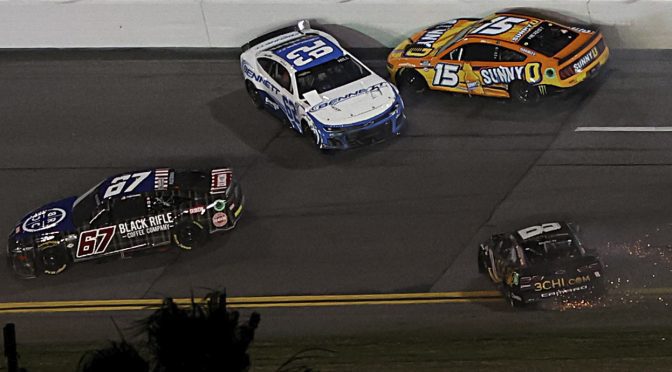
DAYTONA BEACH, Fla. — Kyle Busch was the primary victim of a multi-car crash in Thursday night’s second Bluegreen Vacations Duel qualifying race, losing control after a late-race push from Daniel Suárez.
Busch’s No. 8 Richard Childress Racing Chevrolet veered into the outside retaining wall while leading on the Daytona International Speedway backstretch, ending his race with 40 of 60 laps complete after an errant push from Suárez’s No. 99 Chevrolet. Busch was unhurt but expressed his frustration after being relegated to a backup car for Sunday’s 65th running of the Daytona 500 (2:30 p.m. ET, FOX, MRN, SiriusXM).
“Just a lot of pushing and shoving. I don’t know why,” Busch said at the infield care center. “I mean we were single file. There was no pressure from the outside. There was nothing happening and was just getting pushed for two straight laps and finally, it didn’t want to hang on anymore. It overloaded the left rear and spun out the wrong way on the straightaway.”
Busch’s car nosed into the outside wall as oncoming traffic dodged his vehicles. Noah Gragson, Ryan Preece and Justin Haley dove to the grass to avoid the sliding Chevrolet, but that grassy debris found its way to Austin Hill’s tires, causing the No. 62 Chevrolet to spin.
Hill collided with Travis Pastrana and Riley Herbst, ending Hill’s Daytona 500 chances. Hill was piloting the Beard Motorsports non-chartered entry and failed to qualify for the “Great American Race.”
Busch was left bewildered the aggression reached that point midway through the second of two qualifying races on Thursday night.
“The inside lane with the 99 and the five behind me, they stopped pushing and they weren’t shoving and the outside still disintegrated,” Busch said. “And a couple guys tried to make the outside come forward, never came forward. And then for the last two laps there before I wrecked, they started pushing. I don’t see the sense and it really boggles me.”
The disappointment was bolstered by the fact Busch and his No. 8 team – a fresh pairing for the 2023 season – believed they could win the Daytona 500 with their primary car. Busch is a two-time Cup Series champion but has yet to win the Daytona 500 in 17 tries.
“Car was fine. It was good,” Busch said. “If there was any weak spot we had, it was just exit of the corners where guys could kind of bunch back up to me but that’s to be expected. That’s just the accordion.”
Pastrana, the action sports icon, is driving the No. 67 Toyota for 23XI Racing, another “open” entry, but sealed his spot in the Daytona 500 in Wednesday night’s single-car qualifying session. The 39-year-old noted Wednesday any cost for damages are coming directly out of his pocket this weekend but left the infield care center confident the damage his car suffered is fixable ahead of Sunday’s race without using a backup car.
“I didn’t hit much,” Pastrana said. “The rear was bent pretty good. So we’ll change a few parts out. Shouldn’t be too bad for the pocket and we’ll definitely be back out there but hopefully in the same car.”
Pastrana competed in the Xfinity Series in a full-time effort in 2013 but has never made a Cup Series start. More challenging is that the Next Gen vehicle hardly compares to any prior experience he gleaned in a stock car.
“We were just cruising around back just trying to avoid exactly what happened,” Pastrana said. “Thought we’re far enough back actually, and at 200 miles an hour, it’s hard to get whoa-ed up. So I learned a lot. I kept wanting to go for it and then start getting in the mix. They’re like, ‘just don’t mess up the car.’ I’m like, alright, we’ll just stay in the back. We’ll learn from those guys. See what works, see what doesn’t. …
“Good information going forward and I had a blast. It was super intense.”
Cup teams will have one 50-minute practice session on Friday at 5:35 p.m. ET (FS1, MRN, SiriusXM NASCAR Radio) and additional 50 minutes Saturday at 10:30 a.m. ET (FS1, MRN, SiriusXM) to perfect their cars ahead of Sunday’s Daytona 500.
Each year, the NASCAR Cup Series kicks off the season with its pinnacle event — the Daytona 500.
The 65th annual running is set for Sunday, Feb. 19 (2:30 p.m. ET, FOX, MRN, SiriusXM NASCAR Radio) at Daytona International Speedway. And, like any big event, some unique quirks are part of the build-up.
The “Great American Race’s” most notable difference compared to any other on the Cup schedule is how the starting lineup is set. Forty cars will make the Daytona 500 starting grid. Thirty-six teams are guaranteed starting spots thanks to their Charters, leaving only four spots available for Open teams.
The process began with single-car qualifying on Wednesday, where the two fastest drivers secured the front-row starting positions for Sunday’s race (Hendrick Motorsports’ teammates Alex Bowman and Kyle Larson) and the fastest overall earned the Busch Light Pole (Bowman). Additionally, the two fastest Open cars clinched a spot in Sunday’s main event — those honors went to seven-time champion Jimmie Johnson and Travis Pastrana.
The remaining results from qualifying set the field for the two Bluegreen Vacations Duel races on Thursday. The duel races were 60-lap affairs, the results of which set the lineup for the Daytona 500.
Drivers who were in odd-numbered positions on the speed chart from single-car qualifying made up the starting grid of Duel No. 1, while those who qualified in even-numbered positions made up Duel No. 2. The highest-finishing Open car in each duel advanced into the Daytona 500.
The results of Duel No. 1 set the inside row for the 2023 Daytona 500, while the results of Duel No. 2 set the outside row for Sunday’s race.
DAYTONA BEACH, Fla. — Reigning NASCAR Cup Series champion Joey Logano and Florida native Aric Almirola each won their Bluegreen Vacations Duel at Daytona qualifying races on Thursday at Daytona International Speedway — the event setting the starting order for Sunday’s Daytona 500 (2:30 p.m. ET on FOX, MRN and SiriusXM NASCAR Radio).
It was a Ford sweep at Daytona, but the two races played out very differently.
Logano’s No. 22 Team Penske Ford led 25 of the 60 caution-free laps in the opening race; his Team Penske teammate Ryan Blaney led a race-best 30 laps, finishing third — behind Logano and Joe Gibbs Racing driver Christopher Bell, who crossed the finish line a mere 0.018 seconds after Logano.
In the late race, Almirola led only 17 laps but took the lead for good in the No. 10 Stewart-Haas Racing Ford with two laps remaining and held off fellow Ford driver Austin Cindric and Chase Elliott by a slight 0.122 seconds in a race that featured more drama — two caution periods, including one that ultimately took out the dominant car.
Kyle Busch led the most laps (28) in the second Duel, but his No. 8 Richard Childress Racing Chevrolet was hit from behind by Daniel Suárez’s No. 99 Trackhouse Racing Chevrolet and wrecked from the lead with 18 laps remaining.
“Lots of pushing and shoving,” Busch said afterward, hopeful the team could repair the car and not have to go to a backup on Sunday.
“Doing everything you can to hang on and do the best you can to keep it straight,” Busch said of the incident. “Finally overloaded the left rear and hooked it to the right. Hate it for all my guys. Built a fast Chevy Camaro and was fun to drive. Had a long way to go and don’t understand [this], but it is what it is.”
That six-car accident also damaged Austin Hill’s Chevrolet so badly he had to pull it into the garage. That gave the final Daytona 500 transfer position to IndyCar Series regular Conor Daly, whose No. 50 TMT Racing Chevrolet finished the race 17th in the 21-car field, a lap down. The car had a mechanical problem Wednesday night and wasn’t able to turn a pole qualifying lap.
“Well, we were inherently unlucky for the last 36 hours, but we got lucky,” Daly said. “I wish I could have said that I drove it in on pure pace, but it was just crazy.
“This race, I’ve watched it for so many years and so much crazy stuff can happen and thankfully we were on the right side of the craziness. It’s pretty amazing.
“I’m sure none of you expected to see me here, but we changed everything but the car’s color in that race,” Daly told reporters with a smile, noting he already had 170 text messages as he did post-race interviews.
The first Duel was relatively calm — with no caution periods. Fords dominated the race. RFK Racing driver Chris Buescher and 2021 Daytona 500 winner Michael McDowell rounded out the top five in their Ford Mustangs. Kevin Harvick, who is retiring at the end of the 2023 season, was sixth in the No. 4 Stewart-Haas Racing Ford after riding Logano’s bumper for more than 20 laps at the race end.
“The execution of this race is everything,” Logano said, thanking his Team Penske team. “You know most likely there won’t be a caution, so you’ve got to do a good job on pit road cycling yourself to the front. But then I’m sitting there as the leader and I’m thinking I’m a sitting duck this is not where you want to be. I was hoping they would start racing back there, which they did, and it ended up working out for me.
“When the 20 got to me, I saw Blaney was behind me and I thought, ‘That’s my buddy, I’ve got to stick with him.’ I knew the 20 would make the run to the outside and I probably wouldn’t be able to defend that and just waited for the 12 to push me through there. So good Penske effort there to get the Duel win.”
Toyota’s Bubba Wallace was sixth in the No. 23 23XI Racing Toyota followed by Zane Smith in the No. 36 Front Row Motorsports car. Smith’s effort was good enough to earn the first of the two open Daytona 500 starting positions.
“Those duels are a little nerve-wracking, but I kind of just followed by teammate through there and he was a huge, huge help,” Smith said of McDowell. “That was really my game plan to just stick to what Michael does, he’s obviously very successful at superspeedways.”
Chandler Smith, driving a third Kaulig Racing Toyota, finished 18th in the opening Duel and joined Hill in not making the 2023 DAYTONA 500 field.
As for Almirola, it marked his second Duel victory, the fourth for his Stewart-Haas Racing team. The Tampa, Florida, native — who originally announced he was going to retire at the end of the 2022 season only to re-commit to the team — earned his first career NASCAR Cup Series win at Daytona International Speedway in the 2014 summer race.
“I did have my hands full,” Almirola said, adding, “but man, this is so cool. Daytona is such a special place to me. I grew up sitting in those grandstands dreaming about racing here. I want that one on Sunday (Daytona 500), though. … I know Sunday’s the big one, we’re going to keep focused on that one. The job’s not finished.”
The 40-car field is now set for Sunday’s Daytona 500, including the “open cars” of seven-time NASCAR Cup Series champion Jimmie Johnson and Travis Pastrana, who both advanced based on qualifying speed. It will mark the NASCAR Cup Series debut for Pastrana, who was also among those collected in the second race’s six-car accident.
“Learned a lot about where the car works,” Pastrana said of his No. 67 23XI Racing Toyota. “I think we’ll still be able to run that same car, I just didn’t get it slowed down quite in time to avoid the chaos right in front me.
“We were just kind of running in the back and watching everything that was happening, seeing which lanes worked, how my car worked best. It was a lot of fun. Super intense those first couple laps. … But that was a great time.”
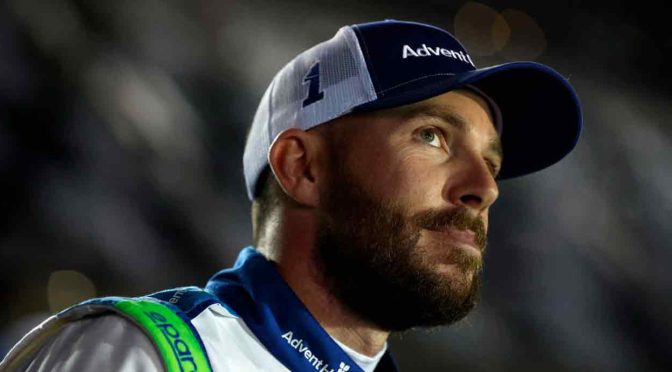
DAYTONA BEACH, Fla. – Ross Chastain has spent his career scratching and clawing for long-term stability at the highest level of NASCAR racing.
He found exactly that.
Trackhouse Racing announced a multiyear extension for Chastain in the Daytona International Speedway media center on Thursday, ensuring he will pilot the No. 1 Chevrolet for many seasons to come.
“We don’t discuss the terms of the agreement,” team president Ty Norris said, “but his beard will be gray.”
Chastain, runner-up in the hunt for the NASCAR Cup Series championship just three months ago, was visibly emotional as the contract extension was announced, preceded by a Trackhouse video played in the room with numerous family members who made the 200-mile trek from Alva, Florida, in attendance.
“It’s incredible to find a home here at Trackhouse,” Chastain said. “I always laugh that it’s Track-‘house’ and we’ve truly made it a home.”
The 30-year-old eighth-generation watermelon farmer capped a jaw-dropping year with his tremendous Martinsville wall ride that propelled him to a second-place finish in the final playoff standings. Consider that Trackhouse came to fruition two years ago, the brainchild of Justin Marks who then purchased the charters and buildings of Chip Ganassi Racing in mid-2021 to build and ensure a second Trackhouse Racing team.
With that came the eventual signing of Chastain, who had been driving the No. 42 Chevrolet for the suddenly-disappearing CGR.
What Chastain brought statistically was phenomenal – his first two career wins (including the first for Trackhouse), 15 top fives and 21 top 10s in a 36-race season.
But Marks is more impressed with what Chastain has brought to Trackhouse’s culture, a critical component of Marks’ vision for his team.
“His work ethic, his never-give-up attitude, the fact that he drives every lap with everything that he’s got all the passion that he’s got,” Marks said. “I mean, when you put in long hours and you work hard on a race car – and whether you’re an engine builder or a mechanic or an engineer, fabricator, whatever it is – when the one person has to get in that car, you want that person out there pushing as hard as they possibly can, honoring your work and your commitment to the company by going and trying to do something with it.
“And that resonates incredibly deeply with the company – both of our [drivers] – because anybody in our company can, whether they’re at the race track watching the two cars or they’re home watching on TV, they know that they’ve got two drivers that are pushing and everything they’ve got. What more could you want in a workplace?”
Chastain’s aggression ruffled feathers at the front of the field in 2022, most notably with veteran Denny Hamlin and Chase Elliott. Don’t expect that level of determination to diminish just because Chastain now has a long-term contract – but the second-year Trackhouse racer noted he constantly evaluates his progress behind the wheel.
“My driving will never stop evolving,” he said. “I think the day that I think that I’ve internally or mentally have it all figured out will probably be the day I announce my inevitable retirement. I just can’t imagine a world where I pull on the racetrack and I know everything. I’ve never ran a perfect lap. And that’s why I continue to put myself in as many racing opportunities as I can.”
Those opportunities include making Xfinity Series starts for DGM Racing and Craftsman Truck Series starts with Niece Motorsports.
When Chastain’s career seemed to reached an abrupt halt with Chip Ganassi Racing ahead of the 2019 Xfinity Series season – courtesy of a sudden sponsorship debacle – Chastain surged to success in the Truck Series with Niece Motorsports owner Al Niece, scoring three victories and advancing to the Championship 4.
“Al is my people,” Chastain said. “We work like family and a big reason of why my career, when it went into his largest valley, came right back up the following season going and winning races and ultimately, was one of the fundamental dominoes that fell to get me back to the Cup Series. And I see so many similarities in Niece and Justin.”
Chastain now has long-term stability heading into his fifth full-time season as a NASCAR Cup Series driver.
The 65th annual Daytona 500 gets underway at 2:30 p.m. ET on Sunday (FOX, MRN, SiriusXM NASCAR Radio).
CONCORD, N.C. – The Coca-Cola Company has joined 14-time NASCAR Cup Series champions Hendrick Motorsports as the Official Beverage Partner of driver Chase Elliott and his No. 9 Chevrolet Camaro ZL1 team.
Throughout the 2023 season, Atlanta-based Coca-Cola will appear as an associate sponsor of Elliott’s race cars beginning with Sunday’s 65th running of the Daytona 500 (2:30 p.m. ET, FOX). The iconic beverage brand will also adorn the No. 9 team’s uniforms and equipment.
Coca-Cola has an extensive history in motorsports, including title sponsorship of NASCAR’s longest race, the Coca-Cola 600, since 1985. Its storied partnerships include race car drivers such as Elliott’s father, 1988 Cup Series champion Bill Elliott.
“Coca-Cola is proud to welcome Chase to its Coca-Cola Racing Family and launch its partnership with Hendrick Motorsports,” said Chris Bigda, director of sports marketing, The Coca-Cola Company, North America. “Continuing to partner with the Elliott family is an honor and thrilling legacy, as Chase joins our Coca-Cola Racing Family 25 years after his father Bill Elliott was a founding member back in 1998. We’re excited for our future together and refreshing this championship team on and off the track.”
Elliott is the third-youngest driver to win a Cup championship, a feat he accomplished in 2020. The 27-year-old Dawsonville, Georgia, native has 18 points-paying wins across seven full-time seasons in NASCAR’s premier series and has been voted by fans as the sport’s Most Popular Driver for five consecutive years (2018-2022). In 2022, he captured a series-leading five victories, earned the regular-season title and made his seventh playoff appearance, advancing to the Championship 4 for the third straight year.
“I’m excited to partner with an iconic brand like Coca-Cola that has Georgia roots just like me,” Elliott said. “Coke has a deep history in the sport, and I’m proud to represent a company that has backed some of NASCAR’s greatest drivers throughout the years, including my dad. I look forward to seeing what we will accomplish together this season and hopefully for years to come.”
With 14 championships and 291 points-paying race wins, Hendrick Motorsports is the most successful team in the history of the NASCAR Cup Series. On Sunday, the organization will seek its record-tying ninth victory in the season-opening Daytona 500.
“Chase and Coca-Cola are a perfect match on so many levels,” said Jeff Gordon, vice chairman of Hendrick Motorsports. “Pairing one of the world’s most recognized brands with the sport’s Most Popular Driver will present a lot of opportunities. The No. 9 team is poised for another great year, so we plan to keep plenty of Coke on ice and celebrate those big moments together.”