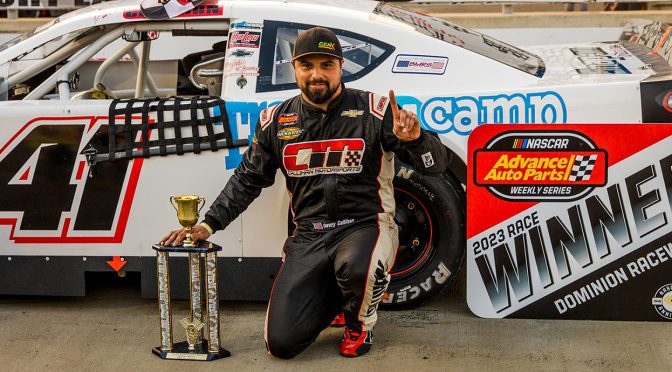
It’s no secret that Davey Callihan has been friends with Willie and Dinah Mullins, the owners of Mullins Racing, for several years.
Callihan, a veteran competitor at Virginia’s Dominion Raceway, is a valued member of the Mullins Racing family. He helps the team prepare for ARCA events at the shop, has been part of the team’s crew at the track and even competed in an ARCA Menards Series East event for the team at North Carolina’s Southern National Motorsports Park in 2021.
“The Mullins’ and I are great friends,” Callihan said. “I’m around their body shop just about every day because we work close to each other.”
Mullins Racing recently added to its fleet of race cars a Limited Late Model — called a Virginia Racer at Dominion Raceway. As they prepared to race the car for the first time, the team was looking for somebody to race the car and give them a good baseline.
Callihan was the obvious choice, and he paid them back in spades by sweeping a pair of twin features at Dominion.
Once again impressed by Callihan’s ability behind the wheel, Willie and Dinah decided to give him an opportunity to make his ARCA Menards Series debut this Saturday at Minnesota’s Elko Speedway in the Menards 250 (8 p.m. CT / 9 p.m. ET on FS2/FloRacing).
“Davey did such a great job in our Virginia Racer Late Model class that we have here at Dominion,” Willie said. “He hopped in our car there and got two wins, so we decided to give him another opportunity to go ARCA racing.”
If Callihan’s name sounds familiar, it’s because he went viral on social media late last year after an incident at Martinsville Speedway during the ValleyStar Credit Union 300 that saw him have a disagreement with fellow competitor Andrew Grady.
Callihan has put that incident behind him and is focus is on racing weekly at Dominion, where he ranks fourth in the track’s Late Model Stock Car point standings.
“I’m kind of the local Late Model short track guy in the area. I guess they think I can get the job done,” Callihan said.
However, a race at Elko Speedway presents a multitude of challenges that Callihan has never faced. For one, Callihan has never competed outside the Southeast, with most of his racing taking place in Virginia or North Carolina.
This also will mark just the second time Callihan has even laid eyes on Elko. He visited the track last season as part of the Mullins Racing crew when Willie drove to a ninth-place finish in the Menards 250.
He’ll have a strong support system helping him get up to speed at the 3/8-mile oval, the shortest track on the ARCA Menards Series schedule. That includes veteran crew chief Kevin Reed Sr., who will be acting as his crew chief during the Menards 250.
The goal for Callihan, according to Willie, is a finish inside the top five. But more importantly, Willie wants Callihan to “aggravate the big teams and make sure they know we’re there.”
Callihan is ready for the challenge.
“They’ve really set me up with a really good race car,” Callihan said. “They’ve given me a race-winning crew chief. Kevin Reed is going to be the crew chief, so I’ll have a lot of experience on the box. That’s going to help me. I’m going to lean on him to try and get sped up on the race track and what I need to be doing.
“I’m going to try to go there, and I really, truly believe with the equipment provided and with the crew chief they’ve provided, that we should be able to go there and definitely run top five. And my expectation is maybe even a little better than that. My expectation to get Mullins Racing their best short-track finish to date.
“Anything fourth or better would be really what I think we can do.”
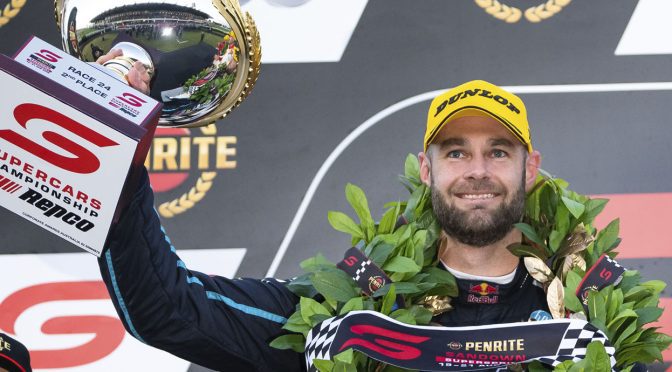
Next on the roster for Trackhouse Racing’s exciting Project 91 program is Australian Supercars Championship competitor Shane van Gisbergen, set to make his first NASCAR Cup Series start at the Chicago Street Course on July 2.
van Gisbergen, a highly-decorated street racer, will vie for the victory in the team’s No. 91 Chevrolet Camaro ZL1 during the historic race weekend in the Windy City. van Gisbergen is currently fourth in the series standings down under and is the defending champion after a record-breaking season in 2022, bringing his career total to 63 wins and 152 podium finishes.
But for the 34-year-old wheelman, racing in NASCAR is the opportunity of a lifetime.
“I can honestly say I have dreamed about an opportunity in NASCAR, but really never thought it would become a reality,” van Gisbergen, a New Zealand native, said in a team release. “I can’t wait to get to the States to meet everyone and prepare for Chicago. It’s NASCAR’s first time on the streets of Chicago, so in some ways, everyone will be a rookie like me, but I don’t underestimate that it’s going to be a huge challenge.”
van Gisbergen will aim to add a NASCAR Cup Series victory to his extensive resume, highlighted by three Supercars championships (2016, 2021 and 2022) and victory in Australia’s grueling Bathurst 1000.
Though van Gisbergen races a Chevrolet Camaro ZL1 in Australia, the model currently competing in the Cup Series, and has a long list of racing accomplishments, Trackhouse Racing owner Justin Marks knows this is a big opportunity for van Gisbergen to compete stateside and familiarize himself with North American race fans.
“I’ll concede the American racing fan might not be as familiar with Shane as they are with Kimi, but if you talk with anyone in Australia, New Zealand and that part of the world, they will tell you he is one of the most talented drivers on the planet,” Marks said. “He’s used to street racing in heavy cars, and I think everyone will be very impressed with his performance.”
Well, based on his incredibly-detailed helmet design, it’s safe to say he’s off to a very good start.
van Gisbergen is the second in a growing list of international drivers to make their NASCAR debut via Project 91, following Räikkönen, the former F1 champion, who raced at Watkins Glen International in 2022 and Circuit of The Americas in 2023. Marks stated in May that there will be ‘multiple‘ drivers behind the wheel of the team’s third entry this season alongside Cup Series regulars Ross Chastain and Daniel Suárez.
6/26 UPDATE: van Gisbergen was on hand at Nashville Superspeedway on June 25 to talk about his upcoming Cup Series debut, indicating that he and Marks had briefly talked about the potential of SVG running an oval-track race at some point:
“We had a small chat about that earlier,” van Gisbergen said during a press conference Sunday. “I’ve never really thought about ovals too much, but yeah you’d love to have a go at it. Like watching yesterday and how committed the guys were in qualifying — they had the practice and then you sit around all day and you get one lap. To see how committed everyone was and see who was braver than the others into Turn 1. It was pretty cool to watch. It sucked watching, I wanted to be out there. So, yeah I’d want to have a go at it one day.”
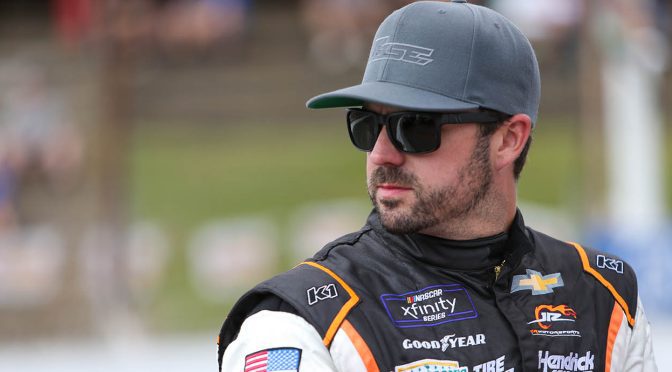
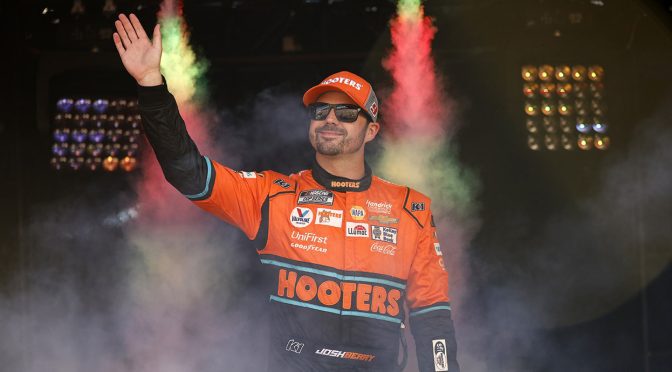
CONCORD, N.C. – Josh Berry is officially set to become a NASCAR Cup Series driver.
Stewart-Haas Racing announced Wednesday at Charlotte Motor Speedway that Berry will drive the No. 4 Ford for the organization beginning in 2024, replacing the retiring 2014 Cup champion Kevin Harvick. Crew chief Rodney Childers will remain atop the pit box for the No. 4 team as Berry officially joins the Cup Series.
“Obviously this is a really special day for me and special for a lot of people,” Berry said Wednesday. “First off, I have to thank everybody sitting up here with me for believing in me and, bringing me here to this. This is such a special day and it’s been a … fun process over the last couple of months getting to know these guys and working with them, and I can’t imagine a better opportunity for myself than to be full-time Cup racing with Stewart-Haas and headed for the No. 4 car.”
Berry found himself front and center of the stage in the Charlotte media center, flanked to his right by SHR chief competition officer Greg Zipadelli and team co-owner Tony Stewart and to his left by Harvick and Childers. In the crowd sat Dale Earnhardt Jr., co-owner of Xfinity Series team JR Motorsports and the kick-starter behind Berry’s racing career.
The belief behind him has been palpable for years. Wednesday provided the clearest example of that belief yet.
“It really means a lot to have the support that I’ve had,” Berry said. “Obviously, to get to this point, I knew that everybody at SHR and this group beside me believes in me and what I bring to the table. Like I’ve said, it’s going to be a great challenge trying to fill the job that Kevin’s done over the years. I mean, he’s a future Hall-of-Famer and has won countless races, a championship and I’ve been watching the races this year – these guys have been running really well from what I’ve been seeing. So it’s really encouraging for me and exciting to know that I’m gonna get such a great group around me. I intend to do everything I can to try to keep that group together and excited to work with me.
“I know that I’ll have some great support with Tony, Kevin and Dale as well as I transition to a full-time Cup driver. It’s all great. Like I said, I really can’t imagine myself going to a better opportunity.”
Zach Sturniolo | NASCAR Studios
The 32-year-old native of Hendersonville, Tennessee, was an immediate candidate of interest for Harvick, Childers and SHR as Harvick planned his retirement. As the organization planned its next steps, it was clear Berry was its guy.
“We literally put all of our eggs in one basket, and we put them on this kid to my left here with Josh Berry,” Stewart said. “He’s somebody that we all feel like is the right fit to step into the No. 4 car in the future and we’re all super excited to have him at Stewart-Haas Racing.”
Harvick, whose resume boasts 60 Cup wins, two Xfinity championships and two Craftsman Truck Series titles as an owner, now co-owns the CARS Late Model Stock Tour with Earnhardt, Jeff Burton and Justin Marks. That connection to Earnhardt – among plenty other ties – led Harvick to picking up the phone for a conversation about Berry.
“That’s really how this started,” Harvick said. “I just called Dale and I said, ‘Hey, would it be OK to have a conversation with Josh about possibly driving the No. 4 car, and that’s really how this started. So once that happened, and it was OK to just have some conversations, then (I) delivered that message to the team and everybody started talking about things and here we are today.”
Earnhardt recalled the conversation vividly, eager to see a door to the Cup Series crack open for Berry, who he met via iRacing some 15 years ago and guided to JRM’s late-model program just two years later.
“I told him (Harvick) that Josh was open to discuss any opportunities with anybody and that he would be thrilled and humbled to be considered for a replacement at Stewart-Haas in any car,” Earnhardt said. “I also introduced the idea that Josh didn’t have any formal representation as he progressed into whatever opportunities he had for the Cup Series.”
Earnhardt, a NASCAR Hall-of-Fame driver and car owner, pointed to Harvick’s agency – KHI Management – which could help Berry land a ride even if the door closed on at Stewart-Haas Racing.
“It (the call) was just about, ‘Yeah, get to know Josh. Why don’t you guys to know him better?’” Earnhardt said. “And they had a lot of meetings with Josh before the season even started. And so we just kind of waited around for them to finally make that decision if that was what they wanted to do.”
Berry’s first inkling of SHR’s interest came in January, when Harvick approached him on media day. From there, conversations continued with SHR’s chief commercial officer Brian McKinley as well as Stewart and Zipadelli.
Stewart emphasized Wednesday Berry earned consideration based on merit, adding sponsorship remains “totally open” on the No. 4 car in 2024.
“I am not interested in some kid’s father coming and buying their way into the Cup Series. I have zero interest in that,” Stewart said. “We want guys that earn their way, that work hard, that understand the values that it takes to be a top-tier driver – not one that just got his high school diploma and now all the sudden he’s a Cup driver. I’ve got zero interest in that. Josh has put the time, the effort, and every time he’s got an opportunity, he’s made the most of it. Those are the traits that championship drivers are built off of, not the easy ticket to get there.”
As conversations progressed through the winter and spring, it became clearer to Berry the ride was his if he wanted it.
“From our side of things, there really was never a question that this was not a great opportunity for me,” Berry said. “Dale was fully supportive and he said himself he thought this was best-case scenario for me and for all this. He’s been there every step of the way.”
Indeed, Earnhardt has been there since the beginning, watching Berry flourish as a racer but never getting a true shot in NASCAR’s national touring series until timing allowed he and JRM to get Berry into the team’s No. 8 Chevrolet in the Xfinity Series for a partial schedule in 2021 – a ride in which Berry was able to triumph at Martinsville Speedway before winning again as a substitute driver in JRM’s No. 1 car at Las Vegas Motor Speedway later that season.
The pride Earnhardt takes in seeing Berry earn a championship-caliber ride in the top level of stock-car racing was evident Wednesday.
“It’s a big relief because we’ve been waiting on this opportunity for Josh,” Earnhardt said. “It’s a big relief any time you can help anybody achieve a goal like that. I’m just looking forward to getting into this next season and him getting behind the wheel and starting to work. It’s going to be a lot of work. It’s going to be tough. There will be some challenges and he’ll have a lot of help and support – myself included – just to navigate all that.
“But it’s a good relief. It’s a happy, happy day for me. It’s fun to watch Josh go through this and realize a dream. It’s a great moment for the sport to have stories like this developing, and now we’ve got to sit and wait. Everybody’s got to go back to work, right? I told Josh, ‘Listen, man, this day’s going to be a big day. Let it all sink in. Absorb it all. Because as soon as this day’s over, you’ll wake up tomorrow and it’s back to the Xfinity Series.’”
CONCORD, N.C. — A dreary Wednesday morning just outside of Charlotte, North Carolina served as one of the most gratifying days of Josh Berry’s life.
Years of learning, grinding and winning at short tracks along the East Coast finally paid off for Berry with the opportunity of a lifetime when Stewart-Haas Racing announced the 32-year-old from Hendersonville, Tennessee will replace Kevin Harvick as the driver of the No. 4 Ford Mustang in the NASCAR Cup Series starting in 2024.
With Berry surrounded by Tony Stewart, Kevin Harvick, Greg Zipadelli and Rodney Childers in Charlotte Motor Speedway’s media center, the rain outside could not put a damper on the mood as he relished the long-awaited chance to race full-time in the Cup Series.
“This is a really special day for me and a lot of people,” Berry said. “I have to thank everyone up here sitting with me for believing in me. It’s been a fun process over the past couple of months, and I can’t imagine a better opportunity for myself.
“If we do the right things and stay the course, the results will come.”
Joining Stewart-Haas Racing’s Cup Series program would not have been possible for Berry without the guidance of another accomplished driver in Dale Earnhardt Jr.
By the early 2010s, Berry and his family had exhausted most of their resources in Legends cars to the point where Berry was considering pulling out of racing altogether. As Berry kept his skills sharp on iRacing, he formed a friendship with Earnhardt, who offered a test in one of his Late Model Stock Cars.
What followed was one of the most efficient careers in Late Model Stock competition.
Berry quickly proved himself against the established veterans of the discipline, earning victories in crown-jewel events like the ValleyStar Credit Union 300 at Martinsville Speedway before claiming the NASCAR Advance Auto Parts Weekly Series national championship in 2020.
Having made periodic starts in the NASCAR Xfinity Series with JR Motorsports during that stretch, Berry became more actively involved in the series starting in 2021. He has carried over his consistency with five victories and a Championship 4 appearance last year.
Advance Auto Parts delivers the NASCAR Weekly Series national championship trophy to Josh Berry and Dale Earnhardt Jr. at the JR Motorsports facility in Mooresville, N.C. on Nov. 17, 2020. (Reagen Lunn/NASCAR)
Berry admitted to slight disbelief over how his career has unfolded since the turn of the decade. There were many days before 2020 in which he believed his career terminus would be racing Late Model Stocks with JR Motorsports.
Despite this, Berry never viewed his circumstances with a negative outlook. He feels his extended time racing on short tracks has only prepared him more for the demands of competing in the Cup Series.
“When I was racing short tracks, all I was worried about was winning races, working hard and building fast race cars,” Berry said. “That was the goal, and I wasn’t really thinking about my future. I had accepted that I was going to be a full-time short track racer, but I didn’t think that was a negative thing.
“There are a lot of great short-track racers fully capable of racing on Saturdays and Sundays, and I feel like I represent those guys.”
A major part of Josh Berry’s success stems from his friendship with Dale Earnhardt Jr., who he has driven for since the early 2010s. (Photo: Reagen Lunn/NASCAR)
While Berry fought for every win in Late Model Stock competition, Earnhardt worked diligently behind the scenes to ensure the young driver would be able to one day progress through NASCAR’s top ranks — even if it meant Berry would have to eventually depart JR Motorsports.
That day will arrive once the 2023 Xfinity Series season concludes. Although Wednesday’s press conference was bittersweet for the NASCAR Hall of Famer, Earnhardt was elated for his long-time driver. He’s eager to see how Berry performs with Stewart-Haas.
“It’s a big relief, because we’ve waited on this opportunity for Josh,” Earnhardt said. “It’s going to be a lot of work, and there will be a lot of challenges, but he’s going to have a lot of support, myself included.
“It’s a happy day for me, and it’s fun to watch Josh go through this, and it’s great for the sport to have stories like this.”
Stewart does not envision Berry having to go through much of a learning period once the 2024 season begins.
Replacing both Chase Elliott and Alex Bowman at Hendrick Motorsports earlier this year gave Berry valuable track time in the Next Gen car, but Stewart stressed Berry’s versatility in Xfinity cars, Late Model Stocks and Super Late Models gives him an advantage compared to younger drivers currently progressing through the developmental ladder.
“You want somebody who has the capability and the mindset of understanding not only what it takes to get to the track and what happens at the shop, but also does the rest of things that it takes to be successful,” Stewart said. “You have to put yourself in a position to win races and championships.
“[Berry] has done that work and has made the most of every opportunity he’s had.”
With so many accomplishments to his name, Josh Berry is ready to take on the responsibilities of being a full-time NASCAR Cup Series driver with Stewart-Haas Racing. (Photo: Adam Fenwick/NASCAR)
Like Stewart, Earnhardt is confident that once Berry gets acclimated to his environment at Stewart-Haas, he will thrive just like he did in Late Model Stocks for so many years.
Being in the Cup Series will require Berry to shoulder more responsibilities, particularly when it comes to building chemistry with his crew and teammates. Earnhardt watched Berry take on a mentorship role countless times with his Late Model Stock program and expects him to become an immediate leader within Stewart-Haas.
“For Josh, he has to use all the support around him,” Earnhardt said. “He has what I think is a Hall-of-Fame crew chief [in Rodney Childers], along with Kevin Harvick, who is a future Hall-of-Fame driver, as well as Greg Zipadelli and Tony Stewart. Josh has so many people who want to see him succeed, and he needs to lean into that.
“The most important role for Josh is to introduce himself to everybody and invest time with the team.”
Berry is ready to face the challenges of being a full-time Cup Series driver, but he also understands wins are not going to come easy. In his eight Cup starts this year, a second place at Richmond Raceway was Berry’s only top five.
Those results have done little to impact Berry’s overall mindset. Adversity never slowed him down when he was dominating Late Model Stock races, and he is only more determined to carry that efficiency into the Cup Series and prove himself as a perfect replacement for Harvick in the No. 4.
“[We] all know how tough Cup [Series] racing is,” Berry said. “I got the full experience with that this year, but I feel like we have the right pieces around us at Stewart-Haas and we can do the necessary things that will allow us to compete for wins in due time.”
Berry’s path to the Cup Series has been far from easy, but every positive and negative he endured on that journey has shaped him into a driver more than capable of racing alongside the best on Sundays.
While Wednesday was an enthralling moment for Berry, he knows more work still needs to be done for him to build upon his proud legacy in racing.
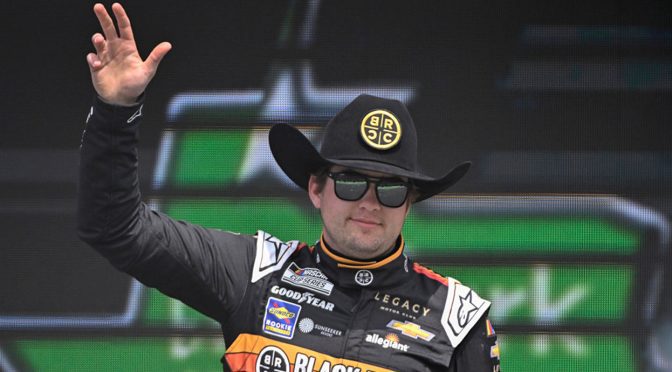
Noah Gragson is set to return to NASCAR Cup Series racing on Sunday at Nashville Superspeedway (7 p.m. ET, NBC, PRN, SiriusXM NASCAR Radio, NBC Sports App) after missing Sonoma Raceway earlier this month, the team announced Wednesday.
Following a crash at World Wide Technology Raceway, the 24-year-old rookie experienced concussion-like symptoms, according to the team, and did not make the trip to the northern California road course. NASCAR Craftsman Truck Series veteran Grant Enfinger filled in for Gragson, piloting the No. 42 Chevrolet for Legacy Motor Club to a 26th-place finish.
CONCORD, N.C. – Josh Berry will drive the No. 4 Ford for Stewart-Haas Racing in the NASCAR Cup Series beginning in 2024, he and the team announced Wednesday at Charlotte Motor Speedway.
The ride becomes Berry’s first full-time opportunity at NASCAR’s top level, replacing 2014 Cup Series champion Kevin Harvick as he retires from his 23-year career before a transition into the television booth. Crew chief Rodney Childers will remain atop the pit box for the No. 4 team as Berry officially joins the Cup Series.
“I can’t imagine a better opportunity for me – to get in a car that’s been as successful and iconic as the No. 4,” Berry said in a team press release. “Kevin is a future NASCAR Hall of Famer, and it’s going to be a challenge trying to come after someone so successful. But I know I’m going to have an amazing group of people around me, led by Rodney Childers, to where we can hit the ground running.”
Berry, 32, is in his second full-time Xfinity Series season with JR Motorsports. The native of Hendersonville, Tennessee, has won five races in the second-tiered series, including a three-win performance in 2022. He moves to Stewart-Haas Racing, which won the 2014 Cup Series championship with Harvick and has earned 69 victories since team co-owner Tony Stewart partnered with Gene Haas in 2009.
“We’re incredibly proud to have Josh Berry begin the next chapter of his racing career in our No. 4 Ford Mustang,” Stewart said in a release. “Kevin Harvick has obviously set a very high bar, but Josh brings maturity, experience and, above all, a winning record to Stewart-Haas Racing. He is the right driver, at the right time, for the No. 4 team and our organization.”
The long-time late-model racer has also filled in for two Hendrick Motorsports teams during the 2023 NASCAR Cup Series season, piloting the No. 9 Chevrolet for five races while Chase Elliott recovered from a broken left leg before getting into the No. 48 Chevrolet for three points races while Alex Bowman recovered from a fractured vertebra. Berry also competed at North Wilkesboro Speedway in the exhibition All-Star events, winning the All-Star Open to advance to his first NASCAR All-Star Race.
While subbing for Elliott, Berry scored his career-best Cup finish by placing second at Richmond Raceway on April 2. His stint in the No. 48 Chevrolet included starts at Dover Motor Speedway, Kansas Speedway and Darlington Raceway, earning a best finish of 10th at Dover.
“Josh Berry has proven himself in the Xfinity Series and this year showed how quickly he can adapt to the cars and the level of competition in the NASCAR Cup Series,” Greg Zipadelli, the team’s chief competition officer, said. “He’ll be a rookie in our race car next year, but he drives like a veteran. He puts in the work to ensure that he’s always ready for the opportunities that come his way, and we’re very happy that his next opportunity is with Stewart-Haas Racing.”
True Speed Communication
Berry is a renowned late-model stock car racer who joined JRM’s late-model program in 2010. Per the team’s website, Berry collected his 100th overall victory with JRM in the Thanksgiving Classic at Southern National Motorsports Park on Nov. 27, 2022. The most significant of those triumphs came at Martinsville Speedway in the ValleyStar Credit Union 300, the most prestigious race in late-model racing.
“Late-model racing is where I came from, and I think it’s the best place to learn and prepare to eventually race in the NASCAR Cup Series,” said Harvick, who co-owns the CARS Late Model Stock Tour. “Josh is a really good example, and probably the best and most recent example, of applying all that he’s learned in late models to what he’s doing in the Xfinity Series.
“Winning the CARS Late Model Stock Tour championship and the NASCAR Weekly Racing Series championship (in 2020) requires a lot of skill and an equal amount of determination. Josh did both and won a lot of races along the way. That experience allowed him to be fast and successful right off the bat when he got to the Xfinity Series, and when he had his opportunities to race in the Cup Series earlier this year, he again showed speed and an ability to race at the front.
“I’m very happy for Josh and proud to see him get this opportunity. He’s going to be a really good fit with Rodney and the No. 4 team.”
His NASCAR trajectory took a bit longer to develop. After two Xfinity races with JRM in 2014, he scored a breakout opportunity in September 2015 at Richmond Raceway, where he was placed behind the wheel of the No. 88 Chevrolet in a last-minute deal because sponsorship hadn’t been sold otherwise.
A seventh-place run garnered heaps of attention after competing inside the top five all night, but it took another six years until he was afforded a significant, multi-race opportunity in the Xfinity Series. Berry joined JRM to drive the No.8 Chevrolet for 12 races in 2021, scoring his first NASCAR national series victory at Martinsville.
In addition to driving the No. 31 Chevrolet for Jordan Anderson Racing five times that season, he also replaced an injured Michael Annett in JRM’s No. 1 entry, earning his second win at Las Vegas Motor Speedway.
“The Xfinity Series win at Martinsville changed my career and allowed us to point toward a full-time season for 2022 where we competed for the championship,” said Berry, who qualified for the Championship 4 in the Xfinity Series last year.
Berry has driven the No. 8 Chevrolet on a full-time basis since the beginning of the 2022 season and currently sits fifth in points, 112 markers behind series leader John Hunter Nemechek with six top-five finishes and 10 top 10s in 14 races.
That road so far has been filled with bumps and surprises, but Berry has held a steady wheel every step of the way. In doing so, he has become an inspiration for grassroots racers across the United States.
“My family were race fans, so I grew up as a race fan at a young age,” said Berry, who is in the midst of his second full NASCAR Xfinity Series season with JR Motorsports. “I watched the races as a kid, but my first racing experience would have been on my eighth birthday when I got a go-kart. I began racing just locally, just me and my mom and dad going racing.”
It wasn’t long before Berry moved up the racing ladder to competing in a four-cylinder at historic Nashville Fairgrounds Speedway.
However, the sudden passing of Berry’s mother combined with the financial burden that comes with racing almost brought an end to his career before it truly got started.
“We built a car for me to race on the quarter mile at the Fairgrounds. I raced it a handful of times, and then my mother unexpectedly passed away,” Berry said. “That created a burden on us for awhile. There was a lull there for a year or so maybe.
“When I was a little bit older, we got a Legend car and raced on the quarter mile there for a handful of years. Basically once I got to graduating high school, I’m 18 or 19 years old at that point, each year we raced a little less. It was just a little bit harder to make happen.”
Josh Berry (88) races Austin McDaniel during a CARS Tour event at Hickory Motor Speedway in 2016. (Photo: Adam Fenwick)
That’s when Berry’s racing career shifted from competing on a real race track to racing on a digital one. At the time, the computer game NASCAR Racing 2003 Season had become popular, and Berry began making a name for himself as a top-tier online competitor.
It was through this that Berry met the man who would have possibly the biggest influence on his racing career: Dale Earnhardt Jr.
At the time, Earnhardt spent much of his free time racing online. The two crossed paths when Berry competed in a league run by Earnhardt. The two later raced against each other on iRacing, which launched in 2008.
“We just developed a friendship on there,” Berry said. “We would just chat here and there. Real casual. We weren’t really even racing together on there, we were just kind of racing around each other and kind of developed a friendship.”
Eventually Earnhardt became so impressed by Berry’s talent that he invited him to come test one of his Late Model Stock Cars. Berry jumped at the opportunity.
“We talked about my racing at the Fairgrounds. I remember he had inquired about it a little bit. I think I sent him some videos of it. Never thought anything of it,” Berry said. “I guess at the time they were in the midst of kind of looking for a driver for the Late Model program at JR Motorsports. They were just looking for some direction there or maybe Dale was looking for a project I think, maybe, for it.
“He asked me if I’d ever like to test his Late Model. Of course I was ecstatic, because at that point in my career and life, I never thought I would ever drive a stock car. To get asked to test like that, it was just crazy.”
Soon after a successful test at Virginia’s Motor Mile Speedway, Berry was named the team’s regular Late Model Stock Car driver. Track championships at Motor Mile (2012) and North Carolina’s Hickory Motor Speedway (2014) followed in the next few years.
The 2015 season brought a major change with the creation of the CARS Tour, a Southeastern-based touring series that featured Late Model Stock Cars as its headline division.
Berry and JR Motorsports quickly found a home with the series. Despite only racing in four events during the inaugural season, Berry won three CARS Tour races. He followed that up with five victories in 2016 and four victories in 2017 to go along with the series championship.
He was doing all of that while also serving as a mentor to young drivers as part of the JR Motorsports Late Model program, including future NASCAR Cup Series star William Byron.
“We decided to go try the CARS Tour, and we ended up finding a home there after that,” Berry said. “A lot of my career and my life has been about timing, right? I raced Late Model Stocks because that was the opportunity that I had. I quickly learned to love that and love Late Model Stock racing and love racing at all these tracks in North Carolina, Virginia, South Carolina, all of these amazing short tracks.
“I just learned to love it. It was my life.”
Josh Berry celebrates in Victory Lane after winning the Late Model Stock portion of the Jack Ingram Memorial at North Carolina’s Hickory Motor Speedway on June 11, 2022. (Photo: Adam Fenwick/NASCAR)
Berry continued in that role while racing with the CARS Tour until the 2020 season, when the COVID-19 pandemic — combined with an on-track incident at North Carolina’s Ace Speedway that led to a one-race suspension from the CARS Tour — changed his plans for the season.
Instead of focusing on the CARS Tour schedule, Berry and JR Motorsports pursued the NASCAR Advance Auto Parts Weekly Series national championship. The decision paid off, as Berry won 26 races and cruised to the national championship.
“It was an unusual year for everybody,” Berry said of 2020. “One of the main things that opened up the idea of us going for the national championship was the pandemic. When race tracks first started opening up, our Late Model program is a business, like a lot of people at that time, you’re just trying to keep your business going.
“My first race back from the pandemic were twin 40-lap races at Hickory. There was like 30 cars there and we won both of them. That was when it kind of clicked. We were like, ‘Wow, we could do this.’”
Josh Berry and Dale Earnhardt Jr. pose with Berry’s NASCAR Advance Auto Parts Weekly Series national championship trophy at the JR Motorsports facility in Mooresville, NC. (Photo: Reagen Lunn/NASCAR)
The Weekly Series championship directly led to Earnhardt tabbing Berry to compete in the NASCAR Xfinity Series part-time in 2021.
Berry repaid Earnhardt’s faith with a victory early in the year at Martinsville Speedway, which he followed with a victory at Las Vegas Motor Speedway while competing as a substitute driver for the injured Michael Annett.
The stock of the driver from Hendersonville, Tennessee has continued to rise since. His impressive performances in the Xfinity Series, which included three wins in 2022, is what led Hendrick Motorsports to pick him to drive the No. 9 Chevrolet while Elliott recovered from a fractured tibia he suffered in a snowboarding accident.
He further turned heads with a runner-up finish in Cup Series competition at Richmond Raceway, prompting Hendrick Motorsports vice chairman Jeff Gordon to say, “I think he’s got a future in the Cup Series.”
Berry will enter the next chapter of his racing career with the support of not only people like Earnhardt and Gordon, but with the support of weekly racers across the country. Berry is living proof that with enough hard work, dreams can come true.
“I’ve had lots of guys, whether they were friends or foes over the years, reach out to me and express the excitement that they have,” Berry said. “What it does, for one, is just solidify what the CARS Tour and what the Weekly Series and what these local tracks are. That it is a proving ground. It is legitimate.
“To be in the position to get an opportunity and capitalize on it and even make it to the Xfinity Series is a big deal. I think it really shows the amount of talent and how important these short tracks are to all of us.”
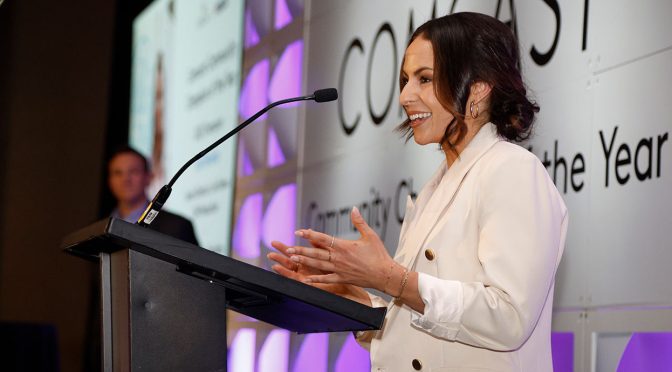
PHILADELPHIA, Pa. (June 21, 2023) – Today, Comcast announced nominations for the 2023 Comcast Community Champion of the Year are now open through August 1, 2023, at ComcastCommunityChampion.com. The prestigious annual award has recognized the philanthropic efforts of individuals within the NASCAR community. In the ninth year of this award, Comcast will surpass $1 million in total contributions made to organizations affiliated with previous champions and finalists with this year’s awards.
To nominate and learn additional details about the award, visit ComcastCommunityChampion.com today through August 1, 2023.
Created in 2015, the Comcast Community Champion of the Year Award was designed to honor the incredible efforts of NASCAR industry members who are improving their communities. Comcast will select and honor three finalists, sharing their stories publicly. Following the finalists’ selection, a committee of NASCAR and Comcast executives, as well as 2022 champion Jes Ferreira, will determine the Comcast Community Champion of the Year. The champion will receive $60,000 to their affiliated charity and the two other finalists will each receive $30,000 to their selected charities later this year.
“Creating positive change across communities is a core pillar of Comcast’s mission and every year we look forward to telling the stories of these inspirational individuals within NASCAR who have selflessly dedicated their time and energy toward supporting others,” said Matt Lederer, Comcast’s Vice President, Brand Partnerships and Amplification.
Any individual with a 2023 annual credential or NASCAR full season license from NASCAR’s top-three national series are eligible to be nominated as a 2023 finalist, including:
• Team owners, drivers and all NASCAR Cup Series™, NASCAR Xfinity Series™ and NASCAR Craftsman Truck Series™ employees • Full-time employees of tracks that are currently on the schedule for NASCAR’s three series • NASCAR Media members who have a Print, Broadcast or Photography Hard Card • NASCAR Officials • NASCAR Partners/Sponsors • Family members of drivers and crew members • Driver and team employees (motorhome drivers, agents, and managers etc.) • Support industry personnel (engine builders, parts and service providers etc.)
Since the inception of the program, Comcast has donated to 24 different nonprofit organizations, furthering the impact of the philanthropic efforts of all finalists and champions. This year, Comcast will reach the milestone of having donated $1 million to deserving organizations in a nine-year span.
“It was truly an honor to have been named Comcast Community Champion of the Year last season,” said Vice President of Live Shows, CSM Production, Jes Ferreira. “Most importantly, Comcast’s generosity benefited Foster Village Charlotte to support all of the life-changing work that they do for foster families in the region.”
Past champions include:
• Vice President of Live Shows, CSM Production, Jes Ferreira representing Foster Village Charlotte • World Wide Technology Raceway Owner, Curtis Francois, representing Raceway Gives Foundation • NASCAR driver, Bubba Wallace, representing the Live To Be Different Foundation • Dover Motor Speedway President, Mike Tatoian, representing USO Delaware • NASCAR champion, Joey Logano, representing the Joey Logano Foundation • Chip Ganassi Racing’s pit crew department representing Ronald McDonald House • JR Motorsports fabricator, Wade Jackson, representing Camp LUCK • NASCAR driver, Joey Gase, representing the Iowa Donor Network
In celebration of the 2023 Comcast Community Champion of the Year program and reaching the million-dollar mark, Comcast will be engaging within the community in Nashville, Tenn. NASCAR Xfinity Series driver Josh Williams, who was a 2022 Comcast Community Champion of the Year finalist, will be visiting Seacrest Studios at Monroe Carell Jr. Children’s Hospital at Vanderbilt as part of his work with the Ryan Seacrest Foundation.
Comcast has a storied history of strengthening communities each and every day of the year providing education opportunities and digital skills training to help create more pathways to economic mobility for young people and adults alike, most recently through its Project UP initiative. Backed by a $1 billion commitment to reach millions of people, Project UP encompasses the programs and community partnerships across Comcast, NBCUniversal and Sky that connect people to the internet, advance economic mobility and open doors for the next generation of innovators, entrepreneurs, storytellers and creators. For more information on Project UP and the latest news on efforts to address digital inequities, visit https://corporate.comcast.com/impact/project-up.
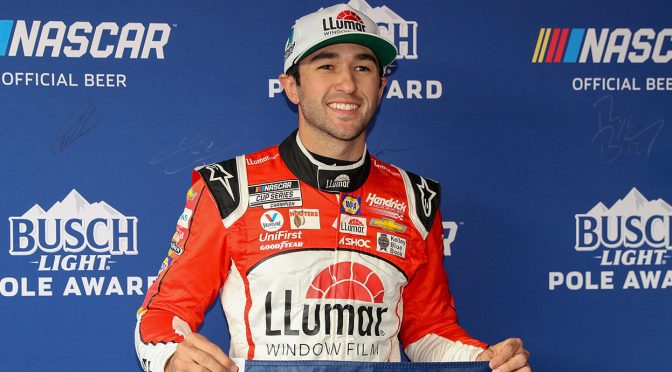
CONCORD, N.C. – Eastman Performance Films, LLC, a subsidiary of Eastman Chemical Company (NYSE: EMN), has extended its sponsorship of Hendrick Motorsports, 2020 NASCAR Cup Series champion Chase Elliott and the No. 9 Chevrolet Camaro ZL1 team for three additional seasons.
The sponsorship, which features the LLumar® brand of window film and paint protection film, will run through 2026. LLumar will be a primary sponsor of Elliott, 27, for two races each season and a major associate sponsor in all other Cup Series events.
“We are excited to extend our sponsorship with Hendrick Motorsports and the No. 9 team,” said Erin Bernhardt, general manager of Eastman Performance Films, LLC. “This sponsorship has helped increase awareness of the LLumar brand and the benefits of window tint and paint protection film for vehicle and homeowners.”
As part of the extension, LLumar will be the primary sponsor on the No. 9 Chevrolet for two additional races this season: the Aug. 26 regular-season finale at Daytona International Speedway and the Oct. 1 event at Talladega Superspeedway, where Elliott is the defending race winner. LLumar will also be the primary sponsor at the Oct. 15 Las Vegas Motor Speedway race, as previously announced.
“We’re delighted to extend our program with Eastman and the LLumar brand,” said Rick Hendrick, owner of Hendrick Motorsports. “LLumar offers tremendous products that we stand behind through the No. 9 team and in our Hendrick Automotive Group car dealerships across the country. It’s been rewarding to see them win races with Chase, translating to even more success off the track. We look forward to the future and continuing to grow our relationship together.”
LLumar high-performance films help improve the appearance and driving comfort of vehicles as well as enhancing the comfort, appearance and privacy in homes and commercial buildings around the world. The LLumar portfolio of products includes window tint and paint protection films for vehicles, and solar control, decorative and safety and security films for residential and commercial buildings.
“I’m excited to continue our relationship with LLumar and to get two additional chances to get them to victory lane this season,” Elliott said. “I’ve really enjoyed getting to meet many of the Eastman employees over the years, whether it’s at their facilities near tracks where we compete or having them out for the races. I look forward to seeing what we can continue to accomplish together in the coming years.”
SOUTH BOSTON, Va. — Mike Looney knows that to be a contender for the Virginia Late Model Triple Crown, you need to get off to a good start. In other words, you need a win or have a solid finish in the Thunder Road Harley-Davidson 200 presented by Grand Atlantic Ocean Resort on Saturday, July 1 at South Boston Speedway, the opening triple crown race.
The Virginia Late Model Triple Crown consists of the July 1 Thunder Road Harley-Davidson 200 presented by Grand Atlantic Ocean Resort at South Boston Speedway, the Hampton Heat 200 on July 22 at Larry King Law’s Langley Speedway, and the Sept. 23 ValleyStar Credit Union 300 at Martinsville Speedway.
“Normally somebody that wins the Triple Crown wins at least one of the three legs,” Looney said. “Martinsville is such a crapshoot to get a top-five finish. It’s tough to even make that show. You’ve got to start out well on the first leg to get to the last leg. That is what we’re focusing on.”
Looney has a good record at South Boston Speedway this season, scoring a pair of second-place finishes and a pair of third-place finishes in his six starts. Overall, Looney’s season record includes five wins and three second-place finishes.
“I can’t thank Billy Martin and the folks that help on this car enough,” Looney said. “They put me in equipment that with luck on our side we can get some wins and have some good runs. I hope we can keep that string going through July 1.”
Looney has two career wins at South Boston Speedway and says winning the July 1 Thunder Road Harley-Davidson 200 presented by Grand Atlantic Ocean Resort and earning the $10,000 winner’s prize would be one of his biggest wins.
“It would be really special to win this race,” Looney remarked. “There are some other big races, but this Fourth of July race at South Boston Speedway has always been the crown jewel of the summer. I came down here and watched the race for many years before I was able to be in a position to be in good equipment to be able to compete in it. It’s an honor to drive for (car owner) Billy Martin, have a fast race car, and have a shot at winning a crown jewel like this.”
Looney has been close to winning South Boston Speedway’s showcase event but has yet to win it. He finished 11th in last year’s 200-lap race and finished sixth in 2021.
“We were close a couple of years ago,” Looney noted. “We had the best car and the main rear seal or something blew out. Oil leaked on our clutch, and the clutch started slipping while we were leading the race. I know how it is to lose it. Now, we’ve just got to figure out how to win it.”
The key to winning the 200-lap race, Looney says, is a combination of multiple factors, the most important being a good car.
“You’ve got to have luck on your side, have good strategy calls, and have good tire conservation,” explained Looney. “These Hoosier F50 tires are hardy tires. You can run them pretty hard, but 200 laps here in July is pretty hard on anything. I think you need to stay as close to the front as you can without burning the right rear tire or right front tire off. You have to manage your equipment, but ultimately, it’s going to come down to the best-handling race car.”
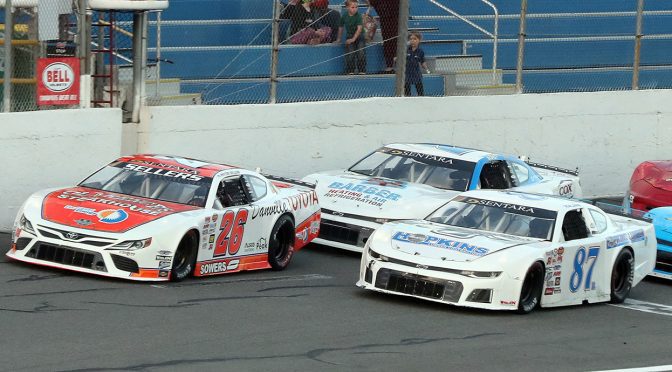
South Boston Speedway’s July 1 Thunder Road Harley-Davidson 200 presented by Grand Atlantic Ocean Resort is one of the region’s premier NASCAR Late Model Stock Car Division events and is annually a favorite among race fans.
Fans will be treated to a dazzling and colorful Fourth of July fireworks show immediately following the last race of the night. Special patriotic festivities will be featured during pre-race ceremonies. In addition, fans can meet the drivers competing in the speedway’s four NASCAR racing divisions during the Autograph Session powered by Hitachi.
It will be an exciting night as fans will see four action-packed races. Along with the 200-lap race for the Sentara Health Late Model Stock Car Division fans will see a 40-lap race for the Budweiser Limited Sportsman Division, a 20-lap race for the Southside Disposal Pure Stock Division and a 20-lap race for the Virginia State Police HEAT Hornets Division.
Fans can purchase advance adult general admission tickets for $20 each online on South Boston Speedway’s website, www.southbostonspeedway.com or by calling the speedway office at 434-572-4947 or toll free at 1-877-440-1540 during regular business hours.
Tickets at the gate on race day will be $25 each. Seniors ages 65 and older, military, healthcare workers, and students (with ID) can purchase tickets for $20 each at the gate on race day.
The tentative race day schedule for the July 1 Thunder Road Harley-Davidson 200 presented by Grand Atlantic Ocean Resort has registration and pit gates opening at 10 a.m. ET. Frontstretch spectator gates will open at 12:30 p.m. ET, and practice will start at 1 p.m. ET. Backstretch and Turn 4 trackside tailgating gates will open at 3:30 p.m. ET.
Qualifying for the 200-lap Sentara Health Late Model Stock Car Division race is set for 4:15 p.m. ET. The Autograph Session powered by Hitachi is scheduled for 5:15 p.m. ET on the frontstretch of the speedway. Pre-race Ceremonies powered by Hitachi will begin at 6:35 p.m. ET, and the first race will get the green flag at 7 p.m. ET.
Friday, June 30 is Thunder Road Harley-Davidson 200 Practice Day and Fan Appreciation Day. Practice will run from 11 a.m. until 7:45 p.m. ET, and fans can come out and watch practice from the track’s spectator areas free of charge.
Fans and competitors can find the latest updates and information on the speedway’s website and through the track’s social media channels. Information may also be obtained by phoning the speedway at 434-572-4947 or toll free at 1-877-440-1540 during regular business hours.