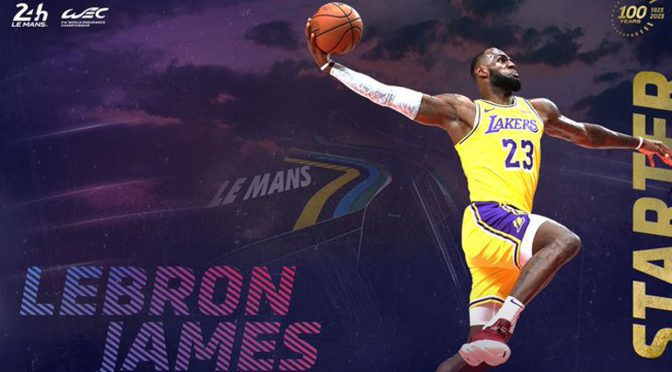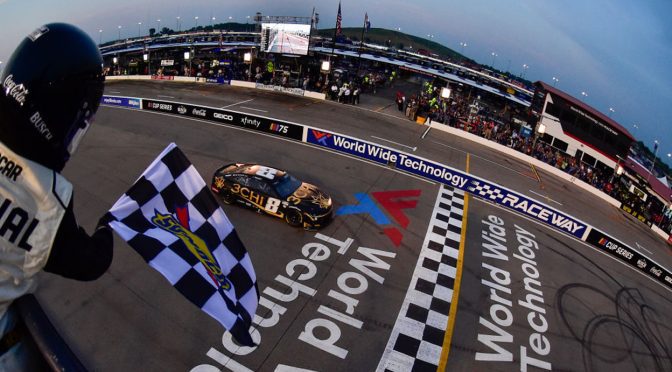
LOS ANGELES — USC quarterback Caleb Williams amassed a highlight reel of amazing plays inside the Los Angeles Memorial Coliseum in 2022. His first Coliseum highlight of 2023 will be waving the green flag for NASCAR’s first race of its 75th anniversary season.
The 2022 Heisman Trophy winner has been named the Honorary Starter for the Busch Light Clash at the Coliseum on Sunday, Feb. 5. He’s the latest addition to a star-studded event that includes racing from the top drivers and cars of the NASCAR Cup Series, and performances by hip hop icons Cypress Hill and Wiz Khalifa.
The season-opening exhibition airs live on FOX, with the main event beginning at 8 p.m. ET/5 p.m. PT.
In December, Williams became the eighth player in USC’s storied history to win the Heisman Trophy. He led the nation with 42 touchdown passes and threw for 4,537 yards for a team that won 11 games. Moreover, Williams’ elusiveness made him a threat on the run, as he rushed for 442 yards and six TDs, while also creating opportunities for his teammates as he scrambled out of the pocket.
Now Williams will create the memory of a lifetime participating in NASCAR’s highly anticipated return to the LA Memorial Coliseum.
The sanctioning body announced earlier this month that 27 cars will compete in the 150-lap Clash main event. Up to 40 NASCAR Cup Series drivers will attempt to qualify for that main event via four heat races and two last-chance qualifiers that will determine the final field of 27.
Practice and qualifying begin at 3 p.m. PT on Saturday, Feb. 4. Heat races begin at 2 p.m. PT on Sunday, Feb. 5, followed by the Cypress Hill performance.
And then shortly after 5 p.m. PT, Williams will wave the green flag for the main event, which features a special mid-race performance by Wiz Khalifa.
Tickets for the 2023 Busch Light Clash at the Coliseum begin at $65, and kids 12-and-under are $10. Fans who want to take their race-day experience to the next level can upgrade to the Ally Pre-Race Party, which includes brunch, a drink ticket for Busch & Coca-Cola products, exclusive entertainment, a pre-race track walk and a special appearance from driver Alex Bowman. Fans are encouraged to get their tickets now while supplies last by visiting www.nascarclash.com. It’s one of the many anticipated events taking place this year as a part of the venue’s centennial anniversary celebration — “Coliseum Forever.”
College students can experience the Busch Light Clash from The Coca-Cola Torch Party Porch for just $40. This standing-room-only general admission section, located on the Coliseum’s peristyle steps, provides college students with up-close access to all the musical entertainment, driver introductions and racing action. College students can take advantage of this exclusive offer by visiting www.nascarclash.com/student.
Sam Hunt Racing announced Monday that two-time NASCAR Xfinity Series champion Tyler Reddick will drive the team’s No. 24 Toyota GR Supra for select races during the 2023 Xfinity Series season.
Reddick, a 10-time winner in the Xfinity circuit, will first race behind the wheel of the entry in February at Auto Club Speedway. Reddick’s full Xfinity Series schedule and partnership information have yet to be announced.
To Reddick, the opportunity to pilot a GR Supra will be an eager one. With the 27-year-old’s move to Toyota Racing as the No. 45 pilot for 23XI Racing beginning in 2023, the experience will help the former Chevrolet driver adapt to the manufacturer. For Sam Hunt Racing, the move will additionally serve as an avenue to continue building the program. This year will mark SHR’s third full-time season in the Xfinity Series and first as a two-car tandem.
“I’m looking forward to the opportunity to run some races in the Xfinity Series with Sam Hunt Racing,” Reddick said in a press release. “This is a big year for their team as they move to full-time racing with two cars, and I’m excited to be a part of helping them grow. This is also another great chance to get in a few more races with Team Toyota. As I’ve been preparing for my first season with 23XI Racing in the Cup Series, I’ve been really impressed at the resources provided by Toyota, so I know we’ll show up to the track with a chance to win.”
Reddick won two consecutive Xfinity Series championships in 2018 and 2019 before his full-time transition to the Cup Series in 2020 with Richard Childress Racing. In addition to his 10 wins, Reddick has amassed 38 top-five finishes, 58 top-10 finishes and 901 laps led for an 11.6 average finish in 96 races spanning five Xfinity Series seasons (2017-19, 2021-22). In the Cup Series, Reddick has earned back-to-back playoff berths (2021-22) and has compiled three wins, all in the 2022 campaign.
Monday, Jan. 23 6 p.m., Greatest Races: NASCAR Cup Series 2004 Subway 400 at Rockingham Speedway (re-air), FS1
9 p.m., Greatest Races: NASCAR Cup Series 2007 Food City 500 at Bristol Motor Speedway (re-air), FS1
Tuesday, Jan. 24 Midnight, NASCAR Race Hub: Season Preview (re-air), FS1
3 p.m., NASCAR Race Hub: 75 years of Racing (re-air), FS2
4 p.m., NASCAR Race Hub: Best of Radioactive 2022 (re-air), FS2
5 p.m., Greatest Races: NASCAR Cup Series 2010 Aaron’s 499 at Talladega Superspeedway (re-air), FS2
Wednesday, Jan. 25
Midnight, Greatest Races: NASCAR Cup Series 2007 Food City 500 at Bristol Motor Speedway (re-air), FS2
3 a.m., NASCAR Race Hub: 75 years of Racing (re-air), FS2
4 a.m., NASCAR Race Hub: Season Preview (re-air), FS2
Thursday, Jan. 26 Noon, Race Classic: 2010 Martinsville (re-air), FS2
3 p.m., Race Classic: 2010 Daytona 500 (re-air), FS2
6 p.m., NASCAR Presents: Beyond the Wheel (re-air), FS2
7 p.m., NASCAR Race Hub Special: Season Preview (re-air), FS2
8 p.m., 2022 Busch Light Clash at the Coliseum (re-air), FS2
On Peacock
5:25 p.m., IMSA: Mazda MX-5 Cup at Daytona — Race 1
Friday. Jan. 27 6 p.m., NASCAR Race Hub Special: Season Preview (re-air), FS1
7 p.m., Race Classic: 1994 Indianapolis (re-air), FS1
11:30 p.m., 100,000 Cameras: Clash at the Coliseum (re-air), FS1
On Peacock 10:10 a.m., IMSA: Mazda MX-5 Cup at Daytona — Race 2
1:35 p.m., IMSA: Michelin Pilot Challenge at Daytona
Saturday, Jan. 28 Midnight, Unrivaled: Earnhardt vs. Gordon (re-air), FS2
1 a.m., NASCAR Race Hub: Best of Radioactive 2022 (re-air), FS2
2 a.m., NASCAR Race Hub: Best of Features 2022 (re-air), FS2
2:30 a.m., NASCAR Race Hub: 2022 Championship Show (re-air), FS2
Noon, IMSA: VP Racing Sportscar Challenge — Roar Before the 24, Race 1 (tape delay), CNBC
1 p.m., IMSA: VP Racing Sportscar Challenge — Roar Before the 24, Race 2 (tape delay), CNBC
1:30 p.m., IMSA Weathertech Sportscar Championship Rolex 24 Hours of Daytona, NBC
2:30 p.m., IMSA Weathertech Sportscar Championship Rolex 24 Hours of Daytona, USA Network
10 p.m., IMSA Weathertech Sportscar Championship Rolex 24 Hours of Daytona, USA Network
On Peacock: 1:30 p.m., IMSA Weathertech Sportscar Championship Rolex 24 Hours of Daytona
Sunday. Jan. 29 6 a.m., IMSA Weathertech Sportscar Championship Rolex 24 Hours of Daytona, USA Network
Noon, IMSA Weathertech Sportscar Championship Rolex 24 Hours of Daytona, NBC 6 p.m., NASCAR Cup Series 2022 Busch Light Clash at the Coliseum (re-air), FS2
8 p.m., NASCAR Race Hub: Best of Radioactive 2022 (re-air), FS2
9 p.m., NASCAR Race Hub: Best of Features 2022 (re-air), FS2
On Peacock Midnight, IMSA Weathertech Sportscar Championship Rolex 24 Hours of Daytona
A trio of historic dirt tracks in the Northeast will join the NASCAR Advance Auto Parts Weekly Series for the 2023 season.
Delaware’s Georgetown Speedway and New York’s Utica-Rome and Fonda Speedways, which are operated by promoter Brett Deyo, are the latest facilities to become NASCAR-sanctioned.
“I’ve been looking at the option [to sanction with NASCAR] for the past couple of years,” Deyo said. “For Fonda and Utica-Rome, we have the same core racers that run both nights, Friday night at Utica-Rome and Saturday night at Fonda. It gives them an opportunity to run for a state championship, the regional championship and the national championship.
“From the Georgetown perspective, there is more growth here. We have a more ambitious schedule then we’ve run [recently]. We’ve been a part-time track since 2016. We’re still not weekly at Georgetown, but we are racing more than we have in the past.”
Georgetown Speedway, located in Georgetown, Delaware, was constructed in 1949 by businessman Melvin L. Joseph. The track will host races on Thursday and Friday nights this year in addition to special events.
Georgetown Speedway (Photo: Ryan Hill/Georgetown Speedway)
Major events on the 2023 calendar at Georgetown include the 12k for 12k Gary Simpson Memorial (July 21) and the Mid-Atlantic Championship (Oct. 27-28). Georgetown will open its season April 7.
Utica-Rome Speedway, located in Vernon, New York, was built in 1961 by Joe Lesik as a quarter-mile asphalt oval before being transformed to a dirt track in 1979. Known as the “Home of Heroes,” Utica-Rome will host weekly racing on Fridays throughout the upcoming season.
Some of auto racing’s best have won track championships at Utica-Rome. They include Richie Evans, who won four titles during Utica-Rome’s asphalt era, and current NASCAR Craftsman Truck Series competitor Stewart Friesen, who is a seven-time track champion.
Major events at the half-mile dirt oval in 2023 include the Richie Evans Remembered 61 (July 20) and the New Yorker (Sept. 3). The season-opener at Utica-Rome is scheduled for April 21.
Fonda Speedway, located in Fonda, New York, opened in 1953 and continues to operate today as a half-mile dirt oval. Dubbed “The Track of Champions,” Fonda played host to four NASCAR Cup Series races in the 1950s and 1960s. Those events, known as the Fonda 200, were won by Junior Johnson, David Pearson and Richard Petty. NASCAR last sanctioned Utica-Rome Speedway in 2016.
Utica-Rome Speedway
The track will host weekly racing on Saturdays throughout the summer. Major events include the season-opening Jack Johnson Memorial Montgomery County Open (April 22) as well as the $53,000-to-win Fonda 200 (Sept. 14-16).
Modifieds will be the headlining class at the trio of tracks in 2023. Ryan Godown (Georgetown), Matt Sheppard (Utica-Rome) and Matt DeLorenzo (Fonda) are the defending Modified track champions at each venue.
The NASCAR Advance Auto Parts Weekly Series sanctions weekly short tracks across the United States and Canada. Layne Riggs is the defending NASCAR Advance Auto Parts Weekly Series Division I national champion.
For Deyo, giving competitors at his three tracks the chance to earn more money and the chance to race for state, regional and national championships made joining the NASCAR Advance Auto Parts Weekly Series a much easier decision.
“It opens up a whole other earning potential for our racers, and that really got me excited, because we’re always trying to give them the most opportunities to make money as we can,” Deyo said. “I felt like the NASCAR program gives them that opportunity without having to do anything different than they were already doing.
“It’s a great opportunity. We pride ourselves on paying well at our tracks. Anytime you can give them an opportunity to race for more money, it’s a good thing. Not to mention the exposure that comes with it, the honor of being a NASCAR champion. Especially during the 75th season, there is just a lot of hype that goes along with it.”
Friday night’s NASCAR Hall of Fame induction ceremonies presented Hershel McGriff with his Hall of Fame ring, his distinctive blue jacket, and apparently … a ride.
At age 95, McGriff became the stock-car shrine’s oldest member and fittingly shared stories that stretched over all eras of NASCAR’s 75 years. His racing career has also arched over many of those diamond years, and now it might be getting its second act.
“Bill McAnally and Richard Childress both offered me a car for a race when I reached the magic number of 100,” McGriff said during his speech before cracking, “I hope they both stay healthy.”
McGriff was welcomed into the hallowed Hall alongside fellow inductees Matt Kenseth and Kirk Shelmerdine as the three members of the Class of 2023. The tributes and honors spoke to McGriff’s longevity, which the longtime West Coast campaigner detailed in his sharp, wide-reaching speech.
A lifetime of memories speak to that – spanning from a dirt-track start just two weeks after World War II ended in 1945, to the first Southern 500 at Darlington Raceway in 1950, to decades on the old Winston West Series, to his final (we think) start in 2018 at age 90.
“That’s just in me. I’ve just gotta keep doing something,” McGriff said. “I still ride a bike all the time, and I’ve gotta keep busy. I was just born that way, while the rest of my family kind of went slow — they were school teachers.”
Torey Fox | NASCAR Studios
Riding a motorcycle was actually where McGriff was last May when he found out he’d been elected to the Hall of Fame. The word came through during a fuel stop while on the annual Kyle Petty Charity Ride, where McGriff has been a regular participant. By then he’d already put in a few hundred miles on the open road that day.
Petty, with a nod to his father, told the group of bikers at dinner that they’d started the day with one Hall of Famer on the ride. Now they were ending it with two.
“It was like he was 20. I mean, you could just see it in his eyes. It was like Christmas morning for a 5-year-old,” Petty said. “I mean, it’s something that … he wanted people to understand what he had done and what he had been a part of. When you look at the sport, the first race is in ’49. You think about (NASCAR’s) 75th year, and the first race is ’49. He was there in ’50. So you look at it that way.
“It was just the emotion, and the emotion from the riders. Because they knew how bad he wanted it. We just called him ‘Hall of Famer’ the rest of the week.”
McGriff drove a little bit of everything in his lifetime, which he chronicled in his sprightly speech – farm equipment at age 10, a scooter with a sidecar to deliver groceries at 11, a church bus at 12, a railroad car at 13, a 1930 Ford Model A that he bought as an eighth-grader, a milk truck, an ambulance, a hearse, a 1940 Hudson in his first race, a 1950 Oldsmobile in the first Southern 500 (a car he drove from his Oregon home to Darlington, raced, then drove back), another Olds to four Cup Series wins in 1954, a Jaguar on a baseball diamond at Baltimore, a fire-breathing Dodge at Le Mans in 1976.
These days, McGriff’s still going, saying he takes his three-wheeled bike out for 150, 200 miles at a time a couple of days a week. He credits his staying power to a daily running regimen during his career — “back before it was popular,” he says – that kept him fit for the stresses of competing in a race car at speed.
So the mention of him racing again in five years might come with a smile and a wink, but there’s a little bit of truth inside every joke. McGriff is convinced he’ll be around at 100, and if there’s a car available …
“Well, it’s kind of a joke, but it is gonna get serious,” McGriff said. “… I’m not worried about me making it to 100. I’m pretty sure I will. … I only have five years to go, and I’ll be back in it. I’ll have to get in shape a little bit more.”
If he does, Childress says he’ll provide the car and the crew as the icing on the 100-candle cake.
“He’s raced against or driven for just about everybody that’s already in the Hall of Fame,” Petty says, “so why not?”
CHARLOTTE – On Friday night at the Charlotte Convention Center, the NASCAR Hall of Fame welcomed a formidable champion of the stock car racing’s premier division, one of the NASCAR Cup Series’ most successful modern-era crew chiefs and a driver who competed in NASCAR events during seven different decades as the Hall of Fame Class of 2023.
Matt Kenseth, the 2003 Cup Series champion; Kirk Shelmerdine, who guided Dale Earnhardt Sr. to four Cup titles; and Hershel McGriff, who won four Cup races in 1954 and competed in NASCAR racing in 2018 at age 90, were inducted into the Hall of Fame during a ceremony in the Crown Ballroom.
In addition, NASCAR Vice Chairman Mike Helton, a fixture in the sport for nearly five decades, was honored with the Landmark Award for Outstanding Contributions to NASCAR.
In 18 full-time seasons at NASCAR’s highest level, Kenseth won 39 races, tied with Hall of Famer Tim Flock for 21st all-time. Driving for team owner and Hall of Famer Jack Roush, Kenseth was the last champion of the Winston Cup era.
In fact, Kenseth is credited, perhaps facetiously, with prompting NASCAR’s move to a Playoff format in 2004. Kenseth won his title the year before with a single victory and wrapped up the championship in the season’s penultimate race. But his consistency that season was the factor that sustained his title run. Kenseth scored 25 top 10s in 36 races, ran second three times and led the Cup standings after each of the final 33 races of the season.
A driver known for his tenacity, Kenseth also won the Daytona 500 twice—in 2009 and 2012—and claimed victory 29 times in 288 NASCAR Xfinity Series starts. In 2013, Kenseth moved from Roush Fenway Racing to Joe Gibbs Racing, won seven Cup races in his first season with his new team and finished second in the final standings for the second time in his career.
Kenseth’s wife, Katie Kenseth and his father, Roy Kenseth, performed the induction honors.
“I always looked at my career as a ladder,” said Kenseth, who led Modern-Era balloting with 69% of the vote. “You start at the bottom, and you hope you climb your way to the top. My ladder had hundreds and hundreds of rungs on it, and without any of them—bottom, middle or top, wherever you sit—I wouldn’t be standing here without any of you.
“So, really, from the bottom of my heart, thank you all.”
Shelmerdine’s star shone brightly during a relatively short tenure as a top-level crew chief. After a three-year stint with driver James Hylton, Shelmerdine moved to Richard Childress Racing. In 1983, at age 25, he got his first Cup victory—and the first-ever victory for Childress—with driver Ricky Rudd on the road course at Riverside International Raceway in California.
The following year, Shelmerdine was paired with the driver who would help to define his career. With driver Dale Earnhardt at RCR, Shelmerdine won twice in 1984, four times in 1985 and five times in his first championship season in 1986.
Three more championships with Earnhardt would follow—in 1987, 1990 and 1991. All told, Shelmerdine won 46 races as a Cup crew chief, two with Rudd and 44 with Earnhardt.
After the 1992 season, Shelmerdine left RCR to pursue a career as a driver that led to 26 Cup starts and three victories in the ARCA Menards Series. He returned to the crew chief role for one season in 1996, leading David Green’s Xfinity Series campaign. Green won twice and finished second to Randy LaJoie in the final standings.
Dale Earnhardt Jr. inducted Shelmerdine and credited the crew chief with putting his seven-time champion father “on the path to greatness.”
Shelmerdine, who was named on 52% of the Modern-Era ballots credited Hylton, Childress and Earnhardt Sr. with the success that earned him a place in the NASCAR Hall of Fame.
“What makes a great crew chief?” Shelmerdine asked rhetorically. “It’s simple—a great driver. We all knew Dale. What else can you say about him? I’m not sure. I think very few people knew how sensitive he really was—I mean all the senses.
“When he and I got together, we just kind of clicked intuitively on how to talk about the car and what he needed to do all those things he could do … We all loved old Ironhead, and sometimes even we thought he was magic.”
McGriff’s storied NASCAR career began in 1950 when he raced his own car in the Southern 500 at newly built Darlington Raceway.
That was the first of 87 Cup Series starts and the first chapter in a stock car racing tenure that wouldn’t end until 2018 (for the time being), when McGriff made the last of his 271 NASCAR ARCA Menards Series West starts at Tucson Speedway—at age 90, as the oldest driver to race in NASCAR-sanctioned competition.
McGriff, who turned 95 in December, collected all four of his Cup wins in 1954, driving for car owner Frank Christian, but his greatest success came on the West Coast, where he won 34 times in what is now the ARCA Menards Series West. During his varied career, McGriff also raced twice in the 24 Hours of Le Mans, in 1976 in his own car and in 1982 in the so-called “Snowplow Camaro” fielded by car owner Billy Hagan, with Dick Brooks as his co-driver.
At Friday night’s induction dinner, team owner Richard Childress revealed that he and McGriff had struck a deal for Childress to prepare a car for McGriff after he turns 100.
“We shook on it,” Childress said.
McGriff was inducted by longtime friend, 96-year-old Ray Park.
“My speech shouldn’t be too long because most of the people I have to thank are dead,” said McGriff, who received 31% of ballots cast in the Pioneer category, edging A.J. Foyt for the honor. “But I truly can’t express in words what this means to me.
“I grew up loving to drive. I started at seven years old with a cart that was pulled by a goat that I bought from my uncle for $4 … at 14, I was just starting eighth grade, and I was the only person in school who had a car—including the teachers and the principal.”
For those who wanted to learn more about his life, McGriff suggested that they read his book, “which hasn’t been written yet.”
“But it’s on my bucket list,” McGriff added.
Helton has earned universal respect as a larger-than-life figure in the NASCAR garage. In a racing career that started with a stint as public relations director at Atlanta Motor Speedway, Helton advanced to the role of NASCAR President in 2000—as the first person outside the France family to hold that position.
Helton, who now serves as Vice Chairman of NASCAR, has long been an advocate for enhanced safety measures on the competition side of the sport.
“I’ve always been better at celebrating all the other people’s accomplishments and contributions to NASCAR,” Helton said. “So, this is a bit humbling to me. But it’s much appreciated, and it’s overwhelming, and I’m not too sure that I’ve gotten my head wrapped around it completely.
“But it’s special. This Hall is special. This evening is an example of how special our history and our heritage and our future is built, and it’s been over the moon for me.”
As part of the ceremonies, the late T. Taylor Warren became the first photojournalist honored with the Squier-Hall Award for NASCAR Media Excellence.
Warren began photographing race cars at the Milwaukee Fairgrounds in 1948, and it was his finish-line photo of the 1959 Daytona 500 that helped decide the winner of the inaugural “Great American Race.” Warren’s daughter Diana accepted the award on his behalf.
DAYTONA BEACH, Fla. – Ben Rhodes smiled recounting his time on pit road Friday morning, picking up a cap he mistakenly left in his pit stall during the IMSA Michelin Pilot Challenge early practice at Daytona International Speedway.
“The next group of cars had already rolled down the track and a team was there and they were speaking a whole other language,’’ the 2021 NASCAR Craftsman Truck Series champion said smiling. “I didn’t know what they were talking about or what was being said. I just got my hat.
“Certainly, there’s an international feel here. And I’m always a fan of getting out of the comfort zone, We run trucks 23 times a year and whenever I can do something different I’m going to jump at the opportunity.’’
That’s certainly the vibe at Daytona this week for the ROAR Before the 24 practice and qualifying sessions on the 3.56-mile road course in preparation for next weekend’s famous Rolex 24 race week.
By the time the ThorSport Racing driver got back to his Ford Motorsports team hauler a few minutes after his extra stop in the pits, there was already a small crowd of autograph seekers waiting, hoping for a signature from Rhodes and his three teammates for the next week – Hailie Deegan, reigning Craftsman Truck Series champion Zane Smith and Cup Series driver Harrison Burton.
It was the only transporter in the garage with eager fans hanging outside hoping for some interaction.
Rhodes and Deegan will drive the No. 41 PF Racing Ford Mustang GT4 and Smith and Burton will pilot the No. 42 Ford Mustang GT4 in the 31-car Grand Sport class of the four-hour IMSA Michelin Pilot Challenge race next Friday afternoon.
In opening practice Friday, Burton and Smith were fifth fastest overall. Rhodes and Deegan were 23rd quickest, opting to make some big changes to their Mustang before the second practice later in the day.
While all these young NASCAR stars concede there is work to be done before next weekend’s race, they were clearly enjoying themselves. And there were absolutely motivated to win the race, despite their relative inexperience competing in this series. And there’s even a little extra incentive with Ford CEO Jim Farley trackside. He’s competing in the VP Challenge event as part of the Rolex race week too.
“I want to win, I’m here to win,’’ the 25-year-old Rhodes said. “But we’ve got to help each other out.’’
Next weekend’s season-opening race will be the first IMSA competition for Smith, 23, who drives the No. 38 Ford F-150 for Front Row Motorsports in the Craftsman Truck Series. He knows there’s a lot to learn, but he’s enjoying the process.
“They put the offer out a few months ago and when you get an opportunity to race something different it’s always a fun time, especially for anything Ford Performance is involved in,’’ said Smith, who won at the Circuit of The Americas road course in last year’s Truck Series race there.
“It’s been fun so far. The Ford Mustang was way different than anything I’ve ever driven. It does pretty much whatever you want it to do. Once the grip started going away, it felt more like home for us,’’ he added with a grin. “And anytime you have the opportunity to race at Daytona, and on a road course especially, is a good time. “
Burton, 22, will be making his second consecutive Michelin Pilot Challenge start on the Daytona road course. He and fellow Cup Series driver Austin Cindric finished ninth overall last year. Cindric is competing in the LMP2 class of the Rolex 24 next week for NASCAR team owner Rick Ware Racing’s team.
“I felt a lot more comfortable this time than I did last time,’’ said Burton, driver of the No. 21 Wood Brothers Ford in the Cup Series. “Last time I had no information to go off of. I just kind of showed up and saw what happens. Going from that to this, where I ran a race and have notes to go over makes it a lot easier.
“You show up, you know your marks, you know what you have to do and then it’s just about the car instead of finding the limits of each area. You find what you need to work on with the car, what you need to work on for yourself instead of just painting with a broad brush. You kind of fine-tune a lot quicker.”
Deegan, driver of the No. 13 ThorSpot Racing Ford in 2023, smiled at the suggestion she is the “veteran” of the group. This will be her third start in the Daytona Michelin Pilot Challenge race. She finished 24th last year co-driving with Cup Series driver Chase Briscoe.
Chris Graythen | Getty Images
“I feel like I have a little experience in these cars but also this type of racing is so new to me also,’’ Deegan, 21, said. “I feel like I’m still learning a lot, learning constantly. Taking information in, trying to get better and every year the car is a little bit different and you have to feel the changes with that and how you can push the car and how you can’t.
“But it’s fun and I enjoy it and really love this stuff. I feel like you can drive the hell out of these cars and they react pretty good to it.”
This year gives Deegan a good chance to “bond” with Rhodes. She moves to Rhodes’ ThorSport Racing team this year and will drive the No. 13 Ford in the Craftsman Truck Series.
“With any good driver, you have faith in them,’’ Deegan said. “Ben’s very successful in the truck stuff. He knows what he’s doing so I feel like I have a lot of faith in him. Definitely not worried about that.”
The quartet is getting driver advice from veteran sports car champion Joey Hand and by the final practice session later Friday afternoon, Burton and Smith topped the speed chart and the Rhodes and Deegan car was fifth fastest. There are three more practices over the weekend.
“It’s definitely way different than what we’re used to just with the amount of cars and how different they are,’’ Smith noted of his new experience. “I grew up watching the ROLEX races and all of this, so it’s pretty cool to be a part of it this year.
“I never thought this day would come. I never saw it in my future, really, especially when I was just trying to make it in NASCAR. It’s cool how the racing world is really all one at the end of the day.”
Matt Kenseth is among the last of a defining era in NASCAR Cup Series competition. The final champion of the Winston Cup era, Kenseth also stands as the last driver to claim the title in a season-long format.
And while Kenseth accomplished the sport’s pinnacle achievement in 2003, it’s the consistency found by the Cambridge, Wisconsin, native over his illustrious career that propelled him into the NASCAR Hall of Fame on Friday as a member of the Class of 2023.
“I don’t really know what I’m doing there,” Kenseth told NASCAR.com Thursday. “You look around and see all the people that have got in before me and how many people are eligible to be put in and I got put in before those people, and so it’s quite overwhelming. So it’s obviously a big honor. It wasn’t something I thought about a lot. Wasn’t really something I thought would really happen, so I’m gonna try to enjoy here as much as I can.”
Kenseth’s humility downplays the significance of his career statistics, which prove Hall-worthy: 39 Cup wins highlighted by two Daytona 500 triumphs, a 47.4% top-10 rate (331 in 697 starts), and 14 victorious seasons split driving for Hall-of-Fame car owners Jack Roush and Joe Gibbs.
But it wasn’t just what Kenseth accomplished on the track that sealed his fate to join the sport’s legends in enshrinement. It’s the relationships he crafted with the men and women who worked on his cars.
Brent Wentz was a mechanic and second spotter for the No. 17 Ford that Kenseth drove from 2008-12. Wentz has worked for a myriad of drivers over a NASCAR career spanning three decades. Kenseth forever tops his list.
Matt Kenseth and crew pose in Victory Lane after getting Jack Roush’s 300th victory by winning the Daytona 500 in 2012. (Todd Warshaw | Getty Images)
“When you work in racing, you want to establish a connection with your driver (and) team,” Wentz said via text. “That makes your job overall better when there is that respect within the team. No one wants to go to work and just be a number.”
That was a mindset Wentz carried to Team Penske, where he worked in the Xfinity Series as a car chief, constantly conscious of encouraging a team atmosphere.
“Matt was that way – practical jokes, talking about football, racing, etc.” Wentz said. “To this day, we have a group chat with a handful of the 17 team members on it. So that should show how close that group was. We won some big races and been through the good (and) bad of the sport together. It’s great to still have that bond (and) communication.”
Establishing those bonds was second nature for Kenseth, who grew up a short-track racer up north.
“Without all the people that work on the cars, build the parts for the cars, without any of them, obviously you’re not gonna compete,” Kenseth said. “So those are the important people. It’s a people sport, much like other sports are, and without having quality people building your cars, working on your cars, pit crewing your cars, you’re not gonna succeed.”
Along with Wentz, Kenseth earned significant praise from another Hall of Famer, Mark Martin, who played an integral role in getting Kenseth to Roush Racing (now known as RFK Racing).
“His path and what he did reminded me a lot of myself and my path,” Martin said. “How he really first popped up on my radar was winning races in Wisconsin. … I know how hard it is to win there, and Matt was winning, not with one car, not with one team with one great crew chief. He was winning it in multiple different cars with multiple different guys around him.
“That told me that Matt was the one that was making that happen, and that hits home with a lot of guys like Rusty Wallace and myself, who did those same things with our own hands, did our own tires, did our own chassis setups, worked on the cars, put together cars, built cars, and those kind of things.”
Kenseth was meticulous about the details, no matter how old he got and no matter what stage of his career he approached. “If your car was faster than everybody else’s,” he said, “it made your job as a driver a lot easier.”
He loved building his own shocks throughout the week, occasionally utilizing them during practice where “sometimes the stuff was terrible. Sometimes it worked pretty well.
“That was kind of one of my favorite things back in the day was just looking at my cars and trying to figure out how to make them faster than the other guy’s car,” Kenseth said. “I think that still holds true today. I think the cars are closer than ever to being the same right now. But when we moved up to Cup or Busch or whatever I was racing in, I always felt like it was super important just to be as engaged you could possibly be, work with the guys as much as you could and try to be another voice and try to give as much input as you can come up with ideas and try to make this stuff faster.”
That effort was always appreciated and reciprocated by the crewmen who worked on Kenseth’s cars.
“When people ask me, ‘Who was your favorite driver to work with, it’s pretty simple: Matt Kenseth is the answer,” Wentz said. “The era of true racers that built (and) maintained and grew up racing their local tracks is slowly going away and so are the drivers that did that. Matt always strived for perfection and we knew that we had to give 110% into anything we did on that 17 team because we knew he was doing the same on (and) off the track.”
Kenseth’s first break on NASCAR’s national circuits came with Robbie Reiser, who owned and crew chiefed the No. 17 car in the NASCAR Xfinity Series, then known as the Busch Series. The two had a long-established relationship from their families competing against each other in Wisconsin.
The duo found immediate success and collected numerous wins together, moving to Roush’s Cup program together in 2000. But it was Kenseth’s continued devotion to Reiser’s Xfinity team that left the most meaningful impact on Reiser.
“We didn’t have much, and I was scrambling to put everything together and make it the best I could for what he wanted to do,” Reiser said Friday at the Hall of Fame. “And, you know, we didn’t even have money to pay him. I mean, when he first started, he basically drove for nothing. I didn’t have money to pay and make the thing work. And he was always behind us. I mean, he could have went and drove for a lot of different people at any time he wanted. And we never had a contract. I mean, we had a handshake. We had a handshake, this is what we’re going to do.
“And we had a dream, and we were going to make that dream happen. And through all of this, I mean, he had all opportunities to go do a lot of different things, but he always kept us involved, and he always believed in what we were doing. And that’s why I want to sit here tonight, and I want to take that same handshake and say congratulations to the Hall of Fame.”
When Bill Brodrick, a longtime public relations rep for Union Oil, wanted to further promote the company’s sponsorship of NASCAR’s annual pit-crew competition, he had an idea.
Brodrick was already a larger-than-life figure as Victory Lane’s ringmaster, orchestrating the weekly “hat dance” of sponsor photos after each race win. His omnipresence and distinctive reddish mane made him stand out as “The Hat Man,” a term he later trademarked. But Brodrick also wanted extra oomph behind Unocal’s pit-stop contest, and as the sport began another stage of growth in the mid-1980s, he sought to amplify the competition’s stars of the hour.
Broderick’s idea materialized in the form of a photo shoot with veteran Dozier Mobley behind the lens, a theme-heavy campaign that emphasized the Richard Childress Racing No. 3 team’s rough edges, and a tagline that ended up sticking.
“Brodrick has this scheme in his head, how he wanted it to look and everything. We took several photos, and only one ended up being the final one,” says Kirk Shelmerdine, then the crew chief for the No. 3 Chevrolet and its driver, Dale Earnhardt. “But there’s some scrapyard there near the airbase at Dover, and he had a little smoke machine and everything else to do it.
“He wanted to get a little momentum going on that facet of the team. It was cool because we were already on the map, but it kind of made it more public.”
Rising from the artificial smoke at that Delaware scrap heap in their Wrangler gear was the newly christened “Junk Yard Dogs” — from left, fueler and enforcer Danny “Chocolate” Myers with a massive chain draped on his shoulders; Shelmerdine, who doubled as the front-tire changer; Will Lind, the rear-tire changer and tire specialist; David Smith, the team’s top lieutenant on chassis and engine detail, leaning on the jack he wielded in his over-the-wall duties; and Cecil Gordon, the longtime independent driver who became RCR’s shop foreman, his arm resting on the trusty No. 3 pit sign.
— Wrangler3Goodwrench (@wrangler3chevy) June 16, 2017
The ragtag setting and the crew’s tough-guy expressions said, “don’t mess with us.” But the theme also underscored the blue-collar work ethic and the edge that made the RCR crew the champions of the pit-stop competition for an unprecedented four consecutive years.
“The reason it was like that, the Junk Yard Dogs, we were pretty scrappy back in the day,” Myers says now. “We kind of did our own deal, right? We weren’t very polished. We had a good time at the race track, and we had a good time when we were away from the race track, right? I guess the only set of rules that we had was when that garage area opens, no matter what you did the night before, when they open that gate to that garage area, you better be the first ones through that gate. And that is a true fact.”
Shelmerdine, the driven leader of that No. 3 crew, will follow the path of Earnhardt and Childress into the NASCAR Hall of Fame during Friday night’s induction ceremony (8 p.m. ET, Peacock, MRN), where he’ll join Matt Kenseth and Hershel McGriff as the Class of 2023’s honorees. His four Cup Series championships top the list of his Hall credentials, but Shelmerdine will also be celebrated as the architect of a workhorse crew that bridged the time between the Wood Brothers’ early pit-stop choreography in the 1960s to the revolutionary teamwork of the No. 24 Rainbow Warriors group in the ’90s.
Their success also spanned two different eras of nicknames. The “Junk Yard Dogs” theme overlapped with Wrangler’s “One Tough Customer” branding that synced so well with Earnhardt’s persona. When GM Goodwrench entered as the No. 3 team’s primary sponsor with a sinister black paint scheme for 1988, Earnhardt grew into his “Intimidator” image, and the advertising redubbed the pit crew as the “Flying Aces” as part of their new look.
“If you’re going to get a nickname,” says Lind, “I guess that wasn’t a bad one.”
Forming a bond
Before the Junk Yard Dogs crew found a home with Richard Childress, the core of the group first met in pairs. Myers was a south-sider in Winston-Salem, North Carolina, and Smith grew up in the community of Rural Hall just north of town. The two were regular companions at the weekly races at Bowman Gray Stadium and formed a natural bond with Childress, who set up shop just south of the Twin Cities in Welcome.
NASCAR Images & Archives | Getty Images
Shelmerdine and Lind were the outsiders, geography-wise. Shelmerdine was a Pennsylvania transplant who opted against enrollment at Penn State at the 11th hour to head south and stake out a career in racing at just 18. Lind moved northbound from his native Lakeland, Florida, looking for the same opportunity. They met each other in the middle, at the race shop of veteran driver James Hylton.
“When I first started there with Hylton, I pretty much didn’t know anything about race cars,” Shelmerdine said. “I couldn’t believe they were letting me touch it. It was a pretty steep curve from there on.”
Says Lind: “You’re very limited on what you could do, but that is how everybody had to learn back then. You basically were a go-fer to start with until you proved that you could actually touch the car.”
When Childress put the pairs together, the personalities made for an intriguing blend — both in their at-track roles and their choice of extracurriculars when on the road. Lind and Myers made sure nightlife was a part of their travel, but Smith was a by-the-book teetotaler.
“Chocolate and I were unfortunately more alike,” Lind says. “We were like a match and gas, and so we ran hard, and Richard did, too. Kirk would kind of hang out, but he was like a one-beer guy and didn’t stay up late. And David was very religious. David had seen hard times and cleaned his life up. It’s very, very true, man. I’ve told this so many times over the years. Kirk was from Pennsylvania, David was from Rural Hall, Chocolate was from Winston, but I was from Florida, and we kind of just had very, very different personalities that got along.
“I’m a firm believer that chemistry can’t be created. I don’t think it’s driven by the coach I think it’s more about the people. For some reason, that chemistry just happens, and so we were actually pretty good for whatever reason there was.”
Smith died in 2016 after battling cancer, but his legacy of innovation endures. Shelmerdine says Smith was instrumental in developing the hydraulics of the lighter-weight aluminum jack, fine-tuning the tool to lift the car in just one pump. “David was probably the best jackman ever,” Shelmerdine says. “It’s kind of like the center on the basketball team, you know. The whole pit stop pivots around when the car gets up and down.”
April 7, 1991- David Smith, Kirk Shelmerdine, Dale Earnhardt, and Will Lind prior to the TranSouth 500 at Darlington. The Goodwrench Chevrolet would finish 32nd after an engine failure. Earnhardt completed 332 laps. #NASCARpic.twitter.com/jZx5GVcWbX
Gordon’s inclusion in the Junk Yard photo came by happenstance, Myers says. The former journeyman racer was more of a race-shop presence, but also managed the handful of “weekend warrior” auxiliary crew members that were part of the team’s at-track personnel rotation. Gordon died in 2012.
“He probably taught me as much about the sport as anybody I’ve worked with,” Lind said. “You’re around him every day and he was quick to guide you away from heading down the wrong road, and he was just a just a good teacher and a good man. Hell of a good friend.”
At the helm was Shelmerdine, who helped all those personalities mesh and who led by quiet, purposeful example. His role as crew chief was one of oversight, but his hands-on nature came out in his versatility. Shelmerdine’s skill as a chassis specialist helped provide Earnhardt with race-winning setups, but the willingness to do multiple jobs to make the team click was a shared attribute among the group.
“Nobody expected us to do the things that we did, so everybody kind of pulled together,” Myers says. “And Kirk was the leader, he made the decisions, but I think it was respect for everybody is the reason that, man, it was successful. I never thought about it that way until just now, but you know, we went to work, carved out a plan, and nobody ever questioned that we did what we needed to do. …
“What made everything work was nobody wanted to let anybody else down. No matter what you needed to do, nobody ever said ‘that’s not my job.’ Nobody ever said, ‘I don’t get paid for this.’ We all did anything and everything. We had specific jobs that we did, right, but we all looked after each other. We all worked for the common cause.”
Says Shelmerdine: “We had just kind of been through it all together. … It really was a good match. Just everybody got along. Of course, everybody loved Dale and Richard and it was bigger than all of us. A kind of a snowball had gotten rolling there, and we were all sort of dedicated to doing what we had to do to keep it rolling.”
NASCAR Images & Archives | Getty Images
Over the wall in competition
The Unocal 76 World Pit Crew Competition was an annual exhibition at Rockingham Speedway that began in 1967. Not surprisingly, the Wood Brothers were among the event’s earliest champions, but when the competition format switched from two-tire stops to changing all four in 1985, RCR’s No. 3 crew began its four-year run.
That stretch came just before Ray Evernham and his Rainbow Warriors made the evolutionary approach of molding pit crews into professional sports teams. When the Childress crew began to dominate, pit-stop drills back at the shop weren’t a regular part of the preparations.
“Our practice was every weekend at the race track, and we were pretty daggone successful with that,” Myers says. “I think it was all desire and dedication, determination. One of the things that I’ll say on the radio a lot is, it didn’t really matter when it didn’t really matter. We had so many things back then that, it was just different. If we didn’t practice, it didn’t really hurt us because nobody else practiced either.”
Says Shelmerdine: “We just had it down really good. We were that fast, and a lot of it sometimes, you slow down to go faster. A lot of it is just not taking unnecessary steps.”
Of course, back then a crew chief wouldn’t be swinging around the nose of the car, air hose in hand, to change tires. Shelmerdine made that process a part of his regular routine for years, all in the last era of when cars navigated pit road without a speed-limit rule.
NASCAR Images & Archives | Getty Images
“For a crew chief to be watching the race, calling the race, and then call a pit stop and get down off the box and go perform the pit stop?” Myers says with a sustained laugh. “That would be unheard of (today).”
The competition itself measured the elapsed time for the car tripping a timing light on its way to the pit stall, then the time for teams to change all four tires and add gas. That total included time penalties for loose lug nuts, errant tires and leftover fuel.
Shelmerdine recalls the No. 3 team lowering its record-setting time in each of its four consecutive victories. In 1987, when another crew introduced a new technique, the rest of the teams picked up on it; RCR’s group adapted quickest to the switch — without the benefit of practicing it beforehand.
Earnhardt — who won his third Cup Series title that season — joined in pushing the car to Victory Lane. “It was kind of funny because he got as big a kick out of us winning as we did,” Lind says.
A sign touting the pit-crew championship has sat alongside the Junk Yard Dogs photo at RCR for years, illustrating how those showcase wins were a point of pride for both driver and crew. Lind has won several championship rings during his time in the sport, but said he counts his pit-crew title ring among his most cherished.
The team’s success under that spotlight translated to a swagger, something that Earnhardt always seemed to have in stock.
“You’d walk through that garage area knowing that you were the pit-crew champions, you’d have your chest poked out a little bit,” Myers said. “To win that thing was really big.”
NASCAR Images & Archives | Getty Images
From the Junk Yard to the Hall
Kirk Shelmerdine admits that he lost track of the timing of Hall of Fame Voting Day last year. Day-to-day domestic tasks were on his list, and the gravity of the moment didn’t kick in until later.
“I was doing stuff around the house and then the phone started blowing up,” Shelmerdine recalled. “Holy smokes, here we go.”
Months after the news of his teammate’s enshrinement broke, Will Lind started making notes, mainly to document the team’s accomplishments. Since retiring from RCR in 2017, Lind’s slower-paced days now are kept occupied with leisurely car restoration and watching his grandchildren’s rec-sports games. His notes are an effort to preserve the firsthand memories from the crew’s busier times on the NASCAR circuit.
“I think the fact that even while we were doing it, I don’t think we realized that we were pretty good at it, you know what I mean?” Lind says. “Again, it sounds vain, but at the time, we were one of the few teams to win it back to back. I felt like I was almost in a coma while I was racing, because so many things went past in my life that I don’t even hardly remember. And we were all the same way; it wasn’t just me. I mean, we were all so focused on that deal.”
Those stories and remembrances from that era should be some of the highlights of induction night, when many of the RCR team are expected to gather and catch up with their former crew chief. Myers, whose gift of gab has a regular audience these days on SiriusXM NASCAR Radio, has those stories in spades.
“We were winning races, we were winning championships, and when you went somewhere, people knew who you were and you wanted to kind of represent yourself and the company and the sponsor,” Myers says. “We were sponsored by Wrangler, so having a new pair of blue jeans, that wasn’t anything special. We were expected to do that and to really do well for the sponsor. But Shelmerdine, I don’t know if he ever wore new blue jeans. We would go somewhere and he would have the worst pair of blue jeans with holes in them sometimes. He was not the flamboyant guy. He was not the ‘look at me’ guy. He was not the guy that was polished when it came to the TV cameras. He was just Kirk. He said what he was thinking, he was not politically correct and it did not bother him to go out to eat with executives, when they were all suit and tie and he was blue jeans and a flannel shirt. That did not bother him at all. He was not self-conscious about it. I think the best way to say about Kirk, he was comfortable in his own skin.”
Comfortable, his former teammates recall, but also a reluctant star on one of the era’s top teams. “Misunderstood” was how Danny Lawrence, longtime engine builder and current RCR managing director of team alliances and Xfinity operations, described Shelmerdine, noting how his low-profile excellence was almost underestimated at the time.
“Kirk never went after that,” Lind says. “He never did interviews. Another thing that was probably as opposite about him and today’s crew chief is he was not all about being on TV and promoting himself, and he wasn’t even much about jumping up and down and hooting and hollering when we won the race. He was just a very low-key emotion kind of guy.
“So to see him in Hall of Fame, that makes you start looking at it. I knew I was lucky to be a part of something like that, after the fact. But to see that it’s finally getting rewarded and just to have been a small part of it is pretty satisfying.”
The spotlight he never really sought out will firmly be on Shelmerdine and his fellow inductees in Charlotte’s Crown Ballroom on Friday evening. Those suits and ties that he mingled with so effortlessly in the Wrangler days will be there, but expect a bit of Junk Yard Dog chic amid the more formal niceties.
“I think it’s a big deal, and I think it may be a bigger deal when it happens,” Myers says. “Whether it’s just him being nonchalant, not uptight or not worrying about it … it wouldn’t surprise me if he had on blue jeans or a flannel shirt, to be honest with you.”
Noah Gragson and Ty Gibbs have both been granted rookie status ahead of the 2023 NASCAR Cup Series season, NASCAR announced Thursday.
Gragson, driver of the No. 42 LEGACY Motor Club Chevrolet, made 18 Cup Series starts last year, the majority of which came for Kaulig Racing in its No. 16 Chevrolet. Ty Gibbs, driver of the No. 54 Joe Gibbs Racing Toyota, made 15 starts for 23XI Racing as Kurt Busch recovered from a concussion.
The duo will battle each other for 2023 Sunoco Rookie of the Year honors after heated battles the past two years in the NASCAR Xfinity Series. Gibbs triumphed on Nov. 5 at Phoenix Raceway, taking home the 2022 Xfinity championship with his seventh win of the season and 11th of his career.
Gragson was victorious eight times last season and finished runner-up to Gibbs in the championship race by 0.397 seconds in his No. 9 JR Motorsports Chevrolet. In total, Gragson has collected 13 Xfinity wins and two Craftsman Truck Series victories.
In the NASCAR Xfinity Series, Sammy Smith and Parker Retzlaff will sport rookie stripes contending for the division’s Rookie of the Year honors. Smith, driving the No. 18 Joe Gibbs Racing Toyota, made nine starts for JGR last season with a career-best finish of third. Retzlaff will pilot the No. 31 Jordan Anderson Racing Chevrolet in 2023 after making five starts for RSS Racing and four for Our Motorsports in 2022.
The NASCAR Craftsman Truck Series will have a hefty dose of rookie contenders in 2023. GMS Racing teammates Rajah Caruth and Daniel Dye will battle Rev Racing’s Nick Sanchez, Bill McAnally Racing’s Jake Garcia, and Bret Holmes Racing owner/driver Bret Holmes for the Sunoco Rookie of the Year title.