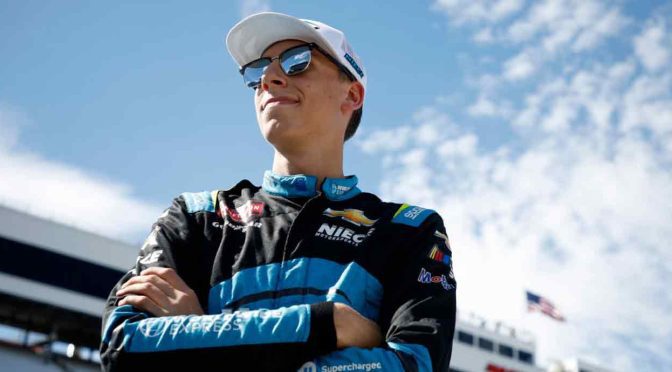
Nothing has come easy for Layne Riggs from the moment his auto racing career began.
A veteran in late model stock car competition despite being just 20, the second-generation competitor from Bahama, North Carolina, has fought for every victory with a small operation, all while waiting for the right opportunity to follow in his father Scott Riggs’ footsteps as a driver in one of NASCAR’s top three divisions.
The decision to bet on himself by going for a NASCAR Advance Auto Parts Weekly Series title paid off for Riggs, who joined a long list of notable national champions with a stellar season that saw him claim 16 victories at five tracks, as well as a track championship at Virginia’s South Boston Speedway.
Going for the national championship was challenging for Riggs on several fronts. He admitted being able to reflect on and cherish what he accomplished in 2022 with his team has been equal parts cathartic and validating.
“It’s been great to celebrate with my team and bask in our glory,” Riggs said. “In the moment when we were winning all the races, it was hard to celebrate anything, as we had to focus on the next day of racing. You couldn’t enjoy the time, but we had a huge team party, and it was great to share stories and celebrate what we did, especially since we’ll probably never do this again.”
Even though he has a familiar last name, Riggs does not see himself much different than the blue-collar drivers who dominate short tracks along the East Coast.
Most of the crew members who assist the Riggs family with their late model stock car program are volunteers, all of whom have worked tirelessly to keep the cars competitive with other top-tier organizations that include JR Motorsports and Sellers Racing Inc.
Being a student at UNC Charlotte only served to complicate matters for Riggs as he poured every ounce of energy into defeating defending Weekly Series champion Peyton Sellers, but he managed to find the perfect balance by constantly communicating with his team about what he needed to be comfortable in his car.
Layne Riggs (99) had to battle Peyton Sellers (26) all year for the NASCAR Advance Auto Parts Weekly Series title, with Riggs ultimately prevailing by four points. (Joe Chandler/South Boston Speedway)
The maturity and composure Riggs needed to stay focused amid his hectic schedule came about by perfecting his race craft against many talented competitors, which included current NASCAR Xfinity Series driver Josh Berry, Bobby McCarty, Deac McCaskill and Jared Fryar.
Without those people to lean on in his developmental period, Riggs believes he would never have gotten close to the Weekly Series crown.
“This past season served as my final exam for late model stock racing,” Riggs said. “I’ve learned so much from all the veterans out there, but I had to apply all the knowledge. You don’t really see that growth until you look back and see all the steps you’ve made, but every aspect of myself has gotten better.”
In the middle of his pursuit for the national championship, Riggs finally got the opportunity to make his NASCAR national series debut by signing a three-race deal with Halmar Friesen Racing in the Craftsman Truck Series.
Riggs wasted no time showing the broader NASCAR fan base the talent he possesses. During his first race at Lucas Oil Indianapolis Raceway Park, after starting 23rd, Riggs patiently climbed his way through the field and challenged many of the best drivers in the Truck Series before ultimately settling for a seventh-place finish.
The next two Truck Series appearances for Riggs saw him carry over the momentum from his performance at IRP. While he did not eclipse his career-best finish, Riggs qualified fourth at Richmond Raceway and second for the season finale at Phoenix Raceway, where he led five laps after passing eventual Truck Series champion Zane Smith shortly after the initial start.
Riggs is currently working on securing the necessary funding to compete in the Truck Series full-time in 2023. Details are still being sorted out, but Riggs hopes to at least get approval for the opener at Daytona International Speedway before seeing how the rest of the year turns out from a financial standpoint.
A more active presence in the Truck Series means Riggs will move on from the discipline that shaped him into the driver he is today, but he still plans to compete in a handful of late model stock car events when he has free time.
“I’ll probably do the Josh Berry schedule where I race [late model stocks] on off weekends,” Riggs said. “There won’t be a set schedule, so I obviously won’t be running for any championships, but you’ll definitely see me at some short tracks just having fun.”
With a national championship under his belt, Layne Riggs is preparing to embark on what he hopes will be a full NASCAR Craftsman Truck Series schedule next year. (Joe Chandler/South Boston Speedway)
Riggs hopes the success and notoriety he enjoyed in 2022 is a positive sign for other blue-collar racers looking to break into NASCAR’s top ranks.
Throughout his late model stock car career, Riggs has come across plenty of drivers he knows would excel in NASCAR’s top series if given the right opportunity. Having been in that crowd himself, Riggs would love to see those same veterans follow a similar path, and he believes ongoing changes in the industry might one day allow them to do so.
For now, Riggs intends to represent the Southeast short track industry as both a Weekly Series champion and a Truck Series competitor. He anticipates a rigorous learning curve during his first year in the division, particularly when it comes to figuring out aerodynamics and going up against the diverse Truck Series roster.
“In the late model world, you have your select veterans that are always up at the front racing each other,” Riggs said. “When you go to the Truck Series, there are so many more of them. The best from the grassroots made it to the Truck Series, so there’s going to be a lot of competition. I felt like I was the best in my area, so I think I’m up to the task.”
Plenty of obstacles lie ahead for Riggs as he transitions into a new phase of his career, but he is ready to embrace the pending adversity and show that his national championship is the first of many NASCAR accomplishments to come.
The 2022 NASCAR season was one to remember, from the season-opening thrillers at Daytona International Speedway to the championship trophy celebrations at Phoenix Raceway. For one last time this year, make your voice heard through exclusive props for a chance to win points and prizes and make sure to tune in to the NASCAR Awards show Saturday, Dec. 3 at 8 p.m. ET on Peacock.
Editor’s note: With Champion’s Week in Nashville ongoing, NASCAR.com will look back at every playoff round of the 2022 season in all three national series.
Race 1: At Las Vegas Motor Speedway, Oct. 16
Sean Gardner | Getty Images
Winner: Joey Logano
Key highlights: Christopher Bell became collateral damage when Bubba Wallace and Kyle Larson tangled on the frontstretch, eliminating the No. 20 team from the race early while fellow playoff driver Ryan Blaney spun late. Joey Logano, meanwhile, charged past Ross Chastain in the closing laps for a critical win that propelled the No. 22 Team Penske Ford into the Championship 4 round.
Key highlights: Chase Briscoe found trouble early and was the lone playoff driver to crash out of the race, but a mistake leaving pit road left Ryan Blaney spinning through Turns 1 and 2 and plummeting down the running order. Kyle Larson, eliminated in the Round of 12, charged to the win fending off Ross Chastain.
Key highlights: With his back against the wall once again, Bell netted the most clutch win of his career to date, catapulting his No. 20 Joe Gibbs Racing team into the Championship 4 with another walk-off victory in the second straight round. Farther back, Ross Chastain used the outside wall in Turns 3 and 4 for an unheard-of full-throttle send to move from 10th to fifth (and then to fourth through post-race inspection) to advance into the title round with Chase Elliott.
Editor’s note: With Champion’s Week in Nashville ongoing, NASCAR.com will look back at every playoff round of the 2022 season in all three national series.
Race 1: At Las Vegas Motor Speedway, Oct. 15
Sean Gardner | Getty Images
Key highlights: After hitting the outside wall in the battle for the lead, Josh Berry was able to manage his car without issue and maintained the lead to secure his berth in the Championship 4. AJ Allmendinger was the only playoff driver to finish outside the top 10 after a pair of loose wheels derailed his day.
Key highlights: The day belonged to the driver of the No. 9 JR Motorsports Chevrolet. Leading 127 of 200 laps, Noah Gragson held off the field on a late restart to secure his well-earned spot in the Championship 4 with win No. 8 on the season. Playoff driver Justin Allgaier had an eventful race, finishing 10th after falling a lap down.
Key highlights: The season’s penultimate race was filled with tension, heartbreak and hurt feelings. Ty Gibbs picked up a win after spinning his teammate Brandon Jones entering Turn 1 on the final lap. Justin Allgaier secured the final spot in the Championship 4 after rubbing fenders with fellow playoff driver AJ Allmendinger, causing Allmendinger’s No. 16 Kaulig Racing Chevrolet to suffer a flat tire.
Editor’s note: With Champion’s Week in Nashville ongoing, NASCAR.com will look back at every playoff round of the 2022 season in all three national series.
Sean Gardner | Getty Images
RACE 1: At Bristol Motor Speedway, Sept. 15
Winner: Ty Majeski
Key highlights: Short tracks, naturally, can lead to late-race restarts. Such was the case at the half-mile oval during the Round of 8 opener, where Majeski rocketed ahead of Zane Smith with 12 laps to go, never looked back and claimed a spot in the Championship 4 as a result.
Key highlights: Despite not being a direct participant in the playoff field, the 31-year-old for Rackley W.A.R. didn’t cease from securing his first career win in the truck circuit. Among all Round of 8 drivers, only two finished inside the top 10 (Ben Rhodes in second and Christian Eckes in fifth).
Key highlights: In what amounted to his second Round of 8 victory (and second in the series overall), Majeski cemented his place as a go-to championship favorite. While both Smiths — Zane and Chandler — locked in their Championship 4 bids by double-digit points (+23 and +13, respectively), Rhodes (+1) secured his spot by the slimmest of margins over Stewart Friesen, despite finishing just behind him in the race (third compared to sixth).
Editor’s note: With Champion’s Week in Nashville ongoing, NASCAR.com will look back at every playoff round of the 2022 season in all three national series.
Race 1: At Texas Motor Speedway, Sept. 25
James Gilbert | Getty Images
Winner: Tyler Reddick
Key highlights: Attrition played a significant role in the opening race of the second round, with playoff drivers Alex Bowman, Chase Elliott and Christopher Bell crashing out of contention, and Bowman sustaining a concussion that sidelined him from competition and eliminated him from the postseason. After William Byron sent Denny Hamlin spinning under caution, Tyler Reddick outlasted the field and fended off Joey Logano for the race victory.
Key highlights: The 2.66-mile superspeedway known for producing chaos surprised everyone with its lack of drama despite a nail-biting finish. Elliott scored the first postseason win for a playoff driver by just 0.046 seconds over Ryan Blaney for a series-high fifth win of the year.
Race 3: At Charlotte Motor Speedway road course, Oct. 9
Mike Mulholland | Getty Images
Winner: Christopher Bell
Key highlights: Chase Elliott dominated the day with 30 laps led, but late cautions shook up the running order. Elliott was sent spinning to a 20th-place finish while Christopher Bell rallied for an improbable walk-off victory in a must-win situation, advancing him to the Round of 8 while a mistake by Kyle Larson and mechanical issues for Daniel Suárez thwarted their title hopes.
For only the second time in his long career, Jon McKennedy in 2022 ran all the races on the NASCAR Whelen Modified Tour schedule.
The 35-year-old from Chelmsford, Massachusetts, turned his second full season with the Tour into his first series championship.
Driving for team owner Tim Lepine, McKennedy used incredible consistency to secure his championship. In 16 races this season, McKennedy finished outside the top 10 just three times, scoring seven top-five finishes and his second career victory at Claremont Motorsports Park on July 29.
“This is the icing on the cake for Jon McKennedy and all the guys that have been behind me for most of my racing career,” McKennedy said. “I want to say I really wish my dad was here. He passed a few years ago. I know he’s looking down. My dad was a huge supporter of my racing going back in the late ’90s when we started off in those little racing karts.
“Never give up. My dad was always a believer that effort equals success.”
Jon McKennedy celebrates after winning the NASCAR Whelen Modified Tour championship during the Virginia is for Racing Lovers 200 at Martinsville Speedway on Oct. 27, 2022. (Adam Fenwick/NASCAR)
McKennedy entered the NASCAR Whelen Modified Tour finale at Martinsville Speedway on Oct. 27 as the championship leader, six points ahead of Ron Silk, 11 points ahead of Justin Bonsignore and 13 points ahead of Eric Goodale.
“I knew in practice we had a good long run car, and physically I felt awesome,” McKennedy said.
Throughout the finale, McKennedy was the best of the championship contenders. He appeared to be in position late in the race to win, but contact while racing at the front of the pack sent him spinning down the backstretch and into Turn 3.
Luckily the damage to McKennedy’s car was minor enough that he was able to continue. He rebounded to finish 12th, which allowed him to secure the championship by six points ahead of Silk.
“At one point I thought we were sitting in a good spot to win,” McKennedy said. “Obviously that last restart there was some misjudging off of (Turn) 2. I felt a big bump and next thing you know I was crashed. That’s definitely disappointing, I didn’t expect that.
“It’s amazing though we were able to even finish and be champions considering the situation. We were in a really bad spot there, spinning in the middle of the back straightaway.”
In his only other full-time season with the NASCAR Whelen Modified Tour in 2020, McKennedy finished second in the series standings.
Prior to becoming a seasoned veteran, McKennedy made his first venture into the series back in 2006 at the age of 19, when he earned two top-10 finishes in eight starts. It took him until 2017 to earn his first top-five finish, a fifth-place run at Stafford Motor Speedway.
One year later, McKennedy scored his maiden NASCAR Whelen Modified Tour victory at Myrtle Beach Speedway in South Carolina driving the famous 7NY for Tommy Baldwin Racing. That stood as his lone Tour victory until his triumph earlier this year at Claremont.
“I look back over the last 10 years, I’ve probably only had 65 or 70 Whelen Modified Tour starts,” McKennedy said. “There were several years I didn’t race the Modified Tour, or the few years I did it was only a couple of races. To do it ourselves with my dad and all of our guys going back years ago we didn’t have the backing or the sponsor to do it. We didn’t have the manpower.
“I was fortunate enough looking back a few of years ago, Tommy Baldwin Jr. called me out of the clear blue. I was literally sitting in a 10-wheeler hauling gravel. Tommy called me and said, ‘Hey McKennedy, it’s Baldwin. I want to try you down at New Smyrna this winter. If you do good, the ride is yours.’”
Jon McKennedy, driver of the No. 79 Modified, looks on during the New Smyrna Visitors Bureau 200 for the NASCAR Whelen Modified Tour during night two of the World Series of Asphalt Stock Car Racing at New Smyrna Speedway in New Smyrna, Florida on February 12, 2022. (Photo: Adam Glanzman/NASCAR)
McKennedy’s partnership with Baldwin ended up lasting four years, which included a full NASCAR Whelen Modified Tour schedule in 2020. Without the opportunity, McKennedy believes he never would have found himself celebrating a series championship at the conclusion of the 2022 season.
“I feel like I owe a big thanks to Tommy,” McKennedy said. “He kind of got me into the Modified Tour the last few years where I made a little more of a name for myself at this level.”
A lot of things could have been different for McKennedy during the 2022 NASCAR Whelen Modified Tour season, but when the final race was run and the points were tabulated, it was McKennedy who joined the likes of Richie Evans, Tony Hirschman Jr., Mike Stefanik, Doug Coby and Justin Bonsignore as a NASCAR Whelen Modified Tour champion.
“At the end of the day we are NASCAR Whelen Modified Tour champions, and I am extremely satisfied,” McKennedy said.
Paul Wolfe’s partnership with Joey Logano nearly began many years earlier, back when the young crew chief was a budding talent atop the pit box looking for a steady NASCAR gig, and back when the teenaged driver was most closely connected with the “Sliced Bread” nickname as a next-big-thing prospect.
“It’s funny how this works out, what a small world it is,” Wolfe says, retelling the story of that crossroads moment now, just weeks removed from winning a Cup Series championship with Logano and with both now as veterans at the top of the stock-car world.
Wolfe was still finding his way after his driving days had ended, earning a reputation for extracting the most performance from equipment that wasn’t quite elite. By 2009, the team that employed him was headed for a shutdown at season’s end, and two solid offers in the Xfinity Series were in the works.
Jared C. Tilton | Getty Images
Brad Keselowski wanted him to be part of his move to Team Penske and a full-time Xfinity campaign. Joe Gibbs Racing had interest in pairing him with Logano, then a Cup Series rookie who still ran a majority of the Xfinity events.
After some initial resistance, Wolfe went with the less-established Xfinity program. He’s been under Roger Penske’s employ ever since.
“I just saw it as an opportunity to build something, rather than just taking over,” Wolfe said. “I don’t know, the thought of building something from nothing was more exciting to me. And that’s really what was the deciding factor for me to go to work at Penske.”
Years later, the 45-year-old Wolfe will be feted with Logano at Champion’s Week festivities in Nashville. It’s the second Cup Series championship for both, and Wolfe has joined the short list of crew chiefs to win premier-series titles with multiple drivers.
It’s been a life’s journey to arrive at this point, with a decade in between those crowning achievements. “Building something” has been more than a deciding factor. For Wolfe, it’s been a mantra.
Starting to grow
“I’ve been in racing for a long time and if you want something, you have to work hard for it. Eventually it’s going to pay off for us.” – Paul Wolfe, Poughkeepsie (N.Y.) Journal, Oct. 5, 2001
Paul Wolfe knew he wanted to be involved with racing early on. Growing up in Milford, New York, Wolfe watched his father, Charlie, compete in Modifieds as a regular at tracks in his home state – Fonda, Utica-Rome, Five Mile Point. He started in go-karts just after turning 10 years old, and soon began traveling in that youth circuit before moving up the ladder.
His younger brother, Steve, took a similar path, but with more of a focus on high school sports than in karting circles. His athleticism later led him to over-the-wall duty, serving as a tire changer for Dale Earnhardt Jr.’s No. 8 among other teams. Today, he’s in an assembly manager’s role at 23XI Racing.
Wolfe’s ambitions led him to move closer to the NASCAR hub in North Carolina in 1996, when he connected with Coy and J.D. Gibbs in their Late Model days. That opened the door to some driving, some building on the fabrication side, and a wealth of foundational learning. All the while, Wolfe had a career safeguard in place.
“I took my New York state tests to be a certified welder. We can work on bridges and do that kind of work,” Wolfe says, recalling his six months of training on a vocational school scholarship in Ohio. “That was kind of like my backup plan if the NASCAR stuff didn’t work out, because I could make a living as a welder. So I kind of had that with me as I went down south.”
His association with the Gibbs organization led to opportunities in the Busch North Series, which evolved into the ARCA Menards Series East. Wolfe drove partial schedules in five seasons (2000-04), netting two pole positions and a best finish of second place on four occasions.
Getty Images
Wolfe later drove part-time in the Xfinity Series, making 16 starts with team owners Tommy Baldwin, Ray Evernham and FitzBradshaw Racing. His time with the Baldwin operation was as part of the team’s Hungry Drivers Program, an audition among several prospects seeking full-time rides, but those part-time seats ran dry by the time 2005 came to a close.
“There just really wasn’t anything for me,” Wolfe says. “I didn’t have any sponsors or anything like that. So I was like well, I got into the sport, learned it as a mechanic, doing it as a fabricator, I can pretty much do anything, and it was like, ‘Well, I’ve kind of got to make a living here.’ ”
Wolfe found steady work with a handful of mid-level teams, starting as a set-up specialist in a shop-based position. But the lure of being at the track was still strong, and a crew chief role was the natural progression.
The list of drivers Wolfe worked with the next few years was extensive – Mike Skinner, Denny Hamlin, Robby Gordon, Scott Lagasse Jr., Jason Leffler among others – but he had no wins to show for the strong showings. Two full-time opportunities were open for 2010, and when Penske representatives pressed him, it seemed like a logical step.
“Oh, man,” Wolfe recalled thinking. “I probably should go talk to these guys.”
Making a bond
“Paul’s very confident in what he does with a race car, and Brad believes in everything he does. That’s a pair to watch in this sport for a long time.” – crew chief Steve Addington, AP, Aug. 16, 2012
One of the most enduring driver-crew chief pairings in recent NASCAR history wasn’t exactly love at first sight. Brad Keselowski had invited Wolfe to meet with him in his motor coach at Michigan International Speedway in August 2009, hoping to forge a partnership for the next season.
Wolfe recalls Keselowski not being able to say precisely where he was headed at the time, but there was already some hesitation concerning a potential clash in personalities. Keselowski had started to establish himself as an up-and-comer with a winning pedigree, but his brash reputation came in sharp contrast to Wolfe’s calm, reserved demeanor.
“Honestly, I wasn’t a big Brad fan, to be honest with you,” Wolfe says. “At that time, I don’t really like this guy, you know, I like where I’m at. I pretty much said, ‘I appreciate taking the time to meet but I think at this point, I’m all set,’ and just basically just told him I didn’t want to do it. And that was that.”
Penske officials, however, had taken their own separate liking to Wolfe, something they later broached with Keselowski.
“I guess Brad told them, ‘Don’t even bother. I’ve already met with him. He turned me down,’ ” Wolfe said.
“I kind of laughed and said, ‘Good luck,’ ” Keselowski told the AP in 2012. “They said, ‘we’ve been talking to him the last two weeks and he wants to do it.'”
The change of heart stemmed at least partly from Wolfe’s uncertain future with the CJM Racing team, which was nearing an offseason closure. The chance to build anew with an organization that was entrenched and expanding in the Cup Series was there.
Tom Pennington | Getty Images
What emerged was one of the most dynamic driver-crew chief debuts in national-series history. Keselowski clinched what was then called the Nationwide Series championship with two races left on the schedule, racking up six wins and amassing 26 top-five finishes in 35 starts. He completed all but one of the 6,489 possible laps and led 1,147 of those (17.7 percent). His average finish for the season was a spellbinding 5.2.
“I guess when you’ve had to work with not much for so long, we became efficient and got the most I could out of what I had,” Wolfe said. “And then you go to Penske, and there’s so many resources and people and technology that I was like, I don’t want to say it made it easier, but I just used what I learned through my struggles and then took what they had, and we were able to build something great.”
The growth continued once Wolfe joined Keselowski in the Cup Series in 2011. The year before, Keselowski had some initial difficulty adjusting to the move up to NASCAR’s top division as a rookie, but gained ground after partnering again with Wolfe. A three-win campaign set the stage for a memorable championship march the next year, delivering Roger Penske his first Cup Series title in 2012.
Victory Lane visits were regular events for the two, who posted at least one win in each of their nine seasons together. But the push for a second title for the No. 2 Ford team came no closer than Keselowski’s Championship 4 appearance in 2017.
“We were both pretty young and didn’t know any better. I feel that’s the essence since I’ve won my second championship, really,” Wolfe said. “At that time, I honestly didn’t know no better. I didn’t realize how hard it really is, and maybe that was why we had so much success is because we just we didn’t know any better. We were just working hard and going racing and having fun. And then you look, it’s taken 10 more years to get another one.
“This is harder than you think it is, and it takes so many pieces of the puzzle to get them together right, to really have a legitimate shot at racing for a championship.”
Logan Riely | Getty Images
Moving the pieces
“There’s nothing sinister here, it was just time for change.” – Roger Penske, AP, Jan. 27, 2020
The offseason bomb dropped just after the new year in 2020, altering the driver-crew chief composition at Team Penske in a dramatic three-team swap. Keselowski and Wolfe had won an organization-best three races the year before, but an early elimination in the playoffs and performance lapses across the board prompted the Captain to shake up the status quo.
“It just felt like it got stagnant. Yeah, we were still winning races but I felt like we could be better than that, and I’m assuming that’s what Roger felt as well,” Wolfe says now. “I don’t know the conversations between the drivers and Roger, where they were on all that, but when the idea was kind of presented to me, I was open to talk about it, for sure. It was no disrespect to anyone or Brad. We accomplished a lot together, had a lot of success together, but it just felt like we weren’t going anywhere from there. It was just, we had our struggles. I don’t know, it felt like a fresh start, maybe what all of us needed.”
Logano was just more than one year removed from his first Cup Series championship with crew chief Todd Gordon in 2018, but the same degree of success was elusive the next year. He and Wolfe weren’t total strangers when they first joined forces, but the veteran crew chief had to adjust his approach to a different driving style.
The dividends were seemingly instant to kick off 2020, as Logano and Wolfe won two of the first four Cup Series races, prevailing at Las Vegas then Phoenix. Days later, the sport shut down after the COVID-19 outbreak, and their progress had to shift again when racing returned without practice and qualifying. Wolfe had to learn on the fly that what worked with Keselowski did not with Logano.
“As we got going here, trying to understand the differences, like, once Joey puts on that helmet, all’s he is focusing on is driving that race car,” Wolfe said. “I don’t know if that’s just what he was used to with Todd or whatever it was, but there were many moments where there were what I would call tougher decisions strategy-wise and Joey was nowhere to be had for a conversation about how we should go about this. It was like, ‘Just tell me what to do.’
“I’d worked with Brad for 10 years, and we had spreadsheets for as the race is playing out. Brad and I always kind of worked through the strategy side together in adjusting on the car, and this is what I think I need. Early on with Joey, there was none of that, so that was like a big adjustment for me. I’m like, ‘This is not what I’m used to, but I’m going to have to figure this out or this isn’t going to work.’ ”
Wolfe also had to mesh with a driver who brimmed with confidence when everything clicked. “I’m probably just the opposite, pretty matter-of-fact,” said Wolfe, who opted not to rein Logano in when he was riding his highest this season.
Sean Gardner | Getty Images
Instead, Wolfe stood by his driver when he declared himself the favorite ahead of this year’s playoffs, then doubled down on the notion once teams arrived for the season finale earlier this month. Two additional factors allowed Wolfe to roll with Logano’s vibe – a successful organizational test at Homestead-Miami Speedway just weeks earlier, plus a Championship 4-clinching win at Las Vegas that allowed the No. 22 team more time to prepare for the title event.
“I knew going to Phoenix, with our past history there with Joey that if we had speed in our car, I had no doubt in my mind that he was going to get the job done,” Wolfe said. “Never once did it cross my mind whether or not we’re gonna have to worry about where Joey was. He was going around telling everyone how he was the favorite and he was going to get it done. He was confident. I just wanted to give him the best opportunity I could. And as a team, we did that, and he showed how good he is. … That was a pretty damn good weekend for us. I don’t know how you could ask for it to be it be much better.”
Logano thrived in his self-assurance, but he also fed off Wolfe’s determination. The race-day preparations for the Phoenix finale began with meetings that Wolfe arranged before the sun had crested the desert hillsides, and Logano appreciated the lengths that his crew chief would go to for the team’s overall goals.
“I’m just happy for him. Paul wants it bad,” Logano said after the team’s champagne-soaked celebration. “Like I said, the way he was preparing, what he was doing, he put a lot on him over the last few weeks. I don’t know how he handles his pressure. Everyone kind of has their own way of what they do. And I’m able to shut off when I go home. Paul is a lot quieter person than I am. If I get him to smile or cheer a little bit, I feel like I’ve really done something. I feel like he holds a lot of things inside, where I vent everything.
“It’s been, I think, a tough few weeks for Paul and his family. Like I said, it’s hard. And the commitment that he put in the last couple weeks, I know his family sacrificed dad time and husband time to do this. And so obviously I greatly appreciate that, and that’s why I’m so happy for him, because it takes a lot to do it, and hey, here we are.”
At age 45, Wolfe says the sacrifices that Logano mentions have made him think about what’s next “more now than ever.” His 8-year-old son, Caden, has followed his father’s path to go-kart racing, and his daughter, Halle, is now 5.
Greg Ives recently stepped down from a weekly crew chief role with Hendrick Motorsports’ No. 48 team, opting for a position within the organization’s competition department that required less travel. Ives’ son Parker regularly competes on the same go-kart circuits as Wolfe’s son.
“Thinking back to those years and how I got started, I just remember those were some of the best times I had with my dad just traveling all over the country racing go-karts, just doing those things as a family and what that taught me,” Wolfe said. “You know, I see those years passing by pretty quick here, now that my son’s already 8. It’s a tough balance because this job has allowed me to do these things.”
Whatever direction he follows, Wolfe says he hopes to remain active in the sport – either in his current role or something new. Wolfe said his contract with Team Penske runs through the end of next season, providing him the better part of a year to make a long-term decision.
In the shorter reach, helping Logano become the first repeat champion since Jimmie Johnson’s record run of five consecutive titles ended in 2010 is the next building block on the list.
“So I’m not going anywhere next year, that’s for sure. I’m gonna take another run at it,” Wolfe says. “But how many years past that? I don’t know yet. I’ve got to put more thought into that. But just proud of what we’ve been able to do at Penske and like I said, now to do it with Joey is really pretty cool.”
DAYTONA BEACH, Fla. (Nov. 28, 2022) – Rising country music artist Erin Kinsey will take the stage to help NASCAR celebrate a 2022 season highlighted by breakthrough moments from many young stars of its own.
The RECORDS Nashville singer-songwriter will perform her debut hit single, “Just Drive,” which has been featured on SiriusXM The Highway “On The Horizon” and amassed more than 40 million streams and views to date, during the NASCAR Awards and Champion Celebration invite-only event this Thursday, Dec. 1, at the Music City Center in downtown Nashville.
“Getting the opportunity to perform at the NASCAR Awards is such an honor, especially with it being in Nashville,” says Kinsey. “As a bit of a speed demon myself, I really admire the amazing drivers who have made incredible careers out of driving fast! This is also my first tv performance, so I am just so excited to get to play a small role in such a huge night for NASCAR. Congratulations to all the winners!”
While Kinsey’s first-ever televised performance marks an exciting career milestone, it will not be her first time gracing the stage at a NASCAR event. The 22-year-old Texas native also performed the National Anthem prior to the NASCAR Cup Series race at Texas Motor Speedway this past May.
Fans can tune in to watch the 2022 NASCAR Awards, including Kinsey’s performance, when it airs Saturday, Dec. 3 at 8 p.m. ET on Peacock. In addition to two-time Cup Series champion Joey Logano, NASCAR will also honor first-time Xfinity Series champion Ty Gibbs and first-time Camping World Truck Series champion Zane Smith as part of the celebration.
Editor’s note: With Champion’s Week in Nashville ongoing, NASCAR.com will look back at every playoff round of the 2022 season in all three national series.
Justin Casterline | Getty Images
RACE 1: At Lucas Oil Indianapolis Raceway Park, July 29
Winner: Grant Enfinger
Key highlights: A return to the popular track for the first time in 10 seasons (2011) quickly saw the playoff field get busy. Leading the field to the checkered flag was playoff driver Enfinger, who snapped a 38-race drought without finding Victory Lane.
Key highlights: Although Ty Majeski held the initial advantage after winning Stage 1, Smith — a fellow playoff competitor — would be the one to seize the opportunity and hold onto it, leading the final 175 laps on the way to his third win of the year and a berth in the following postseason round.
Key highlights: Although Enfinger and Smith already had their Round of 8 positions secure, eight remaining hopefuls — including Nemechek and Carson Hocevar — looked to find their seat in the next round as well. While Hocevar finished runner-up behind Nemechek (despite the latter pitting after the former during the race), the finish wasn’t enough for the No. 42 Chevrolet to move onward in the postseason.