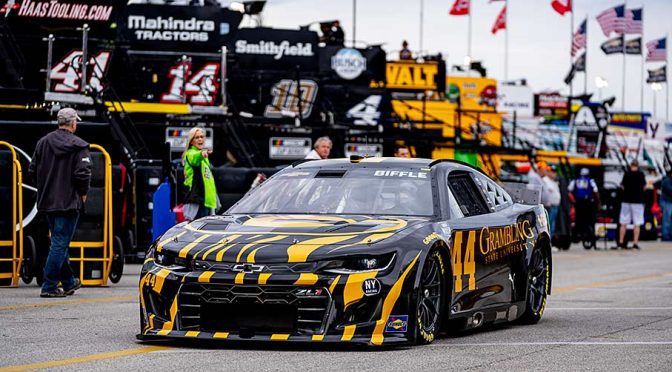
DAYTONA BEACH, Fla. — Greg Biffle was the last driver to take to the track for the first practice—with 15 minutes left in the session.

But Biffle, driving for the newly-formed NY Racing Team, teamed up in a two-car draft with another driver who isn’t guaranteed a spot in Sunday’s race. He and Noah Gragson were 17th and 18th, respectively, in the opening practice session.

RELATED: Biffle back with NY Racing Team | Daytona weekend schedule

Biffle and Gragson, both driving Chevrolets, are two of the six drivers fighting for four starting spots in The Great American Race. The other four occupied the following spots on the initial speed chart: Timmy Hill (27th), JJ Yeley (34th), Jacques Villeneuve (40th) and Kaz Grala (41st).

Hill, Yeley, Villeneuve and Grala confined their activity in practice to single-car runs.

Biffle hasn’t raced in the NASCAR Cup Series since 2016, but he ran—and won—a NASCAR Camping World Truck Series event for Kyle Busch Motorsports in 2019, one of two NASCAR starts for the 52-year-old driver since leaving full-time racing.

“I can’t forget about 2019—I ran a truck race—and that’s been luring me back,” Biffle said. “I’ve been talking to (team owner) John (Cohen) for a couple of years now, and I told him, ‘If you get a program put together, I’ll come help you,’ and here we are. So I’m glad to be back.”

In the day’s second practice session, Grala was the top car among the open teams in 22nd, followed by Gragson (32nd), Biffle (36th), Hill (40th), Villeneuve (41st) and Yeley (42nd).

DAYTONA BEACH, Fla. — Unloaded and unleashed.

NASCAR teams took out the Next Gen cars for their first official hot laps around Daytona International Speedway on Tuesday. There were two 50-minute practice sessions in preparation for Sunday’s season-opening Daytona 500 (2:30 p.m. ET on FOX, MRN and SiriusXM NASCAR Radio).

The reigning Cup Series champion, Kyle Larson, welcomed in the new era as the first driver to roll out of the garage. And the defending Daytona 500 winner, Michael McDowell, closed out the day’s work with the fastest lap time overall.

DAYTONA 500: Weekend schedule | Betting odds | All-time winners

“These cars are definitely bouncing a little more,” McDowell said. “I don’t think they drive any harsher. Like last year, the cars were low to the ground as well and were pretty stiff. It’s just a different feel altogether. …

“I also think that there’s a lot of people that were trying things in those first two practices – see what they can get away with, how aggressive you can be. There’s a lot of cars with a lot of reverse skew, bouncing and moving around quite a bit. Some of them look very un-fun driving. But come race day, you’re going to need something that you can be aggressive with.”

McDowell posted the best lap time in the opening practice at 46.696 seconds and 192.736 mph. Ryan Blaney turned the quickest circuit during the second go-around at 46.732 seconds and 192.588 mph. Fords swept the top five slots in both portions, even going for all 10 in the latter.

For comparison from 2021: Bubba Wallace claimed top rank of Practice 1 at 45.057 seconds and 199.747 mph. Brad Keselowski topped the Practice 2 leaderboard at 45.826 seconds and 196.395 mph.

TUESDAY: Practice 1 results | Practice 2 results | Overall practice recap

Speedweeks has two more practices on tap, but they’re not until Friday and Saturday. Qualifying is Wednesday, and both of the Bluegreen Vacation Duels are Thursday.

“I’m just gonna say it: You’re going to minimize your risk,” McDowell said. “I mean, you’re not going to put yourself in a really bad situation on purpose. For me, I won’t. Just because of where we’re at from an inventory standpoint, how important all the races are. And yes, it does pay points, so if you can put yourself in position to score some stage points, you’re going to want to do that. But it’s really a risk. It’s probably not worth it on Thursday. It’s definitely worth it on Sunday.”

SPEEDWEEKS: Entry lists, qualifying procedure and more

Three teams made their NASCAR debut: Team Hezeberg with Jacques Villeneuve in the No. 27 Ford, NY Racing Team with Greg Biffle in the No. 44 Chevrolet and The Money Team Racing with Kaz Grala driving the No. 50 Chevy.

And then there were two remixed teams in Roush Fenway Keselowski Racing (Keselowski and Chris Buescher in the Nos. 6 and 17 Fords, respectively) and Petty GMS Motorsports (Ty Dillon and Erik Jones in the Nos. 42 and 43 Chevrolets, respectively).

Then – yes, there’s more – existing teams added new entries. Trackhouse Racing adopted Ross Chastain in the No. 1 Chevy, and 23XI Racing gained Kurt Busch in the No. 45 Toyota. Kaulig Racing upgraded to the Cup Series level, too, with Justin Haley in the No. 31 Chevrolet and Daniel Hemric (as a part-timer) in the No. 16 Chevy.

Other moves worth remembering: Austin Cindric (No. 2 Team Penske Ford) and Harrison Burton (No. 21 Wood Brothers Racing Ford) have both moved up from the Xfinity Series.

SILLY SEASON: Track all of the Cup Series movement

Suffice to say, Tuesday involved more than blowing the dust off the garage.

“Coming to Daytona is special, it always is,” McDowell said. “Driving through the tunnel, you kind of get that feeling. I’m sure a lot of you do as well. When you come in, it’s kind of the kickoff to a new season, a fresh start and a lot of opportunities.”

DAYTONA BEACH, Fla. – Defending Daytona 500 winner Michael McDowell turned the fastest lap of Tuesday’s combined two opening Daytona 500 practice sessions at Daytona International Speedway with a top lap of 192.736 mph in the No. 34 Front Row Motorsports Ford.

RELATED: Second practice results | Odds for the 2022 Daytona 500 | Qualifying order for Wednesday

David Ragan, a former summer Daytona race winner, was second fastest in the No. 15 Rick Ware Racing Ford with a quick lap of 192.666 mph around the 2.5-mile high banks – also setting his fast time in the early session.

Team Penske teammates Ryan Blaney and Joey Logano topped the late practice – leading a 10-Ford contingent atop the speed chart in that session. Daniel Suarez was the top Chevrolet, putting his No. 99 Trackhouse Racing Chevrolet 11th quickest. Christopher Bell was the top Toyota in the last session – 23rd fastest among the 42 cars.

It was the first true practice for a points-paying race in 2022 – important because NASCAR is now using Next Gen cars – a new generation of race cars that look as different to fans as it feels for drivers. It’s already getting rave reviews from both contingents after a competitive Busch Light Clash exhibition a week ago in Los Angeles.

And while teams had an opportunity to test on the Daytona high banks in January, Tuesday night’s pair of practice sessions marked the official beginning of the season.

RELATED: First practice results | Schedule for Daytona Speedweeks | Daytona 101: Everything to know

“Practice, as you know, is situational,” McDowell said. “We sort of had a game plan going into practice to try and work with our Ford teammates, in particular, with the Roush Fenway Keselowski cars. And so we wanted to get out in that group and just kind of play around with the draft and not put ourselves in a bad situation where you’re two or three-wide but just kind of line up.

“It worked out well where we were lined up four or five of the Fords and catching the Toyota pack. Lap time here is very situational on where you get the draft and where you get the runs. But I feel really good about our Ford Mustang. Had good speed, drove pretty well, did all the things you’re looking to do with minimal practice and not being in that three, four-wide crazy situation.

“So I feel good.”

Teams return to the Daytona track on Wednesday night (8:05 p.m. ET on FS1, MRN, SiriusXM NASCAR Radio) for Daytona 500 Busch Pole Qualifying – setting the front row for the Feb. 20 Great American Race (2:30 p.m. ET on FOX, MRN and SiriusXM NASCAR Radio).

Qualifying this year will feature a slightly different format. There will be two rounds – the first consisting of single-car runs with the top-10 cars advancing to a second round. The fastest two cars from that round will earn the front row starting positions for Sunday’s race.

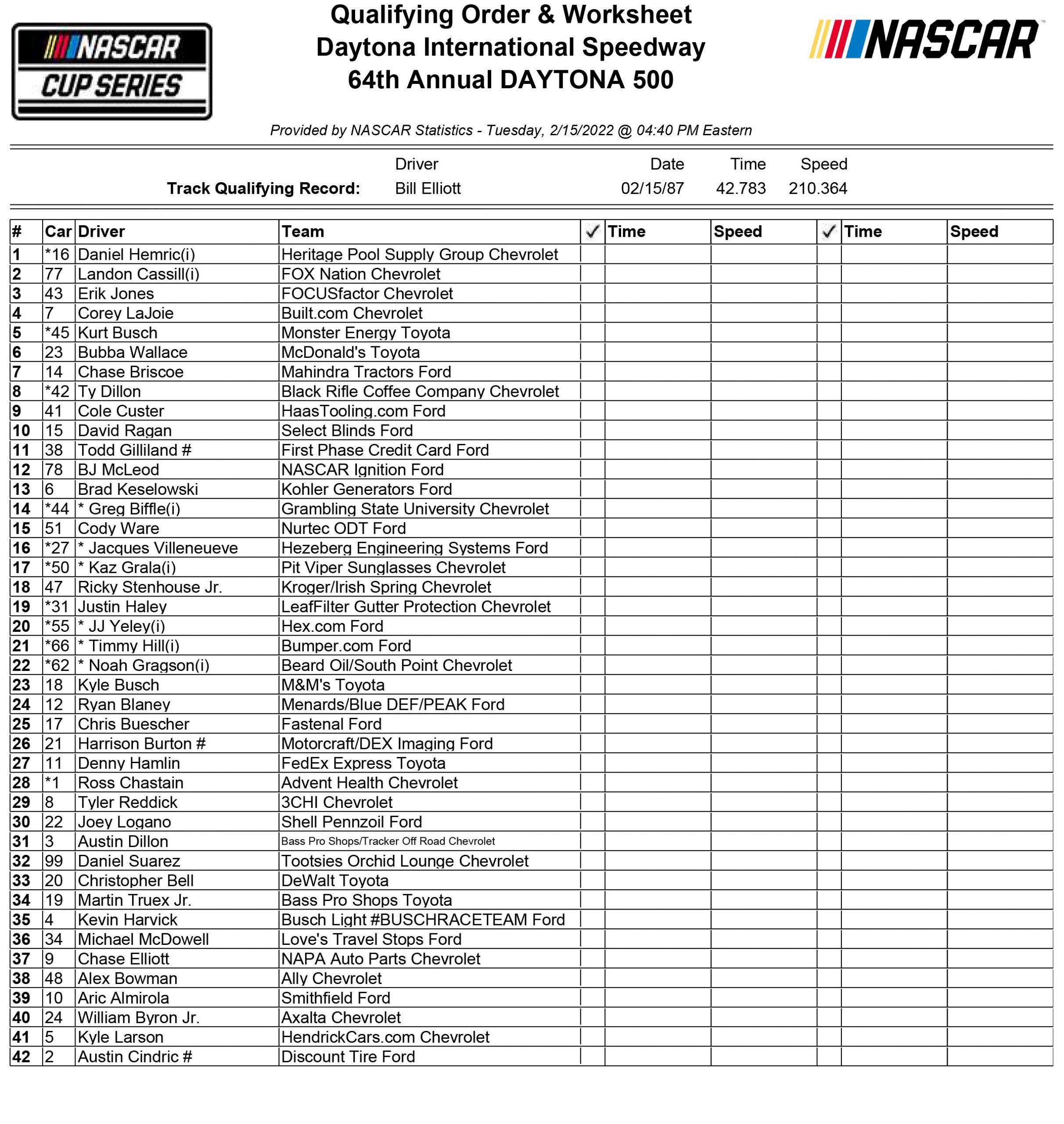
See the order that cars will head out for in the first round of single-car qualifying on Wednesday night (8:05 p.m. ET on FS1, MRN, SiriusXM NASCAR Radio) for the 2022 Daytona 500.

The top 10 cars from Round 1 will advance to the final round with the top two from the final round setting the front row for Sunday’s race (2:30 p.m. ET on FOX, MRN, SiriusXM NASCAR Radio). You can see the full order by clicking the printer icon button above or reading below.

The Action Network specializes in providing sports betting insights/analytics and is a content partner with NASCAR. Check out more NASCAR betting analysis here.

Daytona Speedweeks is officially upon us!

Cars are on track Tuesday (5:05 p.m. ET, FS1) for the NASCAR Cup Series’ first two practice sessions of the week and will be back again Wednesday night for Daytona 500 qualifying (8:05 p.m. ET, FS1).

Daytona 500 odds are widely available, including outrights, finish props and driver matchups, though numbers might adjust after the qualifying session that will set the front row for Sunday’s race.

With this in mind, let’s take a look at two Featured Driver Matchups offering value right now.

RELATED: 2022 Daytona 500 odds | NASCAR BetCenter for the latest from The Action Network 

Daytona 500 Picks

*Odds as of Tuesday morning

Michael McDowell (+150) over Justin Haley

DraftKings Sportsbook has four featured driver matchups posted for the Daytona 500, and this is my favorite of the bunch. And, it’s not just my preferred matchup, but two of The Action Network’s verified experts have also gotten down on this bet as well.

Simply put, there’s no way that an accomplished superspeedway racer and defending Daytona 500 winner should be a +150 underdog to Haley in a race as unpredictable as this one.

Sure, Haley is a strong superspeedway performer as well, but this matchup is much closer to a coin flip than the current odds imply, making McDowell’s +150 side a very enticing one.

Bubba Wallace +3.5 (-110) over Austin Dillon

The reasons to like the matchup are almost exactly the same as the one above. Wallace won the most recent Cup Series race at Talladega last fall, so he’s clearly a driver who knows how to contend at superspeedways.

Dillon is the 2018 Daytona 500 winner, so he’s not too shabby in the draft, either, but again, there’s no way Austin should be such a heavy favorite in the matchup, especially for a race that projects to be extremely random.

By taking Wallace here, we’re getting a three-position buffer AND an underdog price of -110 odds.

Yup, that works for me.

Take a minute to download The Action Network App, which now includes live NASCAR odds and pick tracking as well as the option to follow all of our verified experts.

The odds for the 2022 Daytona 500 are typically balanced, and not much is expected to change as Speedweeks progresses in Florida. 

MORE: Full Daytona schedule | Odds for the 2022 Daytona 500 | Daytona 101

Denny Hamlin, the race favorite, is priced between +800 and +1000 around the betting market. In fact, one bettor likes Hamlin so much that they placed a $10,000 bet on him at +800 at BetMGM to win the 2022 Daytona 500 — meaning the bettor would win $80,000 if the No. 11 Joe Gibbs Racing driver scores his fourth Daytona 500 victory. At multiple sportsbooks, 19 other drivers are listed at 30-to-1 odds or shorter. 

For non-superspeedway races, which are far more predictable than those run at Daytona or Talladega, the favorite’s odds don’t come close to double digits. But the tight pack of pricing for the Daytona 500 mirrors what we’re likely to see on the track this Sunday. 

Driver SuperBook Barstool BetMGM
Denny Hamlin +1000 +850 +800
Ryan Blaney +1200 +1200 +1200
Chase Elliott +1200 +1100 +1000
Joey Logano +1200 +1300 +900
Kyle Larson +1400 +1100 +1000
William Byron +1400 +1400 +1400
Kurt Busch +1600 +1800 +1800
Bubba Wallace +1600 +1600 +1800
Brad Keselowski +1800 +2000 +1600
Alex Bowman +2000 +2000 +1800
Kevin Harvick +2000 +2000 +1600
Kyle Busch +2000 +1600 +1600
Aric Almirola +2000 +2500 +2500
Austin Dillon +2500 +2200 +2500
Austin Cindric +3000 +3000 +2500
Ricky Stenhouse Jr. +3000 +2800 +2500
Christopher Bell +3000 +3000 +2500
Chris Buescher +3000 +3500 +3300
Tyler Reddick +3000 +3000 +2500
Martin Truex Jr +3000 +2200 +2000

While the race itself is preceded by a week’s worth of competitive events, it’s unlikely bettors will see significant odds movement by the time the green flag drops on The Great American Race.   

Two practice sessions Tuesday are followed by qualifying Wednesday, and then the Bluegreen Vacation Duels on Thursday. But Ed Salmons, vice president of risk management at SuperBook USA, doubts anything will transpire that will prompt major adjustments to his numbers. Salmons expects Hendrick Motorsports to be typically dominant in Daytona 500 qualifying — they’ve won six of the last seven poles for The Great American Race. And thanks to the nature of superspeedway racing, we’re not bound to learn much from the Duel races, either.

“It’s restrictor plates. It’s not like one of the guys or one of the teams is just going to drive away from the field,” Salmons said. “I just don’t see a lot that’s going to change things, but who knows, the Fords could look just dominant, and then yeah, they would all get lowered based on that.” 

Sharp Bettors’ Approach To Daytona 

Because of the randomness that comes with plate racing, it’s difficult even for sharp bettors to find an edge. Many sharps stay away from the outright market (betting on a driver to win the race) for Daytona and Talladega. 

“I don’t bet outrights on Daytona or Talladega,” bettor Blake Phillips said. “They’re challenging. Every once in a while, I might place a small bet, have a little bit of fun with it, but I don’t really have much of an expectation of having any sort of a plus-EV (positive expected value) portfolio on that.” 

Phillips will take a similar approach to Daytona he took for the Busch Light Clash at the Coliseum, or any race for which past stats are of little handicapping value. (The Bristol Dirt Race is another example.)  

His approach: Try to spot betting market overreactions in the matchups (betting one driver to finish ahead of another). 

“I’m not betting outrights on (Daytona) because I’m not handicapping it really. I’m playing a very exploitative strategy at these type tracks and races,” Phillips said. “ … For Daytona, it’s just like, who can I get odds on that’s going to keep it clean long enough.” 

Treading Lightly Early In The Season  

As NASCAR rolls out the Next Gen car, bettors are taking a largely watch-and-learn approach this season, particularly when it comes to futures wagering (betting a driver to win the Cup championship). 

“It’s pretty quiet in that market,” Salmons said. ‘The best way I could sum it up is I think the public needs to see some of the new cars and the new teams first before they’re willing to bet it.  

“I’m sure once we get going, and let’s just say if all of a sudden the Penske cars are the best cars — it looked like they had a really good test in Phoenix — so if they come out and have a good showing, their odds will get lowered and people will probably bet them because it’s what they’re seeing. But I think there’s a lot of people just waiting and seeing what’s going to happen.” 

As he’s wont to do, pro bettor Zack White has made a few early long shot futures plays — Chase Briscoe at 750-to-1 odds and Alex Bowman at 30- and 25-to-1 (yes, again) — but he’ll watch how Next Gen racing unfolds and be ready to fire again.

RELATED: Title odds for the 2022 NASCAR Cup Series season | Learn all about the Next Gen car

“Ignoring Daytona for the most part. Will re-assess championship odds after we see some data from Fontana,” White said in a text message.  

“I don’t think we can draw any major conclusions about where the teams are with the new car based on anything we saw at The Clash or anything that we will see at Daytona,” he added. “But who knows, maybe there will be strong market reactions that create opportunity. I’m keeping an eye on it.” 

For Phillips, who doesn’t get too involved in futures, the wait-and-see mentality applies to wagering on races, too, especially this season.  

“The beginning of the season is always kind of weird because with all the changes that happen from season to season, it’s always good to kind of start out light at the beginning,” Phillips said. “I weigh recency a lot heavier than previous results. And now that we’re switching over the Next Gen, we’ve got new team alliances, stuff like that, I’m going to be very, very conservative for the next month or two before I really get comfortable digging in as usual.” 

Marcus DiNitto is Senior News Editor at Gaming Today. He’s been covering sports business for 24 years and sports betting for 11. NASCAR is among the many sports Marcus enjoys betting but often loses on. Follow him on Twitter; do not bet his picks. 
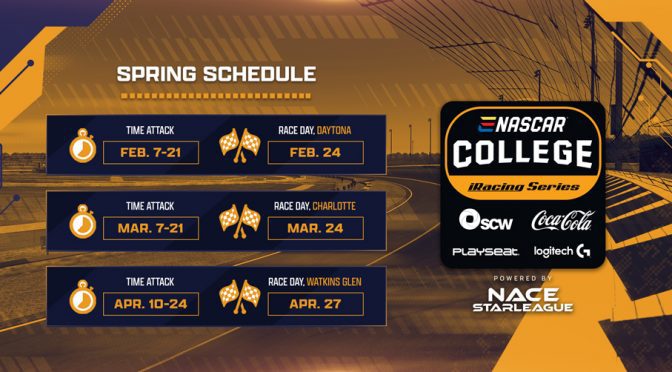
DAYTONA BEACH, FL — College students nationwide will have the chance to compete at Daytona International Speedway — virtually that is. National Association for Stock Car Auto Racing, LLC (NASCAR®) and NACE Starleague, the largest collegiate esports league in North America, announced today the launch of the eNASCAR College iRacing Series, bringing competitive sim racing to more than 500 colleges and universities nationwide.

The new series will be presented by NASCAR Official Partners Coca-Cola, Logitech, Playseat and Southern Computer Warehouse.

“Gaming and Esports are an important component of NASCAR, allowing us to reach new fans who are often engaging with the sport for the first time,” Nick Rend, managing director of gaming and Esports, NASCAR, said. “Our various eNASCAR initiatives have seen exponential growth. We felt this was the right time to extend our reach to a younger audience and launch the eNASCAR College iRacing Series to show students the opportunities that sim racing and our sport hold for them.”

More than 10,000 students will have the option to compete in the eNASCAR College iRacing Series through NACE Starleague, which was established in 2021 as a strategic partnership between the National Association of Collegiate Esports (NACE) and CSL Esports, a Playfly Sports Company.

“It is paramount for CSL Esports and Playfly Sports to continue growing and expanding within NACE Starleague,” Rob Johnson, CEO, CSL Esports said. “Integrating sim racing as part of the league not only provides greater opportunity for students with varied gaming interests, but furthers our long-term mission of linking education, in this case engineering-focused knowledge, with Esports competition.”

The 2022 season opens on Thursday, Feb. 24 with the Playfly Sports 30 race at Daytona International Speedway. Qualifying takes place now through Monday, Feb. 21. The top 40 students who post the fastest qualifying times will advance to the race with the eNASCAR Scholarship Fund awarding the highest finishers a combined $50,000 in scholarships throughout the calendar year.

Students will compete with NASCAR Camping World Truck Series vehicles emblazoned with their school branding. Competition will be led via iRacing.com, the official simulation partner of NASCAR, which provides one of the top online racing simulation portals and features officially-sanctioned, laser-scanned replicas of race tracks around the world.

For more information or to register, visit https://www.enascar.com or https://www.cslesports.com.

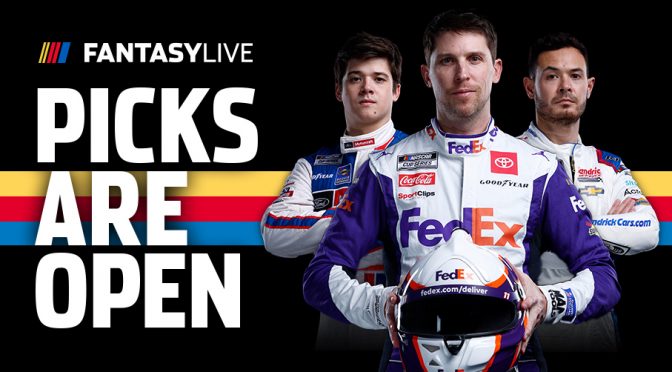
NASCAR Fantasy Live is back in action for the 2022 NASCAR Cup Series season. Players can sign up right now to jump in on the action.

Accessing the game to set your roster can be done by logging into your account and going to the Fantasy page (NASCAR.com/Fantasy). You also can access the game by opening the NASCAR Mobile App, logging into your account and clicking the Fantasy icon on the bottom of the app. Mobile users can also opt in to receive fantasy alerts to help stay on top of their roster each week.

What is the roster composition?
The roster will consist of five starting drivers as well as a garage driver in reserve (more below on that). Picks will open approximately Tuesday of each race week, and driver and garage selections lock five minutes before the race start time.

How does the garage driver work?
Players can substitute their one garage driver for any starting driver up until the start of the Final Stage. Once the Final Stage starts, no more switches are allowed.

So which drivers end up scoring points?
The drivers ending the race in your main roster will comprise the drivers who make up your total score. These are also the drivers who will be counted as being used for that particular race. A driver who ends the race in the garage would not count as being used nor would his or her results count toward your score.

Are there any limits to how much a driver can be used?
Yes, players can only use a particular driver up to 10 times over the 26 regular-season races. A usage tracker will be displayed on your roster screen, showing the number of remaining driver uses you have during the season.

For the playoffs, driver uses will reset, and you can only use a particular driver up to five times over the 10 postseason races. Playoff rosters will consist of five starters and one garage driver. There will be no restrictions on how many playoff or non-playoff drivers you can or can’t use, but you will only be able to use drivers five times during the scheduled playoff portion of the season (slated to be Darlington Raceway on Sept. 4 to Phoenix Raceway on Nov. 6).

What is the scoring system?
The scoring will reflect NASCAR’s scoring system. For example, if Chase Elliott wins Stage 1 and Stage 2 and wins the race, he will earn players 60 fantasy points for that particular race, just as he would earn 60 points for himself in the season standings.

Drivers running in the top 10 at the end of Stage 1 and Stage 2 receive points, starting with 10 points for first, nine for second, etc. The race winner receives 40 points, while second place receives 35 points, third receives 34 points and all the way down to 1 point for drivers who finish 36th-40th.

Will the at-track post-race inspection model have an impact on scoring?
The results won’t be official until the at-track post-race inspection is complete — that should be about 90-120 minutes after the race. Since scoring mirrors that of the drivers in real life, it means if a driver in your lineup fails post-race inspection, your lineup would be subject to the same impact as the driver — last-place points. On the positive side, if you didn’t have a penalized driver in your lineup, the rest of the finishing order moves up, meaning you could potentially pick up points.

What are the bonus picks?
NEW THIS YEAR!!! The bonus picks are changing for the 2022 season and will revolve around four head-to-head matchups each race weekend. Players will receive a 10-point bonus for each correct pick of the driver with the higher finishing position in each of the four head-to-head matchups. Bonus picks lock five minutes before the race start time and DO NOT count against driver usage.

Will my leagues and teams from last year be available?
Yes, any team or league that was active at the end of last season will be available once you log in.

Can I copy my roster for multiple leagues?
Yes, you can copy your picks from one entry to another by using the copy icon located next to your entry name. Remember that rosters carry over each week so be sure to update and set your rosters each week to avoid going through all your uses in the first 10 races. 

What are the prizes I can win in Fantasy Live?
Ah, yes, let’s wrap up with the winnings breakdown. The top scorer for the season-opening Daytona 500 will win $10,000. The overall season winner (that’s the regular season plus playoffs) will win $25,000, while second place will receive $10,000 and third will get $5,000. The top scorer from the 10-race playoffs will win $10,000. The overall playoff winner (the team with the most points over the 10-race playoff period from Darlington to Phoenix) will win $10,000.

The 2022 season marks a year of firsts — you know, new cars, new teams, new ways to totally botch your Fantasy Live lineups. While we can’t really predict what this year holds, our handy generator will give you some unsolicited predictions for the season ahead. If it comes true, it’s because the generator predicted it. If it never comes to fruition, well, it was fun to imagine.


William Byron’s first words in his Victory Lane interview Monday night at Florida’s New Smyrna Speedway quickly and perfectly explained why he spent the first day of 2022 Daytona 500 week competing in the World Series of Asphalt Stock Car Racing.

“It’s just so much fun,” the 24-year-old NASCAR Cup Series driver told FloRacing.” The racing is so hard.”

Byron won Monday night’s Clyde Hart Memorial Super Late Model 100 on Night 4 of the World Series of Asphalt as he prepares to start his fifth season racing for Hendrick Motorsports in the Cup Series. He did so thanks to a clutch final restart with just four laps to go on the half-mile paved oval located just 12 miles south of Daytona International Speedway.

RELATEDWatch World Series of Asphalt live on FloRacing

Byron got a solid jump on the restart, but Gabe Sommers battled back to make the battle for the lead a two-wide endeavor heading into the penultimate lap. Contact between the two allowed Byron to pull ahead for good.

“(Sommers) raced me great,” Byron said. “I felt like he was a little quicker and doing a better job throughout that middle portion of the race. I didn’t have enough turn, and I kept trying to search. Ultimately just got a good restart to race side-by-side I felt like forever. He gave me a little shot into Turn 1, but overall it was really fun.

Byron, a native of Charlotte, North Carolina, became the first non-Floridian to win the Clyde Hart Memorial 100 since Steve Wallace took the checkered flag in the event in 2014.

Sommers, Sammy Smith, Derek Griffith and Justin Mondeik rounded out the top five.

Byron said he hopes to run at least seven more Super Late Model races in 2022 on top of his Cup Series schedule.

Below are more highlights from Monday’s Night 4 of World Series of Asphalt Stock Car Racing action:

  • Carsten DiGiantomasso won Monday night’s 602 Modifieds feature after accomplishing the same feat Sunday night. The 20-year-old from Jackson, New Jersey, made a crucial save again Monday after making what could be the save of the World Series on Sunday night. He will look to go three-for-three in 602 Modifieds on Tuesday evening. Paul Hartwig Jr., Evan Rygielski, Blake Barney and Jaden Brown completed the top five.
  • Craig Lutz held off Jimmy Blewett on the last lap of Monday night’s Tour Type Modified feature at New Smyrna. It marked Lutz’s third World Series of Asphalt victory in Tour Type Modified action. Jimmy Blewett, Patrick Emerling, Ron Silk and Teddy Hodgdon rounded out the top five.
  • Michael Hinde won Monday night’s Pro Late Model feature in his No. 69 machine. It marked his third World Series of Asphalt win in four nights at New Smyrna. He has a chance for a fourth win Tuesday night. Conner Jones, William Sawalich, Jean-Philipe Bergeron and Bryan Kruczek completed the top five.
  • Terry Fisher won the Florida Modified feature Monday for the second night in a row after finishing second in each of the first two nights this year at New Smyrna. Jerry Symons, Wayne Parker, Alan Bruns and David LeBeau rounded out the top five.
  • Tyler Catalano won the Tour-type Modifieds B-Main event Monday night ahead of Chris Ridsdale in second, Jonathan Laurigh in third, Chris Dewalt in fourth and Bud McIntyre in fifth.

Tuesday’s Night 5 action at the World Series of Asphalt features the ARCA Menards Series East’s season-opener, the Race to Stop Suicide 200 presented by Place of Hope.

Racing is scheduled to start at 7:30 p.m. ET and can be viewed live on FloRacing.