After a seven-week sprint from the Daytona 500 through the Cook Out 400 at Martinsville, the Cup Series gets to take a one-week breather for Easter before getting back to another 16 uninterrupted weeks of action from Bristol until the summer break in early August.
That gives us a nice early-season checkpoint, then, to stop and assess what we can already take away from the first fifth of the schedule. Some things we thought would happen have, some definitely have not, and there are some we’re still reserving judgment on. Here are nine early takeaways worth paying attention to — with nine charts to match — as we look ahead to the rest of the 2026 campaign:
🏁 Tyler Reddick is a top-tier championship threat again.
When Tyler Reddick was going winless last season, it might have been easy to write off his sole Championship 4 appearance in 2024 as the peak of what he was capable of in 23XI’s No. 45 Toyota. Aside from that year, he’d made the playoffs four times, but bowed out in the Round of 16 three times (2021, 2022, 2025) with a Round of 8 bid in 2023. Instead of settling in at a lower level, though, Reddick has used 2026 as a springboard for one of the greatest starts to a season in NASCAR history — winning four races already and building a massive 82-point lead in the standings.
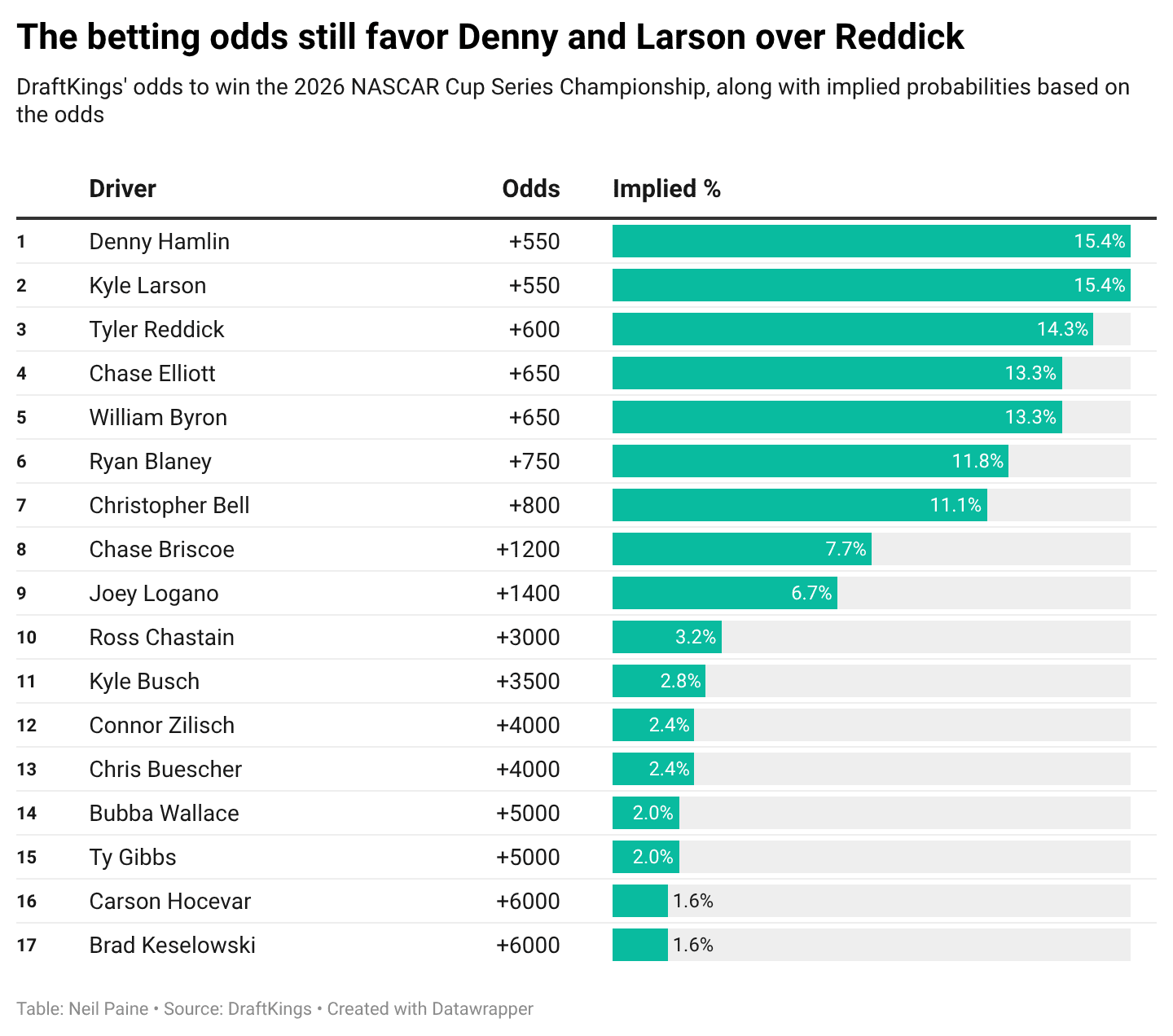
Perhaps surprisingly, DraftKings’ title odds still favor Denny Hamlin and Kyle Larson — the two primary drivers who did battle for last year’s title — at +550 apiece over Reddick at +600. But nobody has been stronger on the track to start the 2026 season, as evidenced by Reddick’s Cup-leading 110.0 Driver Rating (well clear of Hamlin’s second-best 102.0) in addition to his four wins. And his ability to perform at different track types has Reddick set up to be a real problem for the other contenders when The Chase gets underway.
 🏁 Denny Hamlin’s still got it at age 45.
Again, Hamlin — not Reddick — sits atop the odds chart above, indicating that the road to the Cup Series title will probably go through him once again, one way or another, even though he’s still personally seeking career championship No. 1. Hamlin currently sits third in the points standings behind Reddick and Ryan Blaney, and he’s second (ahead of Blaney) in average Driver Rating with his best mark since posting a 109.4 in 2021.
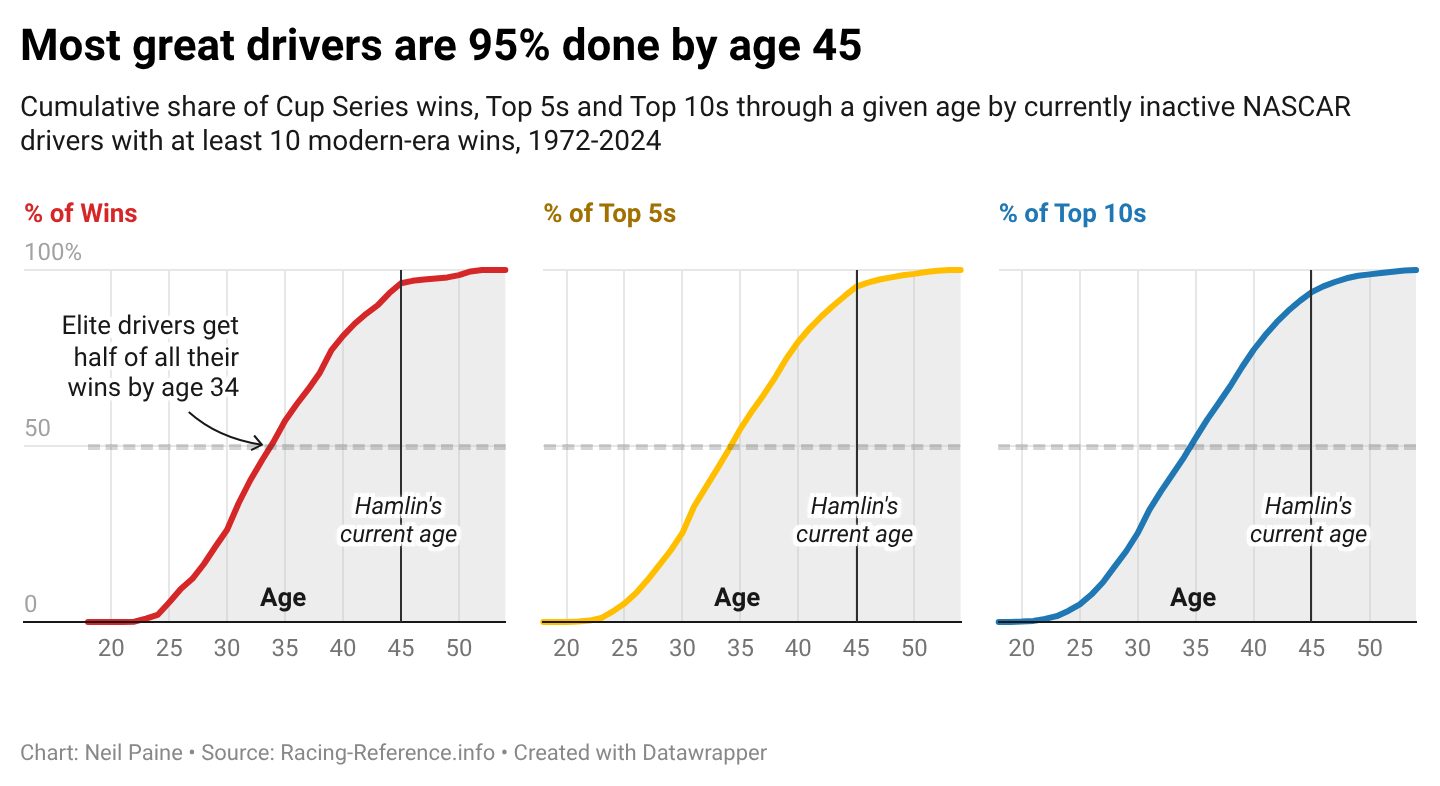 It might sound strange to be the least bit surprised that Hamlin remains in the championship mix, as he drove the No. 11 car to Victory Lane a series-high six times last season and has won multiple races in each of the previous seven seasons. But our previous research shows that even great drivers are almost entirely finished as winning drivers by this age, so there is always the risk that a 45-year-old driver falls off with little warning. So far, though, Hamlin is even better than he was last season — one of the best of his career — by just about any measure you might care to consult.
🏁 Ryan Blaney has the fastest car on the track most weeks.
Watch any Cup race, and chances are the No. 12 Ford of Ryan Blaney will be near the front at the end, either leading or at least threatening to pass the leader during the closing laps. That’s no coincidence — Blaney usually has the fastest car on the track and is able to pass his way into at least striking distance more often than not. According to NASCAR Insights’ statistics, Blaney has the best Speed Rating and Passing Rating of any Cup Series driver in 2026 thus far, and he is also well above the field average on restarts and at defending against passes. When it comes to those four categories, he has much better ratings than the other members of the standings top five:
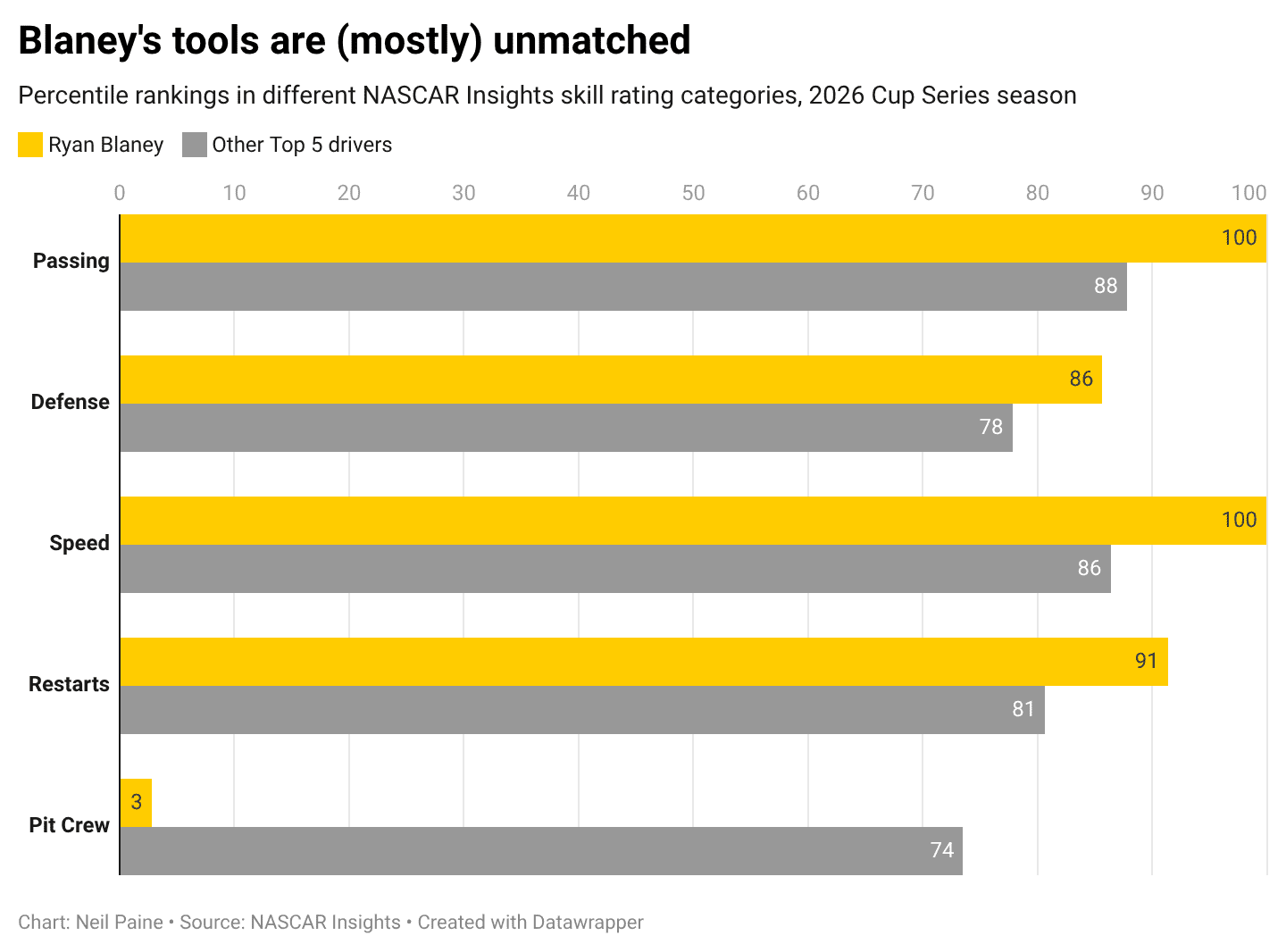 The glaring downside for Blaney, of which much has been made early in the season, is his success (or lack thereof) along pit road, where the No. 12 ranks among the lowest-rated teams in the series. But it’s worth noting Blaney’s team was closer to average last season, so there may be a lot of potential to clean up the problems and give the No. 12 more of a chance to harness its speed later in the season.
🏁 The increased horsepower package is having some effect already.
In addition to the new Chase standings format — more on that later! — the other main structural change for this 2026 Cup season was the adoption of a new horsepower package for road courses and short tracks (technically anything shorter than our standard mile-and-a-halfers), in addition to some aero adjustments. The change was designed to encourage more tire fall-off and help make passing easier with the Next Gen car — and the results thus far are intriguing at the very least.
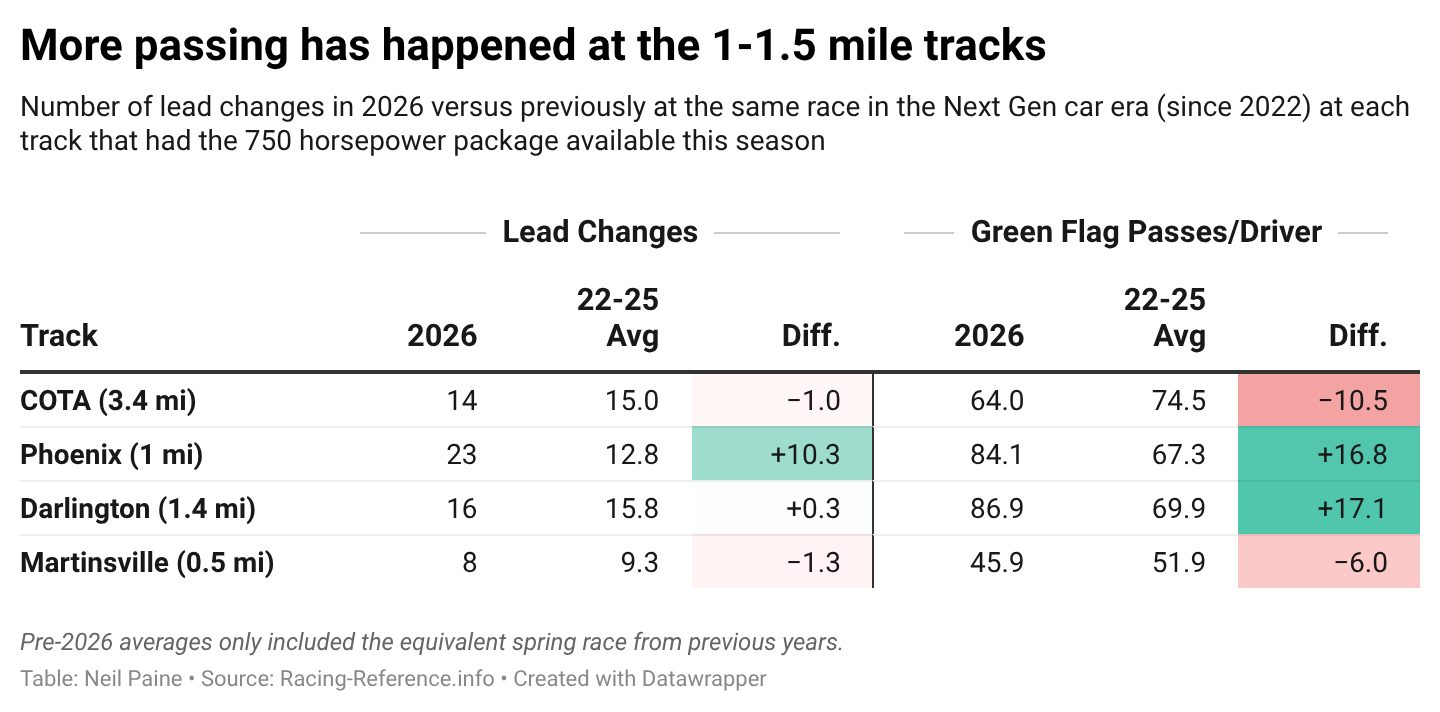 While there were slightly fewer lead changes and green-flag passes per driver on the road course (COTA) and the true short track (Martinsville), there was significantly more passing at Darlington and especially Phoenix this season than in years past. We will surely get more data as the season progresses and more tracks get added to this sample, but some kind of effect already seems apparent for the mile-and-longer tracks that the new setup applied to.
🏁 Hendrick seems to be ironing things out.
One of the big questions in the early phase of the 2026 Cup season has been a version of “What’s going on at Hendrick?” Between the engineering challenges of adapting to Chevrolet’s new Camaro ZL1 chassis and the natural disruption of having one of their star drivers, Alex Bowman, miss four of the first seven races with vertigo symptoms, it has not been an easy start to the year for NASCAR’s all-time most successful organization. However, their collective performance has generally been ticking up throughout the season, capped off by Chase Elliott’s win at Martinsville:
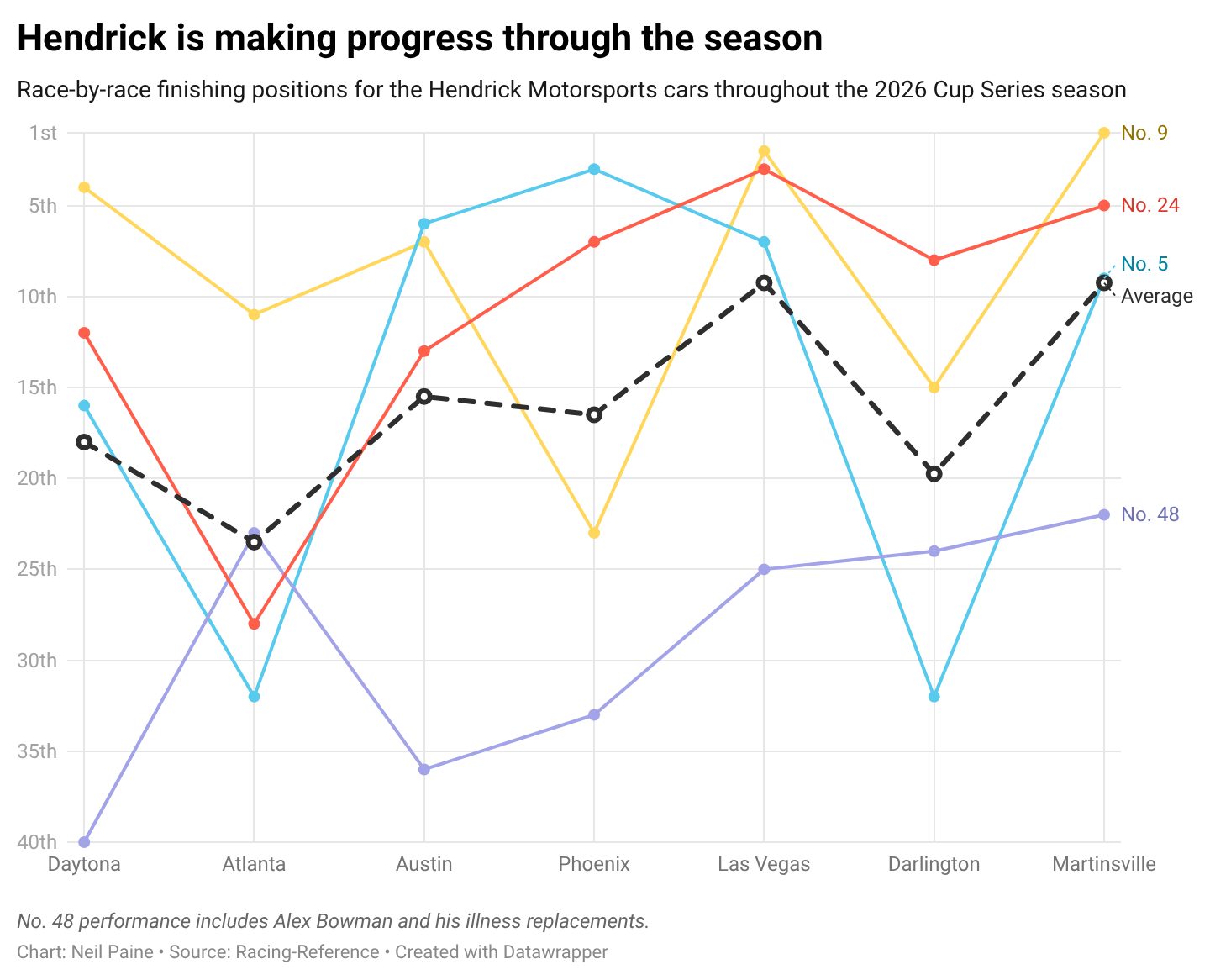 There’s no doubt Hendrick still has plenty of room to improve over the rest of the schedule, too, considering Larson has recorded just a single top five so far — and Byron has yet to win a race despite posting Driver Ratings of 95 or above in each of the past six races. One of those two will get a breakthrough soon.
🏁 SVG is still improving; Zilisch has hit the learning curve.
Two of the more interesting drivers we’ve had our eye on from the very beginning of the season are Trackhouse Racing teammates Shane van Gisbergen and Connor Zilisch. Both are known road-racing savants, and each had their moments of speed at Circuit of The Americas last month — despite neither winning. But the real questions were around their performances at non-road courses. And it’s fair to say SVG has delivered a much more well-rounded performance than Zilisch in the early going.
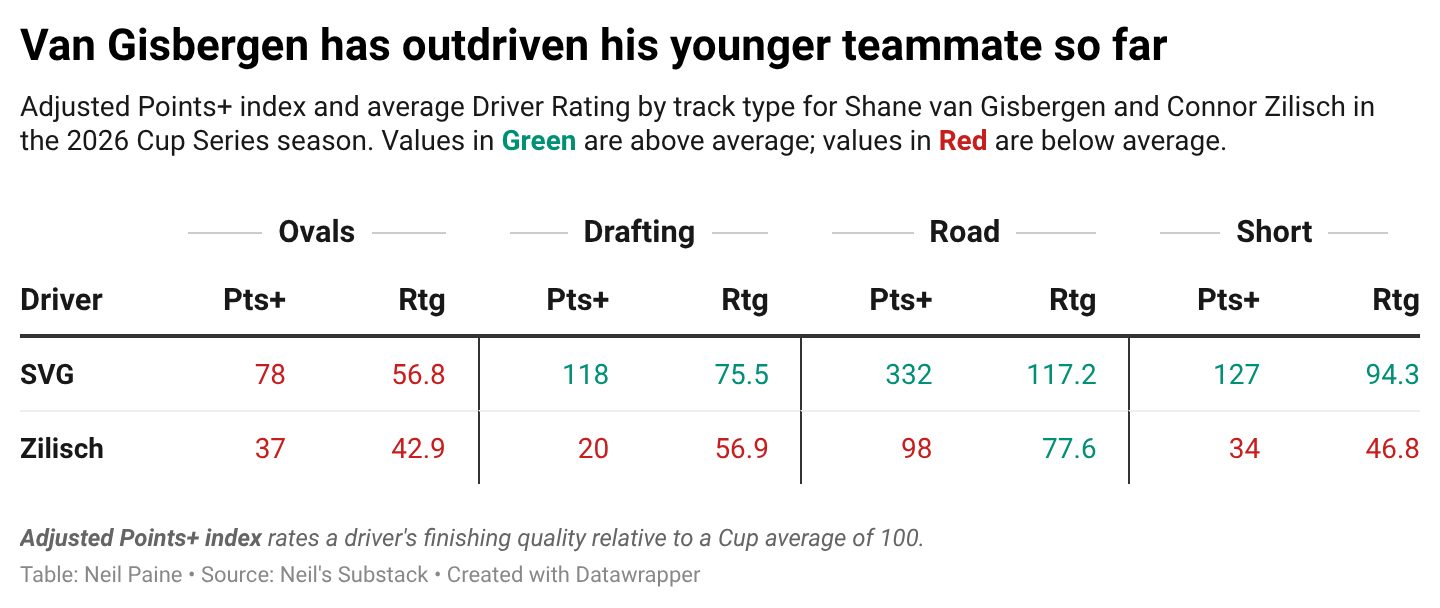 Looking at both Adjusted Points+ index (which rates a driver’s finishing quality relative to a Cup average of 100) and Driver Rating, it’s clear SVG has made great progress since last season — improving to become an above-average driver at both drafting and short tracks in 2026, albeit in small sample sizes for each type. Even at regular ovals, where he still sits below the overall Cup average, van Gisbergen is much closer to average than his numbers (45 Pts+; 47.8 rating) were a year ago. Zilisch, by contrast, has definitely experienced more of a rookie learning curve than perhaps we might have expected from his stats in the Xfinity Series last season, though he gets some grace at age 19. He might now look even more to his older teammate for tips about how to improve quickly on non-road course tracks as the season progresses.
🏁 Toyota is having arguably its best season ever.
While Reddick has deservedly grabbed many of the early headlines for his own individual dominance, he has been only part of the overall Toyota machine that is off to a very fast start in 2026. Between all of their partner teams — Joe Gibbs Racing, 23XI Racing and Legacy Motor Club — Toyota cars have more wins (5), podiums (9), top fives (15) and top 10s (27) than any other manufacturer this season.
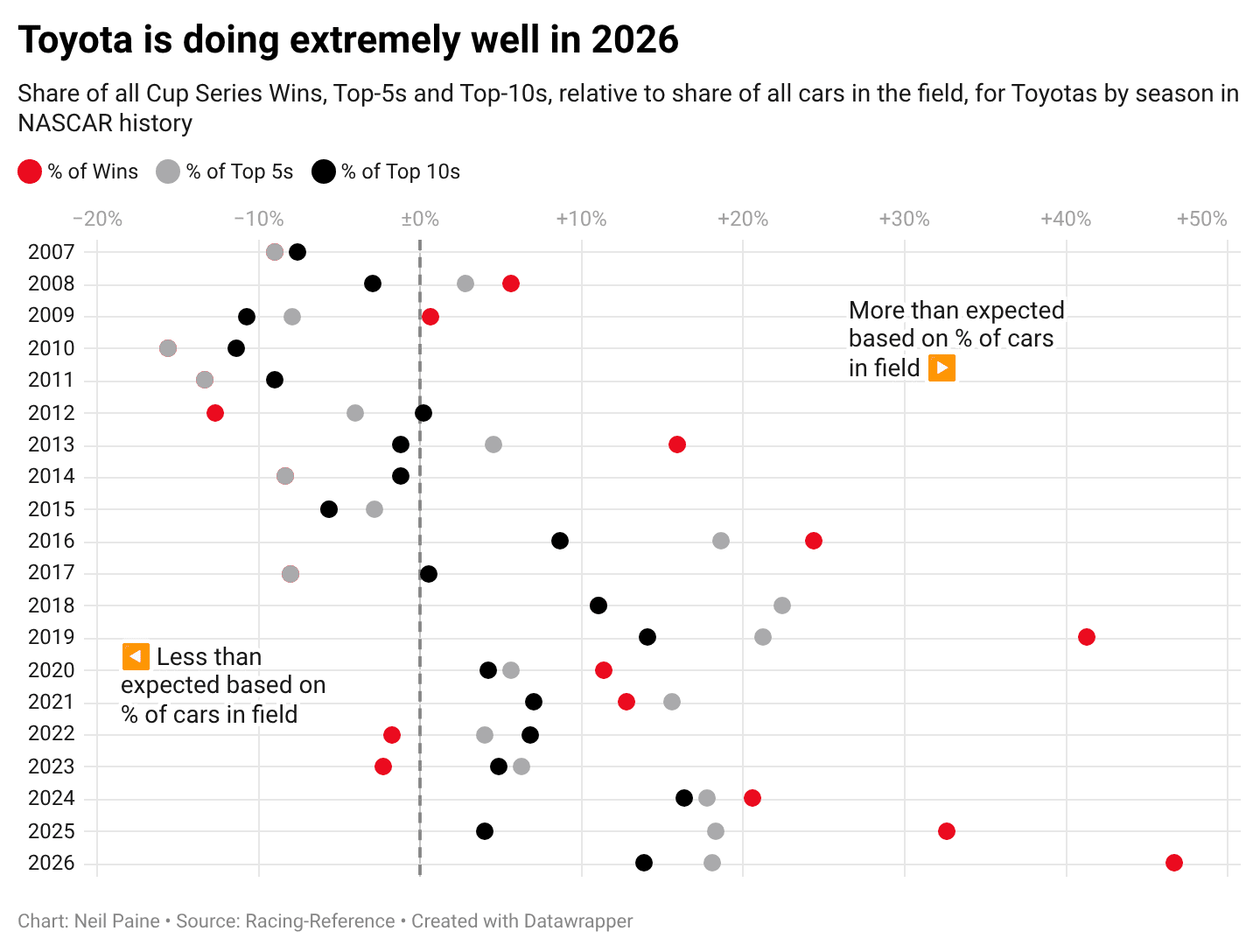 Furthermore, if we compare across seasons by adjusting for the share of all races run by Toyotas each year, they are outwinning their share of the field by 46.7 percentage points this year, their best such differential since joining NASCAR as an OEM in 2007. While they have had a few other seasons with better differentials above their share of car entries in top fives (2018) and top 10s (2024), taken on balance, this is one of — if not the — best showings for the Japanese manufacturer in its history with the sport.
🏁 Kyle Busch and RCR are definitely not having their best season ever.
Two-time champion Kyle Busch cannot seem to find a way to get anything close to even an average level of performance out of his No. 8 Richard Childress Racing Chevy to start the year. Including another miserable day at Martinsville — in which he posted a 41.0 Driver Rating, both his worst mark of the season and his worst-ever showing at the track in his career — Busch has just two above-average Driver Rating runs in seven starts, and he ranks 24th among regular drivers with a 57.9 average rating on the season.
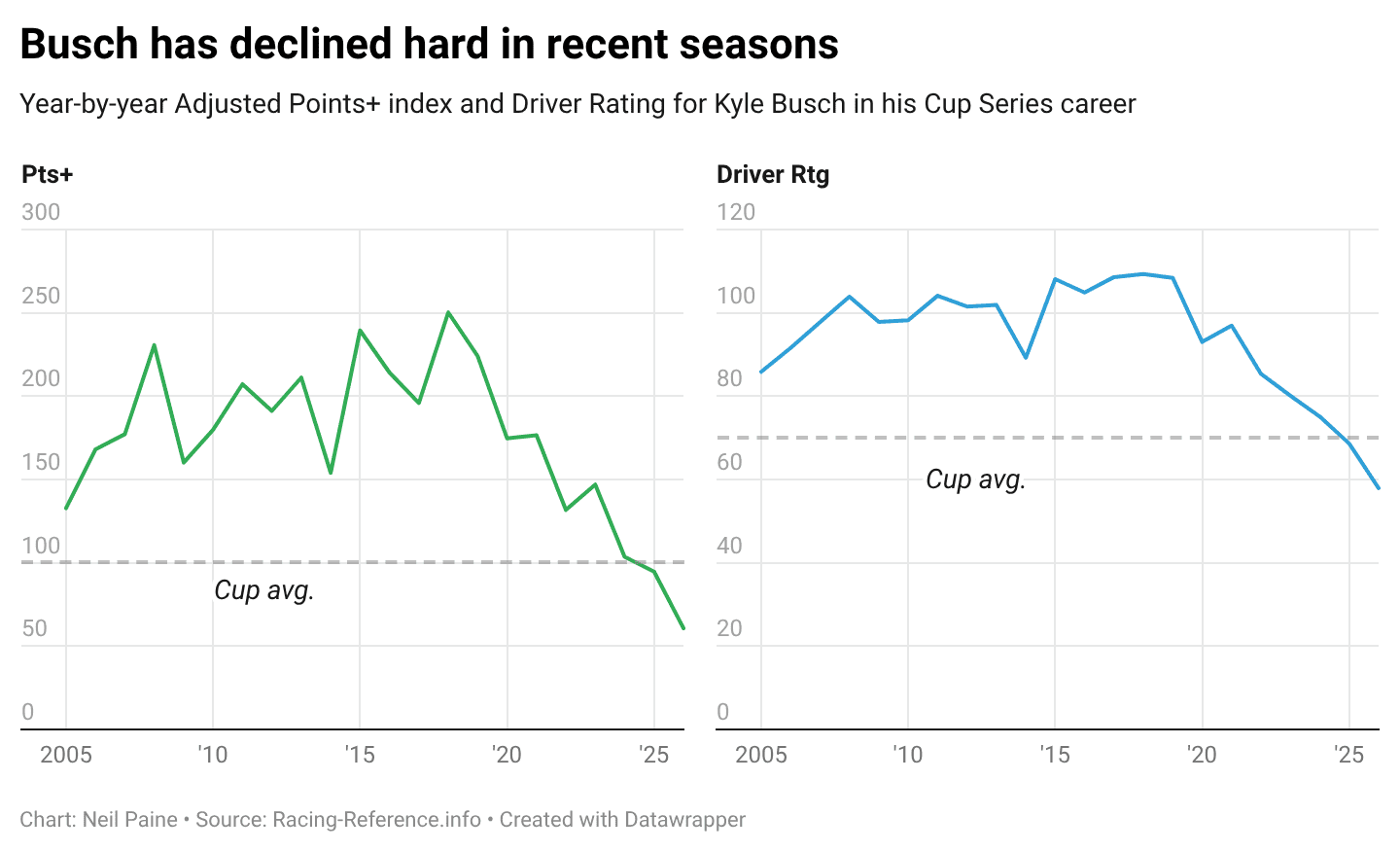 It’s the latest in a fairly long-running trend that has seen Busch’s performance metrics (relative to Cup average) drop off almost continuously since the late 2010s. Since Busch is such a great driver, he had more room to fall from his peak while still driving at an above-average level, but he’s been running out of space to stay above average over the past two seasons. Since RCR as a whole is also having maybe its worst season ever — with zero top 10s and a collective average finish of 23.2 — it’s tough to tell how much Busch would have staved off the decline with a better team.
🏁 The Chase is already on everyone’s minds.
More than just the horsepower change, the biggest change of all in NASCAR for 2026 — The Chase, which did away with the old round-based playoffs and its win-and-in clinching system to instead emphasize points racing among the best drivers in the world at season’s end. And we’re already seeing its effects show up in the way drivers approach each race. At each ranking position in average finish (among regular drivers through seven races in the schedule), the 2026 occupant of that slot has a lower average finish than his 2025 counterpart — sometimes significantly so, as in the case of ’26 leader Tyler Reddick (5.7) versus ’25 leader Kyle Larson (10.4):
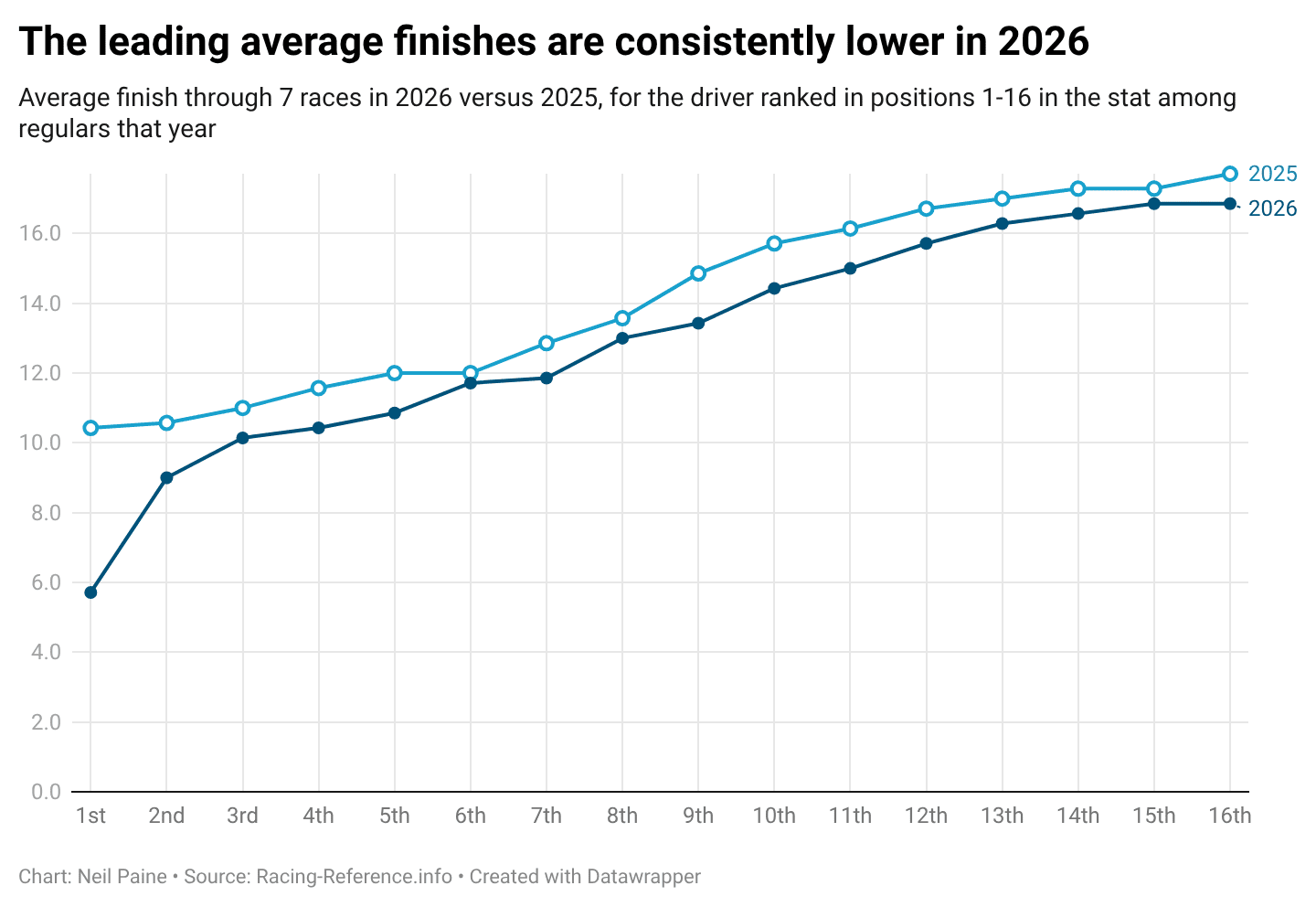 That is obviously driven on some level by Reddick’s incredible number of wins to start the year, but the pattern persists at literally all of the top ranking slots for average finish. This year, top drivers are prizing consistency far more than in the past — something they even admitted to going into Martinsville.
“I think everybody knows the importance of maximizing your day now, where in the previous format you didn’t have to maximize your day,” Christopher Bell said. “It was a win-or-bust mentality, whereas now I think the racing is a little more compelling and aggressive. Everyone knows that every position matters more now than it did in years past.”
“I notice guys are just a little more protective of their finish,” Byron added.