With 14 races in the books already, the 2026 NASCAR Cup Series season is already past the midway point of the regular season, and the final stretch before the Chase field is finalized is fast approaching.
That means it’s the moment in the schedule when teams start to find out who they really are, for better or for worse. A recent upward trend now could carry a driver from decent to great, as we saw just last season with Chase Briscoe’s midseason improvement starting around May and propelling him all the way to the Championship 4. A poorly-timed downturn, on the other hand, could unravel an otherwise strong start to the year.
RELATED: Cup Series standings
So let’s dig into which drivers have been trending up or down over the past month of points-paying races. First, here’s a plot of every Cup regular’s change in both Adjusted Points+ index (which measures finishing quality relative to a Cup average of 100) and Driver Rating (which measures mid-race speed and dominance in addition to finishes) since the start of May, relative to their performance in the ’26 campaign leading up to May 1:
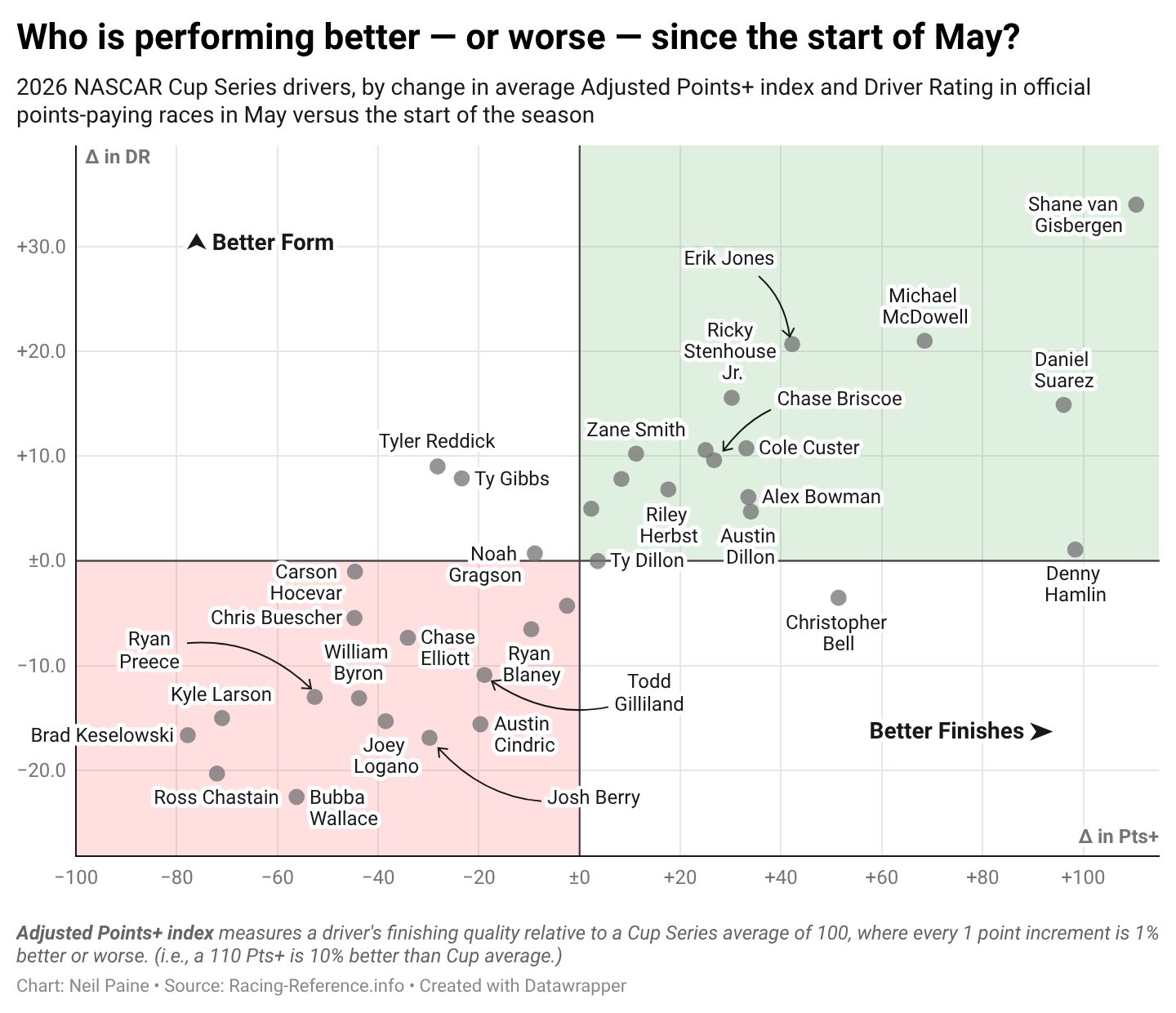
Drivers in the top-right (green) quadrant are finishing better, with better underlying speed and race-long performance as well. Drivers on the bottom-left (in red) are doing worse in both regards. And the rest have mixed results, most likely due to mismatched finishing luck.
Tyler Reddick, for instance, is on less of a race-closing heater than he was when he won five of the season’s first nine races, but his underlying form might actually be better! (His average Driver Rating over the past month is actually up nine points despite zero wins in May.) Conversely, Christopher Bell is holding fairly steady in the rating department — 92.7 May rating versus 96.2 beforehand — but he has a much higher rate of top fives and top-10s, indicating that his finishes are simply catching up to the quality of drives he’s had all along.
For everyone else, let’s dive into the five most (and least) improved drivers by the numbers over the past month.
Trending Up
1. Shane van Gisbergen: SVG was always going to improve statistically in a month containing a road-course race as May did (with Watkins Glen, which van Gisbergen won via an overwhelming late-race comeback) for the first time since early March. But beyond the right-hand turns, SVG has shown remarkable improvement at a wide range of other tracks, finishing 20th or better in five consecutive races — a stretch that includes a superspeedway and three intermediates. With an average Driver Rating of 98.1 over that span, this is the best five-race stretch of his career containing fewer than three road courses, and his Chase odds are now up to 66%.
2. Michael McDowell: McDowell came on strong at the end of last season, with a handful of top 20s and even a few top 10s, but he started 2026 running mostly in the back half of the field aside from consecutive top-10s at Circuit of The Americas and Phoenix Raceway. In recent weeks, however, he has gotten a lot more speed out of the No. 71 Chevy. Yes, McDowell — like SVG — benefited from another road course, but he also has a pair of consecutive top-15 runs at Charlotte Motor Speedway and Nashville Superspeedway, bringing his May averages up to a 142 Adj. Points+ and a 79.2 Driver Rating after sitting at 73 and 58.2 in those metrics, respectively, before the month began.
3. Daniel Suárez: Suárez’s career seemed to be at a crossroads after a mediocre 2025 with Trackhouse Racing. But after opening the 2026 season — now as a Spire Motorsports pilot — with a series of respectable finishes (two top 10s and a top five) entering May, he turned things way up in the past month. The rain-shortened win at Charlotte was the most memorable run — not least because it was in tribute to his late mentor, Kyle Busch — but he also scored a top 10 at Texas Motor Speedway and led 10 laps at Nashville on Sunday. All of a sudden, Suárez hasn’t finished outside the top 20 in a race since Phoenix on March 8. And, like SVG, those strong recent runs have greatly bolstered Suárez’s Chase chances, which now sit in the high-70 % range.
4. Erik Jones: Leading up to May, Jones seemed content to continue being the definition of a mid-pack driver. (He didn’t finish in any position other than 23rd in the entire month of April.) But something changed starting in Texas, where Jones finished 12th, and that uptick has followed through three more top-20 finishes in a row, including an 11th-place run at Nashville, with a 96.8 Driver Rating that was his best form in a race since a 109.5 at Darlington Raceway last August. Though he’s still waiting to break through with another single-digit finish (it’s been since that third-place Darlington run for one of those as well), Jones’ No. 43 car has been much more competitive.
5. Ricky Stenhouse Jr.: Stenhouse can always be counted on for a strong superspeedway run, and indeed, he’s finished second at Daytona International Speedway and sixth at Talladega Superspeedway in 2026 so far. But his recent oval form has been uncommonly solid as well, with an average finish of 11.7 in his past three intermediate races, capped off by a fourth-place finish at Nashville on Sunday, his best at an intermediate since finishing second at Dover in 2022. Aside from a 31st-place road-course run at The Glen, Stenhouse hasn’t finished any worse than 21st since Martinsville Speedway in late March.
Next up: Cole Custer, John Hunter Nemechek, Chase Briscoe.
Trending Down
1. Ross Chastain: Chastain’s form has been steadily sliding towards Cup-average since his wall-riding breakout of 2022 had him looking like the sport’s next big star. But while he was inconsistent, Chastain began 2026 with flashes of the old form — including a pair of top 10s at EchoPark Speedway and Talladega and additional laps led at Daytona, COTA and Martinsville. Ever since, though, he hasn’t managed any better than a 26th-place run at Texas, with an average finish of 31.3 and a 56.4 average Driver Rating in May. That set of finishes is his worst four-race stretch since October 2018, and it has pushed his Chase odds south of 10%.
2. Brad Keselowski: The top-line numbers for Keselowski’s 2026 (16.1 average finish, 116 Adjusted Points+, 74.0 Driver Rating) look almost identical — if not actually slightly better — than what they were a year ago (18.5, 110, 72.3). But those figures were on track to be much better earlier in the year, when Keselowski had four top 10s in his first nine races and an average rating of 79.8, including three showings at or above 91.0. But he hasn’t recorded a top 10 since Kansas Speedway on April 19, and his rating has dipped to 63.4 over that span. He ought to still make The Chase, but too many more slowdowns like this will make that outcome less certain.
3. Bubba Wallace: Just like Keselowski, the overall numbers for Bubba this season are almost perfectly in line with his career norms — right down to an average finish (18.4 vs. 18.5) and Driver Rating (80.6 vs. 80.7) within a tenth of a point of last season — but that hides a hot start followed by a recent slump. After finishing 11th or better in seven of the season’s first nine races, Wallace crashed his way to a 36th-place day at Talladega (where he usually runs well) on April 26, starting a stretch of four finishes outside the top 20 in his most recent five races. (The only exception was a 9th-place run at Texas.) Bubba, too, isn’t in terrible Chase shape despite sitting 15th in the standings, but he needs better finishes soon.
4. Kyle Larson: “What’s wrong with Kyle Larson?” is a question that’s growing from a whisper to a full-blown storyline as the No. 5 has now failed to find its way to Victory Lane in 38 races and counting. Despite the lack of wins, Larson’s 2026 start wasn’t much of a concern — he had six top 10s in the first nine races of the year, and his two finishes outside the top 30 still carried a Driver Rating at or above 88.0, mainly indicating a luck issue. But since finishing dead-last (40th) at Talladega, Larson has a single finish better than 23rd (fifth place at Charlotte) and a mortal-seeming 75.6 average rating. By Adjusted Points+ index, this is Larson’s worst stretch of five races (70 Pts+) since April 2019.
5. Ryan Preece: As he was establishing himself as one of the best breakout stories of 2025 after a move to RFK Racing, Preece’s hallmark became a downright scary level of consistency: From Kansas in May 2025 through the end of the schedule, he scored 11 top 10s in 25 races, finishing outside the top 21 just three times. Following a 25th-place run at Daytona to open 2026, Preece seemed to continue the same trend, with two top 10s and all top 20s in the next 11 contests. But back-to-back runs of 33rd and 36th at Charlotte and Nashville, respectively, are Preece’s first set of consecutive finishes outside the top 30 within a season since July 2024.
Next up: Josh Berry, Joey Logano, William Byron.
One important addendum to the idea of upward or downward trends is that some drivers have more room to rise or fall than others without necessarily changing their general level of performance relative to the overall Cup pecking order. Here’s a plot of Driver Rating changes in May versus the previous races on the calendar, with positive changes in green and negative ones in red, but ordered by May rating:
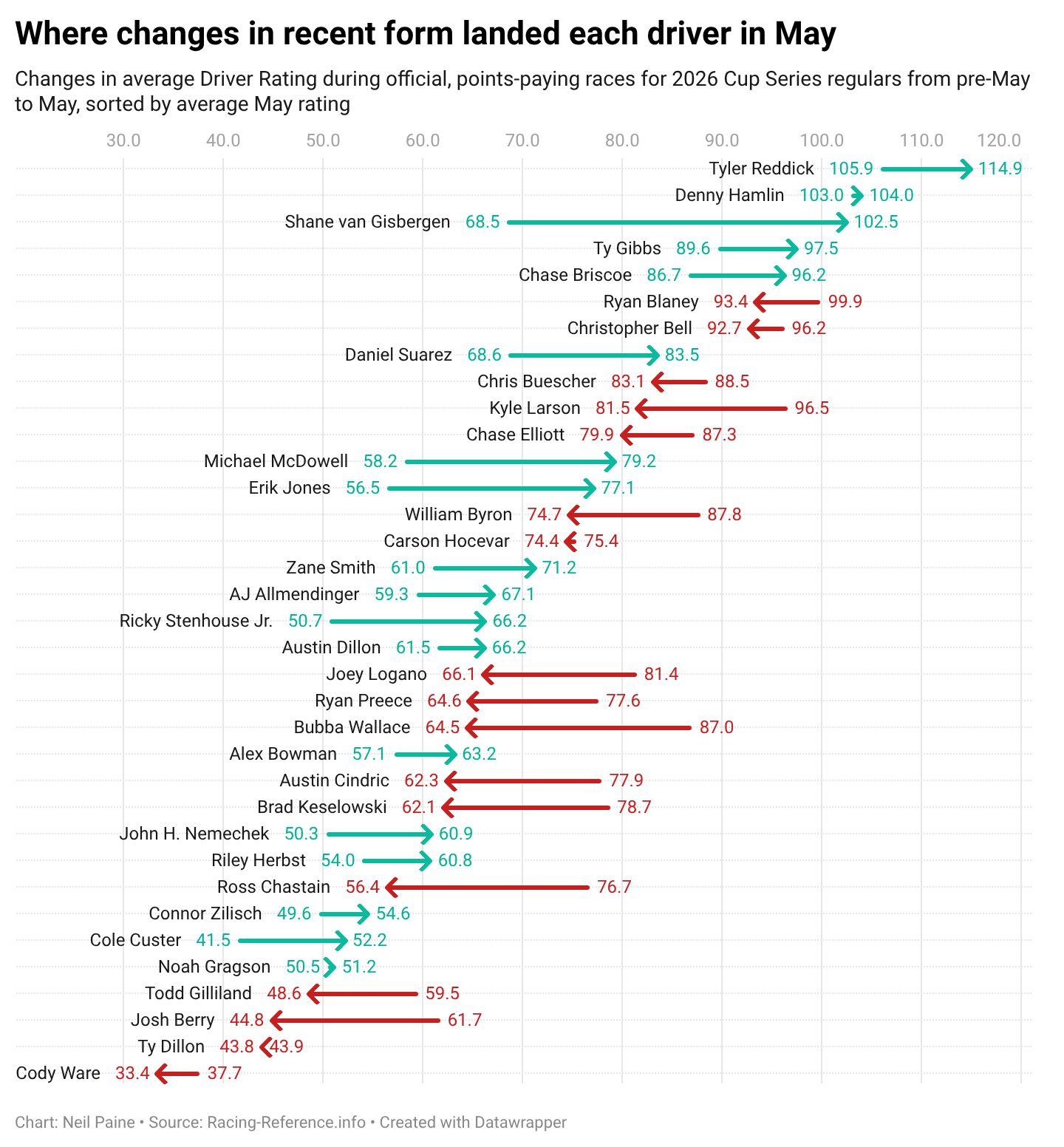
While some of the recent orderings will raise eyebrows — SVG is up to No. 3 in the past month, while Hendrick drivers Larson, Chase Elliott and William Byron are borderline top 10 — a driver like Stenhouse could gain 16 points of rating and still be nearly double-digits behind, say, Byron, even after the latter lost 13 points from his own rating. In other words, up/down stock trends are not power rankings.
MORE: Cup Series schedule
But trends still matter, especially at this point in the calendar. In this new Chase format, one hot month can change a driver’s entire outlook, whether it’s SVG and Suárez moving from the bubble toward safer playoff odds, or Chastain and Preece watching once-promising bids start to look shaky. And with just 12 weeks left before the Chase cutoff arrives, the next handful of weeks will tell us which of these May moves were merely temporary, and which will end up being the start of something truly meaningful.