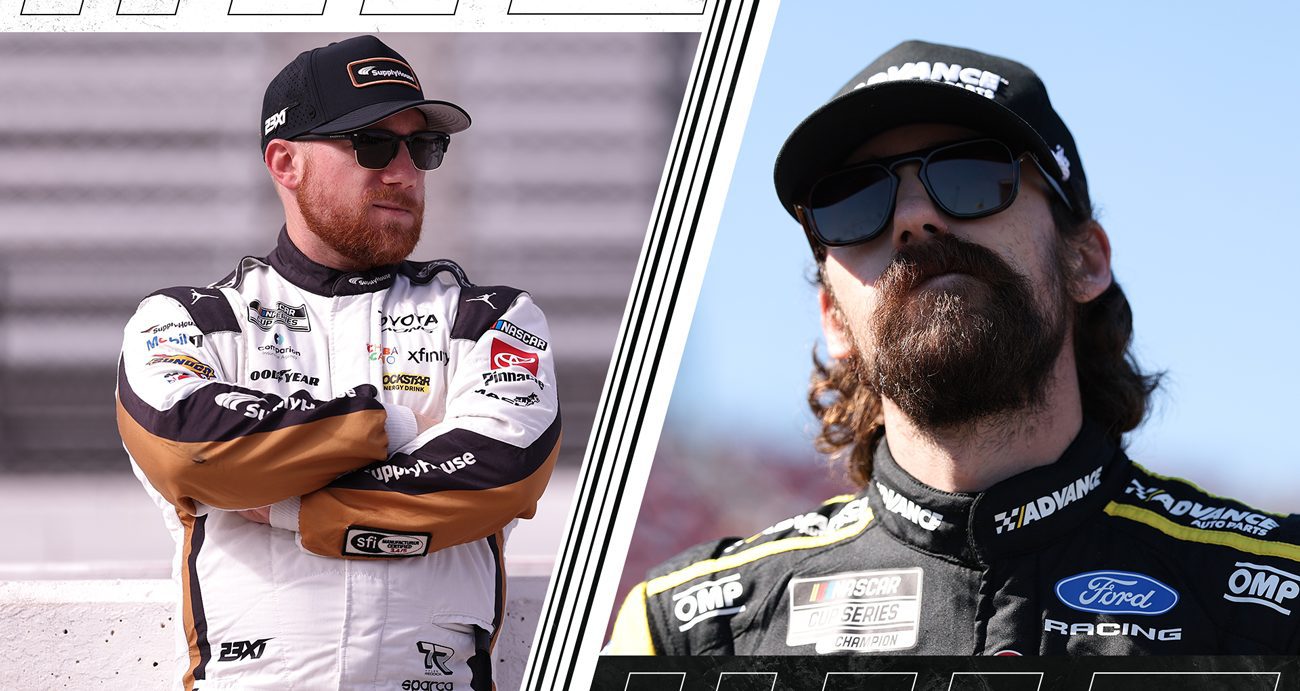
As the Cup Series sets its sights on Homestead-Miami Speedway for the 2026 season finale, the emotions tend to track with where you sit in the standings. For points leader Kyle Larson, the operative word is focus: He has not yet clinched his third career championship, so there is still work left to do. For still-active challengers Christopher Bell and Denny Hamlin, it’s hope that their slim title chances can grow during the afternoon on Sunday, mixed with regret that they’re not closer to Larson in the standings. And for the 13 drivers already eliminated from championship contention in The Chase presented by Mobil 1, the thoughts have turned to the decisions, moments and missed opportunities that helped seal their fate this season.
So as Larson closes in on the goal every team carried into the Daytona 500 back in February, let’s look at where his top rivals lost their way — and what those turning points revealed about the larger trends that ruled their seasons.
🛞 The long shots
Not every Chase driver came into the postseason with the same championship expectations. Some arrived in September knowing they’d need nearly everything to break their way over the final 10 races on the schedule in order to have a shot — and most of those names simply failed to make much headway in that effort. Note that half of the 16 Chase drivers started out eighth or lower in the standings and never rose any higher than that following any race afterward:
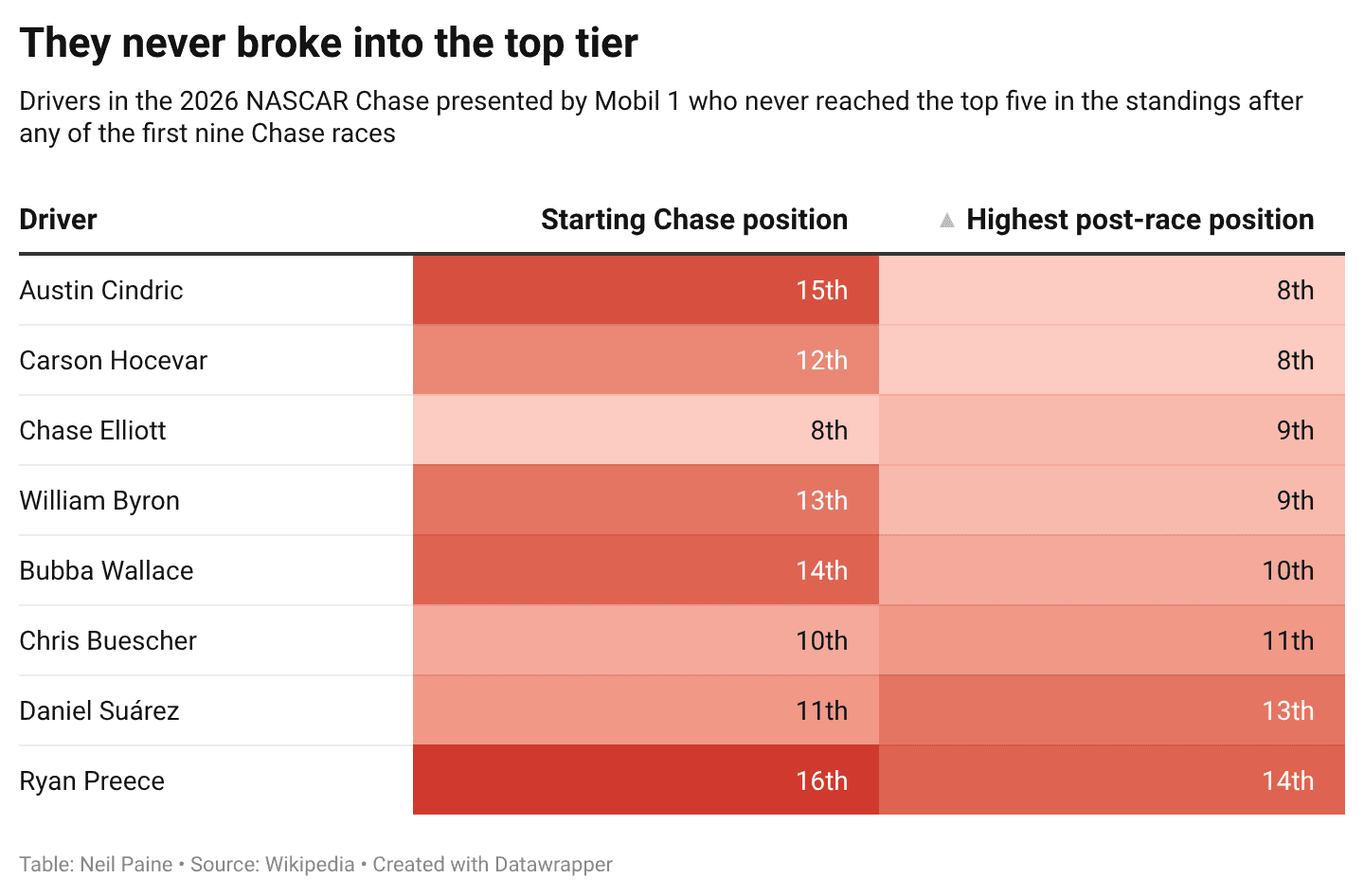 It’s not like they didn’t have their moments of potential or brilliance. We just watched William Byron absolutely dominate at Martinsville (with a 146.2 Driver Rating), and teammate Chase Elliott finished second. Earlier in The Chase, Carson Hocevar (third at Bristol) and Austin Cindric (second at Kansas) scored podium finishes that seemed to suggest they might be a threat for more. But the reseeded Chase points format can be cruel to drivers outside the upper echelon, giving them little or no margin for error. And for most of the names on this list, they were down in this zone of the standings for a reason anyway.
🛞 Ty Gibbs
Smallest deficit in Chase standings: minus-39 after Darlington
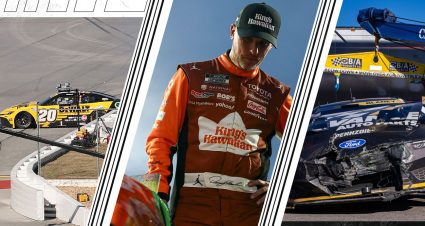
Where it all went wrong: Gibbs seemed like he might be a dark-horse championship pick — sitting fourth in the pre-Chase rankings (40 points back of the lead) — especially after a second-place run at Darlington to begin The Chase. But he never really built momentum from there. Starting with Gateway, the intermediate tracks were punishing, yielding an average finish of 19.2 and a 74.3 Driver Rating. But maybe the biggest missed opportunity came at Bristol, where he’d scored his first career win earlier in the season; despite leading 120 laps, recording 73 fastest laps and ranking second in Driver Rating (115.5), Gibbs lost the lead tangling with Hocevar with under 10 laps to go and ended up fifth, watching as Joey Logano took the W.
🛞 Tyler Reddick
Smallest deficit in Chase standings: minus-24 after Darlington
Where it all went wrong: In The Chase, Reddick was undone by two distinct segments of the schedule: First, a trio of disastrous runs at Gateway, Bristol and Kansas — the tone for which was set just four laps in, when Daniel Suárez slid him up into the wall for major damage — that sent Reddick tumbling from 24 points back to 111. And then, any hopes buoyed by his win at Phoenix were completely deflated when Reddick was caught up in the “Big One” at Talladega, resulting in a 37th-place finish. But honestly, it could be argued that Reddick’s chances dimmed long before that, when he first cooled off from his remarkable early season hot streak. In his first 14 races, he had five wins, a 5.6 average finish and a 108.5 average rating; over the next 12, he had zero wins, a 20.0 average finish and an 80.8 rating to close the regular season.
🛞 Chase Briscoe
Smallest deficit in Chase standings: minus-24 after Phoenix
Where it all went wrong: Briscoe was sort of the opposite of Reddick — a relatively slow start to the season (he had only one set of back-to-back top 10s until June) left him playing catch-up for better positioning heading into The Chase. He ended up fifth in the pre-Chase standings regardless, but once there, a strong run at Bristol was soured by late wall contact and a late lead at Kansas was relinquished to Larson. And even after that, the No. 19 team clawed its way back within 24 points of Larson after consecutive wins at Las Vegas and Charlotte and an eighth-place run at Phoenix. But despite starting Talladega on pole, Briscoe’s day was derailed in the big wreck on Lap 183. (Logano’s car flipped upside down after contact with Briscoe’s No. 19 Toyota.) A frustratingly non-competitive 14th at Martinsville formally ended a title bid that ‘Dega had already ruined.
🛞 Ryan Blaney
Smallest deficit in Chase standings: minus-16 after Darlington
Where it all went wrong: Blaney went into The Chase on the short-list of drivers with serious championship aspirations, if he and his team could consistently perform to their potential. But that was also always the catch with the No. 12 all season. In The Chase, Blaney has had wildly inconsistent results — finishing either top five (five races) or outside the top 32 (four races) every single week. The worst of this unfathomable feast-or-famine trend, though, came early on, at Bristol. Already under pressure from a 35th-place run at Gateway a week prior, Blaney led 202 laps but had a pit-road commitment violation, was infamously spun out by Hocevar to finish just 33rd, and then got the worst of a post-race altercation with Hocevar for good measure. Blaney would recover to pull within 40 points of Larson after Phoenix before a Talladega crash doomed him for good, but the enduring image of Blaney’s disappointing ’26 Chase will be the Hocevar fight.
🛞 Joey Logano
Smallest deficit in Chase standings: minus-16 after Bristol
Where it all went wrong: There was a brief moment when it looked like Logano — whose most recent championship (in 2024) has long been criticized as more a product of the format than his own performance — would earn a pretty sweet measure of vindication by winning another title in a brand-new championship system. Joey had already gone on an epic late-season hot streak to turn his season around, and that seemed to carry over early in The Chase, with a trio of top 10s at Darlington, Gateway and Bristol culminating with a brilliantly opportunistic win at the latter. But in retrospect, that would be as close as Logano got to first place, as the intermediates took their toll — Joey averaged an 86.7 rating at those tracks in The Chase, versus 111.2 at all other tracks. Kansas was a case in point: Logano was in line for a top 10 from the pole (his average running position was eighth and he spent 99% of laps in the top 15), but a late tire problem left him finishing 20th.
🛞 Christopher Bell/Denny Hamlin?
Smallest deficits in Chase standings: Bell minus-5 after Phoenix / Hamlin 0 (leader) after Gateway
Where it all (probably) went wrong: Technically, either Bell or Hamlin could still win the championship; both are within 70 points of Larson, and a perfect day is worth 76 points. So, yes, we’re saying there’s a chance.
But there’s no denying it could have been a much better chance for both drivers.
For Bell, one moment will clearly haunt him for a long time: The self-induced brake lock-up heading toward pit road at Talladega, which sent the No. 20 car skidding into the wall and turning him into a non-factor all day. Bell had just rattled off top-six finishes in four of five races, and his average Driver Rating in the Chase through Phoenix (111.4) was actually higher than Larson’s (109.2) despite the latter’s dominance. With a huge opportunity to take over the championship lead, Bell literally crashed out instead.
Hamlin’s story is less clear-cut. Unlike last year, when one specific moment turned a surefire championship bid upside-down, Denny can only point to a string of little misses that have added up to a big letdown in this year’s Chase. It was that way from the beginning; at Darlington, the No. 11 car led 68 laps but toe-link damage ruined his speed over the last 120+ laps. Little did we know it at the time, but Hamlin would find ways to let promising runs slip away all Chase long.
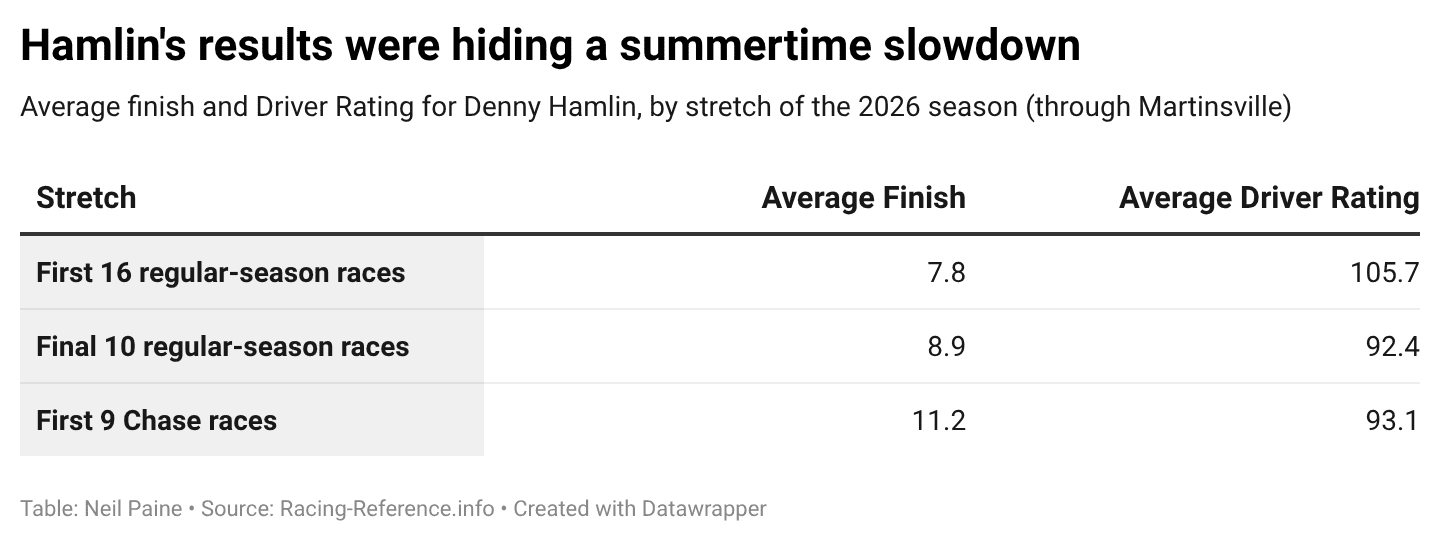
But if we zoom out even further, perhaps this could have been foreseen. As measured by Driver Rating, Hamlin’s core performance down the stretch of the regular season — dating back to mid-June — had been substantially worse than it was earlier in the year, when he was tracking down Reddick for the No. 1 Chase seed. His finishes hadn’t slipped that much, which concealed the extent to which Hamlin went into The Chase far from peak form. But now, his results have caught up with a Chase rating that looks a lot more like the summer stretch run than the early part of the season.
At the time, we still argued that the composition of The Chase’s schedule — with its many favorable tracks for Hamlin — would help make up for any trends in performance. But that hasn’t proven to be true. And unless Hamlin can summon one last superhuman effort this weekend at Homestead, yet another season of championship promise for the No. 11 will end in disappointment.