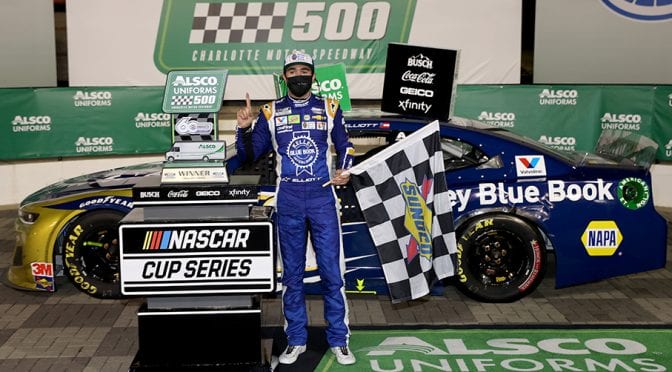
DAYTONA BEACH, Fla. (February 14, 2020) – To honor the legacy of the sport’s founding family, NASCAR today announced that the Bill France Cup will be awarded to the champion of the NASCAR Cup Series, beginning in 2020.

The renamed trophy pays tribute to Bill France Sr., who founded NASCAR in 1947, as well as his son, Bill France Jr., who elevated the sport to a national phenomenon as the sanctioning body’s chief executive from 1972 to 2003.

“As the sport ushers in a new era, it’s fitting that my father’s name is associated with the highest mark of excellence in our sport,” said Jim France, NASCAR Chairman and Chief Executive Officer. “My father and brother’s vision for NASCAR has been realized, many times over, as millions of fans follow and engage each week with the best racing in the world.”

The Bill France Cup, created by Jostens, will maintain the size and shape of last year’s championship trophy and will feature outlines of the 24 NASCAR Cup Series race tracks that comprise the 2020 season schedule. The trophy design will be updated as the race schedule evolves, and new tracks are introduced to NASCAR Cup Series competition.

Bill France Sr. spearheaded NASCAR from its beginning and directed it to its current role as the world’s largest stock car racing organization. Born in Washington, D.C., on Sept. 26, 1909, he came to Daytona Beach, Florida, in 1934. In 1947, France became the driving force behind the establishment of the National Association for Stock Car Auto Racing. The new organization was called NASCAR, resulting from a famous meeting at the Streamline Hotel on A1A in Daytona Beach – a structure that stands to this day as a racing landmark.

Things moved quickly in the 1950s and 1960s for NASCAR. As the sanctioning body’s first president, France built two superspeedways that came to personify the sport – 2.5-mile Daytona International Speedway and 2.66-mile Talladega (Ala.) Superspeedway. Bill Sr. passed away in 1992 at the age of 82.

Bill France Jr. is remembered as the man who followed his visionary father at NASCAR’s helm, in the process becoming a visionary himself as he guided NASCAR to unprecedented levels of popularity. France, who passed away in June 2007 at the age of 74, grew up in the formative years of stock car racing, living and learning every detail of the sport from his own experiences, and those of his father.

Bill Jr. became NASCAR’s president in January 1972, replacing his father and becoming only the second president of the world’s largest auto racing sanctioning body. His emergence coincided with the sport’s emergence, and its eventual ascent to become America’s No. 1 form of motorsports.

For more information on the NASCAR Cup Series and images of the inaugural Bill France Cup, please visit NASCAR.com.

DAYTONA BEACH, Fla. — Blocking on superspeedways isn’t new. Spin your television dial back to the 1979 Daytona 500, when Donnie Allison famously crowded Cale Yarborough, and broadcaster Ken Squier can be heard lamenting, “They threw the block. It didn’t work” on the cooldown lap.

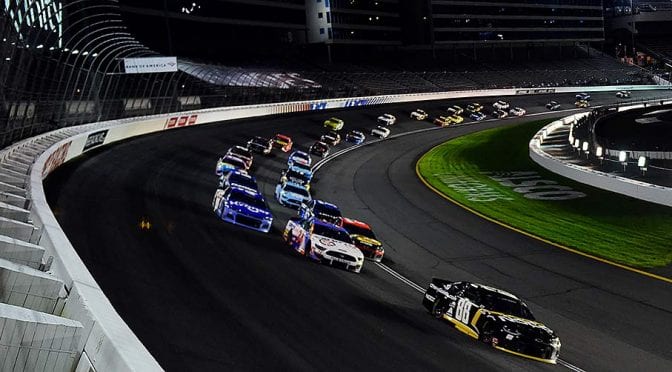
Forty-plus years and many aero packages later, it’s still not exactly working. Last year’s NASCAR Cup Series opener was a battle of attrition, with just 19 of the 40 starters running at the finish. Sunday’s Busch Clash went to another level, with all 18 cars listed on the accident tally sheet and the half-dozen finishers all affected by some level of crash damage.

RELATED: Jones wins hectic Busch Clash

Decades beyond the Yarborough-Allison tussle, Squier’s words still resound as true. As this the Daytona 500 (set to resume Monday at 4 p.m. ET, FOX, MRN, SiriusXM) ticks closer, predictions of further chaos caused by bad blocks gone wrong have elevated the pre-race tension.

“I think it will be more of the same. You are going to have to survive,” said Kevin Harvick, the 2007 race winner. “I think survival will be more talked about this year than any year in the past. We have all been programmed to block and do things with the old package for so many years and this is not the old package.”

It hasn’t been, not since competition officials shifted away from restrictor plates last season as the required method to slow cars at the sport’s biggest ovals — Daytona International Speedway and Talladega Superspeedway. Cars now produce a targeted 550 horsepower — an increase over the previous plate-track output — but those gains are offset by larger spoilers and other aerodynamic baffles.

The result is an increase in speeds, but also cars that punch a larger hole in the way they cut through the air. Momentum and the closing rate from an aerodynamic push are now far more pronounced, so much so that a strong leading car is no longer able to easily block those advances and control the top spot.

That combination of factors left the field for the Clash exhibition in a smoldering heap as the laps wound down. When Joey Logano’s aggressive block of Kyle Busch’s charge went awry, six cars — including the dominant No. 2 Ford of Logano teammate Brad Keselowski — were swept into the fray. A succession of three more multicar crack-ups followed, with some form of pushing and blocking figuring into the cause.

During Wednesday’s Media Day at the track, Keselowski had simmered from his post-crash rant, but still dourly estimated the odds of finishing Sunday’s 500 without incident at 25 percent. He then echoed Squier’s long-ago words with a current-day critique.

“I don’t know how you couldn’t know, but it doesn’t seem to change the behaviors, which is mind-boggling to me,” Keselowski said. “You can’t win races that you’re not running at the finish of and when you’re making double and triple blocks with the closing rates that the cars have right now someone is going to the care center, more likely than not it’s gonna be the car that started the block. So it seems strange to me to make a move that had almost 100 percent certainty of not working, that everyone can see.

MORE: Daytona Speedweeks schedule

“The same moves are being made over and over again and it’s the definition of insanity, but it is what it is and as it affects us, we just try to survive it and not be the one to cause our own demise.”

Changing behaviors won’t happen overnight, even though the specter of a longer, points-paying race would seem to have a calming influence. But rooting and gouging for position and trying to keep freight-train levels of momentum in check are the current rules of engagement.

“People are gonna block. I’m gonna block. We’re all gonna do it,” said Aric Almirola, whose final-lap block of Austin Dillon turned gnarly two years ago. “We’re all gonna make aggressive moves. We’re all gonna do everything we can to try to win the race. That’s what we get paid to do. Sometimes the block or the move is risky, sometimes it’s calculated, whatever you want to call it, but we’re going 200 miles an hour inches apart and mistakes happen, accidents happen. The unfortunate part is when accidents happen here and Talladega, they usually cause a big mess.”

United States President Donald Trump will attend Sunday’s 62nd running of the Daytona 500 at Daytona International Speedway.

“The Daytona 500 is one of the greatest events in sports and the prestigious season-opening event to the NASCAR Cup Series,” track president Chip Wile said in a statement. “Daytona International Speedway has been privileged to have hosted several sitting Presidents of the United States over our history. We’re honored that the President of the United States has chosen to experience the pageantry and excitement of ‘The Great American Race’ by attending Sunday’s 62nd annual Daytona 500.”

Previously, Ronald Reagan attended the 1984 July race at Daytona, which was Richard Petty’s 200th career Cup Series win.

George H.W. Bush also attended a summer Daytona race, in 1992. George W. Bush attended the 2004 Daytona 500, won by Dale Earnhardt Jr.

DAYTONA BEACH, Fla. (Feb. 13, 2020) – Ahead of the iconic DAYTONA 500, NASCAR and Verizon announced today a multi-year partnership to modernize 12 NASCAR-owned race tracks and bring race fans, drivers and teams improved connectivity to enhance the at-track experience. The partnership designates Verizon as the Official Wireless Telecommunications and 5G Mobility Partner of NASCAR, as well as the Official At-Track Wi-Fi Partner of 12 NASCAR-owned race tracks. As part of this agreement, Verizon will work with NASCAR to upgrade its in-venue wireless communications service, starting with delivering improved Wi-Fi service in 12 racetracks, over the next three years.

“There’s nothing like the thrill and excitement of attending a NASCAR race and now there are more ways than ever to capture and share that experience,” said Craig Neeb, executive vice president and chief innovation officer, NASCAR. “Partnering with Verizon will offer fans the benefits of reliable in-venue connectivity as we usher in a new era for our sport.”

“The thousands of fans attending NASCAR events across the country need reliable connectivity to share and send photos and videos of races in real-time, stay up-to-date on their favorite drivers, and connect with fellow fans inside and outside the track,” said George Fischer, Senior Vice President, 5G Ecosystems and Alliances for Verizon Business Group. “As the official wireless provider for NASCAR, we are looking forward to enhancing the fan experience today and working together to revolutionize the future of the racing experience for drivers and fans.”

The 2020 NASCAR Cup Series season kicks off with the 62nd annual DAYTONA 500 on Sunday, February 16 at 2:30 p.m. ET on FOX, MRN and SiriusXM. 

The 2006 Daytona 500 had more ups and downs than an Orlando theme park roller-coaster for Jimmie Johnson.

Johnson’s crew chief Chad Knaus was suspended after a post-qualifying infraction and the long road to a Daytona 500 victory for the No. 48 team started from scratch with fill-in pit boss Darian Grubb.

RELATED: 2006 Daytona 500 race results | See every Daytona 500 winner

The day would end differently than the week had started for the Grubb and Johnson. On Lap 108, the future seven-time champion took the lead for the first time. After swapping it back and forth in the latter quarter of the race, Johnson survived a green-white-checkered finish to beat the odds and win his first Daytona 500.

Tbt 2006daytona500
Harris Lue | NASCAR Creative Design

After the race in Victory Lane, Johnson addressed the tough week and said “I wish Chad Knaus was here! I know he’s kicking his TV set in right now. He’s so bummed out.” Johnson would win a second Daytona 500 in 2013 and is one of two active drivers with multiple Daytona 500 wins.

Relive the payoff to Jimmie and Chad’s tough week at Daytona in 2006 with this classic full race replay.

 The Bluegreen Vacations Duels are a pair of preseason qualifying races that determine a large portion of the field and starting lineup for the 2020 season-opening Daytona 500 (Sunday, Feb. 16 at 2:30 p.m. ET on FOX/FOX Sports App, MRN, SiriusXM NASCAR Radio). Check out the programming schedule, how the Duels work and how the Daytona 500 lineup is set.

When is Daytona 500 qualifying?

Sunday’s single-car qualifying (12:30 p.m. ET, FOX) for the Daytona 500 allows all 43 cars on the entry list to take a single timed lap at the 2.5-mile superspeedway. Only the top two qualifiers have their position locked in for the “Great American Race,” though. The top two fastest speeds are guaranteed to start 1-2; the rest of the lineup will be set via the results of Thursday’s Bluegreen Vacations Duels.

MORE: Every way to follow the race

What is the Duels format?

There are two separate Duel races, each being 60 laps for 150 miles in length. The race lineup for each of the Duels is determined by qualifying speeds from Sunday’s single-lap Daytona 500 qualifying session, with drivers ranking first, third, fifth, etc. on odd number positions making up the lineup of Duel 1 and the even-finishing positions making up the lineup for Duel 2.

How do the Duels set the Daytona 500 lineup?

The front row for the Daytona 500 is determined by the two fastest single-lap qualifying runs from the initial session. The Duels determine where teams will line up for the majority of the remaining spots on the starting grid.

For the start of “The Great American Race,” drivers competing in the first Duel race will line up on the inside row (odd-numbered starting positions) based on the order in which they finish the Duels, and the drivers in the second Duel are placed on the outside row (even-numbered starting positions) in the same order for the Daytona 500.

Note: All Charter teams are guaranteed spots in the Daytona 500.

RELATED: 2020 drivers | Daytona 500 Hub

Can Open Teams make the Daytona 500?

Open slots in the Daytona 500 are filled by the two best finishing Open Teams (one from each race) in their respective Duels. If there are any starting positions remaining to be filled upon completion of the Duels, the remaining positions will be filled in order based on final qualifying results.

How important are the Duels for drivers locked into the front row?

The Duels are the first chance to earn points in the NASCAR Cup Series standings heading into the first race of the season, essentially rewarding good performances with a slight leg up before the season-opener. The top 10 drivers from each Duel earn those points.

While the front row drivers are a lock after the qualifying session, those drivers will need to avoid major damage, engine failures or other major mechanical issues to keep their starting position for the Daytona 500.

How are points awarded?

Points are awarded in a similar manner as stage points, seen throughout the 36 races during the Cup Series season. The winner of each Duel will be awarded 10 points, the second-place driver will gain nine points and continue this trend down to the 10th-place driver, who will get the final point.

 What happens if the Duels are rained out?

If both Duels are canceled due to weather conditions, NASCAR officials will determine the four Open teams that would advance based on qualifying results.

If only the second Duel is canceled, the highest-finishing Open Team from the first Duel will earn a spot on the starting grid, while the remaining three Open slots will be filled based on qualifying results.

In the event of a complete rainout of the Duels where the event is not rescheduled, the full field will be set according to the NASCAR Rule Book.

DAYTONA BEACH, Fla. – The Toyotas may be outnumbered, but they’ll be working together as usual in Sunday’s Daytona 500, says Sunoco Rookie of the Year contender Christopher Bell, driver of the No. 95 Leavine Family Racing Camry.

“I’m sure we’ll talk about that later on in the week,” who posted the ninth-fastest lap in last Sunday’s time trials for the Great American Race (2:30 p.m. ET Sunday on FOX, MRN and SiriusXM NASCAR Radio). “But it’s tough because we’re outnumbered so bad, it’s hard to think all the Toyotas are going to be able to compete against all that Ford and Chevrolet have.”

MORE: Daytona 500 Media Day best quotes

On the other hand, even with just five factory-backed teams, Toyota drivers have excelled in NASCAR’s most prestigious race. In both of Denny Hamlin’s Daytona 500 victories, Toyota Camrys have swept the top three positions.

“Whenever you get down to the end of it, it’s totally different,” Bell said. “Typically, a lot of crashes have taken a lot of cars out. You have to look around and see what’s left. Yeah, I would imagine we’re going to do everything we can to help each other.”

Bell has focused on the upcoming Daytona 500 at the expense of dirt racing plans in the week preceding the race. He forewent a World of Outlaws appearance at Volusia Speedway on Sunday and sprint car races at East Bay in Tampa the following two days to concentrate on preparation for his NASCAR Cup Series debut.

Also contributing to his decision was a violent wreck during midget competition at Western Springs in Auckland, New Zealand, in December.

“I was originally planning on running Volusia, East Bay, East Bay,” Bell said. “When I started looking at the details of it, I’m like, ‘Man, this is my first Cup race weekend. I really need to focus on that.’ I just decided to skip Florida. Unfortunately, the dirt racing doesn’t really start again until later on in the year. You’ll be able to hopefully catch me in a car Easter weekend (the first Cup ‘off’ week).”

Bell said he didn’t feel pressure from his team in making the schedule change. Rather, the impetus came from within.

“The last that I talked to the team about it, they were giving me approval to go do it,” Bell said. “But I felt like I owed it to them to show them that this is my job, and I am solely focused on the Daytona 500, starting my Cup season out right.

DAYTONA BEACH, Fla. — For the first time in his NASCAR Cup Series career, a start in Sunday’s Daytona 500 is not guaranteed for Daniel Suarez.

The driver of the No. 96 Gaunt Brothers Racing Toyota needs to battle his way into “The Great American Race” through one of two Thursday’s Bluegreen Vacations Duel races at Daytona International Speedway (7 p.m. ET on FS1/FOX Sports App, MRN, SiriusXM NASCAR Radio). There are two spots left in the 40-driver Daytona 500 field. Five drivers, though, are looking to fill those vacancies.

“I feel like if I can do my job, I don’t have to kill myself to make it happen,” Suarez said Wednesday at the Daytona 500 Media Day. “I feel like I just have to not beat myself up.”

RELATED: Gaughan, Haley clinch 500 berths | Speedweeks schedule

Suarez really only has to finish better than two non-qualified drivers in Duel 1, which features 22 entries overall. His competitors are Reed Sorenson and Chad Finchum. The others – J.J. Yeley and Timmy Hill – are in Duel 2.

The reason these drivers have to earn their spot in the Daytona 500 is because their teams do not have a Charter; they’re considered Open. Charter teams are locked into the season opener regardless of qualifying results or finish position in Duel races, and there are 36 Charter teams this year.

Suarez and Gaunt Brothers apparently tried to purchase a Charter prior to the start of the 2020 season.

“We walked around Walmart several times, and we didn’t find anything,” Suarez said jokingly. “No, but there’s nothing for sale. … That’s how it works. Hopefully we can find the right one.”

The other way to secure a Daytona 500 bid was through qualifying last Sunday. That’s how Justin Haley and Brendan Gaughan advanced. They were the fastest Open cars.

Haley qualified 31st at 190.018 mph, while Gaughan was 33rd at 188.945 mph. Suarez was then 36th at 185.479 mph.

For perspective: Polesitter Ricky Stenhouse Jr. was 194.582 mph.

“I feel like actually my car was pretty sporty in the draft” Suarez said. “We have an engine that’s just as good as any other Toyota out there. The problem is we don’t have the car, the body. The chassis is slow. It’s not the newest and greatest car. But when we’re in the draft, we’re as good as anyone.”

This is Suarez’s first season with Gaunt Brothers. He spent 2019 with Stewart-Haas Racing, his only season there, in the No. 41 Ford. Rookie Cole Custer now has that ride.

This is not, however, Suarez’s first time in a Toyota. He drove one with Joe Gibbs Racing at the start of his career – the 2017-18 seasons.

There will be three non-Open drivers in Toyotas also on track with Suarez for Duel 1: Joe Gibbs Racing’s Denny Hamlin and Martin Truex Jr., along with Leavine Family Racing’s Christopher Bell. Ideally, for Suarez, they can help with drafting.

“They won’t slow down and look for me to push,” Suarez said. “Nobody would do that. I wouldn’t do that. But if they can push me or push a Toyota, they’re going to push me rather than another manufacturer.”

Suarez has six Daytona starts under his belt, five of which ended in DNFs due to crashes. His 31.8 average finish is highlighted by a 17th-place run in the 2017 summer race.

A trip to Victory Lane is the ultimate goal, but Suarez needs to first be in contention for even a chance at the win.

“If I go down as a driver, the whole team goes down with me,” Suarez said. “If I’m able to keep everyone up, and we’re able to get the right people and build in the right direction, we’re going to have something very special.”

DAYTONA BEACH, Fla. — Erik Jones was back to business Wednesday, making the media rounds three days removed from winning Sunday’s Busch Clash at Daytona International Speedway. Part of that business was fielding questions about his contract status at Joe Gibbs Racing, where he’s bullish about a potential return.

Jones, 23, enters his fourth full season in the NASCAR Cup Series. His first came in 2017 as a rookie with Furniture Row Racing, then a JGR affiliate; his last two have been at the wheel of Gibbs’ No. 20 Toyota, a seat he hopes to keep beyond this season.

RELATED: Season outlook for Joe Gibbs Racing | Erik Jones wins Busch Clash

“I have no intention of leaving my role there,” Jones said Wednesday at Daytona 500 Media Day. “I’d love to continue that. But it is definitely a crazy year. There’s a lot of things happening. There’s a lot of things in motion, I guess, already probably for people, not really for me. I’m excited to see. The pressure is on myself from within, right? There’s no pressure from the outside, in my opinion. It’s pressure from me trying to perform.

“I want to run well. I want to win races. I think if you can do that, the rest of the things are going to come with it, what you want to do. You’ll have as many choices as you want. Hopefully that’s the case.”

Contract negotiations went late into last season for Jones. He re-signed with JGR on Sept. 6, five days after claiming his second career Cup Series win with a triumph in the Southern 500 at Darlington Raceway.

MORE: Erik Jones Driver Page

The timing this year is similarly uncertain, but Jones says he has his hunches.

“At this point in the year, you don’t know. It’s too early,” Jones said. “Last year, I would say by May, June, I felt pretty confident in coming back, what we had going on. You just can’t really get it out there yet. I think for me, you always kind of know what you got going.

” … For me, yeah, I mean, you do what’s right for you. I think for me, that’s staying with JGR.”

DAYTONA BEACH, Fla. (Feb. 12, 2020) – NASCAR® and the U.S. Census Bureau announced today, during DAYTONA 500 Media Day, an Official Partnership designed to spread awareness and encourage participation in the once-a-decade national census. The 2020 Census counts every person living in the U.S., across all 50 states, the District of Columbia, and five U.S. territories. Beginning in mid-March, most homes will receive an invitation to respond to a short questionnaire – online, by phone, or by mail.

As part of the strategic partnership, the Census Bureau will become the race entitlement partner of the NASCAR Xfinity Series™ race at Homestead-Miami Speedway. The race is scheduled to run on Saturday, March 21 and will be broadcast nationally on FS1.

“The 2020 Census is here, and we are excited to partner with NASCAR to help spread the word about the importance of the census to shaping the future of communities across the country,” said Dr. Steven Dillingham, Director of the Census Bureau. “To ensure a complete and accurate count, we need everyone. NASCAR provides us with an excellent platform to educate the public and encourage them to respond this spring.”

The 2020 Census, which is mandated by the U.S. Constitution, is conducted by the Census Bureau, the federal government’s largest statistical agency. The statistics can be used to inform more than hundreds of billions of dollars to states and communities for services like fire stations, schools, and clinics every year for the next 10 years. It also determines how many seats in Congress each state receives.

“We are honored to partner with the Census Bureau to educate our fans about the importance and benefits of participating in the U.S. Census,” said Jill Gregory, NASCAR executive vice president and chief marketing and content officer. “NASCAR is a highly effective marketing platform that reaches millions of fans residing in communities across the country. We look forward to informing our fans how they will be invited to respond to the 2020 Census online, in addition to by phone or by mail, for the first time in history.”

In addition to its race entitlement sponsorship at Homestead-Miami Speedway, the Census Bureau will have at-track activation at Phoenix Raceway, Auto Club Speedway and Richmond Raceway. Additionally, an educational campaign will run across NASCAR’s Digital platforms and air across NASCAR programming on MRN.

“Partnering with the U.S. Census Bureau for our NASCAR Xfinity Series race gives Homestead-Miami Speedway another tremendous opportunity for our 25th anniversary,” said Homestead-Miami Speedway President Al Garcia. “We’re honored to serve as a host track for such an important initiative that affects our entire country. We also look forward to our fans experiencing all the amenities our facility has to offer, as well the exciting racing, which will feature Dale Earnhardt Jr.”