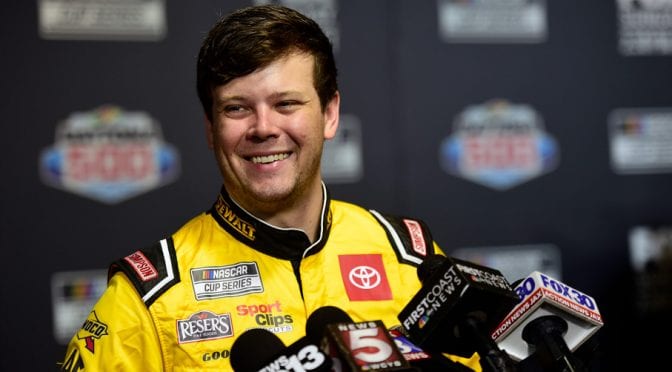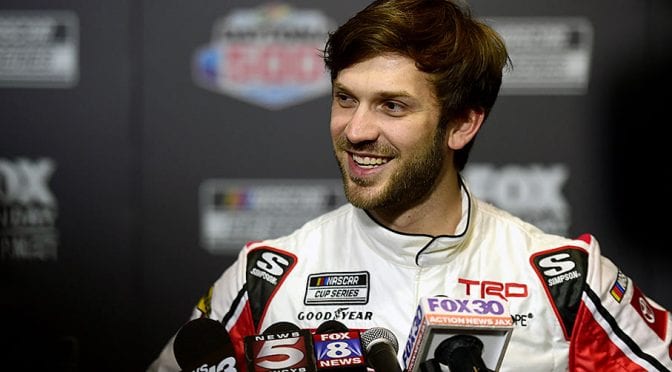
TALLADEGA, Ala. – Ty Dillon was eager to get the rundown from his brother.

On Wednesday at Richmond Raceway, Austin Dillon got a chance to test a prototype of the Next Gen car NASCAR plans to introduce into the Monster Energy NASCAR Cup Series in 2021. The car was assembled by Richard Childress Racing in collaboration with NASCAR.

RELATED: Next Gen car makes debut at Richmond test

Before practice on Friday at Talladega Superspeedway, Ty got feedback from his brother.

“Yeah, I just talked to him right before first practice for about 20 minutes,” Ty Dillon said. “He is really excited about that car. It’s totally different. There are so many things different about it that I’m like, ‘That’s going to happen? They are going to do this with that car?’ I would have no clue what that look or feels like.

“He said it was crazy and a whole lot different. It’s exciting for our sport. Our sport needs to continue to grow and evolve. That’s the kind of steps we need to take in all aspects of the sport.”

The early returns indicate the Next Gen car should set a new performance standard for NASCAR’s top series.

“All he told me is that it stops really good, it turns really good, it feels lighter and faster,” Ty said of Austin’s test run in the car. “Just some different little things and some new unique aspects that I didn’t even know were things on the car they are working on trying. It’s all still in a development stage of a car, but it sounds exciting. I think it’s going to be a lot of good things for the sport…

“I think the car reacts more to driver input and driver ability… It gives the driver more opportunity to show what he can showcase. That’s exciting for all of us.”

TALLADEGA, Ala. — Talladega Superspeedway was the vision of NASCAR founder Bill France Sr., known throughout racing circles as “Big Bill.”

So when Talladega executives were trying to come up with a name for the 35,000-square-foot centerpiece to a massive infield renovation, “Big Bill’s Social Club” was the suggestion that stuck.

The issue was how to make the new area fit the image of Talladega. The sort of pristine overhaul that transformed sister superspeedway Daytona into the premier showplace in motorsports wouldn’t conform to the more rough-hewn character of Talladega.

RELATED: See photos of the renovations

“We literally put everything up new and then paid a lady to come in and paint it all to look old,” said Talladega Chairman Grant Lynch, who is retiring after 26 years at the 2.66-mile track. “So that’s how we did it. She painted all that stuff out there, and you walk up there, and you say, ‘Golly, this looks old — and it does.’

“She did a wonderful job, and I think it gives you a different feel when you walk in there, ‘cause you feel like you’re in Talladega.”

It’s difficult to tell at a glance, but the aged, rusty look of Big Bill’s is artificial. What is quite real is the atmosphere it lends to NASCAR’s largest closed course.

“We’re just as pumped up as we can be,” Lynch said. “The folks that we’re talking to going in and out of it are kind of mesmerized by the size and scope and magnitude of it. All I can say is, I think we’re delivering on our promise to give the fans something special here at Talladega.”

Editor’s note: This story was originally published Oct. 21, 2015. 

The trunks of NASCAR race cars don’t typically have much utilitarian value. There’s the fuel cell and that’s about it. There’s no need for extra freight when traveling at 200 mph.

However, those with VIP privileges or an employee card at Richard Childress Racing’s sprawling museum in Welcome, North Carolina, know there’s treasure inside the trunk of the dozens of retired cars housed there, many of which were wheeled by NASCAR icon Dale Earnhardt.

Steve Ramey, the museum’s curator in residence, pulls the fastening pins and raises the decklid on one in particular, an imposing black No. 3 car that might otherwise blend in with the others.

“I get to pinch myself if you want to know the truth, knowing that when I go to work and I step out of my office, I walk into a room with the black number 3 cars from the day,” Ramey says. “But this car here gets a lot of respect from the fans because they know the meaning of it. … This was his chance, his day and his race, and he took it and brought it home. It means a lot to them.”

Every car at the RCR Museum has a story, but this one stands out. The cargo that Ramey’s looking for on this specific Monday, though, isn’t in the trunk. It triggers his memory — he had removed it for reference. Once he tracks down the three-ring binder specific to RCR Chassis No. 58, the lore gains even more clarity.

The loose-leaf sheets in nondescript folders document each rolling artifact in the museum with pictures, notes and the crew chief’s log. The next-to-last entry for Chassis 58 is a telling one, both succinct and understated considering the magnitude of what the car — and more importantly, the driver — accomplished in its last race.

“Had good race car & Dale did rest.”

This is the story of the 2000 Winston 500, where Dale Earnhardt drove to the last of his 76 NASCAR premier series victories at Talladega Superspeedway. His 10th victory at the Alabama track — still an all-time record — came in stunning fashion, with a rally from 18th place to first in the final five laps.

By then, Earnhardt’s legend was already well-established — as a stock-car racing deity, a hard charger, as “The Intimidator” — but the impact of his final win went beyond the highlight-reel finish. The transcendent performance earned its place in NASCAR history, stirring an already frenzied fan base into hysteria that autumn afternoon.

This summer, NASCAR.com interviewed 31 people — drivers, officials, crewmen and broadcasters — who were at Talladega that day for their personal accounts of the tumultuous race weekend. For this oral history surrounding the race’s 15th anniversary, all interview subjects are listed with their job title or role on Oct. 15, 2000, the day Dale Earnhardt shook the Alabama grandstands with seismic force and embraced his final checkered flag.

There are 12 entries for Chassis No. 58, perhaps none as important as the log for Oct. 15, 2000 — “Had good race car & Dale did the rest.” 

•   •   •   •   • 

The Man and his Playground

“If you call that racing, OK. So be it. We’ll just sit in line. … They could take the restrictor plate off and we’ll see who’ll hold it wide open around here.” — Dale Earnhardt, Talladega, Oct. 11, 1997.

Dale Earnhardt’s contradictory love-hate relationship with the 2.66-mile Alabama speed plant might fly in the face of conventional wisdom, especially for a man who so ably maneuvered its high banks to win 10 times. While he freely expressed his disdain for the speed-sapping restrictor plates, which limited carburetion and choked engine power, Earnhardt was also extraordinarily adept at the tightly woven, aero-dependent racing they produced. The track had dished out its share of hard hits to The Intimidator over the years, but also a lion’s share of its laurels.

Grant Lynch (Chairman, Talladega Superspeedway): His picture is up in our media center, with his comments to the other drivers about, ‘If you don’t want to race at Talladega, tie a kerosene-soaked rag around your ankles so the ants don’t come up there and eat that candy ass.’ … He believed when you came here this was another race and you’re supposed to race. A lot of people didn’t take that same attitude.

Ray Dunlap (pit reporter, ESPN): You have to remember that Earnhardt hated that kind of racing and it was so funny because he was so good at it, but he would really get himself worked up before those races started.

Bill Elliott (owner/driver, Bill Elliott Racing No. 94 Ford): He was really, really a good drafter, just like what Tony Stewart once said. He said, ‘It’s a high-speed chess game and I can’t even play checkers.’ I think Earnhardt was a good chess player.

Andy Petree (team owner, Andy Petree Racing): There was nobody better at that kind of racing than he was — nobody. He had like this sixth sense. It’s almost like being on the highway and trying to figure out which lane is gonna move.

Darrell Waltrip (driver, Haas-Carter Motorsports No. 66 Ford): He was just so, so aggressive. If there was an opening, he took it. And if there wasn’t an opening, he’d make one. He just drove harder at Daytona and Talladega than I think he did anyplace else, and he kind of went where other people were kind of afraid to go or other people wouldn’t go.

Bobby Labonte (driver, Joe Gibbs Racing No. 18 Pontiac): It was like he was Superman, which he was. He was really good at it, but his driving style helped that … his intimidation factor, I guess you might say. He had fast race cars, but he could take a car that wasn’t so fast every day and do better with it than anybody else because he was better at drafting and making that move. Next thing you know, he’s in front of you and it’s like, ‘How did that happen?’ Not everybody else could do that but him, seemed like.

Dale Earnhardt Jr. (driver, Dale Earnhardt Inc. No. 8 Chevrolet): He wasn’t this maniac that just wanted to go faster. I think everybody had the curiosity of what would the cars drive like and what would the race be like if they were unrestricted. It’s just, we’d be going 230 miles an hour, I think.

Danny “Chocolate” Myers (fueler, Richard Childress Racing No. 3 Chevrolet): Earnhardt was a driver. If he was running good, he loved plate racing. If he was running bad, he hated plate racing, I guess.

Earnhardt Jr.: I’m sure he felt more confidence over the competition when he got to those races. He respected his competitors and the guys he was out there racing against, but I think he felt like he was sort of the best at those tracks.

Lynch: I have told the drivers a couple times in the driver’s meeting, I don’t think Talladega is any driver’s favorite race track, probably won’t ever be, but when they get their minds right and they do what they can do here, it cannot be duplicated at any race track in the world by any form of motorsports. It just can’t be done.

Earnhardt’s uncanny skill at restrictor-plate racing and manipulating aerodynamics in his favor promoted a myth that grew into a key piece of NASCAR folklore — that he could see the air.

Lynch: You’ve heard it said that he could see air. Well, he could definitely see something.

Waltrip: He had that open-face helmet and the little pair of bubble goggles and everybody always said, ‘Oh, he could see the air,’ but he really couldn’t see it, he could feel it. If you ever look at him laying over, his head about halfway hanging out that left window with that open-face helmet and those bubble goggles. I don’t think it was so much he could see it, but he could feel it and I think that really helped him find the right path to take — the path of least resistance sometimes.

Dale Earnhardt’s open-face helmet was instrumental in helping him navigate his car through the pack — which led to drivers saying he could see the air. “He really couldn’t see it, (but) he could feel it,” Darrell Waltrip said.
Steve Park (driver, Dale Earnhardt Inc. No. 1 Chevrolet): One of the things we questioned (was) why he didn’t wear a full-face helmet for safety reasons. He said it just impedes his feeling of the amount of internal pressure inside the car and how it changes, especially on superspeedways. That’s pretty unique. You don’t hear that much any more, but I also think that’s what made him so special on the superspeedways.

Bobby Hutchens (chief engineer, Richard Childress Racing): He could feel the air come in and out of the car and the air buffer between the two cars going side-by-side or in front or behind him. I think he used that as a gauge or a measuring mechanism to figure out exactly how to operate his car in those draft conditions, as crazy as that sounds.

Eli Gold (turn announcer, Motor Racing Network): Obviously, that wasn’t something that us mere mortals could understand, but he sure as heck seemed to be able to get through traffic and be in the right place at the right time.

Not only did Earnhardt have personal expertise on his side, he also reaped benefit from his Richard Childress Racing team’s superspeedway know-how. The aerodynamic information was spread among two other organizations — Andy Petree Racing with drivers Joe Nemechek and Kenny Wallace; and Earnhardt’s own Dale Earnhardt Inc., with drivers Dale Earnhardt Jr. and Steve Park — in a fore-runner to NASCAR’s modern-day technical alliances.

Mike Skinner (driver, Richard Childress Racing No. 31 Chevrolet): It didn’t seem to matter at RCR what the aero package was or what the rule package was because our superspeedway program was really, really good. We adapted well to just about anything.

Joe Nemechek (driver, Andy Petree Racing No. 33 Chevrolet): At that point in time we were doing a technology share with RCR. … A lot of work, a lot of innovation went into sitting on those poles and running well at the speedway tracks.

Petree: My first year as his crew chief was ’93. I got there late that year, so we really didn’t have time to really prepare cars and, honestly, the cars were not really up to snuff by my standard because there was not the time to do a lot. I was not happy with what we were taking, not all that happy at all — and we won everything. We won the qualifying race, which was 125-miler at the time, won the shootout and then led most of the 500 until Dale Jarrett passed us and I remembered saying, ‘God, that guy’s good.’

Kevin Hamlin (crew chief, Richard Childress Racing No. 3 Chevrolet): As hard as that car was to make run, as long as you just give him something, he’d usually turn chicken s— into chicken salad.

When Earnhardt arrived at Talladega that fall day, he was in the midst of a career resurgence, in the thick of the championship battle with five races remaining in the 2000 season. He was in the fourth year of a sometimes strained partnership with RCR teammate Mike Skinner, whose crew chief, Larry McReynolds, would depart for the FOX broadcast booth the following season.

Larry McReynolds (crew chief, Richard Childress Racing No. 31 Chevrolet): I’ve got to be candid, and I can easily say this — they worked together about like oil and water. I think they respected each other, but they just did not work together. Dale was never a big fan of Richard adding a second team. That happened simultaneously when I went there in ’97 and I think what poured salt in the wound was the first race that year in ’97 — the Daytona 500 — Mike sat on the pole. … Mike and Dale, they respected each other, they talked to one another, but I think they probably preferred to outrun each other more so than they did the competition at times.

Skinner: He didn’t need a teammate. He’d won numerous championships and numerous races and did all of that without a teammate, and that was his mindset. I guess mine would have been the same way.

Myers: It wasn’t one of those deals where they were the best of friends, the best of teammates, and they did everything to help each other. I don’t think it was like that back then.

Skinner: We had been pumped up about running good, but at that point in time in your career and (McReynolds’), knowing that his crew chief days were coming to an end, I wasn’t getting any younger, my Sprint Cup days were coming to an end. You basically are frustrated deep inside because you know you’re good enough to win, your team is good enough to win, your pit crew is good enough to win. All the tools were there; we just weren’t winning. We stayed pumped up, but, boy, I tell you at times it was awfully hard to not just be really, really, really — I don’t want to use the word ‘childish’ about it — but just so pissed off because we weren’t winning.

Meanwhile, the Dale Earnhardt Inc. organization was in its first season as an up-and-coming two-car team, with his son Dale Earnhardt Jr., a rookie of the year candidate, pairing with Steve Park, a modified hotshot from the Northeast.

Park: He was more like a teammate than a team owner. He didn’t want to see anything happen to any one of his cars or his drivers. All he wanted to see was them succeed, and he put 110 percent effort into making sure that every team had what they needed to try and run up front. He was like a father figure. If you did something right on Sunday, you might get one of those Earnhardt half-grin smiles, but if you did something wrong you were out in the hot sun baling hay, talking to him and having him describe in his way of how you messed up. Believe me, after baling hay for a day out in the hot sun, whatever mistakes you made, you made sure you didn’t make them again.

Though Earnhardt’s roots were firmly planted in his home state of North Carolina, he was adopted as royalty in Alabama. His driving technique and common-man appeal resonated at Talladega, an Earnhardt stronghold that continues to show its favor on his son today.

Dr. Jerry Punch (play-by-play announcer, ESPN): A lot of these people who go to that race track are diehard, grassroots race fans who had tough lives and tough jobs and every day they fought to win, just like Earnhardt. They identified with Earnhardt. He was a racer’s racer and a man’s man, and that’s the kind of people you had in the stands, and they identified. ‘Every day I have to fight this battle to win in my life and this is what this guy is doing right here. Man, I love this guy. He’s one of us.’


Like father, like son. Dale Earnhardt and Dale Earnhardt Jr. watch some of the on-track action during the 2000 Talladega weekend. Alabama fans love Junior the way they loved his Dad.

Park: You think of Talladega and where it’s located geographically and the majority of the fans that used to go and still go to the races at Talladega all worked hard Monday through Friday to get to the race, and then to see a guy that didn’t have a high school education and grew up with his dad racing cars and went from a mill factory worker to a race car driver to, for lack of a better term, the King of Talladega. Demographically, I’d have to say 80 percent of the people were rooting for him at Talladega.

Steve Ramey (motorcoach driver, Richard Childress Racing): How the fans connected with Earnhardt is that he was a working-class guy and he was on their level. Nothing against any of the modern day drivers that we have today, but Earnhardt was a working-class guy and it was our kind of fan base that day.

Mike Helton (President, NASCAR): It was those love-hate relationships that he created wherever he went came part from his driving style, part from just the ambiance that he carried with him through that era. Talladega was very appreciative of Dale Earnhardt Sr.’s … just his common-man ability to do exceptional things, and he did it a lot at Talladega. He did it in Daytona, did it in other places, too, but I think it was probably in sync more with the Talladega fan base than it may have been in other places.

Myers: To go down there with Dale and this race team, you knew you had a chance every time you walked in the door, and you were going into Earnhardt Country.

Ward Burton (driver, Bill Davis Racing No. 22 Pontiac): Dale was obviously one of the most talented drivers there ever was or ever will be. At the same time, his means of passing as many cars as he was able to rough up or wreck, in today’s time I don’t think you’d get away with that, I don’t care who you were. I don’t really think NASCAR would allow the things he got away with for so long. As he got older, he was certainly an ambassador for the sport and had a heck of a fan following, but he also had the ones that were extreme the other way.

Rusty Wallace (driver, Penske Racing South No. 2 Ford): He thrived off it, too, man. It fed him. He’d go out there and the whole grandstand was just lit up, and he’d beam and smile. He’d get in that car and then drive the s— out of it.

Terry Labonte (driver, Hendrick Motorsports No. 5 Chevrolet): He was the Intimidator, and he earned that nickname, so that’s probably why a lot of the fans really admired him and looked up to him. He was a great competitor and a good guy, so I think a lot of fans really latched onto him and knew he came up the hard way and really didn’t have anything handed to him. He earned it all.

Jeff Burton (driver, Roush Fenway Racing No. 99 Ford): He was just a country boy. He was like the rest of us — a normal, everyday average guy. He didn’t dress fancy. He wasn’t a great speaker. He was just a normal guy that could drive the hell out of a race car.

Lynch: In Dale’s heyday at this place the grandstand basically looked black because there were so many black No. 3 T-shirts out there, and then when Dale was gone and Junior took over the mantle in the Budweiser car, then it turned red.

McReynolds: The people down there loved him just like they love his son, but I’m gonna tell you what, that guy had a little extra bounce in his step whenever we’d go there and race.

Earnhardt Jr.: I mean, when he was at the plate tracks at Daytona and especially at Talladega, his arrogance almost of how much better he was than the competition I think is what those fans really liked. They appreciated his style, the way he went about his job. What happened at Talladega with Dad was certainly unique, and the way the fans followed him and the way they appreciated what he did, I think that they liked the way that he put on a show.

Richard Childress (owner, Richard Childress Racing): You could run into him anywhere and he had his blue jeans on and he was just Dale Earnhardt. He was special. He was special to the fans of Talladega and even today it’s Earnhardt country. It’s like Dale Jr. today, basically in my book, home is Talladega. It’s just a family tradition that has been passed on.

•   •   •   •   •

The Program and the Fan

“If I get to meet Dale Earnhardt, it will make my day. Even if I don’t win any money, meeting him will be worth the trip.” — Richard Sturtz, The Baltimore Sun, Oct. 15, 2000.

R.J. Reynolds’ long-running title sponsorship of NASCAR’s top series included an evolving bonus-money program, which grew from the Winston Million’s formation in 1985 into the No Bull 5 incentive in 1998. The program, centered around the company’s marketing campaign for one of its signature brands, offered $1 million as a prize for any of five eligible drivers in five selected races throughout the season. In a step to further engagement, Winston also paired racers with contest-winning fans, who would also win $1 million if their driver prevailed.

Jerry Hailey (engine tuner/tire carrier, Richard Childress Racing No. 3 Chevrolet): That was a big payday. It was a lot of money that we could put into the program. We looked at it as an opportunity for us to get better equipment, to get more people on staff. It was a way to win even more races. It was a great program and the money incentive was phenomenal.

Ramey: For them to have that on their record that was like having a degree or something on your resume — to have that No Bull million on your resume. That was like a key checklist right there.

For this weekend, the No Bull-eligible drivers vying for $1 million were Earnhardt, Park, Jeff Burton, Jeff Gordon and Mark Martin. Five lucky fans arrived in the Yellowhammer State that weekend, not knowing who would be their driver. For Richard Sturtz — then a 45-year-old truck driver from rural Mt. Savage, Maryland — his hopes were resting on being paired with his favorite driver, Dale Earnhardt.

Richard Sturtz (contest winner, No Bull 5): Actually, I went to Darlington and saw one of those cards that you fill out, it’s like a sweepstakes. I didn’t think anything about it, I just filled one out and went to the race and went back home. And then about the first of October, I got this letter saying I can be a contestant in the No Bull 5 contest. I had no idea what that was at the time, so we actually had to go to a justice of the peace to have all these papers all filled out to be a contestant. The next thing I know we were on a plane to Birmingham and they took us down to Alpine, Alabama, where we got to meet the drivers, where they actually had a skeet shoot to see how they finished, and how they finished is how we were actually paired up with the drivers.

Jeff Burton: It was at night, and Dale couldn’t hit the damn thing. He’s a great hunter and he couldn’t shoot the damn things. He couldn’t shoot them because he wouldn’t put his glasses on.

Sturtz: He ended up being fourth and being the outdoorsman that he is, I couldn’t believe it. Jeff Burton and Steve Park, they all beat him.

Jeff Burton: He didn’t want people to see that he had glasses and I remember thinking, ‘He’s damn Dale Earnhardt. Why does he care if somebody knows he’s wearing glasses?’ And now that I’m in my upper 40s, I’m like, ‘Well hell, I don’t want people to know I’m wearing glasses,’ so now I understand a little more.

Sturtz: We got paired up and then they started taking us to the track in these gigantic limos. Up here where I live there’s no such thing, you know.

Childress: I never will forget that this guy had a moustache kind of like Dale.

Richard Sturtz bore a resemblance to Dale Earnhardt, something not lost on Richard Childress. (Photo courtesy of Richard Sturtz)

Sturtz: Jeff Gordon, and my wife was going up there, and me and Dale were going up to Alpine and he said, ‘Dale, I didn’t know you had another brother.’ … Me and him did have some facial features that looked the same. Jeff Gordon said he couldn’t believe it with me looking like Dale.

Hamlin: He was determined he was going to win that guy a million dollars. That was his whole goal for the weekend. I don’t think he cared about necessarily winning the race, he just wanted to win the race so that guy could have a million dollars.

CONTINUED: READ PART 2 HERE

TALLADEGA, Ala. – More than 18 years ago, Kevin Harvick was thrust into a career change he could not have anticipated a week earlier.

After Dale Earnhardt’s death on the final lap of the 2001 Daytona 500, Harvick took over Earnhardt’s vaunted Richard Childress Racing ride the following week at Rockingham—albeit in a Chevrolet sporting the No. 29 in lieu of the trademark No. 3.

In his third start in the car, Harvick won at Atlanta, the first of 48 career victories to date. On Sunday at Talladega, Harvick will make his 677th start in the Monster Energy NASCAR Cup Series. The 2001 Daytona 500 was Earnhardt’s 676th race in NASCAR’s premier series.

RELATED: Talladega weekend schedule | At-track photos from Talladega

“It should make a lot of us standing here feel old,” Harvick said on Friday at Talladega. “I think, as you look back and you don’t realize how long it actually has been and—you guys have heard me say this before—but in the beginning it was really hard to understand the magnitude of the circumstances the first couple years, just because you didn’t really understand much about what was going on as you got into the second year and really started to understand what happened the year before.

“It was already done. Sometimes you do things and then all of a sudden you get past those things and you haven’t really taken in all of the things that happen because you just didn’t understand them. Really, that first particular year we raced so much and the team protected me from so many things because we were on the road so much and didn’t have to really understand the magnitude of it, but there was no hiding from it over an offseason and the next year, as the expectations changed.

“But when you look at, like when I came in, we started racing 36 races and so it happened a little bit quicker than it would have with—I don’t know what the total number of years (Earnhardt raced) were—but I’m sure it’s more. It’s definitely a unique number and stat and makes you think back to a lot of things.”

Team owner Richard Childress will pace the field for Sunday’s 1000Bulbs.com 500 (2 p.m. ET on NBC, MRN and SiriusXM NASCAR Radio), accompanied by Johnny Morris, founder of RCR sponsor Bass Pro Shops.

During the 50th anniversary season of RCR and the 50th anniversary season of Talladega Superspeedway, Childress will be behind the wheel of the No. 3 Chevrolet Earnhardt drove to the final victory of his career—and his 10th at Talladega—on Oct. 15, 2000.

RELATED: Oral history of Earnhardt’s last victory

Having moved from RCR to Stewart-Haas Racing, and having won the series championship in 2014, the first year of the elimination format, Harvick will compete in his 20th full season at NASCAR’s highest level next year. Of all the changes that have occurred in major league stock car racing since his rookie season, Harvick sees the advancements in safety as foremost.

“The rapid progression of the inside of the car—that’s the biggest that has changed, because I live in there on a week-to-week basis and have seen the progression of ‘You don’t have to really wear gloves if you don’t want to, you don’t have to wear a full-face helmet if you don’t want to,’ to today, where they’re bugging you all the time to go update your concussion protocol and going to do your physicals and all those things you used to just cowboy up and not do and think that was the right way to do it.

“The standard of the safety side of things, and it still progresses rapidly today because NASCAR pushes it. The soft walls. The helmets. The seats. I mean, a number of those things have changed, and I would say outside of the car is just the engineering, the amount of engineering that goes into these cars is still going to be surprising to somebody who comes from an industry that’s never seen a NASCAR race.”

TALLADEGA, Ala. — Alex Bowman can get the job done.

The driver of the No. 88 Hendrick Motorsports Chevrolet has proved this postseason he’s able to do what he needs when he needs to in order to survive in the 2019 NASCAR Playoffs. Entering the elimination race the Charlotte Motor Speedway road course two weeks ago, Bowman was two points below the cutline. He powered through to a second-place finish and advanced by just five points.

A week later, Bowman finished third at the Round of 12 opener at Dover International Speedway, actually giving himself 17-point a cushion in the standings.

“I can’t sit here and say that I enjoy the high-pressure situations and that they make me feel good,” Bowman said Friday in between the Monster Energy Series’ practices at Talladega Superspeedway. “But, for some reason, I tend to thrive in those high-pressure situations. I just try to use it to my advantage as much as I can.”

RELATED: Full ‘Dega schedule | Practice results

It has gotten Bowman this far: the second race of the Round of 12, better known as the 1000Bulbs.com 500 at Talladega Superspeedway (Monday, 2 p.m. ET, NBCSN/NBC Sports App, MRN, SiriusXM NASCAR Radio).

Bowman currently sits slightly comfortable in seventh, two spots away from elimination. The cutoff race isn’t until next weekend at Kansas Speedway. The most Bowman wants to do now is survive Talladega.

“I think the speedways are really the only places you can’t look at past finishes as an indicator of how you’re going to run going,” Bowman said. “I think some guys run really good at speedways and others seem to not. But running second here in the spring isn’t necessarily a guarantee we’re going to run well this time.”

Which he did. It marked his best Talladega run in his career. First top-five performance there, too. That was the regular season. This is the postseason.

RELATED: Bowman lends a helping hand in Kansas | Qualifying order 

There have been four playoff races so far. Bowman has placed in the top five in two of them and top 10 in three of them. He was – in order – sixth at Last Vegas Motor Speedway, 23rd at Richmond Raceway, second at the Roval and then third at Dover.

Quite a turnaround for someone whose best finish (prior to the playoffs) since his first career win at Chicagoland Speedway in June was 10th.

“I think we belonged to be in this round and move on before that,” Bowman said. “But I think we’re definitely stating it and doing a really good job of showing that.”

Bowman made the playoffs last season, before ultimately coming 16th in the final standings. It was his first full-time season with Hendrick Motorsports. He ended up making it to the Round of 12 before getting eliminated.

The issue last year, though, was Bowman started the Round of 12 with a 28th-place finish at Dover. He was then 33rd at Talladega and ninth at Kansas.

“We were kind of throwing Hail Marys from there,” Bowman said. “But this year, we have a legitimate shot.”

TALLADEGA, Ala. — Just more than three weeks ago, Daniel Hemric received word that he’d be looking for a new job for the 2020 racing season. That prospective employer hasn’t been decided yet, but Hemric says the outlook is now much rosier.

“I feel like there’s windows of brightness here and there,” Hemric said Friday, in between Monster Energy Series practices at Talladega Superspeedway. “I think I will land on my feet, and I’ll land right where I’m supposed to. Just got to have faith in the good Lord taking care of me. There’s a lot of variables here involved, so hopefully in the next week or two, I can really feel comfortable with what’s going on.

“Still, just a lot of moving parts and pieces that have to fall … so you just try to keep yourself as pumped up as you can in a time like this and just know the sun’s going to come up tomorrow, and we’ll all be better for it. Just trying to keep that mindset and do all I can do to control the outcome, but at the end of the day, it’s going to work out the way it’s supposed to.”

MORE: Key drivers in Silly Season

Hemric’s first full season in the Monster Energy Series has been marked by uneven results, but this weekend’s return to Talladega rekindles memories of one of the year’s bright spots. Hemric placed fifth as part of a stellar team effort by Chevrolet to notch his first — and thus far only — top-five finish.

In the weeks since that late April race here, the landscape has changed for driver-team alignments with new alliances taking shape for 2020. Hemric wasn’t immune, and the news trickled out Sept. 17 that Richard Childress Racing was heading in a different direction with its No. 8 Chevrolet, a seat to be filled by the rookie-in-waiting Tyler Reddick.

Those job ripples haven’t stopped, and Hemric figures prominently in where the next scenarios may shake out.

“As a whole, our sport — especially at the Cup level — has had some pretty big dominoes fall over the last two to three weeks,” Hemric said. “Some of those were a week or two following me finding out what my future was — or what I thought it was. As that’s all happened, it does. It shakes up everything and it brings conversation with folks you never thought you’d be having conversations with, and that’s from all three series. … All I want is a shot to compete and do it at a high level, no matter what level that’s in.”

RELATED: Full Talladega schedule | 2019 standings

Though his time with Richard Childress Racing is winding up after three seasons — two in the Xfinity Series, one in Cup — Hemric insists he’s not simply playing out the string. The 28-year-old driver is in the midst of a tight Sunoco Rookie of the Year battle with JTG Daugherty Racing’s Ryan Preece with six races remaining, starting this weekend at Talladega.

“I think no matter what you want to look at it, all the way up to Homestead, I still have jobs and goals that are still obtainable in what I set out to do — not only this year as my rookie Cup season, but what I set out to do three years ago at RCR,” Hemric said. “I want to check those things off and be in the mix all the way up until the checkered flag flies at Homestead.”

Friday afternoon’s final practice for the Monster Energy NASCAR Cup Series at Talladega Superspeedway offered a mix of mock-qualifying runs and small drafting groups, and Clint Bowyer led the way.

Bowyer posted the fast lap at 202.042 miles per hour in the No. 14 Stewart-Haas Racing Ford in the last 50-minute tune-up session before Sunday’s 1000bulbs.com 500 (2 p.m. ET, NBC/NBC Sports App, MRN, SiriusXM NASCAR Radio). Stewart-Haas Racing teammate Aric Almirola finished in second with a lap at 200.835 mph in the No. 10 Ford. (UPDATE: The race will resume in Stage 2 on Monday at 2 p.m. ET on NBCSN, NBC Sports App, MRN, SiriusXM NASCAR Radio.)

RELATED: Final practice results

Matt Crafton turned more laps for Paul Menard in the No. 21 Wood Brothers Racing Ford, as Menard battles soreness and pain with his neck. Crafton, who will be on standby for Sunday, earned the third-fastest lap at 200.814 mph. Kevin Harvick finished fourth at 200.612 mph, as Ryan Preece rounded out the top five at 200.498 mph.

PRACTICE 1

Denny Hamlin launched to the top of the leaderboard in the final minutes of Monster Energy NASCAR Cup Series opening practice.

RELATED: Practice 1 results

Hamlin, who sits tied for second in the NASCAR Playoffs point standings, muscled his way to the top spot with a lap at 204.094 miles per hour in the No. 11 Joe Gibbs Racing Toyota.

Playoff contender Kevin Harvick finished second in the 50-minute opening session with a lap at 203.688 mph in the No. 4 Stewart-Haas Racing Ford. Kyle Busch finished in third at 203.684 mph, followed by Corey Lajoie (203.407 mph) and Michael McDowell (203.386 mph) to complete the top five. 33 drivers topped the 200 mph mark.

Matt Crafton took laps in the No. 21 Wood Brothers Racing Ford as he is on standby for Paul Menard.

Chase Elliott, William Byron and Ryan Preece all had 15-minute practice holds for being late out of the garage for inspection at Dover, while Martin Truex Jr. lost 15 minutes of practice time for failing pre-race inspection twice at Dover.

TALLADEGA, Ala. — Stewart-Haas Racing renewed its partnership with Aric Almirola and Smithfield Foods earlier this week, maintaining the driver-sponsor combination on the No. 10 Ford Mustang in the NASCAR Cup Series for 2020.

The partnership started back in 2012 in Almirola’s first full-time year in the NASCAR Cup Series. “Having a sponsor in this day and age is pretty critical,” Almirola said Friday at Talladega Superspeedway. “We knew it was going to happen, just a matter of dotting all the I’s and crossing all the T’s.”

Almirola declined to reveal the terms and length of the renewal, which have not been made public.

When asked if this renewal provides more job security and a look into his future, Almirola said performance was still the ultimate goal.

“We haven’t had the year we had last year and that’s just part of the sport,” said Almirola, who was eliminated from the playoff picture after the Round of 16. “Not the year we wanted but we’re going to continue to strive for success and move the needle.”

Almirola is the defending race winner at Talladega, where he claimed a victory that locked him into the Round of 8 for the 2018 NASCAR Playoffs.

RELATED: Almirola, Smithfield back at SHR

History was at hand Thursday evening in the eNASCAR PEAK Antifreeze iRacing Series championship race from virtual Homestead-Miami Speedway.

For 17-year-old Zack Novak, he won his first career iRacing championship. For the series itself, Thursday night’s race was broadcast live on NBCSN, marking the first-ever eNASCAR championship telecast in a culmination of one of the series’ most prominent years to date.

Novak passed fellow Championship 4 driver Keegan Leahy, who dominated for much of the 140-lap race, for the lead with seven laps to go, then held off the G2 Esports driver who entered the race as the favorite. The two drivers were side-by-side coming out of Turn 4 on the final lap with Novak holding his line and staying just ahead of Leahy for the win. It was the series-best fourth win for the series champion.

“(Being called champion) sounds awesome,” Novak told NBCSN. “That was a grind, all season long. Even the race itself was just a crazy grind and I can’t believe I’m in this position. … (Leahy) kept me real honest, raced very clean. I respected him and I tried to race him as clean as I could back and I hope I accomplished that.”

Novak, who will take home $40,000, the largest share of the $100,000 prize pool, drives for Roush Fenway Racing. He won the inaugural eNASCAR IGNITE Series championship (a series for drivers aged 13-16) last year.

Fellow Championship 4 racers Bobby Zalenski (Joe Gibbs Racing) finished fourth and Blake Reynolds (Team Dillon Esports) took ninth.

RELATED: Top moments of 2019

The NASCAR America broadcast marked the first time an official eNASCAR PEAK Antifreeze iRacing Series race has been aired live on national television. iRacing made its NBCSN debut this summer with a pair of All-Star exhibition races hosted by NASCAR America’s Krista Voda, Parker Kligerman and AJ Allmendinger, along with series team owners Steve Letarte and Jeff Burton. Kligerman, also an owner in the series, competed in the events.

Celebrating its 10th season, the 2019 season featured the largest prize pool in eNASCAR PEAK Antifreeze iRacing Series history with over $100,000 on the line between season-ending prizes and weekly performance bonuses. Novak will earn the largest share, receiving $40,000 on top of their weekly winnings, as well as a test day in a US Legends Car and NASCAR Pinty’s Series vehicle with Canada’s Best Racing Team.

In addition, Novak will be flown to Miami for NASCAR’s championship weekend where they will be honored during the pre-race ceremonies for the Monster Energy NASCAR Cup Series Ford EcoBoost 400 at Homestead-Miami Speedway.

MORE: Full eNASCAR coverage