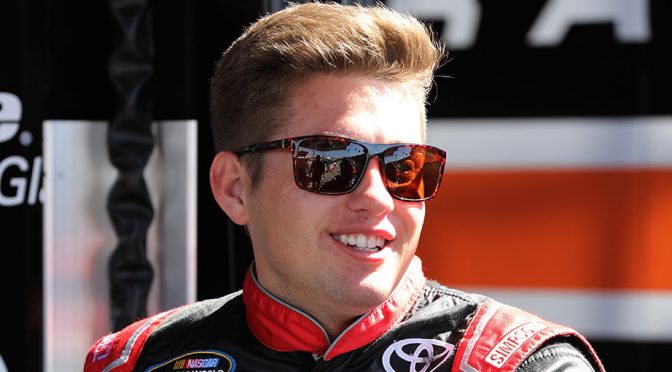
Huntersville, N.C. (April 12, 2018) – Joe Gibbs Racing (JGR) announces that Noah Gragson will be behind the wheel of the No. 18 NASCAR Xfinity Series Toyota Camry for three consecutive races starting at Richmond Raceway on April 20, 2018.
Gragson will be behind the wheel of the No. 18 Toyota Camry for the Toyota Care 250 at Richmond Raceway, Sparks Energy 300 at Talladega Superspeedway and the OneMain Financial 200 at Dover International Speedway. Gragson has experience at all three tracks between both the NASCAR Camping World Truck Series and the NASCAR K&N Pro Series East.Switch has been named the primary sponsor for all three spring races with Gragson.
“I’m fortunate and very honored to make my NASCAR Xfinity Series debut for Joe Gibbs Racing at Richmond Raceway. This past year, I’ve continued to demonstrate that I’m a top competitor in the NASCAR Camping World Truck Series in the No. 18 Safelite Toyota Tundra for Kyle Busch Motorsports,” quoted driver Noah Gragson. “JGR is known for building fast race cars and I’m excited to get behind the wheel of the No. 18 Switch Toyota Camry and prove to everyone that my skillset is ready for the next level. My plan is to not just make my NXS debut, but to also run up front in each race and make a name for myself.”
2018 marks Gragson’s second full-time season at Kyle Busch Motorsports (KBM) as a part of the NCWTS. Gragson has recorded one win, six top-five finishes and 15 top-10 finishes over 29 races with KBM. In 2017, Gragson captured his first NCWTS victory at Martinsville Speedway after starting the race in the fifth position.
NASCAR’s annual short-track spring stretch is in full swing, with Martinsville Speedway (.526 miles), Bristol (.533 miles) and Richmond (.75 miles) comprising three of four races on the Monster Energy NASCAR Cup Series schedule.
It’s a stretch that often is an indicator of a successful season overall for those who do well, and one which gives credence to the bragging-rights garage discussion of who is the best short-track racer in the Monster Energy Series.
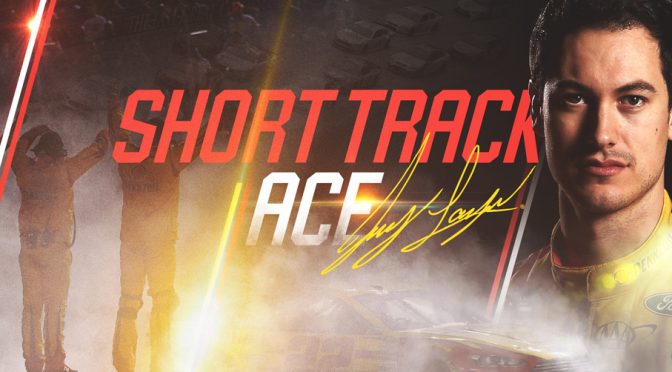
Based on numbers, over the past five years, no one has been better during this spring stretch than Team Penske’s Joey Logano.
According to NASCAR’s statistical services, since 2013 no active driver has had more top-five finishes, top-10 finishes or Busch Pole Awards, or a better average start and average finish during the spring races at these three tracks. Yeah, that’s a lot of categories.
Over the span of 16 races (including this year’s Martinsville race), Logano has bragging rights heading into this week’s race at Bristol (Sunday, 1 p.m. ET, FOX, PRN, SiriusXM NASCAR Radio).
Here’s a breakdown, among active drivers, of where Logano leads at the Martinsville-Bristol-Richmond swing.
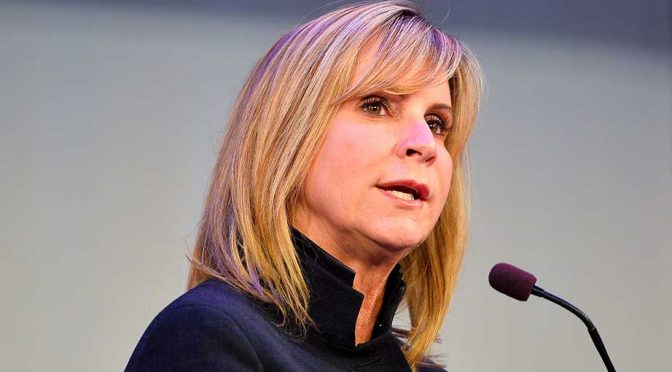
DAYTONA BEACH, Fla. — NASCAR today announced several leadership promotions across its marketing and media operations. Jill Gregory has been promoted to executive vice president & chief marketing officer. Gregory oversees all NASCAR marketing operations and reports directly into NASCAR Chief Operating Officer Steve Phelps.
“Jill’s strategic leadership has been invaluable in our sport’s efforts to drive deeper engagement with our fans whenever and wherever they may be,” said NASCAR President Brent Dewar. “Her passion for our fans and the sport of NASCAR has played an important role in galvanizing our industry to collaborate and grow our sport smartly together.”
Gregory has played a pivotal role in the development of key industry marketing platforms, including the launch of the Industry Action Plan, the development of NASCAR Next, the creation of the Industry Services group, and the refreshing of the NASCAR brand and associated marks and logos. Gregory will be the head of NASCAR’s Charlotte, North Carolina, office.
Pete Jung has been promoted to vice president, brand marketing. Jung is responsible for all brand and consumer marketing efforts, including the implementation of key industry marketing initiatives. Jung joined NASCAR in 2014 after a successful career as a marketing executive at Mastercard, Time Inc. and Publicis. Jung reports into Gregory and will be based in Charlotte.
Brian Herbst has been promoted to vice president, global media strategy and distribution. Herbst is responsible for continuing to develop new media distribution opportunities and digital content partnerships for NASCAR as the media landscape evolves. Herbst joined NASCAR in 2005 and played an important role in the development of the industry’s digital media strategy. Herbst reports into Steve Herbst, NASCAR senior vice president, broadcasting and production, and will be based in Charlotte.
“We look forward to strong thought leadership from Pete and Brian as they shepherd important areas of our business as we market our sport to our core fan and new fan alike,” said Phelps. “Their strategic approach to direct fan engagement will be important to the long-term growth of our sport.”
There’s lots of talk about big data in the news right now, so maybe that’s why we’ve decided to continue our futile exercise of analyzing some data of our own: each NASCAR racer’s song selections for Bristol Motor Speedway driver introductions.
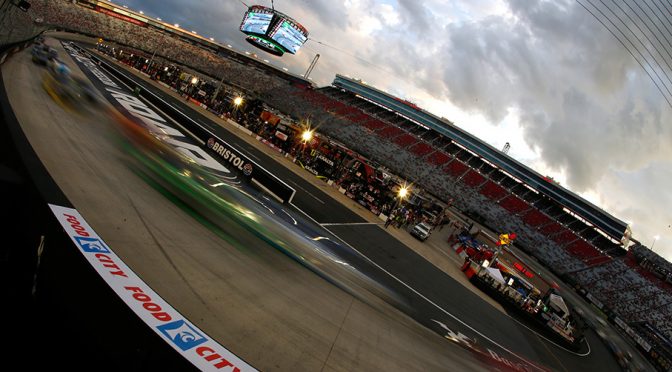
If you’re not already familiar with the nearly decade-old tradition (and one of the finest traditions, in our opinion), Bristol handles driver introductions a little differently than most tracks. Each of the competitors walks into the half-mile colosseum with the introduction music of their choice blaring through the track’s sound system. It’s an intriguing look into each driver’s personality and creativity, expressed through music.
For instance, here’s a video of introductions at Bristol from a few years ago:
With two races at Bristol each year and 40 drivers racing at a time, the data’s started to pile up since 2009 when the introduction music tradition started. So, from AC/DC to Zay Hilfigerrr & Zayion McCall, here are some of our findings, based on data through last summer’s Bristol Night Race.
Most Popular Songs
Last time we pored over the data, it was obvious AC/DC’s Thunderstruck was far and away the most popular driver introduction song, chosen 10 times since 2009. That stat hasn’t changed.
However, Motley Crue’s Kickstart My Heart has elevated to the second most popular song, thanks to BJ McLeod’s selection last summer. (Hey, it’s a great song to get pumped up.)
McLeod joined an elite list of drivers who’ve picked The Crue’s classic:
Travis Kvapil, Spring 2010
Sam Hornish Jr., Summer 2010
Dennis Setzer, Spring 2011
Casey Mears, Spring 2012
Carl Edwards, Spring 2014 (race winner!)
David Gilliland, Summer 2015
Jamie McMurray, Summer 2016
Here’s everything ever picked — 544 different songs by our count.
Most Popular Artists
Like their designation of top song, AC/DC is also the most popular artist among drivers — about 3.6 percent of all picks ever, with 26 entrances total.
With 13 entrances, Motley Crue is now the second-most frequent artist, breaking a tie with Kid Rock. Kid Rock’s descent down the most popular artist list in recent years likely has a lot to do with Tony Stewart’s retirement, who walked out to the Bawitdaba star a total of six times before hanging up the helmet in 2016.
In country news, Brooks & Dunn has cracked the artists Top 10, courtesy of Kasey Kahne.
Here’s the full list of all 350 artists, ordered by number of times used. There’s a whole lot of rock and country.
Musical Stats
Clint Bowyer, David Ragan, Denny Hamlin, Jamie McMurray, Jimmie Johnson, Joey Logano, Kasey Kahne, Kevin Harvick, Kurt Busch, Martin Truex Jr., Matt Kenseth, Paul Menard, and Ryan Newman have started all 17 races where drivers emerge to music.
We’ve still been Nickelback-free since 2011. Casey Mears, Juan Pablo Montoya, Kurt Busch, and Jamie McMurray are the only drivers to have emerged to the band, and only two of them remain active Monster Energy NASCAR Cup Series drivers. Just saying.
Chase Elliott snapped his streak of picking the same artist (Eric Church) each Bristol race in his career when he selected Chevy Don’t Let Me Down by Jeff Bates in last summer’s night race.
However, Ryan Newman’s extended his streak of picking Luke Bryan’s “Huntin’, Fishin’ and Lovin’ Every Day” to three consecutive races. The record-holder for consecutive picks is Jeff Burton, a fan of Guns N’ Roses’ Welcome to the Jungle to the tune of selecting it in five consecutive races (2009-2011). Newman’s the only one on a streak even close right now.
Surprisingly, there are a few notable wildly-popular artists who’ve only been picked once over the years — we were surprised by some of these oft-shunned names:
Alan Jackson (Ricky Stenhouse Jr, 2017 Night Race)
Blink-182 (Ryan Truex, 2014 Night Race)
Chance The Rapper (Ty Dillon, 2017 Spring)
Dave Matthews Band (Jimmie Johnson, 2012 Spring)
David Bowie (Greg Biffle, 2014 Night Race)
Foo Fighters (Brad Keselowski, 2014 Spring)
Iron Maiden (Paul Menard, 2014 Night Race)
Linkin Park (AJ Allmendinger, 2017 Night Race)
Michael Jackson (Reed Sorenson, 2009 Night Race)
Miranda Lambert (Danica Patrick, 2012 Night Race)
Taylor Swift (Matt DiBenedetto, 2016 Spring)
Fantasy Racing Tips (using intro songs as a metric)
Last year, we pointed out a particularly interesting phenomenon that may help you set your Fantasy Live lineup for this year — it still rings true in 2018.
When Brad Keselowski picks a song by Kid Rock as his driver introduction song, he wins the race. When he doesn’t pick Kid Rock, he doesn’t win. It’s science. We have conclusive proof.
Keselowski walked out to Kid Rock songs in the 2011 Night Race and the 2012 Spring race — and won both races. He’s never picked a song by Kid Rock for any other Bristol race, and coincidentally, he’s never won another race at Bristol. The stats don’t lie.
So, Fantasy Live players, the takeaway is simple: If you see Driver No. 2 walk onto the stage Sunday and you don’t hear Kid Rock blasting alongside, adjust your lineup.
Speaking of songs race winners have chosen, here’s a comprehensive list of race-winning driver intro songs, dating back to 2009 when this fine tradition started.
2009 (Night) Kyle Busch: Kanye West’s “Amazing”
2010 (Spring) Jimmie Johnson: Led Zeppelin’s “Ramble On”
If you’re keeping track at home, this is the list of race-winning artists. Somehow, only two artists have propelled drivers to victory more than once (Raytona 500/Kyle Busch and Kid Rock/Brad Keselowski).
Raytona 500 (2 wins)
Kid Rock (2)
Kanye West (1)
Led Zeppelin (1)
V.I.C. (1)
Kip Moore (1)
Metallica (1)
Motley Crue (1)
Carl Orff (1)
Megadeth (1)
Dropkick Murphys (1)
Bon Jovi (1)
Jake Owen (1)
Tupac (1)
Imagine Dragons (1)
What does the future hold?
As much fun as we’ve had watching drivers get creative, the driver introduction procedure at Bristol in 2018 is a little different. It may just change the way we’ve watched drivers walk out to the track for the past decade.
Effective this year, Bristol Motor Speedway has opted to get fans involved with the driver intro song selection process. Now, instead of drivers selecting their own songs in advance of the race, fans will choose one of three songs that best represents each driver.
What does this mean for the future of our analysis? Has our data been collected in vain all this time, now that drivers can no longer flex their creative muscle? We don’t know the answers yet, but we like the idea of getting fans involved. We’ll keep collecting data and see what happens.
One thing’s for sure, though: there’s no Kid Rock song among Brad Keselowski’s finalist options, so based on trends, he won’t claim his first victory of 2018 Sunday.
Some Quick Figures
17 races at Bristol have used driver introduction songs so far, starting in the 2009 night race.
714 total musical entrances have been made. (677 selections have been made, but the three drivers DNQed over the years, their intro songs never seeing the light of day.)
544 different songs have been used in total.
350 different artists or musical acts have been used.
109 songs have been used more than once.
That’s a 20.0 percent song re-usage rate (up from 19.4 percent last year).
Significant updates to the rules package for this year’s Monster Energy NASCAR All-Star Race include engine restrictor plates and revised aerodynamic features in what will serve as a testing ground of sorts as officials consider the full-blown 2019 rules package.
After all, the May 19 All-Star Race (8 p.m. ET on FS1, MRN, SiriusXM NASCAR Radio) is a golden opportunity to try something new, Steve O’Donnell, NASCAR executive vice president and chief racing development officer, said Wednesday,
“I really applaud the industry, because there’s a lot of work that had to go into this from the engine builders, the mapping, the teams have a lot of work to do right now,” O’Donnell said. “I think everybody came together and realized this was a perfect opportunity to try this.
“It’s important to look at this as, directionally, is this something that we want to pursue as a whole from an intermediate track standpoint? So, you look at the downforce levels going to roughly 3,200 pounds of downforce, you look at the engine, the spoiler with the 6-inch spoiler and the 2014 splitter; all of those things factored in, we believe we know how that will affect Indianapolis and Michigan and Pocono. But how will that affect Charlotte? What can we learn?
“It’s more, what can we learn from this and build upon it. … It’s something that we’ve obviously tested and feel good about. We wouldn’t just throw out an experiment. We feel good about it, but it’s something we want to learn from and probably apply more toward 2019.”
The package is a page torn out of the 2017 NASCAR Xfinity Series race at Indianapolis Motor Speedway, which saw side-by-side racing, plus a record numbers of leaders, lead changes and green flag passes that culminated in a battle for the victory.
The All-Star Race also will have an updated group of four stages, which end on Lap 30, Lap 50, Lap 70 and Lap 80. All have the potential to go to NASCAR Overtime, not just the final stage — an enhancement O’Donnell is excited to see play out in real time, and which again could shape the stage formats in the future.
“I think it’s huge for the fans,” O’Donnell said. “I think when you look at the stages and how we got to that point, one of the things left on the table at that point was the overtime for each stage. … Again, this is something that we could take a look at. We have the All-Star Race and some of the fans have asked for (overtime in all stages), so it will give us a good indication of what we can learn.”
NASCAR’s much-anticipated Monster Energy NASCAR All-Star Race is set for May 19 at Charlotte Motor Speedway (FS1, MRN, SiriusXM NASCAR Radio), and now we know both the format and the rules package.
Both key components were unveiled April 11 on “Race Hub.” We’re here to break down the key questions you may have.
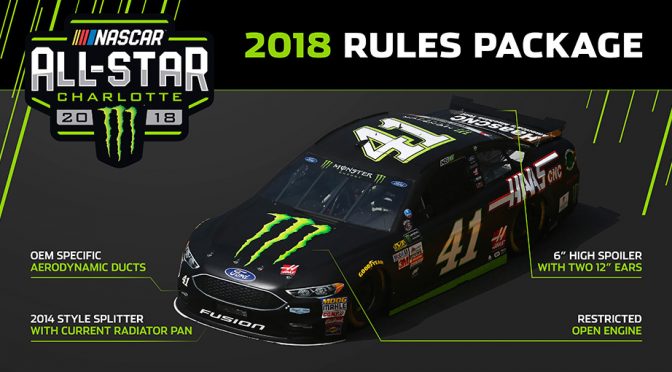
What’s the biggest change this year? The rules package the cars will run. Restrictor plates will be in use at 1.5-mile Charlotte Motor Speedway, along with a 6-inch high spoiler (with two 12-inch ears), a 2014 style splitter and aero ducts.
What does all that mean? It’s designed to promote passing and tight competition. It’s very similar to the package the NASCAR Xfinity Series used at Indianapolis last year, a race which set a record number of leaders and lead changes.
What is the technical advantage of this package? The entire package is designed to give the trailing car more of an aerodynamic advantage. You’ll see more slingshot-style moves and passes for the lead.
Graphic by NASCAR Creative Design
Let’s talk format. What is it? Four stages comprise the event. Stage 1 ends on Lap 30; Stage 2 ends on Lap 50; Stage 3 on Lap 70; and Stage 4 on Lap 80.
What about NASCAR Overtime? NASCAR Overtime will be in effect for ALL stages.
Are there mandatory pit stops? Nope. Pitting is totally in the hands of each individual team this year.
Will the field be reset or inverted for Stage 4? Again, no. This is where strategy comes into play. You might see some weird pitting toward the end of Stage 3 as a play for track position in Stage 4.
Anything else I should know about for the final stage? Only green-flag laps will count in Stage 4.
How is the field set? The field of drivers currently is comprised of all 2017 and 2018 Monster Energy NASCAR Cup Series race winners, former All-Star Race winners competing full time and former Monster Energy Series champs competing full time.
Is there any other way to qualify? Yes. The winners of Stage 1, Stage 2 and Stage 3 in the preceding Monster Energy Open event will advance into the All-Star Race. And of course, there is the annual Fan Vote, the winner of which makes the big show.
How is the starting lineup set? The ever-popular qualifying method is back this year. Drivers take three laps during qualifying, and it includes a mandatory four-tire pit stop. There is no pit-road speeding during qualifying, so drivers will look to push the limits.
DAYTONA BEACH, Fla. (April 11, 2018) — NASCAR and Charlotte Motor Speedway today announced the format and competition package for the May 19 Monster Energy NASCAR All-Star Race, both tailored to achieve one goal — the best possible race for the fans.
For the first time, Monster Energy NASCAR Cup Series cars will implement the competition package used in last season’s successful NASCAR Xfinity Series race at Indianapolis Motor Speedway, which saw record numbers in leaders, lead changes and green-flag passes for the lead.
Each car will be fitted with aero ducts, a six-inch-high spoiler with two 12-inch ears, a restrictor plate and the 2014 style splitter. Working in concert, these additions create a unique aerodynamic effect, the results of which received high praise from fans and competitors following last year’s Xfinity race at Indianapolis.
“NASCAR is committed to innovation and will always work to improve the racing product for every series and venue,” said Steve O’Donnell, NASCAR executive vice president and chief racing development officer. “The yearly Monster Energy NASCAR All-Star Race is an opportunity to see your favorite drivers compete under a unique and exciting format and rules package. The positive feedback following last year’s Xfinity Series race at Indianapolis gave us the foundation to implement this dynamic package for the All-Star Race. We believe the hard work of the entire industry will provide the best race for our passionate fans.”
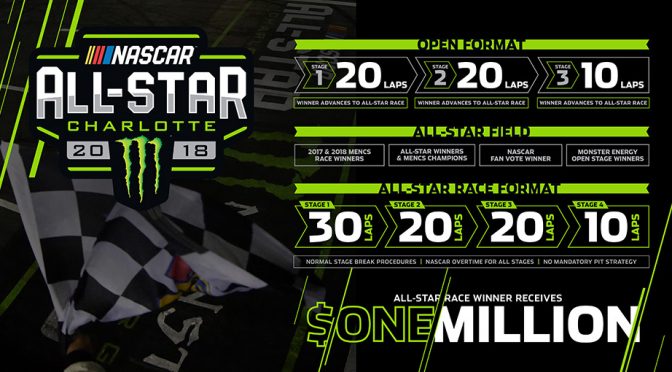
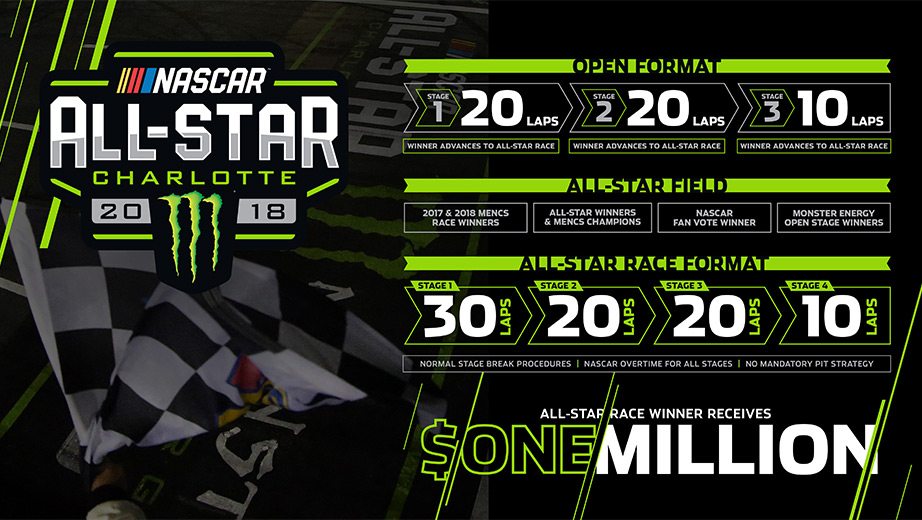
The format for the annual non-points event will include four stages — 30 laps, 20 laps, 20 laps and 10 laps. Only green-flag laps will be counted in the Final Stage. Normal stage break procedures will be in effect, with one exciting addition: NASCAR Overtime will be in play for all stages. Of note, there will be no mandatory pit strategy as in some of the previous editions of the event.
The Monster Energy Open will be three stages set at 20, 20 and 10 laps, respectively. Each stage winner will advance to the evening’s main event.
“The All-Star Race has a long history of edginess and innovation. We want to challenge drivers, spark on-track action and create the best show for the fans,” said Marcus Smith, president and CEO of Speedway Motorsports, Inc. “This race has always been a proving ground for some of the best innovations in our sport, from running under the lights to stage racing and double-file restarts. It’s the perfect opportunity to try something different, and with a 10-lap shootout for a million dollars, expect the unexpected on May 19.”
The field for the 2018 Monster Energy NASCAR All-Star Race will include Monster Energy Series race winners in 2017 and 2018; former all-star race winners who are competing full-time; Monster Energy Series champions who are competing full-time; the winner of each of the three stages of the Monster Energy Open; and the winner of the 2018 Fan Vote.
Currently, the following drivers are eligible to compete: Ryan Blaney, Clint Bowyer, Kurt Busch, Kyle Busch, Austin Dillon, Denny Hamlin, Kevin Harvick, Jimmie Johnson, Kasey Kahne, Matt Kenseth, Brad Keselowski, Kyle Larson, Joey Logano, Jamie McMurray, Ryan Newman, Ricky Stenhouse Jr. and Martin Truex Jr.
Weekend passes for the Monster Energy All-Star Race start at just $79 and include admission to the May 18 N.C. Education Lottery 200 NASCAR Camping World Truck Series race, May 19 Cole Swindell Monster Energy All-Star Race Concert Presented by Rayovac Batteries, Kwikset, George Foreman and National Hardware, and to the Monster Energy Open. Kids 13 and under get in free on Friday and for just $10 on Saturday with a paying adult. Tickets, camping and race-day upgrades are available by visiting www.CharlotteMotorSpeedway.com/tickets or calling 800-455-FANS (3267).
Tune in to the Monster Energy NASCAR All-Star Race at Charlotte Motor Speedway on Saturday, May 19, starting at 6 p.m. ET on FS1, MRN and SiriusXM NASCAR Radio.
NASCAR and Charlotte Motor Speedway announced the format for the Monster Energy NASCAR All-Star Race on Wednesday, leaning heavily on a new rules package to shake up the annual invitational event.
Among the most significant updates are engine restrictor plates to reduce horsepower and revised aerodynamic features — all designed to tighten the competition for the $1 million winner’s prize in the May 19 event (8 p.m. ET, FS1, MRN, SiriusXM).
It will be the first time restrictor plates are used at the 1.5-mile Charlotte track. The aero package as a whole takes a cue from the rules that drew positive reviews during an Xfinity Series race at Indianapolis Motor Speedway last season.
For the All-Star event, cars will use a splitter borrowed from the 2014 rules package with a 2018 radiator pan, a 6-inch tall spoiler with two ‘ear’ extensions measuring 12 inches wide, and manufacturer-specific air ducts designed to minimize the advantage of lead cars in undisturbed air.
“NASCAR is committed to innovation and will always work to improve the racing product for every series and venue,” said Steve O’Donnell, NASCAR executive vice president and chief racing development officer. “The yearly Monster Energy NASCAR All-Star Race is an opportunity to see your favorite drivers compete under a unique and exciting format and rules package. The positive feedback following last year’s Xfinity Series race at Indianapolis gave us the foundation to implement this dynamic package for the All-Star Race. We believe the hard work of the entire industry will provide the best race for our passionate fans.”
That rules package led to a record number of leaders and lead changes for the Xfinity Series at Indianapolis last year. The successful debut prompted series officials to expand its usage this season, adding events at Pocono (June 2) and Michigan (June 9) to its return at Indy (Sept. 8).
Graphic by NASCAR Creative Design
The race is scheduled for four stages. Stage 1 is scheduled to end at Lap 30, Stage 2 at Lap 50, Stage 3 at Lap 70, and a final shootout that ends at the Lap 80 distance. Only green-flag laps will count in the final stage. In a new wrinkle to previous formats, NASCAR Overtime rules will be in effect for the end of each stage.
“The All-Star Race has a long history of edginess and innovation. We want to challenge drivers, spark on-track action and create the best show for the fans,” said Marcus Smith, president and CEO of Speedway Motorsports, Inc. “This race has always been a proving ground for some of the best innovations in our sport, from running under the lights to stage racing and double-file restarts. It’s the perfect opportunity to try something different, and with a 10-lap shootout for a million dollars, expect the unexpected on May 19.”
This year’s distance will be 10 laps longer than the 2017 edition, but will feature a pared-down procedural structure. Unlike previous formats, there will be no mandated pit stops, no choice of alternate tire compounds, no eliminations and no inversions of the running order.
Graphic by NASCAR Creative Design
Eligibility for this year’s All-Star field remains largely unchanged. Drivers who have already qualified for an All-Star berth, with their basis for eligibility:
• Monster Energy Series race winners in 2017 and 2018 to date: Ryan Blaney, Clint Bowyer, Kurt Busch, Kyle Busch, Austin Dillon, Denny Hamlin, Kevin Harvick, Jimmie Johnson, Kasey Kahne, Matt Kenseth, Brad Keselowski, Kyle Larson, Joey Logano, Ryan Newman, Ricky Stenhouse Jr., Martin Truex Jr.
• Former All-Star Race winners who are competing full-time: Jamie McMurray.
• Series champions who are not otherwise eligible: None.
• The three stage winners in the Monster Energy Open qualifying race
On MRN: 1 p.m.: Throwback Thursday presented by Sunoco
Friday, April 20
1 a.m.: NASCAR K&N Pro Series East: Bristol Motor Speedway, NBCSN
9:30 a.m.: NASCAR Xfinity Series final practice, FS1 (Canada: TSN GO)
10:30 a.m.: NASCAR Race Classic: 1998 Daytona 500, FS1
11 a.m.: Monster Energy NASCAR Cup Series practice, FS1 (Canada: TSN GO)
noon: NASCAR Race Hub Weekend Edition, FS1
12:30 p.m.: Monster Energy NASCAR Cup Series final practice, FS1 (Canada: TSN GO)
1:30 p.m.: NASCAR Race Hub, FS1
2:30 p.m.: NASCAR Race Hub, FS1
3:30 p.m.: NASCAR Race Hub Weekend Edition, FS1
4 p.m.: NASCAR Xfinity Series Pole Qualifying, FS1 (Canada: TSN GO)
5 p.m.: NASCAR Race Hub Weekend Edition, FS1
5:30 p.m.: Monster Energy NASCAR Cup Series Busch Pole Qualifying, FS1 (Canada: TSN 3)
6:30 p.m.: NASCAR RaceDay: Xfinity Series, FS1
7 p.m.: NASCAR Xfinity Series ToyotaCare 250, FS1 (Canada: TSN 3)
On MRN: 10 a.m.: Inside Line Fantasy Racing Show (Hosts: Tyler Burnett, Robbie Mays)
Saturday, April 21
12:30 a.m.: Monster Energy NASCAR Cup Series Busch Pole Qualifying, FS2 (re-air)
1:30 a.m.: NASCAR Xfinity Series ToyotaCare 250, FS2 (re-air)
4:30 a.m.: Monster Energy NASCAR Cup Series final practice, FS1 (re-air)
5:30 a.m.: Monster Energy NASCAR Cup Series Busch Pole Qualifying, FS1 (re-air)
6:30 a.m.: NASCAR Xfinity Series ToyotaCare 250, FS1 (re-air)
2:30 p.m.: NASCAR Race Classic: 1988 Daytona 500, FS1
3 p.m.: NASCAR RaceDay, FS1
6 p.m.: Monster Energy NASCAR Cup Series Pre-Race Show, FOX
6:30 p.m.: Monster Energy NASCAR Cup Series Toyota Owners 400, FOX (Canada: TSN 1, 4)
Sunday, April 22
10:30 p.m.: NASCAR Race Classic: 1998 Daytona 500, FS1
11 p.m.: Beyond the Wheel 2018, FS1
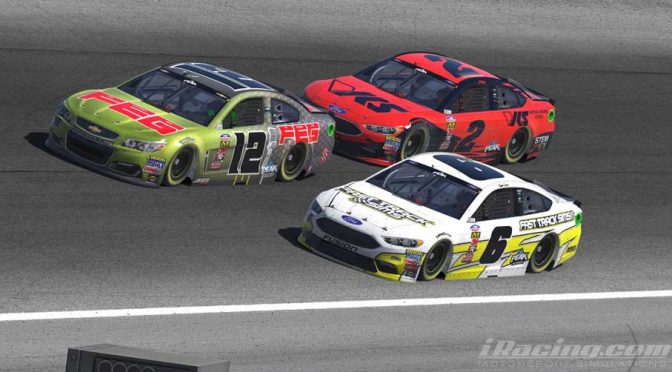
Ryan Luza won his second straight NASCAR PEAK Antifreeze iRacing Series race of 2018, passing both Ray Alfalla and Nikolas Shelton with four laps to go at Las Vegas Motor Speedway. Luza had to overcome some adversity on pit road when he overshot his box on his final stop with 53 laps to go. The mistake cost him the lead as he emerged over two seconds behind both Shelton and Alfalla.
Even with the setback, Luza had plenty of time to catch the leaders as he was running a tenth-of-a-second quicker per lap. With six laps left, Luza had all but eliminated the gap to the leaders, who were running nose to tail with Shelton out front. As the trio came off Turn 2, Shelton got tight and that allowed Alfalla to get a run on Shelton. At the same time, Luza also got a run on Alfalla and the leaders were suddenly three wide entering Turn 3.
Shelton used the momentum of the top groove to his advantage as he cleared the other two off Turn 4 as Alfalla and Luza made slight contact. Despite the contact, Luza closed in once again off Turn 2 with four laps to go. This time, the run was too big for Alfalla or Shelton to stop as Luza cleared both by the exit of Turn 4.
Luza still had lapped traffic to deal with after taking the lead, but he navigated through it without issue and held off Alfalla by .318 seconds at the checkered flag. Shelton fell to third while Chris Shearburn came from 39th to finish fourth. Michael Guest rounded out the top five.
Vegas saw a few front-runners find trouble early, with Bobby Zalenski getting caught up in Jimmy Mullis’ mess on Lap 16 after Mullis was sent into the wall by Brad Davies. The two spun through the front straight grass, but no caution flew as neither car wound up on the racing surface.
On Lap 52, Keegan Leahy was knocked out of contention while leading after contact with Jarl Teien. Teien had crashed in front of the leader and was sitting stationary near the top of Turn 1 when Leahy seemingly did not see the stricken car ahead. Leahy could not avoid contact, which caused serious damage to his car and relegated him to a 36th-place finish.
The crash would bring out one of only two yellow flags during the evening as the second half of the 167-lap event went much smoother than the first. The long run let two different pit strategies play out with some drivers choosing to pit an extra time for tires. The short-pitting strategy, usually a safe bet in iRacing, fell short this time as tire falloff was below average. Zack Novak was the highest-finishing driver on the two-stop strategy in 10th, more than 18 seconds adrift of Luza.
With his back-to-back wins, Luza has closed within three points of the NASCAR PEAK Antifreeze iRacing Series championship lead, as he picked up six points on points leader Alfalla. Leahy’s poor result dropped him to third, 22 off the lead. Michael Conti has quietly worked his way to fourth after notching a top 10, moving in front of Zalenski, who completes the front five.
The fifth race of the 2018 season takes the NASCAR PEAK Antifreeze iRacing Series to Richmond Raceway, the first track less than one mile in length. Richmond is always one of the more unpredictable races on the schedule with past events ranging from very clean to caution-filled with a double-digit number of yellow flags. Can Luza avoid trouble and make it three wins in a row on his quest for a second straight title? Find out in two weeks on iRacing Live!