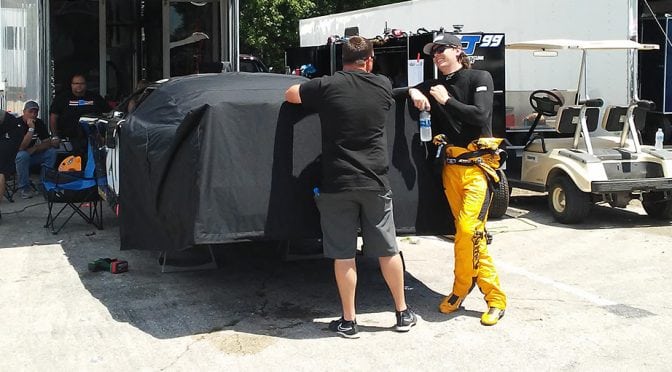
SLINGER, Wis. — Erik Jones is having some difficulty during his first foray into super late models in 2018 — and in his return to Slinger Speedway after a two-year hiatus.

Oh, he isn’t having trouble acclimating to the nuances of short-track racing on a quarter-mile oval or to a car with vastly different characteristics than what he drives in the Monster Energy NASCAR Cup Series — though mechanical gremlins will hamper him later.

No, Jones’ issue is he cannot figure out how to start his all-terrain vehicle as he attempts to speed off to the driver meeting prior to the Slinger Nationals on Tuesday night.

RELATED: Jones ready to rise to top

He thinks he found the ignition button, but soon learns that is incorrect.

“Well, we know the horn works,” he quips.

Eventually Jones fired up the metallic orange ATV and is off to the meeting with plenty of time to spare.

In the race itself, there would be no repeat of what he accomplished just days before when the 22-year-old won the Coke Zero Sugar 400 at Daytona International Speedway. At Slinger, he wound up heading to the garage after completing only 66 laps, his night ending with a crew member in the garage literally blowing out a fire emanating from his overcooked engine.

That Jones finished second-to-last was inconsequential. What resonated was that he had reconnected to his roots, doing something that holds special meaning beyond where he may be classified in the box score.

It is moments like these he cherishes — a flashback to his upbringing when he and his family would spend countless nights like this at similar races throughout the country.
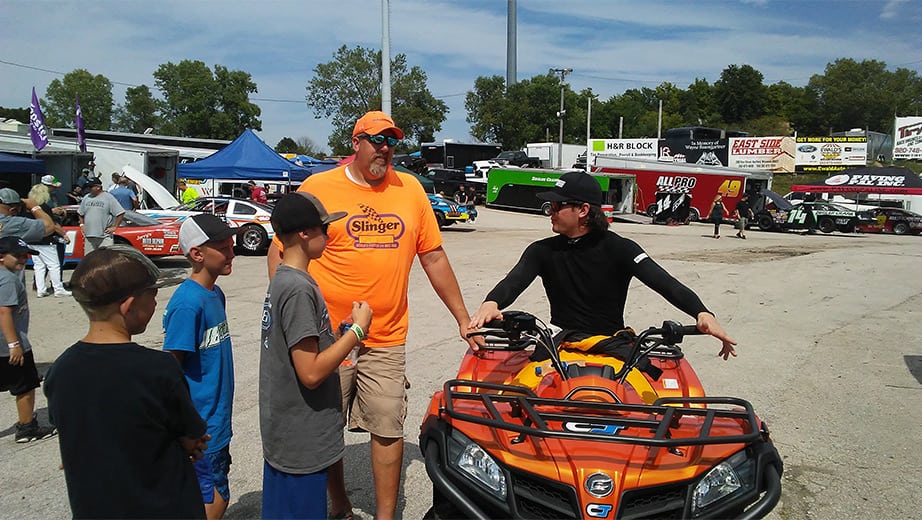
Erik Jones at Slinger

•   •   •

The car wasn’t just any car. It was a 1965 Nassau blue Corvette that Jones’ dad, Dave, loved. But to further his son’s racing career, the family needed money to get Erik a super late model — the same style of car he drove at Slinger — and Dave reasoned the best way to do so was to sell his prized Corvette.

Erik, who recalls he was 12 or 13 at the time, says he came home one day and the car was gone. Dave had sold it to allow Erik to continue pursuing his dream.

“I was like, ‘Man, why did you do that?’ ” Erik said. “He’s like, ‘Well, we’ve got to fund the racing somehow.’ ”

Getting Erik in a super late model proved to be the catalyst that has him where he is today. Behind the wheel of a super late model owned by his father, Jones beat Kyle Busch to win the 2012 Snowball Derby. Impressed by what he saw, Busch signed Jones to drive for his own short-track team and touted him to team owner Joe Gibbs and Toyota, both of which would sign Jones to developmental driver contracts.

MORE: Busch sends classy tweet

Jones has had a meteoric rise ever since. He won the 2015 NASCAR Camping World Truck Series championship, nearly won the NASCAR Xfinity Series championship the following year and earned Sunoco Rookie of the Year honors in the Monster Energy Series in 2017.

Last weekend, he earned his first career Cup victory. It is likely to be the first of many.

•   •   •

As Jones celebrated his Daytona win there was someone missing. He couldn’t share in the achievement with his father, who undoubtedly would’ve taken pride in his son narrowly beating defending Cup champion Martin Truex Jr. in a thrilling finish.

Dave was diagnosed with lung cancer in March 2016. It was terminal; he died from the disease just months later on June 7 at age 53.

“He was so supportive, and (his death) was just a horrible thing,” Gibbs said Saturday night at Daytona. “It was just terrible. … I think, winning tonight, obviously, it’s an emotional thing for him because his dad would have absolutely loved it.”

Everything his parents did in paving the road for him to reach Daytona’s Victory Lane is not something Erik has forgotten. Shortly after Dave’s death, Erik set out to reclaim the car that symbolizes what his parents sacrificed.

The quest to track down his father’s Corvette began with Erik calling one of Dave’s former coworkers. What he learned was the guy who purchased the car had been a salesman at the same company, making it easier to obtain the contact info.

Erik cold-called him, asking if he wanted to sell the Corvette. Initially, the answer was no. The two ended the conversation with the understanding if the guy ever wanted to sell, he would let Erik know. Six months later he did just that.

The car is now with Jones in North Carolina. And as often as he can, he likes to take it for a drive.

“It’s just cool to have it back,” Jones said. “I remember a lot of memories of me with my dad in that car and when I get in it, it smells the same, feels the same. It brings back a lot of good memories.

“It reminds me of what they did. That car is the epitome of that. And to have it back is just a great family memory.”

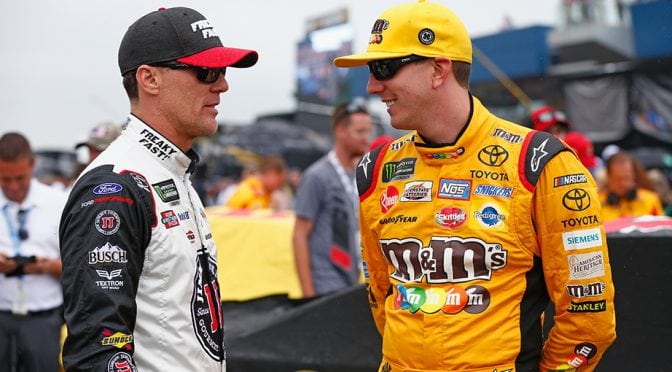
Trackside Live is packing some extra horsepower this weekend with two shows from Kentucky Speedway. The first show will be on Friday, July 13 at 3 p.m. ET, while the second show will be on Saturday, July 14 at 4 p.m. ET.

WATCH: Trackside Live | MORE: Full schedule for Kentucky | Buy your tickets

Don’t miss your chance to meet your favorite drivers ahead of the final 1.5-mile race of the regular season. Watch the video above and get excited for the Bluegrass State showdown! It’s going to be a good one.

Enjoy!

There is probably no one more ready to pull into Kentucky Speedway than Team Penske’s Brad Keselowski. A three-time Monster Energy NASCAR Cup Series winner at the 1.5-mile track – best among his peers – Saturday night’s Quaker State 400 (at 7:30 p.m. ET on NBCSN, PRN, SiriusXM NASCAR Radio) may be just the kind of panacea his season could use.

The 2012 Monster Energy Series champion remains surprisingly winless through the opening 18 races, but his record in Kentucky gives him every rightful reason to be optimistic.

In addition to Keselowski’s three premier series wins here (in 2012, 2014, and 2016), he has three NASCAR Xfinity Series race trophies too.  He won the pole position and led a record 199 of the 267 laps in his 2014 Cup triumph.

It may be just the motivation and expectation to right the ship for Penske’s No. 2 Ford team. Although he was involved in an accident Saturday night in Daytona Beach (his fourth DNF of the year), Keselowski had five top-10 finishes in the previous seven races leading into Daytona. Importantly, he has four top 10s in the six 1.5-mile tracks the series has run already in 2018. And his runner-up finish on the Atlanta mile-and-a-half is his best showing of any race this year.

Keselowski, 34, has won at least one race in the last seven seasons – and he’s won in eight of the past nine years leading into 2018.

He has the second-best driver rating at Kentucky (109.6) and is ranked among the top-10 in all major statistical categories. He’s finished seventh or better in five of the seven races at Kentucky. And he’s tops in one that’s not official – he’s won the last three races in even numbered years. It’s 2018.

Hendrick Motorsports and Mountain Dew have extended their already-long partnership through 2020, a renewal which includes primary sponsorship of Chase Elliott’s No. 9 Chevrolet.

Mountain Dew will wrap Elliott’s car for four races in each year of the extension. The brand and Elliott have been tied together since Elliott’s rookie year in 2016. Additionally, Mountain Dew will be an associate sponsor of the No. 9 team in the remaining races in which it is not a primary sponsor.

PHOTOS: Elliott through the years

“It means a lot to partner with a brand like Mtn Dew that has such a storied history in racing,” Elliott said in a team release. “I appreciate everything they’ve done for the sport, for our team and for me personally. We’ve been able to do cool things away from the track, from snowboarding in the mountains to riding ATVs in the desert. That aspect of the relationship is really fun.”

Mountain Dew has a deep relationship with Hendrick, having sponsored Dale Earnhardt Jr. beginning in the 2008 season and lasting through his retirement in 2017. Icon drivers and iconic paint schemes — like Darrell Waltrip — also sported Mountain Dew throughout history.

“Like the Elliott family, Mtn Dew has a tremendous legacy in racing,” said Rick Hendrick, owner of Hendrick Motorsports. “Chase’s performance on the track, lifestyle off the track and popularity with the fans make him a perfect fit for the brand. This new agreement will take our association with PepsiCo into our 24th season together. We’re extremely proud of our partnership and look forward to the many great opportunities ahead.”

Elliott, 22, was the 2016 Sunoco Rookie of the Year and has qualified for the NASCAR Playoffs the previous two years — his first two years at NASCAR’s top level. He also won the NASCAR Xfinity Series title in 2014.

“Chase Elliott is becoming one of the biggest superstars in the world of racing, and we’re excited to continue to bring his genuine personality to DEW Nation through our partnership with Hendrick Motorsports,” said Justin Faiber, sports marketing senior manager, PepsiCo. “We can’t think of a better driver to represent the brand’s future in the sport than Chase.”

Zack Novak picked up his first NASCAR PEAK Antifreeze iRacing Series win of 2018 at Chicagoland Speedway, holding off Ryan Luza on a restart with five laps to go. Luza looked to have the faster car, but a caution ended the race before he could make a bid for the lead. Bobby Zalenski finished third followed by Phillip Diaz, who earned his first top-five result of the season. Ryan Lowe came from 33rd on the grid to complete the top five.

Novak took the lead by staying out longer than the leaders during the last green flag pit cycle and catching a timely caution when Brandon Pipgrass spun with 25 laps left. The yellow trapped Luza and Keegan Leahy, two of the favorites, back in traffic. With four more cautions to come in the last 20 circuits, Luza had little time to make moves while Leahy was caught up in a restart crash on Lap 148.

RELATED: Full 2018 iRacing schedule/results

Despite the cautions, Luza kept moving forward during the few green-flag laps between crashes, and with four laps to go he closed right to the bumper of Novak in Turns 3 and 4 before clipping the apron and losing a couple car lengths. The final caution waved just half a lap later and Luza had to settle for his sixth top-five finish in seven starts this season.

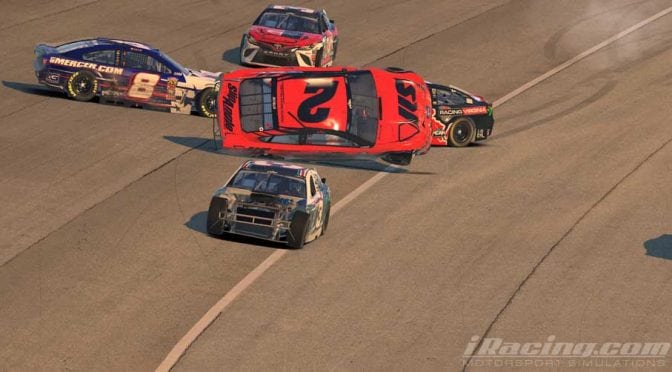
In the chaos, three more strong drivers found themselves on the wrong side of the leaderboard. Ray Alfalla did not lead any laps but contended in the top five for much of the evening before crashing out in spectacular fashion on Lap 153. Ryan Luza and Jimmy Mullis were battling for fourth just ahead of Alfalla exiting Turn 2 when Luza made slight contact with Mullis, sending him into the outside wall. The sudden loss in momentum caused several cars to pile into Mullis’ stricken car, causing a massive pileup that saw Alfalla flip side over side down half the backstretch.

Michael Conti paced the field for 34 laps before an unfortunate speeding penalty on pit road took him out of contention. The penalty combined with a caution that forced him to take the wave around to regain his lost lap relegated Conti to 18th.

Jarl Teien, fresh off his second-place effort at Sonoma, won the pole and looked to keep his momentum going after a dismal start to the season. Initially, Teien looked strong and led 29 laps early, but he was trapped a lap down by a caution and wound up in the same crash that took out Alfalla. Teien finished 28th, putting a dent in his quest to make the top 20 in the standings.

Zalenski took the points lead from Alfalla after the latter had trouble, but the margin is just only four points. Leahy sits third, 18 markers off the lead. Matt Bussa is an additional 15 points back in fourth, followed by Nickolas Shelton in fifth. Luza is currently sixth after his second-place run.

With only four races remaining before the playoffs, the NASCAR PEAK Antifreeze iRacing Series will make its annual visit New Hampshire Motor Speedway. The Magic Mile is notoriously tough to pass on, meaning pit strategy could be brought to the forefront once again. As the stakes rise, will desperate drivers close to the playoff bubble try for a Hail Mary strategy, or will the familiar faces assume their usual roles at the front?

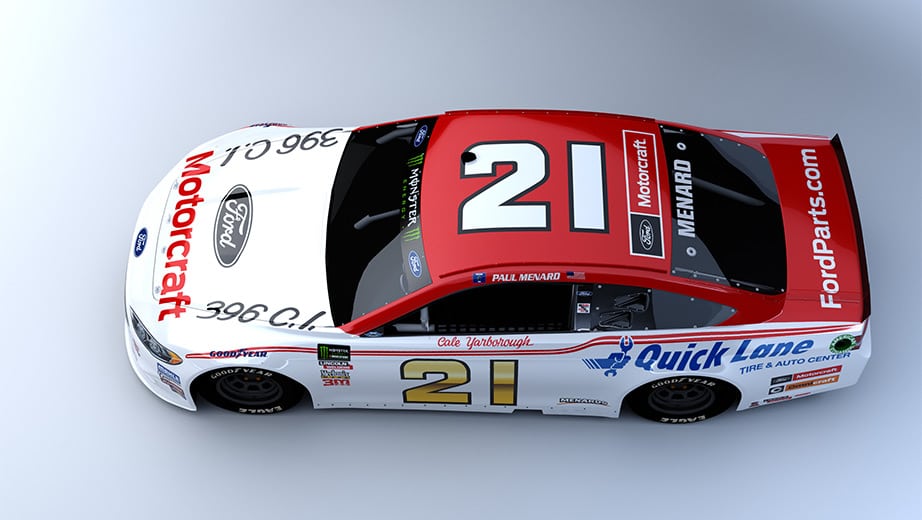
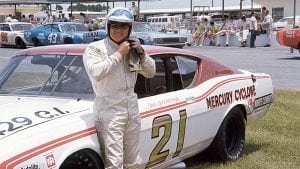
For this year’s Bojangles Southern 500 at Darlington Raceway, Paul Menard’s No. 21 Motorcraft/Quick Lane Ford Fusion will carry a red-and-white paint scheme reminiscent of the Wood Brothers’ 1968 Mercury Cyclone that Cale Yarborough drove to victory in the 1968 Southern 500.

The paint scheme honoring Yarborough is part of the track’s fourth-annual throwback weekend. The theme for this year’s campaign is “Seven Decades of NASCAR” and few drivers and teams have as much history at Darlington as Yarborough and the Wood Brothers.

Paul Menard Throwback Darlington Scheme

Yarborough is from Timmonsville, S.C., which is just 14 miles from NASCAR’s original superspeedway. He made his first NASCAR start in the 1957 Southern 500 at the age of 18. Three of his first four NASCAR starts were in the Southern 500, but it wasn’t until he teamed with the Wood Brothers late in the 1966 season that he had a car capable of winning the 500.

This year’s throwback scheme on the Motorcraft/Quick Lane Fusion comes 50 years after Yarborough’s first Southern 500 victory in 1968.

PHOTOS: See Darlington throwback schemes

That win came in a race in which he led 169 laps, including the final 90, and finished four car lengths ahead of another Darlington legend and eventual Wood Brothers driver David Pearson.

The 1968 win was the first of five in the Southern 500 for Yarborough and the first of eight overall at Darlington for the Wood Brothers, including three more Southern 500s – two with Pearson and one with the late Neil Bonnett.

RacingOne
RacingOne

Eddie Wood said Yarborough certainly deserves the recognition.

“He’s one of the original heroes of our sport,” Wood said. “He got his first Southern 500 victory in our car and had a great career winning 83 races and three championships.”

Thirteen of those wins came in cars fielded by the Wood Brothers, and in many ways Yarborough’s career paralleled that of the Woods.

Before they joined forces in 1966, both had won races but the pairing led to a rise in results by both Yarborough and the Wood Brothers.

“When Cale got in our cars, they won a lot of races, sat on a lot of poles and led a lot of laps,” Wood said.

“It was a good time for him and for the Wood Brothers.”

The throwback paint scheme features many of the same details that were on the 1968 Cyclone Yarborough drove, right down to the “396 Cubic Inches” lettering on the hood.

Wood explained that in those days NASCAR required teams to prominently post the engine size on the car. And that engine size was unique in that 396-cubic-inch engines are normally associated with another manufacturer.

In the Woods case, the 396 described a de-stroked 427-cubic-inch Ford engine.

Wood said the rules at the time allowed teams to run a lighter overall car weight if the size of the engine was smaller than NASCAR allowed.

He also said he wouldn’t mind NASCAR going back to posting cubic inches or horsepower numbers on the hood.

“Who wouldn’t like to see a Motorcraft/Quick Lane Fusion with ‘900-HP’ on the hood?” he asked.

The Bojangles Southern 500 is set for Sept. 2 at Darlington Raceway.

There’s something intimate about handwriting. As distinctive and unique as a fingerprint — loopy drawls, all capital letters, chicken scratch — the letters often can tell a story about the person writing it.

It’s why even in the technological age, handwritten notes remain a treasured arrival in the mailbox.

Liz Allison has found plenty of treasure in previously unopened boxes around her Nashville, Tennessee, home. Treasures and mementos of her late husband Davey Allison. Old trophies. Hats. Pictures.

And this speech.

RELATED: Learn more about Davey Allison

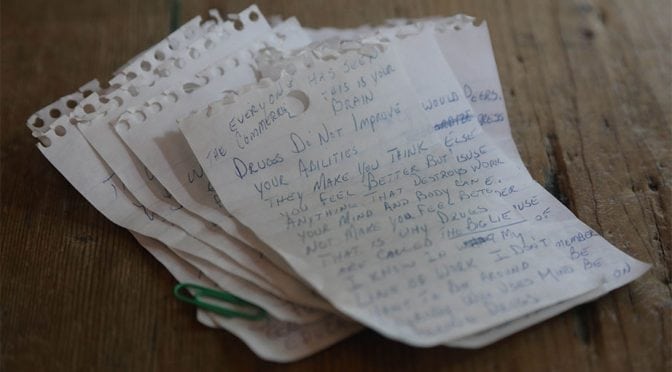
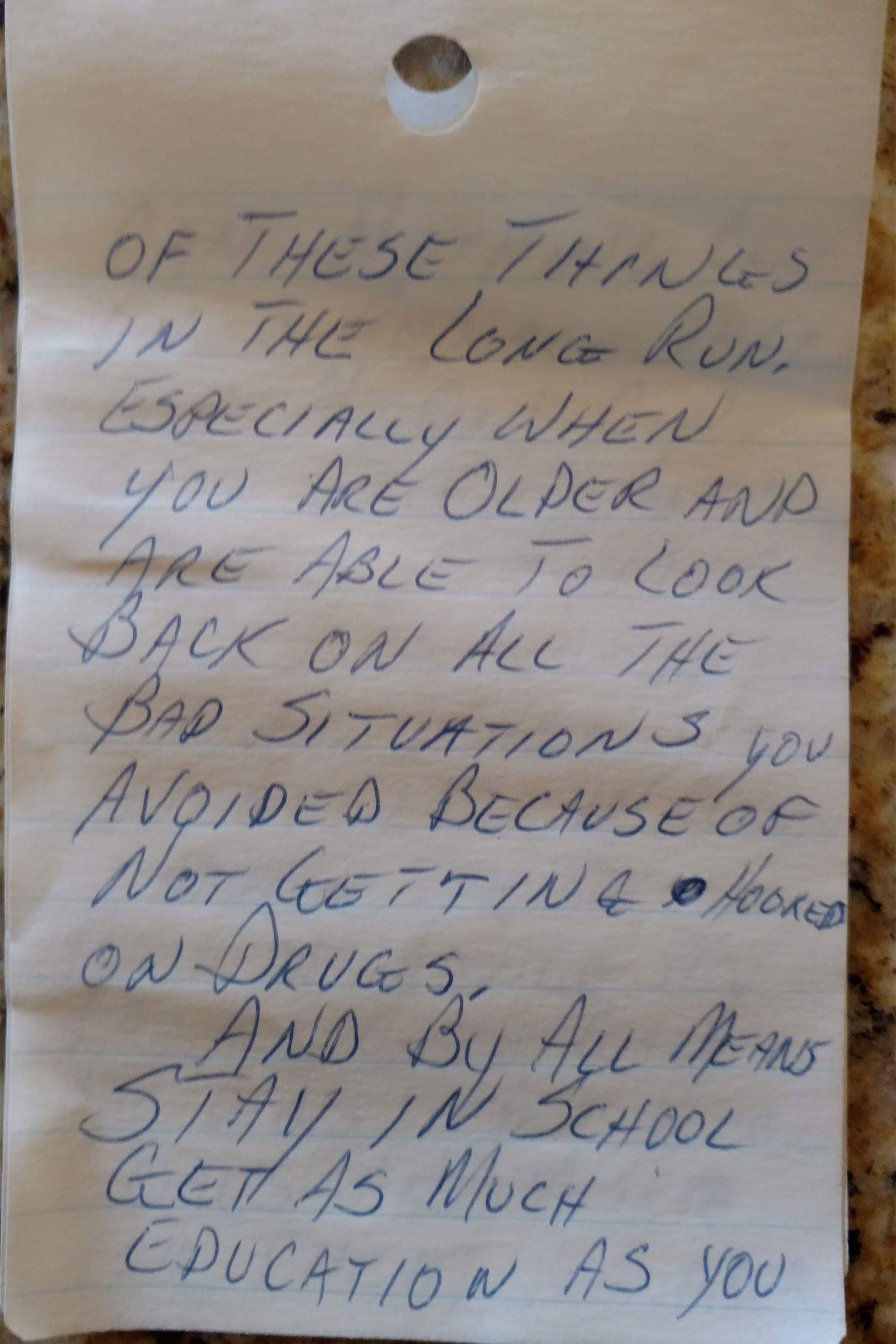
Davey had written a speech to give to high school students in the summer of 1993 about the dangers of doing drugs. It was a topic he was passionate about. His untimely death in July relegated his speech to a box that was taped shut and stuffed into storage.

His words remained there for 25 years until Liz Allison found them recently while going through some of Davey’s belongings.

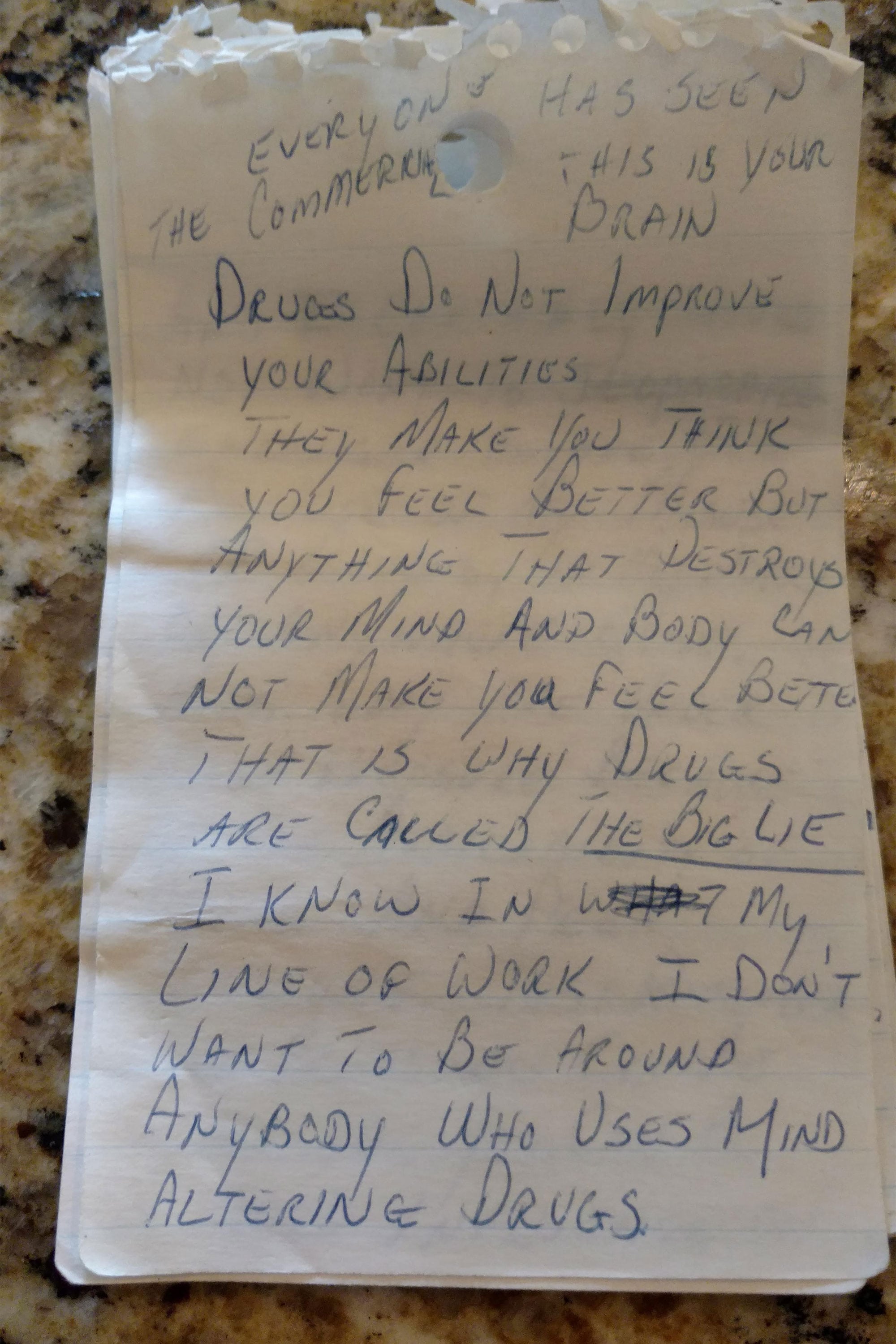
And now, for the first time, in his own words and his own handwriting — raw and unedited, including scratch-outs — is Davey Allison’s speech, with a full transcript typed out below.


Davey Allison handwritten speech

“Everyone has seen the commercial: This is your brain. Drugs do not improve your abilities. They make you think you feel better but anything that destroys your mind and body can not make you feel better. This is why drugs are called THE BIG LIE. I know in my line of work I don’t want to be around anybody who uses mind altering drugs. And I certainly would not want to endanger anyone else because of my misuse of drugs, in my work or anywhere else. Kids today are under more pressure because of the availability of drugs and peer pressure. Just remember peer pressure can be reversed. You can be a good influence on your friends and peers. Just say no and impress upon them that you don’t need drugs to have a good time. And remind them they don’t either. You don’t need drugs to be able to accomplish your goals. As I already said, they do not make you better than you already are. You can’t do something by taking drugs that you were not already capable of doing. Besides, if you accomplish something naturally, without artificial stimulation, it will mean a lot more to you.

“If you were walking in the woods and came across a rattlesnake, what would you do? You would probably run the other direction. Certainly you would not stop to play with it. Well drugs kill a lot more people every year than all snakes combined. Think about that when you see someone using drugs and especially if they are offered to you. Drugs kill. They are deadly. They do not just kill the people who use them either. Not only do innocent victims suffer from accidents caused by drug users, but there are the victims of robberies and murders because drugs take control of you once you start to use them. They make you willing to do whatever it takes to get your next fix. Who wants that kind of responsibility hanging over their heads? I could not live with myself with that kind of guilt on my mind. Think about that.

“Do yourself a favor, get involved in sports, school projects or clubs, or some kind of community activity. Get someone to take you fishing or hunting during the right seasons. Believe me, you will get a lot more satisfaction and fulfillment out of these things in the long run. Especially when you are older and are able to look back on all the bad situations you avoided because of not getting hooked on drugs.

“And by all means stay in school. Get as much education as you can. Nothing can ever replace that and no one can ever take it away. Once you have it, it is always there when you need it. In closing, the best piece of advice my father ever gave me was: Set your goals and work for them, remember who you are and where you came from, and always treat people the way you want to be treated!”

When he was 17 years old, Robbie Allison started reading the biography of his late father Davey Allison, penned by his mother and Davey’s widow, Liz. Titled “Full Circle,” Robbie dove into the book as a way to get to know his father, who died tragically when Robbie was not yet 2 years old.

When he got to the chapter of his father’s fatal helicopter crash, Robbie felt a pang of loss, an emotion he didn’t quite comprehend when he was young.

RELATED: Learn more about Davey Allison

“There I am at the end of his life, and that really took me by surprise,” he said. “I’m just getting into this story and enjoying what I’m reading, and he’s gone. I think it’s very symbolic of his life. There was so much that he had left to accomplish, and it was cut so short. I think that’s something that we all still grieve over.

“When I read that book … I felt like I experienced losing him.”

The process of getting to know their father after his death is strange for Robbie Allison and Krista Allison Sheinfeld, Allison’s children. Sometimes Robbie goes back to Hueytown, Alabama, to visit his father’s grave. He doesn’t usually tell anyone he’s going — he goes to sit and talk to his dad.

Like any son, he yearns for a father’s listening ear.

“It’s always a private event … and it’s usually kind of spur of the moment,” Robbie said. “I just decide at 11 p.m. one night I’m going to drive four hours and go down there and visit him. But it’s always during momentous times like that, when I just want to talk to him, and kind of share my own life with him.”

Liz Allison with daughter Krista and son Robbie
Scott Hunter | NASCAR Productions

Like Robbie, Krista has few memories of her father; most come from photos or videos, as she was also young (3 years old) when he passed.

But one of Davey’s distinct features remains with her.

“I know Robbie and I have talked about this. We remember the way that he smelled,” she said. Both Robbie and Krista say they associate the smell of charcoal with their father.

“I do remember his voice,” she continued. “Not just from videos and from TV, but he had such a memorable voice. I do remember that so clearly and those are the memories I like to keep with me that I try not to let the TV and video memories overpower too much.”

Family members have helped paint the picture of Davey for Robbie, too. But finishing the biography was the final, sometimes painful, part in getting to know his father.

“They say there’s the five stages of grief and I went through all five of them just from reading that biography,” Robbie said. “When I got to the other side of those five steps, and grief is a lifelong process, but when I had felt like I had properly processed grieving over that loss, I was glad that I did it.

“I felt like that was something that as much as I missed out on knowing him as a dad, I felt like I missed out on grieving losing him. Being able to do that, I think, allowed me to move into my adulthood and feel like I’d gotten to know him, and I had lost him, and life goes on.”

MORE: Bobby Allison helps grandchildren build bridge back to Davey

Davey Allison’s trademark toughness was as much a part of his lore as his triumphs. Time and again, the future Hall of Famer righted himself after being knocked down.

Allison’s grit was a prominent part of his final full season in 1992, when he had his closest brush with NASCAR’s premier series championship. Allison fought through multiple injuries, twice being airlifted from tracks, yet still started every race.

RELATED: Learn more about Davey Allison

In a particularly perilous stretch from spring into summer, Allison’s mettle was tested with a flurry of severe crashes. In April, he suffered rib and lower back injuries in a crash at Bristol Motor Speedway. The following week, Allison suited up with a flak jacket and a reinforced seat to ease the pain, then fought through late-race leg cramps to win at North Wilkesboro Speedway.

In those days, the race winner was routinely brought to the press box above the grandstands to meet the media. Allison’s trip through the bleachers attracted a crowd, which waited patiently outside the track’s rickety stairs for his availability to end. Allison, still reeling from the strain of 400 laps, signed autographs for every fan in line, asking only for a chair from the speedway staff.

One month later, Allison won again at NASCAR’s All-Star Race, the first held under the lights at Charlotte Motor Speedway. The price was costly; Allison crashed after contact with Kyle Petty under the checkered flag, making heavy contact with the outside retaining wall.

Allison suffered a concussion and a bruised lung. He completed all 400 laps the following week in the Coca-Cola 600 at Charlotte to maintain his series points lead.

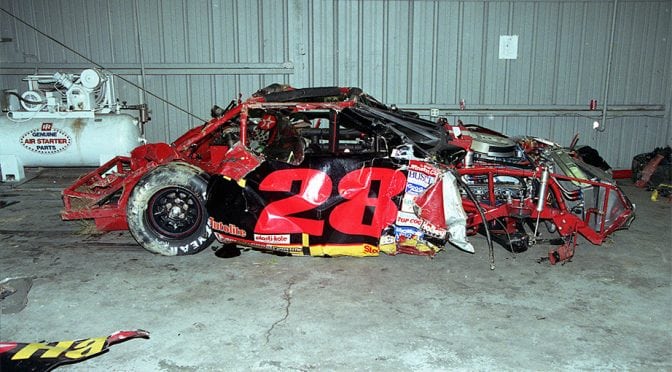
The hardest hit of all came two months later at Pocono Raceway. Contact with Darrell Waltrip’s car sent Allison’s No. 28 spinning into a dramatic 11-flip blowover in the infield grass. Allison absorbed a fractured and dislocated right wrist, a broken collarbone, broken right forearm and multiple facial bruises.

“I don’t know how many licks like this our little driver can take,” Larry McReynolds, Allison’s crew chief, told reporters after the race. Remarkably, Allison’s determination to start the following week’s race at Talladega Superspeedway became known in a matter of days.

Allison underwent 4 1/2 hours of surgery on that Pocono Sunday, with plates and screws inserted to address his arm fractures. After a follow-up bone graft operation Thursday, he was released from the hospital Friday and practiced the car the next day, fitted with a special cast to assist in shifting gears. An early caution allowed Allison to give way after five green-flag laps to relief driver Bobby Hillin Jr., who filled in admirably for a third-place finish.

All this occurred while Allison battled through significant facial swelling and dark, bloodshot eyes. “I would take these sunglasses off, but it’ll remind you of Beetlejuice,” Allison quipped.

Allison stayed on the mend and in the championship hunt that season, tough to the end.

MORE: When Liz met Davey, a NASCAR love story