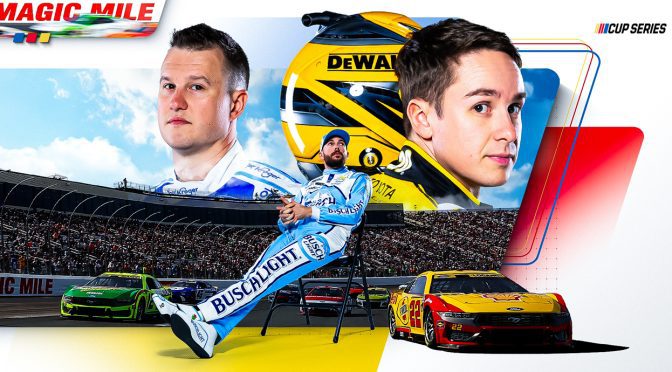
JOLIET, Ill. — Through the first half of the 2026 NASCAR Cup Series season, Toyota teams have combined to win 11 of 18 races.

RFK Racing team co-owner and driver Brad Keselowski said Friday at Chicagoland Speedway he believes the manufacturer has earned its flowers. But he also sees lessons Ford and Chevrolet can learn from what a rival Original Equipment Manufacturer is accomplishing behind the scenes.

MORE: Chicagoland schedule | Cup standings

With 10 weekly entries from Team Penske, RFK Racing, Front Row Motorsports and Wood Brothers Racing, Ford has combined for just one points-paying win this year, courtesy of Penske’s Ryan Blaney at Phoenix Raceway in March. Ford will get a new body on the race track in 2027 via its Mustang Dark Horse SC, but no body updates can be made until then.

In Keselowski’s opinion, “dramatic” rules changes made in the last decade have altered the NASCAR paradigm, specifically as engineering responsibilities pivoted from the teams to the manufacturers, creating “a tremendous dynamic shift in the sport” triggered after Furniture Row Racing’s alliance with Joe Gibbs Racing led to a 2017 championship followed by a departure from the sport after the 2018 campaign.

“So the rules and all the things behind the scenes got altered and pushed in such a way as to prevent that from possibly happening again, and I think that’s where they are right now,” Keselowski said. “The unintended consequences, whether that was second-order or third-order effect, is you created this stalemate of organizations. And the OEMs all either consciously or subconsciously decided who their favorite was because they had to — or felt like they had to. And I think you’ve seen that now with how the last six or seven seasons have played out where it’s the top organization at each OEM.”

Brad Keselowski drives the No. 6 Ford at Chicagoland.
James Gilbert | Getty Images

Today, Toyota is excelling above its counterparts, notably through the performance of Joe Gibbs Racing’s four-car operation and an alliance shared with 23XI Racing, sharing 11 wins this year among four drivers. Other manufacturers’ lead programs share alliances, such as Chevrolet’s Hendrick Motorsports with Spire Motorsports and Ford’s Team Penske with Wood Brothers Racing. But those partnerships haven’t produced the same results as Toyota’s.

“What’s become unique, I think, over the last two or three years specifically is — and I’ll give a lot of credit to Toyota for this — is they’ve recognized that that stalemate is not necessarily good for the sport or for them as an OEM,” Keselowski said. “And they’ve done a lot of things to push elite collaboration amongst their top organizations so that they have, for reference, two ‘A’ organizations, rather than an ‘A,’ ‘B’ and ‘C.’ As I’ve seen to date, the other OEMs have not done that, and Toyota is making them pay for that with results on the race track. They deserve credit for that.

“The challenge that I see is: Will the other two OEMs actually react to that? I haven’t seen that at the moment. I think RFK is doing all the things it needs to do to position itself to be successful if that were to happen, particularly in the Ford camp. But at this point we have not seen the level of collaboration at Ford that we see at Toyota, and it creates challenges for the program. And I have not seen from the outside — I’m not inside Chevrolet — the same things there. So we’re having one of these seasons where it looks like Toyota is going to dominate throughout, and there’s a great argument to be made that they’re winning races in the boardroom with really great decision-making.”

RFK Racing and Penske, both of which are three-car operations, sit atop the pecking order in Ford Racing, though Penske has been considered the manufacturer’s most successful outfit with championships in four of the last eight NASCAR Cup Series seasons. If the information among Ford’s top teams could be shared equally the way Keselowski believes it should, he sees a path in which the rising tide could lift Ford’s boats.

“In my mind, at least, I think the burden is on the OEMs and the decision-makers at the highest of levels that want their programs to be successful in NASCAR to react accordingly within the rules,” Keselowski said. “And there’s means and measures to do that. As it works its way specifically into RFK, I think we’ve proven our merit. We have three teams that are in a position that I’m proud of. Are we winning races every week? No. We only have one win this season in the non-points-paying race with the Clash. But we continue to show that we have, I think, the organization to push to that next level, given the right opportunities. And I’m really proud of that.”

The team isn’t going anywhere any time soon, Keselowski said, as he confirmed RFK Racing has a long-term contract in place with Ford Motor Company.

“We’re committed to that. We want to be successful with them,” he said. “We’re hopeful that we can continue to innovate with them to this next level. We’re in a lull right now that we don’t want to be in. Ford doesn’t want to be in the same lull — I feel pretty safe in saying that. The onus is on us to step it up and figure it out.”

JOLIET, Ill. — Ryan Blaney described last week’s cool-suit failure as a “snowball effect” of cascading problems that caused him to overheat at Sonoma Raceway. Any snowballs or other forms of frozen precipitation would have come in handy during his sweltering Sunday drive.

“Yeah, I was down bad,” Blaney said Friday, five days later. “I was down bad. Your boy was struggling.”

Blaney gutted out a sixth-place finish last weekend at Sonoma, visiting the track’s care center post-race for fluids after exiting his No. 12 Team Penske Ford. He arrives this weekend at a revived Chicagoland Speedway in better health, riding a consistent streak into Sunday’s eero 400 (6 p.m. ET, TNT Sports, truTV, HBO Max, MRN Radio, SiriusXM NASCAR Radio).

RELATED: Chicagoland schedule | Fantasy preview

Blaney said when he flipped on his driver-cooling suit after Stage 1 of last weekend’s event, the system malfunctioned. Cycling through and resetting it didn’t work. As the cool suit’s fluid warmed, his No. 12 crew handed him a pressure-filled tool during a pit stop to help him flush the system. The race, however, stayed under mostly green-flag conditions the rest of the way, and Blaney didn’t have much chance for a water-bottle break as he navigated the intricate road course at speed.

Blaney tried to stash the tool in a small compartment inside the driver’s door, but it rattled loose to the floorboard — “into the abyss,” he said. Then leg cramps cropped up with 20 laps left, especially in his left calf entering the Turn 11 hairpin.

“I haven’t had that in a while, and like the worst place to cramp is your left calf at a road course, and I was happy I didn’t run off anywhere,” Blaney said. “But we got through it, and the AMR (medical) folks were great. They were at me really quick and got me fixed up after, so appreciate them for responding really quick from when I needed them. I think we diagnosed the problem, so that was good that we found the gremlin and were able to fix it, so hopefully it doesn’t happen again.”

Blaney has equaled a career-best streak of six consecutive top-10 finishes heading into Sunday’s 400-miler, the first event of the season’s second half. He’s also heading into a potentially opportune time to heat up — his last two summers have been marked by multirace performance spikes, and 11 of his 18 career Cup Series wins have arrived in the back half of the season.

Other bellwethers are a little less favorable. Ford is winless in the last 14 Cup Series races, dating back to his March 8 victory at Penske stronghold Phoenix Raceway. Ford drivers have also managed just one top-five result in the four events on 1.5-mile tracks in 2026, and Team Penske has weathered the last 10 races without a top-five finish — its longest dry spell since 2008.

Blaney has stayed steady through the season’s first half, slotting him third in the Cup standings but still 100-plus points behind Toyota drivers Denny Hamlin and Tyler Reddick, the campaign’s front-runners. Before his top-10 streak began, Blaney was 162 points off the top, but now stands 104 points back of Hamlin, the new series leader.

MORE: Cup Series standings

Just eight races remain until the 16-driver Chase field is determined, and there’s more ground to gain to fulfill Blaney’s aspirations of claiming the Regular Season Championship and the advantageous No. 1 seed. Difficult but doable is how he sees it.

“You never know,” Blaney said after Friday’s practice. “I don’t know. You can see big, big swings week to week. Denny was able to do it off of really, really good performance, and tons and tons of points winning races. I think the 45 (Reddick) might have had a little bit of trouble while he was winning. Like, Michigan was a big one, then like in our case, we just kind of banged out some top 10s. Those guys had some problems, and we cut down a lot of points in the last just two weeks. So, you never know. We just try to focus on us. Like, I look at the points, but I don’t study it methodically. I kind of look at it a few times through the week to remind myself where we’re at, and just try to put together the best weekend.

“So you never know, the last couple months could get interesting, and we just try to get better week in, week out, and you never know where that stuff could go. So I’d say it’s not out of the question, but it’s going to be really, really hard to achieve.”

Blaney made four Chicagoland starts in Cup Series competition before the track was temporarily shuttered after the 2019 season, but he’s among a handful of drivers with recent experience here. Blaney joined Hamlin and defending Cup champion Kyle Larson in participating in a Goodyear tire test in April, and those laps may prove to be beneficial.

“They helped,” Blaney said. “Give us a little bit of a … I wouldn’t say head-start, but we were able to come here and learn for two days. Then as a driver, for me, up to speed a little bit faster of how to approach the race track. So, I hope it helps. We’ll see come Sunday.”

23XI Racing driver Riley Herbst topped the leaderboard in Friday evening’s NASCAR Cup Series practice at Chicagoland Speedway, as the premier series hit the 1.5-mile Joliet track for the first time since 2019.

The driver of the No. 35 Toyota posted the fastest lap at 178.065 mph in the closing minutes of practice, leading a 23XI 1-2 with teammate Bubba Wallace second-fastest (177.930 mph). All four 23XI Toyotas were inside the top eight.

RELATED: Practice results | At-track photos: Chicagoland

Kyle Larson (177.877 mph), Denny Hamlin (177.877 mph) and Ty Gibbs (177.754 mph) rounded out the top five.

Naval Base Coronado winner Corey Heim (177.719 mph), Austin Cindric (177.643 mph), Tyler Reddick (177.526 mph), Carson Hocevar (177.223 mph) and Chris Buescher (177.189 mph) completed the top 10.

Cindric led the way in five-lap average speed, but Reddick’s No. 45 Toyota was quickest in the 10-, 15-, 20- and 25-lap averages.

MORE: Watch Reddick navigate Chicagoland in Cup practice

Qualifying is slated for Saturday at 3 p.m. ET on truTV, followed by Sunday’s eero 400 (6 p.m. ET, TNT Sports, truTV, HBO Max, MRN Radio, SiriusXM NASCAR Radio).

Due to inclement weather on Friday, NASCAR O’Reilly Auto Parts Series practice at Chicagoland Speedway was postponed until Saturday at 1:30 p.m. ET in place of qualifying. Therefore, the starting lineup for Saturday’s Cuervo 300 (5:30 p.m. ET, The CW, MRN Radio, SiriusXM NASCAR Radio) has been set by the NASCAR Rule Book.

See below for the full starting lineup. Connor Zilisch will lead the field to green.

POSITIONNUMBERDRIVER
11Connor Zilisch
219Brent Crews
39Carson Kvapil
417Corey Day
599Parker Retzlaff
62Jesse Love
796Anthony Alfredo
800Sheldon Creed
941Sam Mayer
108Sammy Smith
1188Chase Elliott
1291Myatt Snider
1318William Sawalich
1439Ryan Sieg
1587Nick Sanchez
1621Austin Hill
177Justin Allgaier
1824Harrison Burton
1907Josh Bilicki
2051Jeremy Clements
210Cole Custer
2227Jeb Burton
2342Garrett Smithley
2444Brennan Poole
2554Taylor Gray
2626Dean Thompson
2748Patrick Staropoli
2802Ryan Ellis
2920Brandon Jones
3031Blaine Perkins
3192Leland Honeyman Jr.
3232Rajah Caruth
3328Kyle Sieg
3445Lavar Scott
3553Tyler Tomassi
3647Dawson Cram
3755Joey Gase
3838J.J. Yeley

The crying eyes gesture wasn’t new for Kyle Busch.

At least twice before — after wins at Bristol Motor Speedway and Watkins Glen International — “Rowdy” had gleefully pantomimed the supposed tears of the detractors who were resigned to his inevitability.

But this time was different — and not only because it became perhaps the defining episode of Busch being cast in the role of NASCAR’s greatest villain.

Kyle Busch pretends to wipe tears from eyes after winning the NASCAR Cup Series race in 2018 at Chicagoland Speedway.
NBC Sports

Walking down the banking while clutching the checkered flag from a slam-bang win over Kyle Larson at Chicagoland Speedway, Busch removed his headsock and stopped to mug directly into an NBC camera. He rubbed his left eye with the poutiest of faces before flinging away his earbuds in a dramatic flourish.

The scene was captured for a live national TV audience of millions who watched a classic GIF being born in real time.

While it’s a quintessential moment in the colorful career of a captivating champion whose polarizing personality always commanded the main stage, there was also something unique about this turn as the bad guy.

Of all the iconic instances in which Busch is remembered for playing the heel, this was among the least performative. The crying eyes gesture hardly required an acting job.

Busch was channeling his authentic disappointment at the perceived lack of appreciation that thousands showed for the enthralling series of haymakers just traded by two Hall of Fame-level talents.

In a failed attempt at a “slide job” (a dirt-racing maneuver involving out-braking to gain a spot), Kyle Larson drove into the side of Busch and then into the lead on the backstretch. Busch repaid the contact in the last turn and reclaimed the position for the win.

Epic stuff.

Yet a familiar chorus of boos still erupted as Busch triumphantly exited his No. 18 Toyota.

“When you put on a great show and have a really fun time being able to do everything as hard as you can to try to win a Cup Series race, for as hard as they are to win, it would certainly be nice to have some appreciation for putting on a good show for those fans,” he would later say. “When the boos are raining down on you in that moment, it certainly doesn’t make you feel good about yourself or what you just did, and so you sometimes aren’t thinking straight or clearly in those moments.”

His interview in the immediate aftermath underscored the genuine befuddlement with the negative reaction to a final lap destined to be replayed for eternity.

WATCH: Eight years later: Larson revisits 2018 Chicagoland finish

“I don’t know what you are all whining about, but if you don’t like that kind of racing, don’t even watch,” Busch said with a dismissive wave of his right hand that he followed by later blowing a kiss to the crowd. “Pretty cool going to Victory Lane.”

When he got there several minutes later, the next interview revealed he was still hung up on the crowd’s reaction.

“My fans, they’re pretty passionate, they’re pretty powerful for what we got going on with Rowdy Nation,” he said. “The rest of them, I don’t know what they’re booing about. That was a hell of a race. You got problems if you don’t like that.”

Of course, Busch could understand their reaction because he often was the one who stoked it over two decades and 234 wins in NASCAR’s top three national series.

Among stars who were comfortable and secure enough to wear the black hat, he was unequaled at effortlessly embracing the opportunity.

Smashing a guitar in Victory Lane at Nashville Superspeedway … literally dropping a mic in the Charlotte Motor Speedway media center … giving a sarcastic thumbs up in a post-Bristol Motor Speedway care center interview.

Kyle Busch in the No. 18 Toyota makes contact with Kyle Larson in the No. 42 Chevrolet during the NASCAR Cup Series race in 2018 at Chicagoland Speedway.
NBC Sports

The visuals are among the many reasons Busch was the “Most GIF-able Driver in NASCAR History.”

As he once put it, “people are obsessed with everything I do.”

And on July 1, 2018, there was ample reason to be mesmerized.

What’s forgotten about Busch’s win at Chicagoland is how unlikely it was.

He qualified 16th, failed to score a point in either stage and hardly factored until seizing control to lead the final 59 laps. On a scorching summer day, crew chief Adam Stevens was struck by how, “given how poor our car was,” Busch stayed focused on improving by giving strong feedback without giving up.

“We missed it all weekend,” Stevens said. “But he’s a one-in-a-million talent. The sport hasn’t seen too many people with his level of talent. To get the chance to win races with him is what every little boy dreams about.”

Even the runner-up was somewhat in awe of the finish.

“I love racing Kyle,” Larson said. “I know all you fans are probably mad at him, but hey, we put on a hell of a show for you guys. That was a blast. That’s got to be one of the best NASCAR finishes of all time.”

Maybe it’s also the way to reinterpret Busch’s gesture eight years later.

Cry your eyes out, fans.

You witnessed greatness … before it was gone.

Editor’s Note: Keep tabs on this page for lineup advice following qualifying, including changes you should consider.

Fantasy Update: The more things change, the more they stay the same in 2026. Surprise, surprise, Toyota unloaded with an abundance of speed at Chicagoland Speedway as Tyler Reddick and 23XI Racing paced practice on Friday. Denny Hamlin led the field in qualifying, winning his fourth Busch Light Pole Award of the season. RFK Racing showed up with legitimate speed, sweeping the second row. San Diego winner Corey Heim could play sleeper again this weekend, ranking inside the top five on five-, 10-, 15-, 20- and 25-lap averages in practice. The lone change in my lineup is adding a Toyota in Christopher Bell, and I’ll replace Kyle Larson with Hamlin as my 36 for 36 pick.

Starting five: Denny Hamlin, Kyle Larson, Tyler Reddick, Christopher Bell, Chase Briscoe.
Garage pick: Brad Keselowski.

For the first time in 2,562 days, the Cup Series will return to the challenging and bumpy Chicagoland Speedway this weekend. Eighteen drivers — nearly half the field entered — have never run a Cup race at the 1.5-mile track. The last two events there in 2018 and 2019 had banger finishes, including Alex Bowman breaking through to Victory Lane for the first time. Kyle Larson was in the mix both times and participated in April’s Goodyear tire test, so look for the No. 5 team to be among the race favorites.

Returning to Fastlane this year is my weekly NASCAR 36 for 36 pick, where you can come play along. It’s a season-long points battle introduced in 2024 where strategy is the primary emphasis. With 36 chartered cars and 36 races on the 2026 schedule, players can choose each car once for the duration of the season.

RELATED: NASCAR Fantasy Live hub | Play 36 for 36 

MUST START

Driver: Kyle Larson, No. 5 Hendrick Motorsports Chevrolet
Selections remaining: 4
Comment: Larson has notably excelled at venues with old asphalt, and Chicagoland is among the oldest surfaces on the circuit. The two-time Cup champion has finished runner-up in each of the last two trips to Joliet, including an epic last-lap battle with Kyle Busch in 2018. Through six starts, he holds a 6.2 average finish here, the best all-time among drivers with multiple starts.

Driver: Denny Hamlin, No. 11 Joe Gibbs Racing Toyota
Selections remaining: 2
Comment: With just a couple of starts remaining for Hamlin, I’m in a pickle this weekend. But whenever the series hits an intermediate track in 2026, he is the guy to beat, finishing fourth or better in the last six races at 1.5-mile tracks. Hamlin also participated in the Goodyear tire test in April.

Driver: Tyler Reddick, No. 45 23XI Racing Toyota
Selections remaining: 4
Comment: Even though Reddick has never made a Cup start at Chicagoland, this old surface falls right into his wheelhouse. His dirt background has helped him excel at sister tracks Darlington Raceway and Homestead-Miami Speedway. Reddick has four top-five and five top-10 efforts in the last six races at 1.5-mile tracks, with an average running position of 5.16 at those tracks in 2026.

denny hamlin wins at pocono.
David Jensen | Getty Images

DRIVERS TO AVOID

Driver: Joey Logano, No. 22 Team Penske Ford
Selections remaining: 7
Comment: With finishes of eighth or better in the last six Chicagoland races, this weekend serves as an opportunity for Logano to flip the script on his season after plummeting to 20th in points. But Penske’s intermediate program has left much to be desired in 2026, as Logano has finished outside the top 30 in two of the last three 1.5-mile events.

Driver: Carson Hocevar, No. 77 Spire Motorsports Chevrolet
Selections remaining: 6
Comment: Given how Chicagoland drives, it seems like a good fit for Hocevar. But the No. 77 team has struggled recently, earning a single top 10 in the last 11 visits to 1.5-mile tracks. He could spend time up front, though, leading laps in nine of the last 10 races at the cookie-cutter tracks.

Carson Hocevar at Bristol.
Matt Kelley | Getty Images

SLEEPERS OF THE WEEK

Driver: Alex Bowman, No. 48 Hendrick Motorsports Chevrolet
Selections remaining: 10
Comment: As Bowman stated following a 10th-place finish at Sonoma Raceway, the last few months have been “horrendous” for the No. 48 team. He is the most recent victor at Chicagoland and has 10 top 10s in the last 15 attempts at 1.5-mile circuits.

Driver: Brad Keselowski, No. 6 RFK Racing Ford
Selections remaining: 7
Comment: Placing 15th at Sonoma stopped an abysmal skid for Keselowski of four straight finishes of 34th or worse. He is among the best at Chicagoland, with nine straight top-10 finishes in the heartland, including a pair of triumphs.

Alex Bowman wins at Chicagoland in 2019.
Matt Sullivan | Getty Images

FEATURED MATCHUPS

Ty Gibbs vs. Chase Briscoe
Pick:
Briscoe
Comment: Low-grip race tracks favor drivers with a dirt-racing background, and while Gibbs has been introduced to dirt racing in the last few years, Briscoe is embedded in it. Expect a big weekend from the No. 19 bunch.

Kyle Larson vs. William Byron
Pick:
Larson
Comment: This colossal matchup is a tough pick, but Larson gets the nod. He’s been a walking highlight reel at Chicagoland but is still searching for Victory Lane. Byron shouldn’t be overlooked, though, with six top 10s in the last seven races at 1.5-mile tracks and a series-best 9.4 average finish at them in the Next Gen car.

Todd Gilliland vs. Carson Hocevar
Pick:
Hocevar
Comment: While Hocevar hasn’t finished great at intermediate tracks, he is always fast at them. There is plenty of upside, and it’s a favorable matchup with Gilliland having yet to score a top-10 at a 1.5-mile track.

Alex Bowman vs. Austin Cindric
Pick:
Bowman
Comment: Entering the In-Season Challenge as the final seed, Bowman is this year’s Cinderella story, trying to pull off a Saint Peter’s-like run in this bracket-style format. He should have the clear advantage this weekend, with Cindric having only six top-15 finishes in the last 24 attempts at 1.5-mile races.

MY LINEUP

Starting five: Kyle Larson, Denny Hamlin, Tyler Reddick, Chase Elliott, Chase Briscoe.
Garage pick: Brad Keselowski.

36 FOR 36

Pick: Kyle Larson, No. 5 Hendrick Motorsports Chevrolet
Comment: We’re swinging for the fences with this pick, but Chicagoland presents a grand opportunity for Larson to snap a 42-race winless drought. He has consecutive runner-up finishes at Chicagoland and has been in the hunt here since he was a rookie in 2014. For a driver who was recently the king of intermediates, Chicagoland is statistically his best with an average finish of 6.2.

Typically, Justin Allgaier is a skilled road racer, but the driver of the No. 7 JR Motorsports Chevrolet doubtless would gladly forget the last two events on circuits that turn right as well as left.

On June 20, Allgaier fell out of the NASCAR O’Reilly Auto Parts Series race at Naval Base Coronado in 32nd place because of an engine failure. Last Saturday at Sonoma Raceway, he finished 26th.

RELATED: Chicagoland weekend schedule | O’Reilly Series standings

The good news is that, despite the disappointing results on the road and street circuits, Allgaier retained the lion’s share of his series lead. He holds a 207-point advantage over second place and defending series champion Jesse Love entering Saturday’s Cuervo 300 at Chicagoland Speedway (5:30 p.m. ET, The CW, MRN Radio, SiriusXM NASCAR Radio).

Allgaier also has an enviable edge entering the 20th race on the O’Reilly Series schedule. Not only did he represent Chevrolet in the Goodyear tire test at Chicagoland in April, but he also conducted the subsequent wheel-force test at the speedway, which will host its first O’Reilly Series race since 2019.

Allgaier has two victories at Chicagoland. The only other drivers in the field with wins at the track are Cup Series interlopers Chase Elliott and Cole Custer (one each). Custer won the last race held at Chicagoland seven years ago.

“I’m so happy to be going back to Chicagoland,” said Allgaier, a native of Riverton, Illinois. “This has always been one of my favorite tracks, and it’s great to see it back on the schedule. Hopefully, our notes from the past can help us get a good baseline for this weekend, but I know that (crew chief) Andrew (Overstreet) and all the guys on this No. 7 group will be ready to go when we unload.

“It’s always great getting the chance to race back in the home state, not only for me but for everyone at Brandt Professional Agriculture as well. We just need to go out and execute like we have throughout this season, and if we do, I think we can have an awesome homecoming on Saturday night and celebrate the 4th of July in style.”

There are currently five races left in the O’Reilly Series regular season, and the battle for 12 Chase spots is intensifying. Currently, Joe Gibbs Racing teammates Taylor Gray and William Sawalich straddle the cut line, with 12th-place Gray holding a 20-point edge.

It’s time for Round 2 of the 2026 In-Season Challenge as the NASCAR Cup Series heads to Chicagoland Speedway on Sunday (6 p.m. ET, TNT Sports, truTV, HBO Max, MRN Radio, SiriusXM NASCAR Radio) for its first visit to the Joliet, Illinois, facility since 2019. With how Round 1 played out, the expectations are even higher for the only 1.5-mile track in this year’s bracket.

While the entire right side of the bracket was chalk at Sonoma Raceway, the left side featured three upsets — including top-seeded Tyler Reddick losing to No. 32 Alex Bowman after an early mechanical issue. To add insult to injury, Reddick lost the series points lead for the first time all season. No. 25 Todd Gilliland also upset No. 8 Daniel Suárez despite finishing outside the top 25, and crafty road racer Michael McDowell defeated No. 13 Bubba Wallace. Three of the 16 Round 1 matchups were decided by two spots or fewer.

This week features a handful of matchups between heavy hitters that could ultimately make or break your bracket. Chicagoland certainly has unknowns from sitting dormant for seven years, but generally, expect the cream to rise to the top just like a typical intermediate race.

RELATED: Check your bracket! | In-Season Challenge hub

ROUND 2 MATCHUPS:

  • (No. 2) Denny Hamlin vs. (No. 15) Erik Jones
  • (No. 3) Ryan Blaney vs. (No. 14) Shane van Gisbergen
  • (No. 4) Chase Elliott vs. (No. 20) Michael McDowell
  • (No. 5) Ty Gibbs vs. (No. 12) Chase Briscoe
  • (No. 6) Kyle Larson vs. (No. 11) William Byron
  • (No. 7) Chris Buescher vs. (No. 10) Christopher Bell
  • (No. 9) Carson Hocevar vs. (No. 25) Todd Gilliland
  • (No. 16) Austin Cindric vs. (No. 32) Alex Bowman

TRACK BREAKDOWN

It’s difficult to predict exactly how Chicagoland will play out, but expect significant tire conservation efforts. The revived speedway features its original racing surface since opening in 2001, and Cup Series teams will have 12 sets of Goodyear rubber for the weekend.

Races where tires are at a premium tend to favor veteran drivers, so look no further than Denny Hamlin. He’s the best remaining seed and faces No. 15 Erik Jones, who’s on an upswing over the summer months. But Hamlin has a whopping 2.5 average finish on intermediates this season with an average running position of 3.89. Hamlin also participated in a Goodyear tire test at Chicagoland this spring with Kyle Larson and Ryan Blaney. And speaking of Larson, he owns the best average finish in six starts at the track (6.17), with Hendrick Motorsports teammate Chase Elliott right behind him (8.75) in four starts.

Sunday could be busy on pit road over 267 laps, but all trends seem to favor Joe Gibbs Racing and Hendrick Motorsports. 23XI Racing should also be strong, but none of the Hamlin-co-owned cars remain in the bracket.

MATCHUP OF THE WEEK: (No. 6) Kyle Larson vs. (No. 11) William Byron

This matchup has some serious star power, and yeah, they’re teammates, too. A pair of the best on intermediate tracks, Larson and Byron will square off in Round 2 at Chicagoland — both coming off relatively decisive wins at Sonoma Raceway. Larson stomped Riley Herbst in Round 1, finishing fourth while the 23XI Racing driver placed 30th. Meanwhile, Byron finished 12th at the road course compared to 21st for opponent Ricky Stenhouse Jr.

Hendrick Motorsports is seemingly off on pace at larger ovals this season, at least compared to Toyota — this year’s benchmark. But both Larson and Byron showed plenty of life in recent weeks at Michigan International Speedway and Pocono Raceway. Larson’s riding a streak of five top fives in the last six races. With a third-place finish at Pocono, the “Tricky Triangle” served as arguably Byron’s best race of the season.

So as the 2026 campaign inches toward The Chase, this head-to-head battle could serve as an important marker for Hendrick with both drivers looking for their first wins of the season. On paper, Larson has the advantage, with more momentum and a stronger record at Chicagoland — a track dormant since 2019 — but this matchup could be a nailbiter.

MORE: Recap Round 1 action

a split image graphic featuring kyle larson and william byron, NASCAR.com's matchup of the week for round 2 of the 2026 in-season challenge.
Getty Images

KEY MATCHUP: (No. 5) Ty Gibbs vs. (No. 12) Chase Briscoe

Another teammate matchup, this time inside Joe Gibbs Racing — and it should be just as entertaining as the Hendrick drivers. Gibbs is enjoying a career-best season, sitting fourth in the series ranks with a win at Bristol Motor Speedway this spring and the fifth-best average finish (13.17). On the other hand, Briscoe is finally beginning to surge after a brutal spring stretch, recording top 10s in four of the last seven races and nearly outgunning Shane van Gisbergen last weekend at Sonoma.

Neither driver has raced in the Cup Series at Chicagoland, and Gibbs hasn’t raced at the facility at all. Briscoe has four previous starts in lower series, including an ARCA Menards Series win in 2016. That experience honestly might not be relevant in the Next Gen car, but it’s at least something. Overall, Gibbs has shown more consistency in 2026 and has top 10s in three of the first four 1.5-mile races this year. This is as big a toss-up as you can get, but with the No. 19 team heading in the right direction, Briscoe may have a slight edge — and he could hand Gibbs his first-ever In-Season Challenge loss.

KEY MATCHUP: (No. 7) Chris Buescher vs. (No. 10) Christopher Bell

This battle might be less heralded than the others, but it could very well come down to the wire. Buescher is one of the most consistent drivers in the series, earning nine top 10s through 18 races and finishing outside the top 20 just three times. Bell is quite the opposite in a season defined by feast or famine, with three finishes outside the top 20 in just the last four weeks. But when the No. 20 JGR team has a clean race, he’s almost always a contender.

Bell has earned six top-five finishes this season and continues to nurse a broken wrist — although his P5 effort at Sonoma shows it isn’t inhibiting him from logging marquee finishes. His ceiling is generally higher than Buescher’s on a week-to-week basis, and with Toyota’s stellar intermediate speed in 2026, Bell should be the favorite in this matchup. But if his day starts to unravel, Buescher will almost certainly take advantage.

UPSET WATCH: (No. 3) Ryan Blaney

Blaney has data from the spring tire test in his back pocket, but faces No. 14 van Gisbergen in Round 2, who’s fresh off a victory last weekend at Sonoma Raceway. SVG is clearly improved across the board in 2026, as evidenced by his +5.6 gain in average finish compared to this time last year.

But specifically, van Gisbergen has shown an ability to perform well at larger tracks when he has a favorable qualifying draw. This weekend, he’ll be the fifth-to-last driver to roll out for a hot lap. The qualifying metric is weighted between the team’s finish in the prior race and owners’ points. After finishing second at Circuit of The Americas in March, he earned a favorable draw and ultimately finished 11th. He then won at Watkins Glen International in May, followed by a pair of top-10 qualifying results at Charlotte Motor Speedway and Nashville Superspeedway. He finished 11th and fifth in those events, respectively.

Meanwhile, Blaney is third in points, yet Ford’s pace remains off at intermediates. The No. 12 Team Penske driver is usually the best of the bunch, but he hasn’t finished better than seventh all year at traditional ovals 1.5 miles or larger. Blaney is favored here, but it’s a dangerous matchup for the 2023 Cup champ.

On the heels of consecutive road-course races, the Cup Series will head to the Chicago area this weekend — but not to the streets of Grant Park, as it had in each of the previous three seasons. Instead, NASCAR will return to 1.5-mile Chicagoland Speedway in Joliet, Illinois, for the first time since 2019. And as much as that seems like it was just yesterday — time does fly, doesn’t it? — the previous race was so long ago that roughly half (46%) of this week’s field will be making their Cup debut at the track, with only 10 drivers having logged at least five career races there, and only three — Brad Keselowski, Denny Hamlin and Alex Bowman — having won there before.

And, of course, nobody has run Chicagoland in a Next Gen car yet, until now.

RELATED: Chicagoland schedule | Cup standings

In other words, this is basically a brand-new track for the majority of drivers in the Cup Series. A few weeks ago, we dove into who does the best at learning new tracks, so go read that if you want to know about the “quickest studies” in the sport ahead of an unfamiliar test. But this week, we wanted to focus on the particulars and attributes of the track itself to re-familiarize ourselves with NASCAR’s latest return to a track that was previously on hiatus.

Let’s start with a snapshot of how Chicagoland tended to compare with other intermediate tracks during its original run from 2001 to 2019:
Chart showing percentile rankings for Chicagoland Speedway relative to other immediate tracks from 2001-2019.
When we judge Chicagoland against its fellow intermediate cousins, we see that it was relatively middle-of-the-road in many regards. The polesitter did slightly better than average, and there were slightly more lead changes per lap than the typical standard oval. At the same time, the favorite did slightly worse than average here — though nowhere near a Daytona/Talladega level, or, among intermediates, Pocono or Texas — and the long-term projected quality of the winner was slightly worse than the average track. There were also slightly fewer cautions per lap, and a lot fewer laps spent under caution as a share of the race (indicating longer green-flag runs than typical intermediates).

The main outliers, though, were about how winners tended to get to the checkered flag. The average Driver Rating for winners within the race itself (129.2) was lower than 83% of all other intermediate tracks, meaning a winning driver was not necessarily a dominant driver. And relatedly, the eventual winner’s average starting position on the grid (14.6) was worse than any other intermediate of the era except Rockingham (14.7). That means the winner often needed to make their way from deeper in the field to the front of the pack than on the average oval — early-race track position was less important than usual.

This means the traditional book on Chicagoland, which emphasizes managing tires over the long run — and other tactical considerations like fuel-saving (see Tony Stewart, 2011) and pit calls — should reign supreme again this week. A fast car is nice, and so is clean air up front. But the winner tends to come from relative obscurity throughout most of the day, getting to the front at the end through a combination of smart strategy and timely passing, using the multiple grooves of the track to win late. (Or maybe just a timely slide job like in the Kyle-and-Kyle show from 2018.)

In that sense, this track also drew easy comparisons with Homestead — few other places let you run so close to the fence throughout the corner. But as a high-tire-wear mile-and-a-half track, Chicagoland also rates as similar to Kansas and, to a lesser extent, Darlington, Las Vegas, Charlotte and Texas.

And I happen to have a system that, for each track, measures an average of recent Driver Ratings at similar tracks for any given stop on the schedule, weighted toward more recent results at more similar tracks. Putting the greatest emphasis on recent results at Homestead and Kansas, with some additional consideration paid to the other tracks mentioned above, here are the best (and worst) projected drivers at Chicagoland, particularly relative to their typical performance at all tracks:
Chart showing projected Driver Rating at Chicagoland based on recent performances at similar tracks versus a driver's expected rating at a typical track.
Unsurprisingly, Denny Hamlin, the king of intermediates — and the king of tire management and fuel saving — should be the best at Chicagoland as well. (He’s also won here before, so Denny has the experience factor on his side, too.) Kyle Larson and Tyler Reddick, two more of the most talented mile-and-a-half merchants in the sport, ought to also be among your favorites. But one driver who might not be is Ryan Blaney — he doesn’t tend to do quite as well as usual at this type of track, at least not recently.

The real drivers who are set to do worse here, though, are your usual road-course specialists — Shane van Gisbergen, Michael McDowell, Connor Zilisch — plus Ty Gibbs, Joey Logano and Ross Chastain, all of whom do worse at similar tracks than we’d expect from their overall résumé.

And what implications might all of this have for the In-Season Challenge, now in its Round of 16? Here are the weekend’s matchups, compared according to projected Driver Ratings at Chicagoland:
Chart showing the projected Driver Ratings for Chicagoland in the In-Season Challenge matchups.
Unsurprisingly, the matchups featuring seeded favorites Hamlin, Blaney and Chase Elliott look lopsided by this accounting. (Even a less-good-than-usual Blaney against an improving-on-ovals van Gisbergen is a matchup tilted heavily toward the No. 12 Penske car.) A few other battles look like they are fairly even matchups on paper, or could at least be highly compelling to watch — such as Larson vs. William Byron, Christopher Bell vs. Chris Buescher and Chase Briscoe vs. Ty Gibbs.

And then there’s No. 32 seed Alex Bowman, fresh off toppling top overall seed Tyler Reddick, facing No. 16 seed Austin Cindric in a matchup where the No. 48 Chevrolet could have a very real chance to grab another upset and, for the second straight year, power the 32nd seed through Round 2.

Seven years is a long time in NASCAR, of course. The cars are different, the drivers are different and the standings format is different. But if Chicagoland’s historical tendencies hold, the winner will probably come from somewhere other than the front of the field for much of the day — and he’ll probably get there by being smarter than everybody else.

SEEKONK, Mass. — After an abysmal start to the 2026 NASCAR Whelen Modified Tour season, Matt Hirschman needed something positive.

The pilot of the No. 60 PeeDee Motorsports Modified got the morale boost he was looking for with a victory in Wednesday’s Firecracker 150 presented by the Bethesda Leadership Group at Seekonk Speedway.

“It’s been a minute here on this Whelen Modified Tour this year,” said Hirschman after his victory in the opening round of the three-race Whelen Midsummer Championship miniseries. “It’s a hot summer Wednesday night at Seekonk Speedway, and part of the nickname ‘Big Money’ Matt Hirschman came from winning this race on this Wednesday night here at Seekonk.

“(There is) no better place to get back in Whelen Modified Tour Victory Lane than here tonight.”

RELATED: Complete results from the Firecracker 150

Throughout his career, Seekonk Speedway has always been a place Hirschman could race and know he’d be competitive.

Entering the season, Hirschman had won the last three Modified Tour races at the track to go along with several victories in non-NASCAR events through the years.

Things didn’t go Hirschman’s way in the most recent event at Seekonk in May, when he struggled and finished a disappointing 20th. Entering Wednesday’s event, Hirschman was determined to flip the script and return to form.

That’s exactly what he did.

Matt Hirschman
Matt Hirschman has now won four of the last five NASCAR Whelen Modified Tour races at Seekonk Speedway. (Photo: Jaiden Tripi/NASCAR)

Starting eighth after the redraw, Hirschman patiently worked his way through the field and found himself in second when the first caution flag of the evening waved with fewer than 50 laps left.

Restarting on the outside of leader Stephen Kopcik, Hirschman rocketed into Turn 1 and easily took the lead. He held the top spot for the remainder of the race to earn his fourth Modified Tour victory at Seekonk and the 11th Tour victory of his career overall.

“We put it together tonight. I don’t know how; maybe we got lucky,” Hirschman said. “Here we are in Victory Lane. We’re going to enjoy this with the team. All these teams work hard, but I’m glad I could get a morale boost here for these guys.”

Dowling, making just his third Modified Tour start of the season, raced his way from the 12th starting position to finish second.

It was his best NASCAR Whelen Modified Tour finish since a runner-up result at South Boston Speedway in 2019.

Patrick Emerling finished third ahead of Kopcik, who led the most laps, in fourth and defending NASCAR Whelen Modified Tour champion Austin Beers in fifth.

Eric Goodale, Teddy Hodgdon, Andrew Molleur, Jon McKennedy and Paulie Hartwig III were sixth through 10th, respectively.

The Modified Tour season continues with Round 2 of JDV Productions’ Whelen Midsummer Championship next Friday night, July 10 at Claremont Motorsports Park with the running of the Clash at Claremont.

FloRacing will provide live flag-to-flag coverage beginning at 8:30 p.m. ET.