All three national series continue the playoff action this weekend in NASCAR’s backyard, as the Cup Series and Xfinity Series return to the Charlotte Motor Speedway Roval and the Truck Series will tackle the intricate road course/oval for the first time. It’s the cutoff race in the Round of 12 for both the Cup Series and Xfinity Series Playoffs, while the Truck Series sparks up its Round of 8. Bookmark this page and come back often for your race-week essentials — from links to qualifying order, average practice speeds, results and more.
Race day: Sunday at 3 p.m. ET on USA Network. The categories listed below will be filled out with links as the information becomes available.
Tires: Nine sets for the weekend (seven new race sets, one set transferred from qualifying and one set for practice). Teams are also allowed six sets of wet-weather tires (four new race sets, one set transferred from qualifying and one set for practice).
Race day: Saturday at 5 p.m. ET on The CW. The categories listed below will be filled out with links as the information becomes available.
Tires: Six sets for the weekend (three new race sets, one set transferred from qualifying and two sets for practice). Teams are also allowed four sets of wet-weather tires (three new race sets and one set for practice).
Race day: Friday at 3:30 p.m. ET on FS1. The categories listed below will be filled out with links as the information becomes available.
Tires: Five sets for the weekend (three new race sets, one set transferred from qualifying and one set for practice). Teams are also allowed four sets of wet-weather tires (three new race sets and one set for practice).
TEMPERANCE, Mich. — The 2026 ARCA Menards Series schedule was announced today. The slate again features 20 races at 19 tracks, including the return to two familiar fan favorites.
The 2026 season will open at Daytona International Speedway, and for the first time since 2021, the championship will be decided at Kansas Speedway. The series will also make its much-anticipated return to Pocono Raceway in June and Chicagoland Speedway in July.
“The 2026 ARCA Menards Series schedule will see long-term relationships with NASCAR national series tracks like Daytona International Speedway, Talladega Superspeedway, Kansas Speedway and Michigan International Speedway continue,” ARCA president Ron Drager said. “We’ll also return to traditional short-track venues like Toledo Speedway, Elko Speedway, Berlin Raceway and Lucas Oil Indianapolis Raceway Park, in addition to the road courses at Lime Rock Park and Watkins Glen International and the two dirt tracks at the Illinois State Fairgrounds and the DuQuoin State Fairgrounds.
“It’s a great mix of tracks across the country that will provide our teams and our fans one of the most diverse schedules in American motorsports.”
The highlights:
The series will race at Daytona for the 63rd consecutive year dating back to 1964. As it has for the last seven years, the race will be the opener of a same-day doubleheader with the NASCAR O’Reilly Auto Parts Series the day before the Daytona 500.
FOX will broadcast the Daytona ARCA 200 for the second consecutive year; 13 races will air on FS1, and six will be shown on FS2.
The series finale will return to Kansas Speedway for the first time since 2021. The track will be the only venue to host two series races, the first in May and the championship round in September.
Chicagoland Speedway returns to the schedule for the first time since 2019 in July. Pocono Raceway returns for the first time since 2023 in June. Both races will run on companion weekends with the NASCAR Cup Series.
Toledo Speedway will return to its traditional May date, with other standalone short-track races at Berlin Raceway and Elko Speedway in June, Madison International Speedway in August and Salem Speedway in September.
The two dirt miles at the Illinois State Fair and DuQuoin State Fair both return on their traditional weekends.
Two road course races are on the schedule, with Watkins Glen International moving to May and a return to Lime Rock Park for the second consecutive season in July.
Additional conjunction races with NASCAR’s national series will be held at Phoenix Raceway in March, Talladega Superspeedway in April, Michigan International Speedway in June, Lucas Oil Indianapolis Raceway Park in July, Iowa Speedway in August and Bristol Motor Speedway in September.
The race at Phoenix Raceway in March will be a combination race with the ARCA Menards Series West. Races at Lucas Oil Indianapolis Raceway Park, Iowa Speedway and Bristol Motor Speedway will be combination races with the ARCA Menards Series East. A fourth combination race will be announced when the ARCA Menards Series East schedule is released.
Below is the complete 2026 ARCA Menards Series schedule.
2026 ARCA Menards Series schedule
Date
Track, Location
Time (ET)
TV
Sat., Feb. 14
Daytona International Speedway, Daytona Beach, Fla.
Noon
FOX
Thurs., March 5
Phoenix Raceway, Avondale, Ariz.
6 p.m.
FS1
Sat., April 18
Kansas Speedway, Kansas City, Kan.
12:30 p.m.
FS1
Sat., April 25
Talladega Superspeedway, Talladega, Ala.
12:30 p.m.
FS1
Fri., May 8
Watkins Glen International, Watkins Glen, N.Y.
1:30 p.m.
FS2
Sat., May 16
Toledo Speedway, Toledo, Ohio
7 p.m.
FS1
Fri., June 5
Michigan International Speedway, Brooklyn, Mich.
5 p.m.
FS2
Fri., June 12
Pocono Raceway, Long Pond, Penn.
3 p.m.
FS1
Sat., June 20
Berlin Raceway, Marne, Mich.
7 p.m.
FS2
Sat., June 27
Elko Speedway, Elko, Minn.
9 p.m.
FS2
Fri., July 3
Chicagoland Speedway, Joliet, Ill.
8 p.m.
FS1
Fri., July 10
Lime Rock Park, Lime Rock, Conn.
4 p.m.
FS2
Fri., July 24
Lucas Oil Indianapolis Raceway Park, Brownsburg, Ind.
CONCORD, N.C. — Recovering from a first-lap crash in “Calamity Corner”, Corey Heim rallied to win Friday’s Ecosave 250 at the Charlotte Motor Speedway Roval, setting a single-season NASCAR Craftsman Truck Series record with his 10th win of the 2025 campaign, breaking the tie with Greg Biffle.
Driving a heavily taped No. 11 Tricon Garage Toyota, Heim took the lead by staying out for an overtime restart while teammate Brent Crews, who had led a race-high 56 laps, pitted for fuel and tires.
Heim drove away on the restart and beat runner-up Crews to the finish line by 1.338 seconds, leading the first-ever 1-2-3 finish for Tricon, with rookie Gio Ruggiero coming home third.
“It was not easy today — I think it was probably the toughest one of the year so far,” said Heim, who secured a spot in the Oct. 31 Championship 4 finale at Phoenix Raceway. “Just shows the resilience of this Tricon team. They fixed it up so good for me after that incident on the first lap — just kind of out of our control.
“I thought we were done, honestly. The right front completely folded when it hit the wall over there.”
In fact, the race was just a few seconds old when three playoff drivers tangled in Turn 1, nicknamed “Calamity Corner” as the frequent scene of accidents at the 2.28-mile, 17-turn circuit.
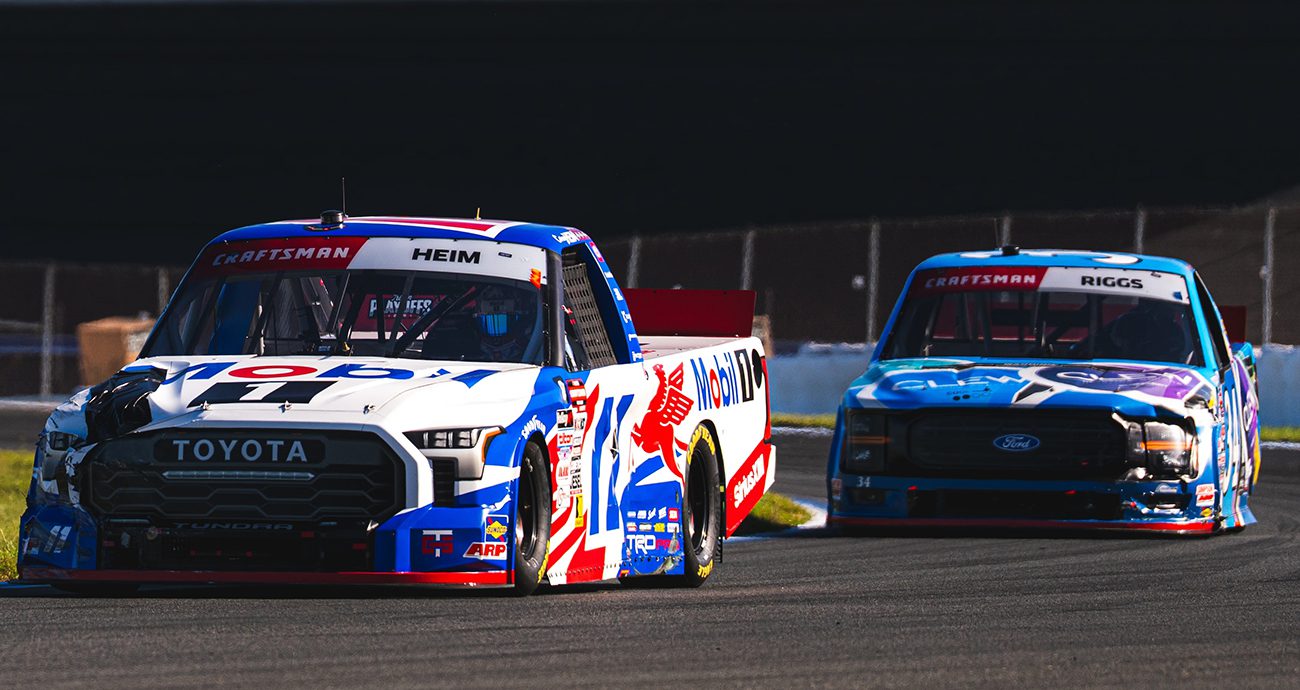
Contact from Grant Enfinger sent second-place starter Layne Riggs spinning in a collision that knocked the No. 11 Toyota of Heim, the pole winner and runaway series leader, into the Turn 1 barrier.
All three trucks sustained damage, with Heim suffering a left-rear tire rub that required multiple pit stops to correct.
“We were not as good as we were in practice and qualifying after that damage,” said the 23-year-old Heim, who earned his first victory at the Roval and the 21st of his career, placing seventh all-time. “My steering wheel was about 45 degrees to the left, and we came down pit road like six times to try to get it back to at least somewhat where it was.”
As Heim worked his way back to the front after the accident, Crews dominated, though he short-pitted in both the first and second stages to set up track position after the breaks.
In fact, Crews appeared bound for his first victory in the series before another Tricon teammate, Toni Breidinger, stalled in Turn 5 to cause the fourth and final caution, sending the race to overtime.
Crews came to pit road from the lead with third-place Connor Zilisch, as Heim stayed on track with Connor Mosack, Riggs and Chandler Smith.
Riggs, who had been racing without a sway bar since the early crash, suffered clutch issues on the restart and held up the outside lane. With trucks spinning behind him, Heim opened a gap and maintained it throughout the two-lap extra period.
“We had a super-fast truck, as you got to see,” Crews said philosophically. “I’m out there leading the race today — I had a blast. Really happy for Tricon today to go 1-2-3, and congrats to the whole 11 team. They did a great job all day as well.
“I was happy to see them get back up there, but I definitely didn’t want to see [Heim] stay out there (for the overtime).”
With Heim advancing to the Championship 4, the other seven playoff drivers left the opening race in the Round of 8 clustered together around the elimination line. Daniel Hemric (11th after starting from the rear) and Tyler Ankrum (ninth) are second and third in the standings, two points above the cutline.
Fourth-place finisher Rajah Caruth is fourth in the standings, just one point to the good over Riggs, two clear of defending series champion Ty Majeski and four ahead of Enfinger and Kaden Honeycutt, who won the first and second stages before finishing 14th.
Zilisch came home fifth in Friday’s race, followed by Josh Bilicki, Enfinger, Majeski, Ankrum and Mosack. Riggs finished 21st to drop below the cutline and was still steamed about the first-lap incident after the race.
“We just got wrecked by the 9 (Enfinger),” Riggs said. “I don’t really understand what his thought process is. People say you’re supposed to take advice from the veterans and learn from them of how to race, and they race the worst out of anybody.
“That’s twice this year we’ve gotten wrecked by the 9 truck — at Watkins Glen and here, both road courses, two separate incidents, two blatantly wrong on his part. We drug a sway bar arm off after that contact and just had a terrible handling truck the rest of the day.
“At the end, we were just going to try to salvage something, but something in the rear end housing broke, or a clutch started slipping, but I had no power there at the end.”
The Truck Series returns to action on Friday, Oct. 17, for the Love’s RV Stop 225 at Talladega Superspeedway (4 p.m. ET, FS1, NRN Radio, SiriusXM NASCAR Radio).
NOTE: Post-race inspection in the Craftsman Truck Series garage concluded without issue, confirming Heim as the race winner. No trucks will return to the NASCAR R&D Center in Concord, North Carolina.
CONCORD, N.C. — As it usually does, the Charlotte Motor Speedway Roval delivered its fair share of drama to playoff contenders, with opening-lap contact setting the tone for the Round of 8 opener in the NASCAR Craftsman Truck Series’ debut on the 17-turn road course.
Right out of the gate, the leaders wrecked on Lap 1 as Grant Enfinger made contact with Layne Riggs, jolting the No. 34 Front Row Motorsports Ford into polesitter Corey Heim and sending the two into the barrier.
All three playoff drivers had to claw their way back and were able to tally stage points in the 70-lap affair, but the results told three separate stories: Heim miraculously recovered to score a record-breaking 10th series win; Enfinger snagged a seventh-place result; and a mechanical issue on the overtime restart parachuted Riggs to a 21st-place finish.
Riggs wasted no time expressing his frustrations with Enfinger after the race.
“Just got wrecked by the 9. I don’t really understand what his thought process is,” Riggs said. “People say you’re supposed to take advice from the veterans and learn from them of how to race, and they race worse out of anybody. That’s twice this year that we’ve gotten wrecked by the (No.) 9 truck — at Watkins Glen and here. Two road courses. Two separate incidents. Two blatantly wrong on his part.”
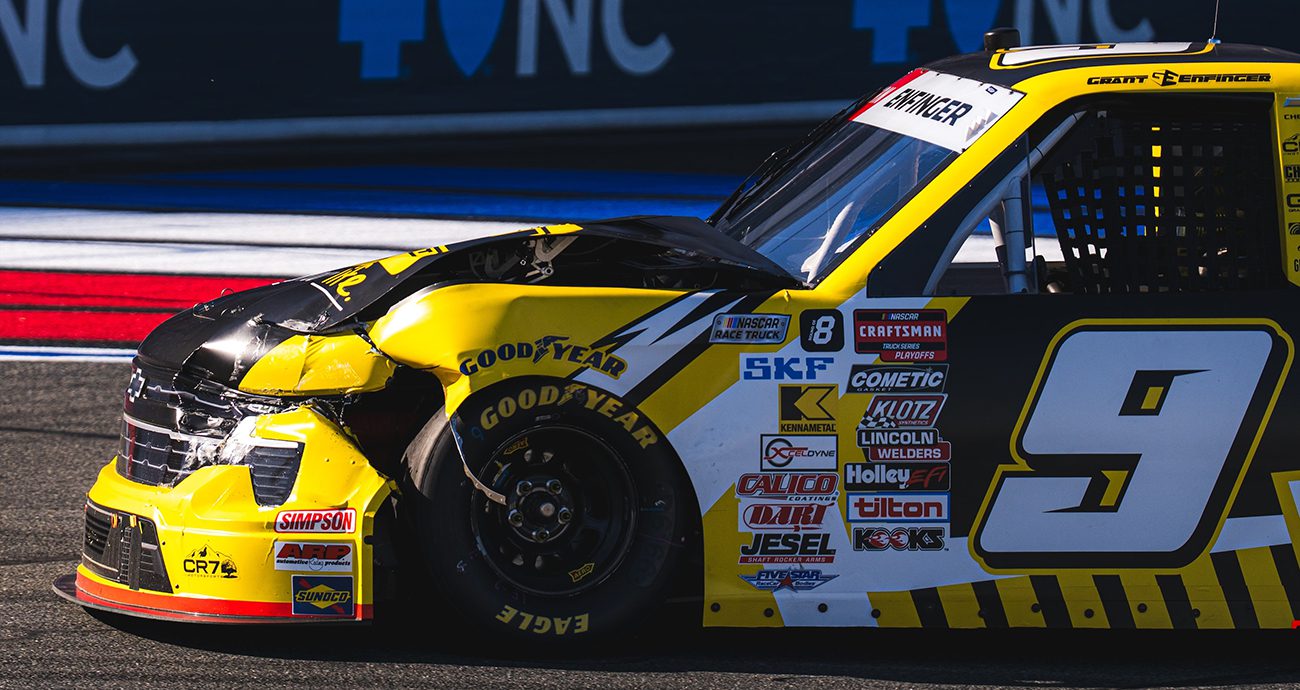
Enfinger explained his side of the opening lap, taking responsibility for the incident that caused notable damage to both the Nos. 11 and 34 trucks.
“I was trying to get clear into the second row bottom there,” Enfinger said. “I thought we were still driving into the corner and 100% cleaned out Layne and Corey. I apologize to those guys. Obviously, it wasn’t intentional. I looked like a fool doing that. I was still planning on driving in at least another car length or two and about the time I was turning down, Layne started checking up to hit the corner and I just smoked them.”
Alejandro Alvarez | NASCAR Digital Media
It wasn’t the only run-in Enfinger had with his fellow playoff contenders.
On the final lap, Enfinger contacted and the No. 52 Halmar Friesen Racing truck piloted by Kaden Honeycutt and sent him spinning. The two drivers were battling for a top-five finish when Enfinger dove his No. 9 CR7 Motorsports Chevrolet into the Turn 7 hairpin and turned Honeycutt around.
Honeycutt swept the first two stages, but the last-lap spin sent him down the results sheet to 14th.
After climbing out of his truck, Honeycutt made a beeline over to the No. 9 truck where he had a heated conversation with Enfinger.
“It is so hard to hold my tongue about this — I don’t understand why stuff like this happens,” Honeycutt said. “All year, we’ve ran good and just had no results. It is what it is, but thankfully we are only four (points) under, so it could be a whole lot worse.”
“He was upset. I got into him,” Enfinger said of Honeycutt confronting him. “I had a run on (Josh) Bilicki and made the move down there, and I was sliding in there, and Honeycutt was stopping kind of to get a good exit to the corner and I ran into him. It was my fault. It was 100% a racing incident. Those guys have run into me in the past. I ran into them. It definitely wasn’t intentional. I don’t blame him, but I think they’ll look back at it and realize I wasn’t just trying to be a clown. It just was a racing deal.”
Leaving the Roval, the playoff standings couldn’t be tighter.
Heim locked himself into the Championship 4 and is the only driver feeling safe. Tyler Ankrum now holds second in the standings and is just two points above the cutline, tied with McAnally-Hilgemann Racing teammate Daniel Hemric. Riggs is the first driver out of the provisional title round, just one point below Rajah Caruth at the cutline, while Enfinger and Honeycutt sit seventh and eighth both four points outside the Championship 4.
What’s on deck? A trip to the daunting Talladega Superspeedway on Oct. 17 (4 p.m. ET, FS1, NASCAR Racing Network, SiriusXM NASCAR Radio) where anything can happen and anyone can grab the checkered flag.
“Everybody at Front Row Motorsports, they deserve a lot better day than today,” Riggs said of his day after the Lap 1 incident. “I have a lot of choice words for how the initial start played out — really disappointed in the the amount of talent that that took.”
“Proud of the day and proud of the effort,” Enfinger said. “We had a little bit of pace. We don’t have contending pace at a road course yet and I’m not gonna be happy till we have that. But I feel like we finished where we should have, minus my screw up into Turn 1.”
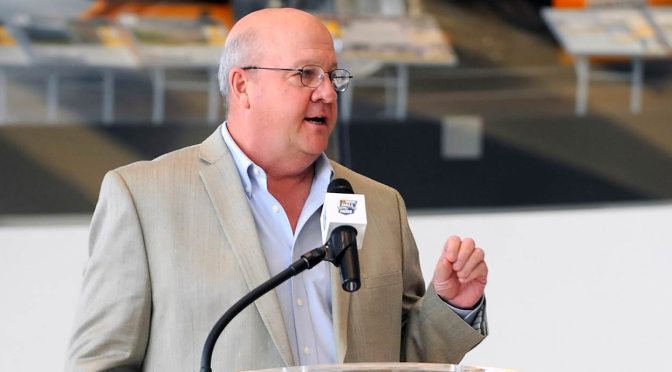
Grant Lynch, who guided Talladega Superspeedway for 26 years with an unwavering devotion to improving the fan experience, died Thursday morning. He was 71.
Lynch was president and later chairman of the 2.66-mile Alabama track until his retirement after the 2019 NASCAR season, which marked the facility’s 50th anniversary. He was honored the previous year with the Buddy Shuman Award, which recognizes individuals and organizations whose efforts and contributions have helped advance the sport of stock car racing.
Lynch, a South Dakota native, spent 10 years with R.J. Reynolds’ sports marketing group before coming to Talladega, first as its general manager before being named track president in the fall of 1993, succeeding current NASCAR executive Mike Helton. At his appointment, Lynch said his goal was to make Talladega “the most fan-friendly place on the circuit.” He was also a staunch advocate for the style of high-speed racing that the steeply banked trioval produces.
“Quite frankly, in my opinion, this is the most exciting race track in the world,” Lynch told the Associated Press in 1998. “You see guys here racing side by side, lap after lap. Nobody in the stands sits down.”
Lynch oversaw multiple projects to bring more modern touches to Talladega, the last of which was a $50 million transformation of the track’s infield in 2019. The first race for the track’s new amenities was also the 100th for the NASCAR Cup Series. Lynch served as grand marshal and gave the command to start engines.
“I’ll be going out in November, but I get to build one last big project for the Frances,” Lynch told NASCAR.com that year. “I got to build some others, but I’m looking forward to doing this as kind of my swan song. Then I’m going to go do what I want every day.”
NASCAR released an official statement Thursday afternoon: “Grant Lynch’s leadership, vision and larger-than-life personality helped make Talladega Superspeedway one of the most iconic and fan-friendly venues in all of motorsports. As the track’s longtime president and later chairman, he guided Talladega through more than two decades of growth and transformation while building lasting relationships with fans, competitors and colleagues across the industry. From his time with R.J. Reynolds, Talladega and even into retirement, Grant was not only a trusted leader but also a cherished friend to so many in the NASCAR family. NASCAR extends its heartfelt condolences to Grant’s family and loved ones during this difficult time.”
NASCAR’s playoff races at the Roval never end quietly — even when the checkered flag has signaled a relatively calm finish on the treacherous road course inside Charlotte Motor Speedway.
That was evident last year when the Round of 8 field seemed to have been set with 10 laps remaining when Tyler Reddick moved into the final spot. He eventually advanced by four points over Joey Logano.
More than two hours later, Alex Bowman’s car was disqualified, Logano’s championship bid was resuscitated, and Charlotte’s reputation as host of the annual cutoff cauldron of chaos remained secure.
Logano would win two of the next four races to wrap up his third Cup championship in the most extreme example yet of how the unpredictability of the Roval can reverberate through NASCAR’s premier series.
Sunday will mark the eighth consecutive year that the road course-speedway hybrid has held an elimination event, and at least one driver annually is singled out for a heart-pounding roller-coaster ride of agony or elation while teetering on the brink of advancement or oblivion.
The Roval’s inaugural race in 2018 set the tone with an unbelievably game-changing final lap.
Comfortably above the cutline by seven points and less than a quarter mile from transferring to the second round, Jimmie Johnson was charging toward his first victory of the season when he overdrove a corner in the frontstretch chicane and tangled with Martin Truex Jr. for the lead. Meanwhile, Kyle Larson, who had led a race-high 47 laps before destroying his front-end suspension in a massive crash, was driving a wounded No. 42 Chevrolet with the grace of Mr. Magoo. After being involved in the same wreck (and two earlier incidents), Aric Almirola was just as desperate with a damaged car.
After his spin, Johnson finished eighth and fell into a three-way tie with Almirola, who gained six positions in three laps, and Larson, who comically slammed into the frontstretch wall to make a left turn past the stalled car of Jeffrey Earnhardt and across the finish line to pick up the final point he needed to advance.
And thus began the Roval’s run as the playoffs’ primary change agent.
The track moved from Round of 16 cutoff race to Round of 12 finale the following year, but the bedlam never has subsided.
Chase Elliott wrecked on a restart while leading halfway through the 2019 race and still managed to win. (Teammate Alex Bowman, ailing from dehydration and illness, barely advanced by battling for second after falling to last on the first lap in a backup car.) In 2020, Kyle Busch’s two-championship run with crew chief Adam Stevens essentially ended with a 30th-place elimination.
In 2021, Larson flipped from seemingly out of the playoffs with a malfunctioning alternator in the first stage to leading the final eight laps after a remarkable recovery that was pivotal in his championship push. In 2022, he suffered a stunning elimination in his title defense after slapping the Turn 7 wall with 12 laps remaining and squandering an 18-point lead while fixing the damage.
In 2023, Brad Keselowski entered above the cutline and was eliminated after a horror show of a spin and a pass-through penalty for a missed chicane. Last October was Bowman’s turn to deal with a Roval heartbreak.
Every year, a playoff driver and team get put through the wringer at this unusual 17-turn, 2.28-mile layout that might have the highest degree of difficulty in NASCAR.
Who will face the Roval’s wrath this season?
Be prepared to stick around until after the finish to find out.
Before Jeff Gordon drove important laps in a NASCAR career that would lead to four Cup Series championships and 93 Cup victories, Charlotte Motor Speedway president Humpy Wheeler introduced the driver as “the finest young racing talent in the world today.”
Wheeler was better than most at evaluating racing talent. Gordon was better than most at using that talent. On the day that Wheeler escorted Gordon to a stage in front of curious NASCAR media, however, the driver looked more like a kid on the way to his junior prom than a wheelman who would race to international fame.
Connor Zilisch could play the young Jeff Gordon in a movie. Nineteen years old and as trim, clean-cut and well-spoken as Gordon back in the day, Zilisch would not need a stunt driver for the racing scenes. He will arrive full-time in the Cup Series next season with clear billing as the Next Big Thing, a highly skilled driver with unlimited potential and promise.
After somewhat of a tentative start this year, Zilisch has stormed through the Xfinity Series like a man aflame. Garage area observers were wide-eyed last season when Zilisch won his Xfinity Series debut at Watkins Glen International in the first of four get-acquainted races in NASCAR’s No. 2 series. Impressive, for sure, but there was little thought of what would follow this season.
Over the past 16 Xfinity races, Zilisch, driving for JR Motorsports while on loan from Trackhouse Racing, has won eight times, finished second four times and has finished in the top five in every race. It is not a stretch to claim that he could have won all 16 of those races.
Having proven the potential Trackhouse owner Justin Marks saw in him when he was signed as a developmental driver, Zilisch will be promoted to the Cup Series a year ahead of the original schedule. After a handful of Cup appearances this season, he is scheduled to run the full Cup tour in 2026, and it was announced Sept. 23 that veteran crew chief Randall Burnett, previously with Kyle Busch at Richard Childress Racing, will lead his team.
Of course, other young drivers have been labeled as solid prospects over the years. Some fall by the wayside; others don’t reach projected heights because of team or other issues; some win sporadically; others stumble out of the gate under the heat of expectations but eventually perform at high levels.
Meg Oliphant | Getty Images
Famously anointed by no less a personage than NASCAR Hall of Famer Mark Martin as a sure-fire talent and nicknamed Sliced Bread (as in “best thing since” by Randy LaJoie), Joey Logano arrived in the Cup Series as royalty-in-waiting. The going was slow, however, as he scored only three times across his first five seasons before winning five races in 2014 and a first Cup championship in 2018.
Zilisch, having paved the way with brilliance in Xfinity, has everyone’s attention. He will roll into 2026 with a winning team, deep sponsorship (including designation as a Red Bull athlete, putting him in strong international company) and experience with a top-flight Xfinity operation.
The world will be watching, and Zilisch, mature beyond his years and quietly confident in his experience and ability, seems ready. And he understands that there will be no slipping under the radar, no arriving in the dark of night at Daytona Beach in February wearing a disguise.
Earning garlands at the next level will be a tougher go, and the bright lights will be on.
“It’s tough to avoid it, especially in today’s age with social media and how often you see it and get tagged in it,” he said. “But, with that, I enjoy the pressure and wanting to live up to it and wanting to be one of the greats. My expectations are the same going into every weekend, regardless if I’ve won four in a row or if we’ve wrecked out of the last four.
“You have to use the momentum as confidence, and you have to build on that, but you can’t let it get to you and affect the way you’re preparing each week. So I tell myself every week not to let the outside noise affect what I’m doing, not to let it change the way I approach each weekend.”
His emotional balance at such a young age came from his parents (Jim and Janice Zilisch) and former driver and current racing consultant Josh Wise, who counts Zilisch among the clients he has helped move through the rapids that can slow advances at the top levels of automobile racing.
“Josh has been a big mentor of mine and has helped me with not setting expectations,” Zilisch said. “There are so many things in this sport that are not in the driver’s control, so you’re only a small part of the puzzle. If you don’t live up to expectations, maybe sometimes it’s not because you didn’t do your job.”
James Gilbert | Getty Images
If Zilisch could pick a turnaround moment this season, it came on April 26 at Talladega Speedway. A crash in the 11th race of the Xfinity season left him with several damaged back vertebrae and forced him to miss the following race at Texas Motor Speedway.
Zilisch sat in the team pit box during the Texas race and watched substitute driver Kyle Larson drive the Zilisch car to victory. Zilisch returned to the car for the next race at Charlotte Motor Speedway and hasn’t finished worse than fifth since.
“After I hurt myself at Talladega, the switch flipped and things have kind of just completely turned around,” he said. “Certainly, this year has been a lot of fun, but as we go into next year, it’s going to be a much different story.”
Zilisch crashed a few cars in the first half of the season, before and after winning March 1 at Circuit of The Americas in Austin, Texas.
“I hit enough people that I realized that something I was doing was not right,” he said. “I sit down with the people that I trust and I ask them, ‘Is this my fault?’ They’ll tell me yes or they’ll tell me no. I have to understand that some things aren’t teachable. You have to go out there and mess up to learn.
“I don’t think I’m going to learn much next year if I try to stay under the radar and just putt around. I want to go out and give it my all, knowing that every week is not going to be great. The goal is to give it 100 percent and try to compete for wins.”
Mardy Lindley, Zilisch’s crew chief at JRM, said the driver is a sponge. “He coaches himself,” Lindley said. “He looks at all the data. He can correct himself if he needs to, and he does it mostly on his own. We can see issues, but he sees them before we even have to say anything, which makes him really unique. He’s just a natural. He’s not just intelligent; he’s race-intelligent.
“We’ve had other guys do well in our cars, but they all had a lot more experience than Connor. You have to tell yourself to remember that he’s a rookie, and he’s got the attention of the NASCAR garage.”
Zilisch started racing go-karts at age 4. Four years later, the family went on the road in search of better competition and bigger events. “Being 8 years old and traveling for a sport, I just thought that was the coolest thing ever,” Zilisch said. “I’ve enjoyed it all from a young age. It’s what I’ve loved to do since before I can remember.”
The Zilisches met Kevin Harvick and his son, Keelan, along the go-kart trail, and Connor said Harvick was instrumental in moving him from karts to stock cars and into the Chevrolet fold. The wins kept coming, and Zilisch was carried along in a wave of successes. The standard life of a teenager was no more.
His “normal” education came through online classes. “I never stepped foot in a high school,” he said. “I know I’m never going to get to go to college. I never got to watch my friends play football on Friday nights. But there’s not much I would trade for the life I live now.”
For many, Zilisch wasn’t particularly a big news figure until he made headlines by falling off his race car while celebrating in Victory Lane Aug. 9 at Watkins Glen. He suffered a broken collarbone but won three straight races (at Daytona, with relief-driving help from Parker Kligerman, Portland and Gateway) after the fall.
Zilisch is an unusual name, both in NASCAR and in general. Connor is busy giving it wider exposure. He points out that there’s at least one other Connor Zilisch in the United States. “He’s a little older than me, and we’ve talked,” Zilisch said. “I’d like to get him to a race one day.”
Three of the Round of 8 playoff spots already are taken as the NASCAR Xfinity Series heads for Saturday’s Blue Cross NC 250 at the Charlotte Motor Speedway Roval (5 p.m. ET, The CW, PRN Radio, SiriusXM NASCAR Radio).
Brandon Jones advanced on the strength of his victory last Saturday at Kansas Speedway. JR Motorsports teammates Connor Zilisch and Justin Allgaier have already clinched Round of 8 berths on points.
Fourth-place Sam Mayer is 43 points above the current cutline entering the elimination race at the 2.28-mile road course, needing to score just 19 points to advance, no matter who wins the race.
Mayer has won the last two Xfinity Series events at the 17-turn circuit.
For the rest of the playoff field, however, the race for the final four spots in the next round couldn’t be much tighter.
Fifth-place Taylor Gray is 16 points above the elimination line. Twelfth-place Sammy Smith is just 14 points below. Accordingly, performance in Saturday’s race will be a primary governing factor in setting the field for the Round of 8.
Hoping to join teammates Zilisch and Allgaier in the next round, Smith comes to Charlotte with momentum from last weekend’s fourth-place run at Kansas Speedway.
“We ran a solid race all day long at Kansas last weekend, which was what we needed to put us back in the game and have a shot at advancing to the Round of 8,” said Smith, who has finished 11th and 10th in his two starts at the Roval.
“I have full faith that this Pilot Chevrolet team can accomplish just that. This has been our strongest season yet on road courses, so I’m looking forward to this Saturday at the Roval.”
Zilisch is the overwhelming favorite to win at the Charlotte Roval. Four of his rookie-record nine victories this season have come on tracks that feature right turns as well as lefts.
Editor’s note: Sunday’s NASCAR Cup Series race from the Charlotte Motor Speedway Roval is at 3 p.m. ET on USA Network.
The NASCAR Cup Series Playoffs’ Round of 12 has officially reached its elimination phase, with one race remaining before four more drivers are ousted from championship contention. And because of what’s on the line, we’ve seen time and again how those races dial up the intensity — and the desperation — leading to dramatic (if also chaotic) results.
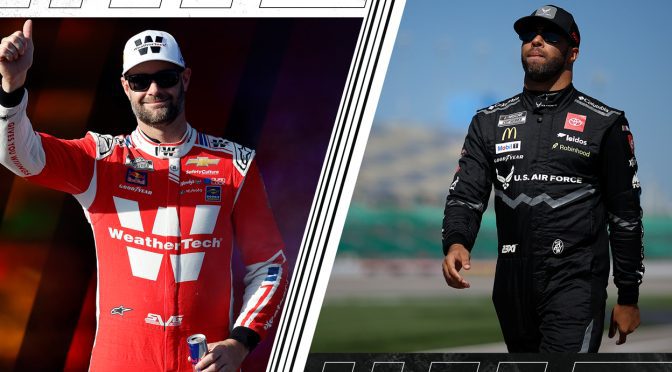
The interesting wrinkle this week at Charlotte, though, is the Roval factor — and what it means with Shane van Gisbergen poised to play spoiler to the playoff drivers who need a win.
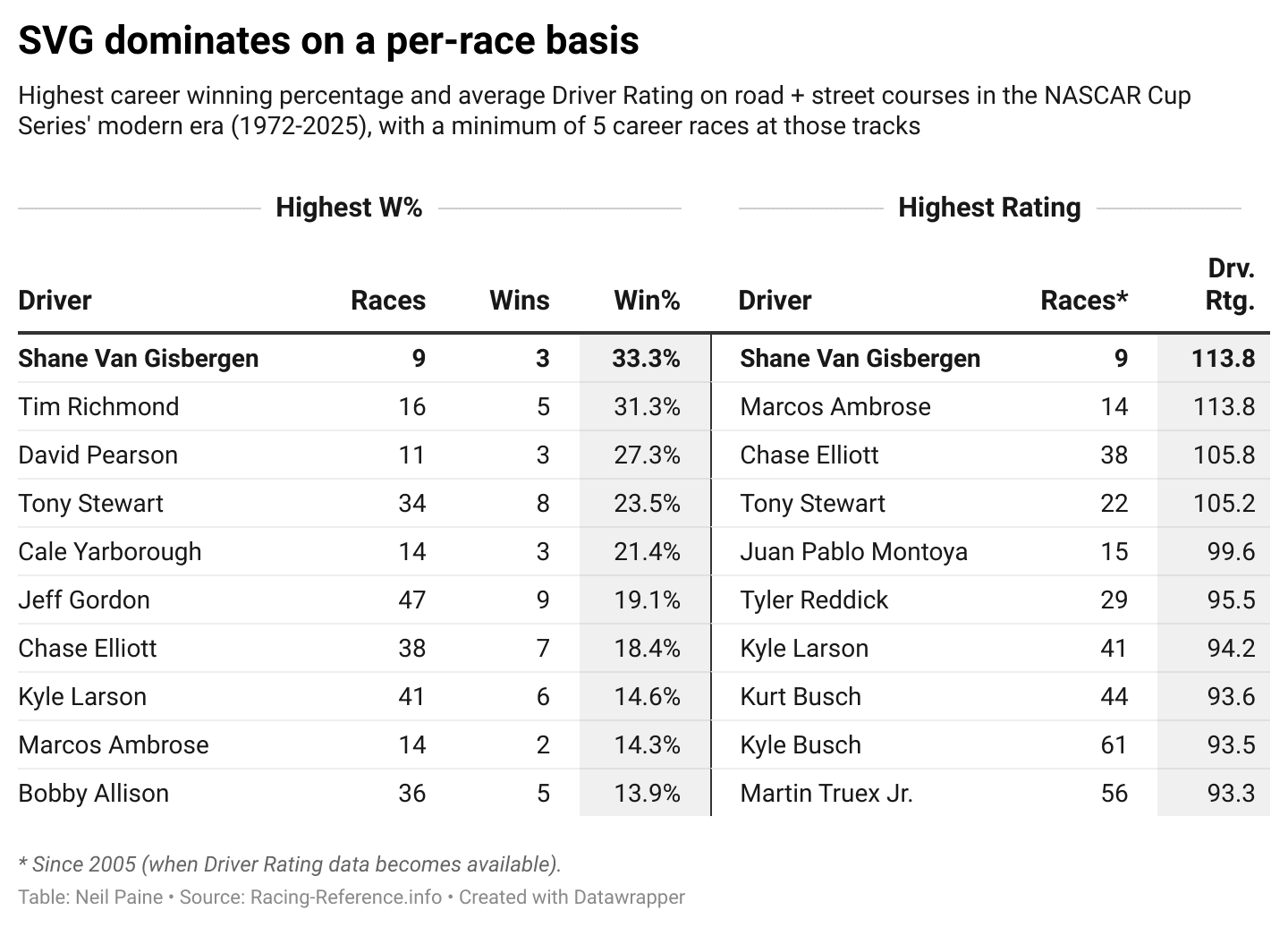
If SVG isn’t already the Cup Series’ GOAT road-course driver (and we made the case for him here), he’s darned close to it. Van Gisbergen has won each of the past four road races on the Cup schedule, and he’s finished no worse than seventh in a road race since Chicago in 2024. While he’s not an automatic win in these races, his career winning percentage on the road of 45% is still the highest in history. It’s terrifying to think of needing a head-to-head win over arguably history’s most dominant road-racing machine.
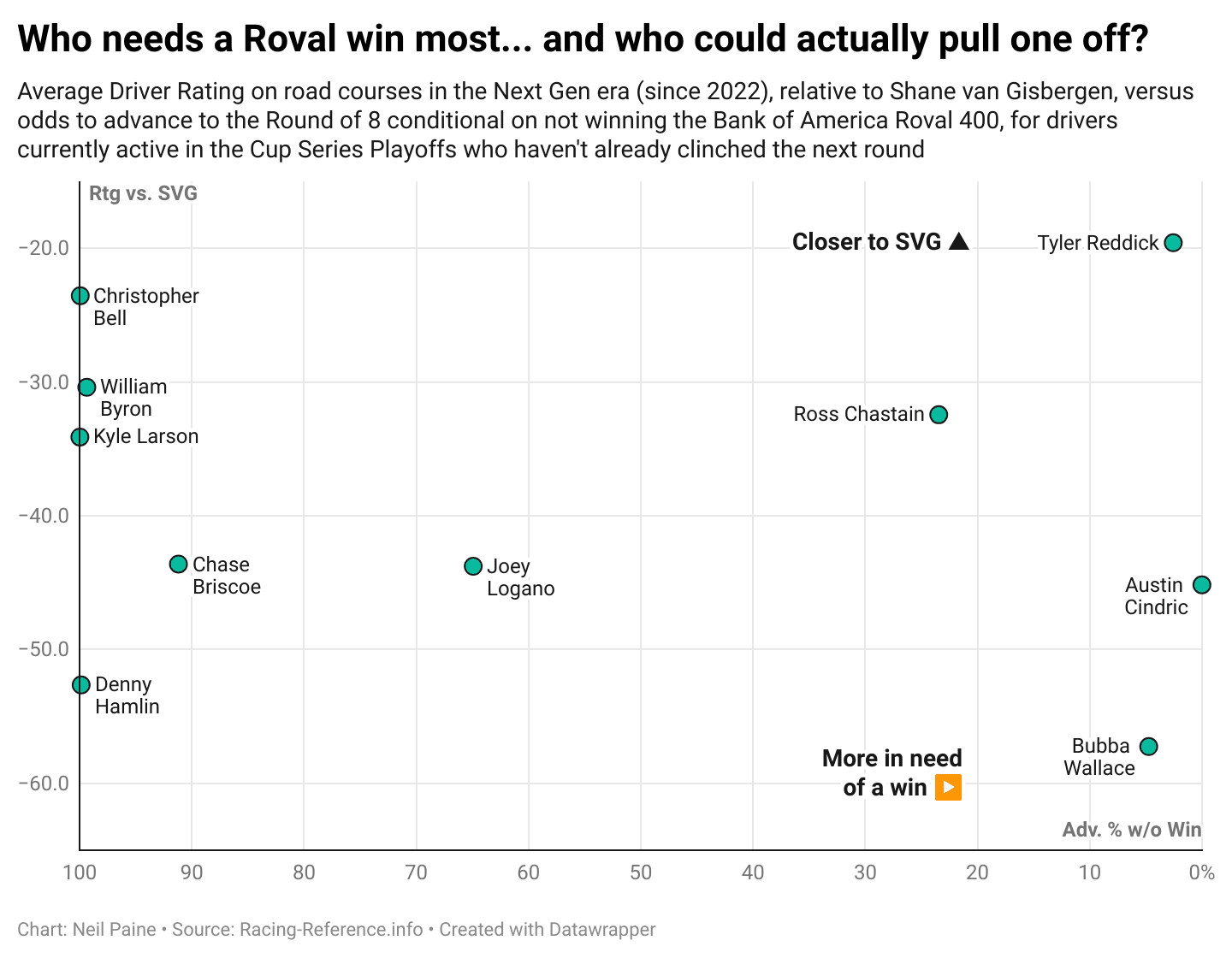
Needing a win, though, is exactly the situation a number of playoff drivers are in this week, knowing they probably can’t advance to the Round of 8 without driving to Victory Lane at the Roval. In fact, we can estimate just how much each driver is in “must-win” mode with our NASCAR Playoffs forecast model, which uses track-type projected Driver Ratings to simulate the remainder of the playoffs 10,000 times, tracking their odds to advance in only the simulations where they did not win at Charlotte.
Before we power-rank the playoff drivers based on how much they need to do the impossible — beat SVG at a road course-like track — here’s a plot of each driver’s advancement odds without a win versus their Next Gen career Driver Rating on road courses … relative to van Gisbergen. (Hint: Everyone is negative, it’s just a question of how much.)
(Note: Excluding Ryan Blaney and Chase Elliott, of course, since they don’t have to worry about clinching a spot in the Round of 8 anymore, having already won their way in.)
For each driver in the mix, let’s run down how much they need to take on the challenge of unseating SVG on Sunday, from the least in need of a victory to the most, listing their odds to make the Round of 8 conditional on not getting the win:
Locked in already
Chase Elliott (100%) and Ryan Blaney (100%) have already won races this round, enough said.
Will almost certainly make it either way
This group includes Kyle Larson (>99.9%), Christopher Bell (99.9%), Denny Hamlin (99.9%) and William Byron (99.4%), each of whom is at least 40 points clear of the cutline and carries at least a 99.4 percent chance to advance even without a win. These drivers aren’t technically assured of a spot in the Round of 8 yet, but they can be considered all but clinched unless they finish last, get no stage points and see multiple drivers who are currently below the line score max or near-max points. So for all intents and purposes, nobody in this group needs to focus on beating SVG to make the next round.
Solid chance to make it either way
Chase Briscoe (91.2%) will be one of the most interesting drivers to watch on Sunday in Charlotte as his +21 point margin to the cutline gives him a relatively safe outlook under most normal circumstances. When we consider Briscoe’s 102.9 average Driver Rating at road courses this season and his 9.4 average start in those races, he ought to be in line for some stage points, a decent finish and thus a ticket punched to the Round of 8. However, in the model, things do get somewhat scary for Briscoe if he lands outside the top 20, particularly if he finishes between 26th and 30th (63.6% advancement odds) or outside the top 30 (42.2%).
Under more must-win pressure — but still above 60% to advance even without a W — is Joey Logano (64.9%), who sits 13 points clear of Ross Chastain for the final spot in the Round of 8. A non-winning top-10 drive on Sunday would likely be enough unless one of the drivers below the line scores the win, and even then, he might still be OK depending on what Briscoe does. But a finish in the teens would start to put him in danger — and he could be in real trouble with anything lower than that, which is bad news given Joey’s good-not-great record (73.4 Driver Rating) on road courses. The head-to-head comparison of Logano versus Chastain is the highest-leverage battle of the day on Sunday.
Probably needs a win, but might be OK without one
If Logano is starting to feel like he needs a win, Ross Chastain (23.5%) knows he probably will need one if he wants to make it out of the Round of 12. The non-winning route is not completely improbable with a good run — a non-winning top five would bump Ross’ advancement percentage odds up to 61.0 — and Chastain is relatively strong on road courses (with a 91.8 Driver Rating the past two seasons). But he would also need help with the confluence of several other events to complete that comeback path, including poor days from either Logano or Briscoe (allowing him to gain ground in points) and someone below him in the playoff standings not winning. It’s a scenario that’s certainly possible, but also just convoluted enough that the most straightforward way for Ross to advance is probably just to get the checkered flag over SVG at the Roval.
Win or go home
This final tier belongs to Bubba Wallace (4.7%), Tyler Reddick (2.6%) and Austin Cindric (<0.1%), each of whom goes into the elimination race at least 26 points below the cutline and, if we’re being honest, probably needs a win to advance.
Wallace finished a hard-luck (putting it diplomatically) fifth at Kansas Speedway as a last-lap collision with team owner Denny Hamlin ruined what was set to be a winning run to clinch a trip to the Round of 8. Instead, Wallace now either needs a huge points day and a lot of luck — even a non-win top five would only set his advancement odds at 17.2% — or, more realistically, a victory despite his Next Gen road-course Driver Rating sitting the furthest below SVG of any active playoff driver. It doesn’t look good for the No. 23 car.
Nor do things seem much better for his teammate, Reddick, who is in an even worse version of Wallace’s situation on points. The only glimmer of hope for the No. 45 team is the fact that Reddick’s 100.2 average rating on road courses is the closest to van Gisbergen of any current Cup driver, making him the biggest threat to beat SVG outright and not have to worry about the points at all. It’s a Hail Mary at this point, but it’s not crazy to envision Reddick winning the race he started on pole in 2023 and has never finished worse than 12th.
And finally, there’s Cindric, the ultimate must-win driver at Charlotte this weekend. His 48-point deficit in the standings — with three drivers also wedged between him and Logano — effectively places him too far back to point his way in under nearly any circumstances. (Even with a second-place finish and two stage wins — worth 55 total points — he would need every playoff driver below Briscoe in the standings to finish 30th or worse with no stage points to be able to leapfrog them in points.)
So the main question is whether Cindric can outcompete SVG for the win on a road course … and the bad news there is that, despite his early-career reputation as a good road-racer (with a 93.2 rating in 2022), his form there has declined significantly in recent years. (He was a below-average 62.1 this season.) In their 11 career road-course races together, Cindric has only finished higher than SVG three times, and he’s only posted the higher Driver Rating once — though it was at last year’s Roval race.
————————-
Whatever happens from here, we know the Roval will claim four more playoff drivers on Sunday, one way or another. And for the drivers staring down elimination, the path forward is brutally simple: Find a way to take down SVG in his element — along with the rest of the field — or watch their title hopes come to a crashing halt at the Roval.
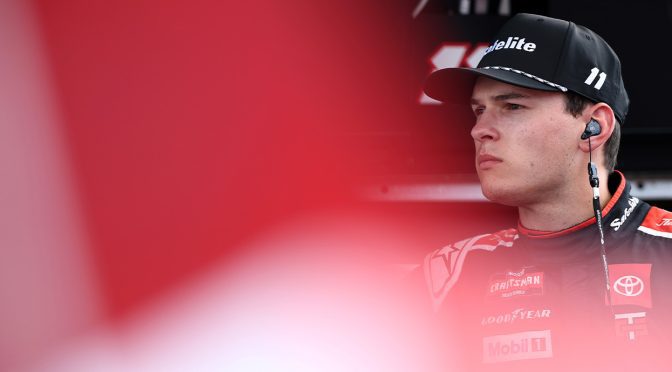
When looking back at the 2025 Craftsman Truck Series season in the future, it’ll be hard not to automatically think of 23-year-old Corey Heim and his No. 11 Tricon Garage Toyota team’s record-tying nine victories … and counting.
Two road-course wins stand among those nine, and as the series readies for its first trip to the Charlotte Motor Speedway Roval on Friday afternoon (3:30 p.m. ET, FS1, NASCAR Racing Network Radio, Sirius XM NASCAR Radio), a third is looking like a strong bet.
Heim wouldn’t necessarily say his road-racing prowess came naturally, but he instead credits studying the aces from other series and experience gained during his time in the ARCA Menards Series.
“I never really came from a road-course background,” Heim told NASCAR.com. “You see a lot of guys that are kind of dominating today in the Xfinity Series with (Connor) Zilisch and Cup with SVG (Shane van Gisbergen). Of course, those guys come from the road-course racing backgrounds, and I think just studying them and understanding what makes them so good on these … is kind of a big deal of where I sort of progressed a lot.
“I really started working hard on it when I first raced in ARCA, because of the few road-course races that we did within that full-time ARCA year for me. But prior to that, I think I had a couple Legends car races growing up on the road courses, and maybe a couple TA2 (Muscle Car) races to just kind of get my feet in the water.”
The aforementioned Zilisch is experiencing similar success to Heim in his first full-time season in the NASCAR Xfinity Series, with nine victories on the year, and he will race in the No. 7 Spire Motorsports Truck this weekend at the Charlotte Roval. Racing against Zilisch is a challenge Heim values.
“I’ve always been a believer in ‘if you want to be the best, you’ve got to beat the best,’ right?” Heim said. “So, Connor coming down is definitely a challenge. He ran well at Watkins Glen, especially for coming in last-second for Kaden (Honeycutt). I’m sure that was pretty tough to kind of prepare for. So, definitely going to probably have my hands full with him this weekend.”
In terms of progression at NASCAR’s national level, new to Heim in 2025 is his driver development deal with 23XI Racing. In addition to a part-time schedule in the No. 67 Toyota, the Marietta, Georgia, native has had access to the training facilities and competition meetings at “Airspeed” as Bubba Wallace and Tyler Reddick prepare for their own playoff push.
“It’s definitely been a difference-maker for me this year,” Heim said. “Just being able to work on the Cup side on a week-to-week basis, even the races that I haven’t been racing in the Cup car, I come to all the pre-race meetings and all the preparation. So to be a part of that and prepare like a Cup driver for the Truck Series, I think, makes a big difference. And I know I’m very lucky to be able to have that opportunity.”
The Craftsman Truck Series has the finish line in sight, with only the three-race Round of 8 remaining before the four drivers who will race for a championship at Phoenix Raceway are determined.
Heim is leaning on the veteran experience of his Tricon Garage group, a team that has mostly been together since Heim’s first full-time campaign back in 2023. The No. 11 Toyota team has competed at Phoenix in the Championship 4 for two consecutive years, carrying the determination to grasp the season-ending trophy that has eluded them.
“Those guys are all just so motivated,” Heim said. “I feel like it’s hard to come by, and especially a truck team, where the core guys have been there pretty much since the beginning of my tenure with Tricon. From spotter to crew chief to truck chief to the people in the fab shop, the people who make it happen back at the shop.
“I don’t feel like I’m still in the building phase with (crew chief) Scott (Zipadelli) and really the whole team, I feel like we all understand each other. We don’t have to stay on each other during the week to make sure the truck’s where it needs to be. Or he doesn’t have to stay on me to make sure I’m where I need to be for my preparation. It’s just everyone trusts each other and knows that we’re all motivated enough to go get it done. So they certainly make my life easy, and I hope it’s the same for them.”