Related: Meet Elliott’s spotter
Editor’s note: This is the second in a series of interviews with NASCAR Sprint Cup Series spotters.
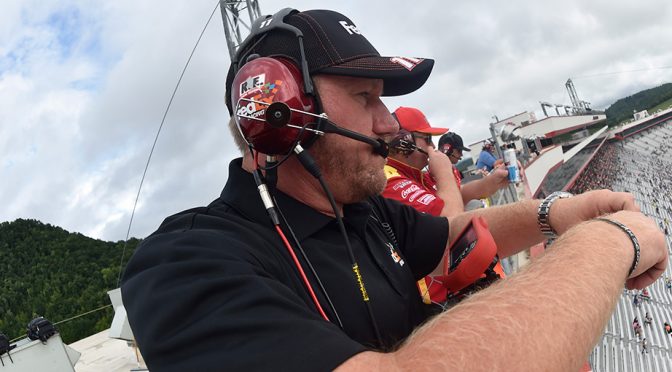
Chris Lambert, Spotter for Denny Hamlin, No. 11 Joe Gibbs Racing Toyota
HOW DID YOU GET STARTED SPOTTING?
“In 1996, I worked for Mike Herman Jr., who actually spots for (Ricky) Stenhouse Jr. now at the Sprint Cup level. We went to school together and he was racing Late Models around North and South Carolina, Virginia, Tennessee area. I worked for him fulltime in the shop, keeping up his cars. One night his cousin, who had done all the spotting, we ran on a Friday night, he coached high school football so he couldn’t be there. Me being a full-time employee, I basically got thrown into the fire. We won that night. I started spotting Late Models after that.”
WHAT OTHER DUTIES DO YOU HAVE WITH THE TEAM?
“Here at Gibbs I don’t do anything else but spot for Denny.”
DO YOU SPOT IN OTHER SERIES?
“I do Erik Jones in the XFINITY Series car, and Timothy Peters (Red Horse Racing) in the NASCAR Camping World Truck Series. I have a pretty full schedule, doing about 106-110 races a year. I do a lot of Modified stuff and ARCA stuff for Venturini Motorsports; I do the No. 25 car for them. I do the 24 Hour race at Daytona every year with Action Express Racing. I do the Snowball Derby. I stay busy. If somebody calls and wants me to come do something and it fits, this is how I make my living. There are a few of us fortunate enough to just spot. When I was at Red Bull Racing, I worked in the shop building cars and spotting. When I came to JGR, I just focused on spotting.”
HOW LONG HAVE YOU BEEN WITH DENNY?
“I started with Denny in 2012 so this is year five. It was Darian’s (Grubb, crew chief) first year. I’ve spotted for Erik this year; I did some with him last year because the 20 (XFINITY) car was split last year with him, Denny, Matt (Kenseth). I was doing Jason Leffler when the drove the 18 Truck for Kyle Busch Motorsports (in 2012). When they let him go mid-year, (Tony) Hirschman, who spots for Kyle now, went to do that. He was spotting for Timothy so basically we just swapped. I’ve been with him ever since.”
WHAT WAS YOUR FIRST RACE AS A SPOTTER?
“The first actual points race would have been at Chicago in ’07. I got out of the sport for a while full-time but got back in at the end of ’06, the start of ’07. I went to MB2 when (former owner) Bobby Ginn bought in to that deal. Doug Randolph hired me; I was doing all the races with Regan Smith, the XFINITY stuff. I was doing Kraig Kinser in the Trucks at Morgan-Dollar (Motorsports). Sometime around the end of June, first of July they let T.J. Majors, who was spotting for Sterling Marlin, go. I did Sterling’s stuff for two weeks — that’s when they shut down and had the merger with DEI and all of that. I did the 150s in ’07 at Daytona; we were trying to get Regan in the Daytona 500 in a fourth car for Ginn. It was a little different, just working with Slugger (Labbe), who was the crew chief at the time, and Sterling. Here it was my first race. What do you tell Sterling? A lot of good stories there. …
“That year I went to Daytona for testing and I was like a deer in the headlights. I had never done a plate race. I’d done a few mile-and-a-halves, some ARCA stuff, but I was just in awe of what you had to do in a plate race.”
WHAT’S THE MOST BIZARRE THING YOU’VE SEEN WHILE SPOTTING?
“On track or off? Honestly, probably the truck that caught fire in the parking lot at Kentucky earlier this year. We see the smoke but we’re under green, so we can’t do anything. When the caution comes out we all make a beeline over there to see what it is and you see a truck with a grille in the back and the truck is just engulfed. There was a fire either at Kansas or Chicago one year down in Turn 1, the grass had caught fire. And you obviously see a few things with people in the crowd that are feeling pretty good about themselves. The tops come off and stuff like that. But the truck fire at Kentucky? Even the guys in the cars were commenting on it, they could see the smoke.”
WATCH: Truck fire behind track at Kentucky
WHAT’S BEEN YOUR MOST MEMORABLE EXPERIENCE AS A SPOTTER?
“Definitely the (Daytona) 500 this year. Being born in Kannapolis, right in the heart of Earnhardt country, stock car country. I was at the race track when I was three months old. My mom passed away, she had cancer, when I was three so I lived with my aunt for a while. I was in and out with my grandfather and my aunt. Her son raced dirt cars so I was at the shop all the time. To grow up in the heart of the sport, to know Dale Jr. and Dale Sr., winning the 500, on a professional level, was the top.
“First getting with Denny, getting with a top-tier driver and having success right out of the box with him. When you get in this sport, you obviously want to win a championship but there are certain races you want to win. The All-Star race, which we won last year, Daytona, Indy. Having that 500 ring and trophy at the house (is special). Especially if you’re a spotter because you feel like you have more involvement in the plate races. We’re never driving the race cars obviously, but you feel like you have your hand on the cars. … Winning a plate race is fulfilling itself, but winning the 500 and the way we did it … outside of getting married and having my two boys, it was probably my most memorable day in my entire life. You have little things you go through, you strive for … to know you’ve just won the biggest race in your industry and to know you had a hand in it, it was pure elation. … Once everything settled down and he got into Victory Lane, I just took my radios off and just sat there for a minute taking it all in. It was like ‘wow.’ As a Cannon Mills lint head from Kannapolis, that’s just won the biggest race in our sport … I look at the ring now and all that and tears still well up. It’s just ‘wow, it really happened.’ “
WHAT’S THE MOST DIFFICULT PART OF YOUR JOB?
“The long days. Not really for the race itself. Just the practice days on Friday and Saturday, doing all the series. There are certain times, at Richmond for instance on Friday when they’d run XFINITY and (Sprint) Cup. You get up there at 8 in the morning and you won’t get a break until 4 in the afternoon. Even though we’re just standing around or sitting around, you’re in the sun, you’re in the elements; it’s hot. And a lot of us don’t just spot anymore. I’m up there with a stop watch and I’ll do split times. I’ll pick a spot on entry to Turn 1 to the center and get a split time, then center out. So I’m always working, trying to figure out who is fast, where we might be getting beat. … So I’m constantly working, doing something whether it’s watching cars and their lines or whatever. Then you do qualifying and then the race at night. So it’s long days, no shade, a lot of times we have to go down two or three flights of stairs just to go to the bathroom.
“And during the race there is so much going on in our headsets, listening to NASCAR, having a second radio, scanning myself to make sure that I’m transmitting correctly and I don’t have a problem. Having that much going on and having to concentrate on what I’m doing. There will be times when Wheels (crew chief Mike Wheeler) will be talking to me on Channel 2, I’m spotting and we’re in the middle of three wide and he’s telling me something. As soon as I get Denny cleared, I’m ’10-4, I heard you.’ It might be a lap later but just trying to keep up with everything that’s going on.
“When I first started, I never listened to myself. They said ‘hey, you really need to do that. That way you’ll know if you have a radio issue.’ I hated it. I would just turn it down very faint. Now, I don’t know that I could go do a race without scanning myself.”
WHAT CURRENT DRIVER WOULD MAKE A GOOD SPOTTER?
“Honestly, I don’t know. Every time I think of somebody, I remember a comment that they made where they’ve been on the spotters’ stand and either tried it, whether it was Jimmie (Johnson) spotting for his brother in an off-road race or something, Denny spotting for Jordan in the Better Half Dash … when I worked for Brian Vickers at Red Bull and he was out the first time for (health problems), I had Casey Mears and Reed Sorenson in the car. BV came up to the roof with me a lot of times. I always think it’s great for them to come see my vantage point. See what I see, especially under racing conditions with binoculars and everything else. Then you’ll get a better idea of why when you know you’re clear by a foot and I’m still saying ‘inside;’ you’re going away from me and the angle is bad. And I’m going to be sure you’re clear before I clear you.
“Probably somebody like Matt (Kenseth) would be good. I did a handful of XFINITY Series races with Matt and then he talked me into going to Chicago last year for the stand-alone race when Ross (Kenseth) ran the 20 car. … I know he’s spotted for Ross some in the Late Model car. Somebody like him; David Ragan probably has experience doing short track stuff.”
WHICH TRACK IS YOUR FAVORITE?
“Darlington, just because of the history. That’s another race that’s on my bucket list that I want to win. And any track that I can sleep in my own bed is great. The plate races — I used to hate them when I started because I didn’t feel like was giving the driver everything that he needed. Now that I come here with Denny and we’ve had so much success in the plate races. Whether it’s me, the car or the way you have to race those races now, I really enjoy feeling like I’m that involved and that on top of things. Daytona obviously is the pinnacle of our sport so that’s one, but Darlington is by far my favorite.”
WHAT IS ONE THING ABOUT WHAT YOUR JOB ENTAILS THAT THE AVERAGE FAN MIGHT NOT KNOW?
“Just how involved we are now. I think the TV, the media exposure over the years has brought it to light some. When I tell people that don’t know anything about the sport what I do, that I’m in the driver’s ear, getting him through wrecks and all that, they think it’s pretty cool. It used to be that you just threw a body up there, and it would be the last person on the team that wasn’t doing anything. They’d just throw them up there to make sure somebody was there. But with the full-containment seats and headrests, their peripheral vision is next to nothing. When we ran the cars jacked up in the rear, they couldn’t see out of the back. So we’re really their second set of eyes, know what’s going on and see everything that’s around them.
“It used to be that we just showed up and if we could get them through the wrecks then we were fine. But then it got to the point where if you weren’t giving them a competitive advantage, you weren’t going to have a job. … If I’m not feeding him information about what I see when guys pick up time or whatever, then he’s not going to keep me around.
“Ultimately our job is still, at the end of the day, to make sure the car rolls on the hauler in one piece and our driver is safe. That’s our main goal. But if you’re not giving them what they feel like is a competitive advantage, you’re not going to have a job here.”