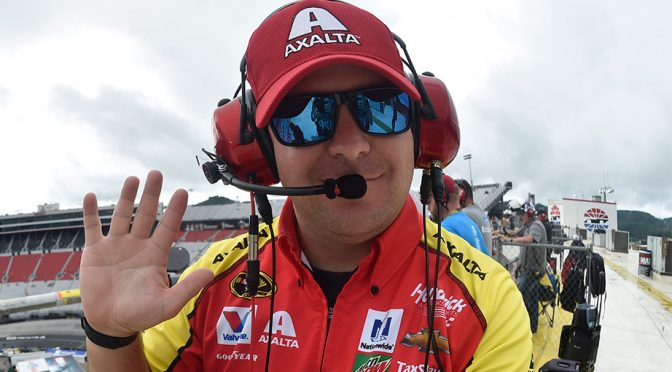
Editor’s note: Above photo of T.J. Majors courtesy of Nigel Kinrade.
T.J. Majors and Kevin Hamlin walk from the garage to the spotters’ stand at Michigan International Speedway this summer. As they approach the tunnel that goes under the track, a 20-something man shouts “T.J.!” and asks for his autograph. Majors — arguably NASCAR’s most well-known spotter, given that he works for Dale Earnhardt Jr. — hands what he is carrying to Hamlin (Kasey Kahne‘s spotter) and calls him his secretary, which draws a laughing rebuke of, “Shut up.”
Now Majors steps off an elevator into a lobby above the track’s grandstands and sees fellow spotters sitting on couches and on the floor. He greets them by pointing down the line, “He’s cool, he’s not cool, he’s cool …”
The atmosphere among the two dozen or so spotters gathered in the lobby before a Saturday NASCAR Sprint Cup Series practice is like the locker room in a stick-and-ball sport, only thank heavens everybody remains fully clothed the entire time. You can tell how much these guys like each other by how terribly they treat each other.
The spotter community is not for the thin of skin or the faint of heart. If you see a snake at your feet, it’s probably rubber, and Majors probably threw it there. If the skin around your eyes feel funny, check your binoculars for shoe polish. If you don’t walk by and turn the volume on somebody’s radio way up at least once in your spotting career, you’re doing it wrong.
As the banter continues, Tab Boyd, Joey Logano‘s spotter, leans over and says, “This is all off the record,” which in a journalistic sense is not true because this is a public place. But it doesn’t matter anyway, because little of what transpires is repeatable in a “you would not say that in front of your mom” sense.
Even non-spotters get in on the fun. Sammie Lukaskiewicz, the vice president for marketing and communications at MIS, was at the race at Auto Club Speedway earlier in the season when she heard Majors say he couldn’t see over the rail on the spotter stand at MIS. Another spotter cracked that the vertically challenged Majors needed a cinder block to stand on. The next race at Michigan, Majors arrived on the spotters’ stand to discover Lukaskiewicz had gotten a cinder block, painted it Nationwide blue for Earnhardt Jr.’s sponsor and written Majors’ Twitter handle on it (@Tjmajors).
As much fun as spotters have at each other’s expense, it was how the spotter community reacted in one of its darkest times that revealed the most about its members.
Last December, Chris Osborne (Matt Kenseth‘s spotter), his wife and their son were in a car accident. Though he was badly injured, Osborne started making phone calls while he was still at the scene. The third one he placed was to Chris Lambert, a fellow spotter at Joe Gibbs Racing.
RELATED: Osborne returns to spotters’ stand | Kenseth’s spotter gives update on family’s health
Lambert (Denny Hamlin‘s spotter), Mike Herman Jr. (Ricky Stenhouse Jr.) and Rick Carelli (Kurt Busch) were at the hospital before Osborne went into surgery. They were still there when he got out seven hours later.
More spotters arrived after Osborne’s surgery ended. None of this surprised him, because they are all good friends of his. What surprised him, though, was that the spotters (along with other members of the NASCAR community) stayed for so long and kept coming back. In the weeks and months that followed, they brought so much food to his house that his family had to draw up a schedule to make sure none of it went to waste.
After he recovered, Osborne (whom spotters call by the nickname “Crazy”) returned to the track for the first time at Martinsville Speedway. Lambert, Herman and Carelli — the same three spotters who arrived first at the hospital — helped him lug his gear across the track and ascend the stairs to the spotters’ stand 115 feet above the track.
RELATED: Get to know Chris Lambert, Hamlin’s spotter
From there, Osborne could see a yellow banner on the windshield of Kenseth’s hauler welcoming him back. Carelli — who spent more than 10 days in the hospital after a wreck when he raced in the Camping World Truck Series in 1999 — created another banner, had all the spotters sign it and draped it over the spotters’ stand.
After the weekend ended, Osborne took Carelli’s banner home and hung it in his garage. He sees it every time he comes and goes, a constant reminder of how his spotter family loved him when he needed it most.
• • •
There is no community in sports quite like NASCAR’s spotter community. Forty of them stand elbow to elbow for dozens of races every year. They laugh together, tease together and compete together. From their perch above the track, they share triumphs and temper tantrums, wrecks and restarts, heat and heights. They want to beat each other, of course, and they are all looking for every edge they can get. But when the race is over, and one of them has won, his phone will blow up with congratulations.
Spotters have been a crucial part of each NASCAR team since the sanctioning body mandated them about 25 years ago, but as the sport has become more competitive, spotting has grown in importance. While spotters’ most important task remains to make the sport safer, they have increasingly become an integral part of the competition. Whichever driver wins the championship this year will do so because a spotter helped guide him there — by telling him how to avoid wrecks, by helping him find faster lines, by being eyes in the back of his head — and so much more.
The first known example of a driver using a radio in a NASCAR race came in 1952, and drivers in the decades afterward sometimes stashed crew members around the track with radios to give them insight as to what was happening around them. Eddie Jones, a crew member for Junior Johnson and Associates, dressed like a fan and sat in the stands with a two-way radio to help Darrell Waltrip win a championship in the early 1980s. If that wasn’t exactly cheating, it was at the very least doing something secretive to gain an advantage over the competition.
Spotters have since become such an indispensable safety tool that they are one of only three people required to be present during every lap of every race, along with the driver and crew chief. But safety is far from the only role. A spotter aggregates, analyzes, edits and delivers information. He is a backseat driver, a negotiator, a weatherman, a cheerleader, a psychologist, a whipping boy and a confidant.
It takes a unique set of personality traits to be able to fill all those roles. NASCAR.com analyzed the backgrounds of 25 spotters and found they share much in common. All are men. Fifteen of them have experience of their own racing. Most spot for drivers in other series, too. Their voices are more recognizable than their faces, but Twitter has made some of them quasi-NASCAR celebrities.
None of them grew up aspiring to be a spotter. Their origin stories follow a similar pattern: They had some other job in racing, somebody needed a fill-in spotter, and that eventually became a regular gig. Roughly half of spotters say spotting is their full-time job.
RELATED: Meet Eddie D’Hondt, Elliott’s spotter
The spotters who have “other” jobs work mostly in racing. The clear trend, though, is that spotting is becoming a full-time job that involves much more than a few hours atop the roof on Friday, Saturday and Sunday. “I laugh at that question as if there’s any time to have another ‘day job,’ ” says Eddie D’Hondt, who in his 16 years as spotter worked with Bill Elliott, Kyle Busch and Jeff Gordon. He is the voice in Chase Elliott‘s ear now. “My job as a spotter at Hendrick Motorsports is a 5 1/2 day-a-week job and has been for more than a few years now.”
Film study and meetings fill up D’Hondt’s time before he gets to the race track. “Leaves little to no time for anything but reloading your suitcase and mowing the lawn.”
• • •
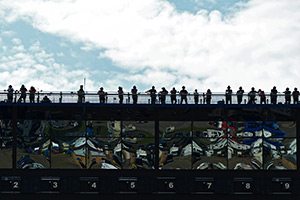
The spotters file out of the elevator lobby at MIS and walk up a flight of stairs to the spotters’ stand. It is a strange working environment — a walkway 5 feet wide and 200 feet long and sits 140 feet above the frontstretch. (Those measurements come courtesy of Lukaskiewicz and apply only to Michigan; they vary from track to track.)
A metal railing keeps the spotters from tumbling over the side and into the grandstands. Along the rail are 40 pieces of tape. They are alternatively white, blue, green, red and yellow, and they serve like sticky nameplates and notebooks. They are covered with car numbers, the number of laps and miles in the race, pit road speed, pit road maps, the weekend’s schedule, even artwork. Logano’s Boyd is a doodler. At Michigan, he sketched a checkered flag and a fish skeleton smoking a cigarette.
Brandon Benesch’s tape contains the most information. He is the spotter for Danica Patrick, and for each turn of the track, he writes Patrick’s speeds on entry, in the center of the corner and on exit. Then he writes the corresponding speeds of other drivers, because Patrick likes to know where she is losing or gaining ground.
That’s far more information than most drivers want. Even though Patrick likes a lot of information, Benesch still has to decide what to tell her and what not to tell her. He learned the hard way that sometimes less is more. A few years ago at Martinsville, with about eight laps to go, another driver told his spotter to tell Benesch that it looked like Patrick had a left-rear tire going down. The spotter told Benesch, and Benesch relayed that to Patrick — which he regrets doing.
Benesch planted in Patrick’s head the idea that she had a problem. She lost four positions as she attempted to determine whether the information was true. It wasn’t, and Benesch wonders if the whole thing was a ploy by the other driver to try to get Patrick’s spot … although that gives the other driver credit for prophet-level foresight that he (probably) doesn’t actually have.
• • •
Counterintuitive truths gleaned from the spotters’ stand and hours of interviews with the men up there: Spotters watch other cars more than they watch their own. Road courses are easier to spot at because spotters can only see a fraction of the track and aren’t responsible for the rest. The fastest driver is the easiest to spot for, because the only place to look is ahead. One spotter joked that Earl Barban, spotter for six-time champion Jimmie Johnson, shouldn’t be paid because all he ever has to do is say, “clear,” as Johnson zooms by somebody.
While spotting at a restrictor-plate race is mentally exhausting because the cars run so close together for so long, some spotters say it’s actually easier because problems develop slowly — they can see wrecks start to happen before they actually happen. Some spotters consider Bristol and Dover to be the most difficult tracks to spot at because crashes happen quickly. A wreck is avoidable but only if the spotter sees it immediately and gives accurate directions.
A fierce rainstorm sweeps over MIS, sending spotters scurrying back to the lobby and cutting Sprint Cup practice short. Some spotters leave for the day, but most remain because the Camping World Truck Series race is next, and they spot in that series, too.
As they walk back up the stairs for parade laps before the race, each carries four radios — a primary radio, a radio that plays their own voice back to them so they know the primary is working, a radio to talk to the crew chief without the driver hearing, and a radio to hear NASCAR decisions.
From up there, spotters can see for miles in any direction. The grandstand is easily the tallest building in sight. The sleepy, sloping Irish Hills that surround MIS offer an idyllic contrast to the sheet metal mayhem below.
It’s almost startling how far away the backstretch is. The distance from the middle of the spotter stand to the center of the backstretch is 2,400 feet — and that’s not even the farthest among tracks. Nobody else in the sports world is intimately involved in the outcome and simultaneously so far from the action. With the naked eye, it’s impossible to read car numbers or identify sponsors. Only the colors of cars make it possible to distinguish one from the other. Binoculars are a must-have — and so is up-to-date sponsor information.
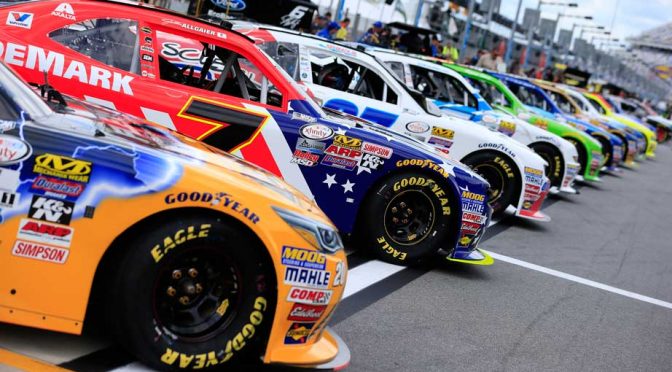
Fifteen years ago, most cars had the same paint schemes for the entire season. Now they change constantly, and it’s important for spotters to keep up, not just so they can find their own drivers but so they know who their driver is racing against.
Tony Stewart, Kevin Harvick and Danica Patrick had identical paint schemes this year at Pocono, which made keeping track of them difficult, especially considering the spotter’s stand is 2,925 feet — more than half a mile — from the track at its farthest point.
Night races compound the problem. Majors said he once lost his car in the Rolex 24 sports-car race at Daytona. Joey Meier, Brad Keselowski‘s spotter, walks around the garage every Friday morning to verify what sponsor each driver’s car has, including his own, and he does that in part because of what happened during a NASCAR XFINITY Series practice years ago.
As cars hit the track, Meier waited and waited and waited for his car to appear. It never did … or so he thought. After a wreck, the cars stopped on the frontstretch. Meier looked down and saw a car with his number but a different sponsor and paint scheme.
“Hey, did we get a new sponsor?” Meier asked over the radio.
“Oh, I guess I should have told you that,” the crew chief replied.
Meier’s car had been on the track the whole time, only he didn’t know it.
• • •
Everything happens at hyper speed in NASCAR, even conversations. Radio conversations between spotters and drivers are a fascinating two-step of safety and speed, competition and cooperation, information and invective, where the smallest slip (or delay) of the tongue can be the difference between winning and losing. To be a great spotter requires a precise combination of timing, language and inflection, of knowing not just when to say something but how, when and whether to say it.
Spotters use a shorthand vernacular that makes sense if you already speak NASCAR. But if you don’t, a spotter’s conversation with a driver sounds like gibberish. “Check up,” for example, means slow down or stop, but only in NASCAR.
Radio chatter gets even harder to understand when drivers and spotters create their own mini-vocabularies. When Osborne worked at the Talladega spotters’ stand — 130 feet high, 12 feet wide, 30 feet long and 3,000 feet from the backstretch — he will watch Kenseth’s car, the cars in front of Kenseth’s car and the cars behind Kenseth’s car, all at once, for 500 miles, which is draining enough on its own. On top of that, Osborne needs to talk for 80 to 90 percent of the time. Osborne must balance the need for precision with the need for brevity, and the two often conflict.
For example, when Kenseth is in a pack of cars, he can’t see past the car in front of him. But he wants to know how close the second car ahead of him is to the car immediately ahead of him. That information allows Kenseth to decide how much throttle and brake he needs.
Think about that for a second. Think about how complicated that is, and the fact it is happening at 200 miles per hour and that Osborne will often be more than half a mile away while the conversation is going on. A full explanation would go like this. “Hey, Matt, the car two ahead of you is ahead of the car immediately in front of you by approximately a quarter of a car-length.”
But it would take Osborne so long to say it that way that by the time he got done saying it, it would no longer be true. Instead, he sums up that incredibly complex situation in simple words: “Tight” means there is no space between the two cars, “quarter,” means there is one-fourth of a car length between them, “half,” means half, etc.
If the verbiage sounds like gibberish to an outsider, sometimes it does to an insider, too. Mike Calinoff spotted for Dale Earnhardt Jr.’s first Cup race (Coke 600, 1999). Calinoff was a late replacement, and he says Dale Earnhardt Sr., who owned Junior’s Dale Earnhardt Inc. team, gave him succinct instructions: “Don’t wreck.” The first conversation Calinoff and Junior ever had was brief and took place moments before the race started.
They had to learn to work together on the fly. At the first caution, Calinoff keyed his microphone to ask Junior for feedback on the information he was giving. Too much? Not enough? Junior told Calinoff that he seemed to be doing fine … but Junior, a North Carolina native, also said he was having a hard time understanding Calinoff because Calinoff, a New Yorker, spoke “Yankee.”
Sometimes the conversation on the radio sounds like gibberish because it is, in point of fact, gibberish. Sometimes conversations take place in code so as not to give away strategic decisions. (NASCAR has rules against eavesdropping, which team members only break if they are by themselves or with somebody.)
Before every race, Brad Keselowski‘s No. 2 team randomly generates its code words based on either beer products or playing cards. The team changes the code every week so that even if other teams decipher their clandestine calls, that information is useless the following week. The code words are taped to Keselowski’s steering wheel, but not until he gets buckled into the car, so nobody can peek in during pre-race festivities. Even Meier doesn’t find out what the code words are until someone uses one.
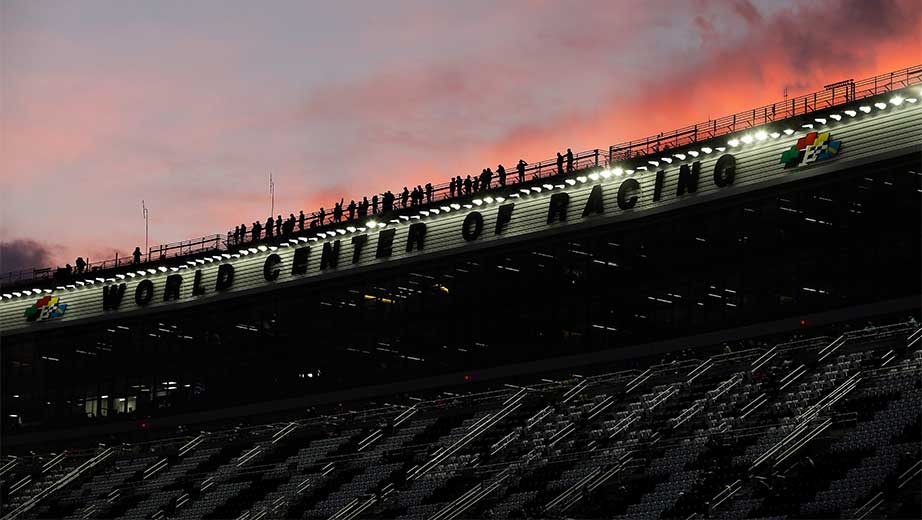
Here’s something else the spotters love … the view.
• • •
As the trucks pull onto the track at Michigan for the race, the banter among spotters stops. It’s time for them to pay attention, and it’s almost impossible to hear, anyway.
Each spotter stands in the same place each time he goes to a particular track, an informal seating assignment based on seniority. They stand in the same place for multiple reasons. One is that having the same vantage point helps them be consistent. Another is that because they’ve all been doing this for so long, each knows where every other spotter is. So if Majors needs to relay a message to Meier, he doesn’t have to waste time looking for him.
Which is not to say those messages always get relayed.
“Any time a guy says, ‘Go tell that guy I’m going to wreck him,’ maybe 20 percent of the time, you do,” Majors says. “In our world, up there, don’t talk about it. If you’re going to do it, do it. Because if you’re saying it, you’re probably not going to do it.”
There are other reasons spotters don’t pass on such threats. Safety, for one. A spotter walking across the spotters’ stand to yell at another spotter can’t simultaneously watch the race. And discerning spotters know their drivers only kind of mean it, anyway. So much happens in every race that most anger dissipates within a few laps .. even if it is replaced by anger at somebody else.
One spotter hit on what seems like an ingenious, if less than totally honest, solution. After being told, “Go tell that guy’s spotter that he’s in trouble,” he waited a minute or so. Then he keyed the mic, said the message had been delivered and that the offending driver had apologized. But he never delivered the message and therefore never received an apology. But relaying the fake apology calmed his driver down, so that justified a little white lie.
According to the spotter, at least.
• • •
Calinoff, who spotted at the Cup level from the late 1990s through the 2013 season, was one of the NASCAR’s first celebrity spotters. He turned his fame from winning the Sprint Cup in 2003 and two Daytona 500s with Matt Kenseth into speaking appearances and TV and radio gigs, and he used it to help fuel his PR and social media business, which he has owned since 2005.
“I always say I was the luckiest guy on the roof,” he says. “I have a great relationship with the driver and with the team and the team owner. It was fun.”
Calinoff returned to the spotters’ stand this summer with Kenseth in the Slinger Speedway Nationals in Wisconsin, one of the premier late model races in the Midwest. He decided that morning it would be the last race he ever spotted. The duo won the race, and Kenseth gave Calinoff the trophy. That prompted Calinoff to write an utterly charming column at PopularSpeed.com (which Calinoff owns) about working with Kenseth.
He wrote that he could count his close friends on five fingers, and Kenseth is one of them … the one right in the middle. “He sent me a text after that of laughing with the tears emoji … and the gesture associated with the reference,” Calinoff says.
There aren’t a lot of spotters who could publicly tease their driver like that. Relationships as close as the one between Calinoff and Kenseth are uncommon. And there is no doubt that their friendship helped them succeed over the seasons they raced together at Roush Fenway Racing.
As a writer and owner of PopularSpeed.com, Calinoff decides which stories to tell and how to tell them, and in a way, he did the same thing as a spotter. Once at Richmond, Ryan Newman‘s spotter tapped Calinoff on the shoulder, expressed Newman’s displeasure at Kenseth for some incidental contact and asked Calinoff to relay that message. “I gave him the thumbs up. No problem, bud, I’ll tell him right now. I’d make-believe I’m pushing that button. Hey, Newman’s not thrilled that you got into him. Just so you know,” Calinoff says. “Newman’s spotter patted pat me on the back, walked away and his driver was satisfied. I never came close to pushing the button.”
This was not the first or last time Calinoff pretended to deliver a message. “I’m not going to distract the driver with information that won’t have any future significance, unless it was someone you’d expect would retaliate. Plus, trust me, he’s already figured out that the guy wasn’t happy. That emoji reference likely came into play. You’ve got to assess the situation. How important is that bump in the fender going to be later in the race? The whole thing is about giving relevant information at the right time. And if it doesn’t matter, it doesn’t matter.”
• • •
Spotting is a thankless job because it is far easier to pinpoint a spotter’s mistakes than to identify his excellence. A spotter can say 500 things in a race, get 499 of them correct and one of them wrong, and the driver pillories him out for it. Or the spotter could be right about that 500th thing, but the driver is mad at the crew chief and takes it out on the spotter. The spotter has to be strong enough to endure both, and that’s why it’s sometimes helpful for the driver and spotter to also be friends.
Majors and Earnhardt Jr. have been friends since the late 1990s, when they met racing online. Majors has seen Junior grow from a driver who got easily distracted and angry during races to one whose maturity is a strength. Which is not to say they got along all that time. They sometimes fought like a crotchety old married couple.
RELATED: Dale Jr. offers his view from the broadcast booth
The worst fight, Majors says, came when he was calling a race as he always did when suddenly Junior told him, basically, to shut up. He said something like, “I don’t want to hear anything if I’m passing a guy until I’m clear. As soon as you say c — I’m coming up.”
Majors didn’t know what that outburst was about, but he abided by the instructions. (That’s a good trait for a spotter to have. He doesn’t have to understand the logic behind instructions, he just has to follow them.) “So we’re passing a guy. He doesn’t pass him, so I never cleared him. He comes off the corner about wrecking the guy. And he’s like, ‘Were you not going to say anything?’ I’m like, ‘You weren’t clear.’ He said, ‘Still there’ is OK,” Majors says, and pauses, as if reliving this silly little squabble. “Now you tell me!”
That exchange made Majors mad enough that for 30 laps, he didn’t say anything. Crew members texted him to make sure he was still up there. “Yeah, I’m still up here,” he told them. “But I’m not saying a thing. If there’s a wreck, I’ll talk, but otherwise, I’m not saying a thing.”
The race ended, they dashed to the plane, and for the whole flight home, Majors didn’t speak to Junior. They cleared the air when they got back to Charlotte. “You’ve got to quit changing your mind six times in the middle of a race,” Majors told Junior. “I can do a lot of things, but reading minds isn’t one of them.”
And thus ended the last bad fight they ever had.
Add short memory to the list of attributes spotters share. The next race, next lap, next corner, next pass is all that matters.